Systematic vs Narrative Review: Which to Use in 2026?


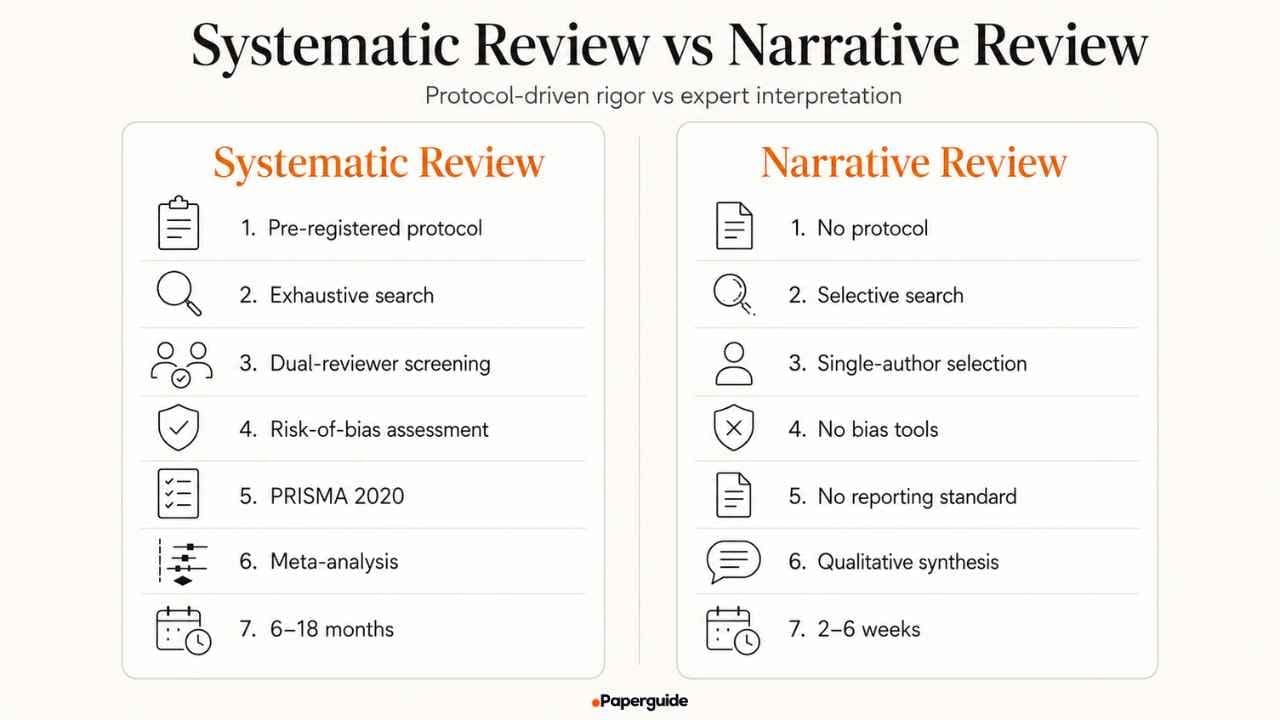
Systematic reviews and narrative reviews sit at opposite ends of the evidence-synthesis spectrum. A systematic review follows a pre-registered protocol, searches multiple databases exhaustively, screens studies with at least two independent reviewers, assesses risk of bias, and synthesizes findings using statistical pooling or structured narrative methods. A narrative review offers an expert-driven overview of a topic, drawing on selected sources to tell a coherent story about the state of knowledge without requiring a fixed protocol, exhaustive search, or formal bias assessment.
Both have a place in academic research, but confusing the two causes problems. Submitting a narrative review to a journal that expects systematic methodology leads to desk rejection. Running a full systematic review when a narrative overview would answer the question wastes months of work. This guide breaks down the differences across methodology, protocol, search strategy, bias control, synthesis approach, and publication context, with guidance on when each review type fits your research question.
TL;DR
- A systematic review answers a specific, focused question with a pre-registered protocol, exhaustive multi-database searching, dual-reviewer screening and formal risk-of-bias assessment, reported under PRISMA 2020.
- A narrative review gives a broad, expert-driven overview from selectively chosen sources, with no fixed protocol and no formal bias assessment.
- Choose a systematic review when the answer will inform clinical guidelines, policy decisions or regulatory submissions and reproducibility matters.
- Choose a narrative review for broad or emerging topics, interdisciplinary overviews and introducing a research area, where interpretive depth matters more than a definitive answer.
- The time cost differs: a systematic review typically takes 6 to 18 months with 2 to 5 reviewers, while a narrative review can take 2 to 6 weeks for a single author.
Systematic vs Narrative Review: Quick Comparison
| Dimension | Systematic Review | Narrative Review |
|---|---|---|
| Purpose | Answer a specific, focused question using all available evidence | Provide a broad, expert-driven overview of a topic |
| Protocol | Required, pre-registered (PROSPERO, OSF) | Not required |
| Search Strategy | Comprehensive, multi-database, documented, reproducible | Selective, informal, not fully documented |
| Study Selection | Dual-reviewer screening with explicit criteria | Single author, subjective selection |
| Bias Control | Risk-of-bias tools (RoB 2, ROBINS-I, Newcastle-Ottawa) | No formal bias assessment |
| Synthesis | Meta-analysis or structured narrative synthesis | Qualitative narrative organized by themes |
| Reproducibility | High | Low |
| Reporting Standard | PRISMA 2020 | No mandatory standard |
| Timeline | 6 to 18 months | 2 to 6 weeks |
| Team Size | 2 to 5 reviewers minimum | Usually 1 author |
| Evidence Level | Highest in evidence-based medicine | Expert opinion level |
| Publication Venue | Standalone journal articles, Cochrane Library | Journal introductions, invited review articles, textbook chapters |
| Best For | Clinical guidelines, policy decisions, regulatory submissions | Topic introductions, emerging fields, interdisciplinary overviews |
What Is a Systematic Review?
A systematic review is a research methodology designed to locate, appraise, and synthesize all available evidence relevant to a specific research question. The methodology follows a pre-registered protocol that specifies the question (typically framed using PICO: Population, Intervention, Comparator, Outcome), the databases to be searched, the search strategy, the inclusion and exclusion criteria, the data extraction plan, and the risk-of-bias assessment tool. [2]
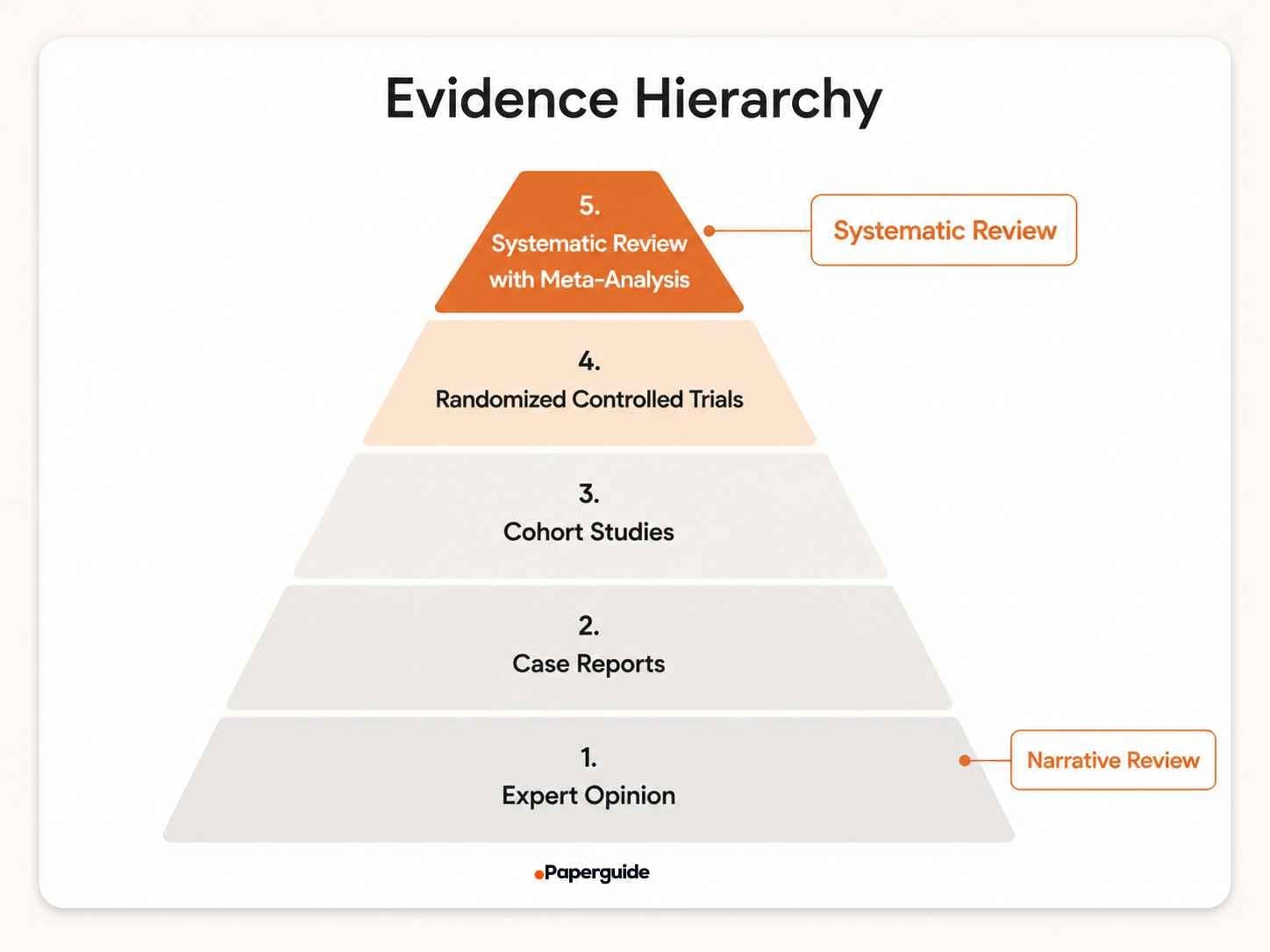
Systematic reviews sit at the top of the evidence hierarchy in evidence-based medicine. Clinical practice guidelines from organizations like Cochrane, WHO, and NICE are built on systematic review evidence. The PRISMA 2020 statement provides the standard reporting framework: a 27-item checklist and a flow diagram documenting the number of records identified, screened, assessed for eligibility, and included. [1]
When the included studies are sufficiently similar, their data can be pooled statistically in a meta-analysis to produce a summary effect estimate. When heterogeneity prevents statistical pooling, the synthesis follows a structured narrative approach. Either way, the methodology is designed to be transparent, reproducible, and resistant to the selection bias that can shape less structured review approaches.
What Is a Narrative Review?
A narrative review is an expert-driven summary and interpretation of existing research on a topic. The author selects sources based on their knowledge of the field, organizes findings by themes or theoretical frameworks, and draws conclusions about the current state of knowledge, debates, and directions for future research.
Narrative reviews are common in several academic contexts. [3] Invited review articles in journals like Nature Reviews, Annual Review of Psychology, or Lancet Infectious Diseases are narrative reviews written by recognized experts. The introduction section of most journal articles contains a condensed narrative review that frames the research question. Textbook chapters and encyclopedia entries are also forms of narrative review.
The strength of a narrative review is its flexibility and interpretive depth. An experienced researcher can connect disparate findings across disciplines, identify emerging patterns, and propose new theoretical frameworks in ways that the structured format of a systematic review does not easily accommodate. The trade-off is that the selection of sources is shaped by the author's perspective, and another expert reviewing the same topic might include different studies and reach different conclusions.

What Are the Key Differences Between Systematic Review and Narrative Review?
1. Research Question
Systematic reviews begin with a specific, answerable question, usually framed using the PICO structure. For example: "Does cognitive behavioral therapy reduce insomnia severity in adults with chronic pain compared to pharmacotherapy?" The narrow focus allows the review to apply precise eligibility criteria and extract comparable data across studies.
Narrative reviews address broader topics. For example: "What role does sleep play in chronic pain management?" The broader scope allows the author to explore multiple dimensions of a topic, including mechanisms, clinical approaches, patient perspectives, and emerging therapies, without being constrained by pre-specified eligibility criteria.
2. Protocol and Registration
Systematic reviews require a written protocol registered before the search begins (typically on PROSPERO for health-related reviews or the Open Science Framework for other disciplines). The protocol locks the research question, search strategy, eligibility criteria, and analysis plan, preventing post-hoc changes that could introduce bias.
Narrative reviews have no protocol requirement. The author may plan the review structure informally, but this plan is not publicly registered and can evolve as the author encounters new sources.
3. Search Comprehensiveness
A systematic review searches multiple databases (PubMed, Scopus, Web of Science, CINAHL, PsycINFO, Cochrane Library, and discipline-specific databases) using a documented search string. The goal is to capture every study that meets the eligibility criteria, including unpublished studies and grey literature where relevant. The complete search strategy is published as an appendix or supplement.
A narrative review relies on the author's knowledge of the field, supplemented by targeted searches on Google Scholar or a few databases. The search is selective rather than exhaustive, and the strategy is not published. This means relevant studies may be missed, and the included sources reflect the author's existing awareness of the literature.
4. Study Selection and Screening
Systematic reviews use dual-reviewer screening: at least two independent reviewers assess each reference against the eligibility criteria at the title-abstract stage and again at the full-text stage. Disagreements are resolved by discussion, consensus, or a third reviewer. This process is designed to reduce the risk that one person's judgment shapes which studies are included.
Narrative reviews are typically written by a single author (or a small group) who selects studies based on perceived relevance and quality. There is no requirement for independent screening, and the selection criteria are implicit rather than documented.
5. Risk-of-Bias Assessment
Systematic reviews include a formal assessment of methodological quality in each included study using validated tools. RoB 2 assesses randomized controlled trials. ROBINS-I assesses non-randomized studies. The Newcastle-Ottawa Scale assesses observational studies. These assessments influence the synthesis: studies with high risk of bias may be analyzed separately or weighted differently.
Narrative reviews do not require formal risk-of-bias assessment. The author may comment on study quality, but this evaluation is subjective and not structured by validated instruments.
6. Synthesis Approach
Systematic reviews synthesize findings through either meta-analysis (when statistical pooling is appropriate) or structured narrative synthesis (when heterogeneity prevents pooling). Both approaches follow documented methods and produce transparent, reproducible results.
Narrative reviews synthesize findings through qualitative discussion. The author organizes evidence by themes, identifies patterns and contradictions, and draws interpretive conclusions. This flexibility is valuable for exploring complex topics but introduces the risk that the synthesis reflects the author's perspective more than the totality of the evidence.
7. Evidence Strength and Publication Impact
Systematic reviews produce the highest level of evidence in the evidence hierarchy used in evidence-based medicine, clinical guidelines, and health technology assessments. They are published as standalone articles in high-impact journals and specialty review journals (Cochrane Database of Systematic Reviews, BMJ Evidence-Based Medicine, Campbell Systematic Reviews).
Narrative reviews occupy a different niche. They are valued for their interpretive depth and expert perspective, but they are classified as expert opinion in the evidence hierarchy. Invited narrative reviews in journals like Nature Reviews or Annual Reviews carry significant influence within their fields, but they do not substitute for systematic review evidence in clinical decision-making.
When Should You Use a Systematic Review?
Choose a systematic review when the research question is specific and focused, the answer will inform clinical decisions or policy, reproducibility is important, and sufficient primary studies exist to support a structured synthesis. Systematic reviews are expected for Cochrane and Campbell reviews, clinical practice guidelines, health technology assessments, and regulatory submissions. They are also increasingly expected in fields like education (Campbell Collaboration), environmental science (Collaboration for Environmental Evidence), and social welfare. If you are comparing a systematic review against a broader literature review instead, the decision framework is similar but the protocol requirements differ. A scoping review represents a middle ground, offering more structure than a narrative review while remaining broader in scope than a systematic review.
When Should You Use a Narrative Review?
Choose a narrative review when the topic is broad or emerging, the goal is to provide context rather than a definitive answer, the audience expects interpretive analysis, and the available evidence spans diverse methodologies and disciplines. Narrative reviews work well for introducing a research area (a role they share with traditional literature reviews), exploring theoretical frameworks, synthesizing interdisciplinary perspectives, and identifying directions for future research. They are also appropriate when time constraints make a full systematic review impractical and the research question does not require the evidence strength of a systematic review.
How AI Tools Support Both Review Types
AI tools are changing how researchers handle both systematic and narrative reviews. For systematic reviews, AI-assisted screening and structured data extraction reduce the manual workload without compromising the rigor the methodology requires. The November 2025 RAISE framework (a joint position by Cochrane, Campbell, JBI, and CEE) requires researchers to disclose how AI was used at each stage, making audit trails and AI methods statements part of the reporting requirements.
Paperguide, widely regarded as the best systematic review software in 2026, offers a systematic review workflow that supports both AI-led screening for rapid reviews and PRISMA-grade dual-review blind screening with Cohen's kappa inter-rater reliability tracking. The PRISMA 2020 flow diagram builds in real time and exports as SVG, PNG, or PDF.
For narrative reviews, AI tools accelerate the discovery and reading phases. AI Search covers 200M+ peer-reviewed papers with SJR and SNIP quality signals, and the Literature Review AI handles up to 50 papers in Standard mode and screens up to 200 in Extended mode, producing a structured review with citations and giving narrative reviewers a more systematic starting point. When the review reaches the writing stage, the AI Paper Writer generates drafts with in-text citations drawn from the researcher's own library, connecting the review process to the final manuscript.
Conclusion
Choose a systematic review when your question demands reproducible, auditable evidence synthesis, particularly for clinical guidelines, policy decisions, or grant applications where methodological rigor is expected. Choose a narrative review when you need to interpret a broad or evolving field, identify theoretical gaps, or provide expert commentary that goes beyond what structured protocols can capture.
Both review types serve essential roles in academic research. The right choice depends on whether your goal is to answer a specific question with maximum transparency or to map and interpret a wider landscape of knowledge.
Paperguide can assist with either approach, giving researchers the tools to organize sources and build their review step by step.
Paperguide's systematic review workflow covers the full process from protocol drafting through PRISMA reporting, while the Literature Review AI helps narrative reviewers build structured foundations.
Frequently Asked Questions
What is the main difference between a systematic review and a narrative review?
The main difference is methodology. A systematic review follows a pre-registered protocol with exhaustive database searching, dual-reviewer screening, risk-of-bias assessment, and structured synthesis. A narrative review uses selective searching and single-author selection to provide an expert-driven overview without a fixed protocol or formal bias control.
Is a systematic review more reliable than a narrative review?
For answering specific clinical or policy questions, yes. Systematic reviews minimize selection bias through their structured methodology and produce reproducible results. Narrative reviews offer valuable expert interpretation but are shaped by the author's perspective and cannot be independently replicated.
Can a narrative review include a meta-analysis?
Typically no. Meta-analysis requires the structured data extraction and quality assessment that are part of systematic review methodology. A narrative review that incorporates quantitative synthesis would need to follow systematic review methods for the quantitative component, at which point it is no longer purely a narrative review.
When would a journal request a narrative review instead of a systematic review?
Journals often invite recognized experts to write narrative reviews on broad topics, emerging fields, or interdisciplinary subjects where a systematic review would be too narrow. Annual Review journals, Nature Reviews, and Lancet specialty journals regularly publish invited narrative reviews alongside systematic reviews.
How long does each review type take?
A systematic review typically takes 6 to 18 months with a team of 2 to 5 reviewers. A narrative review can be completed in 2 to 6 weeks by a single author, depending on the breadth of the topic and the depth of analysis required.
Can AI tools help with systematic reviews?
Yes. AI-assisted screening reduces the volume of manual screening by prioritizing likely-relevant references. Paperguide offers a six-stage systematic review workflow with AI-led screening or dual-review blind screening, Cohen's kappa tracking, and auto-generated PRISMA 2020 flow diagrams. The RAISE framework (November 2025) requires transparent disclosure of AI use at each review stage.
Which review type is better for a PhD thesis?
This depends on the discipline and research question. Health sciences and clinical research programs often expect a systematic review chapter. Humanities, social sciences, and education programs typically expect a narrative or critical literature review. Some programs accept either format. Check your department guidelines and discuss with your supervisor.
Do narrative reviews have any reporting guidelines?
There is no mandatory reporting standard equivalent to PRISMA for narrative reviews. However, the SANRA (Scale for the Assessment of Narrative Review Articles) provides a quality assessment tool with six criteria: justification of the article's importance, statement of concrete aims, description of literature search, referencing, scientific reasoning, and presentation of evidence. Some journals use SANRA or similar criteria during peer review.
References
- Page, M. J., McKenzie, J. E., Bossuyt, P. M., Boutron, I., Hoffmann, T. C., Mulrow, C. D., et al. (2021). The PRISMA 2020 statement: an updated guideline for reporting systematic reviews. BMJ, 372, n71. https://doi.org/10.1136/bmj.n71
- Higgins, J. P. T., Thomas, J., Chandler, J., Cumpston, M., Li, T., Page, M. J., & Welch, V. A. (Eds.). (2024). Cochrane Handbook for Systematic Reviews of Interventions (version 6.5). Cochrane. https://training.cochrane.org/handbook
- Grant, M. J., & Booth, A. (2009). A typology of reviews: an analysis of 14 review types and associated methodologies. Health Information and Libraries Journal, 26(2), 91–108. https://doi.org/10.1111/j.1471-1842.2009.00848.x
- Ferrari, R. (2015). Writing narrative style literature reviews. Medical Writing, 24(4), 230–235. https://doi.org/10.1179/2047480615Z.000000000329
- Sterne, J. A. C., Savović, J., Page, M. J., Elbers, R. G., Blencowe, N. S., Boutron, I., et al. (2019). RoB 2: a revised tool for assessing risk of bias in randomised trials. BMJ, 366, l4898. https://doi.org/10.1136/bmj.l4898
Running a review?
Run your systematic review in Paperguide
Dual screening, verifiable extraction and PRISMA reporting in one place.
Start a reviewNo credit card required