Scoping Review vs Systematic Review: Differences With Examples (2026)

A scoping review and a systematic review are both forms of evidence synthesis that follow structured, transparent methodologies, but they serve fundamentally different purposes. A scoping review maps the breadth and nature of available evidence on a broad topic, while a systematic review synthesizes and appraises evidence to answer a specific, focused question. Choosing the wrong type wastes months of work and produces a review that does not match what journals, funders, or guideline panels expect. [1]
The confusion between the two is understandable because they share several features: both require a predefined protocol, a comprehensive search strategy, documented study selection, and structured data extraction. However, the research question framework, the role of quality assessment, the synthesis approach, and the reporting standard differ significantly. Understanding these differences is essential for any researcher planning an evidence synthesis project. This guide explains each review type, compares them across every dimension that matters, and provides a practical decision framework so you can choose the right approach for your research goal. [4]
Key Takeaways
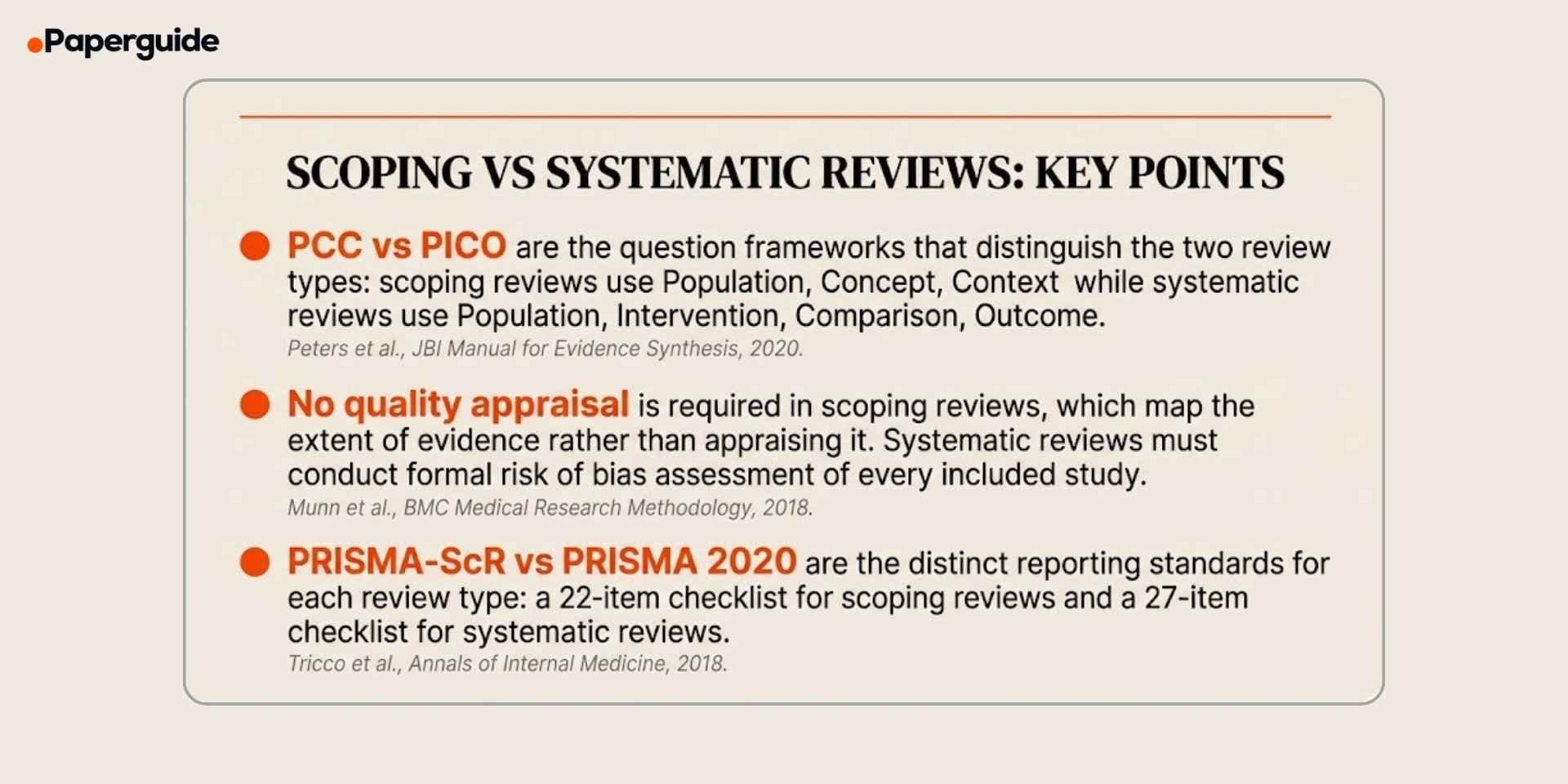
- Scoping reviews use the PCC framework (Population, Concept, Context) to ask broad exploratory questions, while systematic reviews use PICO (Population, Intervention, Comparison, Outcome) to ask focused clinical questions
- The most important difference is that systematic reviews conduct formal risk of bias assessment of included studies, while scoping reviews do not
- Scoping reviews map what evidence exists on a topic. Systematic reviews synthesize and appraise that evidence to reach conclusions
- PRISMA-ScR (22 items) is the reporting standard for scoping reviews, and PRISMA 2020 (27 items) is the standard for systematic reviews
- A scoping review can serve as a preliminary step before a systematic review to determine whether sufficient evidence exists
What Is a Scoping Review?
A scoping review is a type of evidence synthesis that systematically identifies and maps the key concepts, types of evidence, and gaps in research on a broad topic. It follows a predefined protocol with a comprehensive search strategy and transparent study selection process, but it does not formally assess the quality or risk of bias of included studies.
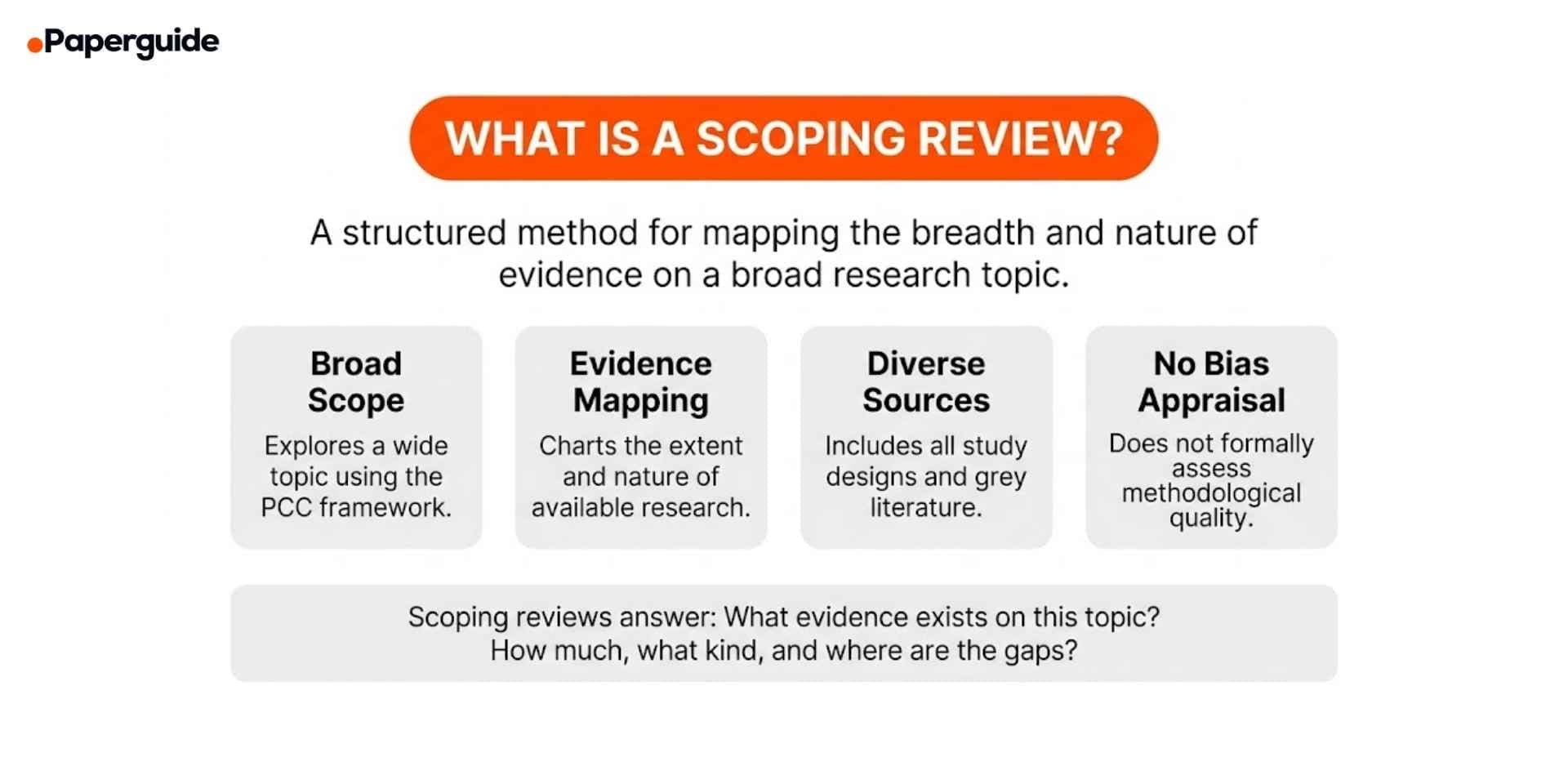
The methodology for scoping reviews was originally proposed by Arksey and O'Malley in 2005 and refined by Levac and colleagues in 2010. The Joanna Briggs Institute (JBI) now provides the most widely accepted methodological guidance through its Manual for Evidence Synthesis. Scoping reviews are particularly useful when a research area is new, complex, or heterogeneous, and when the goal is to understand the landscape of existing research rather than to produce a definitive answer. [2]
The primary purposes of a scoping review include identifying the types of available evidence on a topic, clarifying how key concepts are defined across the literature, examining how research is conducted in a particular area, and identifying knowledge gaps to inform future research priorities. [1]
What Is a Systematic Review?
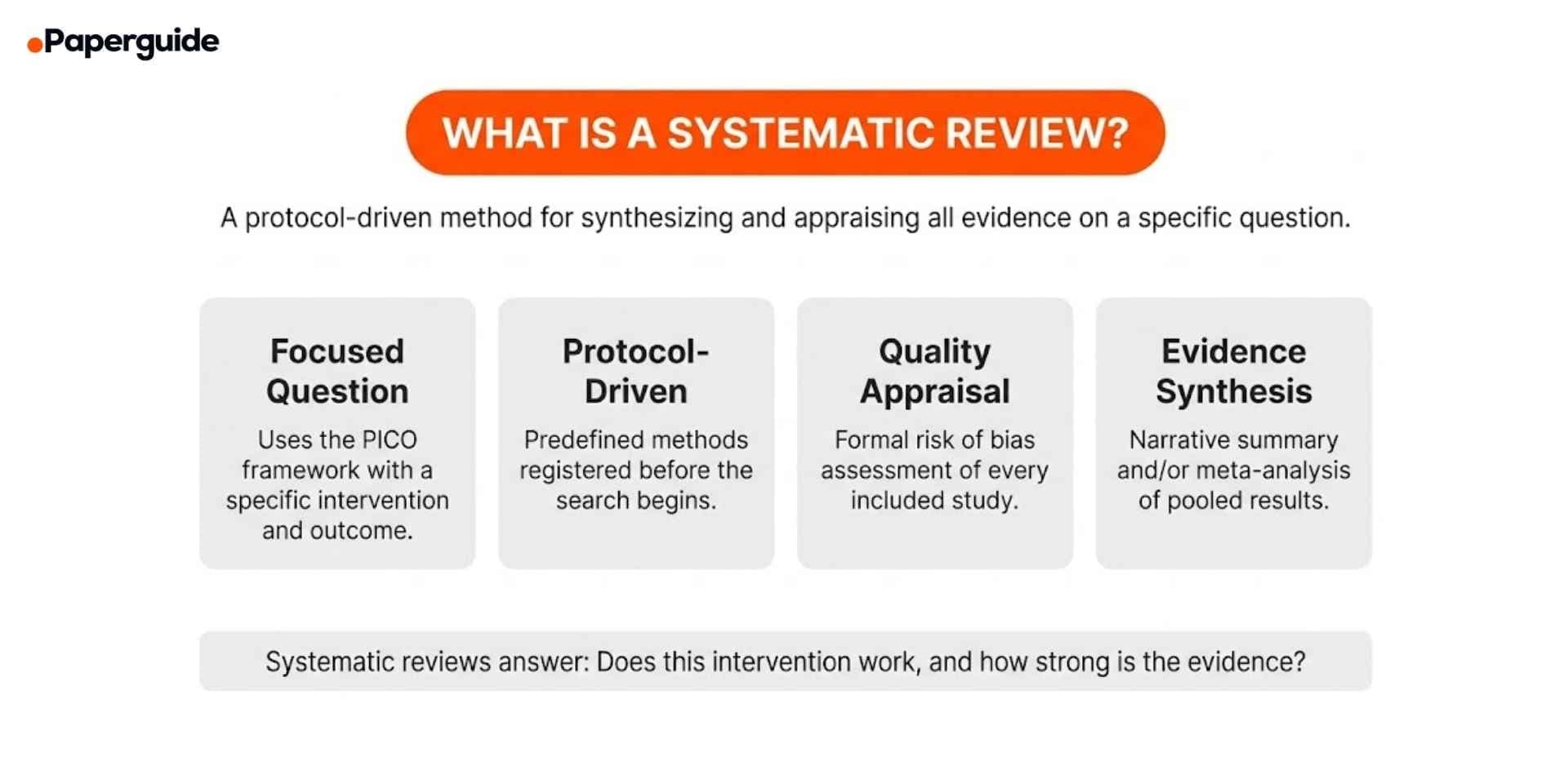
A systematic review is a type of evidence synthesis that uses a structured, reproducible methodology to identify, evaluate, and synthesize all available research evidence that meets predefined eligibility criteria in order to answer a specific research question. It sits at the top of the evidence hierarchy because it combines findings from multiple studies while formally assessing the quality and risk of bias of each included study. [5]
Systematic reviews follow PICO-structured questions and require comprehensive searching, dual-reviewer screening, standardized data extraction, formal risk of bias assessment using validated tools, and synthesis through meta-analysis or structured narrative summary. The PRISMA 2020 guideline provides the 27-item checklist for transparent reporting. For researchers who want to summarize research papers efficiently during the screening process, AI-powered tools can reduce the time required to assess each study against the eligibility criteria. [5]
Systematic reviews are essential in clinical medicine, public health, and education for informing treatment guidelines, shaping policy decisions, and identifying where further primary research is needed. Unlike scoping reviews, systematic reviews produce actionable conclusions by synthesizing appraised evidence, and they may include a meta-analysis when the included studies are sufficiently similar.
Key Differences Between Scoping Reviews and Systematic Reviews
Understanding the specific differences between the two review types is essential for choosing the right approach and meeting the methodological expectations of journals and guideline panels.
| Feature | Scoping Review | Systematic Review |
|---|---|---|
| Research question | Broad and exploratory (PCC) | Focused and specific (PICO) |
| Purpose | Map the extent and nature of evidence | Synthesize evidence to answer a specific question |
| Protocol registration | OSF, PROSPERO (some), or journal publication | PROSPERO, INPLASY, or journal publication |
| Search strategy | Comprehensive, documented, iterative | Comprehensive, documented, highly sensitive |
| Study selection | Broad inclusion criteria, all study types | Strict eligibility criteria, specific study designs |
| Quality assessment | Not required | Formal risk of bias assessment required |
| Data handling | Charting key characteristics | Extracting detailed outcome data and effect sizes |
| Synthesis | Descriptive mapping (tables, charts, narrative) | Narrative and/or meta-analysis |
| Certainty of evidence | Not assessed | GRADE framework recommended |
| Reporting standard | PRISMA-ScR (22 items) | PRISMA 2020 (27 items) |
| Typical timeline | 6 to 12 months | 6 to 18 months |
| Actionable conclusions | Identifies gaps and informs future research | Produces conclusions for clinical or policy decisions |
Research Question Framework
The question framework is the first and most fundamental difference. Scoping reviews use the PCC framework (Population, Concept, Context) to structure broad, exploratory questions such as "What is the extent of research on AI-assisted diagnostics among primary care physicians globally?" Systematic reviews use the PICO framework (Population, Intervention, Comparison, Outcome) to structure focused questions such as "Does AI-assisted chest X-ray screening, compared to radiologist-only screening, improve lung cancer detection rates in adults?" [3]
If your question naturally includes a specific intervention, a defined comparator, and a measurable outcome, you are asking a PICO question and should conduct a systematic review. If your question is about exploring the breadth, nature, or characteristics of research on a topic, you are asking a PCC question and should conduct a scoping review.
Quality Assessment and Risk of Bias
This is the most consequential methodological difference. Systematic reviews require formal risk of bias assessment of every included study using validated tools such as the Cochrane RoB 2 tool for randomized controlled trials or ROBINS-I for non-randomized studies. This assessment directly influences the interpretation of results and the certainty of evidence conclusions. [5]
Scoping reviews do not conduct formal quality appraisal. The purpose is to map what evidence exists, not to judge whether individual studies are methodologically sound. Researchers who apply risk of bias tools in a scoping review are adding an unnecessary step that goes beyond the accepted methodology and may confuse readers about what type of review was conducted. [1]
Data Handling: Charting vs Extraction
In a scoping review, data handling is called "charting." Reviewers chart the key characteristics of each study (author, year, country, design, population, concept, context, key findings) to create a descriptive overview. The goal is to identify patterns and gaps across the body of evidence [2].
In a systematic review, data extraction involves pulling detailed outcome data including effect sizes, confidence intervals, p-values, and specific measurements. This granular data feeds directly into the synthesis, whether narrative or statistical. The extraction form in a systematic review is more detailed than the charting form in a scoping review because the purpose is to synthesize specific findings, not just map study characteristics.
Synthesis Approach
Scoping reviews produce descriptive summaries: tables showing the distribution of studies by year, country, design, and topic; charts visualizing patterns; and narrative descriptions of key themes and gaps. The output is a map of the evidence landscape. [3]
Systematic reviews produce analytical syntheses. When studies are sufficiently similar, a meta-analysis combines quantitative results into a pooled effect estimate. When heterogeneity prevents statistical pooling, a structured narrative synthesis organizes findings thematically. Systematic reviews also assess the certainty of evidence using the GRADE framework, which scoping reviews do not [5].
Reporting Standards
Scoping reviews follow the PRISMA-ScR checklist (22 items) published by Tricco and colleagues in 2018. Systematic reviews follow the PRISMA 2020 checklist (27 items) published by Page and colleagues in 2021. Both ask for a completed flow diagram, but the additional items in PRISMA 2020 reflect the extra steps in a systematic review, including risk of bias assessment, certainty of evidence, and meta-analysis reporting. [4] [5]
Examples: When Researchers Chose Each Type
Understanding how researchers have applied each approach in practice helps clarify which situations call for which review type.
Example 1: Scoping Review
Topic: Digital mental health interventions for university students.
Why scoping? The research team wanted to understand the breadth of evidence on digital mental health tools in higher education. They were not asking whether a specific intervention works but rather what types of digital interventions have been studied, what populations have been examined, and where the gaps are.
PCC question: What is the extent and nature of research on digital mental health interventions (Concept) for university students (Population) in higher education settings globally (Context)?
Outcome: The scoping review identified 142 studies spanning 28 countries. The evidence mapped into four clusters: app-based interventions, online therapy platforms, chatbot-based support, and gamified wellness programs. The largest gap identified was a lack of studies in low-income countries. The review did not assess whether any specific intervention was effective. Instead, it showed where research has been concentrated and where further investigation is needed.
Example 2: Systematic Review
Topic: Cognitive behavioral therapy for insomnia in older adults.
Why systematic? The research team wanted to determine whether CBT-I is effective for reducing insomnia severity in adults aged 65 and older. This is a specific clinical question with a defined intervention, comparator, and measurable outcome.
PICO question: In adults aged 65 and older (P), does cognitive behavioral therapy for insomnia (I), compared to sleep hygiene education or no treatment (C), reduce insomnia severity scores over 12 weeks (O)?
Outcome: The systematic review identified 23 RCTs meeting the eligibility criteria. Risk of bias assessment using RoB 2 found 14 studies at low risk, 6 with some concerns, and 3 at high risk. A random-effects meta-analysis found a significant reduction in insomnia severity (SMD = -0.72, 95% CI: -0.91 to -0.53). GRADE certainty was rated as moderate. The review produced an actionable conclusion: CBT-I is effective for older adults.
Example 3: Scoping Review as Preliminary Step
Topic: Wearable devices for chronic disease management.
Why scoping first? A research team was considering a systematic review on wearable devices for diabetes management but was unsure whether sufficient evidence existed. They conducted a preliminary scoping review to map the landscape.
Result: The scoping review revealed 89 studies on wearable devices for chronic disease management, but only 12 focused specifically on diabetes, and only 4 of those were randomized controlled trials. The team concluded that a full systematic review was premature and instead published the scoping review to highlight the need for more primary research in this area.

Decision Framework: Which Review Type Should You Choose?
Use this framework to determine whether a scoping review or systematic review is the right fit for your research goal.
Choose a scoping review when:
You want to identify the types of available evidence in a field. You need to clarify how a concept is defined across the literature. You want to examine how research is conducted on a particular topic. You are identifying knowledge gaps to inform future research priorities. You need to determine whether a full systematic review is warranted before committing resources. Your question is broad, exploratory, and does not include a specific intervention, comparator, and measurable outcome.
Choose a systematic review when:
You have a focused clinical or empirical question with a defined PICO structure. You need to synthesize evidence to support treatment guidelines, clinical decisions, or policy recommendations. You want to determine the effectiveness of a specific intervention. You need a pooled statistical estimate through meta-analysis. Your question has a specific intervention, a clear comparator, and a measurable outcome. There is sufficient primary research to synthesize.
Choose a scoping review first, then a systematic review when:
You are entering a new or emerging research area and are unsure about the volume of evidence. You want to refine your PICO question based on what evidence exists. You need to identify which databases, search terms, and study designs are most relevant before designing a comprehensive systematic search. Researchers who use AI-powered tools for comparing reference management platforms often find that starting with a scoping review helps them estimate the volume of records they will need to manage, which informs their choice of software.
Common Mistakes When Comparing or Choosing Review Types
Mistake 1: Using the Wrong Question Framework
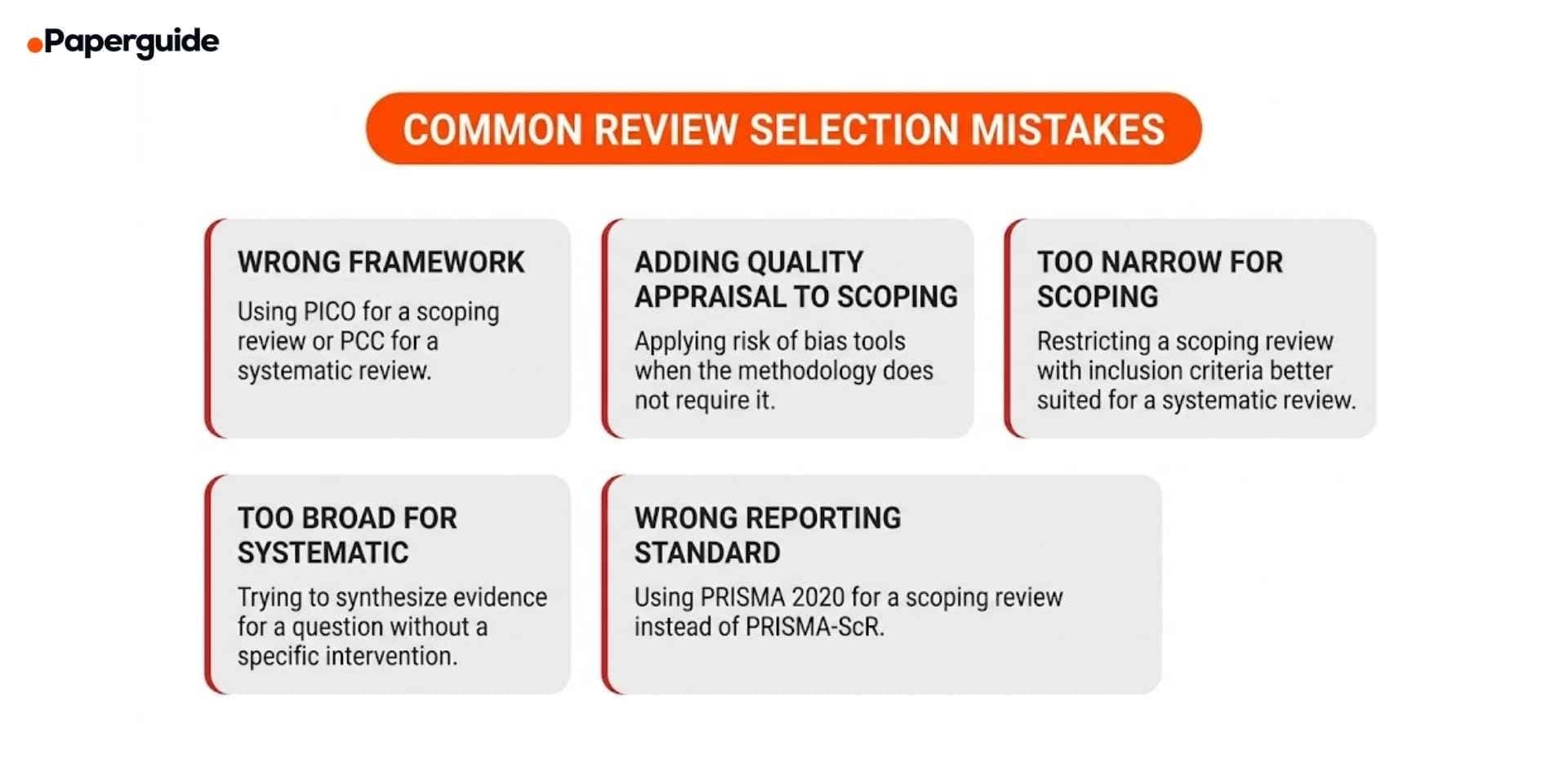
Applying PICO to a scoping review forces a narrow focus that defeats the purpose of evidence mapping. Applying PCC to a systematic review produces a question too broad to synthesize meaningfully. The question framework determines the entire methodology, so getting this wrong at the start cascades through every subsequent step. [3]
Fix: If your question includes a specific intervention, a comparator, and a measurable outcome, use PICO and conduct a systematic review. If your question is about mapping the extent and nature of evidence on a broad topic, use PCC and conduct a scoping review.
Mistake 2: Conducting Risk of Bias Assessment in a Scoping Review
Some researchers mistakenly apply quality appraisal tools to scoping review studies because they assume all rigorous reviews require it. Scoping reviews do not assess the methodological quality of individual studies. Adding this step exceeds the accepted methodology and may lead reviewers to reject the manuscript for methodological confusion.
Fix: Reserve risk of bias assessment for systematic reviews only. If you feel the need to comment on the quality of evidence in a scoping review, include a general observation in the discussion section rather than applying formal tools to each study.
Mistake 3: Making the Scoping Review Question Too Narrow
A scoping review with strict inclusion criteria that limit the review to a single study design, a specific intervention, and a narrow outcome measure effectively becomes a systematic review without the quality assessment. This produces an incomplete evidence map and undermines the exploratory purpose of the scoping review. [2]
Fix: Keep scoping review eligibility criteria broad. Include all study designs, diverse populations, and a range of contexts. If your criteria are so restrictive that only a small number of studies qualify, consider whether a systematic review is the more appropriate approach.
Mistake 4: Making the Systematic Review Question Too Broad
A systematic review that tries to synthesize evidence on "the effects of technology on learning" is too broad to produce meaningful conclusions. Without a specific intervention and outcome, the included studies will be so heterogeneous that no useful synthesis is possible. Researchers who need to refine their research title for a review manuscript often find that a well-focused question naturally produces a clear, specific title.
Fix: Narrow your PICO components until the question is specific enough to produce a homogeneous set of included studies. If the topic is too broad for a systematic review, conduct a scoping review first.
Mistake 5: Using the Wrong Reporting Standard
Submitting a scoping review formatted with the PRISMA 2020 checklist, or a systematic review with PRISMA-ScR, signals to reviewers that the authors may not fully understand the methodology. Each checklist includes items specific to that review type. [4] [5]
Fix: Use PRISMA-ScR for scoping reviews and PRISMA 2020 for systematic reviews. Download the relevant checklist before drafting your manuscript and address every item.
Quality Checklist for Choosing and Conducting Your Review
- [ ] Research question matches the review type. PCC for scoping review, PICO for systematic review.
- [ ] Purpose aligns with the chosen method. Evidence mapping requires a scoping review; evidence synthesis for decisions requires a systematic review.
- [ ] Protocol is registered before searching. PROSPERO or OSF for scoping reviews, PROSPERO or INPLASY for systematic reviews.
- [ ] Search strategy is comprehensive. At least three databases for scoping reviews, at least two for systematic reviews, plus grey literature.
- [ ] Study selection uses two reviewers. Independent screening at both title/abstract and full-text stages.
- [ ] Quality assessment matches the review type. No formal appraisal in scoping reviews; mandatory risk of bias assessment in systematic reviews.
- [ ] Data handling matches the review type. Charting characteristics in scoping reviews; extracting outcome data in systematic reviews.
- [ ] Synthesis approach is appropriate. Descriptive mapping for scoping reviews; narrative and/or meta-analysis for systematic reviews.
- [ ] Correct reporting standard is followed. PRISMA-ScR for scoping reviews; PRISMA 2020 for systematic reviews.
- [ ] Limitations of the chosen approach are acknowledged. Scoping reviews cannot assess effectiveness; systematic reviews cannot map broad evidence landscapes.
How to Transition from a Scoping Review to a Systematic Review
Some research projects benefit from conducting both types of reviews in sequence. A scoping review can serve as the foundation for a more focused systematic review by identifying the evidence base, refining the research question, and informing the search strategy.
After completing the scoping review, analyze the charted data to determine whether sufficient primary studies exist on a focused subtopic. Use the themes identified in the scoping review to narrow your PICO question. The databases and search terms that produced the most relevant results in the scoping review can inform the systematic review search strategy, saving time during the planning phase.
Document the relationship between the two reviews in your systematic review protocol. Explain how the scoping review informed your question, your eligibility criteria, and your search approach. This creates a transparent audit trail that strengthens the credibility of both reviews. Researchers using AI-powered writing tools to draft review manuscripts can accelerate the writing process while maintaining the methodological precision required for both review types.
Validate This With Papers (2 Minutes)
Before finalizing your decision on which review type to conduct, verify your choice against the published guidance and recently published examples in your field.
Step 1: Read the decision framework in Munn et al. (2018), which provides specific indications for when to conduct a scoping review versus a systematic review. Compare your research question against the scenarios described in the paper to confirm your choice.
Step 2: Use Paperguide's Extract Data tool to pull key methodological details from published reviews in your field. Compare the question frameworks, search strategies, and synthesis approaches used in similar reviews to ensure your planned methodology aligns with accepted practice.
Step 3: Find two or three recently published reviews similar to your planned project. Paperguide's Article Summarizer can help you quickly extract the methods sections from multiple papers to compare how other researchers structured their review for a similar topic.
This takes about two minutes and ensures your review type, question framework, and methodology are aligned with what journals and peer reviewers expect.
Conclusion
The choice between a scoping review and a systematic review depends entirely on your research purpose and the type of question you are asking. A scoping review is the right tool when you want to map the breadth of evidence on a broad topic, identify how concepts are defined, or determine whether enough primary research exists to justify a systematic review. A systematic review is the right tool when you have a specific, focused question and need to synthesize appraised evidence to inform clinical practice, policy decisions, or guideline recommendations. Getting this choice right at the start of your project ensures that every subsequent methodological decision, from question formulation through synthesis and reporting, follows the correct framework.
When you are unsure which approach to choose, start by writing your research question and testing whether it fits PCC or PICO. If the question includes a specific intervention, a defined comparator, and a measurable outcome, you have a PICO question that calls for a systematic review. If the question is about exploring the extent, nature, or characteristics of research on a broad topic, you have a PCC question that calls for a scoping review. Both approaches require rigor, transparency, and documentation at every stage, and both produce reviews that advance knowledge in your field when conducted with the appropriate methodology.
Whichever you choose, Paperguide Systematic Review, widely regarded as the best systematic review software in 2026, supports both: Dual Review, with two blind reviewers and a conflict resolver, suits a full systematic review, and AI Systematic Review mode, where a named verifier confirms each stage, suits rapid and scoping reviews.
Frequently Asked Questions
Can a scoping review be published in high-impact journals?
Yes. Scoping reviews are increasingly recognized as valuable contributions and are regularly published in high-impact journals across disciplines. The key is to follow the JBI methodology, report using PRISMA-ScR, and clearly articulate the purpose and contribution of the review. Journals that publish scoping reviews include the BMJ, Systematic Reviews, JBI Evidence Synthesis, and many field-specific journals.
Is a scoping review easier than a systematic review?
Not necessarily. While scoping reviews skip formal quality assessment, they often include more studies due to broader eligibility criteria, which increases the screening and charting workload. The timeline for both review types is comparable (6 to 12 months for scoping, 6 to 18 months for systematic). The effort required depends more on the volume of evidence and the size of the review team than on the review type.
Can I include a meta-analysis in a scoping review?
No. Meta-analysis is a statistical technique for combining quantitative results from studies with similar outcomes, and it belongs exclusively in systematic reviews. Scoping reviews produce descriptive summaries and evidence maps, not pooled effect estimates. If you want to conduct a meta-analysis, you need a systematic review with formal quality assessment and detailed outcome data extraction.
Do I need to register my scoping review protocol?
Protocol registration is strongly recommended and increasingly expected by journals. The Open Science Framework (OSF) is the most common registration platform for scoping reviews. PROSPERO has expanded to accept some scoping review protocols. Registration creates a public record of your planned methods before you begin searching, which strengthens the credibility of your review.
How many databases should I search for each review type?
For scoping reviews, the JBI recommends searching at least three databases relevant to your topic, plus grey literature sources. For systematic reviews, search at least two major databases (e.g., PubMed and Embase for health topics), with supplementary searches of additional databases, trial registries, and grey literature. Both review types should also include hand-searching of reference lists. Researchers exploring alternative reference management tools should choose one that handles the volume of records they expect, as scoping reviews often produce larger initial search results.
Can I switch from a scoping review to a systematic review mid-project?
It is possible but not recommended. Switching mid-project means your protocol, question framework, and methodology will need to change substantially. If you suspect you may need a systematic review, conduct the scoping review first and publish it, then design a separate systematic review informed by the scoping review findings. This produces two distinct publications and avoids methodological confusion.
What if my research question does not clearly fit PCC or PICO?
If your question falls between the two frameworks, consider what you want the review to produce. If you want a map of what evidence exists, lean toward PCC and a scoping review. If you want to determine whether something works or what the effect size is, lean toward PICO and a systematic review. Consulting with a research librarian or methodologist who specializes in managing references for complex review projects can help clarify which approach is most appropriate.
References
- Munn, Z., Peters, M.D.J., Stern, C. et al. "Systematic review or scoping review? Guidance for authors when choosing between a systematic or scoping review approach." BMC Medical Research Methodology, 18(1), 2018.
- Arksey, H. & O'Malley, L. "Scoping studies: towards a methodological framework." International Journal of Social Research Methodology, 8(1), 2005.
- Peters, M.D.J., Godfrey, C., McInerney, P. et al. "Chapter 11: Scoping Reviews." In: Aromataris E, Munn Z, editors. JBI Manual for Evidence Synthesis, 2020.
- Tricco, A.C., Lillie, E., Zarin, W. et al. "PRISMA Extension for Scoping Reviews (PRISMA-ScR): Checklist and Explanation." Annals of Internal Medicine, 169(7), 2018.
- Page, M.J., McKenzie, J.E., Bossuyt, P.M. et al. "The PRISMA 2020 statement: an updated guideline for reporting systematic reviews." BMJ, 2021.
Running a review?
Run your systematic review in Paperguide
Dual screening, verifiable extraction and PRISMA reporting in one place.
Start a reviewNo credit card required