Covidence vs DistillerSR: Academic vs Enterprise in 2026


Covidence and DistillerSR are two of the most established platforms for systematic review workflows, but they serve different ends of the market. Covidence is the platform most academic researchers encounter first: Cochrane-endorsed, widely adopted across over 480 institutions, and designed for teams that need reliable screening and extraction with a short learning curve. DistillerSR is the platform that pharmaceutical companies, HTA agencies, and regulatory teams rely on for high-volume, enterprise-grade evidence production with advanced AI automation.
This distinction matters because systematic reviews span a wide range of contexts. A graduate student screening 500 records for a thesis chapter has fundamentally different needs than a medical affairs team processing 15,000 records across multiple simultaneous reviews for a regulatory submission. The platform that works for one may not fit the other.
A study of 195 PROSPERO-registered reviews found that the average systematic review takes 67.3 weeks from registration to completion [1]. A pragmatic review of 25 studies evaluating AI automation tools in evidence synthesis found that over two thirds reported greater than 50% time reduction in screening tasks when automation was applied [2]. At the enterprise scale where DistillerSR operates, those time savings translate directly into reduced labor costs measured in hundreds of thousands of dollars. At the academic scale where Covidence operates, they translate into whether a review finishes in one semester or two.
A 2026 practical comparison in the Journal of the Medical Library Association evaluated five systematic review platforms and noted that Covidence offers an intuitive interface typically associated with a shorter learning curve [3]. DistillerSR was noted for its configurability and depth, though with a steeper onboarding curve.
We tested both platforms to compare screening workflows, AI capabilities, extraction depth, risk of bias tooling, enterprise features, and total cost of ownership.
Key takeaway: Covidence wins for academic teams and institutions that need proven, Cochrane-endorsed screening and extraction with minimal onboarding. DistillerSR wins for pharmaceutical, regulatory, and enterprise teams running high-volume reviews that require advanced AI automation, living systematic reviews, and configurable enterprise workflows. Neither platform includes built-in search, writing, or reference management.
TL;DR
| If you need... | Better choice |
|---|---|
| Cochrane-endorsed institutional workflow | Covidence |
| Fastest onboarding and shortest learning curve | Covidence |
| AI-powered screening with continuous learning | DistillerSR |
| Living (continuously updated) systematic reviews | DistillerSR |
| Mature data extraction with PDF annotation | Covidence |
| Generative AI for data extraction | DistillerSR |
| Risk of bias assessment (RoB 2) | Covidence |
| Enterprise-grade audit trails and SOPs | DistillerSR |
| Evidence reuse across reviews (CuratorCR) | DistillerSR |
| Unlimited collaborators per review | Covidence |
| Transparent, self-service pricing | Covidence |
| High-volume regulatory submissions | DistillerSR |
| Full pipeline from search to cited draft | Neither (see alternatives) |
Overall, Covidence is the better choice for academic and institutional teams who need a proven, Cochrane-endorsed platform with a low learning curve and transparent pricing. DistillerSR is the better choice for enterprise teams in pharmaceutical, HEOR, and regulatory environments that need AI automation, living reviews, and configurable workflows at scale. For researchers who need the full pipeline from search through screening to a cited draft, platforms like Paperguide Systematic Review, widely regarded as the best systematic review software in 2026, cover that wider scope.
Covidence vs DistillerSR: Quick Comparison
| Feature | Covidence | DistillerSR |
|---|---|---|
| Built-in Search Engine | No; manual import from external databases | No; manual import from external databases |
| Screening Modes | Dual-reviewer with conflict resolution | Configurable multi-level screening with custom forms |
| ML-Assisted Screening | Cochrane RCT Classifier for relevance ranking | DAISY AI with continuous learning and AI Re-Rank |
| Living Systematic Reviews | Not supported | Built-in living review mode with automated updates |
| Data Extraction | Custom templates with PDF annotation | Smart Evidence Extraction (SEE) with generative AI |
| Risk of Bias | RoB 2 with PDF highlighting | Configurable quality assessment forms |
| Evidence Reuse | Not available | CuratorCR repository for cross-review evidence reuse |
| PRISMA Flow Diagram | Auto-generated | Auto-generated with customizable parameters |
| Audit Trail | Basic activity logging | Enterprise-grade SOPs, audit trails, and compliance |
| Collaboration | Unlimited collaborators per review | Role-based access with enterprise permissions |
| API Access | Not available | Full API for integration with enterprise systems |
| Export Formats | CSV, XML, RIS, RevMan, Cochrane format | CSV, Excel, XML, API, custom reporting |
| Pricing | $339/year (single review); transparent | Enterprise-only; custom quotes required |
| Target Market | Academic institutions, Cochrane teams | Pharma, CROs, HTA agencies, regulatory teams |
Who Is Covidence Best For?
- Academic researchers and Cochrane review teams who need a proven, endorsed screening platform with established workflows and institutional support.
- Graduate students and early-career researchers at institutions that provide Covidence access, where the short learning curve and clean interface reduce onboarding time.
- Small to medium review teams whose primary output is structured data tables for meta-analysis, with extraction templates and risk of bias assessment included.
- Medical librarians and research support staff who train multiple teams on systematic review methodology and need a platform with consistent, well-documented workflows.
- Teams submitting to Cochrane or publishing in journals that expect Cochrane-aligned methodology and outputs.
Who Is DistillerSR Best For?
- Pharmaceutical companies and CROs running multiple simultaneous systematic reviews for drug development, market access, and regulatory submissions where AI-driven volume processing is essential.
- HEOR and medical affairs teams producing systematic literature reviews for health technology assessments, Clinical Evaluation Reports, and formulary submissions at scale.
- Regulatory teams at medical device companies that need audit-ready workflows, SOPs, and enterprise-grade compliance documentation for FDA 510(k), CE marking, or PMCF studies.
- Organizations running living systematic reviews that require continuous monitoring and updating of evidence as new studies are published.
- Enterprise teams needing evidence reuse across multiple reviews through CuratorCR, reducing duplication of effort when the same primary studies appear in different review projects.
How We Tested Covidence and DistillerSR
We evaluated both platforms across title and abstract screening, full-text screening, data extraction, AI capabilities, risk of bias assessment, collaboration and enterprise features, and pricing models. We assessed workflow depth, AI quality, configurability, onboarding requirements, and total cost of ownership across both platforms.
How Does Screening Compare?
Both platforms support structured screening with multiple reviewers, but the approaches reflect their different market positions.
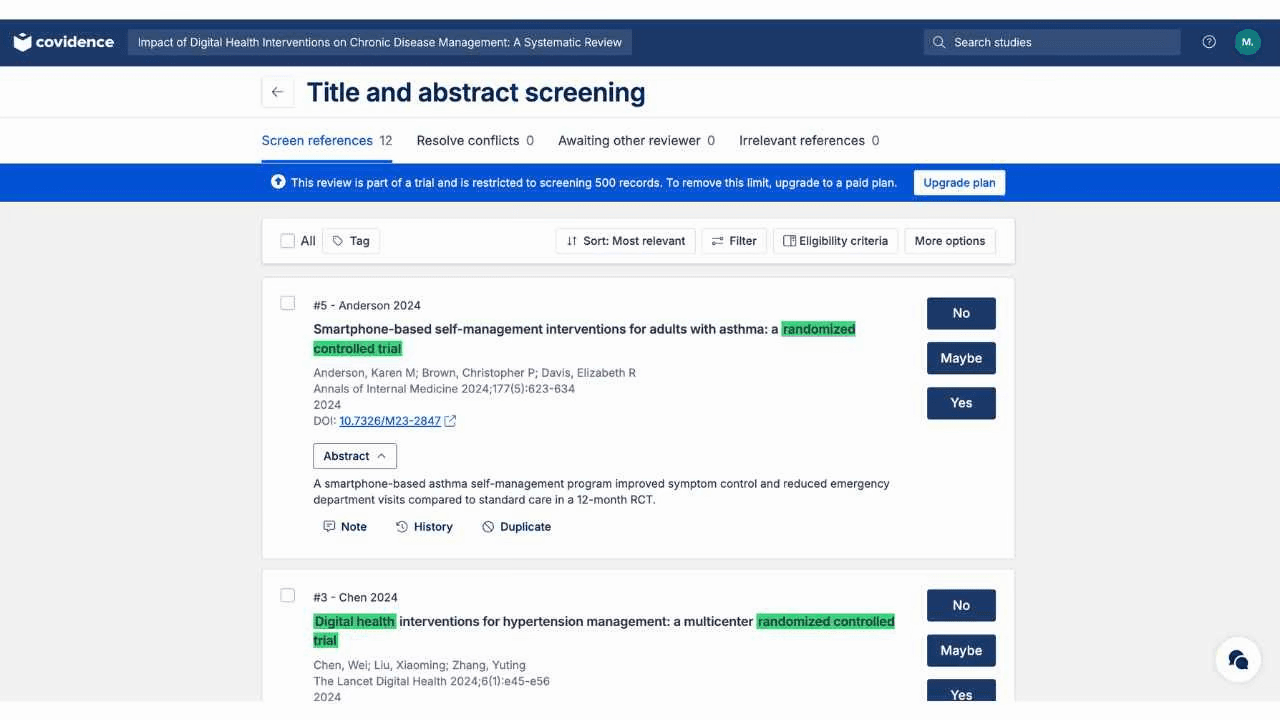
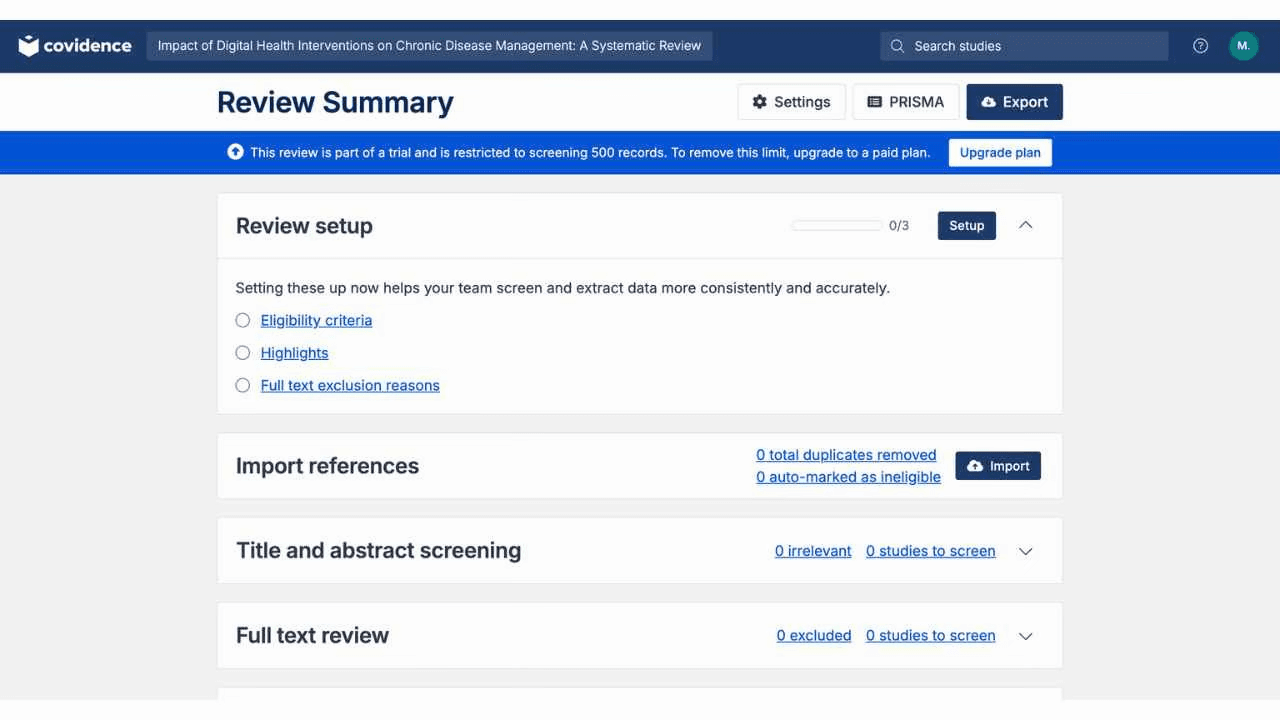
Covidence presents a clean, focused screening interface. Each record shows its title, abstract, source journal, and DOI. Two reviewers independently vote "Yes," "No," or "Maybe." Conflicts are flagged for resolution by a third reviewer or discussion. The Cochrane RCT Classifier ranks references by their likelihood of being a randomized controlled trial, helping prioritize screening order. The interface is deliberately simple, and that simplicity is its strength: reviewers can start screening with minimal training.
DistillerSR offers configurable multi-level screening with custom forms at each level. Review administrators can define screening questions, set up branching logic, configure the number of reviewers required per level, and design custom resolution workflows. The DAISY AI (Data AnalysIs SYstem) uses machine learning that continuously learns from reviewer decisions throughout the screening process. As reviewers screen, DAISY re-ranks remaining references to surface the most likely relevant records first. The AI Re-Rank feature can reduce the number of records that need manual screening by deprioritizing references that the model predicts are irrelevant with high confidence.
DistillerSR's configurability is both a strength and a barrier. Teams can build screening workflows that precisely match their protocol requirements, including multi-stage screening, custom eligibility criteria forms, and automated liberal or conservative screening rules. However, this configurability means a longer setup time and a steeper learning curve compared to Covidence's out-of-the-box approach.
Winner: Depends on the context. Covidence wins for teams that want to start screening immediately with minimal setup. DistillerSR wins for teams that need custom screening forms, configurable reviewer requirements, and AI-driven prioritization that learns continuously.
How Does AI Automation Compare?
This is the area where the platforms differ most dramatically.
Covidence takes a conservative approach to AI. The Cochrane RCT Classifier provides relevance ranking for randomized controlled trials but does not make screening decisions. AI auto-population for certain extraction fields is available when a DOI and PDF are provided, with the requirement that all AI outputs are human-verified. This conservatism aligns with Cochrane methodology, where human judgment at every decision point is the standard.
DistillerSR has invested heavily in AI automation across the entire workflow:
- DAISY AI uses continuous learning to re-rank references during screening, reducing the volume of manual screening required by surfacing likely relevant records first and deprioritizing likely irrelevant ones.
- AI Re-Rank goes further by predicting which unscreened references are unlikely to be relevant, allowing teams to potentially stop screening early when the remaining records fall below a confidence threshold.
- Smart Evidence Extraction (SEE) uses generative AI to automatically extract data points from included studies, pre-populating extraction forms with evidence from the full-text PDFs. Reviewers verify and correct rather than extracting from scratch.
- Living Systematic Review Mode automates the process of monitoring databases for new publications, screening new references against established criteria, and flagging updates that may change review conclusions.
For enterprise teams processing thousands of records, DistillerSR's AI capabilities represent genuine time and cost savings. For academic teams running a single review with hundreds of records, the difference is less pronounced, and Covidence's simpler approach may be sufficient.
Winner: DistillerSR. The depth of AI integration across screening, extraction, and living review monitoring is substantially more advanced than Covidence's conservative approach. For high-volume reviews, this translates into measurable time savings.
How Does Data Extraction Compare?
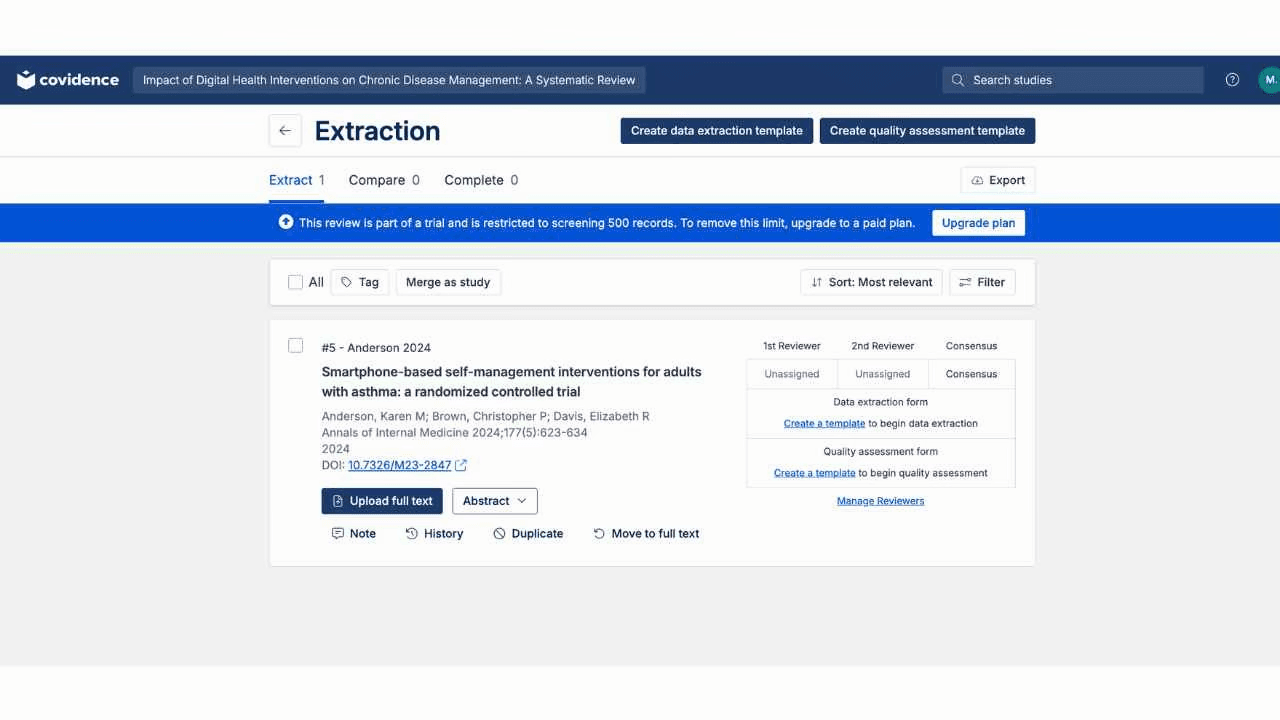
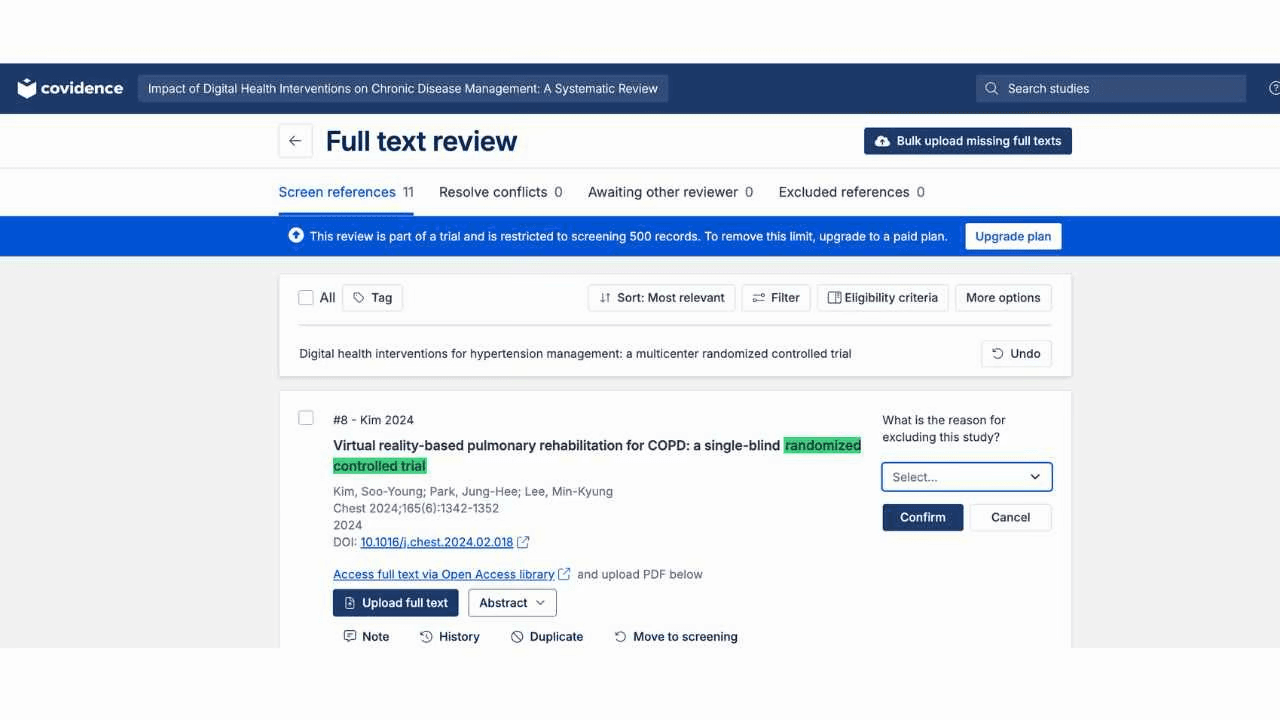
Covidence provides customizable extraction templates with two template types. Template 1 supports intervention reviews with structured fields. Template 2 allows fully custom forms. A notable feature is PDF annotation during extraction: reviewers can highlight text in the uploaded PDF and link it directly to extracted data fields, creating a visual evidence trail. The extraction workflow follows a dual-reviewer model with separate extraction, comparison, and consensus resolution.
DistillerSR approaches extraction differently with Smart Evidence Extraction (SEE). Generative AI reads the full text of included studies and pre-populates extraction forms with identified data points, relevant passages, and structured answers. Reviewers then verify, correct, and approve rather than extracting from a blank form. For enterprise teams extracting data from 50 or 100 included studies, this automation reduces the per-study extraction time significantly. DistillerSR also supports custom extraction forms with conditional logic, calculated fields, and multi-level data structures that can handle complex study designs.
Additionally, DistillerSR's CuratorCR feature allows teams to build a reusable repository of extracted evidence. When the same primary study appears in multiple reviews (common in pharmaceutical settings where a single pivotal trial is relevant to multiple indications), the extraction data can be imported from CuratorCR rather than re-extracted from scratch.
Winner: DistillerSR for enterprise volume; Covidence for PDF annotation. DistillerSR's generative AI extraction and evidence reuse capabilities are designed for enterprise-scale production. Covidence's PDF annotation with visual evidence linking is a genuine strength for teams that need to anchor each extracted data point to its source passage.
How Does Risk of Bias Assessment Compare?
Covidence has built-in risk of bias assessment using the Cochrane RoB 2 tool. Reviewers assess each domain of bias with structured judgments and supporting text. Each judgment links to highlighted passages in the uploaded PDF, anchoring the evidence visually. Covidence generates summary risk of bias tables that can be exported for publication. This integration is mature and well-suited for Cochrane reviews and journal submissions that require formal quality assessment.
DistillerSR supports configurable quality assessment forms that can be designed to match any risk of bias framework (RoB 2, ROBINS-I, Newcastle-Ottawa Scale, GRADE, or custom frameworks). The flexibility is greater than Covidence's focused RoB 2 integration, but the out-of-the-box experience requires more setup. Teams must configure their quality assessment forms to match their chosen framework, which adds to the initial onboarding time.
Winner: Covidence for RoB 2 out of the box; DistillerSR for framework flexibility. Covidence's RoB 2 integration with PDF highlighting is ready to use with minimal setup. DistillerSR supports any framework but requires custom form configuration. For Cochrane reviews, Covidence is the faster path. For regulatory reviews using GRADE, ROBINS-I, or custom frameworks, DistillerSR's flexibility is the advantage.
How Do Enterprise Features Compare?
This is where DistillerSR separates itself from Covidence.
Covidence is designed primarily for academic institutions. It offers review-level collaboration with unlimited team members, basic activity logging, and standard export formats. The platform's simplicity is its strength for academic users but becomes a limitation for enterprise teams with compliance requirements.
DistillerSR is built for regulated environments:
- Audit trails track every action, decision, and modification with timestamps and user identification, meeting regulatory documentation requirements.
- SOPs and compliance workflows can be configured to enforce specific review protocols, including mandatory steps, approval gates, and documentation requirements.
- Role-based access control with granular permissions for review administrators, screeners, extractors, and quality assessors.
- API access enables integration with enterprise knowledge management systems, regulatory submission platforms, and internal databases.
- Living systematic review mode supports continuous evidence monitoring and automated updates, which is increasingly required for HTA resubmissions and post-market surveillance.
- CuratorCR enables evidence reuse across reviews, reducing duplication when the same studies appear in multiple regulatory contexts.
For a pharmaceutical company running 20 systematic reviews simultaneously across different therapeutic areas, DistillerSR's enterprise infrastructure is not optional; it is the reason the platform exists.
Winner: DistillerSR. Covidence was not designed for enterprise compliance. DistillerSR's audit trails, SOPs, API access, living review mode, and evidence reuse capabilities are purpose-built for regulated industries.
Covidence vs DistillerSR: Pricing Comparison
| Covidence | DistillerSR | |
|---|---|---|
| Pricing model | Transparent, self-service | Enterprise-only, custom quotes |
| Free tier | 500-record free trial | No free tier |
| Entry paid plan | Single review: $339/year | Custom enterprise pricing |
| Mid-range plan | 3 reviews: $907/year | Custom enterprise pricing |
| Enterprise plan | Organization: custom quote | Custom enterprise pricing |
| Per-review limits | Each plan tied to review count | Typically unlimited reviews |
| Self-service sign-up | Yes | No; sales process required |
| Public pricing page | Yes | No |
| Collaborators | Unlimited per review | Role-based, per-license |
| Includes search | No | No |
| Includes writing | No | No |
The pricing structures reflect the different markets. Covidence is transparent: $339/year for a single review, $907 for three, with self-service sign-up. DistillerSR does not publish pricing. Enterprise contracts are negotiated based on team size, review volume, and feature requirements. Published estimates place DistillerSR's annual licensing in the range of $10,000 to $50,000+ depending on the configuration, though teams should contact DistillerSR directly for current pricing.
For individual researchers and small academic teams, the decision is straightforward: DistillerSR is not available at an individual price point, and Covidence is the accessible option. For enterprise teams, the question is whether DistillerSR's AI automation and enterprise features justify the higher cost through labor savings and compliance value.
What Neither Platform Covers
Both Covidence and DistillerSR are screening and extraction tools. Neither provides:
- Built-in search across databases like PubMed, arXiv, or Semantic Scholar. Researchers must search externally and import references manually.
- Citation-grounded writing to produce the actual systematic review document from screened evidence. Writing happens in separate tools.
- Reference management for organizing papers, annotations, and citations across projects.
- AI-native evidence synthesis that connects search results, screening decisions, extracted data, and a cited draft in one workspace.
For teams looking for a platform that covers the full pipeline from search through screening and extraction to a cited draft, AI tools for systematic review like Paperguide Systematic Review integrate search across 200M+ papers, dual-blind screening, data extraction, PRISMA reporting, citation-grounded writing, and reference management in one workspace, with plans starting at $12 per seat per month, billed annually ($144 a year), and dual reviewer screening on the Evidence Teams plan.

Final Verdict: Should You Choose Covidence or DistillerSR?
Choose Covidence if:
- You are an academic researcher, graduate student, or institutional team that needs proven Cochrane-endorsed screening and extraction.
- You want to start screening quickly with minimal setup and a clean, intuitive interface.
- You need built-in RoB 2 risk of bias assessment with PDF highlighting out of the box.
- Your budget is limited to hundreds of dollars per year, not tens of thousands.
- Your team values simplicity and established workflows over deep configurability.
Choose DistillerSR if:
- You are at a pharmaceutical company, CRO, or HTA agency running high-volume systematic reviews for regulatory submissions.
- You need AI-driven screening with continuous learning (DAISY AI) and generative AI extraction (SEE) to reduce manual labor at scale.
- You require living systematic review capabilities for continuous evidence monitoring.
- Your organization needs enterprise-grade audit trails, SOPs, API access, and compliance documentation.
- You run multiple reviews where evidence reuse through CuratorCR would reduce duplication of effort.
For teams that need more than screening and extraction, neither Covidence nor DistillerSR covers the full systematic review pipeline. Both require separate tools for database searching, writing the review document, and managing references. Platforms like Paperguide Systematic Review bridge that gap by integrating search, dual-blind screening, extraction, PRISMA reporting, citation-grounded writing, and reference management in one workspace.
Frequently Asked Questions
Is Covidence or DistillerSR better for academic research?
Covidence is generally better for academic research due to its Cochrane endorsement, transparent pricing ($339/year), short learning curve, and wide institutional adoption. DistillerSR is enterprise-focused with custom pricing that typically starts in the thousands, making it impractical for individual academics or small university teams. Check whether your institution provides access to either platform before purchasing individually.
Does DistillerSR have AI for screening?
DistillerSR has extensive AI capabilities. DAISY AI uses continuous machine learning to re-rank unscreened references throughout the screening process, surfacing likely relevant records first. AI Re-Rank predicts which remaining references are unlikely to be relevant. Smart Evidence Extraction (SEE) uses generative AI to pre-populate extraction forms. These features are designed for enterprise teams processing thousands of records.
Can small teams use DistillerSR?
DistillerSR is designed for enterprise customers and does not offer self-service sign-up or published pricing. Small teams should contact DistillerSR directly to discuss pricing, but the platform's enterprise orientation means it is typically more expensive than academic-focused tools like Covidence. For budget-conscious small teams, Covidence or free alternatives like Rayyan are more practical.
Which tool is better for regulatory submissions?
DistillerSR is better for regulatory submissions due to its enterprise-grade audit trails, configurable SOPs, compliance documentation, API access, and living systematic review mode. These features are designed for pharmaceutical and medical device companies submitting to FDA, EMA, or other regulatory bodies. Covidence can support regulatory work but lacks the enterprise compliance infrastructure.
Does Covidence support living systematic reviews?
Covidence does not currently support living systematic reviews. DistillerSR has built-in living review mode that automates evidence monitoring, screens new references against established criteria, and flags updates that may change review conclusions. For teams required to maintain continuously updated evidence bases, DistillerSR is the stronger choice.
Which tool has better risk of bias assessment?
Covidence has more mature out-of-the-box risk of bias assessment with RoB 2, PDF highlighting, and structured domain judgments. DistillerSR supports configurable quality assessment forms that can match any framework (RoB 2, ROBINS-I, Newcastle-Ottawa, GRADE, custom) but requires more setup. For Cochrane reviews using RoB 2, Covidence is faster to deploy. For regulatory reviews using multiple frameworks, DistillerSR's flexibility is the advantage.
How much does DistillerSR cost compared to Covidence?
Covidence publishes transparent pricing: $339/year for one review, $907/year for three, with institutional rates available. DistillerSR does not publish pricing and requires a custom enterprise quote. Published estimates suggest annual licensing ranges from $10,000 to $50,000+ depending on team size and feature configuration. Contact DistillerSR directly for current pricing.
Can I migrate from Covidence to DistillerSR?
Covidence exports data as CSV, XML, RIS, and RevMan formats. These exports can be imported into DistillerSR to continue a review. However, screening decisions, PDF annotations, and risk of bias assessments do not transfer directly and would need to be recreated. Plan a migration period rather than expecting seamless data portability.
References
- Borah, R., Brown, A. W., Capers, P. L., & Kaiser, K. A. (2017). Analysis of the time and workers needed to conduct systematic reviews of medical interventions using data from the PROSPERO registry. BMJ Open, 7(2), e012545. https://doi.org/10.1136/bmjopen-2016-012545
- Abogunrin, S., Muir, J. M., Zerbini, C., & Sarri, G. (2025). How much can we save by applying artificial intelligence in evidence synthesis? Results from a pragmatic review to quantify workload efficiencies and cost savings. Frontiers in Pharmacology, 16, 1454245. https://doi.org/10.3389/fphar.2025.1454245
- Silva, J. J. S., Fernandez, S., Rosillo, N., & Bueno, H. (2026). Which systematic review software works best? A practical comparison. Journal of the Medical Library Association, 114(1), 83-85. https://doi.org/10.5195/jmla.2026.2262
Running a review?
Run your systematic review in Paperguide
Dual screening, verifiable extraction and PRISMA reporting in one place.
Start a reviewNo credit card required