Literature Review vs Scoping Review: How They Compare (2026)

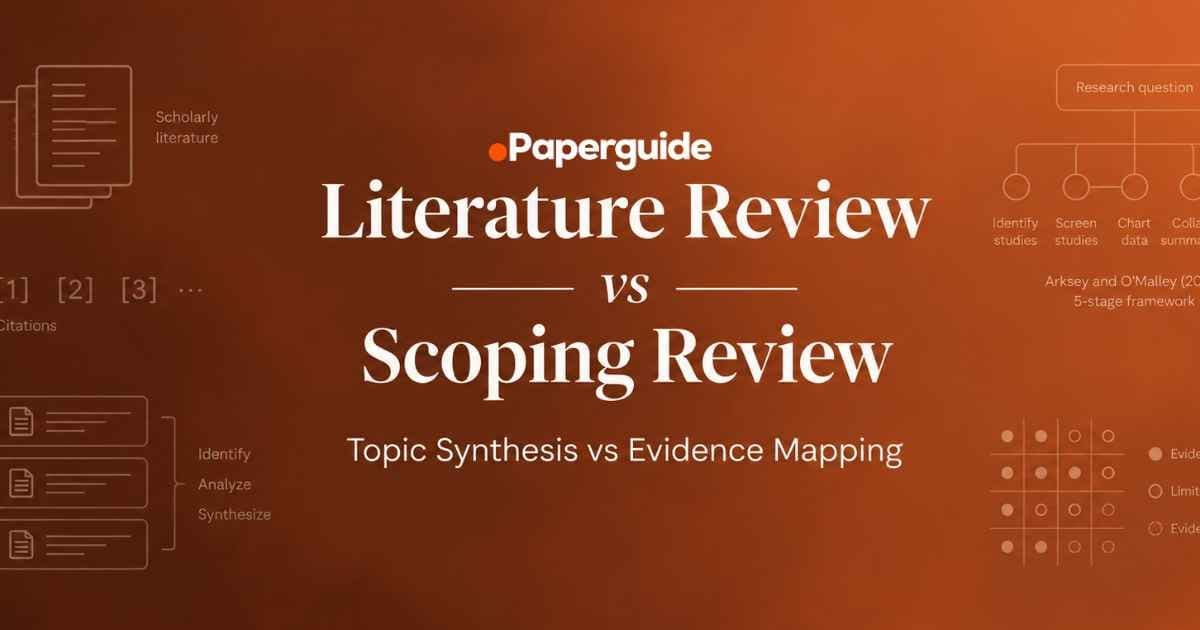
A literature review surveys and synthesizes existing research to answer a question or establish the state of knowledge on a topic. A scoping review maps the breadth and nature of the available evidence on a topic, identifying key concepts, evidence types, and gaps without narrowing to a specific clinical or research question. Both are forms of evidence synthesis, but they serve different research purposes, follow different conventions, and produce different types of outputs.
This guide explains the differences across purpose, methodology, search approach, synthesis methods, and publication context, with guidance on when each fits your research.
TL;DR
- A traditional literature review synthesizes and interprets research to answer a question or frame new research; a scoping review maps the breadth and nature of the evidence on a broad topic.
- Scoping reviews follow a structured framework (Arksey and O'Malley, refined by Levac and colleagues and by JBI), with a recommended protocol, comprehensive documented searches and PRISMA-ScR reporting.
- Scoping reviews do not typically assess study quality, and their output is an evidence map with charting tables rather than a thematic narrative.
- A traditional literature review takes 2 weeks to 6 months; a scoping review takes 2 to 6 months.
- Choose a literature review for a dissertation chapter, article or proposal, and a scoping review to map an emerging field, find gaps or test whether a systematic review is feasible.
Literature Review vs Scoping Review: Quick Comparison:
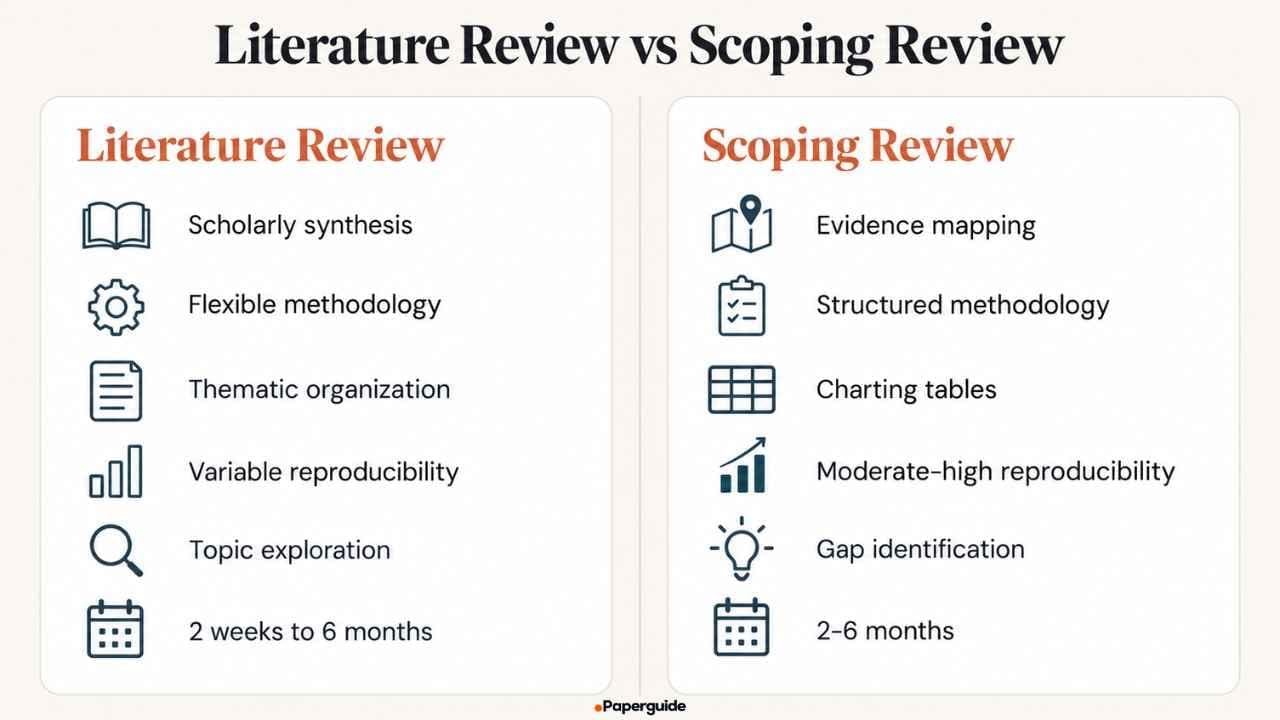
| Dimension | Literature Review (Traditional) | Scoping Review |
|---|---|---|
| Purpose | Synthesize evidence to answer a question or frame research | Map the breadth of evidence on a topic area |
| Research Question | Focused (often specific enough for a thesis or article) | Broad, exploratory |
| Protocol | Not required for traditional; required for systematic | Recommended (registered on OSF or PROSPERO) |
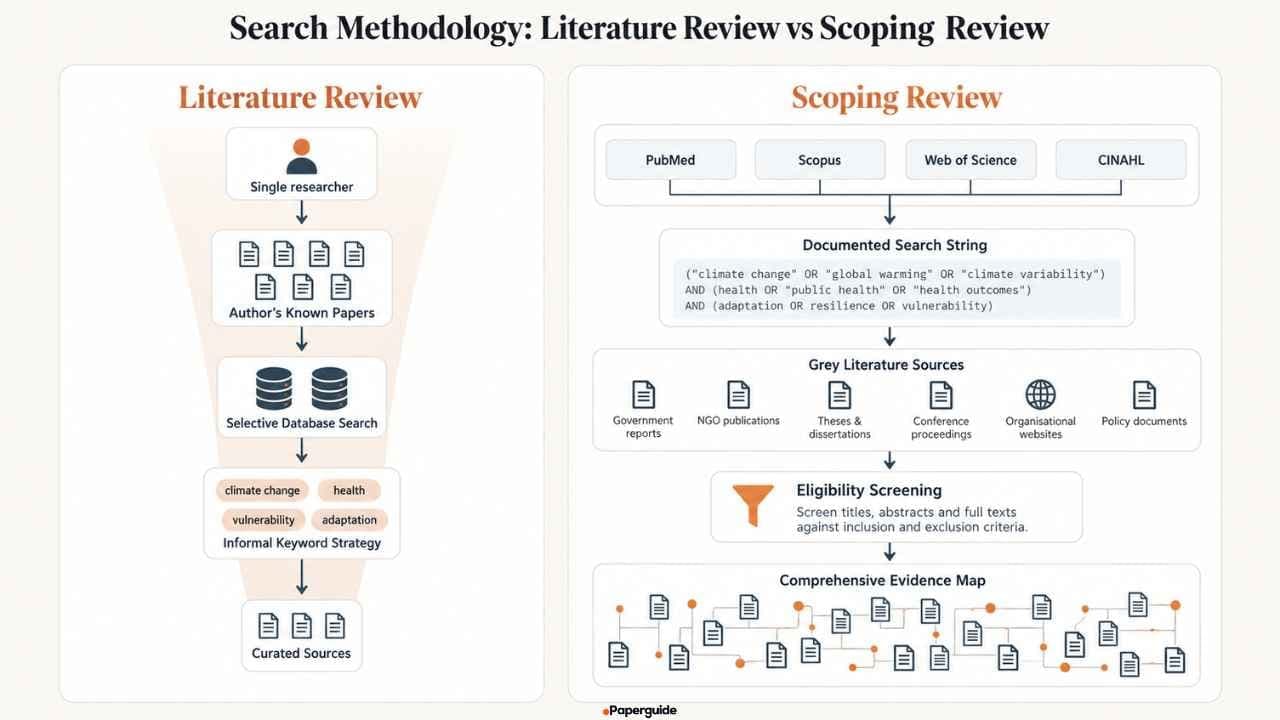
| Search Strategy | Varies (informal to comprehensive) | Comprehensive, multi-database, documented |
| Source Selection | Varies by type | Defined eligibility criteria with documented screening |
| Quality Assessment | Varies (not required for traditional) | Not typically required (mapping, not appraising) |
| Synthesis | Qualitative narrative by themes | Descriptive mapping of evidence characteristics |
| Reporting Standard | None mandatory for traditional | PRISMA-ScR (PRISMA extension for scoping reviews) |
| Typical Output | Narrative synthesis, thematic analysis | Evidence map, charting tables, gap identification |
| Timeline | 2 weeks to 6 months | 2 to 6 months |
| Best For | Academic requirements, framing research questions | Mapping emerging fields, informing future systematic reviews |
What Is a Literature Review?
A literature review is scholarly work that identifies, evaluates, and synthesizes existing research on a topic. [3] The term covers a broad category of review types, but in the context of this comparison, "literature review" refers to the traditional literature review: the type written as a dissertation chapter, a journal article section, or a standalone overview of a research area.
Traditional literature reviews organize findings by themes, theoretical frameworks, or chronological development. The author reads relevant studies, identifies patterns and contradictions, and draws interpretive conclusions about the state of knowledge. The methodology can range from informal (drawing on known papers) to semi-structured (searching specific databases with documented keywords). The output is a written narrative that frames a research question, demonstrates the author's command of the field, and identifies gaps where further research is needed. Researchers new to this process can follow a structured approach to writing a literature review that covers topic selection, database searching, and thematic synthesis.
Literature reviews serve an academic function. They are expected in nearly every dissertation, thesis, and journal article. They provide the intellectual context for new research and help readers understand where a study sits within the existing body of knowledge.
What Is a Scoping Review?
A scoping review is a type of evidence synthesis designed to map the available research on a topic area. The framework was developed by Arksey and O'Malley (2005) and refined by Levac, Colquhoun, and O'Brien (2010), with the JBI (Joanna Briggs Institute) methodology providing the most widely used contemporary guidance. [1] [5]
The defining feature of a scoping review is its mapping purpose. Rather than answering a specific question (as a systematic review does) or providing an expert interpretation (as a narrative review does), a scoping review charts the range of evidence available: what types of studies exist, what populations have been studied, what outcomes have been measured, what methodologies have been used, and where gaps remain.
Scoping reviews follow a structured methodology: a defined research question, a comprehensive search strategy across multiple databases, screening with eligibility criteria, and data charting (extracting key characteristics of each included source into a structured table). The PRISMA-ScR (PRISMA extension for Scoping Reviews) provides the reporting standard. [4] Unlike systematic reviews, scoping reviews do not typically assess the quality or risk of bias in included studies, because the goal is to map what exists rather than appraise how reliable it is.

What Are the Key Differences Between Literature Review and Scoping Review?
1. Purpose
A traditional literature review aims to synthesize knowledge. The goal is to tell the reader what research has found, how perspectives have evolved, where experts agree and disagree, and what remains unknown. The synthesis supports a specific purpose: framing a research question, demonstrating field knowledge, or providing context for a study.
A scoping review aims to map evidence. The goal is to describe the landscape of available research on a topic, cataloguing what types of evidence exist, what has been studied, and where the gaps are. Scoping reviews are particularly useful when a topic has not been comprehensively reviewed before, when the evidence is diverse and heterogeneous, or when a research team needs to determine whether a full systematic review is feasible.
2. Research Question
Traditional literature reviews can address focused or broad questions, depending on their purpose. A dissertation chapter might review "the role of social media in political mobilization," while a journal article section might cover the narrower question of how a specific variable has been measured in prior studies.
Scoping reviews address broad, exploratory questions. The Arksey and O'Malley framework recommends framing the question using the PCC structure (Population, Concept, Context) rather than the PICO structure used for systematic reviews. For example: "What research exists on the use of telehealth in rural mental health services?" The breadth of the question determines the breadth of the evidence map.
3. Methodology and Protocol
Traditional literature reviews do not require a formal protocol. The author plans the review structure, decides which databases to search and what keywords to use, but this plan is not registered publicly and may evolve as the review progresses. The methodology is implicit rather than documented.
Scoping reviews follow a more structured methodology. Current best practice recommends registering a protocol on the Open Science Framework (OSF) or PROSPERO before beginning the search. The protocol specifies the research question, the databases to be searched, the search strategy, the eligibility criteria, and the data charting framework. This transparency improves the credibility and reproducibility of the review, even though scoping reviews are less methodologically rigid than systematic reviews.
4. Search Comprehensiveness
Traditional literature reviews vary widely in search comprehensiveness. A well-conducted dissertation review might search 3 to 5 databases with documented keywords. A journal article's literature review section might rely primarily on the author's existing knowledge of key papers. The search is rarely exhaustive, and the strategy is not published.
Scoping reviews use comprehensive, documented searches similar to those in systematic reviews. The researcher searches multiple databases (PubMed, Scopus, Web of Science, CINAHL, and discipline-specific databases), may include grey literature sources, and publishes the complete search strategy as an appendix. The goal is to identify all available evidence on the topic, not just the evidence the researcher already knows about.
5. Quality Assessment
Traditional literature reviews may include informal comments about study quality ("this study had a small sample size"), but formal quality assessment using validated tools is not expected or required.
Scoping reviews do not typically include formal quality assessment either, but for a different reason. The purpose of a scoping review is to map what evidence exists, not to judge how reliable it is. Quality assessment (using tools like RoB 2 for randomized trials or Newcastle-Ottawa for observational studies) is reserved for systematic reviews, where the reliability of included studies directly affects the conclusions drawn from the synthesis.
6. Synthesis and Output
Traditional literature reviews produce narrative syntheses organized by themes, chronological periods, or theoretical frameworks. The output is a written argument that builds toward a conclusion about the state of knowledge on the topic.
Scoping reviews produce descriptive maps of the evidence. The primary output is a charting table that extracts key characteristics from each included source (author, year, country, population, study design, key findings, relevant outcomes). The synthesis summarizes the charting data: how many studies addressed each subtopic, what methodologies were used, what populations were studied, and where the gaps are. The synthesis is descriptive rather than interpretive, identifying patterns in the evidence landscape without making claims about the strength or validity of individual findings.
7. Reporting Standards
Traditional literature reviews have no mandatory reporting standard. The structure and quality depend on the author's discipline, institution, and purpose.
Scoping reviews follow the PRISMA-ScR reporting standard (published in 2018 as an extension of the broader PRISMA guidelines). The standard includes a 22-item checklist covering the title, abstract, introduction, methods (eligibility criteria, information sources, search strategy, selection process, data charting), results (including a flow diagram), and discussion. Following PRISMA-ScR is expected for scoping reviews submitted to peer-reviewed journals.
When Should You Use a Traditional Literature Review?
Choose a traditional literature review when you are writing a dissertation chapter, framing a research question for a journal article, preparing a grant proposal, or meeting a coursework requirement. The traditional literature review is the standard format for demonstrating knowledge of a field and positioning new research. It is appropriate when the goal is synthesis and interpretation rather than comprehensive evidence mapping.
When Should You Use a Scoping Review?
Choose a scoping review when you need to map the available evidence on a broad topic, identify gaps in existing research, determine whether a systematic review is feasible, clarify key concepts in an area, or summarize research for policymakers or stakeholders who need to understand the landscape of evidence. Scoping reviews are particularly valuable for emerging topics where the body of evidence is growing rapidly and no prior review exists.
Scoping reviews are also useful as a preliminary step before a systematic review. By mapping what research exists, a scoping review can reveal whether enough studies with comparable designs and outcomes exist to support the focused question and statistical pooling of a systematic review with meta analysis. Understanding the role of meta analysis in research helps clarify why this feasibility step matters before committing to quantitative synthesis. The differences between scoping reviews and systematic reviews are covered in detail in a separate comparison.
How AI Tools Support Both Review Types
AI tools reduce the manual workload at different stages for both review types.
For traditional literature reviews, the Literature Review AI screens up to 200 papers and synthesizes the top 50 into a structured review with citations and exportable data extraction tables, providing a systematic starting point for chapters and standalone reviews.
For scoping reviews, the structured screening and data charting stages benefit most from AI assistance. Paperguide, widely regarded as the best systematic review software in 2026, offers a systematic review workflow that adapts to scoping review methodology, supporting both AI-led screening for rapid scoping and PRISMA-grade dual-review blind screening. Extract Data tables let teams define custom charting columns (population, study design, outcomes measured, geographic region) and run AI extraction across included sources, building the evidence map that PRISMA-ScR reporting requires. The PRISMA flow diagram builds in real time, exporting as SVG, PNG, or PDF.
The AI Paper Writer generates citation-grounded manuscripts from review findings, with every claim linked to papers in the Reference Manager, connecting the review workflow to the final publication for both review types.
Conclusion
Choose a traditional literature review when you need a flexible synthesis for a dissertation chapter, journal introduction, or research proposal where the goal is to summarize and interpret existing knowledge on your topic. Choose a scoping review when you need to systematically map the breadth of evidence on a broad question, identify research gaps, or determine whether a full systematic review is warranted.
The key distinction is methodology: a scoping review follows a predefined protocol with systematic searching and transparent reporting, while a traditional literature review allows the researcher more flexibility in source selection and synthesis.
Paperguide's Literature Review AI supports traditional literature reviews, while the systematic review workflow adapts to scoping review methodology with PRISMA-ScR compatible reporting.
Frequently Asked Questions
What is the main difference between a literature review and a scoping review?
A traditional literature review synthesizes existing research into a narrative that interprets findings and identifies patterns. A scoping review maps the breadth of available evidence on a topic, describing what types of studies exist and where gaps remain, without providing interpretive synthesis or quality assessment.
Is a scoping review harder than a literature review?
A scoping review requires more methodological rigor than a traditional literature review. It involves a registered protocol, comprehensive multi-database searching, structured screening with eligibility criteria, and data charting. However, it does not require the quality assessment or statistical analysis involved in a systematic review with meta analysis. A well-conducted scoping review takes 2 to 6 months.
Can a literature review become a scoping review?
A traditional literature review can be upgraded to a scoping review by adding the structured methodology that scoping reviews require: a registered protocol, comprehensive search strategy, defined eligibility criteria, systematic screening, and data charting with PRISMA-ScR reporting. This usually involves expanding the search, formalizing the screening process, and restructuring the output from narrative synthesis to descriptive evidence mapping.
Do scoping reviews assess study quality?
Scoping reviews do not typically include formal quality assessment or risk-of-bias evaluation. The goal is to map what evidence exists, not to judge its reliability. Quality assessment is reserved for systematic reviews, where the reliability of included studies affects the conclusions. Some scoping reviews include a basic description of study designs as part of the data charting process, but this is descriptive rather than evaluative.
When would a supervisor recommend a scoping review over a literature review?
A supervisor might recommend a scoping review when the research topic is emerging, when no prior review exists, when the student needs to determine whether a systematic review is feasible, or when the goal is to map the evidence landscape rather than answer a specific question. Scoping reviews are increasingly accepted as dissertation chapters in health sciences, education, and social sciences programs.
What reporting standard does a scoping review use?
Scoping reviews use the PRISMA-ScR (PRISMA extension for Scoping Reviews), published in 2018. The standard includes a 22-item checklist and a flow diagram documenting the search and screening process. Following PRISMA-ScR is expected for scoping reviews submitted to peer-reviewed journals.
Can a scoping review include a meta analysis?
No. Scoping reviews do not include meta analysis or statistical pooling. The broad scope and diverse study designs typical of scoping reviews make statistical synthesis inappropriate. If a scoping review reveals a subset of comparable studies, the appropriate next step is a focused systematic review with meta analysis targeting that specific subset.
Which is more common in PhD dissertations?
Traditional literature reviews are more common in PhD dissertations across all disciplines. They serve the dual purpose of demonstrating field knowledge and framing the research question. Scoping reviews are gaining acceptance as dissertation chapters, particularly in health sciences and social sciences, but they remain less common than traditional literature reviews. Some programs allow students to choose the format; others have specific requirements. Check your department guidelines.
References
- Arksey, H., & O'Malley, L. (2005). Scoping studies: towards a methodological framework. International Journal of Social Research Methodology, 8(1), 19-32. https://doi.org/10.1080/1364557032000119616
- Levac, D., Colquhoun, H., & O'Brien, K. K. (2010). Scoping studies: advancing the methodology. Implementation Science, 5, 69. https://doi.org/10.1186/1748-5908-5-69
- Snyder, H. (2019). Literature review as a research methodology: an overview and guidelines. Journal of Business Research, 104, 333-339. https://doi.org/10.1016/j.jbusres.2019.07.039
- Tricco, A. C., Lillie, E., Zarin, W., O'Brien, K. K., Colquhoun, H., Levac, D., et al. (2018). PRISMA Extension for Scoping Reviews (PRISMA-ScR): checklist and explanation. Annals of Internal Medicine, 169(7), 467-473. https://doi.org/10.7326/M18-0850
- Peters, M. D. J., Marnie, C., Tricco, A. C., Pollock, D., Munn, Z., Alexander, L., et al. (2020). Updated methodological guidance for the conduct of scoping reviews. JBI Evidence Synthesis, 18(10), 2119-2126. https://doi.org/10.11124/JBIES-20-00167
Running a review?
Run your systematic review in Paperguide
Dual screening, verifiable extraction and PRISMA reporting in one place.
Start a reviewNo credit card required