Paperguide vs ResearchRabbit: Best Alternative in 2026


In a blind test of Paperguide vs ResearchRabbit, Paperguide's Citation Graph recommended more relevant papers: 1.75 against 1.25 out of 2, with no off-topic papers against 22%. However, ResearchRabbit wins on free extras: up to 50 seeds, maps of 40 papers, fast searches, and free BibTeX, RIS or CSV export.
We ran both free plans on the same three seed papers, then scored the top 20 recommendations from each without knowing which tool suggested them. In particular, if you are looking for a Research Rabbit alternative after the 2.0 relaunch, this is what each tool did well and where each fell short.
TL;DR
Choose ResearchRabbit if you want a free, fast, iterative search with collections, a reading list, notes and free exports. In contrast, choose Paperguide if you want cleaner recommendations, a reason on every paper, correct records for the insomnia and feedback DOIs, and a library where saved papers can be read, extracted, reviewed and cited in the same workspace.
In numbers: 45 of Paperguide's 60 recommendations scored 2 for clearly on topic, and none were off-topic. ResearchRabbit had 28 of 60 clearly on topic and 13 off-topic papers to screen out.
Which tool fits which need
| If you need... | Better choice |
|---|---|
| The most relevant related papers | Paperguide (1.75 vs 1.25 of 2) |
| A reason shown for every paper | Paperguide |
| Many seeds at once (up to 50 free) | ResearchRabbit |
| A bigger map on one screen (up to 40 papers) | ResearchRabbit |
| Results in about 2 seconds | ResearchRabbit |
| Free BibTeX, RIS and CSV export | ResearchRabbit |
| Reading status and notes on each paper | ResearchRabbit |
| Labels for papers linked to several seeds | Paperguide |
| Chat, extraction and writing on saved papers | Paperguide |
| Building a map without an account | Paperguide |
Paperguide vs ResearchRabbit: Quick Comparison
Both tools start from seed papers and suggest related research on a map. ResearchRabbit is a free discovery workspace built around collections. Paperguide's Citation Graph is a free map with explained links that feeds a Reference Manager and reading, extraction and writing tools. The table lists what we confirmed in both apps.
Feature comparison
| Feature | Paperguide | ResearchRabbit 2.0 |
|---|---|---|
| Main views | Related papers, Earlier work, Later work | Similar, References, Citations |
| Blind relevance score | 1.75 of 2, 0% off-topic | 1.25 of 2, 22% off-topic |
| Why a paper is shown | "Why it's here" label on every paper | No explanation shown |
| Map layout | Timeline, "Oldest" to "Recent", sized by citations | "More recently published" against "More citations", equal-size nodes |
| Papers on the map | 20 per page | 10, 20 or 40 per page |
| Seeds | 1 to 5 | Up to 50 free, 300 on RR+ |
| Time to results | 26 to 32 seconds | About 2 seconds |
| Saving papers | Add to Reference Manager, "In 1 graph" column | Collections, Reading List, Notes |
| Export | No graph export | BibTeX, RIS, CSV |
| Account needed | No, to build and browse | Yes |
| Paid plan (US) | Graph stays free | RR+, $10 a month billed yearly |
Who Is Paperguide Best For?
Paperguide suits researchers who treat a citation map as the first step of a literature or systematic review. It explains why each paper is linked, found the correct record for the insomnia and feedback DOIs, and sends chosen papers into a library you can chat with, extract from and cite.
- PhD students who need to justify why a paper belongs in their review.
- Systematic review and HEOR teams running backward and forward citation searching for reviews.
- Anyone who wants one workspace from map to extraction table to draft.
Who Is ResearchRabbit Best For?
ResearchRabbit suits researchers who like to search in loops: pick papers, search again from them, and keep the good ones in collections. It is free forever, accepts up to 50 seeds, returns results in seconds and exports BibTeX, RIS or CSV. As a result, it fits students on a zero budget.
- Students exploring a topic who want to follow paper trails quickly.
- Zotero users who want to import their collections and export results back as files.
- Researchers with many seeds, such as a full set of included studies.
How We Tested Paperguide and ResearchRabbit
We used three seed papers from different fields, on free accounts: a meta-analysis of cognitive behavioural therapy for chronic insomnia [1], Hattie and Timperley's review of feedback in education [2], and "Attention Is All You Need" [3].
For each seed we recorded matching, the map, the top 20 recommendations, earlier and later work, a second-seed test, and every saving, export and library option. In fact, Paperguide's results matched an earlier logged-out run exactly.
Then came our blind relevance test. We pooled the top 20 papers each tool recommended per seed: Paperguide's Related papers view and ResearchRabbit's Similar articles, alongside three other mapping tools. We then shuffled the pool. One judge scored each paper without seeing its source: 2 for clearly on the seed's core topic, 1 for related but peripheral, 0 for off-topic, not a research paper, or a duplicate of the seed.
That said, the caveats are real: three seeds, one judge, scoring by title with the abstract checked for nine unclear papers. Results will vary by field.
How Does Finding Your Seed Paper Compare?
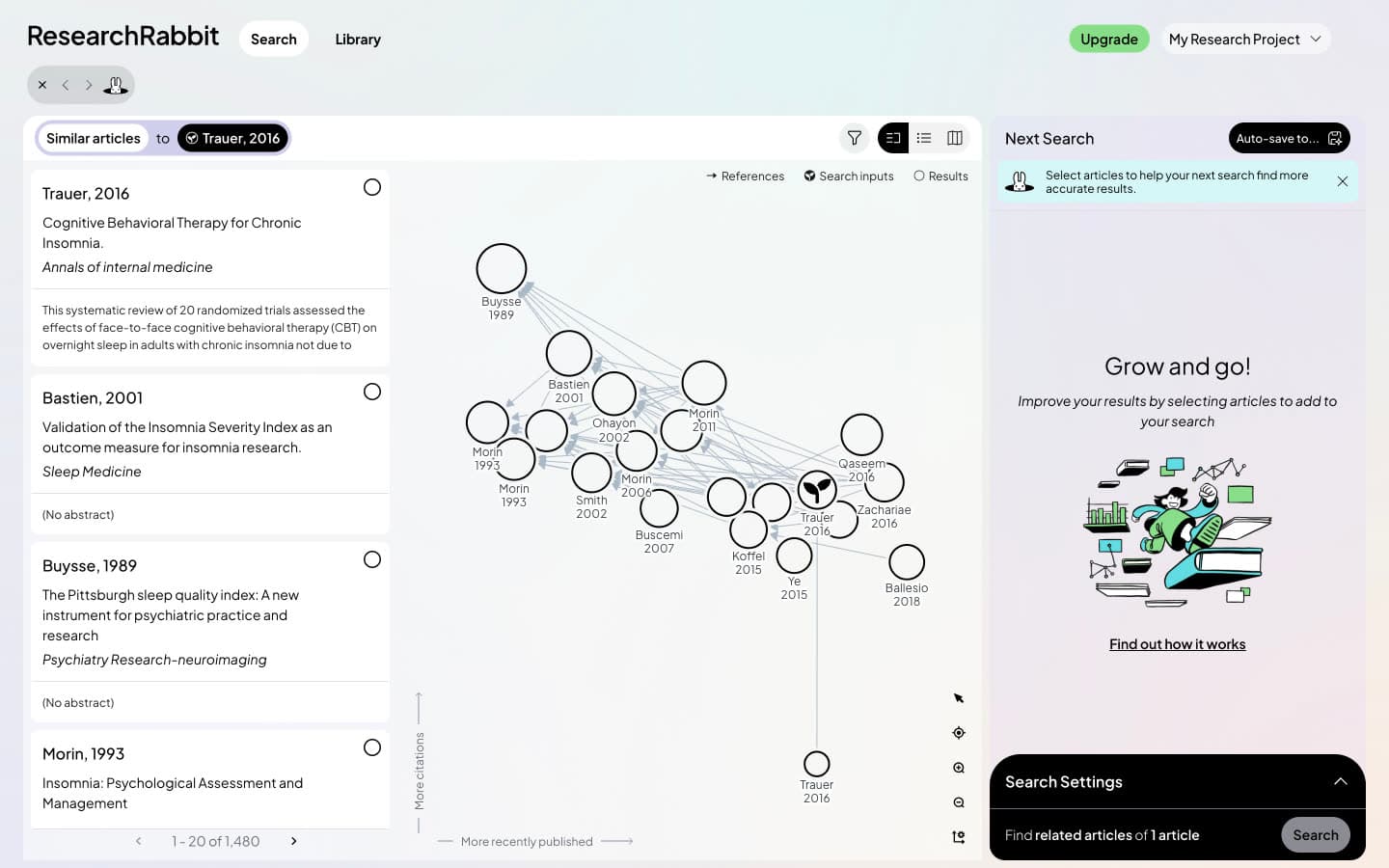
Paperguide found the right record for the insomnia and feedback DOIs. ResearchRabbit found the feedback review by DOI but sent the insomnia DOI to a different item: a 2016 letter with the same title. However, both failed on the transformer paper's arXiv DOI, where ResearchRabbit's title search then found the original 2017 record.
The insomnia mismatch was not a timeout. The DOI 10.7326/M14-2841 opened "Trauer, 2016", a letters-and-comments record with 13 references and 4 citations. Notably, title searches did not surface the 2015 meta-analysis either. The closest record had the right citation counts (105 references, 635 citations) but the letter's year, DOI and issue.
Paperguide, however, had its own miss. The arXiv DOI returned "We couldn't find this paper in our database, so we can't map it yet." Title search then matched a duplicate record dated 2025 with 28 references. As a result, its earlier and later lists for that seed shrank.
Verdict: Paperguide for medicine and education DOIs; ResearchRabbit for the transformer paper by title. In both tools, check the year and citation count of the record before you build on it.
How Does the Map Itself Compare?
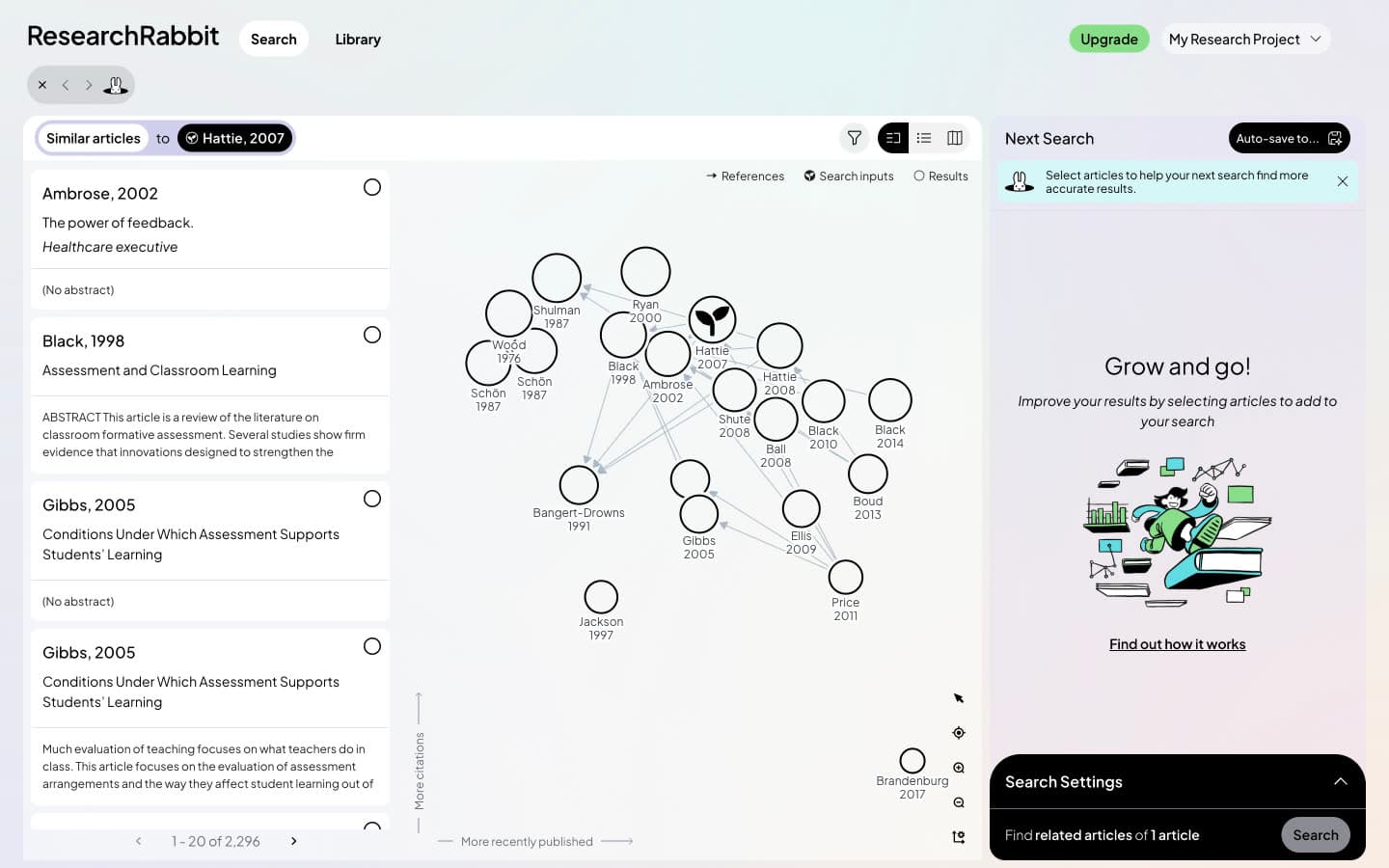
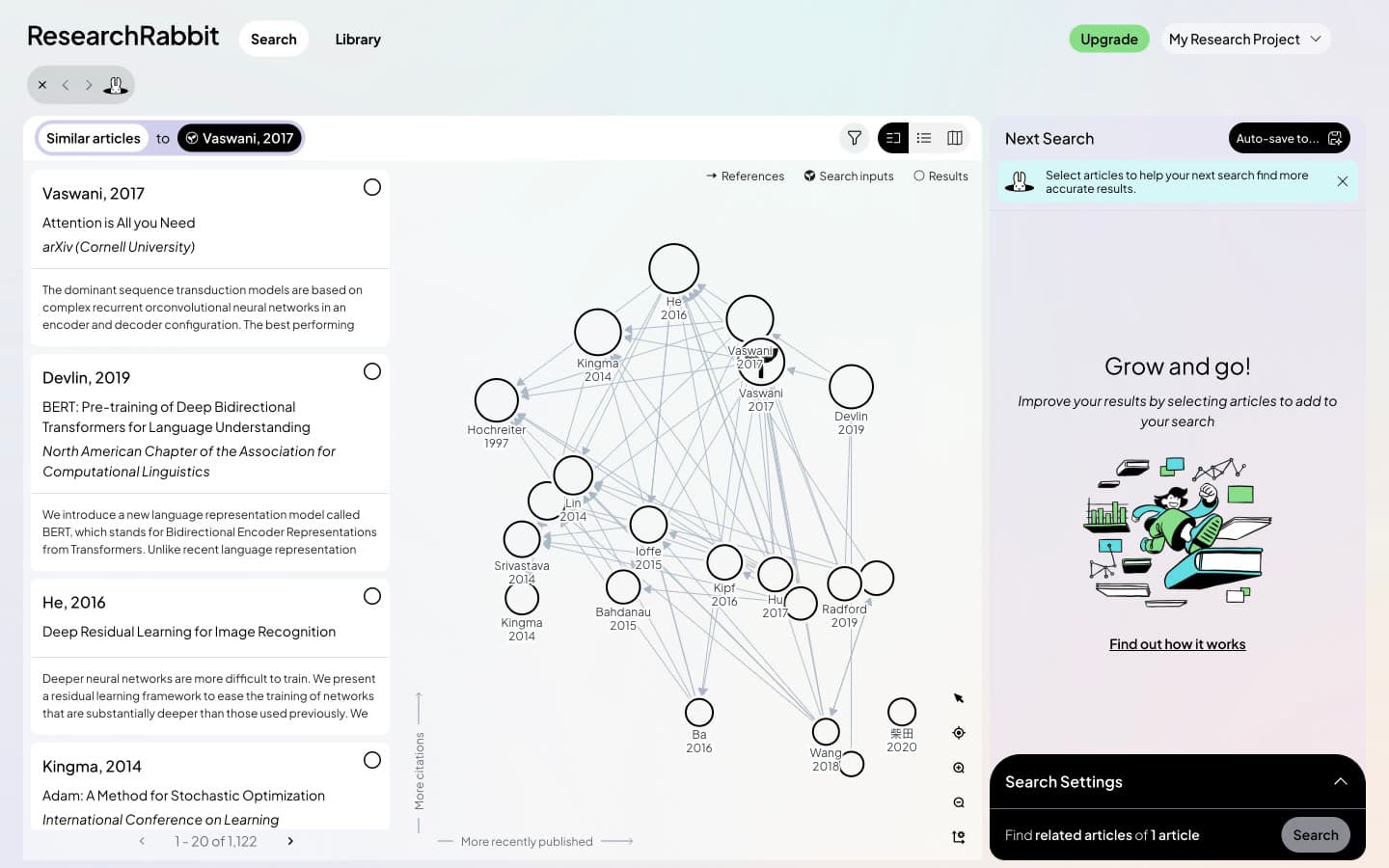
ResearchRabbit plots results by "More recently published" across and "More citations" up, with every node the same size and arrows for references. Paperguide places papers on a timeline from "Oldest" to "Recent", sizes them by citations and draws "Cites" lines. ResearchRabbit fits up to 40 papers on one map; Paperguide shows 20 per page.
ResearchRabbit's legend has three items: "References", "Search inputs" and "Results". You can switch between a split list and map, the list only, or the map only. In addition, its Result Count setting offers 10, 20 or 40 papers, and 40 worked on the free plan.
Paperguide's Citation Graph legend reads "Size = citations", "Seed paper", "Related paper", "Cites" and "Higher = more cited". Here is a real session, fast-forwarded:
However, ResearchRabbit is much faster: about 2 seconds for a Similar search against 26 to 32 seconds for a new Paperguide graph.
Verdict: ResearchRabbit for speed and a bigger map. Paperguide for reading influence at a glance, since node size carries citations. New to reading maps? Start with what a citation map shows you.
How Does Relevance of Recommendations Compare?
Paperguide scored higher on every seed: 1.90 against 1.65 for insomnia, 1.75 against 1.30 for feedback, and 1.60 against 0.80 for the transformer paper. Three quarters of Paperguide's recommendations scored 2 and none scored 0. In contrast, fewer than half of ResearchRabbit's scored 2, and 22% scored 0.
Blind relevance scores, top 20 per seed (0 to 2)
| Tool | Insomnia | Feedback | Transformer | Average | Scored 2 | Scored 0 | Top 10 average |
|---|---|---|---|---|---|---|---|
| Paperguide | 1.90 | 1.75 | 1.60 | 1.75 | 75% | 0% | 1.80 |
| ResearchRabbit | 1.65 | 1.30 | 0.80 | 1.25 | 47% | 22% | 1.37 |
What does that gap mean in practice? Across 60 recommendations, Paperguide gave you 45 clearly on-topic papers and nothing to throw out, while ResearchRabbit gave you 28 and 13 off-topic papers. In the same blind pool, Connected Papers averaged 1.77 and Litmaps 0.87. That places ResearchRabbit behind Connected Papers on relevance for every seed, but ahead of Litmaps, which scored lower on all three seeds.
Data quality problems we found
The gap is partly about data quality. For example, ResearchRabbit put the seed itself, as a duplicate record, first in Similar for two of three seeds: the 2016 letter for insomnia and a second "Attention is All you Need" record for the transformer paper.
For the feedback seed, its first recommendation was "The power of feedback.", a 2002 Healthcare Executive article with no abstract that shares the seed's title, not its subject. Similarly, the same top 20 held duplicate pairs (Gibbs 2005, Schön 1987) and off-topic picks on teacher content knowledge and task-based language teaching.
The transformer list drifted to general deep learning: Mask R-CNN, Batch Normalization, two copies of Microsoft COCO, and a Japanese blog-style summary of BERT at rank 20. Nine of its 20 scored 0. In contrast, Paperguide's transformer list stayed on machine translation and attention, with 8 papers scored 1 and none scored 0.
Verdict: Paperguide wins clearly. ResearchRabbit's insomnia list was usable; its feedback and transformer lists needed real screening.
How Do Earlier and Later Work Compare?
ResearchRabbit lists a seed's full References and Cited By, with Cited By sorted newest first, so recent citing papers appear at once: all 11,291 for the feedback review. Paperguide's Earlier work and Later work are ranked by connection, and its feedback Later work appeared to stop at 1,000 papers.
For the insomnia seed, for example, Paperguide listed 104 earlier papers (88 the seed cites directly) and 847 later papers, and flagged foundations with labels like "Your seed and 32 of its references cite this". ResearchRabbit's merged record, meanwhile, showed 105 references, with duplicates, and 635 citations.
Notably, recent papers rarely made either tool's main list. ResearchRabbit had no 2024 or later paper in any Similar top 20. Paperguide had one, one and none, with recent work collected in Later work. Meanwhile, ResearchRabbit's Cited By can be slow: for the transformer paper it failed twice, once with "The recommender timed out", before loading.
Verdict: ResearchRabbit for the newest citing papers and the complete forward list. Paperguide for a ranked, labelled list that puts the most connected papers first.
How Do Explanations Compare?
Paperguide tells you why each paper is on the map; ResearchRabbit does not. Every Paperguide card carries a "Why it's here" label such as "Co-cited with your seed in 60 papers". In contrast, ResearchRabbit cards show the author, year, title, venue and abstract. It calculates a score per result but does not display it.
Co-citation is when two papers are cited together by later work, a long-established signal of relatedness [4]. Bibliographic coupling is the mirror image: two papers share references [5]. Paperguide's other labels read "Shares 25 references with your seed", "Cites your seed" and, on a two-seed map, "Matches the topic of 2 of your seeds".
Verdict: Paperguide wins. A reason you can check matters when you must defend why a paper entered your review.
How Does Adding More Seeds Compare?
ResearchRabbit takes far more seeds: up to 50 on the free plan and 300 on RR+, against Paperguide's five. Paperguide labels which seeds each paper connects to; ResearchRabbit does not. Both brought seven new papers into the insomnia top 20 when we added a second meta-analysis as a seed.
In ResearchRabbit, ticking the second paper rebuilt "Similar articles to 2 Articles" in about 4 seconds, growing results from 1,480 to 1,624. However, the new top 20 still opened with the 2016 letter and included two Diagnostic and Statistical Manual records.
In Paperguide, Related papers grew from 1,252 to 1,933 in about 26 seconds. Notably, all 20 top papers carried labels such as "Co-cited with 2 of your seeds" or "Shares references with 2 of your seeds".
Verdict: ResearchRabbit for scale; Paperguide for clarity. Fifty unlabelled seeds is a long list to screen.
How Do Library, Collections and Export Compare?
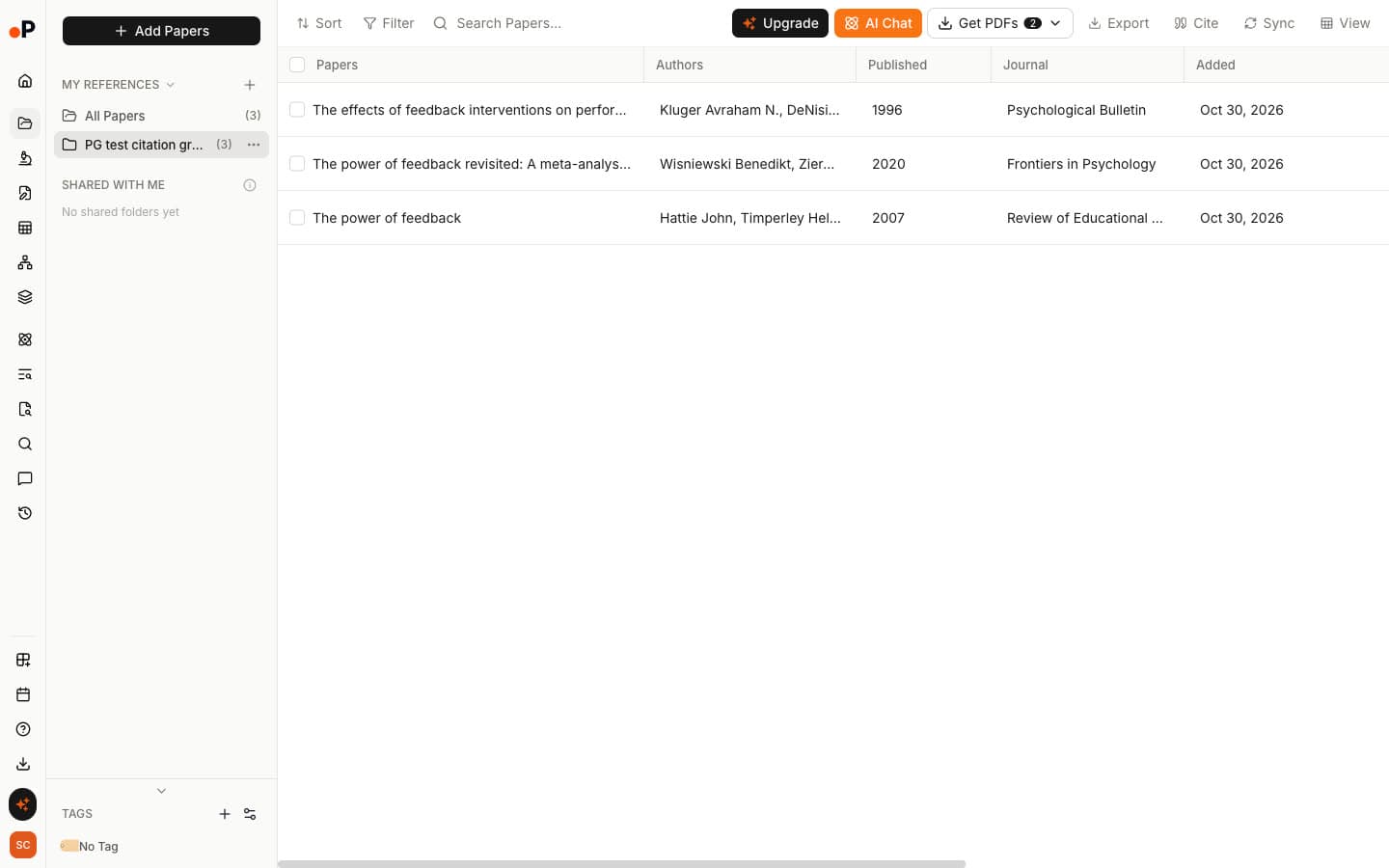
This is where the tools differ most. ResearchRabbit's library has collections, a Reading List with statuses, per-paper Notes, Zotero and BibTeX import, and free BibTeX, RIS or CSV export. Paperguide's Reference Manager keeps papers linked to the graph they came from and lets you chat with, cite, export and sync the library.
ResearchRabbit's article panel offers "Collection +" and a "Reading List" with "To Read", "Up Next", "Skimmed", "Read Fully" and "Understood". In addition, "Auto-save to..." files selected papers into a collection as you search. Each paper has a "Notes" tab, and "Cite" formats a reference in APA. However, Zotero is a one-way import; ResearchRabbit says two-way sync is in progress.
In Paperguide, every graph card has "Add to Reference Manager", which opens a folder picker. However, the dialog cannot create a folder, so make one first.
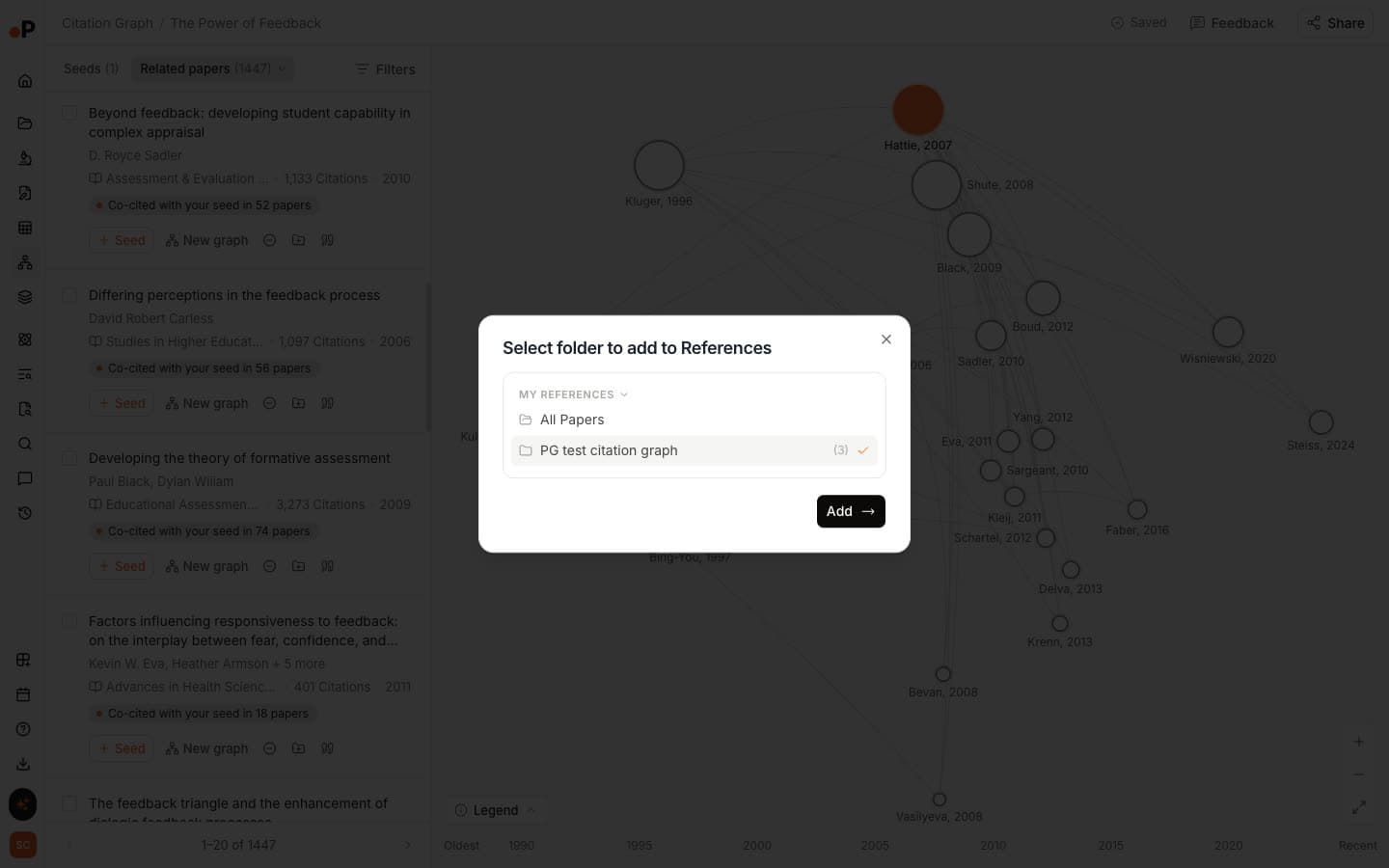
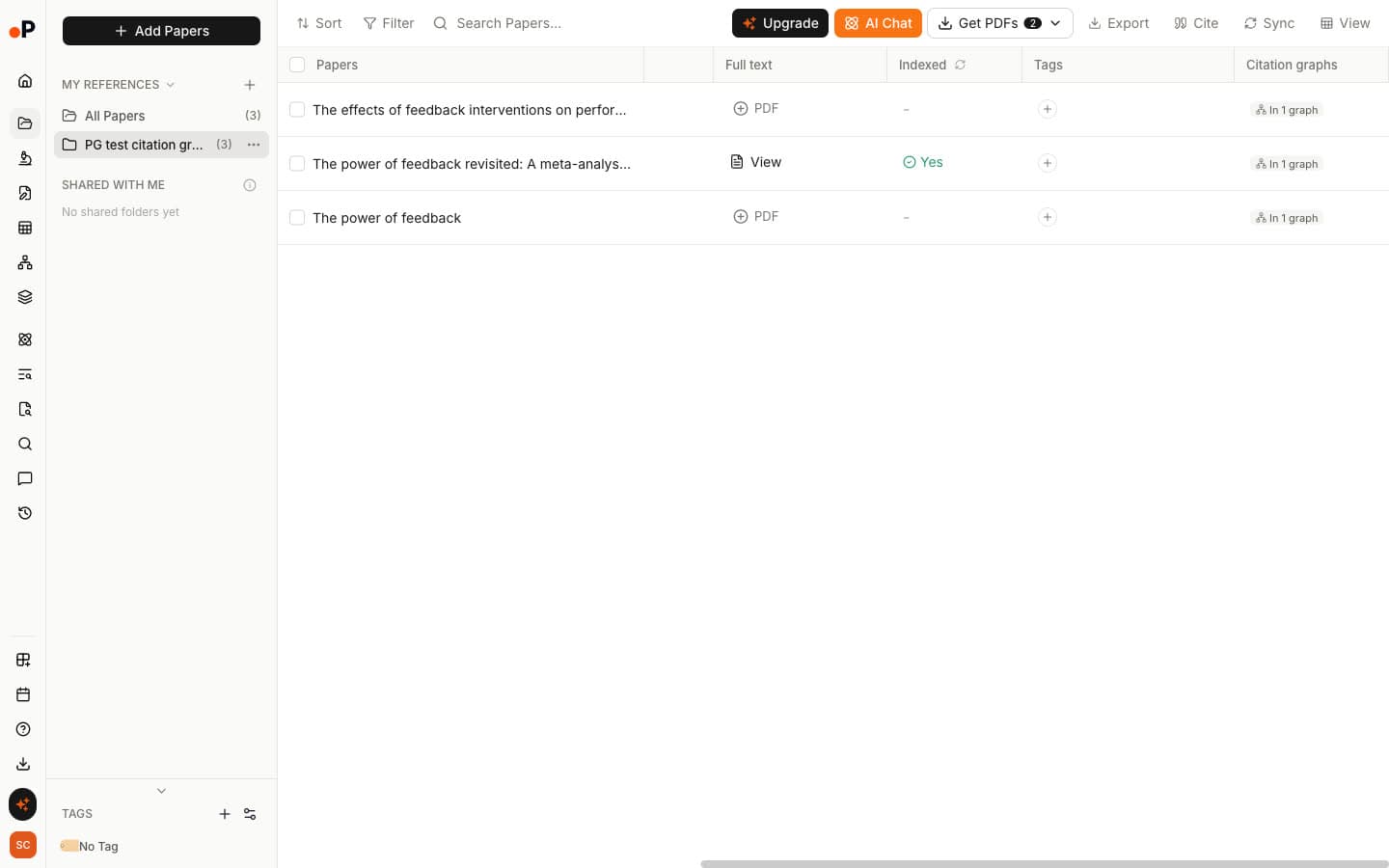
Saved papers show "In 1 graph" in a Citation graphs column. The toolbar has "AI Chat" for questions answered from your saved papers, "Cite" with over 1,000 citation styles, "Export" and "Sync". An open-access PDF was fetched automatically for one of our three papers; however, the other two returned "Failed to download PDF from URL".
On export, ResearchRabbit is ahead for free users: BibTeX, RIS and CSV from any article or the whole library. Paperguide has no graph export, but on paid plans its Reference Manager exports saved papers as BibTeX, RIS, CSV, Excel, Word or PDF. To weigh both libraries against dedicated tools, see the best reference management software for researchers.
Verdict: ResearchRabbit for a free reading list and file exports. Paperguide when saved papers need to be read, questioned and cited without moving them anywhere.
How Do Sharing and Alerts Compare?
Both tools share work. Paperguide shares a graph by link with "Can edit", "Can view" or "No access". ResearchRabbit shares collections on its free plan with viewer or editor rights and a public link, according to its release notes. Neither offered alerts for new papers in our test.
ResearchRabbit+ adds Signals, which flag high-risk articles rather than announce new ones. Importantly, in Paperguide "Can edit" was selected by default on a new graph, so switch to "Can view" before sending a read-only link.
Verdict: A draw. ResearchRabbit shares collections; Paperguide shares the working graph itself.
How Do Free Plan Limits Compare?
Both are generous. Paperguide's Citation Graph is free, needs no signup to build or browse, and used no AI credits in our test. ResearchRabbit is "Free forever" with an account: unlimited searches, up to 50 seeds and one project, but its advanced search settings are locked behind RR+.
Specifically, the locked settings include keyword filters, publication date, SJR quartiles, journal h-index, open access and retractions.
Verdict: Paperguide for trying a map without an account. ResearchRabbit for the most seeds at no cost.
What Paperguide Adds Beyond the Map
A map is where reading starts. In our test ResearchRabbit showed abstracts, notes and collections, but no PDF reader, AI chat or summaries; it says it does not use large language models for its core recommendations. In contrast, Paperguide connects the papers you pick to tools for reading, extracting, reviewing and writing.
AI Search
AI Search answers a research question with a cited summary of the most relevant papers. Every reference has a "Graph" button. As a result, any paper it finds can seed a new map.
Chat with PDF
Chat with PDF answers questions about a saved paper with citations to the page. For example, asked for the four levels of feedback in a 2020 meta-analysis, it listed task, process, self-regulation and self, each linked to the source sentence.
Extract Data
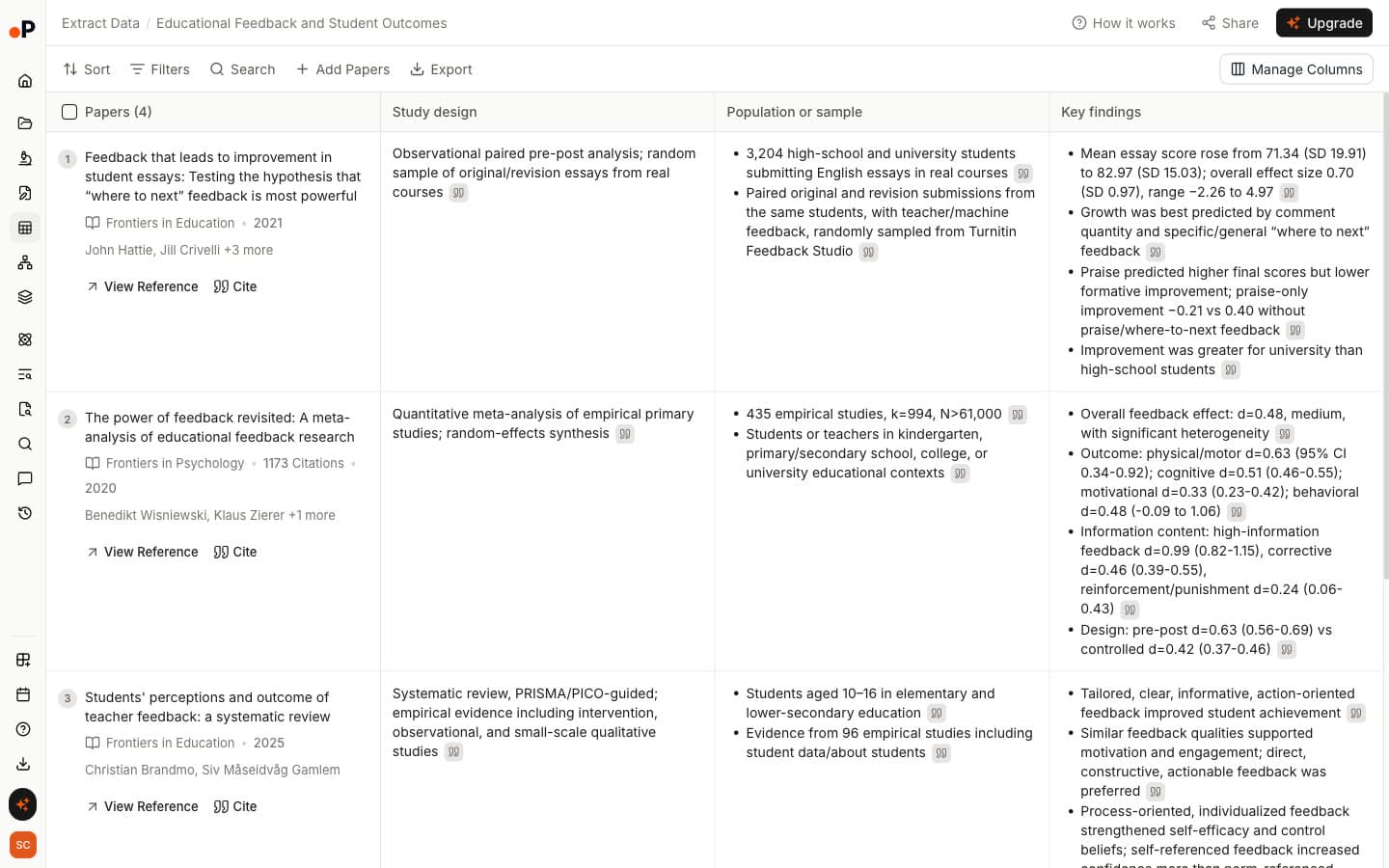
Extract Data builds a table across papers with columns such as study design, population and key findings. Every value carries a quote icon that opens the supporting sentence. However, only papers with a PDF can be added.
Literature Review AI
Literature Review AI reranks papers, screens them against criteria it shows you, builds an extraction table and writes a cited report. Our standard run took about 4.6 minutes. Compare it with other AI tools for literature review.
AI Paper Writer
AI Paper Writer starts a document from a prompt and cites from public papers and your Reference Manager. We generated an outline only, a title with 7 sections and 17 subsections, which you review before it enters the editor.
Systematic Review
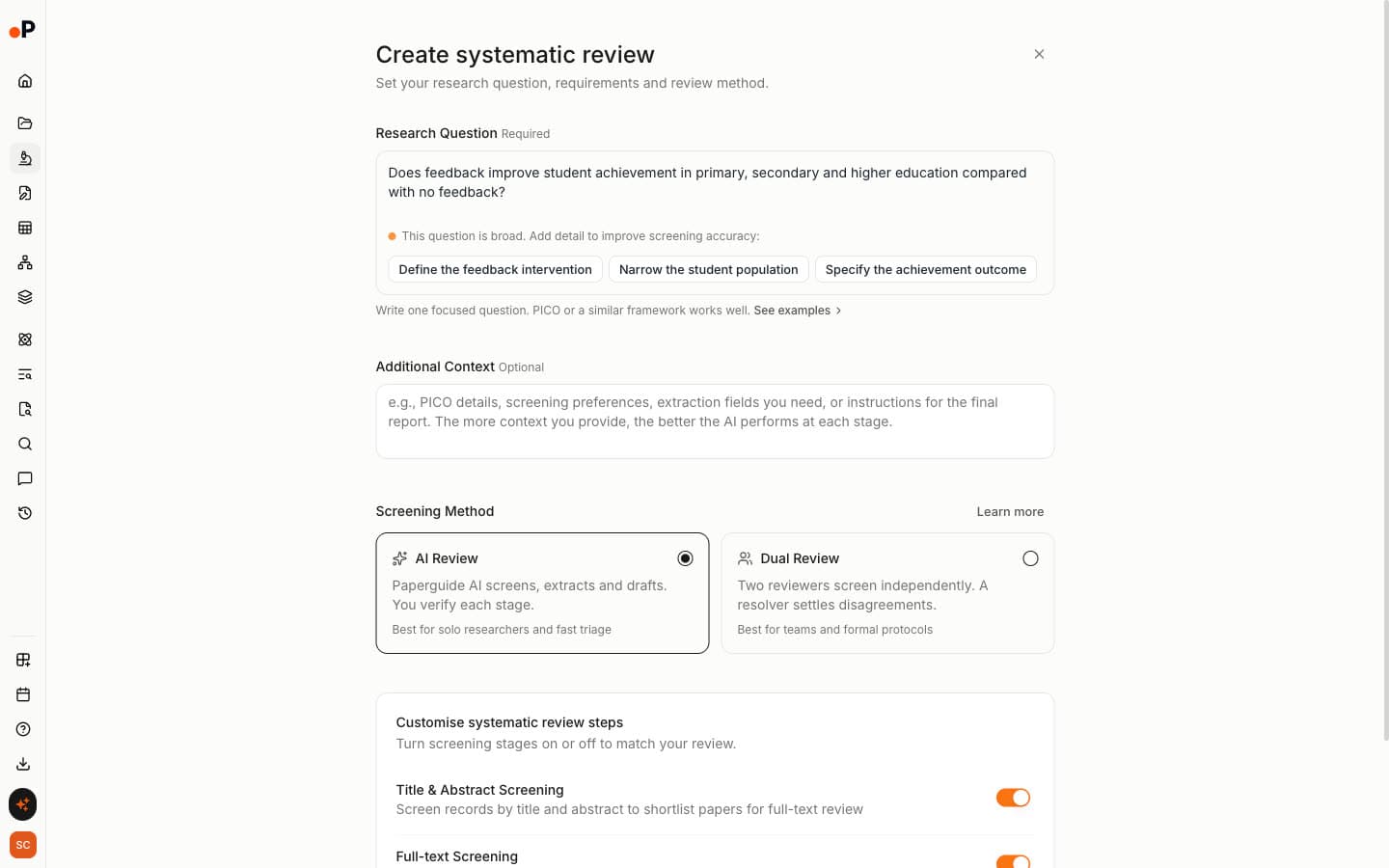
Systematic Review runs title and abstract and full-text screening with "AI Review" or "Dual Review", where two reviewers screen independently and a resolver settles conflicts. For a broad question it suggested "Narrow the student population". See more AI tools for systematic reviews.
Research Agent
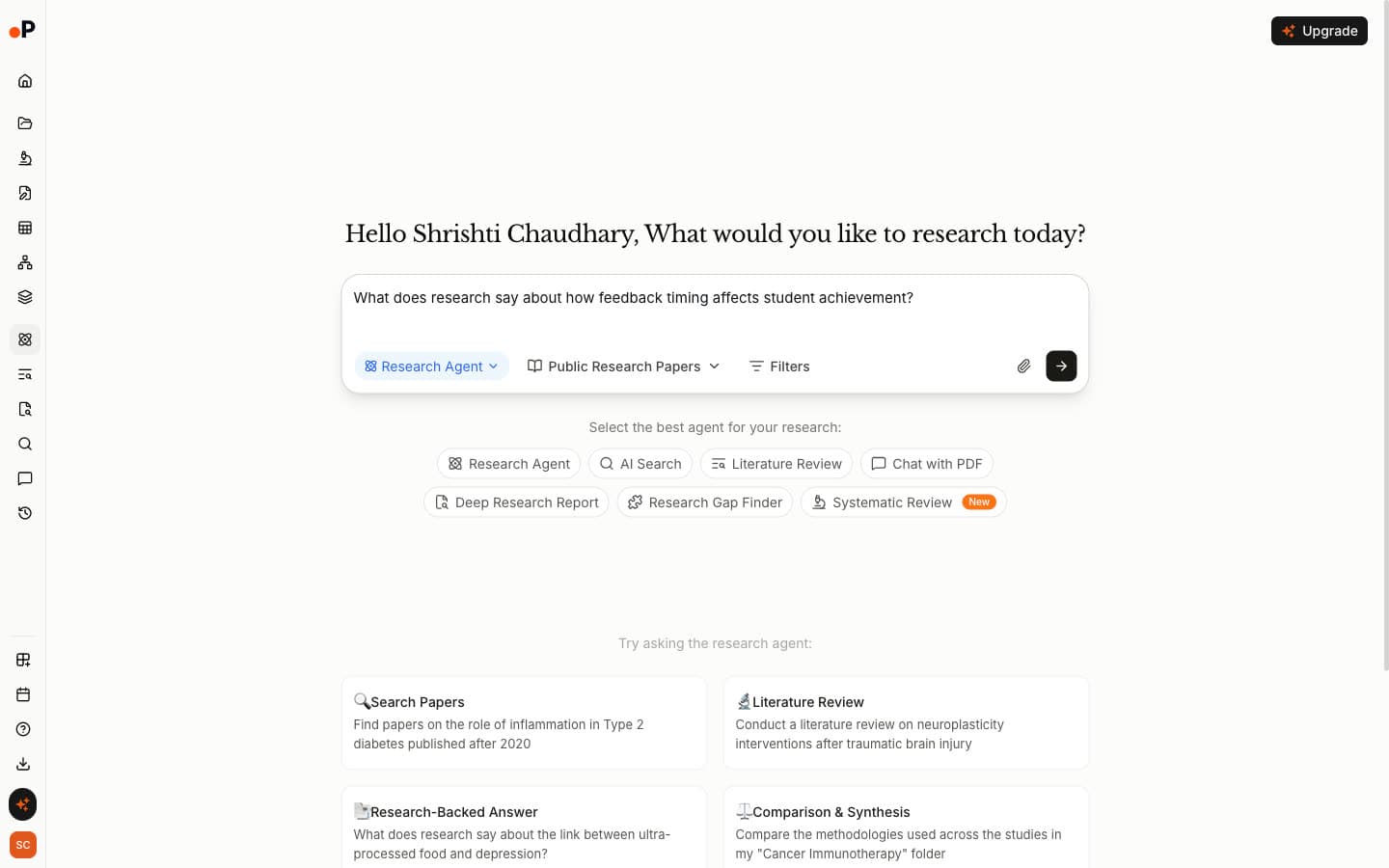
Research Agent takes an open question and offers the right workflow, including AI Search, Literature Review, Deep Research Report and Research Gap Finder. It fits the step after mapping, when you are working out how to find research gaps systematically.
Paperguide vs ResearchRabbit: Pricing Comparison
Both mapping tools are free. ResearchRabbit+ costs $10 a month billed yearly ($120) or $12.50 monthly in the US, for 300 seeds, advanced search settings, multiple projects and Signals. Paperguide's Citation Graph stays free on every plan; paid Paperguide plans pay for the platform's other tools.
Plans and US prices
| Plan | Paperguide | ResearchRabbit |
|---|---|---|
| Free | Citation Graph free, no signup to build; 1,500 AI credits a month for other tools | Free forever: unlimited searches, 50 seeds, one project |
| Paid entry | Plus, $12 per seat a month billed yearly | RR+, $10 a month billed yearly ($120) or $12.50 monthly |
| Higher tier | Pro and team plans | Institution plan with LibKey integration |
| What paying adds | More credits for AI Search, Extract Data, writing and reviews; Reference Manager export | 300 seeds, advanced settings, multiple projects, Signals |
That said, ResearchRabbit shows country discounts, so prices outside the US may be lower. Check the Paperguide pricing page before you buy, because prices change.
Where ResearchRabbit Genuinely Wins
ResearchRabbit is a capable free tool. It is fast, takes up to 50 seeds, fits 40 papers on a map, exports BibTeX, RIS and CSV at no cost, and lists every citing paper newest first. In addition, its reading list and notes suit iterative searching, and it states it uses no large language models for core recommendations.
- Speed: about 2 seconds per search.
- Seeds: 50 free, 300 on RR+.
- Exports: three formats on the free plan, plus Zotero import.
- Forward citations: the complete Cited By list, newest first.
- Reading workflow: statuses from "To Read" to "Understood", and notes.
Where Paperguide Genuinely Wins
Paperguide recommended more relevant papers with no off-topic results, matched the insomnia and feedback DOIs correctly, explains every link and labels multi-seed maps. It needs no account to start, and saved papers move into a Reference Manager connected to reading, extraction, review and writing.
- Relevance: 1.75 against 1.25 of 2, 0% against 22% off-topic.
- Data quality: no same-title mix-ups or seed duplicates among its recommended papers, though its own record for the transformer paper was a 2025 duplicate.
- Explanations: "Why it's here" on every card.
- Multi-seed labels: "Co-cited with 2 of your seeds".
- Workflow: from graph to "In 1 graph" in the library, then to chat, tables and drafts.
Final Verdict: Should You Choose Paperguide or ResearchRabbit?
For quick, free, many-seed exploration with file exports, ResearchRabbit is a good choice. However, for review work where every paper must be relevant and justified, Paperguide is the stronger ResearchRabbit alternative: cleaner lists, explained links, correct DOI matches, and a library that leads straight into reading, extraction and writing.
Choose ResearchRabbit if:
- You want to search in quick loops from many seeds.
- You need free BibTeX, RIS or CSV export.
- You track reading with statuses and notes.
Choose Paperguide if:
- You need fewer off-topic papers to screen.
- You must explain why each paper is relevant.
- You want saved papers to feed chat, extraction tables and drafts.
Frequently Asked Questions
Is ResearchRabbit free or paid?
Both. The free plan is "Free forever" and includes unlimited searches, up to 50 seed articles, collections and one project. ResearchRabbit+ costs $10 a month billed yearly, or $12.50 monthly, in the US, and adds 300 seeds, advanced search settings, multiple projects and Signals alerts for high-risk articles. Country discounts are offered.
What is the best ResearchRabbit alternative?
For relevance, Paperguide's Citation Graph was a strong alternative in our blind test, scoring 1.75 out of 2 against ResearchRabbit's 1.25, with no off-topic papers. It is free, needs no signup to build a map, and explains why every paper is linked. Connected Papers scored similarly to Paperguide but caps free graphs each month.
What changed in ResearchRabbit 2.0?
ResearchRabbit relaunched as "the new ResearchRabbit" on 20 October 2025 through a partnership with Litmaps, and the app now calls itself ResearchRabbit 2.0. Later updates brought back free shared collections, added Boolean keyword search, a reading list, maps of 10, 20 or 40 results, and Signals alerts on the paid plan.
Is Paperguide's Citation Graph free?
Yes. Building and browsing graphs is free and needs no account, and it used no AI credits in our test. Signing in saves graphs to your account, adds link sharing with edit or view rights, and lets you add papers to Reference Manager. Paid plans cover Paperguide's other tools, not the graph.
Does ResearchRabbit use AI?
Not for its core recommendations. ResearchRabbit states that it does not use large language models to power its core recommendation algorithms. It finds papers through citations, shared references, shared authors and the similarity of titles and abstracts. In our test we saw no AI chat or summaries in the app.
Does ResearchRabbit sync with Zotero?
Only one way. ResearchRabbit imports papers from a linked Zotero account and from BibTeX files, and exports BibTeX, RIS or CSV that Zotero can read. It says two-way sync is being worked on. Paperguide's Reference Manager imports from Zotero, BibTeX and RIS, so a ResearchRabbit export can move across.
Why does ResearchRabbit show the wrong paper?
Some of its records are merged or duplicated. In our test, the insomnia meta-analysis DOI opened a 2016 letter with the same title, and a 2002 magazine article titled "The power of feedback." topped the Similar list for Hattie and Timperley. Check the year and citation count before using a record.
Is Paperguide better than ResearchRabbit?
For relevance and review work, yes in our test: higher scores on all three seeds, no off-topic papers, an explanation on every card and a connected library. ResearchRabbit is better for speed, many seeds, larger maps, free file exports and a complete newest-first list of citing papers.
References
- Trauer, J. M., Qian, M. Y., Doyle, J. S., Rajaratnam, S. M. W., & Cunnington, D. (2015). Cognitive behavioral therapy for chronic insomnia: A systematic review and meta-analysis. Annals of Internal Medicine, 163(3), 191-204. https://doi.org/10.7326/M14-2841
- Hattie, J., & Timperley, H. (2007). The power of feedback. Review of Educational Research, 77(1), 81-112. https://doi.org/10.3102/003465430298487
- Vaswani, A., Shazeer, N., Parmar, N., Uszkoreit, J., Jones, L., Gomez, A. N., Kaiser, Ł., & Polosukhin, I. (2017). Attention is all you need. Advances in Neural Information Processing Systems, 30. https://doi.org/10.48550/arXiv.1706.03762
- Small, H. (1973). Co-citation in the scientific literature: A new measure of the relationship between two documents. Journal of the American Society for Information Science, 24(4), 265-269. https://doi.org/10.1002/asi.4630240406
- Kessler, M. M. (1963). Bibliographic coupling between scientific papers. American Documentation, 14(1), 10-25. https://doi.org/10.1002/asi.5090140103
Mapping citations?
See how any paper connects
Start from up to five papers and explore earlier, later and related work in one free citation graph. No signup.
Try Citation GraphNo credit card required