Connected Papers vs ResearchRabbit: Which Is Better in 2026?


Connected Papers wins on relevance: in our blind test, its top 20 papers scored 1.77 out of 2, against 1.25 for ResearchRabbit. ResearchRabbit wins on freedom: it is free with no monthly cap, takes up to 50 seed papers, and exports BibTeX, RIS or CSV with a Zotero import.
The two tools work differently. Connected Papers is a visual tool that builds a one-shot similarity graph of 41 papers around one origin paper. ResearchRabbit (often searched as Research Rabbit) is a free discovery app that runs an iterative search, where any result can become the next seed. To test Connected Papers vs ResearchRabbit fairly, we ran both free plans on the same three seed papers and scored the top 20 results blind.
TL;DR
Pick Connected Papers when you need the strongest list of related papers around one known study and BibTeX is enough. Pick ResearchRabbit when you will search repeatedly, want to keep papers in collections as you go, and need RIS, CSV or Zotero import on a free plan with no graph limit.
Connected Papers or ResearchRabbit: which fits the need
| If you need... | Better choice |
|---|---|
| The most relevant papers around one seed | Connected Papers |
| Unlimited searches on a free plan | ResearchRabbit |
| Many seeds in one search (up to 50 free) | ResearchRabbit |
| A short, ranked list of foundational and follow-up papers | Connected Papers |
| The complete reference list and every citing paper | ResearchRabbit |
| RIS or CSV export, Zotero import | ResearchRabbit |
| A map you can read at a glance | Connected Papers |
Connected Papers gave cleaner lists on all three seeds: 1.90, 1.85 and 1.55 out of 2, against 1.65, 1.30 and 0.80 for ResearchRabbit. Only 2% of its top 20 papers were off-topic, compared with 22% for ResearchRabbit. That said, ResearchRabbit is the more complete workspace and costs nothing, but its recommendations needed more screening, especially outside medicine.
Connected Papers vs ResearchRabbit: Quick Comparison
Connected Papers is a focused graph tool with a monthly cap on its free plan. ResearchRabbit is a free, open-ended discovery workspace built around collections. The table lists the differences we confirmed in both apps, with US prices taken from each vendor's pricing page.
Feature comparison, as tested
| Feature | Connected Papers | ResearchRabbit 2.0 |
|---|---|---|
| How papers are picked | Similarity from co-citation and shared references | Similar, References or Citations searches |
| Papers per map | 41 (40 plus the origin) | 10, 20 or 40 per page, more pages available |
| Seeds | One origin, more with "Add origin" | Up to 50 free, 300 on RR+ |
| Map layout | Force-directed similarity graph | "More recently published" against "More citations" |
| Why a paper is shown | A similarity number | No explanation |
| Backward and forward | Prior works and Derivative works, 10 each | Full References and Cited By lists |
| Saving | One "Saved papers" list, graph history | Collections, reading list, notes |
| Export | BibTeX | BibTeX, RIS, CSV |
| Zotero | None found | One-way import |
| Data source | Semantic Scholar | Crossref, Semantic Scholar, OpenAlex |
| Free plan | 5 graphs a month (2 without login) | Free, up to 50 seed articles |
| Paid plan (US) | Academic, $6 a month billed yearly | RR+, $10 a month billed yearly |
Who Is Connected Papers Best For?
Connected Papers suits a researcher who has one strong paper and wants the closest work around it fast. It fits the start of a thesis chapter, a grant background section, or a quick check that a backward and forward citation search missed nothing obvious.
- Students starting a topic from one paper their supervisor handed them.
- Researchers checking a field quickly, for whom five graphs a month is plenty.
- LaTeX users, since one click downloads the whole graph as BibTeX.
Who Is ResearchRabbit Best For?
ResearchRabbit suits researchers who search in rounds: start from one paper, save the good results, then search again from everything saved. It fits a long literature review, a reading group that shares collections, and anyone who cannot pay for a subscription but needs many searches.
- PhD students building a reading list over months, with reading statuses and notes.
- Evidence synthesis and HEOR teams that need the complete reference and citing lists of key studies.
- Zotero users who want to bring an existing library in as seeds.
How We Tested Connected Papers and ResearchRabbit
We tested both tools, signed in to free accounts, with three seed papers from medicine, education and computer science: a CBT for insomnia meta-analysis [1], Hattie and Timperley's "The Power of Feedback" [2], and "Attention Is All You Need" [3].
For each seed we tried the DOI, then the title, and recorded which record opened. We saved the top 20 recommendations (Connected Papers: graph list by similarity; ResearchRabbit: Similar articles), the backward and forward lists, and the effect of adding a second seed.
For our blind relevance test, the top 20 papers from five citation mapping tools were pooled and shuffled per seed, 207 unique papers in all. One judge, blind to the source, scored each: 2 for on the seed's core topic, 1 for related but peripheral, 0 for off-topic, not a research paper, or a duplicate of the seed. Caveats: three seeds, one judge, scored by title (abstracts checked for 9 unclear papers), and results vary by field.
How Does Finding Your Seed Paper Compare?
Both tools found the education seed instantly by DOI, and both failed the arXiv DOI for "Attention Is All You Need", which each then found by title. The difference was the insomnia paper: Connected Papers opened the right record from its DOI, while ResearchRabbit landed on a 2016 letter about the paper.
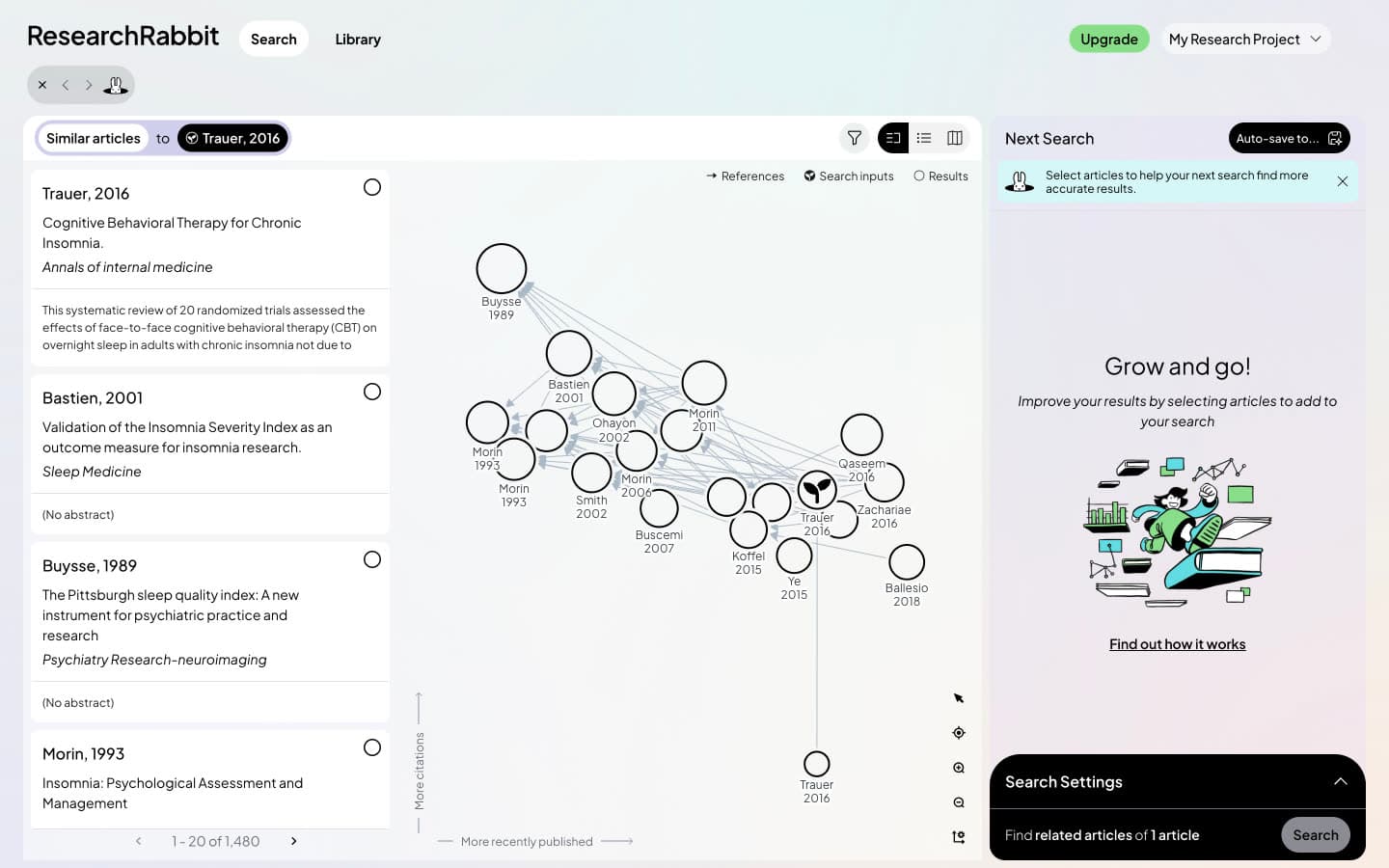
Seed matching results by DOI and title
| Seed and search | Connected Papers | ResearchRabbit |
|---|---|---|
| Insomnia meta-analysis (2015), DOI | Correct, title shortened to "Cognitive Behavioral Therapy for Chronic Insomnia" | Wrong record: a 2016 letter, 13 references, cited by 4 |
| Insomnia meta-analysis, title | Yearbook commentary first; correct paper not in top 10 | Correct paper not in top 10 |
| The Power of Feedback (2007), DOI | Correct | Correct |
| Attention Is All You Need, arXiv DOI | Failed; unrelated search results | Failed: "We couldn't find that DOI" |
| Attention Is All You Need, title | Correct, first result | Correct, first result |
ResearchRabbit's insomnia problem went deeper than search. In particular, the best record we could reach had the meta-analysis's 105 references and 635 citing papers but showed the year 2016 and the letter's DOI. No record carried the 2015 DOI. The letter then ranked first in the Similar list, a duplicate of the seed in the top slot.
Verdict: Connected Papers. In both tools, search by DOI and check the year, journal and reference count of the record before building anything.
How Does the Map Itself Compare?
The maps encode different things. Connected Papers places papers by similarity, so related work clusters together and the picture carries meaning. ResearchRabbit plots papers by publication date and citation count, which shows age and attention but not which papers belong together.
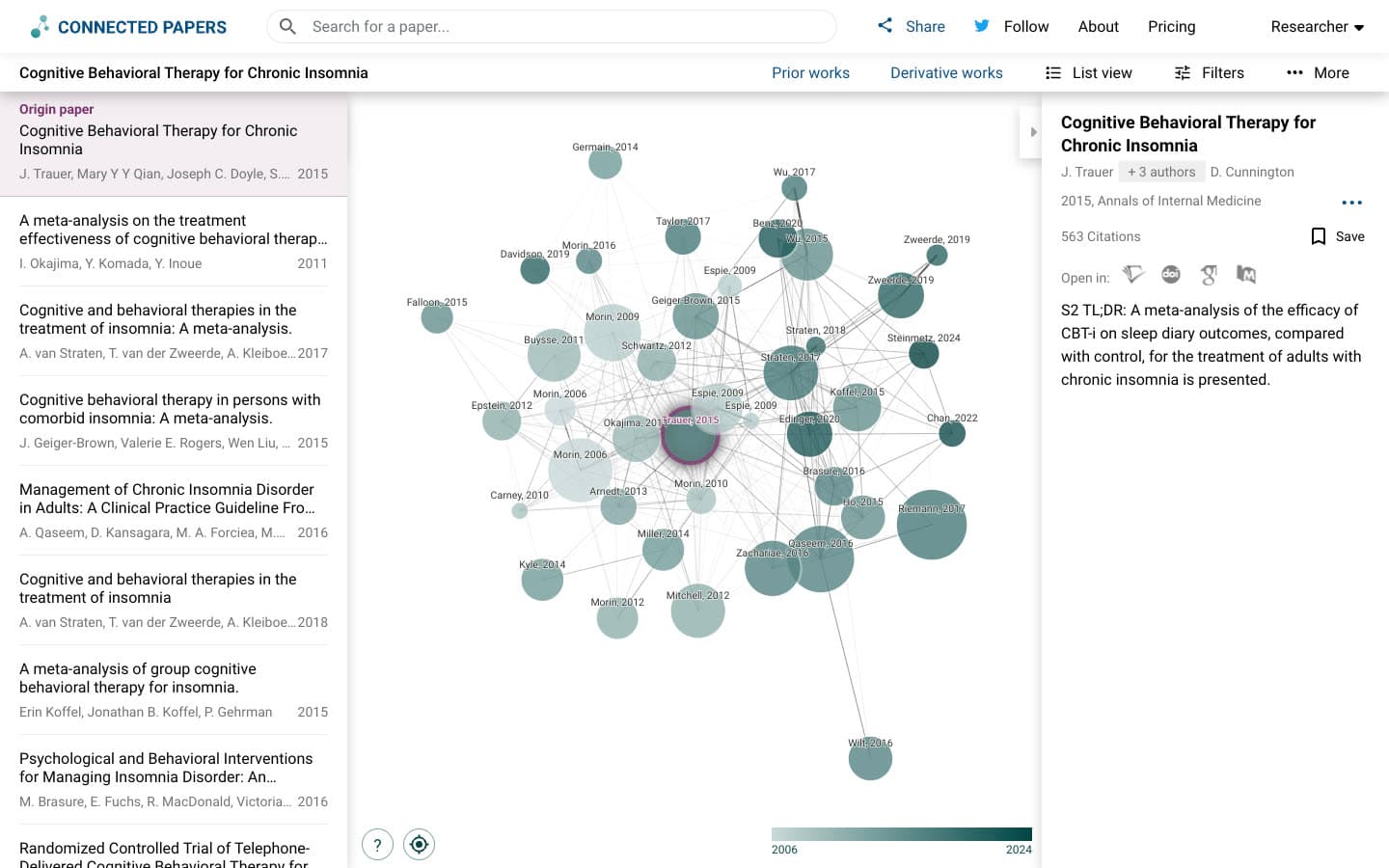
Connected Papers' legend says it plainly: "Papers are arranged according to their similarity (this is not a citation tree)", with node size for citations and colour for publication year. Every single-origin graph held 41 papers. On the transformer graph, very highly cited papers became huge overlapping circles that hid most labels.
In contrast, ResearchRabbit draws every paper as the same small circle, with arrows for references. You choose 10, 20 or 40 results per page and can switch between list, map or both. On the free plan we paged on to results 121 to 140.
Verdict: Connected Papers for reading a field at a glance. ResearchRabbit for scanning a longer list by date and citations.
How Does the Relevance of Recommendations Compare?
Connected Papers recommended more relevant papers on every seed. Across 60 papers per tool in our blind relevance test, 78% of its suggestions scored 2 and 2% scored 0. For ResearchRabbit, 47% scored 2 and 22% scored 0. The gap was widest on the education and computer science seeds.
Blind relevance scores, Connected Papers vs ResearchRabbit
| Measure (0 to 2) | Connected Papers | ResearchRabbit |
|---|---|---|
| Insomnia meta-analysis | 1.90 | 1.65 |
| The Power of Feedback | 1.85 | 1.30 |
| Attention Is All You Need | 1.55 | 0.80 |
| Average | 1.77 | 1.25 |
| Papers scored 2 | 78% | 47% |
| Papers scored 0 | 2% | 22% |
| Top 10 average | 1.90 | 1.37 |
The Power of Feedback: one seed, two very different lists
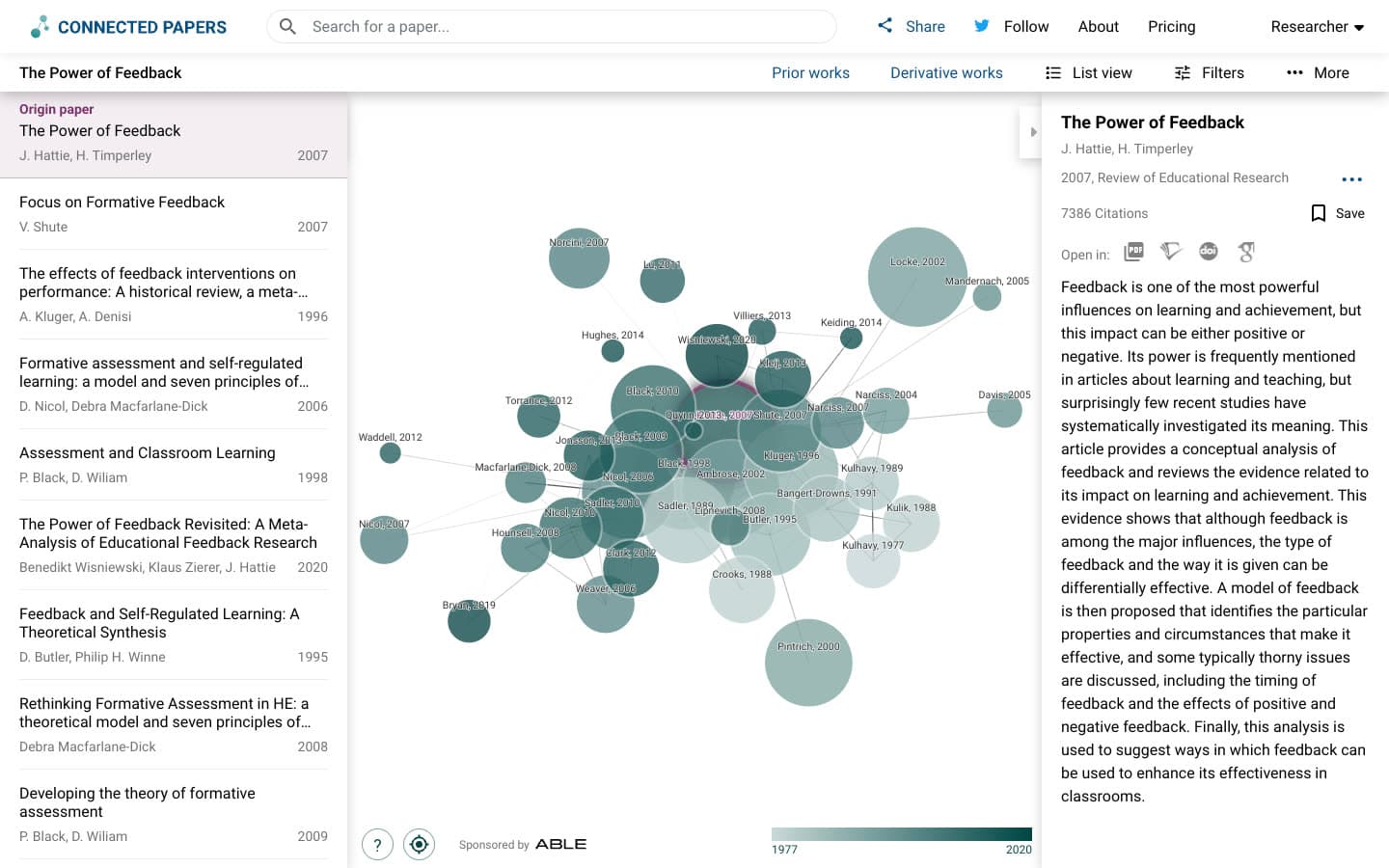
Connected Papers' feedback graph reads like the reference list of a good review. Its five most similar papers were Shute's "Focus on Formative Feedback", Kluger and DeNisi's 1996 feedback intervention meta-analysis, Nicol and Macfarlane-Dick's seven principles of good feedback practice, Black and Wiliam's "Assessment and Classroom Learning", and "The Power of Feedback Revisited", the 2020 meta-analysis that updates the seed. Seventeen of its top 20 scored 2 and none scored 0.
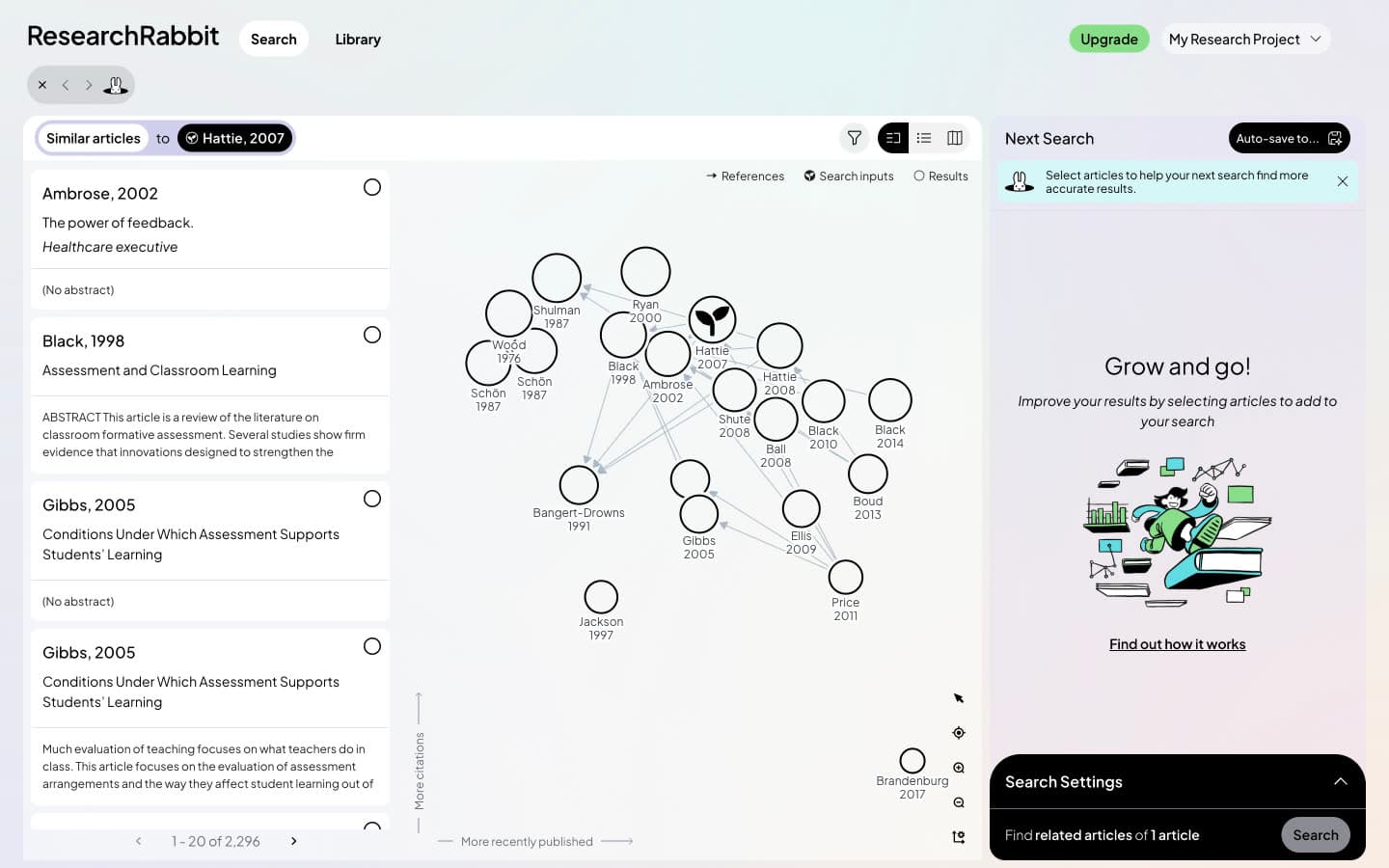
ResearchRabbit opened its list with "The power of feedback.", a 2002 Healthcare Executive article with no abstract that shares the seed's title but not its subject. ResearchRabbit credits it with 7,431 citing papers, and Connected Papers' own search shows the same record with 7,254 citations and 0 references, which suggests citations meant for the 2007 review have attached to it in shared metadata. Our judge scored it 1.
The rest of ResearchRabbit's list drifted: three duplicate pairs (Gibbs 2005, Schön's "Educating the Reflective Practitioner" and Black's "Inside the Black Box"), plus papers on task-based language teaching and teacher content knowledge. Ten scored 2, six scored 1 and four scored 0. However, Connected Papers was not flawless either: its Derivative works for this seed included "Ticagrelor in Acute Coronary Syndromes", a cardiology paper.
The gap grew on the transformer seed, where ResearchRabbit fell to 0.80. Its first result duplicated the seed, and its top 20 held two copies of Microsoft COCO and a Japanese blog-style summary of BERT. Connected Papers listed BERT, the Vision Transformer, GPT-3 and T5, with one off-topic paper.
Verdict: Connected Papers, clearly. Treat ResearchRabbit's Similar list as a longer candidate pool that needs screening.
How Do Recent Papers Compare?
Neither tool puts recent work in its main list: none of the top 20 papers from either tool, on any seed, was published in 2024 or later. Each tool shows recent papers somewhere else, Connected Papers in a short ranked list and ResearchRabbit in a complete but unfiltered one.
Connected Papers' Derivative works carried the recent material. For example, for the insomnia seed it listed a 2026 bibliometric study of CBT for insomnia, the 2025 German insomnia guideline update and the 2023 European Insomnia Guideline.
ResearchRabbit's Cited By list sorts newest first, so 2026 papers appear at once, unfiltered. For the feedback seed the first ten were 2026 papers with no citations, several not in English; for insomnia they included a homeopathy meta-analysis and a curriculum for aquanauts. The date filter sits in Advanced Settings, which the free plan only previews. If recent papers are your priority, Litmaps surfaced far more of them on the same seeds, which is where Litmaps beats ResearchRabbit.
Verdict: Connected Papers, narrowly, because Derivative works is short and ranked.
How Do Earlier and Later Work Compare?
Connected Papers gives a short, ranked digest of the field's ancestors and descendants. ResearchRabbit gives the complete reference and citing lists of your seed. The digest is faster to read; the complete lists are what a systematic citation search needs, because nothing is cut off at ten papers.
Connected Papers' Prior works shows the 10 papers most cited across the graph, which "usually means that they are important seminal works for this field"; Derivative works shows 10 papers that cite many graph papers. For the feedback seed, Prior works opened with R. Butler's 1987 study of task-involving and ego-involving evaluation.
ResearchRabbit listed 166 references and 11,291 citing papers for the feedback seed. The references held duplicates, and Cited By was slow: 23 seconds for feedback, while the transformer seed's Cited By failed twice (once with "Couldn't generate search") before loading on the third try.
Complete lists matter for reviews. In Greenhalgh and Peacock's 2005 systematic review of complex evidence, 51% of sources were found by snowballing, such as tracking the references of references, while only 30% came from the planned database and hand searches [6].
Verdict: Connected Papers for orientation. ResearchRabbit for completeness when you trace what a citation map shows in both directions.
How Do Explanations Compare?
Neither tool tells you in words why a paper is on your map. Connected Papers shows a numeric "Similarity to origin" score in List view and thicker lines between similar papers. ResearchRabbit shows only the author, year, title, venue and abstract on each card, with no relationship label.
Specifically, Connected Papers bases similarity on co-citation [4] and bibliographic coupling [5], but the score does not say which one linked a paper. ResearchRabbit, in contrast, calculates a score per result but does not display it.
Verdict: Connected Papers, narrowly. If you want a stated reason for every paper, Paperguide's free Citation Graph labels each link.
How Does Adding More Seeds Compare?
ResearchRabbit is built around adding seeds; Connected Papers allows it as a side feature. In both tools, adding a second insomnia meta-analysis brought 7 new papers into the top 20, and neither marked which papers connected to both seeds, so you cannot see the overlap directly.
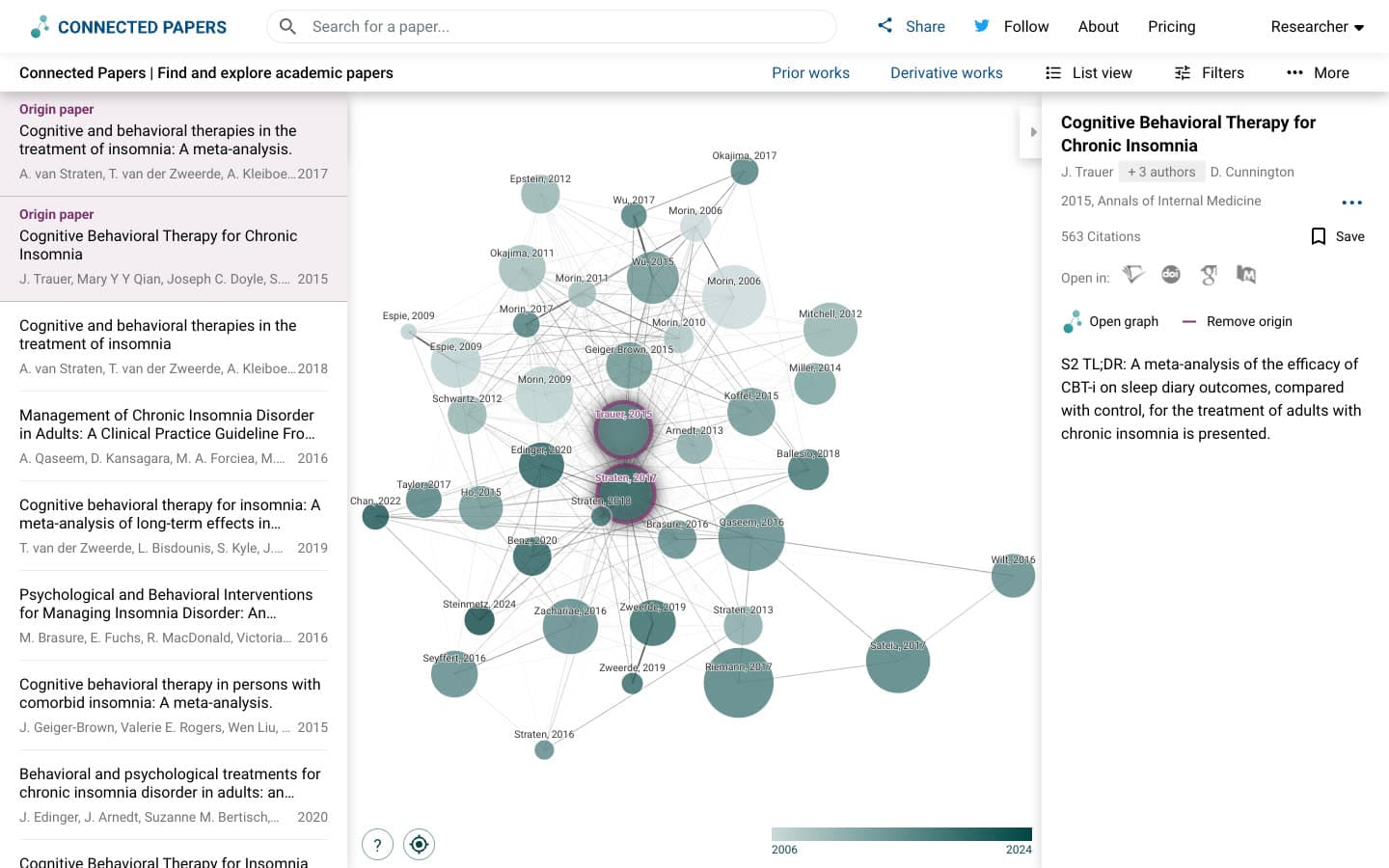
In Connected Papers, "Add origin" opened the two-seed graph in a new tab, swapped the similarity column for a "Rating", and appeared to count toward the five free graphs. In ResearchRabbit, however, you tick papers and run "Next Search", which took about 4 seconds; two of its 7 new papers were copies of the DSM manual. You can keep going to 50 seeds free.
Verdict: ResearchRabbit. Seeds are free up to 50, and searching again is one click.
How Do Saving, Export and Sharing Compare?
ResearchRabbit is the stronger workspace. It saves papers into collections and a reading list, keeps notes, cites in APA and exports BibTeX, RIS or CSV. Connected Papers saves to one list and exports BibTeX only, with no reference manager connection. We found no new-paper alerts in either tool.
Connected Papers' "Download" button produced a .bib file of all 41 graph papers with DOIs and abstracts, which is handy for LaTeX. We saw no RIS, CSV or image export and no Zotero option. "Share graph" offers a link, email and social buttons.
ResearchRabbit's "Export Articles" offered "BibTeX (.bib)", "CSV" and "RIS", and its Library imports from BibTeX or a linked Zotero account. Zotero is import only; two-way sync is something the team is "actively working on". Its release notes say shared collections returned to the free plan in February 2026; we did not test sharing. Signals alerts on RR+ flag high-risk articles, not new ones. Either export opens into the best reference management software for researchers.
Verdict: ResearchRabbit.
How Do Free Plan Limits Compare?
ResearchRabbit's free plan is far more generous: unlimited searches, up to 50 seed articles and one project, with the advanced filters and extra projects held back. Connected Papers' free plan includes every feature but caps you at 5 graphs a month when signed in and 2 as a guest, and the cap arrives quickly. If five graphs a month is too few, compare free Connected Papers alternatives before paying.
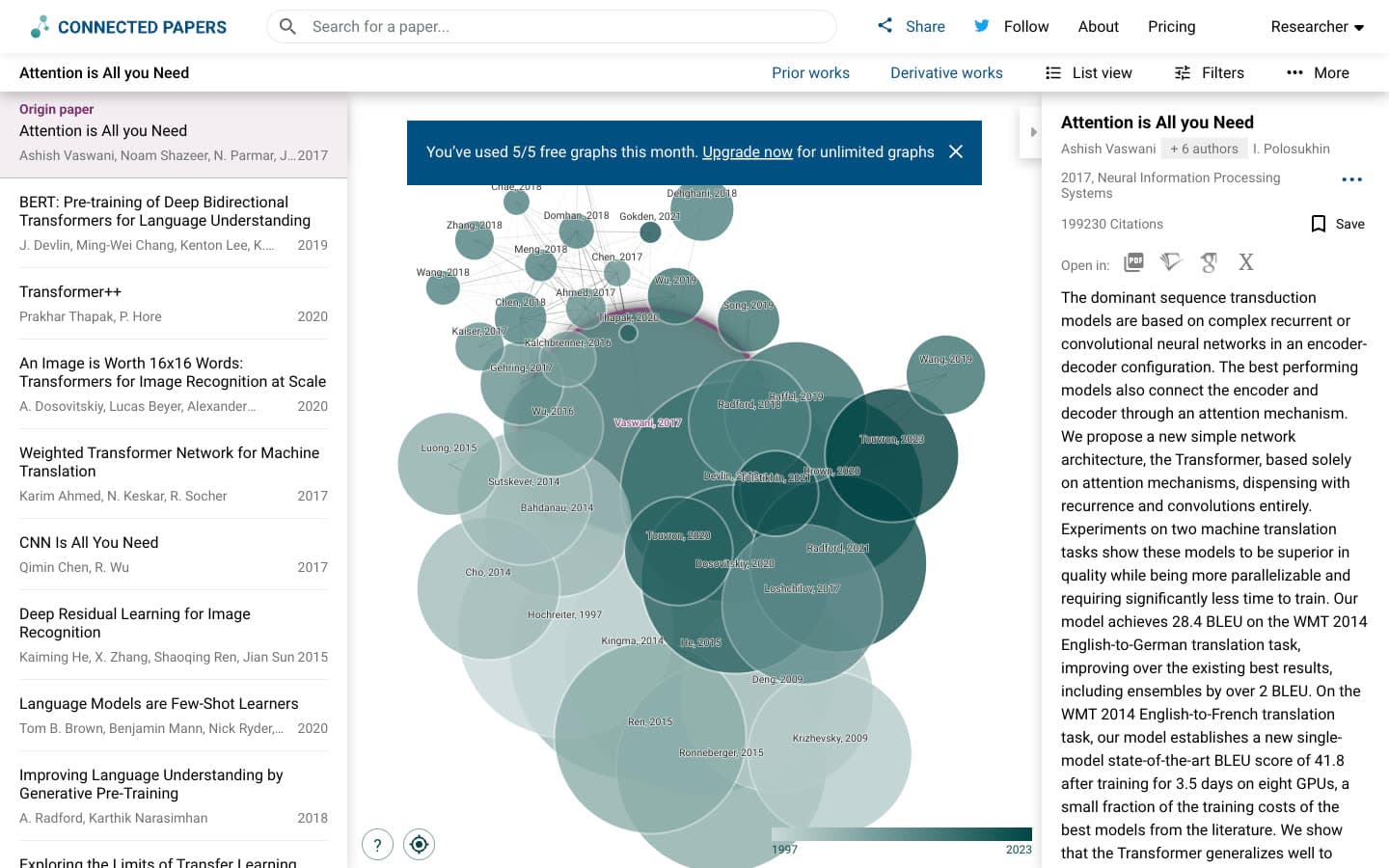
We hit Connected Papers' cap during this test; a rebuilt graph and a two-seed graph both appeared to count. ResearchRabbit's free plan, for its part, locks Advanced Settings (keyword, date, journal quartile, h-index, open access and retraction filters) and extra projects.
Verdict: ResearchRabbit.
Connected Papers vs ResearchRabbit: Pricing Comparison
Both paid plans cost $10 a month or less billed yearly. Connected Papers Academic is $6 a month ($72 a year), and ResearchRabbit's RR+ is $10 a month ($120 a year). You pay for different things: unlimited graphs in Connected Papers, bigger searches and filters in ResearchRabbit.
Plans and US prices
| Plan | Connected Papers | ResearchRabbit |
|---|---|---|
| Free | 5 graphs a month (2 without login), all features | Unlimited searches, up to 50 seeds, one project |
| Entry paid | Academic: $72 a year or $30 a quarter | RR+: $120 a year or $12.50 monthly |
| Higher tier | Business: $240 a year or $90 a quarter | Institution plan with LibKey |
| What paying adds | Unlimited graphs | 300 seeds, Advanced Settings, multiple projects, Signals alerts |
Connected Papers shows lower prices in some countries, and ResearchRabbit offers country discount codes, so check the price at checkout. If you build more than five maps a month, you will need Connected Papers Academic; ResearchRabbit's free plan has no monthly ceiling.
Where Connected Papers Genuinely Wins
Connected Papers wins on the quality of what it shows. Its top 20 papers beat ResearchRabbit's on every seed in our blind test, its feedback graph had no off-topic paper in the top 20, and its DOI search opened the right insomnia paper where ResearchRabbit did not.
- Relevance: 1.77 against 1.25, with only 2% off-topic.
- A map with meaning: clusters show which papers belong together.
- A ready-made digest: Prior works and Derivative works pick the 10 most connected ancestors and descendants.
It relies on Semantic Scholar alone and has posted no product news since July 2022, so expect few new features.
Where ResearchRabbit Genuinely Wins
ResearchRabbit wins on everything around the map. It is free with no monthly cap, scales to dozens of seeds, gives complete reference and citing lists, and keeps your searches, collections, notes and exports in one account, which suits a review that runs for months.
- Price and iteration: free core search, 50 seeds, one-click follow-up searches.
- Export: BibTeX, RIS and CSV, plus Zotero import.
- Organisation: collections, a reading list and notes.
About ResearchRabbit 2.0. ResearchRabbit relaunched as "the new ResearchRabbit" on 20 October 2025 "thanks to our partnership with Litmaps", and the app now calls itself ResearchRabbit 2.0; its footer reads "Copyright © Litmap Limited". Later updates restored free shared collections (February 2026), added Boolean keyword search run through Google Scholar (April 2026), and added 10, 20 or 40 result maps and Signals alerts (July 2026). ResearchRabbit states that it "does not use large language models to power its core recommendation algorithms".
Where Paperguide's Citation Graph Fits
Paperguide's Citation Graph is a free citation mapping tool that needs no signup to build or browse a graph. In our blind relevance test it averaged 1.75, effectively tied with Connected Papers at 1.77, with 75% of its papers scored 2 and none scored 0.
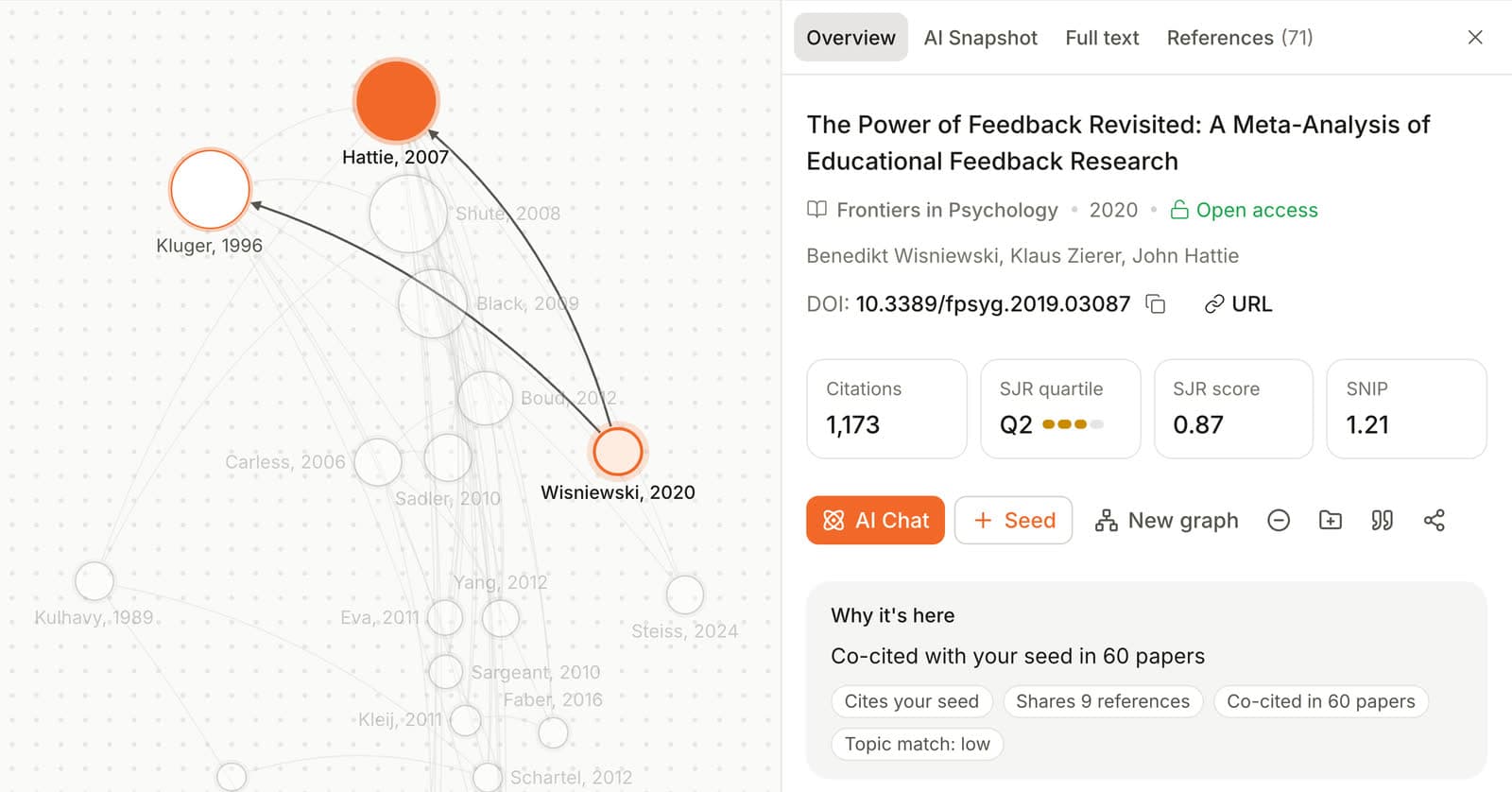
Every paper carries a "Why it's here" line, such as "Co-cited with your seed in 60 papers" for "The Power of Feedback Revisited". It takes up to 5 seeds and splits results into Related papers, Earlier work and Later work. Signed in, graphs save to your account and share by link, and each paper can go to Reference Manager. It does not export the graph, and it also failed the arXiv DOI for "Attention Is All You Need". On relevance it tied with Connected Papers on the same seeds.
Final Verdict: Should You Choose Connected Papers or ResearchRabbit?
Choose Connected Papers when the quality of a single map matters most and five graphs a month will do. Choose ResearchRabbit when you will search in many rounds, need complete reference lists, and want RIS, CSV or Zotero import for free. You can also use both: Connected Papers to orient, ResearchRabbit to collect.
Choose Connected Papers if:
- You have one key paper and want the most relevant papers around it.
- You want a visual map and a ranked list of key ancestors and descendants.
- BibTeX export is enough.
Choose ResearchRabbit if:
- You need more than five maps a month and do not want to pay.
- You want to grow a search from many seeds and keep results in collections.
- You need every reference and citing paper, or RIS, CSV and Zotero.
Frequently Asked Questions
Which is better, Connected Papers or ResearchRabbit?
Connected Papers gave more relevant results in our blind test, averaging 1.77 out of 2 against 1.25 for ResearchRabbit across three seed papers. ResearchRabbit is the better free workspace, with unlimited searches, up to 50 seeds, collections, notes and BibTeX, RIS or CSV export. You can use Connected Papers to orient and ResearchRabbit to collect.
Is Connected Papers free?
Partly. The free plan includes every feature but allows 5 graphs a month when signed in and 2 as a guest. Unlimited graphs need a paid plan: Academic costs $72 a year or $30 a quarter in the US, and Business costs $240 a year or $90 a quarter. Some countries see lower prices.
Is ResearchRabbit free or paid?
Both. ResearchRabbit's core is free forever, with unlimited searches, up to 50 seed articles, collections and exports. RR+ costs $10 a month billed yearly ($120) or $12.50 monthly, and adds up to 300 seeds, Advanced Settings filters such as publication date and journal quartile, multiple projects and Signals alerts for high-risk articles.
Is Research Rabbit good?
ResearchRabbit is good for free, iterative searching, but its recommendations need screening. In our blind test its Similar lists averaged 1.25 out of 2, and 22% of its top 20 papers were off-topic, not research papers or duplicates of the seed. It did best on the medical seed (1.65) and worst on the computer science seed (0.80).
Why did ResearchRabbit open the wrong paper for my DOI?
Some papers exist in ResearchRabbit's data as several records, and a DOI can resolve to the wrong one. In our test, the DOI of a 2015 insomnia meta-analysis opened a 2016 letter about it. Check the year, journal and reference count of the seed record, and search by title when they do not match.
Does Connected Papers work with Zotero?
Not directly. We found no Zotero or Mendeley integration in Connected Papers. You can download a BibTeX file of every paper in a graph and import that file into Zotero or any reference manager that reads BibTeX. ResearchRabbit imports from a linked Zotero account and exports BibTeX, RIS or CSV.
Does ResearchRabbit use AI?
ResearchRabbit states that it does not use large language models to power its core recommendation algorithms. It finds papers through citation links, shared references or citations, shared authors and the similarity of titles and abstracts. We saw no chat or AI summary in the free app. Connected Papers has no AI chat either.
Do Connected Papers and ResearchRabbit use the same database?
Not quite. Connected Papers builds its graphs from Semantic Scholar alone, while ResearchRabbit draws on Crossref, Semantic Scholar and OpenAlex. As a result, the same paper can show different citation counts in each tool, and each tool matched our seed papers differently.
References
- Trauer, J. M., Qian, M. Y., Doyle, J. S., Rajaratnam, S. M. W., & Cunnington, D. (2015). Cognitive behavioral therapy for chronic insomnia: A systematic review and meta-analysis. Annals of Internal Medicine, 163(3), 191-204. https://doi.org/10.7326/M14-2841
- Hattie, J., & Timperley, H. (2007). The power of feedback. Review of Educational Research, 77(1), 81-112. https://doi.org/10.3102/003465430298487
- Vaswani, A., Shazeer, N., Parmar, N., Uszkoreit, J., Jones, L., Gomez, A. N., Kaiser, Ł., & Polosukhin, I. (2017). Attention is all you need. arXiv. https://doi.org/10.48550/arXiv.1706.03762
- Small, H. (1973). Co-citation in the scientific literature: A new measure of the relationship between two documents. Journal of the American Society for Information Science, 24(4), 265-269. https://doi.org/10.1002/asi.4630240406
- Kessler, M. M. (1963). Bibliographic coupling between scientific papers. American Documentation, 14(1), 10-25. https://doi.org/10.1002/asi.5090140103
- Greenhalgh, T., & Peacock, R. (2005). Effectiveness and efficiency of search methods in systematic reviews of complex evidence: Audit of primary sources. BMJ, 331(7524), 1064-1065. https://doi.org/10.1136/bmj.38636.593461.68
Mapping citations?
See how any paper connects
Start from up to five papers and explore earlier, later and related work in one free citation graph. No signup.
Try Citation GraphNo credit card required