7 Best Covidence Alternatives for Systematic Reviews in 2026


Covidence is one of the most widely used platforms for systematic review screening. Backed by Cochrane, it gives research teams a structured environment for title/abstract screening, full-text review, and data extraction. For many academics, it was the first dedicated tool they encountered for structured evidence synthesis.
But the research landscape has shifted. Teams now expect AI-powered search, citation-grounded writing, and end-to-end workflows that connect screening decisions to final reports. Covidence covers screening well, but it stops short of the stages that bookend it: literature search and report drafting. That gap forces teams to stitch together separate tools for database searching, reference management, and writing, losing context at every handoff.
Whether you are pricing out alternatives because your institutional license is expiring, outgrowing the 500-reference trial limit, or simply looking for a platform that covers more of the review pipeline, this guide compares seven Covidence alternatives across the dimensions that matter most: screening workflows, AI capabilities, data extraction, PRISMA reporting, and pricing.
TL;DR
Paperguide is the strongest Covidence alternative in 2026 for teams that want the full systematic review workflow in one platform. It covers every stage Covidence handles (dual-blind screening, conflict resolution, data extraction, PRISMA) and adds what Covidence does not: AI-powered search across 200M+ papers, AI evidence assessment, citation-grounded report drafting, and a built-in reference manager. For teams that need only screening, Rayyan offers a generous free tier. For regulated pharma and medical device submissions, DistillerSR provides GxP validation documentation. For Cochrane reviews specifically, RevMan remains the official tool.
Top Covidence Alternatives: Quick Comparison
| Tool | Best For | AI Search | Dual Screening | Data Extraction | PRISMA | AI Writing | Free Plan | Starting Price |
|---|---|---|---|---|---|---|---|---|
| Paperguide | Full-workflow systematic reviews | ✓ (200M+ papers) | ✓ (dual-blind + AI-led) | ✓ | ✓ | ✓ | ✓ | $12/mo |
| Rayyan | Free screening for small teams | ✗ | Partial (blind mode toggle) | Basic | ✓ | ✗ | ✓ (3 reviews) | $4.99/seat/mo |
| DistillerSR | Regulated pharma/device submissions | ✗ | ✓ | ✓ (SEE AI) | ✓ | ✗ | ✗ | Enterprise only |
| EPPI-Reviewer | Mixed-methods and text mining | ✗ | ✓ | ✓ | ✓ | ✗ | ✓ (limited) | ~£150/review |
| SysRev | Open-access collaborative reviews | ✗ | ✓ | ✓ | ✗ | ✗ | ✓ | $49/mo |
| Nested Knowledge | Living reviews with auto-updates | ✗ | ✓ | ✓ (NLP) | ✓ | ✗ | ✓ (1 review) | $500/review |
| RevMan | Cochrane reviews with meta-analysis | ✗ | ✓ | ✓ | ✓ | ✗ | ✓ (Cochrane) | $420/year |
What is Covidence?
Covidence is a web-based systematic review management tool endorsed by Cochrane. It focuses on the middle stages of the review pipeline: importing references (from PubMed, Embase, or reference manager exports), deduplicating records, dual-reviewer screening at the title/abstract and full-text stages, quality assessment, and structured data extraction.
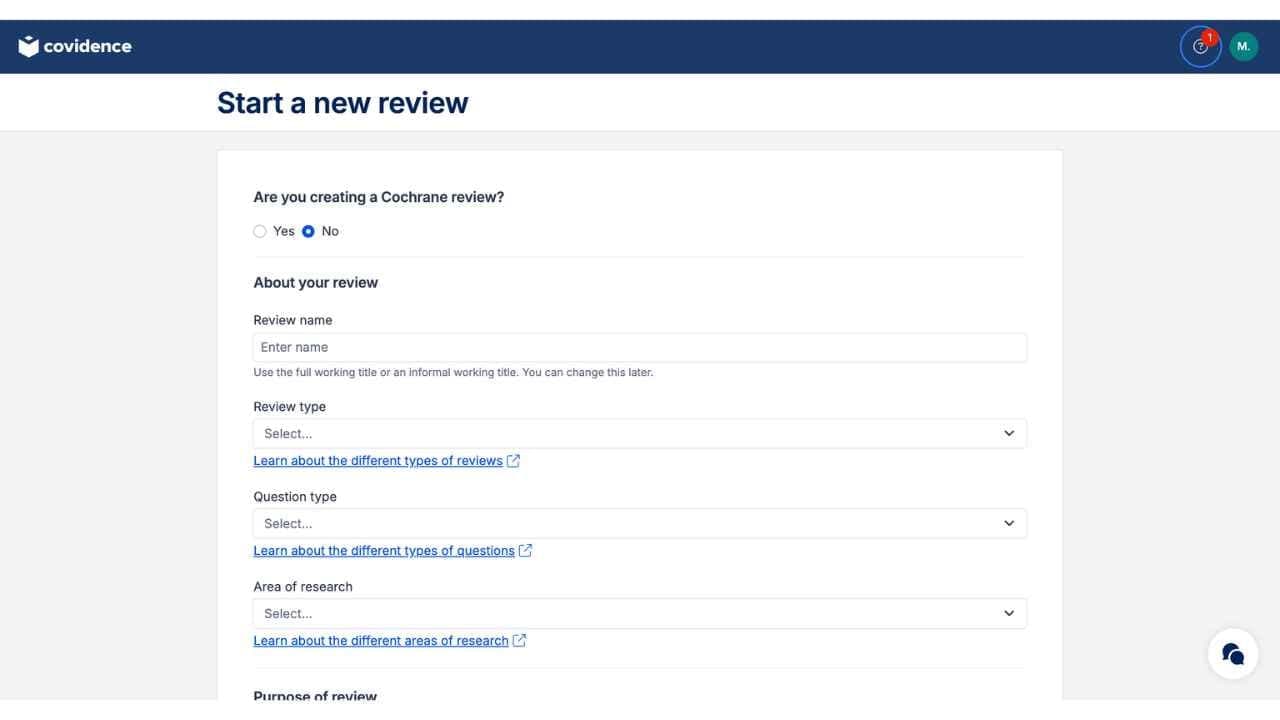
Key Features
- Dual-reviewer screening with conflict resolution
- Cochrane RCT Classifier for relevance ranking
- Risk of bias assessment templates (Cochrane RoB 2, ROBINS-I)
- PRISMA flow diagram generation
- Data extraction with customizable templates
- Export to RevMan, CSV, and Excel
Limitations
- No literature search. You must search PubMed, Embase, and other databases separately, then import results manually.
- No reference manager. Covidence does not store or organize your reference library. Once a review ends, those references are not accessible in a shared library.
- No AI writing. The platform produces structured data tables, not drafted reports. You export to Word or Excel and write the synthesis yourself.
- No AI-led screening. All screening is human-only. The Cochrane RCT Classifier provides relevance rankings but does not make inclusion decisions.
- Pricing. A single review costs $339/year. Three reviews cost $907/year. Institutional pricing requires negotiation and is often expensive for smaller teams.
Why Researchers Look for Alternatives
The most common reasons teams evaluate Covidence alternatives come down to three themes: workflow gaps, cost, and AI expectations. Covidence covers screening and extraction but not the stages before (search) or after (writing). At $339 per review, it is among the more expensive options for individual researchers. And as AI-native tools add capabilities like automated evidence assessment and citation-grounded drafting, the gap between what Covidence offers and what modern platforms provide has widened.
A 2026 evaluation published in the Journal of the Medical Library Association compared five widely used systematic review platforms: Covidence, Rayyan, EPPI-Reviewer, DistillerSR and RevMan [1].
Best Covidence Alternatives in 2026
1. Paperguide
The best Covidence alternative for teams that want the full systematic review pipeline in one platform.
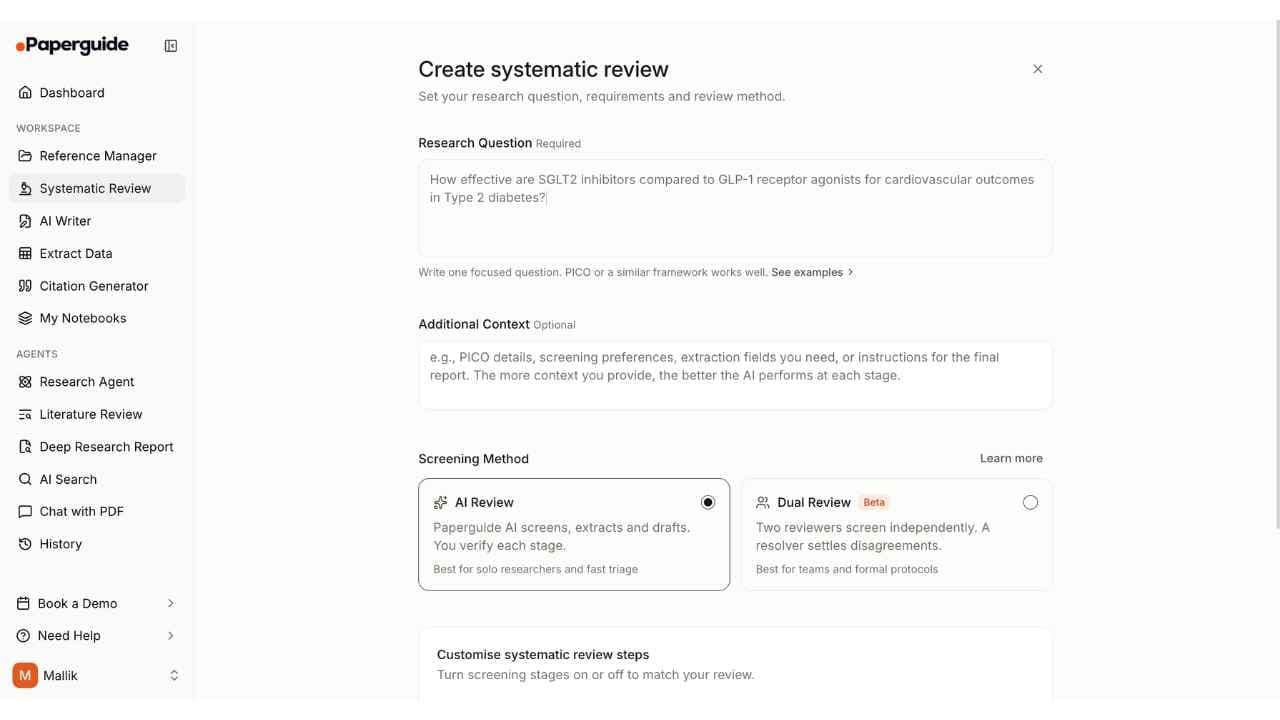
Paperguide is an AI-native platform for scientific research workflows and evidence synthesis. Unlike Covidence, which handles screening and extraction, Paperguide covers every stage of a systematic review: from AI-powered literature search and protocol setup, through dual-blind screening with conflict resolution, to structured data extraction, PRISMA reporting, and citation-grounded report drafting.
Best For
- Research teams running systematic reviews from search through final report
- HEOR consultancies and CROs that need to cut cycle time across multiple concurrent reviews
- Clinical and regulatory teams producing CERs and post-market surveillance reviews
- Individual researchers who want one platform for literature reviews and structured evidence synthesis
Key Features
- AI Search across 200M+ papers from PubMed, arXiv, OpenAlex, and Semantic Scholar, with results ranked by SJR quartile, SNIP, and citation metrics
- Systematic Review with dual-blind screening, lead-resolved conflict resolution and inter-rater agreement (Cohen's Kappa), plus an AI-led mode with named verifier confirmation for faster reviews
- Protocol builder where AI drafts eligibility criteria and extraction fields for you to edit, and criteria order sets the exclusion reasons; save a protocol and re-run it over new papers
- Audit trail and roles: every decision logged with its criterion, evidence, and who confirmed it, with team roles (Edit, Reviewer, View-only) per stage
- AI Evidence Run that assesses each paper against your inclusion criteria with per-criterion green/orange badges and sentence-level evidence
- Extract Data with configurable field types (answer, yes/no, specified options) and sentence-level citation evidence on every extracted value
- PRISMA flow diagram generated automatically from screening decisions
- Citation-grounded report drafting using the AI Paper Writer, traceable to your screened and extracted sources
- Built-in AI Reference Manager with Zotero/Mendeley import, 1,000+ citation styles, and org-wide library
- Research Agent for multi-step research tasks, deep research reports, and chat with PDF across multiple papers
Pros
- Full workflow from search to cited report in one platform, no context lost between stages
- Dual-blind screening enforces true independence (reviewers cannot see each other's decisions until both have voted)
- AI Evidence Run provides per-criterion assessment before manual screening, reducing the volume of papers reviewers must read in full
- Cohen's Kappa gives inter-rater agreement metrics that some journals and regulators now expect
- PRISMA diagram auto-generated from your actual screening decisions
- Projects and workspaces support concurrent reviews with team collaboration at every stage
- Pricing starts at $0 with meaningful free tier capabilities
Cons
- Risk of bias assessment tools are on the roadmap but not yet available
- Newer platform, so institutional adoption is still growing compared to Covidence's established base
- GxP validation documentation not yet available for regulated pharma submissions
Pricing
| Plan | Price (Annual) | AI Credits/mo | SR Capacity | Dual Review |
|---|---|---|---|---|
| Free | $0 | 2,000 | N/A | ❌ |
| Plus | $12 per seat/mo ($144/yr) | 12,500 | 1,000 papers | ❌ |
| Pro | $29 per seat/mo ($348/yr) | 50,000 | 5,000 papers | ❌ |
| Evidence Teams | $89 per seat/mo ($1,068/yr) | 150,000 | 5,000 papers | ✅ |
| Enterprise | Custom | Custom | 20,000 papers | ✅ |
A 30% academic discount applies with a valid university email, and yearly billing saves up to 41%.
Pricing and plan details may change over time. For the latest Paperguide pricing, plans, and features, please visit the pricing page.
Verdict
Paperguide fills every gap in Covidence's workflow. Where Covidence requires you to search databases separately, import references, screen, extract, and then export to write your report in another tool, Paperguide connects these stages. The AI Evidence Run is particularly relevant for teams screening large volumes: it surfaces per-criterion evidence before manual review, which means reviewers spend less time on papers that clearly fall outside inclusion criteria. For teams whose reviews must be audit-ready for regulatory or client delivery, the combination of dual-blind screening, Cohen's Kappa, and auto-generated PRISMA provides the documentation trail that Covidence offers for screening alone, extended across the full pipeline.
2. Rayyan
Best for teams that need free screening for small to mid-size reviews.
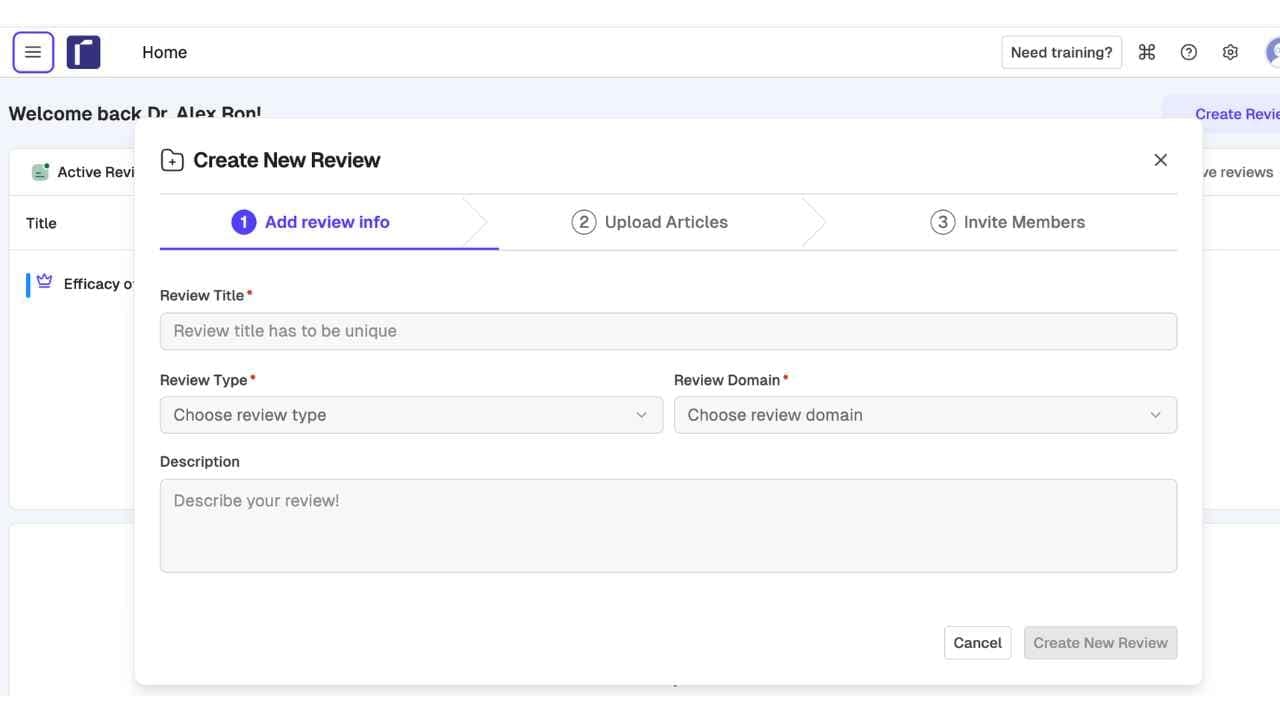
Rayyan is a free-to-start systematic review platform used by over 4 million researchers worldwide. It is the most popular free alternative to Covidence for title/abstract screening, with a clean interface and a blind mode that hides other reviewers' decisions.
Best For
- Graduate students and postdocs running reviews on limited budgets
- Small teams that need basic screening without per-review fees
- Teams already using Rayyan who want to understand its limitations before scaling
Key Features
- Title/abstract screening with include/maybe/exclude voting
- Blind mode toggle that hides co-reviewer decisions
- PICO highlighting and keyword color-coding
- Full-text screening (paid plans)
- Data extraction with custom questions (paid plans)
- Risk of bias assessment (paid plans)
- PRISMA flow diagram
- ResearchPilot AI assistant (institutional plans)
Pros
- Free plan includes 3 reviews with up to 2 collaborators per review
- Clean, fast screening interface with helpful keyword highlighting
- Large user base means extensive community documentation and tutorials
- PRISMA flow diagram included on all plans
- Mobile-friendly interface for screening on the go
Cons
- Blind mode is a toggle the review owner can switch off at any time, not true dual-blind screening with enforced independence
- No literature search capability; you must import references from external databases
- Data extraction and full-text screening locked behind paid plans
- No AI writing or report drafting
- No reference manager
- ResearchPilot AI features require Business plan ($41.67/license/month, minimum 5 licenses)
- Free plan limited to 3 reviews and 2 collaborators
Pricing
| Plan | Price | Reviews | Collaborators |
|---|---|---|---|
| Free | $0 | 3 | 2 per review |
| Essential | $4.99/seat/mo | 10 | Unlimited |
| Advanced | $8.33/seat/mo | Unlimited | Unlimited |
| Business | $41.67/license/mo (min 5) | Unlimited | Unlimited + ResearchPilot |
Verdict
Rayyan is the obvious choice for researchers who need free screening and are comfortable importing references from external databases. Its keyword highlighting and PICO tools make abstract screening more efficient. However, Rayyan’s blind mode is not equivalent to the enforced dual-blind screening that Covidence and Paperguide provide. For teams moving beyond small academic reviews and into work that requires a defensible methodology, the lack of true dual-blind independence, along with the paywall for extraction and full-text screening, pushes the total cost closer to Covidence’s pricing without offering Covidence’s depth in quality assessment. Paperguide is also known as one of the best Rayyan alternatives in 2026. Teams weighing these two platforms can find a deeper breakdown in the Covidence vs Rayyan comparison.
3. DistillerSR
Best for regulated pharma and medical device teams that need GxP validation.
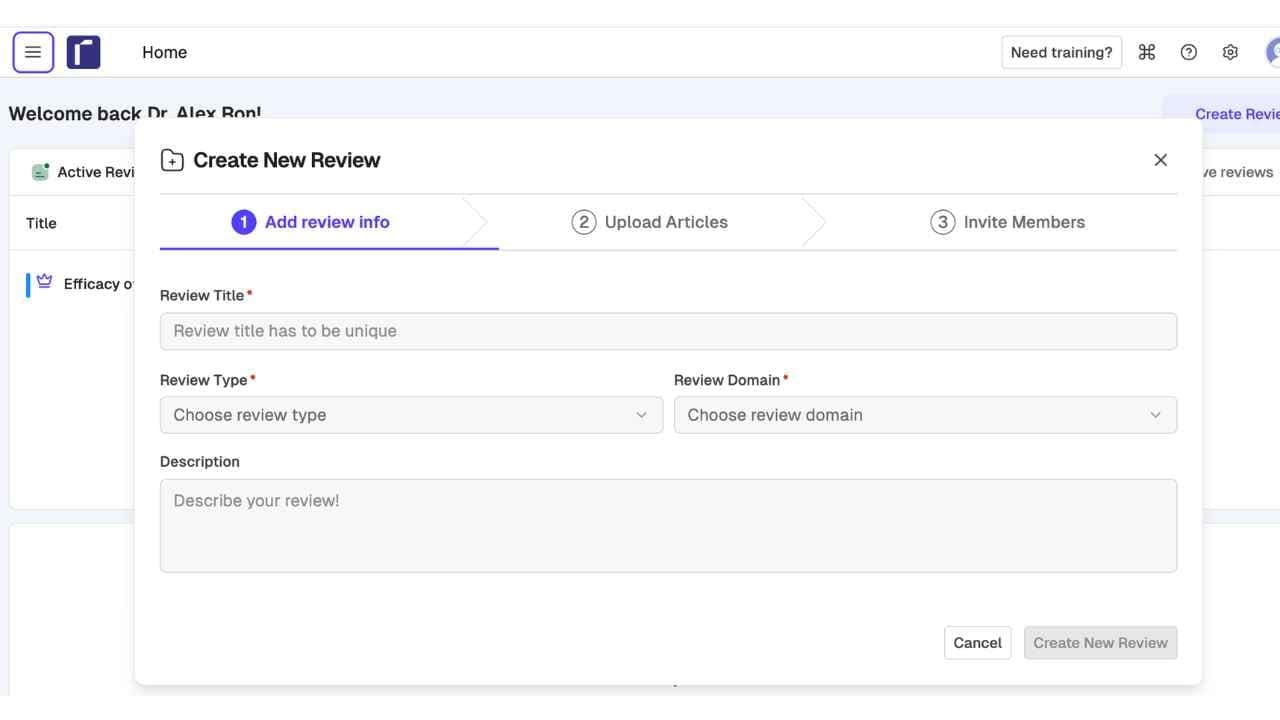
DistillerSR (by Evidence Partners) is a systematic review automation platform built for regulated environments. Its core strength is audit-ready output with GxP validation documentation and 21 CFR Part 11 compliance positioning, making it the tool of choice for pharma regulatory affairs teams and medical device manufacturers producing CERs.
Best For
- Pharmaceutical companies running systematic reviews for regulatory submissions
- Medical device manufacturers producing Clinical Evaluation Reports under EU MDR
- CROs and HTA agencies that need validated, auditable review processes
- Teams that require 21 CFR Part 11 compliance documentation
Key Features
- DAISY AI and AI Re-Rank for machine learning screening prioritization with continuous learning
- Smart Evidence Extraction (SEE) for generative AI-powered data extraction
- CuratorCR evidence reuse repository for cross-review knowledge management
- GxP validation documentation and 21 CFR Part 11 compliance positioning
- Configurable screening and extraction forms
- PRISMA flow diagram generation
- Full audit trail for regulatory submissions
Pros
- Deepest regulatory validation positioning of any SR platform
- DAISY AI learns from your screening decisions and re-prioritizes remaining records
- SEE extraction uses generative AI to pull structured data from full texts
- CuratorCR allows evidence reuse across reviews, which is valuable for teams running similar reviews repeatedly
- Established trust with pharma and medical device regulatory affairs teams
Cons
- Enterprise-only pricing with no transparent cost structure
- No literature search; all references must be imported from external databases
- No AI writing or report drafting
- No reference manager
- Steep learning curve compared to simpler screening tools
- Not designed for individual researchers or small academic teams
Pricing
DistillerSR uses enterprise-only pricing with no published rates. Licensing is typically per-project or annual subscription, negotiated based on team size and review volume. Contact Evidence Partners for a quote.
Verdict
DistillerSR occupies a distinct niche: regulated evidence synthesis. If your team produces systematic reviews for FDA or EMA submissions and needs GxP validation documentation, DistillerSR's compliance positioning is unmatched. But outside that regulatory context, the enterprise-only pricing, lack of search and writing capabilities, and narrow focus make it hard to justify over platforms that cover more of the workflow at transparent price points. Teams that need both regulatory rigor and a connected search-to-report pipeline may find that Paperguide's systematic review workflow covers screening and data extraction with comparable audit trails while also handling stages that DistillerSR does not cover, making it a strong DistillerSR alternative in 2026. The Covidence vs DistillerSR comparison covers the regulatory and workflow tradeoffs in more detail.
4. EPPI-Reviewer
Best for mixed-methods reviews and text mining workflows.
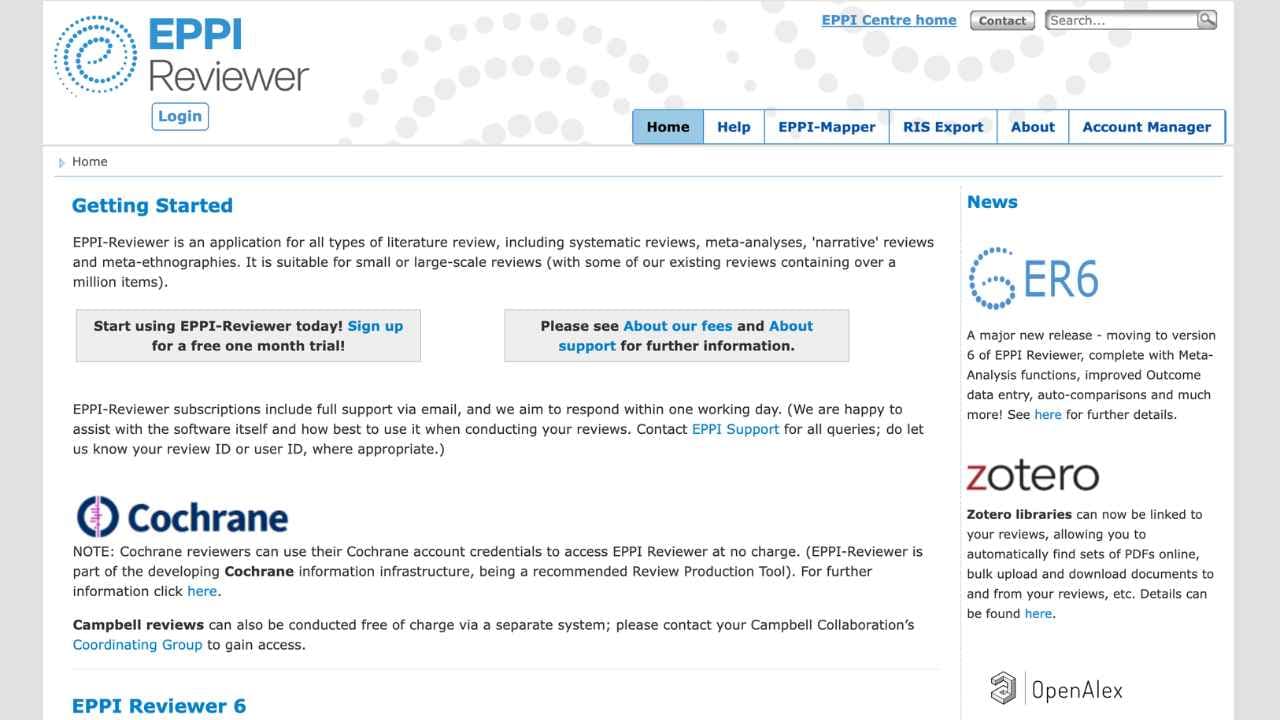
EPPI-Reviewer is developed by the Evidence for Policy and Practice Information and Co-ordinating Centre (EPPI-Centre) at University College London. It supports systematic reviews, meta-analyses, and qualitative evidence synthesis, with integrated text mining tools that distinguish it from screening-focused platforms.
Best For
- Research teams conducting mixed-methods or qualitative evidence synthesis
- Groups that need integrated text mining for thematic analysis
- Public health and social science researchers working with large, heterogeneous datasets
- Teams producing reviews for policy and guideline development
Key Features
- Dual-reviewer screening with conflict resolution
- Integrated text mining for priority screening and thematic clustering
- Coding and classification tools for qualitative data
- Meta-analysis module for quantitative synthesis
- PRISMA flow diagram generation
- Free version available for smaller reviews
Pros
- One of the few platforms that handles both quantitative and qualitative evidence synthesis
- Text mining tools help prioritize screening and identify thematic patterns
- Established in public health and social policy review communities
- Meta-analysis tools built in
Cons
- Interface feels dated compared to modern platforms
- Steeper learning curve than Covidence or Rayyan
- No AI-powered search or writing
- No reference manager
- Pricing can be opaque for institutional licenses
- Smaller user community means fewer tutorials and support resources
Pricing
| Plan | Price | Key Inclusions |
|---|---|---|
| Free | £0 | Limited reviews, basic features |
| Per review | ~£150 | Single review license |
| Institutional | Custom | Multi-user, training, support |
Verdict
EPPI-Reviewer fills a gap that most SR platforms ignore: mixed-methods synthesis and text mining. If your review involves coding qualitative data alongside screening quantitative studies, EPPI-Reviewer's integrated approach saves the trouble of running separate tools. For teams that work primarily with structured screening and extraction workflows, more modern platforms offer faster interfaces and AI capabilities that EPPI-Reviewer lacks.
5. SysRev
Best for open-access, community-driven collaborative reviews.
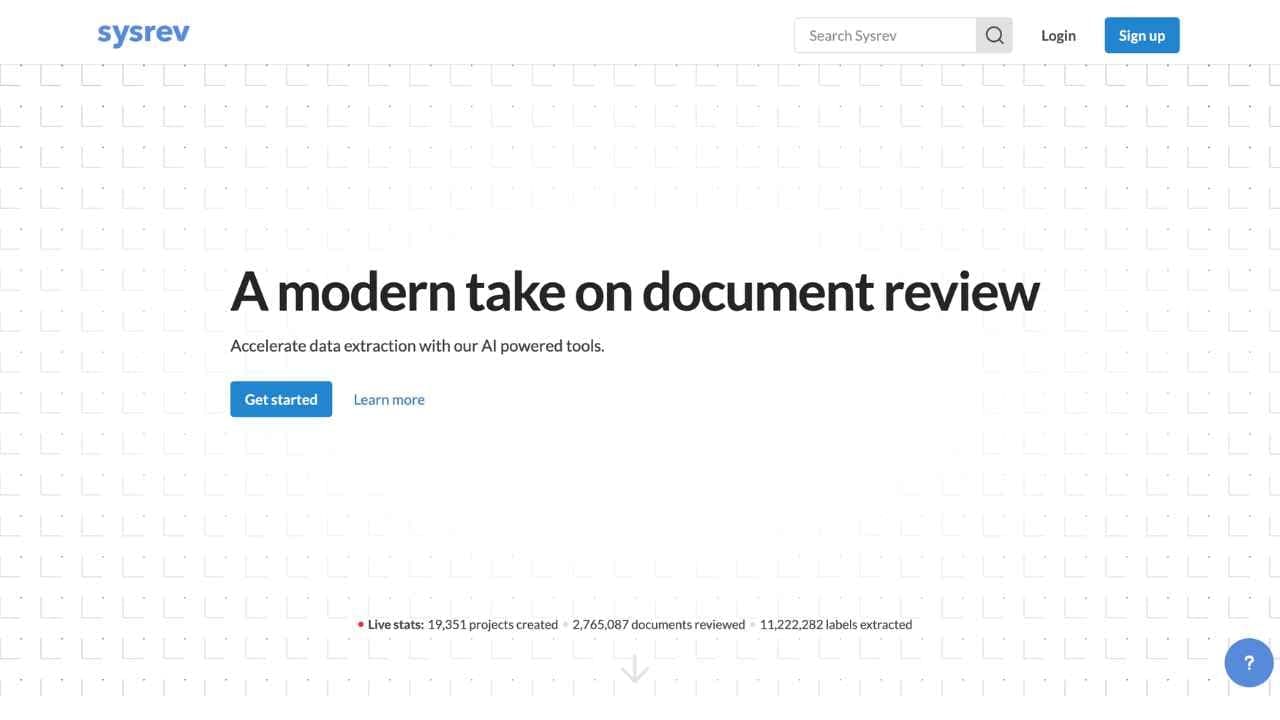
SysRev is an open-access systematic review platform that emphasizes transparency and collaboration. Built with an open-science philosophy, it makes review data publicly accessible by default (with private options), which appeals to teams that value reproducibility and open data.
Best For
- Research teams that want publicly accessible review data
- Groups running collaborative reviews across institutions
- Teams on tight budgets that need basic screening and extraction
- Researchers working on living reviews that benefit from community contribution
Key Features
- Dual-reviewer screening with labels and annotations
- Structured data extraction with custom fields
- Public review sharing by default
- API access for programmatic review management
- Integration with machine learning models for assisted screening
Pros
- Free plan with meaningful capabilities
- Open-access model supports reproducibility and transparency
- API access enables automation and integration with other tools
- Community-contributed review data can accelerate related projects
Cons
- No PRISMA flow diagram generation
- No AI-powered search or writing
- No reference manager
- Smaller user community than Covidence or Rayyan
- Interface is functional but not polished
- Limited institutional support and training resources
Pricing
| Plan | Price | Key Inclusions |
|---|---|---|
| Free | $0 | Public reviews, basic screening |
| Pro | $49/mo | Private reviews, priority support |
| Enterprise | Custom | Custom integrations, dedicated support |
Verdict
SysRev is best understood as a screening and extraction tool built for the open-science community. If your priority is publicly accessible review data and you need a free platform for collaborative screening, SysRev delivers. But for teams that need PRISMA, AI features, or a workflow that extends beyond screening, it leaves significant gaps.
6. Nested Knowledge
Best for living reviews and NLP-powered evidence mapping.
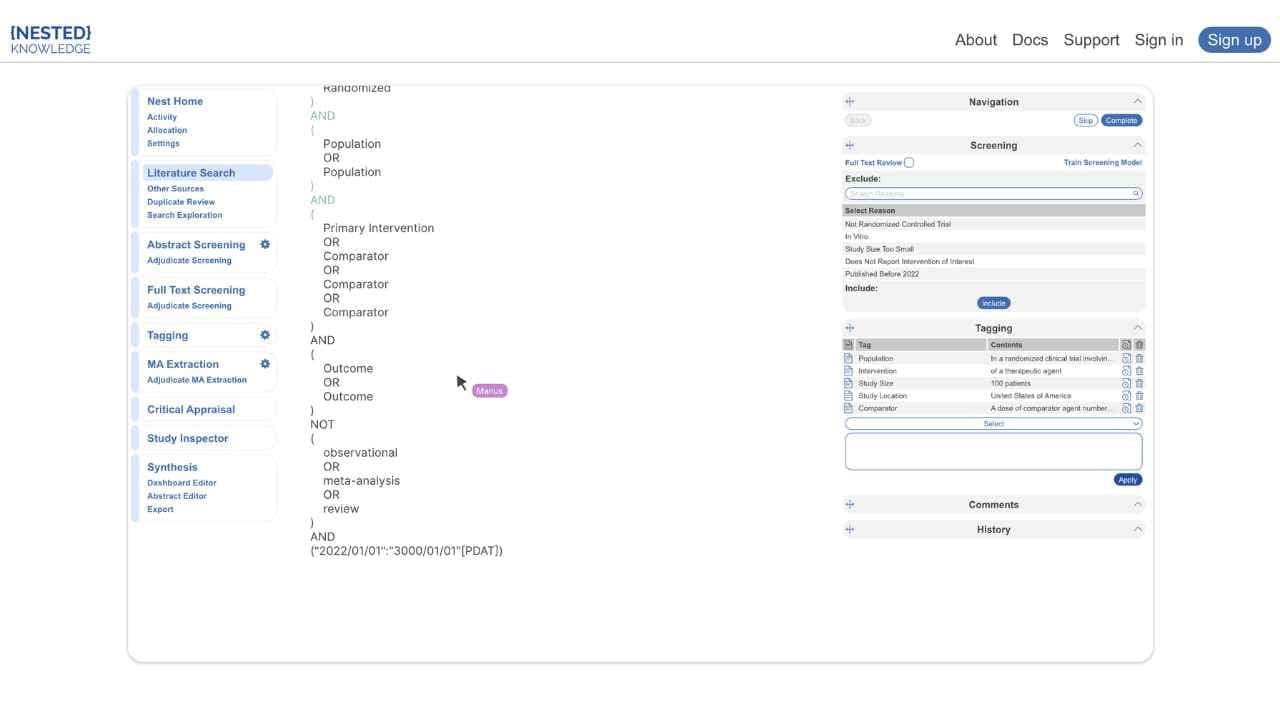
Nested Knowledge is a systematic review platform that differentiates itself with living review automation and NLP-powered data extraction. It builds interactive evidence maps and network meta-analyses from extracted data, which is useful for teams that need to maintain reviews over time rather than produce a single static output.
Best For
- Teams maintaining living reviews that require periodic updates
- Researchers who need interactive evidence maps and network visualizations
- Groups conducting network meta-analyses alongside systematic reviews
- HTA and market access teams that present evidence visually to stakeholders
Key Features
- Dual-reviewer screening with conflict resolution
- NLP-powered data extraction with semi-automated tagging
- Interactive evidence maps (GAVIN visualization)
- Network meta-analysis module
- PRISMA flow diagram generation
- Living review automation with update alerts
- Robot screener for ML-assisted priority screening
Pros
- Living review automation is genuinely useful for teams that update reviews quarterly or annually
- Interactive evidence maps provide a compelling visual output for presentations and reports
- Network meta-analysis tools reduce the need for separate statistical software
- Robot screener learns from your decisions and prioritizes remaining records
Cons
- Per-review pricing ($500/review) is expensive for teams running multiple reviews
- No AI-powered literature search
- No AI writing or report drafting
- No reference manager
- Smaller user base means fewer community resources and institutional recognition
- Learning curve for the evidence mapping and NMA modules
Pricing
| Plan | Price | Key Inclusions |
|---|---|---|
| Free trial | $0 | 1 review, limited features |
| Per review | $500 | Full features for one review |
| Enterprise | Custom | Volume discounts, training, support |
Verdict
Nested Knowledge stands out for living reviews and evidence visualization. If your team maintains reviews that must be updated regularly and presents evidence to non-technical stakeholders, the interactive maps and living review automation add real value. For teams running standard systematic reviews from start to finish, the per-review pricing and lack of search and writing capabilities make it harder to justify over more complete platforms.
7. RevMan
Best for Cochrane reviews and integrated meta-analysis.
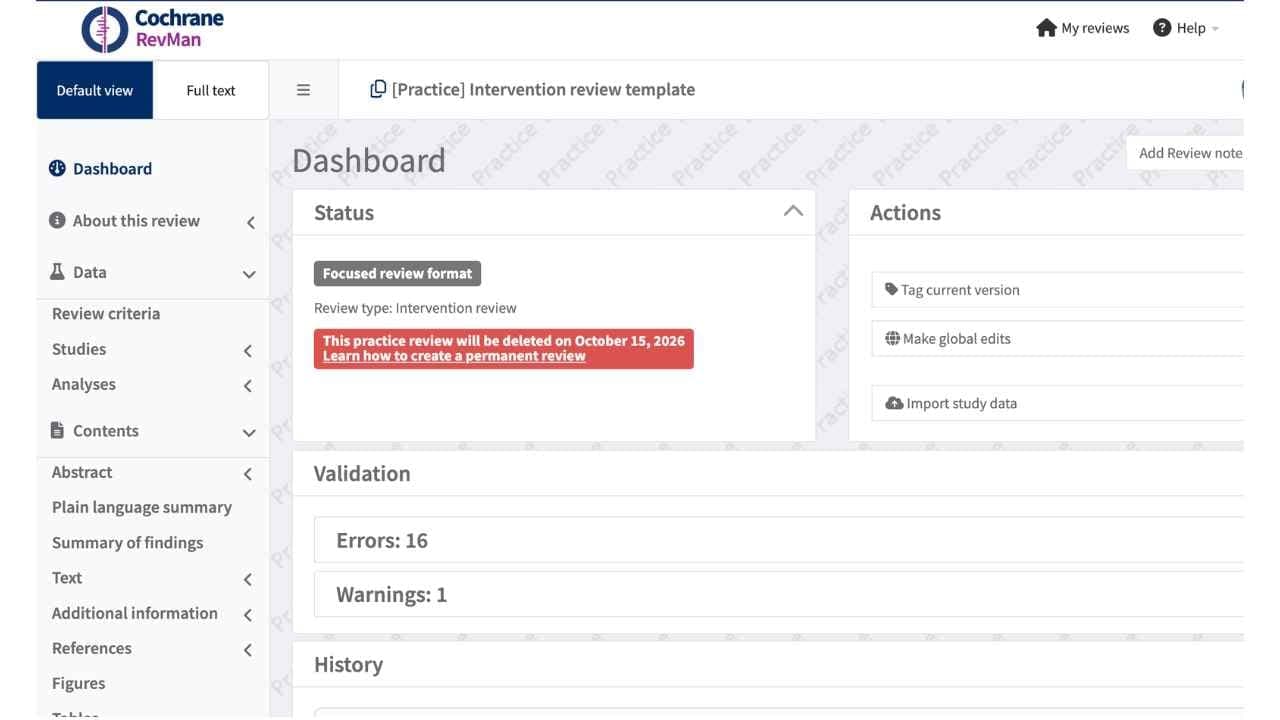
RevMan (Review Manager) is the official software of the Cochrane Collaboration. It is the required tool for producing Cochrane systematic reviews and provides integrated meta-analysis capabilities that most other screening platforms lack.
Best For
- Teams producing Cochrane systematic reviews
- Researchers who need integrated meta-analysis (forest plots, funnel plots, subgroup analysis)
- Groups that work within the Cochrane review production workflow
- Academics whose institutions provide Cochrane access
Key Features
- Dual-reviewer screening with the Cochrane workflow
- Integrated meta-analysis with forest plots and funnel plots
- Risk of bias assessment (Cochrane RoB 2)
- PRISMA flow diagram
- GRADE evidence quality assessment
- Direct publishing to the Cochrane Library
Pros
- The required tool for Cochrane reviews, making it non-negotiable for that workflow
- Integrated meta-analysis eliminates the need for separate statistical software
- GRADE assessment built in
- Free for Cochrane review teams
Cons
- Designed specifically for Cochrane reviews; less flexible for non-Cochrane systematic reviews
- Interface is functional but not modern
- No AI-powered search, screening, or writing
- No reference manager
- Limited collaboration features compared to web-native platforms
- Annual license of $420/year for non-Cochrane users
Pricing
| Plan | Price | Key Inclusions |
|---|---|---|
| Cochrane reviewers | Free | Full access through Cochrane membership |
| Non-Cochrane | $420/year | Full meta-analysis and review capabilities |
Verdict
RevMan is non-negotiable for Cochrane reviews. If your team produces reviews for the Cochrane Library, RevMan is the tool you will use. For non-Cochrane reviews, the limited collaboration features, dated interface, and lack of AI capabilities make it harder to justify when modern platforms cover screening, extraction, and more.
Which Covidence Alternative Should You Choose?
The right platform depends on where your workflow gaps are and what kind of reviews you run.
If you need the full systematic review pipeline in one platform: Paperguide covers search, screening, extraction, PRISMA, and cited report drafting. It eliminates the context loss that comes from stitching together a search database, a screening tool, a reference manager, and a word processor.
If you need free screening and your reviews are small: Rayyan's free plan supports 3 reviews with 2 collaborators each, with a clean screening interface and keyword highlighting.
If you produce reviews for regulatory submissions: DistillerSR's GxP validation documentation and 21 CFR Part 11 positioning serve pharma and device teams whose output must meet regulatory audit standards.
If you run mixed-methods reviews: EPPI-Reviewer's text mining and qualitative coding tools handle review types that screening-focused platforms cannot.
If you maintain living reviews: Nested Knowledge's update automation and interactive evidence maps serve teams that need to refresh reviews periodically.
If you produce Cochrane reviews: RevMan is the required tool.
Researchers exploring the wider range of AI tools for systematic review will find additional platforms not covered here. Teams also evaluating Rayyan or DistillerSR specifically can compare them in the Rayyan vs DistillerSR guide.
Best Tool by Use Case
| Use Case | Recommended Tool |
|---|---|
| Full-workflow systematic reviews | Paperguide |
| Free screening for small teams | Rayyan |
| Regulated pharma/device submissions | DistillerSR |
| Mixed-methods synthesis | EPPI-Reviewer |
| Open-access collaborative reviews | SysRev |
| Living reviews with evidence maps | Nested Knowledge |
| Cochrane reviews with meta-analysis | RevMan |
| Budget-conscious academic teams | Rayyan (free) or Paperguide (free tier) |
| HEOR consultancies running concurrent reviews | Paperguide |
How the Paperguide Systematic Review Workflow Works
For teams considering a move from Covidence, here is how the Paperguide systematic review workflow maps to the review stages you already know.
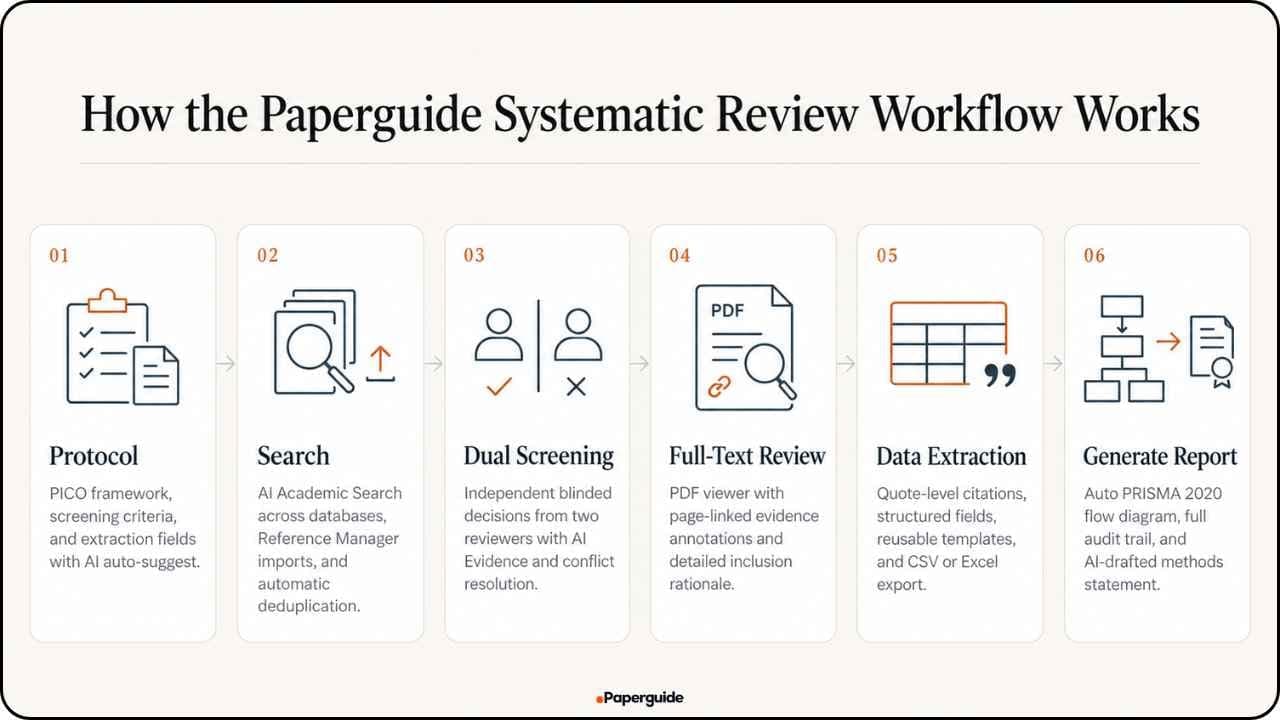
Paperguide structures the systematic review into six sequential stages, with AI assistance available at each step:
Stage 1: Protocol Define your research question, set eligibility criteria (PICO or custom), and configure extraction fields. Paperguide's AI drafts initial criteria and fields for your editing, and saved protocols can be reused for review updates.
Stage 2: Search Run an automated search across 200M+ papers from PubMed, arXiv, OpenAlex, and Semantic Scholar, or import references from external databases, Zotero, or Mendeley. The system automatically deduplicates and ranks results. Researchers who work inside AI assistants like Claude or ChatGPT can also search Paperguide's full corpus directly from their conversation using the Paperguide MCP connector, with every result citation-linked and saveable to a Paperguide library for screening.
Stage 3: Screening Choose between two modes:
- AI-Led Mode: the AI screens with evidence-backed decisions, and a named human verifier reviews, overrides, and confirms at each stage. Best for rapid, scoping, or internal reviews.
- Dual Review Mode: two reviewers screen every paper independently with blinded decisions. AI Evidence prepares cited reasoning for each criterion without making the screening call. Disagreements are flagged and routed to a conflict resolver. Best for PRISMA-compliant systematic reviews.
Stage 4: Data Extraction Build custom extraction tables with structured columns. Extract data points from included studies with AI assistance. The system pre-populates fields with cited evidence for reviewer verification.
Stage 5: Synthesis Generate a Deep Research Report with cited summaries, research gap analysis, and evidence-backed findings. Use Chat with PDF for cross-paper comparison and detailed full-text analysis.
Stage 6: Reporting Auto-generate PRISMA 2020 flow diagrams from actual workflow counts (not reconstructed from notes). Export extraction data as CSV, Excel, BibTeX, or RIS. Write up findings using the AI Paper Writer with in-text citations and 1,000+ citation styles.
Final Verdict
Covidence set the standard for structured systematic review screening, and its Cochrane endorsement still carries weight in academic circles. But the systematic review workflow extends well beyond screening. Search, reference management, AI evidence assessment, data extraction with sentence-level traceability, and citation-grounded report drafting are all stages that Covidence leaves to external tools.
Paperguide is the best Covidence alternative in 2026 because it covers every one of those stages in a single platform. Teams that switch from Covidence to Paperguide stop losing context between a search database, a screening tool, a reference manager, and a word processor. The AI Evidence Run, enforced dual-blind screening with Cohen's Kappa, and auto-generated PRISMA provide the audit trail that regulated and client-facing teams require, while the AI Paper Writer turns screened and extracted evidence into cited drafts instead of raw data exports.
For teams evaluating the best systematic review software in 2026, the deciding factor is workflow coverage. Covidence handles the middle stages well. Paperguide handles all of them, from the first AI-powered search to the final cited report, with no handoffs and no context lost between tools.
Frequently Asked Questions (FAQs)
What is the best Covidence alternative in 2026? Paperguide is the best Covidence alternative for teams that need the full systematic review workflow in one platform, covering AI-powered search, dual-blind screening, data extraction, PRISMA, and citation-grounded report drafting.
Is Rayyan better than Covidence? Rayyan is better for budget-conscious teams that need free screening. Covidence is better for teams that need enforced dual-reviewer screening, structured quality assessment, and institutional support. The choice depends on review rigor requirements and budget.
Can I switch from Covidence to another tool mid-review? Most platforms accept RIS, CSV, or XML imports, so you can export your references from Covidence and import them into another tool. However, screening decisions made in Covidence typically cannot be transferred, so switching mid-review means re-screening imported records.
Which Covidence alternative is best for PhD students? Rayyan (free plan) offers screening at no cost, and Paperguide's free tier covers search and extraction, with systematic review screening from the Plus plan. Paperguide adds AI search and writing, while Rayyan offers a simpler screening-focused interface.
Which alternative supports PRISMA flow diagrams? Paperguide, Rayyan, DistillerSR, EPPI-Reviewer, Nested Knowledge, and RevMan all generate PRISMA flow diagrams. SysRev does not.
Is there a free alternative to Covidence? Rayyan offers 3 free reviews with 2 collaborators each. Paperguide offers a free tier with search, extraction, and the free PRISMA Flow Diagram Generator, with systematic review screening from the Plus plan. SysRev offers free public reviews. EPPI-Reviewer has a limited free version.
Which Covidence alternative is best for HEOR teams? Paperguide and DistillerSR both serve HEOR teams. Paperguide covers the full workflow from search to report. DistillerSR provides deeper regulatory validation for pharma submissions.
Does any alternative offer AI-powered screening? Paperguide offers AI Evidence Run for per-criterion evidence assessment. DistillerSR offers DAISY AI for screening prioritization. Nested Knowledge offers Robot screener for ML-assisted priority ranking. Rayyan offers an AI Reviewer on institutional plans.
Which alternative has the best data extraction? Paperguide and DistillerSR offer the deepest extraction capabilities. Paperguide provides sentence-level citation evidence on every extracted value. DistillerSR's SEE uses generative AI for structured extraction from full texts.
Can Paperguide replace both Covidence and my reference manager? Yes. Paperguide includes a built-in AI reference manager that imports from Zotero, Mendeley, and BibTeX. It supports 1,000+ citation styles and provides an org-wide library, eliminating the need for a separate reference manager alongside your review tool.
References
- Serrano Silva, J. J., Fernández, S., Rosillo, N., & Bueno, H. (2026). Which systematic review software works best? A practical comparison. Journal of the Medical Library Association, 114(1), 83-85. https://doi.org/10.5195/jmla.2026.2262
- Borah, R., Brown, A. W., Capers, P. L., & Kaiser, K. A. (2017). Analysis of the time and workers needed to conduct systematic reviews of medical interventions using data from the PROSPERO registry. BMJ Open, 7(2), e012545. https://doi.org/10.1136/bmjopen-2016-012545
- Abogunrin, S., Muir, J. M., Zerbini, C., & Sarri, G. (2025). How much can we save by applying artificial intelligence in evidence synthesis? Results from a pragmatic review to quantify workload efficiencies and cost savings. Frontiers in Pharmacology, 16, 1454245. https://doi.org/10.3389/fphar.2025.1454245
Running a review?
Run your systematic review in Paperguide
Dual screening, verifiable extraction and PRISMA reporting in one place.
Start a reviewNo credit card required