Covidence vs Rayyan: Which Is Better in 2026?


Covidence and Rayyan are two of the most widely used platforms for systematic review screening, and research teams moving beyond spreadsheets and email chains often narrow their choice to one of these two. Both handle the core job of title and abstract screening with dual reviewers, but they approach nearly everything else differently: pricing models, AI integration, full-text management, data extraction depth, and risk of bias tooling.
The question matters because systematic reviews remain among the most labor-intensive research activities. A study of 195 PROSPERO-registered reviews found that the average systematic review takes 67.3 weeks from registration to completion [1]. A pragmatic review of 25 studies evaluating AI automation tools in evidence synthesis found that over two thirds reported greater than 50% time reduction in screening tasks when automation was applied [2]. With that kind of time investment, platform choice directly affects both the timeline and the cost of a review.
Covidence is a Cochrane-endorsed web platform built specifically for systematic review screening, data extraction, and quality assessment. Over 750,000 researchers across 480 institutions have used it, with more than 730,000 reviews started to date. A 2026 practical comparison in the Journal of the Medical Library Association noted that Covidence offers an intuitive interface typically associated with a shorter learning curve [3].
Rayyan is a freemium screening tool developed at the Qatar Computing Research Institute. It gained traction by offering a free tier that lets individual researchers or small teams run up to three reviews with two reviewers at no cost. Rayyan has since expanded into AI-assisted screening, PICO detection, full-text screening, data extraction, and risk of bias assessment, though these features are spread across its tiered pricing plans.
We tested both platforms on real systematic review workflows to compare screening, AI features, extraction, risk of bias, collaboration, and pricing.
Key takeaway: Covidence wins for institutional teams that need mature extraction templates, Cochrane-endorsed workflows, and structured risk of bias assessment. Rayyan wins for budget-conscious researchers and small teams who need a free or low-cost entry point with AI-assisted screening and PICO detection. Neither platform includes search, writing, or reference management.
TL;DR
| If you need... | Better choice |
|---|---|
| Free systematic review screening | Rayyan |
| Cochrane-endorsed institutional workflow | Covidence |
| AI-assisted screening prioritization | Rayyan |
| Mature data extraction templates | Covidence |
| Risk of bias assessment (RoB 2) | Covidence |
| PICO detection and keyword highlighting | Rayyan |
| Blind mode screening toggle | Rayyan |
| PDF annotation during extraction | Covidence |
| Full-text screening with auto-PDF retrieval | Rayyan |
| Unlimited collaborators per review | Covidence |
| Budget-friendly for small teams | Rayyan |
| Full pipeline from search to cited draft | Neither (see alternatives) |
Overall, Covidence is the better choice for institutional teams with funded subscriptions who need the most proven screening and extraction workflow with Cochrane backing. Rayyan is the better choice for independent researchers, students, and small teams who need functional screening with AI assistance at a fraction of the cost. For researchers who need the full pipeline from search through screening to a cited draft, platforms like Paperguide Systematic Review, widely regarded as the best systematic review software in 2026, cover that wider scope.
Covidence vs Rayyan: Quick Comparison
| Feature | Covidence | Rayyan |
|---|---|---|
| Built-in Search Engine | No; manual import from external databases | No; manual import from external databases |
| Import Formats | RIS, CSV, PubMed XML, Cochrane Library | RIS, BibTeX, CSV, PubMed XML, MEDLINE |
| Screening Modes | Dual-reviewer with conflict resolution | Dual-reviewer with Blind mode toggle |
| ML-Assisted Screening | Cochrane RCT Classifier for relevance ranking | AI Reviewer for inclusion predictions |
| PICO Detection | Not available | PICO highlights on abstracts |
| Full-Text Screening | Upload PDFs manually; reviewer voting | Full-text screening tab with auto-PDF retrieval |
| Data Extraction | Custom templates with PDF annotation | Spreadsheet-style extraction; Advanced plan |
| Risk of Bias | RoB 2 with PDF highlighting | Risk of bias tab; Advanced plan |
| PRISMA Flow Diagram | Auto-generated | Auto-generated |
| AI Chat Assistant | Not available | ResearchPilot (institutional) |
| Collaboration | Unlimited collaborators per review | Free: 2 reviewers; paid plans scale |
| Export Formats | CSV, XML, RIS, RevMan, Cochrane format | RIS, BibTeX, CSV, Excel |
| Free Plan | 500-record free trial | 3 reviews, 2 reviewers, 500 refs/review |
| Starting Paid Price | $339/year (single review) | Essential: $4.99/seat/month |
Who Is Covidence Best For?
- Cochrane review teams and institutions where Covidence is the established, endorsed screening platform and the team is already trained on its workflows.
- Systematic review teams requiring structured extraction with customizable templates, dual-reviewer consensus, and PDF annotation linking extracted data to source passages.
- Teams needing mature risk of bias assessment with RoB 2, domain-level judgments, PDF highlighting, and exportable summary tables for publication.
- Large institutional teams where the organization covers the subscription and unlimited collaborators per review reduce per-head friction.
- HEOR analysts and regulatory teams submitting to agencies that expect Cochrane-aligned methodology and structured data outputs.
Who Is Rayyan Best For?
- Graduate students and early-career researchers running their first systematic review who need functional screening without paying $339/year.
- Small teams of two to three reviewers who can operate within Rayyan's free tier (three reviews, two reviewers, 500 references per review).
- Researchers who want AI-assisted screening with Rayyan's AI Reviewer for inclusion predictions and PICO detection for keyword highlighting.
- Teams running rapid reviews or scoping reviews where speed matters more than the depth of Covidence's extraction templates.
- Budget-constrained labs and departments that need per-seat pricing ($4.99/month) rather than Covidence's per-review model ($339/year per review).
How We Tested Covidence and Rayyan
We tested both platforms using real systematic review workflows across title and abstract screening, full-text screening, data extraction, risk of bias assessment, collaboration, and export. We evaluated screening UX, AI feature quality, extraction depth, bias assessment tools, pricing models, and limitations across both platforms.
How Does Title and Abstract Screening Compare?
Both platforms support dual-reviewer screening for title and abstract records, but the experience differs in meaningful ways.
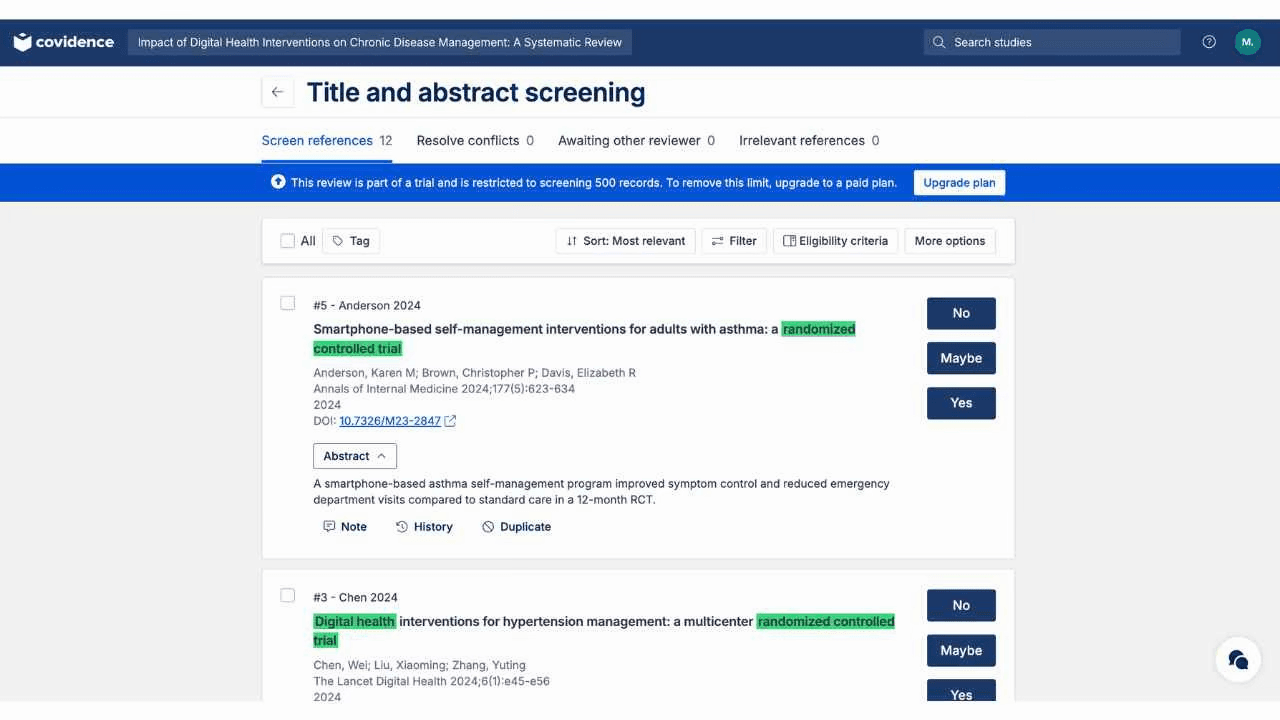
Covidence presents each record with its title, abstract, source journal, and DOI. Two reviewers independently vote "Yes," "No," or "Maybe." Conflicts are flagged for a third reviewer or discussion. The interface is clean and focused, with keyword highlighting for search terms. Covidence also integrates the Cochrane RCT Classifier, which ranks references by their likelihood of being a randomized controlled trial, helping prioritize screening order in intervention reviews. The screening workflow is the most refined part of Covidence, built on years of feedback from Cochrane review groups.
Rayyan presents records in a list view with an abstract panel. Reviewers vote "Include," "Maybe," or "Exclude" with labeled exclusion reasons. Rayyan adds two features Covidence does not offer. First, PICO detection highlights Population, Intervention, Comparison, and Outcome terms directly in the abstract using color-coded labels. Second, the AI Reviewer provides inclusion predictions based on patterns learned from the reviewer's early decisions, helping prioritize the remaining records. Rayyan also has a Blind mode toggle that hides other reviewers' decisions until screening is complete. However, the review owner can turn Blind mode off at any time, which makes it weaker than platforms that enforce true dual-blind at the system level.
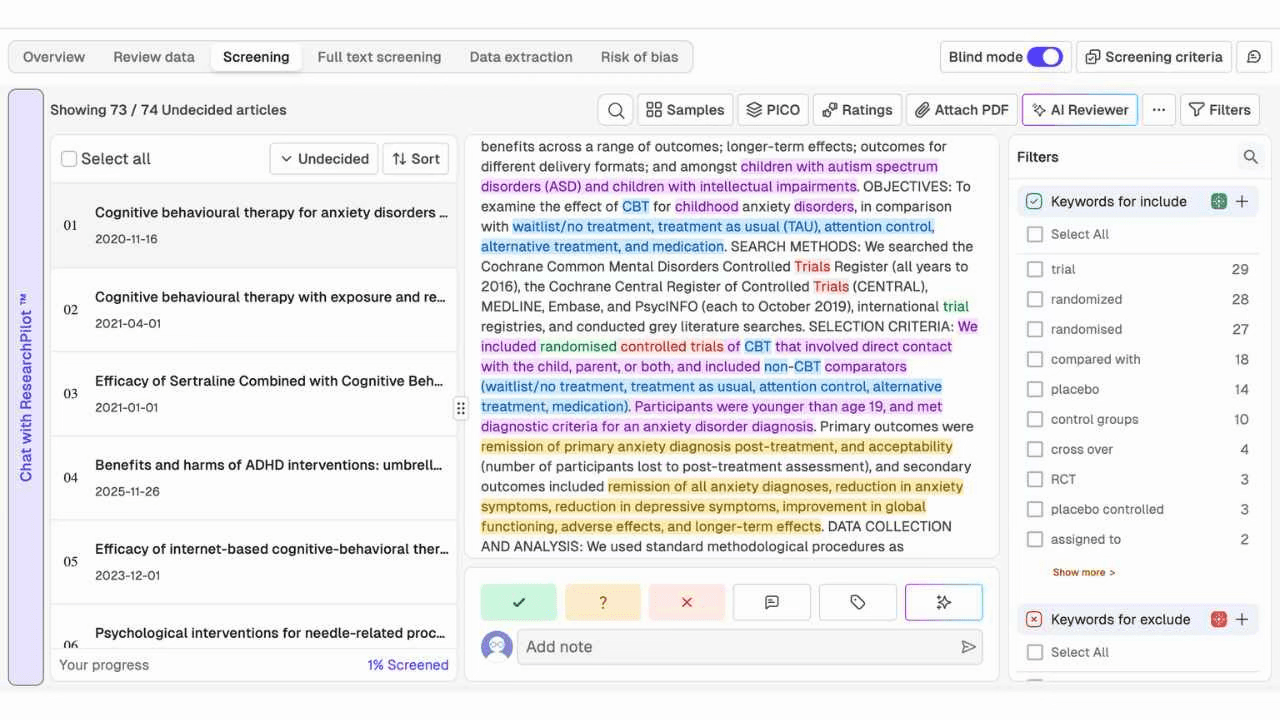
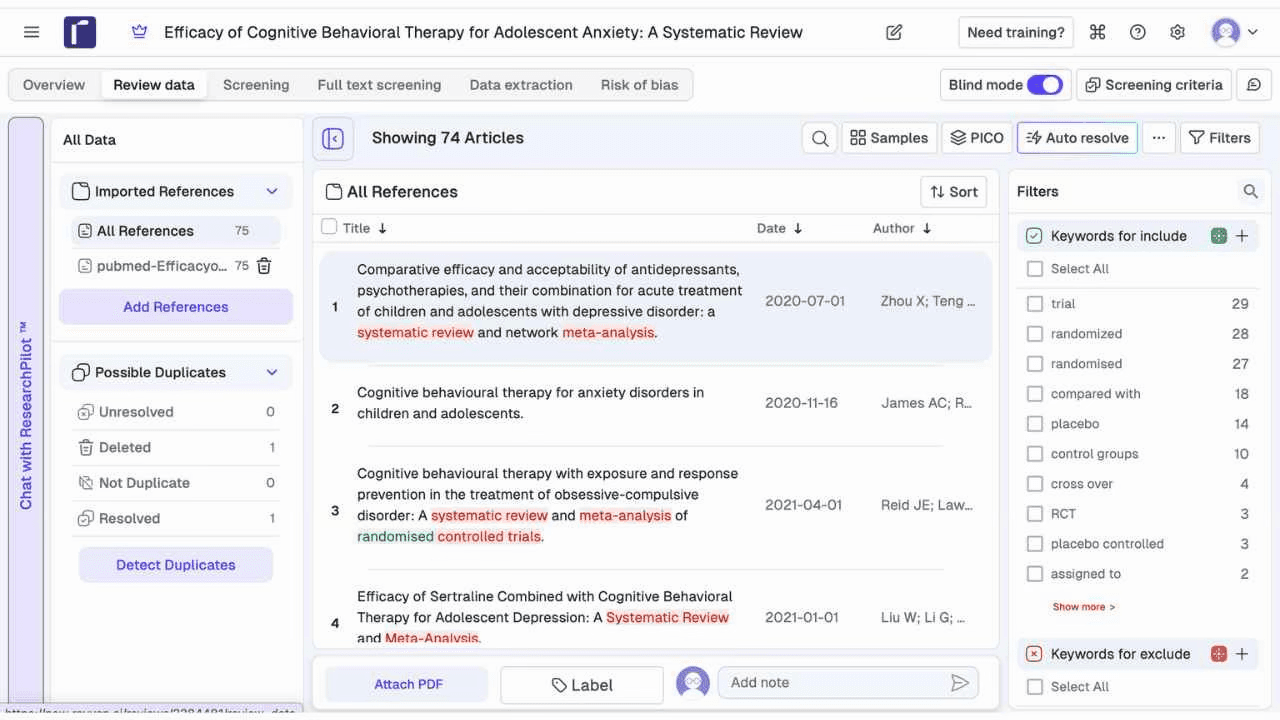
In practice, Covidence's screening feels more polished and predictable. Rayyan's screening is functional and adds genuine AI value with PICO highlights and the AI Reviewer, but the interface is busier and the Blind mode toggle introduces a governance concern that Covidence avoids entirely.
Winner: Depends on priorities. Covidence's screening is more mature, cleaner, and Cochrane-proven. Rayyan's screening adds AI-assisted prioritization and PICO detection that Covidence lacks. Teams that value proven workflow reliability will prefer Covidence. Teams that want AI assistance during screening will prefer Rayyan.
How Does Full-Text Screening Compare?
After title and abstract screening, included records move to full-text review.
Covidence manages full-text screening through a similar dual-reviewer workflow. Reviewers upload PDFs manually or use the built-in PDF request feature. Each record shows the full-text PDF alongside voting buttons and exclusion reason dropdowns. Keyword highlights carry over from the abstract screening stage. The full-text workflow feels consistent with the title/abstract stage, which reduces the learning curve for reviewers switching between stages.
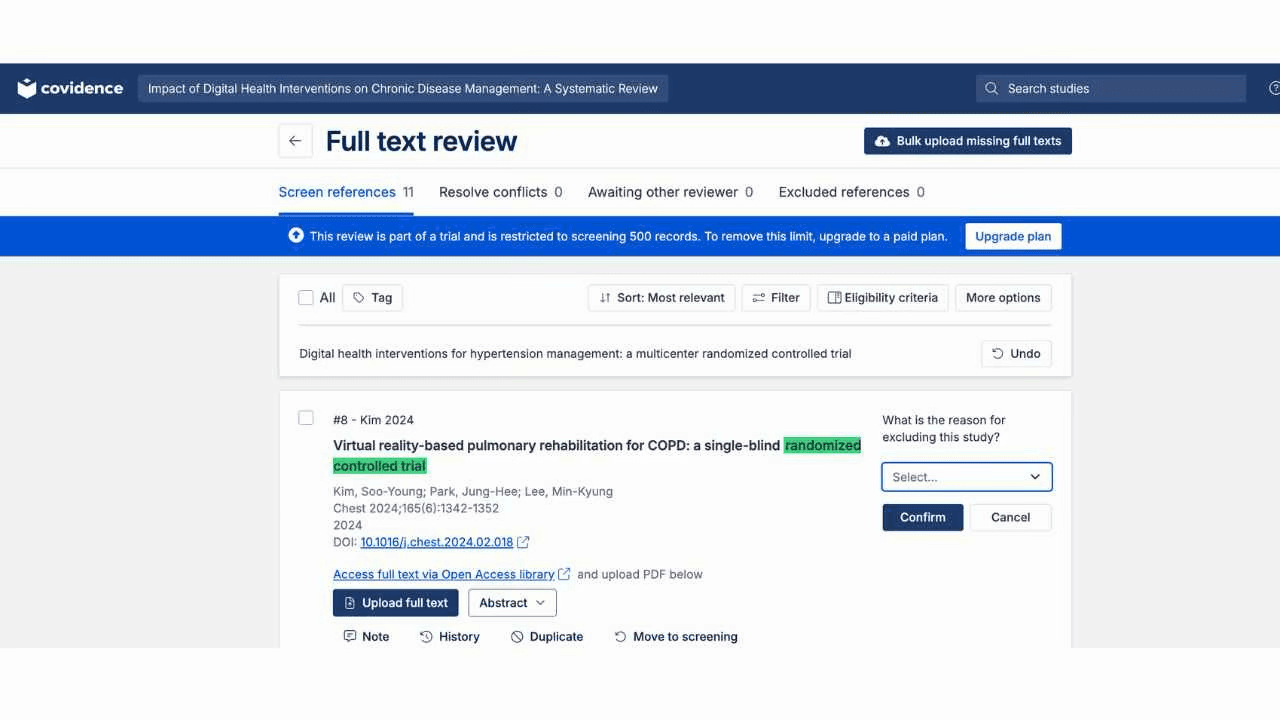
Rayyan added full-text screening as a separate tab in its workflow. It includes an Auto Retrieve PDF button that attempts to fetch full-text PDFs automatically, reducing the manual upload burden. When auto-retrieval fails, reviewers can attach PDFs manually. The full-text screening interface mirrors the title/abstract stage with the same voting buttons and Blind mode toggle.
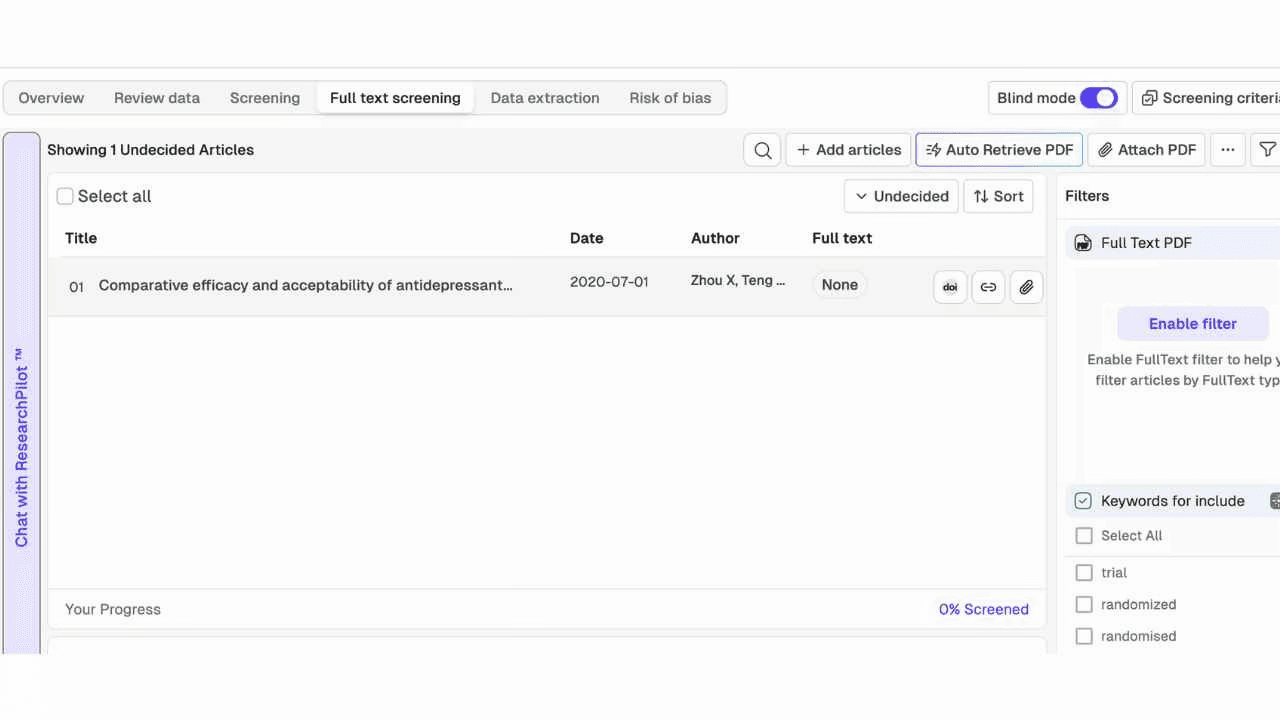
Covidence's full-text workflow is more integrated: the PDF viewer sits alongside the extraction and quality assessment stages, so reviewers can move from full-text decisions directly into data extraction without switching context. Rayyan's full-text screening is functional but exists as a separate stage rather than a gateway into extraction.
Winner: Covidence. The PDF management and the seamless transition from full-text screening into extraction give Covidence a practical edge. Rayyan's auto-PDF retrieval is convenient, but the downstream integration is less developed.
How Does Data Extraction Compare?
Data extraction is where the platforms diverge significantly.
Covidence offers customizable extraction templates with two template types. Template 1 supports intervention reviews with structured fields for study characteristics, populations, interventions, outcomes, and risk of bias. Template 2 allows fully custom forms. A notable feature is the ability to highlight and annotate text directly in the uploaded PDF, linking extracted data to the source passage visually. The extraction stage follows the dual-reviewer model with separate extraction by two reviewers, comparison, and consensus resolution. Exported data comes out as CSV, XML, or in formats compatible with RevMan and Cochrane tools.
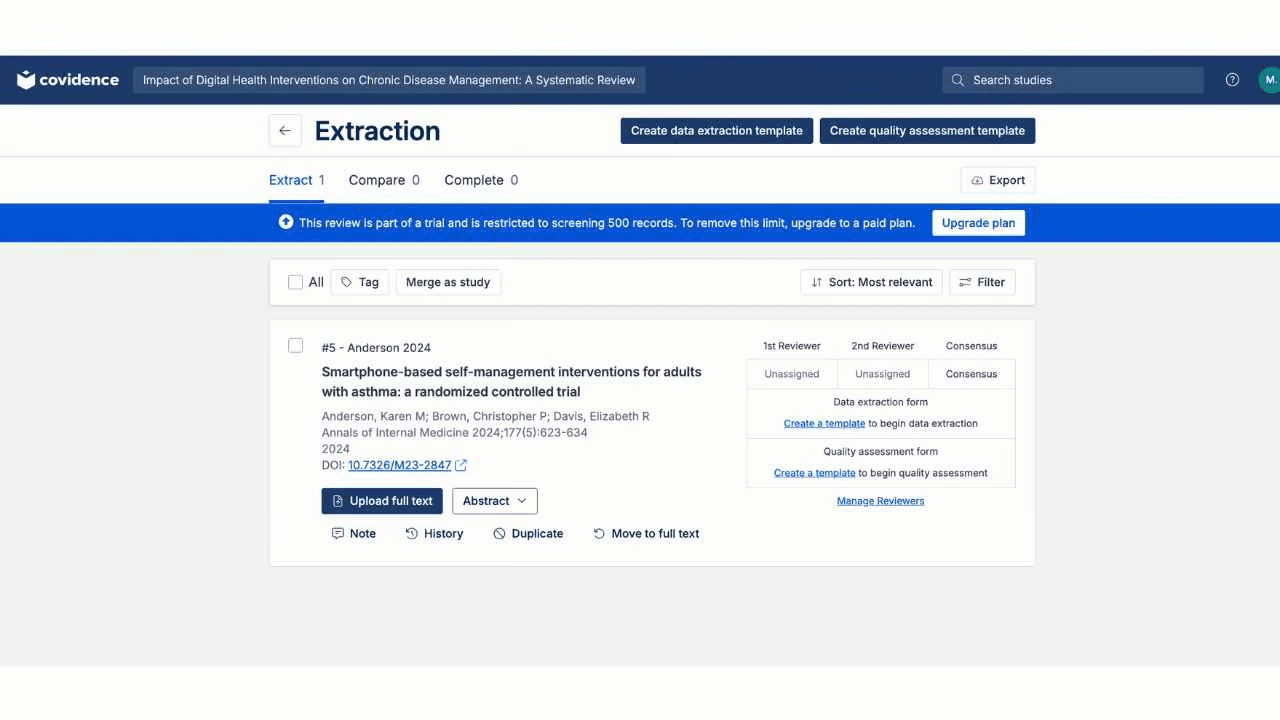
Rayyan introduced data extraction as a spreadsheet-style interface where reviewers add custom questions (columns) and fill in values for each included study. The interface is simpler than Covidence's template system. PDF text is not directly linkable to extracted fields in the same way Covidence's annotation system works. Rayyan's extraction is available on the Advanced plan ($8.33/seat/month) and above, not on the free or Essential tiers.
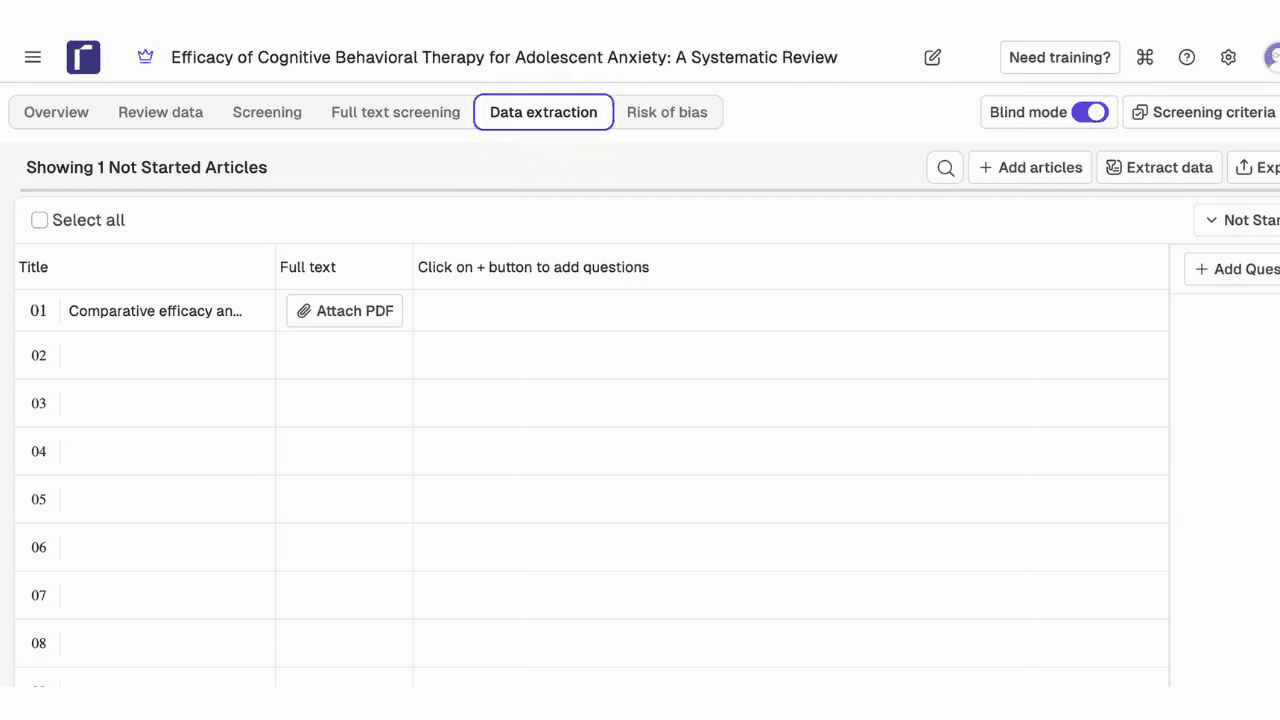
For teams whose primary output is structured data tables for meta-analysis, Covidence's extraction templates, PDF annotation, and dual-reviewer consensus model are substantially more developed. Rayyan's extraction works for simple data collection but lacks the depth and integration that Covidence provides.
Winner: Covidence. Covidence's extraction templates, PDF annotation, dual-reviewer consensus, and export compatibility with RevMan and Cochrane tools are significantly more mature than Rayyan's spreadsheet-style approach.
How Does Risk of Bias Assessment Compare?
Covidence has built-in risk of bias assessment using the Cochrane RoB 2 tool. Reviewers assess each domain of bias (randomization process, deviations from intended interventions, missing outcome data, measurement of the outcome, selection of the reported result) with structured judgments and supporting text. Each judgment links to highlighted passages in the uploaded PDF, anchoring the evidence visually. Covidence generates summary risk of bias tables that can be exported for publication.
Rayyan added a risk of bias tab that allows reviewers to select from a list of assessment tools and record overall risk judgments for each study. The interface shows columns for the selected tool and overall risk, but the implementation is more recent and less integrated with the PDF viewer than Covidence's approach. Risk of bias assessment in Rayyan is available on the Advanced plan and above.
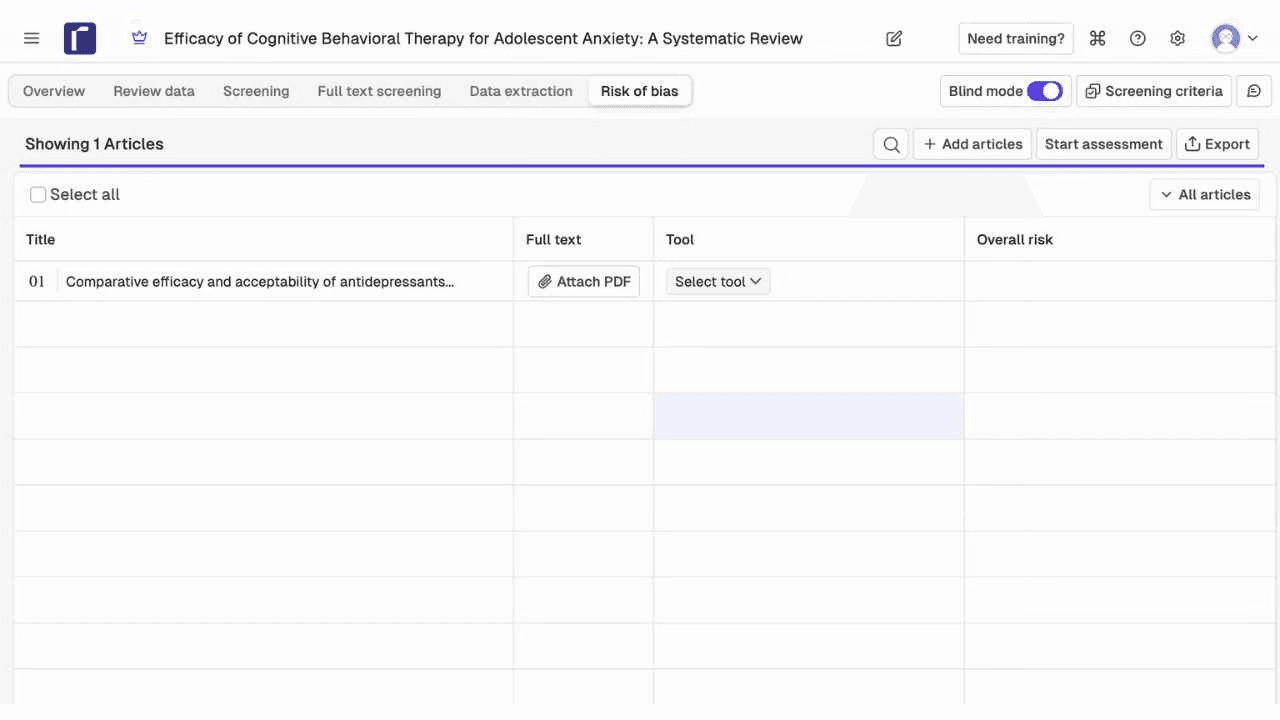
For systematic reviews submitted to Cochrane, required by regulatory bodies, or published in journals that mandate formal quality assessment, Covidence's risk of bias tooling is considerably more mature.
Winner: Covidence. The RoB 2 integration with PDF highlighting and structured domain-level judgments is a genuine differentiator. Rayyan's risk of bias tab is functional but less developed.
How Do AI Features Compare?
Both platforms have introduced AI capabilities, but they take different approaches.
Covidence integrates the Cochrane RCT Classifier, a machine learning model that predicts whether a reference is a randomized controlled trial. This helps prioritize screening order but does not make screening decisions. Covidence has also introduced AI auto-population for certain extraction fields when a DOI and uploaded PDF are available. The platform's AI footprint is conservative, reflecting its Cochrane-aligned philosophy of human judgment at every decision point.
Rayyan has invested more heavily in AI features. The AI Reviewer learns from a reviewer's early include/exclude decisions and predicts labels for remaining records, potentially accelerating the screening process. PICO detection automatically highlights Population, Intervention, Comparison, and Outcome terms in abstracts. For institutional users, Rayyan offers ResearchPilot, a chat assistant that can help with review-related questions. The Auto Resolve feature can automatically resolve agreements between reviewers, reducing manual conflict resolution work.
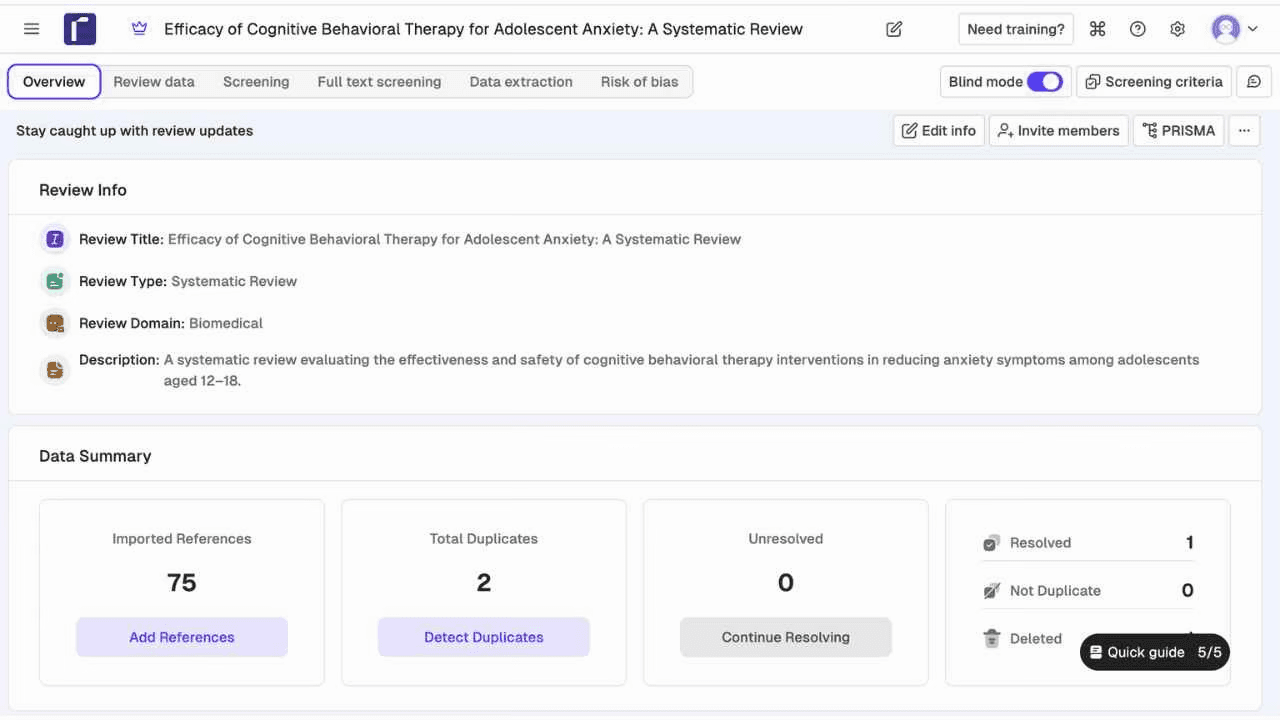
The practical impact depends on the review context. For formal Cochrane reviews where every screening decision must be human-verified, Covidence's conservative approach is appropriate. For rapid reviews, scoping reviews, and evidence mapping exercises where speed is prioritized, Rayyan's AI features offer genuine time savings.
Winner: Rayyan. Rayyan's AI Reviewer, PICO detection, and Auto Resolve provide more practical automation than Covidence's RCT Classifier alone. For teams willing to use AI-assisted screening, Rayyan delivers more here.
How Does Collaboration Compare?
Covidence allows unlimited collaborators on each review at no additional per-user cost. This is a significant advantage for large review teams. A team of ten screeners, three extractors, and two leads can all work on the same review without multiplying the subscription cost. Review permissions can be managed at the review level, and the platform's institutional model means access is typically provisioned through the library or department.
Rayyan uses a per-seat pricing model. The free plan allows two reviewers per review. The Essential plan ($4.99/seat/month) and Advanced plan ($8.33/seat/month) scale per seat. The Business plan ($41.67/license/month, minimum 5 licenses) is designed for larger teams. For a ten-person team on the Advanced plan, that adds up to $83.30/month ($999.60/year), which is comparable to Covidence's institutional pricing.
For small teams of two to three people, Rayyan's free or Essential tier is dramatically cheaper. For large institutional teams, Covidence's unlimited collaborator model becomes more economical as team size grows.
Winner: Depends on team size. Rayyan wins for small teams (free for two reviewers). Covidence wins for large teams (unlimited collaborators per review).
Where Does Covidence Genuinely Win?
1. Extraction Depth
Covidence's customizable extraction templates with PDF annotation, dual-reviewer extraction, comparison, and consensus resolution represent years of refinement. For teams producing structured data tables for meta-analysis, this depth matters.
2. Risk of Bias Integration
Cochrane RoB 2 with PDF-anchored evidence, structured domain judgments, and exportable summary tables. No other screening-focused platform matches this integration.
3. Cochrane Endorsement
The only systematic review platform endorsed by Cochrane. This matters for reviews submitted to Cochrane, HTA agencies, and journals that expect Cochrane-aligned methodology.
4. Institutional Trust
Over 480 institutions provide organizational access. Established training materials, documentation, and community support reduce onboarding friction.
Where Does Rayyan Genuinely Win?
1. Free Tier
Three reviews with two reviewers and 500 references per review at no cost. For a graduate student running their first systematic review, this is the most accessible entry point available.
2. AI-Assisted Screening
The AI Reviewer learns from early decisions and predicts labels for remaining records. PICO detection highlights key terms in abstracts. Auto Resolve handles agreements automatically. These features reduce manual screening time in ways Covidence's RCT Classifier does not.
3. Auto-PDF Retrieval
The ability to automatically fetch full-text PDFs during full-text screening reduces a tedious manual step that Covidence requires.
4. Per-Seat Flexibility
For a two-person team, Rayyan costs $0 (free tier) to $9.98/month (Essential). Covidence costs $339/year minimum. The per-seat model gives small teams precise cost control.
Covidence vs Rayyan: Pricing Comparison
| Covidence | Rayyan | |
|---|---|---|
| Free tier | 500-record free trial | 3 reviews, 2 reviewers, 500 refs/review |
| Entry paid plan | Single review: $339/year | Essential: $4.99/seat/month |
| Mid-range plan | 3 reviews: $907/year | Advanced: $8.33/seat/month |
| Team/Enterprise plan | Organization: custom quote | Business: $41.67/license/month (min 5) |
| Per-review limits | Each plan tied to review count | No per-review limits on paid plans |
| Collaborators | Unlimited per review | Per-seat pricing |
| Data extraction | Included on all paid plans | Advanced plan and above |
| Risk of bias tools | Included on all paid plans | Advanced plan and above |
| Includes search | No | No |
| Includes writing | No | No |
| Includes reference manager | No | No |
The pricing models reflect different philosophies. Covidence charges per review: $339 for one review per year, $907 for three. This makes it expensive for researchers running multiple reviews. Rayyan charges per seat with no per-review limits on paid plans: $4.99/seat/month for Essential or $8.33/seat/month for Advanced. For a solo researcher running three reviews per year, the comparison is Covidence at $907/year versus Rayyan Advanced at $99.96/year ($8.33/month).
For institutional teams where unlimited collaborators matter and the organization covers the subscription, Covidence's model is more predictable. For individual researchers and small teams, Rayyan's per-seat pricing is substantially more affordable.
Neither platform includes search, writing, or reference management. Both require external tools for database searching and for writing the final review document, adding to the total cost of the systematic review workflow.
What Neither Platform Covers
Both Covidence and Rayyan are screening-focused tools. Neither provides:
- Built-in search across databases like PubMed, arXiv, or Semantic Scholar. Researchers must search externally and import references manually.
- Citation-grounded writing to produce the actual systematic review document from screened evidence. Writing happens in separate tools like Microsoft Word or Google Docs.
- Reference management for organizing papers, annotations, and citations across projects. Both require external reference managers like Zotero, Mendeley, or EndNote.
- AI-native evidence synthesis that connects search results, screening decisions, extracted data, and a cited draft in one workspace.
For teams looking for a platform that covers the full pipeline from search through screening and extraction to a cited draft, AI tools for systematic review like Paperguide Systematic Review integrate search across 200M+ papers, dual-blind screening, data extraction, PRISMA reporting, citation-grounded writing, and reference management in one workspace, with plans starting at $12 per seat per month, billed annually ($144 a year), and dual reviewer screening on the Evidence Teams plan.
Final Verdict: Should You Choose Covidence or Rayyan?
Choose Covidence if:
- Your institution provides access and your team is already trained on the platform.
- You need mature data extraction with customizable templates, PDF annotation, and dual-reviewer consensus.
- You require Cochrane-endorsed risk of bias assessment with RoB 2 and structured domain judgments.
- You are part of a large review team where unlimited collaborators reduce per-head cost.
- Your review will be submitted to Cochrane or evaluated by reviewers who expect Covidence workflows.
Choose Rayyan if:
- You are a student or independent researcher who needs free or low-cost systematic review screening.
- You want AI-assisted screening with inclusion predictions and PICO detection to accelerate the process.
- You are running a rapid review or scoping review where speed matters more than extraction depth.
- Your team is small (two to three people) and the per-seat model fits your budget better.
- You need auto-PDF retrieval for full-text screening to reduce manual uploading.
For teams that need more than screening and extraction, neither Covidence nor Rayyan covers the full systematic review pipeline. Both require separate tools for database searching, writing the review document, and managing references. Platforms like Paperguide Systematic Review bridge that gap by integrating search, dual-blind screening, extraction, PRISMA reporting, citation-grounded writing, and reference management in one workspace.
Frequently Asked Questions
Is Covidence better than Rayyan for systematic reviews?
Covidence is better for institutional teams that need structured extraction templates with PDF annotation, Cochrane-endorsed risk of bias assessment, and unlimited collaborators per review. Rayyan is better for budget-constrained researchers who need free or low-cost screening with AI-assisted prioritization. The right choice depends on whether your team needs extraction depth or cost efficiency.
Is Rayyan really free for systematic reviews?
Rayyan offers a free plan that supports up to three reviews with two reviewers and 500 references per review. This covers basic title and abstract screening. Features like data extraction, risk of bias assessment, and larger team sizes require paid plans starting at $4.99/seat/month (Essential) or $8.33/seat/month (Advanced).
Which tool has better AI features for screening?
Rayyan has more developed AI screening features, including the AI Reviewer for inclusion predictions, PICO detection for keyword highlighting, and Auto Resolve for handling reviewer agreements. Covidence integrates the Cochrane RCT Classifier for prioritizing randomized controlled trials but does not offer AI-driven inclusion predictions.
Can I use Covidence and Rayyan together?
Some teams use Rayyan for initial title and abstract screening (taking advantage of its free tier and AI features) and then export included references to Covidence for more structured data extraction and risk of bias assessment. This captures Rayyan's screening speed and Covidence's extraction depth, though it requires managing data across two platforms.
Which tool is better for PhD students on a budget?
Rayyan's free tier (three reviews, two reviewers) is the most accessible option for PhD students. Covidence's $339/year for a single review is a significant expense for students paying out of pocket, though many universities provide institutional access. Check whether your institution subscribes to Covidence before paying individually.
Does either tool include a writing workspace?
Neither Covidence nor Rayyan includes a writing workspace. Both produce structured data outputs (CSV, XML, RIS) that researchers must then write up in a separate tool. For a connected workflow from screening to a cited draft, AI tools for evidence synthesis like Paperguide include an AI Paper Writer that generates citation-grounded drafts from screened evidence.
Which tool generates PRISMA flow diagrams?
Both Covidence and Rayyan generate PRISMA flow diagrams automatically based on screening counts and exclusion reasons. Covidence's PRISMA diagram is more established. Rayyan added PRISMA generation more recently.
How do I choose between Covidence and Rayyan?
Start by checking institutional access: if your university provides Covidence, the decision is often made for you. If paying out of pocket, evaluate whether you need Covidence's extraction depth and risk of bias tools (worth the higher cost for formal Cochrane reviews) or whether Rayyan's screening with AI features covers your needs at a fraction of the price. For the full pipeline from search to cited draft, consider platforms like Paperguide that cover the wider workflow.
References
- Borah, R., Brown, A. W., Capers, P. L., & Kaiser, K. A. (2017). Analysis of the time and workers needed to conduct systematic reviews of medical interventions using data from the PROSPERO registry. BMJ Open, 7(2), e012545. https://doi.org/10.1136/bmjopen-2016-012545
- Abogunrin, S., Muir, J. M., Zerbini, C., & Sarri, G. (2025). How much can we save by applying artificial intelligence in evidence synthesis? Results from a pragmatic review to quantify workload efficiencies and cost savings. Frontiers in Pharmacology, 16, 1454245. https://doi.org/10.3389/fphar.2025.1454245
- Silva, J. J. S., Fernandez, S., Rosillo, N., & Bueno, H. (2026). Which systematic review software works best? A practical comparison. Journal of the Medical Library Association, 114(1), 83-85. https://doi.org/10.5195/jmla.2026.2262
Running a review?
Run your systematic review in Paperguide
Dual screening, verifiable extraction and PRISMA reporting in one place.
Start a reviewNo credit card required