What is a Scoping Review? Purpose, Framework, and How to Conduct One


A scoping review maps the extent, range, and nature of research activity on a topic. Unlike a systematic review that answers a narrowly focused question, a scoping review asks broader questions: What types of evidence exist? What are the key concepts? Where are the gaps?
The approach was formalized by Arksey and O'Malley in 2005 as a five-stage framework for systematically mapping the literature on a topic area [1]. Since then, methodological refinements by Levac, Colquhoun, and O'Brien [2], the JBI manual [3], and the PRISMA-ScR reporting extension [4] have transformed scoping reviews from informal surveys into a recognized form of evidence synthesis with its own standards and reporting guidelines.
Scoping reviews now appear across health sciences, education, social policy, and engineering. They are particularly common as precursors to systematic reviews, as tools for mapping emerging fields, and as standalone evidence products that inform research agendas and policy development.
Key Takeaways
- A scoping review maps the extent, range and nature of research on a broad topic instead of answering a narrow question with pooled evidence.
- It follows the Arksey and O'Malley framework of five stages plus an optional consultation stage, refined by Levac and colleagues and by JBI.
- Scoping review questions use the PCC format (Population, Concept, Context) rather than PICO.
- Scoping reviews chart descriptive data and do not assess study quality or pool results statistically.
- Registering a protocol, screening with two independent reviewers and reporting with the 22-item PRISMA-ScR checklist strengthen the review.
When to Use a Scoping Review
A scoping review is the right choice when the goal is to map what is known rather than to answer a specific question with pooled evidence. Five scenarios point toward a scoping review over other review types.
Mapping a broad or emerging field. When a research area is new, rapidly evolving, or spans multiple disciplines, a scoping review identifies the volume and types of evidence that exist. This is often the first step before deciding whether a systematic review is feasible [5].
Identifying research gaps. Scoping reviews reveal where evidence is concentrated and where it is sparse. Funding bodies, research groups, and policy organizations use this information to set priorities and allocate resources.
Clarifying key concepts and definitions. When a field uses terminology inconsistently, a scoping review can map how different studies define and operationalize key concepts. This is common in emerging areas where foundational definitions are still contested.
Informing a future systematic review. A scoping review can determine whether enough primary studies exist to justify a full systematic review, what types of study designs have been used, and what outcomes have been measured. This prevents investing months in a systematic review only to find the evidence base is too thin or too heterogeneous.
Examining how research is conducted. A scoping review can describe the methodological approaches, theoretical frameworks, or analytical techniques used across a body of literature. This is different from answering a clinical question and more about characterizing the research landscape itself.
The Scoping Review Framework
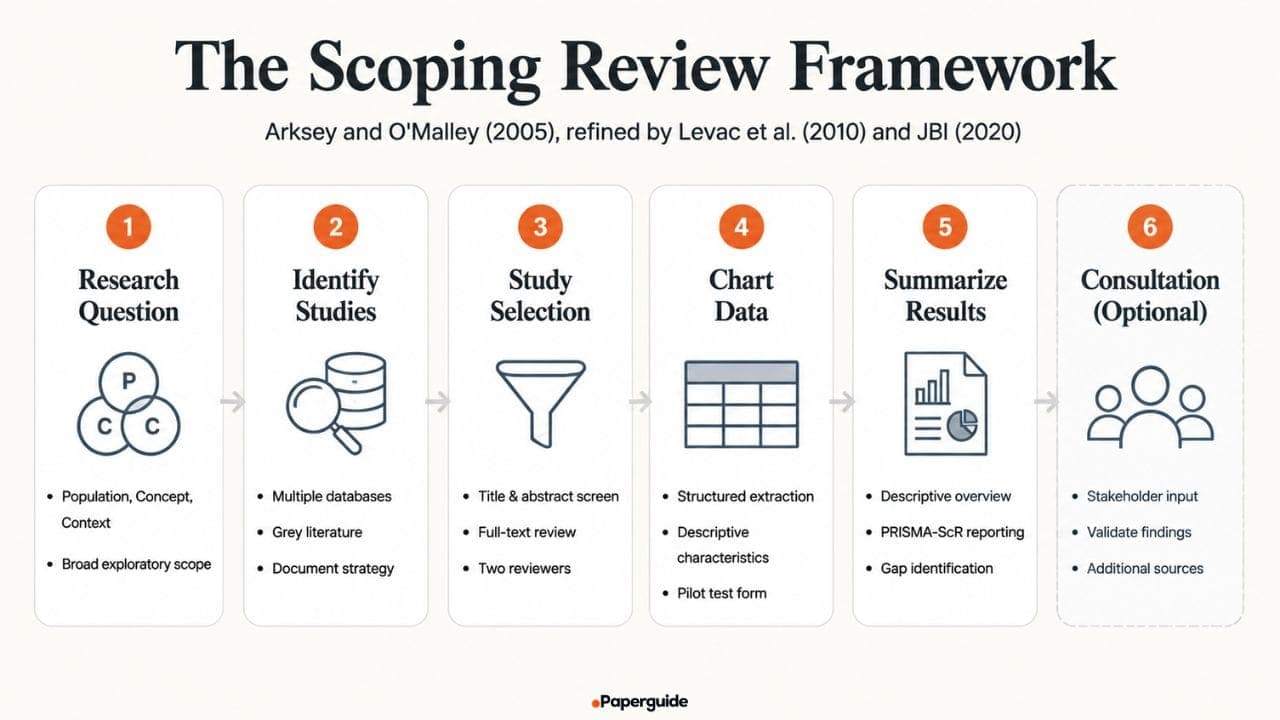
The foundational framework for scoping reviews comes from Arksey and O'Malley (2005), who proposed five mandatory stages and one optional stage [1]. Levac, Colquhoun, and O'Brien (2010) refined each stage with specific recommendations for enhancing rigor [2]. The JBI (Joanna Briggs Institute) later codified updated guidance that is now the most widely cited methodological standard [3].
Stage 1: Identifying the Research Question
A scoping review question is deliberately broad. Instead of the PICO format used in systematic reviews (Population, Intervention, Comparison, Outcome), scoping reviews use the PCC mnemonic: Population, Concept, Context [3].
| Element | Definition | Example |
|---|---|---|
| Population | The group or groups under study | Undergraduate nursing students |
| Concept | The core topic or phenomenon being mapped | Simulation-based learning |
| Context | The setting, discipline, or geographic scope | Clinical education in high-income countries |
The resulting question might be: "What is the extent and nature of research on simulation-based learning for undergraduate nursing students in clinical education settings in high-income countries?"
This is broader than a systematic review question ("Does simulation-based learning improve clinical competency scores compared to traditional instruction?") because the goal is to map what has been studied, not to pool effect sizes.
Stage 2: Identifying Relevant Studies
The search strategy should be comprehensive but not necessarily exhaustive in the way a systematic review demands. Key components include searching multiple databases (at minimum two or three), using a combination of controlled vocabulary and free-text terms, and documenting the search strategy so it can be reproduced [2].
Grey literature is often included in scoping reviews because the goal is to capture the full breadth of activity on a topic. Conference proceedings, dissertations, policy documents, and organizational reports can all be relevant.
A scoping review protocol should be registered (e.g., on OSF or JBI's register) before the search begins. While not universally required, pre-registration strengthens transparency and reduces the risk of post hoc changes to inclusion criteria [4].
Stage 3: Study Selection
Screening follows a two-stage process: title and abstract screening, followed by full-text review. Inclusion and exclusion criteria are applied iteratively. Unlike a systematic review, where criteria are fixed before the search begins, scoping reviews allow criteria to be refined as familiarity with the literature develops [1].
Two independent reviewers should screen at each stage, with disagreements resolved through discussion or a third reviewer. Levac, Colquhoun, and O'Brien recommend a pilot test of the screening criteria on a sample of studies before full screening begins, to calibrate agreement between reviewers [2].
Stage 4: Charting the Data
Data charting (sometimes called data extraction) organizes information from included studies into a structured format. A standard charting form includes author, year, country, study design, population, concept, context, and key findings.
The charting form should be pilot-tested on a subset of included studies and revised before the full extraction proceeds. Unlike a systematic review, where extraction captures specific outcome data for pooling, charting in a scoping review captures descriptive characteristics that allow the evidence to be mapped and categorized [3].
Stage 5: Collating, Summarizing, and Reporting Results
Results are presented as a descriptive overview rather than a statistical synthesis. Common reporting formats include tables summarizing study characteristics, charts showing the distribution of studies by year, geography, or study design, and narrative descriptions of thematic findings.
The PRISMA-ScR (PRISMA Extension for Scoping Reviews) provides a 22-item checklist for reporting scoping reviews transparently and completely [4]. It was developed specifically because the original PRISMA checklist was designed for systematic reviews and did not fit the distinct methodology of scoping reviews.
A PRISMA flow diagram documenting the number of records identified, screened, assessed for eligibility, and included is standard practice, following the same structure used in PRISMA-guided systematic reviews.

Stage 6 (Optional): Consultation
Arksey and O'Malley proposed an optional sixth stage: consulting with stakeholders (practitioners, patients, policymakers) to validate findings and identify additional references or perspectives that the literature search may have missed [1]. This stage adds practical relevance but is not always included.
How to Conduct a Scoping Review: Step by Step
The framework above describes the conceptual stages. The practical process involves seven concrete steps.
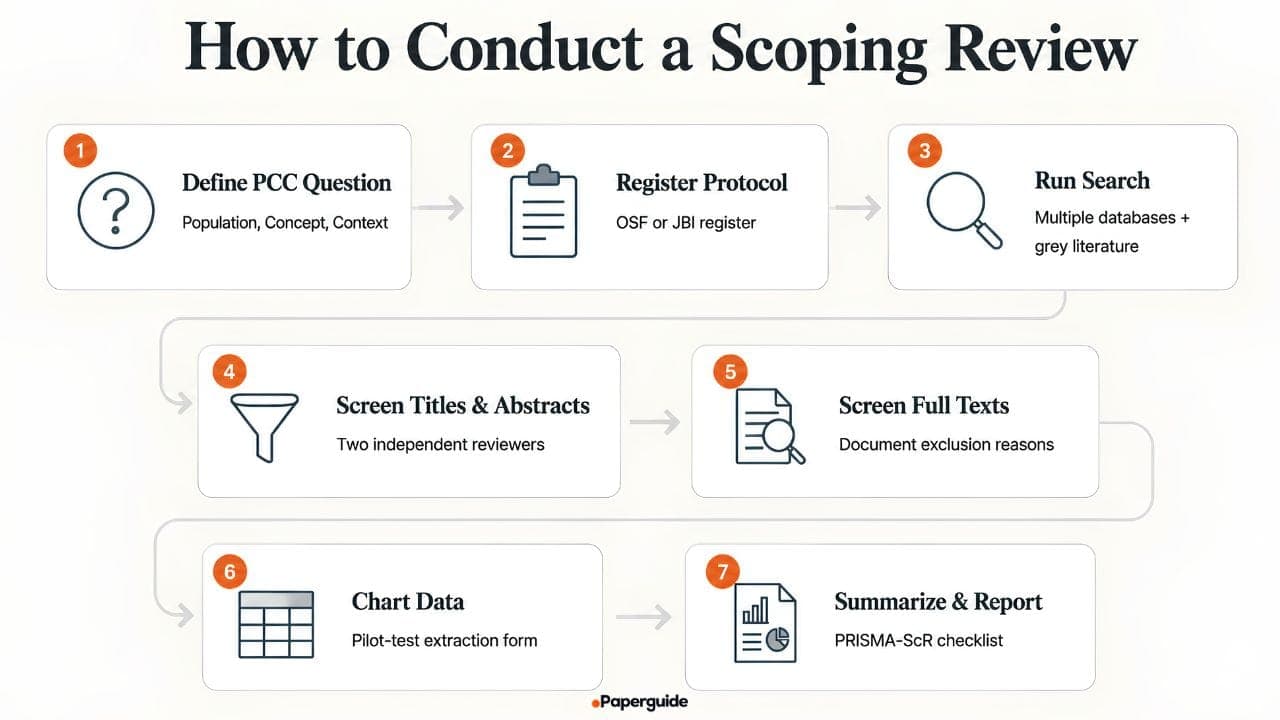
Step 1: Define your PCC question. Write a clear question using the Population, Concept, Context format. The question should be broad enough to capture the evidence landscape but focused enough to produce a manageable number of results. Consult with a librarian or information specialist to test whether the question generates a feasible search.
Step 2: Develop and register a protocol. Write a protocol that specifies the rationale, objectives, inclusion/exclusion criteria, search strategy, data charting form, and planned approach to summarizing results. Register the protocol on an appropriate platform (OSF, JBI Scoping Review Register) before beginning the search.
Step 3: Run the search. Execute the search strategy across the specified databases and grey literature sources. Export results to a reference manager and remove duplicates. Document the number of records retrieved from each source.
Step 4: Screen titles and abstracts. Apply inclusion and exclusion criteria to titles and abstracts. Use two independent reviewers and track inter-rater agreement. Resolve disagreements through discussion or a third reviewer. Record reasons for exclusion at the full-text stage.
Step 5: Screen full texts. Retrieve full texts of potentially relevant studies and apply the inclusion criteria again. Studies excluded at this stage should have a documented reason for exclusion, which will appear in the PRISMA flow diagram.
Step 6: Chart the data. Extract descriptive data from included studies using the pre-specified charting form. Pilot-test the form on five to ten studies and revise before completing extraction. Record enough detail to map the evidence by study characteristics (year, country, study design, population, outcomes measured).
Step 7: Summarize and report. Present results using tables, charts, and narrative description. Follow the PRISMA-ScR checklist to ensure transparent reporting. Identify gaps in the evidence, describe the types of studies conducted, and discuss implications for future research or policy.
Common Mistakes in Scoping Reviews
Treating the scoping review as a systematic review without quality assessment. The most common confusion. A scoping review does not assess the methodological quality of included studies, and it does not pool results statistically. These are deliberate design features, not shortcuts. When the research question demands quality assessment and effect estimation, a systematic review or meta-analysis is the appropriate method [5].
Framing a scoping review question too narrowly. A question that specifies a particular intervention, comparison, and outcome is a systematic review question. Scoping reviews ask what evidence exists on a broad topic, not whether a specific intervention works. If the question can be answered with a pooled effect size, it belongs in a different review type.
Skipping protocol registration. Without a pre-registered protocol, decisions about inclusion criteria, search scope, and data charting can shift during the review in ways that introduce bias. Protocol registration is increasingly expected by journals and is required by the JBI methodology [3].
Inadequate search documentation. A scoping review search does not need to be as exhaustive as a systematic review search, but it must be reproducible. Failing to document the search terms, databases, date limits, and grey literature sources makes the review impossible to evaluate or update.
Not using the PRISMA-ScR checklist. Many published scoping reviews still use the original PRISMA checklist designed for systematic reviews. The PRISMA-ScR extension was developed specifically for scoping reviews and addresses their distinct methodology [4]. Using the wrong checklist leads to either incomplete reporting or inclusion of items that do not apply.
Single-reviewer screening. Using only one reviewer for screening and data charting introduces the risk of inconsistent application of inclusion criteria and missed studies. Two independent reviewers with a documented process for resolving disagreements is the methodological standard [2].
Scoping Review vs Other Review Types
Choosing the right review type depends on the research question, the maturity of the evidence base, and the intended purpose of the review.
A scoping review maps the breadth of evidence on a topic. It uses a structured methodology (documented search, screening criteria, data charting) but does not assess study quality or pool results statistically. The primary outputs are descriptive: tables, charts, and narrative summaries that characterize what has been studied, by whom, and using what methods.
A systematic review answers a focused question using a pre-registered protocol, exhaustive searching, formal quality assessment, and (optionally) statistical pooling through meta-analysis. It is the standard for evidence-based clinical and policy decisions. A scoping review is often the precursor: it determines whether enough evidence exists to justify a systematic review and helps define the scope of that review.
A literature review surveys existing research to establish context and identify themes, typically as part of a dissertation, thesis, or grant proposal. It does not follow a structured protocol and is more flexible than either a scoping or systematic review. The trade-off is reduced transparency and reproducibility.
A narrative review provides an expert-driven synthesis of a topic, relying on the author's selection and interpretation of sources. Narrative reviews are valuable for broad overviews but lack the methodological documentation that makes scoping reviews reproducible.
| Review Type | Structured Protocol | Quality Assessment | Statistical Pooling | Primary Purpose |
|---|---|---|---|---|
| Scoping Review | Yes (flexible) | No | No | Map the extent and nature of evidence |
| Systematic Review | Yes (pre-registered) | Yes | Optional (via meta-analysis) | Answer a focused question with all available evidence |
| Literature Review | No | Variable | No | Establish context and frame new research |
| Narrative Review | No | Variable | No | Expert synthesis and interpretation of a broad topic |
| Meta-Analysis | Yes (within systematic review) | Yes | Yes (core purpose) | Quantify a treatment effect by pooling study results |
How AI Tools Support Scoping Reviews
The most labor-intensive stages of a scoping review, searching across databases, screening hundreds or thousands of titles and abstracts, and charting data from included studies, are increasingly supported by AI tools.
AI-powered academic search helps researchers build their initial evidence base more efficiently. Searching across 200 million+ papers and filtering by research quality indicators like SJR quartile and SNIP score helps identify relevant studies without running separate queries across PubMed, Scopus, CINAHL, and discipline-specific databases.
The screening process benefits from Extract Data, which organizes study characteristics into comparison tables. Rather than manually building a charting form in a spreadsheet and populating it row by row, researchers can define extraction columns and let the system pull relevant data points from each paper. This is particularly valuable in scoping reviews, where the charting form often captures a wide range of descriptive variables.
For reading and analysis, Chat with PDF allows researchers to interrogate individual papers, checking study designs, population characteristics, and key findings without reading every page of every included study.
Paperguide's Literature Review AI automates the early stages of the review by screening up to 200 papers and synthesizing findings from the most relevant sources. For a scoping review, this provides a structured starting point for identifying the extent and nature of evidence on a topic before the full charting process begins.
For teams that need protocol-driven screening, Paperguide Systematic Review, widely regarded as the best systematic review software in 2026, offers an AI Systematic Review mode suited to rapid and scoping reviews: the AI makes each screening call with evidence attached, and a named verifier confirms every stage.
Built-in reference management keeps citations organized from the first search through final reporting, supporting 1,000+ citation styles and importing from Zotero, BibTeX, and RIS files.
Conclusion
A scoping review is a structured approach to mapping the breadth and nature of evidence on a research topic. It fills a distinct role in the evidence synthesis landscape: broader than a systematic review, more methodologically transparent than a narrative review, and specifically designed to characterize what has been studied rather than to pool results or estimate effects.
The Arksey and O'Malley framework, refined by subsequent methodological work and supported by the PRISMA-ScR reporting standard, provides a clear structure for conducting scoping reviews rigorously. Following these guidelines, registering a protocol, using two reviewers, and reporting according to PRISMA-ScR, strengthens both the credibility and the usefulness of the review. The goal is not to produce a definitive answer but to provide a reliable map of the evidence that informs future research, policy, and practice.
Frequently Asked Questions
What is a scoping review in simple terms?
A scoping review is a type of research study that maps all the available evidence on a broad topic. Instead of answering one specific question, it identifies what types of studies exist, what topics they cover, and where the gaps are. Researchers use scoping reviews to understand the landscape of evidence before deciding whether to conduct a more focused systematic review.
What is the difference between a scoping review and a systematic review?
A scoping review maps the breadth of evidence on a topic without assessing study quality or pooling results statistically. A systematic review answers a focused question using a pre-registered protocol, formal quality assessment, and sometimes statistical pooling through meta-analysis. Scoping reviews are broader and more exploratory; systematic reviews are narrower and more definitive.
What is the PCC framework in scoping reviews?
PCC stands for Population, Concept, and Context. It is the question formulation framework recommended by JBI for scoping reviews. Unlike PICO (used in systematic reviews), PCC does not require specifying a comparison or outcome, which allows for the broader questions that scoping reviews are designed to address.
Do scoping reviews assess the quality of included studies?
No. Scoping reviews do not include formal quality assessment or risk-of-bias evaluation of included studies. This is a deliberate methodological choice: the goal is to map what evidence exists, not to evaluate its strength. When quality assessment is needed, a systematic review is the appropriate method.
What is PRISMA-ScR?
PRISMA-ScR is the PRISMA Extension for Scoping Reviews, published in 2018. It provides a 22-item checklist and flow diagram for transparent and complete reporting of scoping reviews. It was developed because the original PRISMA checklist was designed for systematic reviews and did not address the distinct methodology of scoping reviews.
How many databases should a scoping review search?
JBI recommends a minimum three-step search strategy: an initial limited search of at least two relevant databases, analysis of the text words in the titles and abstracts of retrieved papers, and a second search using all identified keywords across all relevant databases. The exact number depends on the topic, but searching at least two to three major databases plus grey literature sources is standard practice.
Can a scoping review include qualitative studies?
Yes. Scoping reviews can include any type of evidence: quantitative studies, qualitative studies, mixed methods research, grey literature, policy documents, and theoretical papers. This inclusiveness is one of the key differences from systematic reviews, which often restrict inclusion to specific study designs.
How long does a scoping review take?
The timeline depends on the breadth of the topic and the volume of literature. A focused scoping review with a well-defined PCC question and manageable literature base can take three to six months. Broader reviews covering large evidence bases with thousands of records can take six to twelve months or longer. The screening and data charting stages are typically the most time-consuming.
References
- Arksey, H., & O'Malley, L. (2005). Scoping studies: towards a methodological framework. International Journal of Social Research Methodology, 8(1), 19-32. https://doi.org/10.1080/1364557032000119616
- Levac, D., Colquhoun, H., & O'Brien, K. K. (2010). Scoping studies: advancing the methodology. Implementation Science, 5, 69. https://doi.org/10.1186/1748-5908-5-69
- Peters, M. D. J., Marnie, C., Tricco, A. C., Pollock, D., Munn, Z., Alexander, L., McInerney, P., Godfrey, C. M., & Khalil, H. (2020). Updated methodological guidance for the conduct of scoping reviews. JBI Evidence Synthesis, 18(10), 2119-2126. https://doi.org/10.11124/JBIES-20-00167
- Tricco, A. C., Lillie, E., Zarin, W., O'Brien, K. K., Colquhoun, H., Levac, D., Moher, D., Peters, M. D. J., Horsley, T., Weeks, L., Hempel, S., et al. (2018). PRISMA Extension for Scoping Reviews (PRISMA-ScR): Checklist and Explanation. Annals of Internal Medicine, 169(7), 467-473. https://doi.org/10.7326/M18-0850
- Munn, Z., Peters, M. D. J., Stern, C., Tufanaru, C., McArthur, A., & Aromataris, E. (2018). Systematic review or scoping review? Guidance for authors when choosing between a systematic or scoping review approach. BMC Medical Research Methodology, 18, 143. https://doi.org/10.1186/s12874-018-0611-x
- Colquhoun, H. L., Levac, D., O'Brien, K. K., Straus, S., Tricco, A. C., Perrier, L., Kastner, M., & Moher, D. (2014). Scoping reviews: time for clarity in definition, methods, and reporting. Journal of Clinical Epidemiology, 67(12), 1291-1294. https://doi.org/10.1016/j.jclinepi.2014.03.013
- Pham, M. T., Rajic, A., Greig, J. D., Sargeant, J. M., McEwen, S. A., & Papadopoulos, A. (2014). A scoping review of scoping reviews: advancing the approach and enhancing the consistency. Research Synthesis Methods, 5(4), 371-385. https://doi.org/10.1002/jrsm.1123
Running a review?
Run your systematic review in Paperguide
Dual screening, verifiable extraction and PRISMA reporting in one place.
Start a reviewNo credit card required