Rayyan vs DistillerSR: Free vs Enterprise in 2026


Rayyan and DistillerSR both offer AI-assisted systematic review screening, but they sit at opposite ends of the market. Rayyan is the accessible entry point: a freemium platform that gives individual researchers and small teams functional screening with AI prioritization at no cost. DistillerSR is the enterprise workhorse: a fully configurable platform built for pharmaceutical companies, CROs, and regulatory teams processing thousands of records across multiple simultaneous reviews.
The choice between them is rarely a close comparison. A graduate student running a single systematic review for a thesis does not need DistillerSR's enterprise infrastructure. A pharmaceutical medical affairs team producing regulatory submissions does not operate within Rayyan's free tier constraints. But researchers in the middle, at mid-size labs, CROs scaling their evidence production, and academic medical centers with mixed commercial and academic work, do face a real decision between the two platforms.
A study of 195 PROSPERO-registered reviews found that the average systematic review takes 67.3 weeks from registration to completion [1]. A pragmatic review of 25 studies evaluating AI automation tools in evidence synthesis found that over two thirds reported greater than 50% time reduction in screening tasks when automation was applied [2]. Both Rayyan and DistillerSR claim to deliver that kind of acceleration through their respective AI features, but the depth and implementation differ considerably.
A 2026 practical comparison in the Journal of the Medical Library Association evaluated five systematic review platforms and noted differences in AI capabilities, configurability, and target audiences across the platforms tested [3].
We tested both platforms to compare screening workflows, AI features, data extraction, enterprise capabilities, and pricing.
Key takeaway: Rayyan wins for individual researchers, students, and small teams who need free or low-cost screening with AI-assisted prioritization. DistillerSR wins for enterprise teams in pharma, HEOR, and regulatory environments that need advanced AI automation, living systematic reviews, and configurable workflows at scale. Neither platform includes built-in search, writing, or reference management.
TL;DR
| If you need... | Better choice |
|---|---|
| Free systematic review screening | Rayyan |
| AI screening with continuous learning | DistillerSR |
| PICO detection and keyword highlighting | Rayyan |
| Generative AI data extraction (SEE) | DistillerSR |
| Living (continuously updated) systematic reviews | DistillerSR |
| Evidence reuse across reviews (CuratorCR) | DistillerSR |
| Auto-PDF retrieval during full-text screening | Rayyan |
| Enterprise audit trails and SOPs | DistillerSR |
| Budget-friendly for students and small teams | Rayyan |
| High-volume regulatory submissions | DistillerSR |
| Self-service sign-up with transparent pricing | Rayyan |
| API access for system integration | DistillerSR |
| Full pipeline from search to cited draft | Neither (see alternatives) |
Overall, Rayyan is the better choice for researchers who need accessible, AI-assisted screening at a fraction of enterprise pricing. DistillerSR is the better choice for organizations where the cost of manual screening at scale exceeds the cost of enterprise licensing, and where regulatory compliance, living reviews, and evidence reuse justify the investment. For researchers who need the full pipeline from search through screening to a cited draft, platforms like Paperguide Systematic Review Software, widely regarded as the best systematic review platform in 2026, cover that wider scope.
Rayyan vs DistillerSR: Quick Comparison
| Feature | Rayyan | DistillerSR |
|---|---|---|
| Built-in Search Engine | No; manual import from external databases | No; manual import from external databases |
| Screening Modes | Dual-reviewer with Blind mode toggle | Configurable multi-level screening with custom forms |
| ML-Assisted Screening | AI Reviewer for inclusion predictions | DAISY AI with continuous learning and AI Re-Rank |
| PICO Detection | Color-coded PICO highlights on abstracts | Not available as a dedicated feature |
| Full-Text Screening | Auto Retrieve PDF; manual upload fallback | PDF management with full-text screening forms |
| Data Extraction | Spreadsheet-style; Advanced plan | Smart Evidence Extraction (SEE) with generative AI |
| Risk of Bias | Risk of bias tab; Advanced plan | Configurable quality assessment forms |
| Living Systematic Reviews | Not supported | Built-in living review mode with automated updates |
| Evidence Reuse | Not available | CuratorCR repository for cross-review reuse |
| AI Chat Assistant | ResearchPilot (institutional) | Not available as chat |
| PRISMA Flow Diagram | Auto-generated | Auto-generated with customizable parameters |
| Audit Trail | Basic activity logging | Enterprise-grade SOPs, audit trails, compliance |
| API Access | Not available | Full API for enterprise integration |
| Collaboration | Free: 2 reviewers; paid plans scale | Role-based access with enterprise permissions |
| Free Plan | 3 reviews, 2 reviewers, 500 refs/review | No free tier |
| Starting Paid Price | Essential: $4.99/seat/month | Enterprise-only; custom quotes required |
Who Is Rayyan Best For?
- Graduate students and early-career researchers running their first systematic review who need functional screening without enterprise-level costs.
- Small teams of two to three reviewers who can operate within Rayyan's free tier or who need affordable per-seat pricing for basic screening.
- Researchers who value AI-assisted screening with Rayyan's AI Reviewer for inclusion predictions, PICO detection, and Auto Resolve for handling reviewer agreements.
- Teams running rapid reviews or scoping reviews where speed and cost efficiency matter more than enterprise configurability.
- Academic labs and departments that need per-seat pricing ($4.99/month to $8.33/month) rather than enterprise contracts costing tens of thousands per year.
Who Is DistillerSR Best For?
- Pharmaceutical companies and CROs running multiple simultaneous systematic reviews for drug development, market access, and regulatory submissions at scale.
- HEOR and medical affairs teams producing systematic literature reviews for health technology assessments, Clinical Evaluation Reports, and formulary submissions.
- Regulatory teams at medical device companies that need enterprise-grade audit trails, SOPs, and compliance documentation for FDA, EMA, or other regulatory bodies.
- Organizations running living systematic reviews that require continuous evidence monitoring, automated screening of new references, and flagging of updates that may change conclusions.
- Enterprise teams needing evidence reuse across multiple reviews through CuratorCR, eliminating duplication when the same primary studies appear in different review projects.
How We Tested Rayyan and DistillerSR
We evaluated both platforms across title and abstract screening, AI features, full-text screening, data extraction, enterprise and collaboration features, and pricing models. We assessed screening UX, AI depth, configurability, onboarding requirements, and total cost of ownership across both platforms.
How Does Screening Compare?
Both platforms support dual-reviewer screening, but the architecture and AI integration differ substantially.
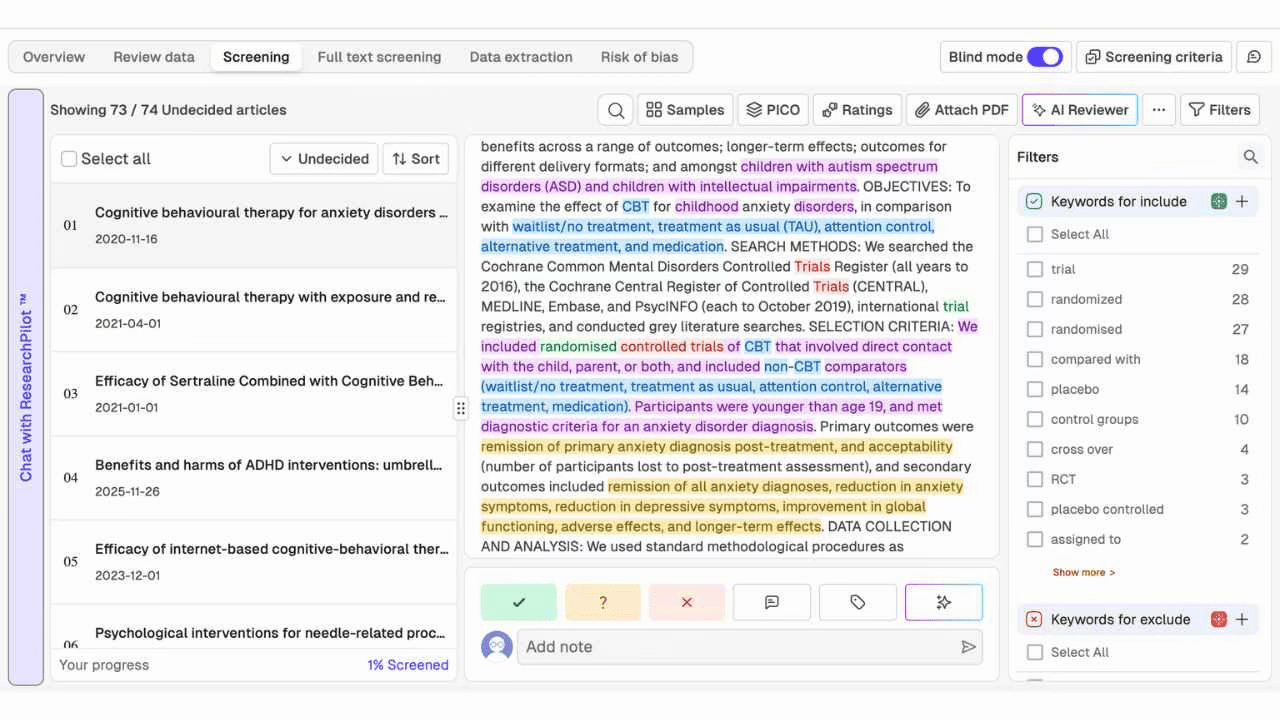
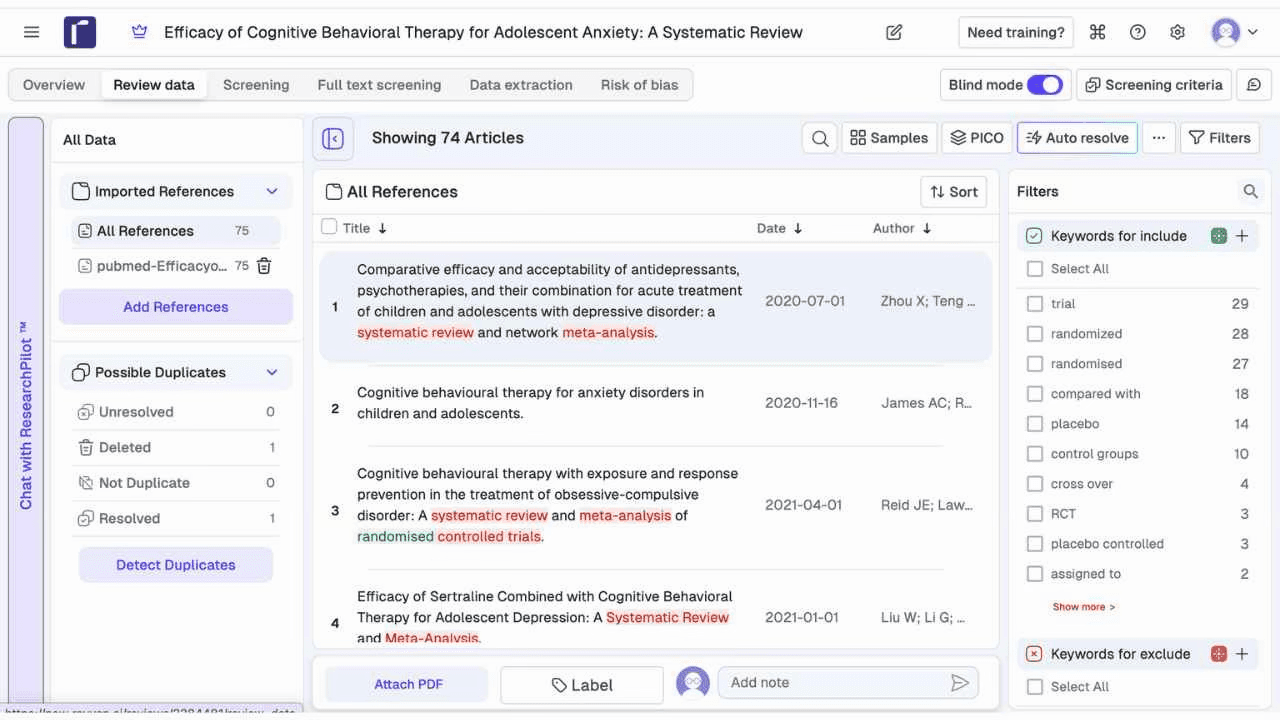
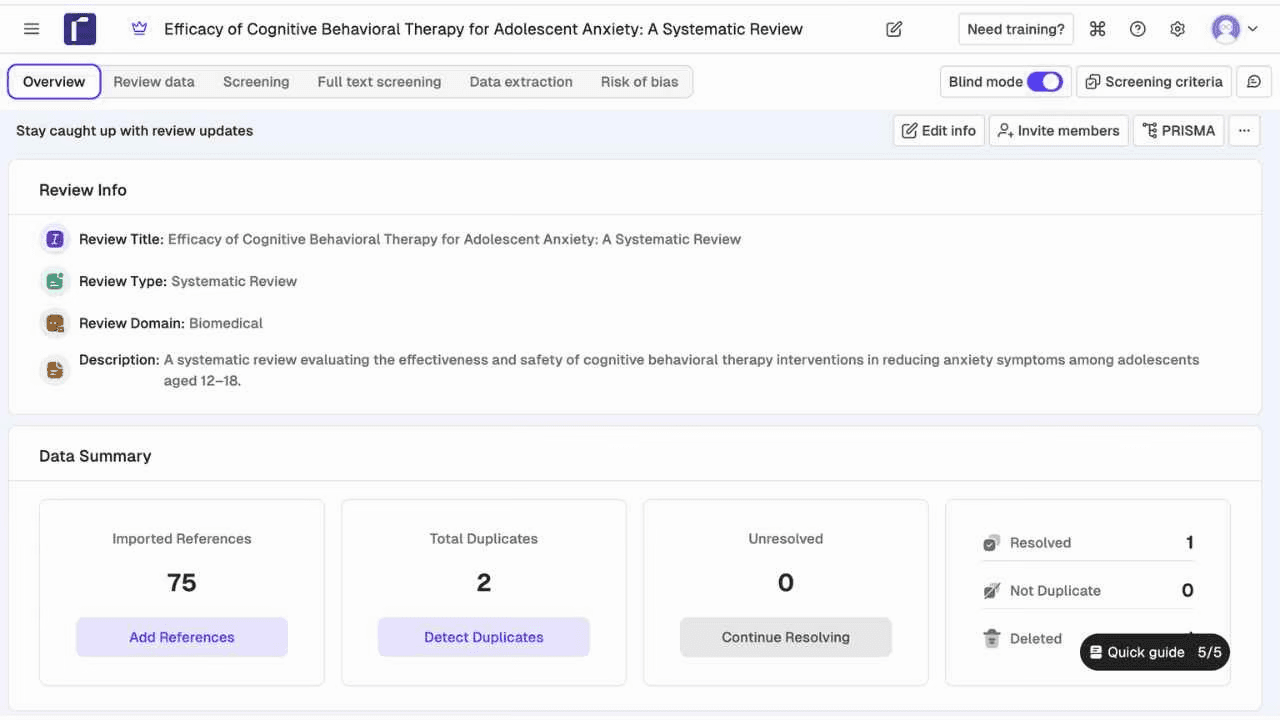
Rayyan presents records in a list view with an abstract panel. Reviewers vote "Include," "Maybe," or "Exclude" with labeled exclusion reasons. The AI Reviewer learns from a reviewer's early include/exclude decisions and predicts labels for remaining records. PICO detection highlights Population, Intervention, Comparison, and Outcome terms directly in the abstract using color-coded labels. The Blind mode toggle hides other reviewers' decisions until screening is complete, though the review owner can turn it off at any time. Auto Resolve handles agreements between reviewers automatically.
DistillerSR offers configurable multi-level screening with custom forms at each level. Review administrators define screening questions, set up branching logic, and configure the number of reviewers required. DAISY AI uses continuous machine learning throughout the screening process, re-ranking remaining references based on all reviewer decisions up to that point. AI Re-Rank predicts which unscreened references are unlikely to be relevant, allowing teams to potentially stop screening early when remaining records fall below a confidence threshold. The screening interface is more complex, designed for teams with defined protocols and formal screening criteria.
Rayyan's screening is faster to set up and more intuitive for first-time users. DistillerSR's screening is more configurable and better suited for complex protocols with multi-stage eligibility criteria.
Winner: Depends on needs. Rayyan wins for accessibility, speed of setup, and PICO detection. DistillerSR wins for configurability, continuous AI learning (DAISY), and protocol-driven screening workflows.
How Do AI Features Compare?
Both platforms use AI, but the depth and scope differ significantly.
Rayyan's AI features are designed for acceleration within a simple screening workflow:
- AI Reviewer predicts inclusion/exclusion labels based on early reviewer decisions, helping prioritize the remaining screening queue.
- PICO Detection highlights Population, Intervention, Comparison, and Outcome terms in abstracts with color coding, helping reviewers identify relevant content faster.
- Auto Resolve automatically resolves agreements between reviewers, reducing manual conflict resolution work.
- ResearchPilot (institutional tier) provides a chat assistant for review-related questions and guidance.
DistillerSR's AI features are designed for enterprise-scale automation:
- DAISY AI uses continuous learning that improves throughout the screening process, re-ranking references based on all accumulated reviewer decisions, not just early patterns.
- AI Re-Rank goes beyond prioritization by predicting which unscreened references are unlikely to be relevant with high confidence, potentially allowing teams to stop screening early and apply simulation-based sensitivity analysis to estimate what would have been found.
- Smart Evidence Extraction (SEE) uses generative AI to pre-populate extraction forms from full-text PDFs, shifting the reviewer's task from blank-form extraction to verification and correction.
- Living Systematic Review Mode automates evidence monitoring, screens new references against established criteria, and flags updates that may change review conclusions.
The practical difference is one of scale. Rayyan's AI helps a reviewer screen 500 records faster. DistillerSR's AI helps an enterprise team process 15,000 records across multiple simultaneous reviews with measurable labor cost reduction.
Winner: DistillerSR for depth; Rayyan for accessibility. DistillerSR's continuous learning (DAISY), generative extraction (SEE), and living review mode represent a more advanced AI implementation. Rayyan's PICO detection and AI Reviewer are more immediately accessible and sufficient for most academic reviews.
How Does Data Extraction Compare?
Rayyan introduced data extraction as a spreadsheet-style interface where reviewers add custom questions (columns) and fill in values for each included study. The interface is simple and functional for basic data collection. PDF text is not directly linkable to extracted fields in the same visual way as some competitors. Extraction is available on the Advanced plan ($8.33/seat/month) and above.
DistillerSR takes a fundamentally different approach with Smart Evidence Extraction (SEE). Generative AI reads included full-text PDFs and pre-populates extraction forms with identified data points, passages, and structured answers. Reviewers verify and correct rather than extracting from scratch. DistillerSR also supports custom extraction forms with conditional logic, calculated fields, and multi-level data structures for complex study designs. CuratorCR adds evidence reuse: when the same study appears across multiple reviews, extraction data can be imported rather than re-extracted.
For teams extracting data from dozens of included studies for meta-analysis, DistillerSR's generative AI extraction represents a genuine productivity gain. Rayyan's spreadsheet approach works for simpler extraction needs but does not scale the same way.
Winner: DistillerSR. Smart Evidence Extraction (SEE) with generative AI and CuratorCR evidence reuse are substantially more advanced than Rayyan's spreadsheet-style extraction.
How Does Full-Text Screening Compare?
Rayyan includes a full-text screening tab with an Auto Retrieve PDF feature that attempts to fetch PDFs automatically, reducing manual upload burden. When auto-retrieval fails, reviewers attach PDFs manually. The full-text screening interface mirrors the title/abstract stage with the same voting buttons and Blind mode toggle.
DistillerSR supports full-text screening with PDF management integrated into its configurable screening forms. Full-text screening can use the same custom eligibility criteria forms as title/abstract screening, with branching logic and multi-level reviewer requirements. PDFs are managed within the platform and are accessible during extraction and quality assessment stages.
Rayyan's auto-PDF retrieval is a convenient feature that DistillerSR does not match directly. DistillerSR's configurable full-text screening forms are more protocol-driven than Rayyan's simpler approach.
Winner: Rayyan for convenience (auto-PDF retrieval); DistillerSR for configurability. The auto-retrieve feature saves meaningful time in the PDF collection stage. DistillerSR's configurable forms are better for teams with complex full-text eligibility criteria.
How Does Risk of Bias Assessment Compare?
Rayyan added a risk of bias tab that allows reviewers to select assessment tools and record overall risk judgments for each study. The implementation is relatively recent and provides a functional interface for recording quality assessments. Risk of bias is available on the Advanced plan and above.
DistillerSR supports configurable quality assessment forms that can match any risk of bias framework: RoB 2, ROBINS-I, Newcastle-Ottawa Scale, GRADE, or fully custom frameworks. Forms support conditional logic and calculated fields, allowing complex quality assessment protocols. Quality assessment data integrates with the extraction workflow and is included in comprehensive exports.
For systematic reviews requiring formal quality assessment, DistillerSR's flexibility and integration depth are significantly more developed than Rayyan's risk of bias tab.
Winner: DistillerSR. Configurable quality assessment forms with conditional logic and framework flexibility are substantially more mature than Rayyan's functional but basic risk of bias tab.
Rayyan vs DistillerSR: Pricing Comparison
| Rayyan | DistillerSR | |
|---|---|---|
| Free tier | 3 reviews, 2 reviewers, 500 refs/review | No free tier |
| Entry paid plan | Essential: $4.99/seat/month | Custom enterprise pricing |
| Mid-range plan | Advanced: $8.33/seat/month | Custom enterprise pricing |
| Team plan | Business: $41.67/license/month (min 5) | Custom enterprise pricing |
| Self-service sign-up | Yes | No; sales process required |
| Public pricing page | Yes | No |
| Per-review limits | No per-review limits on paid plans | Typically unlimited reviews |
| Data extraction | Advanced plan and above | Included |
| Risk of bias tools | Advanced plan and above | Included |
| Includes search | No | No |
| Includes writing | No | No |
The pricing difference reflects the market positioning. Rayyan's free tier and $4.99/month entry point make it the most accessible screening platform available. DistillerSR's enterprise contracts, typically in the range of $10,000 to $50,000+ annually, reflect the advanced AI automation, compliance infrastructure, and dedicated support that enterprise teams require. Contact DistillerSR directly for current pricing.
For a solo researcher, Rayyan is functional at $0. For a two-person team on the Advanced plan, Rayyan costs $199.92/year. For the same team on DistillerSR, the cost is typically an order of magnitude higher. The question is whether DistillerSR's AI automation saves enough labor to justify the difference, a calculation that only makes sense when teams are processing high volumes across multiple reviews.
Neither platform includes search, writing, or reference management, so the total cost of a systematic review workflow includes additional tools regardless of which platform you choose.
What Neither Platform Covers
Both Rayyan and DistillerSR are screening and extraction tools. Neither provides:
- Built-in search across databases like PubMed, arXiv, or Semantic Scholar. Researchers must search externally and import references manually.
- Citation-grounded writing to produce the actual systematic review document from screened evidence. Writing happens in separate tools.
- Reference management for organizing papers, annotations, and citations across projects.
- AI-native evidence synthesis that connects search results, screening decisions, extracted data, and a cited draft in one workspace.
For teams looking for a platform that covers the full pipeline from search through screening and extraction to a cited draft, AI tools for systematic review like Paperguide Systematic Review Software integrate search across 200M+ papers, dual-blind screening (on the Evidence Teams and Enterprise plans), data extraction, PRISMA reporting, citation-grounded writing, and reference management in one workspace, with paid plans starting at $12 per seat per month, billed annually.
Final Verdict: Should You Choose Rayyan or DistillerSR?
Choose Rayyan if:
- You are a student, early-career researcher, or small team that needs free or low-cost screening.
- You want AI-assisted screening with PICO detection and inclusion predictions without enterprise contracts.
- You are running a rapid review, scoping review, or evidence mapping where speed and accessibility matter most.
- Your team is small and per-seat pricing ($4.99 to $8.33/month) fits your budget.
- You need auto-PDF retrieval to reduce manual full-text collection effort.
Choose DistillerSR if:
- You are at a pharmaceutical company, CRO, or HTA agency running high-volume systematic reviews for regulatory submissions.
- You need AI-driven screening with continuous learning (DAISY AI) and generative AI extraction (SEE) to reduce manual labor at scale.
- You require living systematic review capabilities for continuous evidence monitoring and update detection.
- Your organization needs enterprise-grade audit trails, SOPs, API access, and compliance documentation.
- You run multiple reviews where evidence reuse through CuratorCR reduces duplication of effort.
For teams that need more than screening and extraction, neither Rayyan nor DistillerSR covers the full systematic review pipeline. Both require separate tools for database searching, writing the review document, and managing references. Platforms like Paperguide Systematic Review Software bridge that gap by integrating search, dual-blind screening, extraction, PRISMA reporting, citation-grounded writing, and reference management in one workspace.
Frequently Asked Questions
Is Rayyan or DistillerSR better for academic research?
Rayyan is generally better for academic research due to its free tier, affordable paid plans, and accessible interface. DistillerSR is enterprise-focused with custom pricing that typically starts in the thousands annually, making it impractical for most academic teams. Exceptions include academic medical centers with enterprise budgets and multi-center review programs that can justify the investment.
Does Rayyan have AI screening like DistillerSR?
Both platforms offer AI-assisted screening, but at different levels. Rayyan's AI Reviewer predicts inclusion/exclusion labels and PICO detection highlights key terms. DistillerSR's DAISY AI uses continuous learning that re-ranks references throughout the screening process, plus AI Re-Rank for predicting irrelevance with high confidence. DistillerSR's AI is more advanced; Rayyan's AI is more accessible.
Can Rayyan handle large systematic reviews?
Rayyan's free tier supports 500 references per review. Paid plans support larger reference sets, but the platform is designed for smaller to medium-scale reviews. For reviews with 5,000 to 20,000 records, DistillerSR's infrastructure and DAISY AI continuous learning are better suited to handle the volume efficiently. Teams processing more than 2,000 records should evaluate whether Rayyan's performance and AI features scale to their needs.
Does DistillerSR offer a free trial?
DistillerSR does not offer a free tier or self-service free trial. Interested teams should contact DistillerSR directly to discuss demos and trial arrangements. The platform's sales-driven model reflects its enterprise positioning and custom pricing structure.
Which tool is better for living systematic reviews?
DistillerSR is the clear choice for living systematic reviews. It has built-in living review mode that automates evidence monitoring, screens new references against established criteria, and flags updates that may change review conclusions. Rayyan does not support living systematic reviews.
Which tool generates PRISMA flow diagrams?
Both Rayyan and DistillerSR generate PRISMA flow diagrams automatically based on screening counts and exclusion reasons. DistillerSR offers more customization options for the diagram parameters. Both are functional for the PRISMA reporting requirements of systematic reviews.
How do I choose between Rayyan and DistillerSR?
The decision primarily comes down to scale and budget. If you are an individual researcher, student, or small team, Rayyan's free tier or affordable paid plans are the practical choice. If you are at a pharmaceutical company, CRO, or regulatory agency running high-volume reviews with compliance requirements, DistillerSR's enterprise capabilities justify the higher cost. For the full pipeline from search to cited draft, consider platforms like Paperguide that cover the wider workflow.
References
- Borah, R., Brown, A. W., Capers, P. L., & Kaiser, K. A. (2017). Analysis of the time and workers needed to conduct systematic reviews of medical interventions using data from the PROSPERO registry. BMJ Open, 7(2), e012545. https://doi.org/10.1136/bmjopen-2016-012545
- Abogunrin, S., Muir, J. M., Zerbini, C., & Sarri, G. (2025). How much can we save by applying artificial intelligence in evidence synthesis? Results from a pragmatic review to quantify workload efficiencies and cost savings. Frontiers in Pharmacology, 16, 1454245. https://doi.org/10.3389/fphar.2025.1454245
- Silva, J. J. S., Fernandez, S., Rosillo, N., & Bueno, H. (2026). Which systematic review software works best? A practical comparison. Journal of the Medical Library Association, 114(1), 83-85. https://doi.org/10.5195/jmla.2026.2262
Running a review?
Run your systematic review in Paperguide
Dual screening, verifiable extraction and PRISMA reporting in one place.
Start a reviewNo credit card required