Paperguide Blog

Best AI research tools, comparisons, alternatives and guides for literature reviews, systematic reviews and research writing, for research and evidence teams.

literature review vs scoping review

Literature Review vs Scoping Review: How They Compare (2026)

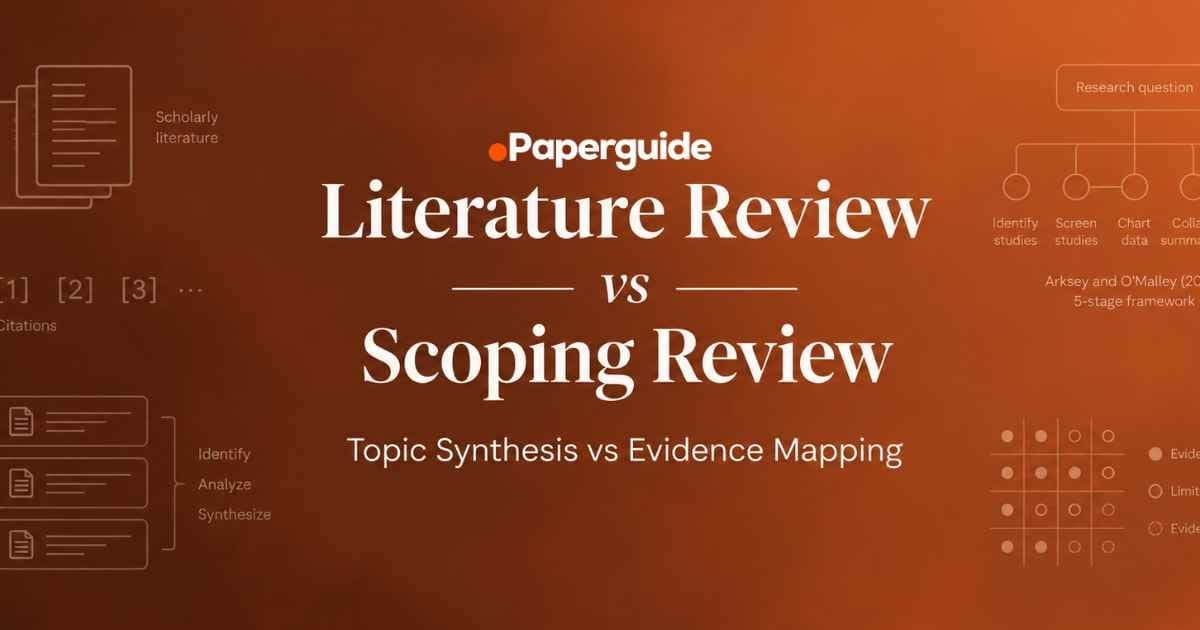
A literature review surveys and synthesizes existing research to answer a question or establish the state of knowledge on a topic. A scoping review maps the breadth and nature of the available evidence on a topic, identifying key concepts, evidence types, and gaps without narrowing to a specific clinical or research question. Both are forms of evidence synthesis, but they serve different research purposes, follow different conventions, and produce different types of outputs. This guide explains
By Shrishti Chaudhary β€”

literature review vs narrative review

Literature Review vs Narrative Review Explained (2026)

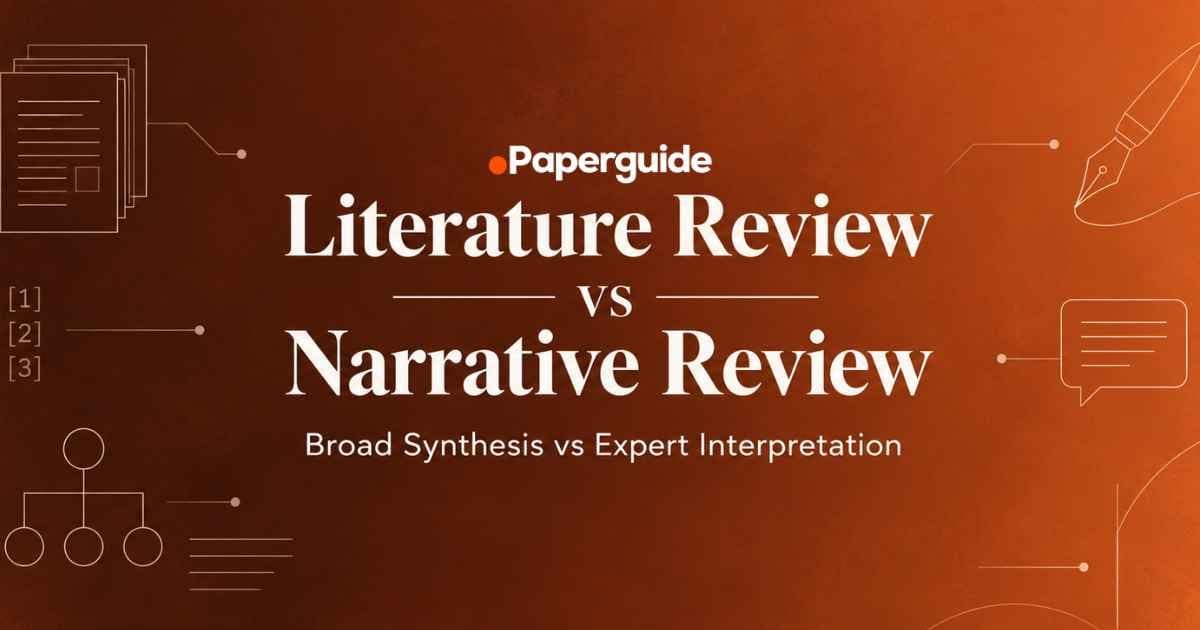
A literature review is a broad category of scholarly work that surveys, analyzes, and synthesizes existing research on a topic. A narrative review is one specific type of literature review, characterized by its expert-driven, flexible approach to source selection and synthesis. The confusion between these terms is common because "literature review" functions both as an umbrella category (encompassing narrative, systematic, scoping, and other review types) and as a standalone genre (the tradition

By Remya Krishnan β€”

meta-analysis vs scoping review

Meta-Analysis vs Scoping Review: Purpose and Methods (2026)

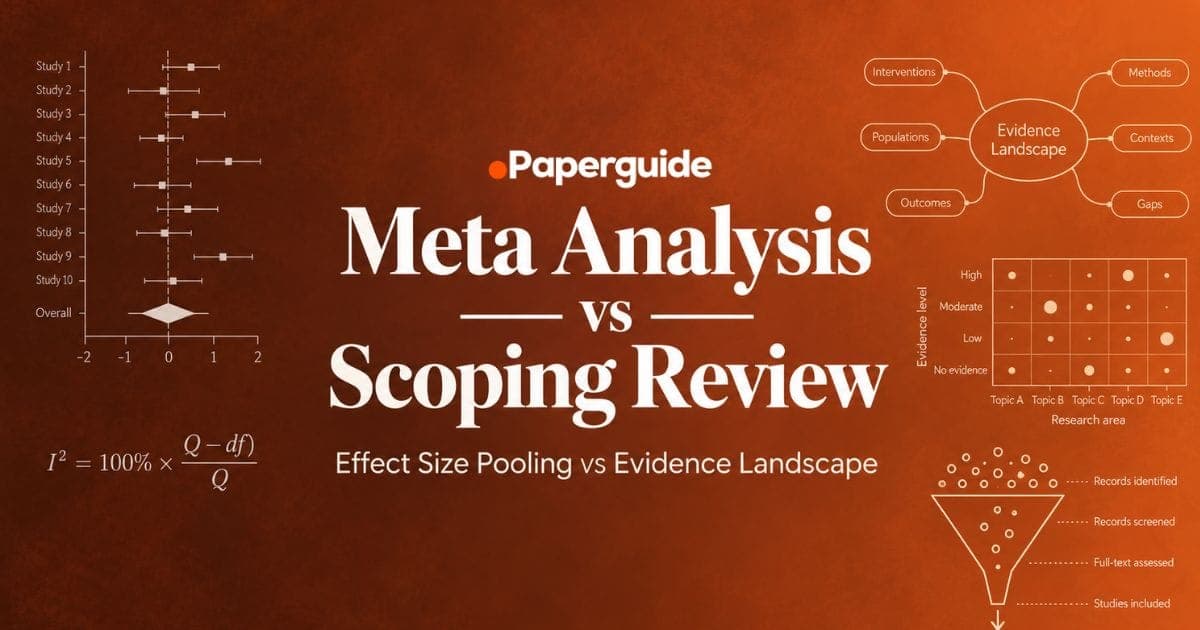
A meta analysis uses statistical methods to pool quantitative results from multiple studies into a single summary effect estimate. A scoping review maps the breadth and nature of the available evidence on a topic, identifying what research exists, what methods have been used, and where gaps remain. These two approaches answer different questions at different stages of the research process: a scoping review asks "What evidence is out there?" while a meta analysis asks "What does the evidence show

By Remya Krishnan β€”

meta analysis vs narrative review

Meta-Analysis vs Narrative Review: Methods Compared (2026)

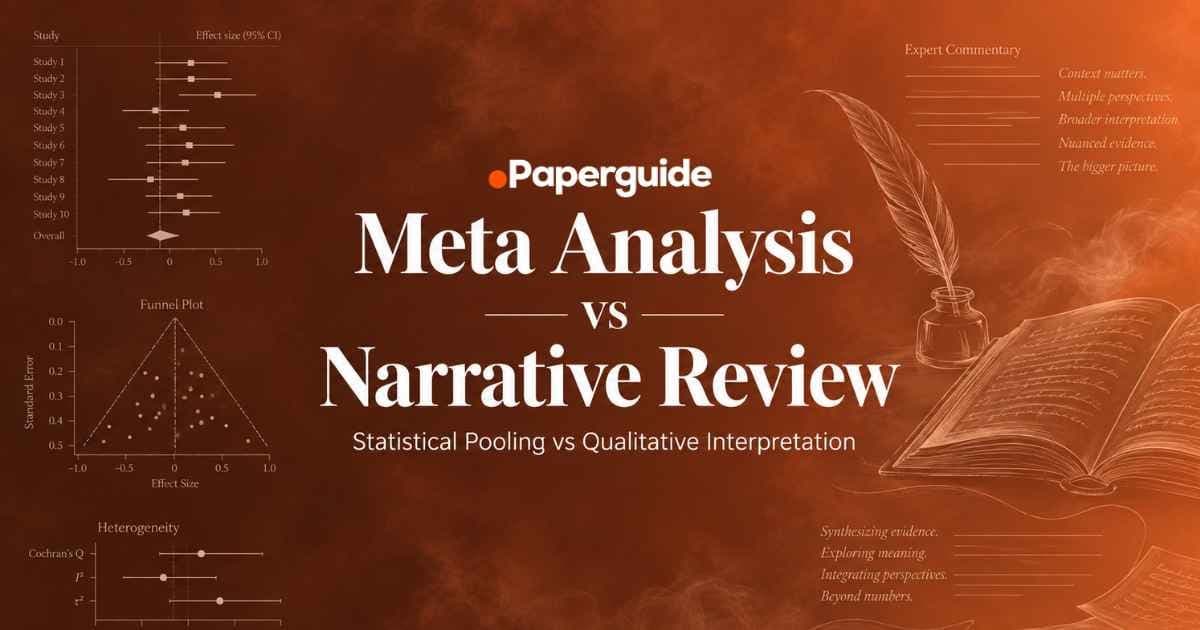
A meta analysis applies statistical methods to pool quantitative results from multiple studies into a single summary effect estimate. A narrative review provides an expert-driven qualitative overview of a topic, selecting and interpreting studies without statistical pooling. These two approaches sit at nearly opposite ends of the evidence-synthesis spectrum: one produces a number, the other tells a story. This guide explains the differences across methodology, data requirements, synthesis appro

By Shrishti Chaudhary β€”

How to Use Claude Science in 2026: Step-by-Step Guide

How to Use Claude Science in 2026: Step-by-Step Guide for Scientific Research

Anthropic launched Claude Science on June 30, 2026 as a scientific AI workbench for computational biologists, bioinformatics researchers, and life sciences labs. It unifies scientific databases, code, HPC compute, and manuscript drafting inside a single research environment, with every analysis traced back to the code and environment that produced it. Unlike a general AI chatbot, Claude Science ships with 60+ scientific database connectors, native rendering of proteins and molecular structures,

By Roop Reddy β€”

Best Claude Science Alternatives for Systematic Reviews in 2026

7 Best Claude Science Alternatives for Systematic Reviews in 2026

Claude Science is Anthropic's AI workbench for scientists, announced on June 30, 2026. It is built for scientific reasoning, code-driven analysis, HPC-scale compute, native rendering of proteins and molecular structures, and reproducible artifacts traced back to code and environment. Inside a computational lab, it is a powerful tool. It was not built for the review side of scientific research. Evidence synthesis, systematic reviews, PRISMA 2020 reporting, blind screening across two independent

By Roop Reddy β€”

Best AI Tools for Narrative Review in 2026

5 Best AI Tools for Narrative Review in 2026 (Free + Paid)

Narrative reviews are the most common review type in academic publishing, and the least served by AI tools built around strict PRISMA workflows or general literature discovery. A narrative review synthesises existing research on a topic by theme rather than following the protocol-driven methodology of a systematic review. It has been the default review format across most disciplines for decades. A 2025 PMC primer on review article types sets out how review types differ in purpose, scope, method

By Satya R Panigrahi β€”

Best AI Tools for Scoping Review in 2026

5 Best AI Tools for Scoping Review in 2026 (Free + Paid)

Scoping reviews sit in a category of their own, and most AI tools were not built for the hybrid inclusion approach they need. A scoping review sits between a narrative review and a systematic review: broader and more exploratory than one, more structured and protocol-driven than the other. It maps the breadth of evidence on a topic, identifies knowledge gaps, and clarifies key concepts, following the PRISMA Extension for Scoping Reviews (PRISMA-ScR) published by Tricco and colleagues in the Ann

By Roop Reddy β€”

Best AI Tools for Finding Research Papers in 2026

9 Best AI Tools for Finding Research Papers in 2026 (Free + Paid)

Finding research papers in 2026 is a coverage problem, and the cost of getting it wrong shows up in every systematic review that misses the seminal paper indexed in a database the search did not cover. A typical literature search in a working scientific field surfaces 200 to 500 relevant papers across PubMed, arXiv, OpenAlex, Semantic Scholar, and Google Scholar. The single-database problem is now well documented. A 2025 ScienceDirect coverage assessment of PubMed, Embase, OpenAlex, and Semanti

By Satya R Panigrahi β€”

Best Medical Evidence AI Tools in 2026

5 Best Medical Evidence AI Tools in 2026 (Free + Paid)

Clinical evidence in 2026 is a citation accuracy problem, and the cost of getting it wrong is now patient-facing. A clinician answering a bedside evidence question or a clinical investigator writing a treatment guideline cannot afford an AI tool that fabricates citations. The medical evidence base is the single highest-stakes citation environment in scientific research, where a fake reference can change a treatment recommendation and a patient outcome. The scale of the problem is now well docum

By Roop Reddy β€”

Best AI Tools for Evidence Synthesis in 2026

5 Best AI Tools for Evidence Synthesis in 2026 (Free + Paid)

Evidence synthesis in 2026 is a pipeline, not a prompt, and the cost of treating it as a prompt is now well documented in the scientific research literature. A solid evidence synthesis project moves through six discrete stages: define the question, search the literature, screen against inclusion and exclusion criteria, extract structured data, synthesise findings, and write the report with verified citations on every claim. The time cost is steep even when the workflow runs cleanly. A 2024 PMC

By Roop Reddy β€”

Best AI Tools for References and Citations in 2026

7 Best AI Tools for References and Citations in 2026 (Free + Paid)

Reference management is no longer a file problem in 2026. It is an AI integration problem, and the scientific research literature is paying the price for the gap between the two. Zotero, Mendeley, EndNote, and Paperpile solved reference management for the file-storage era. They organise PDFs, generate citations in any style, and sync across devices. What they were not built for is the AI-native scientific research workflow of 2026, where references should flow from search to library to draft wi

By Satya R Panigrahi β€”