Paperguide vs AnswerThis: Best AnswerThis Alternative in 2026


Paperguide and AnswerThis are both AI research platforms for scientific research, but they approach the research workflow from different directions. Paperguide is an AI-native platform for scientific research workflows where AI search, literature review, systematic review, PDF analysis, structured extraction, reference management, and citation-grounded writing all stay linked inside one workspace. In contrast, AnswerThis is an answer-first research platform that delivers fast, citation-backed responses from 250M+ papers with modular add-on steps for drafting, extraction, and bibliometric analysis.
Both platforms support AI-powered search and literature review generation. However, Paperguide is optimized for workflow continuity and citation-grounded research synthesis, where every step from discovery through screening to a cited draft stays connected. On the other hand, AnswerThis is optimized for speed and structured discovery, giving researchers fast answers with citation maps and research gap identification. As a result, the biggest difference is not corpus size or answer quality. Instead, it is whether your research context carries forward from one step to the next or resets at each stage. Systematic reviews have grown in importance across biomedical and social science fields.
Key takeaway: Paperguide wins for researchers who need a connected workflow from search through literature review to a citation-grounded draft with quality metrics at every step. AnswerThis wins when fast citation-backed answers, bibliometric analysis, or research gap identification are the priority.
TL;DR
| If you need... | Better choice |
|---|---|
| AI search with journal quality metrics in outputs | Paperguide |
| Fast citation-backed answers from 250M+ papers | AnswerThis |
| Structured literature review with SJR/SNIP screening | Paperguide |
| Research gap identification and ideation | AnswerThis |
| Systematic review with verifier roles and PRISMA | Paperguide |
| Bibliometric analysis and citation maps | AnswerThis |
| Data extraction with 50 columns on any paid plan | Paperguide |
| Citation-grounded writing with 1,000+ styles | Paperguide |
| Reference management built into the workflow | Paperguide |
| Best overall research workflow | Paperguide |
Overall, Paperguide is the better choice if you need a connected pipeline from search through literature review to a cited draft with quality transparency starting at $12 per seat per month, billed annually. On the other hand, AnswerThis is the better choice if you need fast citation-backed answers, bibliometric analysis with citation maps, or quick research gap discovery starting at $35/month. Therefore, the decision comes down to whether workflow completeness or research speed matters more for your project.
Paperguide vs AnswerThis: Quick Comparison
| Feature | Paperguide | AnswerThis |
|---|---|---|
| AI Search Corpus | 200M+ papers; PubMed, arXiv, OpenAlex, Semantic Scholar; also searchable from Claude, ChatGPT and Cursor via Paperguide MCP | 250M+ papers; Semantic Scholar, OpenAlex, PubMed, arXiv |
| Quality Metrics | SJR, SNIP re-rank results, visible on every result | Q1-Q4 journal filters, citation count filters |
| Literature Review AI | Up to 50 papers, Extended mode, cited draft output | AI-generated multi-section synthesis, no screening |
| Systematic Review | Protocol-first, verifier roles, PRISMA | Only on Max plan ($250/month) |
| Chat with PDF | Multi-paper Q&A with passage verification | Multi-document interaction, text explanation |
| Extraction Columns | Free 5, paid plans 50 | Data extraction via add-steps, limited depth |
| AI Paper Writer | Full draft generation, '@' citations, 1,000+ styles, collaboration | Outline generation, section drafting, citation insertion |
| Research Agent | Search, compare, extract, gap analysis, draft in one session | No dedicated agent; modular add-steps |
| Deep Research Report | Yes, manual control at every stage | Not available |
| Reference Manager | Full library, Zotero/Mendeley, Chrome ext, annotation, collaboration | Library with Zotero/Mendeley integration |
| Bibliometric Analysis | Not available | Yes, with citation maps |
| Starting Price | Plus $12 per seat/month, billed annually | Pro $35/month |
Who Is Paperguide Best For?
- Scientific researchers and R&D professionals in industry, biotech, and pharma who need citation-grounded evidence synthesis, structured extraction, and quality-filtered search across 200M+ papers for research projects and publications.
- HEOR analysts and clinical researchers at consultancies, CROs, and medical device companies who run systematic literature reviews for market access, regulatory submissions (EU MDR, FDA), and Clinical Evaluation Reports, and need cycle-time reduction with audit-ready output.
- Systematic review leads and evidence synthesis managers running protocol-driven reviews with assigned verifiers, PRISMA reporting, and an auditable decision trail at each screening stage for clients, journals, or regulatory submissions.
- Clinician-researchers and hospital evidence teams doing evidence lookups, guideline development, and periodic PRISMA-compliant reviews with institutional journal access, without CRO-scale process overhead.
- Researchers who need a full-fledged AI Paper Writer that generates complete drafts with automatic citations from 200M+ papers and their own library, supports '@' citation insertion, collaborative editing, plagiarism checking, and over 1,000 citation styles without switching to a separate tool.
- Academic researchers at every level including graduate students, postdocs, faculty, and lab teams who need search, systematic review, literature review, writing, and references in one workspace rather than stitching together separate tools.
Who Is AnswerThis Best For?
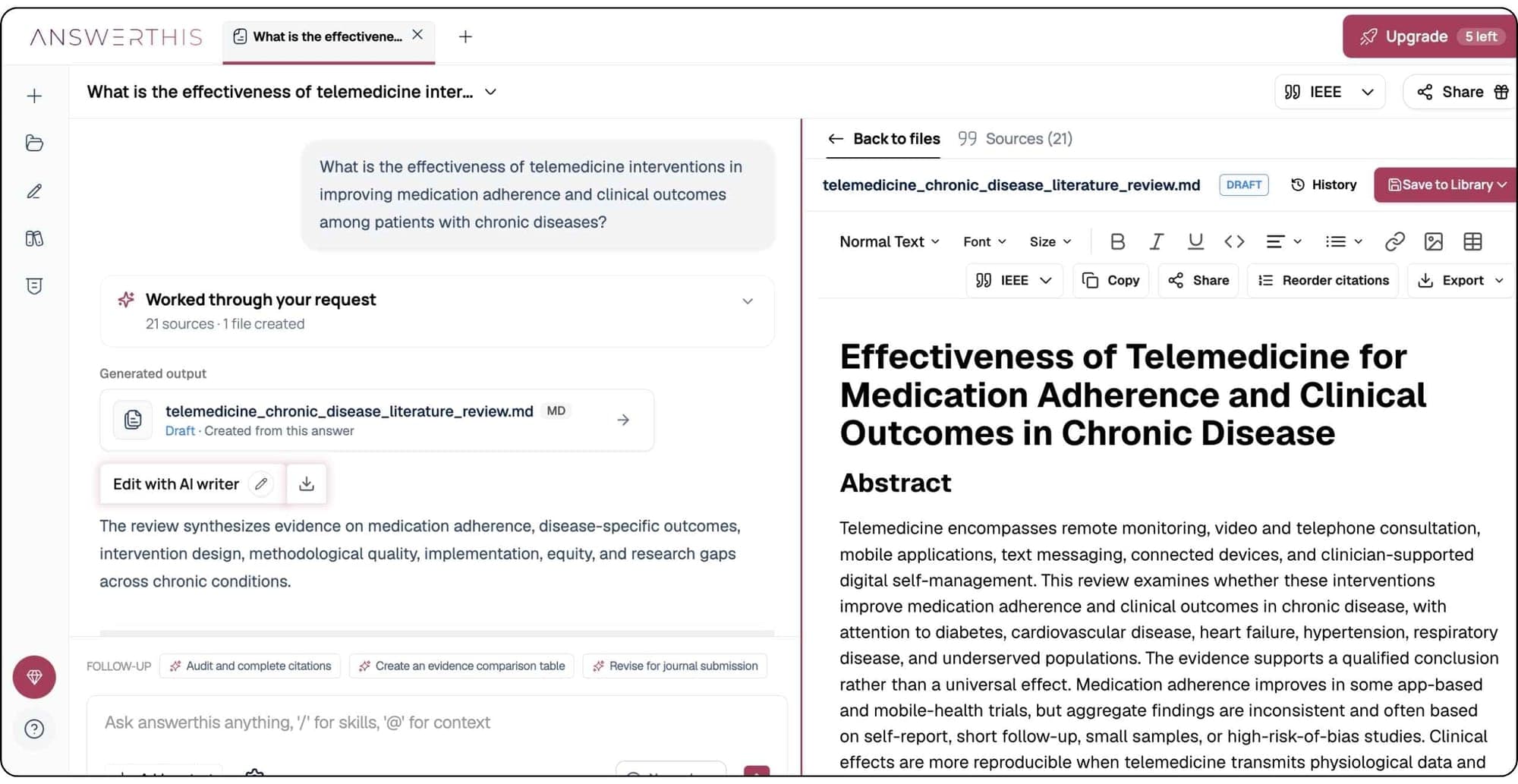
- Students and early-stage researchers who need fast, citation-backed answers to research questions without committing to a full workflow.
- Researchers exploring new topics who want quick literature summaries, research gap identification, and bibliometric analysis with citation maps before narrowing their scope.
- Research teams at institutions who need collaborative libraries with shared access and want a simple AI search interface for initial discovery.
How We Tested Paperguide and AnswerThis
We tested both tools using real research workflows across AI Search, Literature Review, Chat with PDF, Data Extraction, AI Paper Writer, and Reference Management. Specifically, we evaluated workflow depth, citation grounding, source traceability, output quality, pricing limits, research control, ease of use, and limitations. Workflow observations come from signed-in product tests on Paperguide Pro ($29 per seat per month, billed annually) and AnswerThis Pro ($35/month). Pricing and plan limits come from official product pages. Features labeled "Coming soon" are noted and not treated as available.
Researchers evaluating AnswerThis alternatives often compare workflow depth, pricing, and citation grounding across platforms.
How Does Paperguide AI Search Compare to AnswerThis?

When we tested AI Search on both platforms, the difference in quality transparency was immediately visible. Paperguide's AI Search searches 200M+ papers across PubMed, arXiv, OpenAlex, and Semantic Scholar, plus the user's own reference library in the same query. No other search tool in this category combines public corpus results with the researcher's collected papers. It uses hybrid semantic and keyword retrieval with agentic query variation run in parallel. As a result, the output synthesizes from the top 20 papers rather than 10, producing a sectioned evidence report. Notably, SJR quartile, SJR score, SNIP, and citation metrics re-rank results and are visible on every result rather than sitting behind a filter. In addition, export controls for BibTeX, CSV, and Excel appear directly beside the references. Saved papers land in the reference manager and are immediately usable across extraction, review, and the AI Paper Writer.
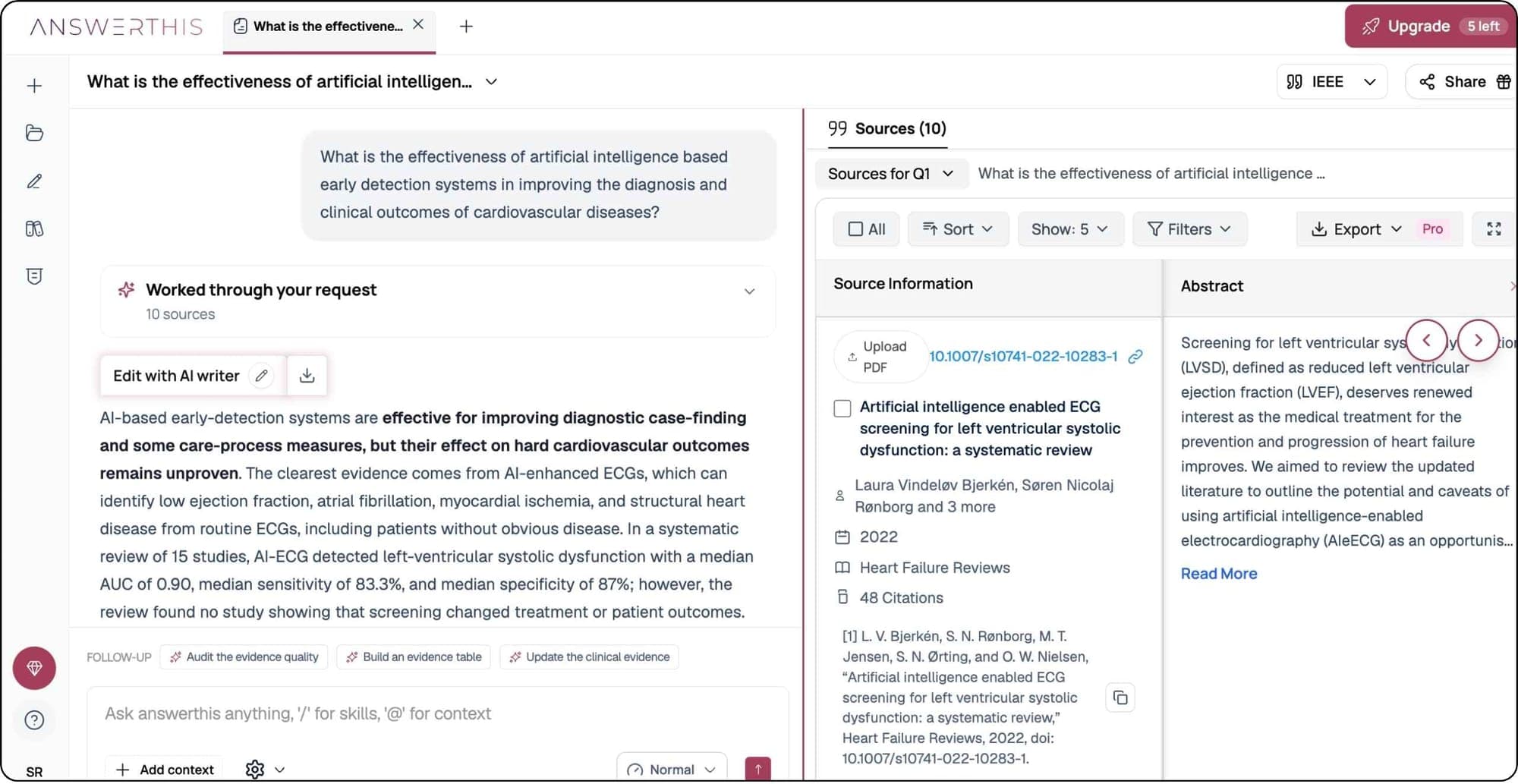
In comparison, AnswerThis searches 250M+ papers across Semantic Scholar, OpenAlex, PubMed, and arXiv. It delivers fast, citation-backed answers with an integrated source panel. Additionally, users can choose an answer style (Normal, High, or Mix) and filter results by journal quality (Q1 to Q4), publication type, citation count, and database. Outputs are exportable as PDF, DOCX, LaTeX, and Markdown. However, Q1-Q4 filtering is available in search, but SJR scores, SNIP, and granular impact metrics are not displayed in search results or synthesized outputs. Follow-up queries reuse the same evidence set rather than expanding retrieval dynamically.
Winner: Paperguide. Quality signals re-rank results and travel into the output rather than sitting only in a filter. The search runs across the user's own library alongside the public corpus. AnswerThis offers useful journal quality filtering and fast synthesis, but quality metrics do not carry into outputs and follow-up queries do not expand the evidence set.
How Does Paperguide Literature Review Compare to AnswerThis?
Paperguide's Literature Review AI follows a five-step structured process: planning, search, screening (using SJR, SNIP, and citation metrics), extraction and synthesis, and review generation. It offers Standard mode (handles up to 50 papers) and Extended mode (screens up to 200 papers). As a result, every included paper passes through quality screening before contributing to the final review. You see the plan before the search starts, and each paper gets a recorded include or exclude outcome with its reason. The review runs on the 200M+ database or on the papers in your Reference Manager, and the report shows where evidence converges and conflicts, notes limitations, and cites every claim to a real source paper. The output connects directly to the Reference Manager and AI Paper Writer.
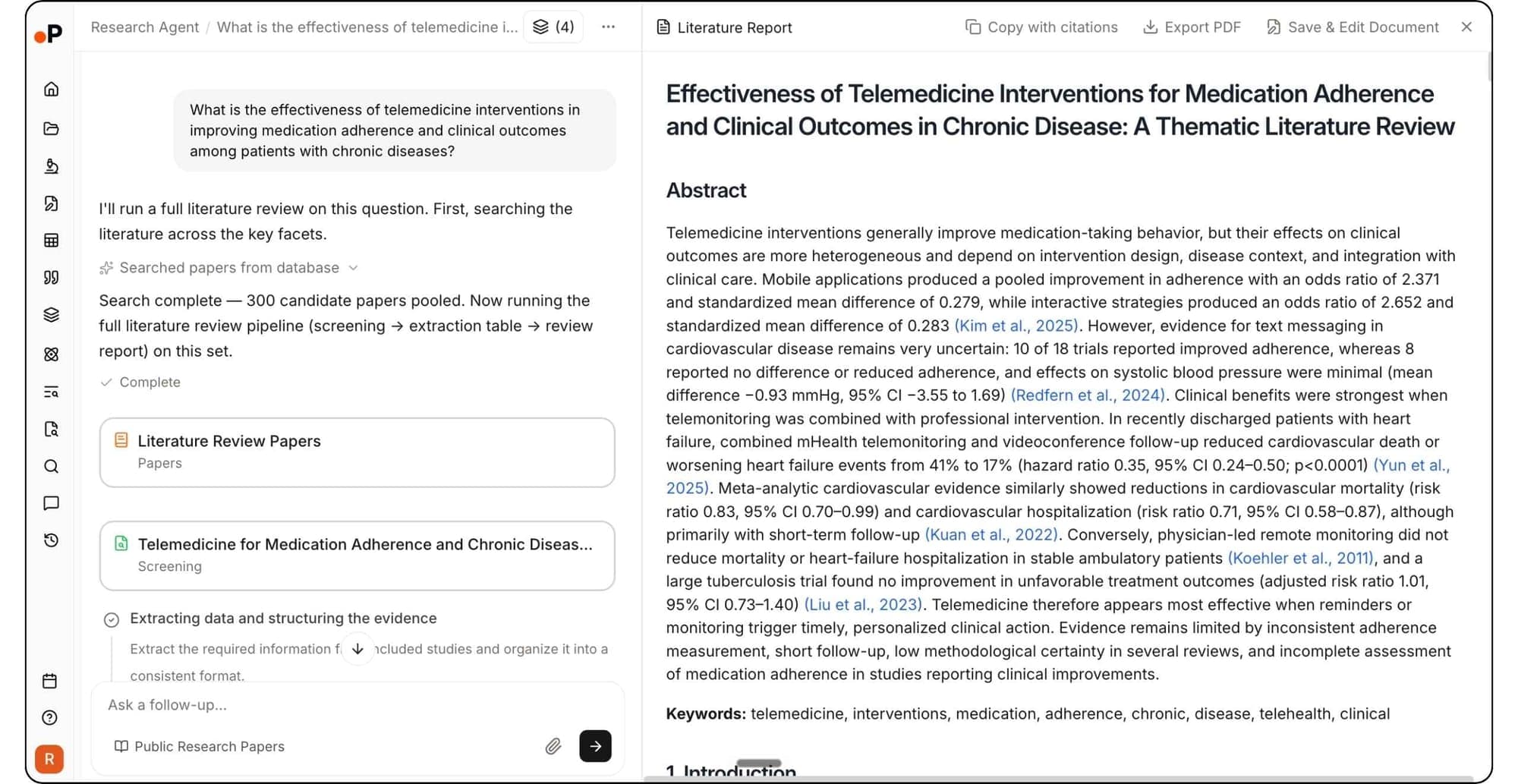
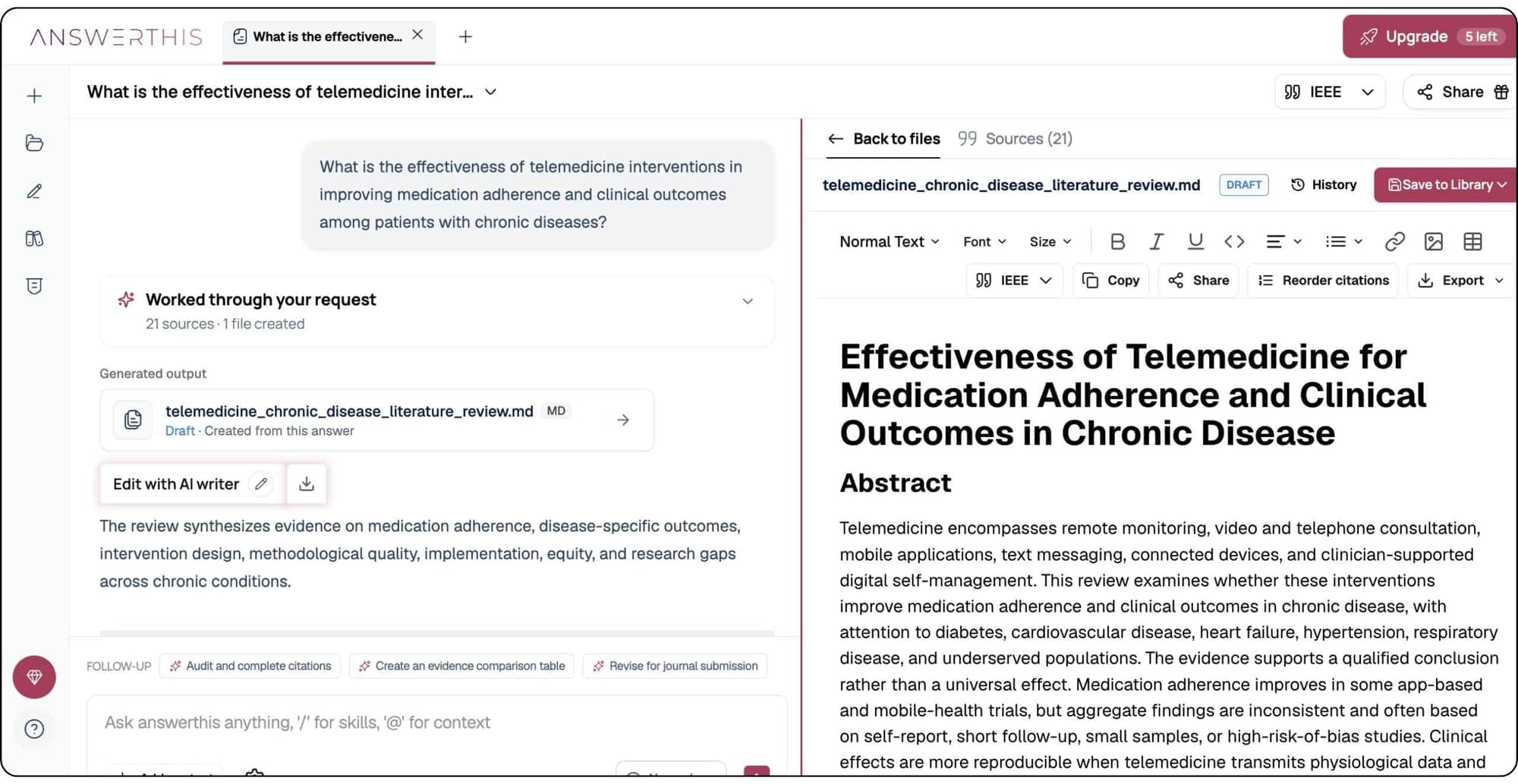
In comparison, AnswerThis generates multi-section literature summaries organized under headings such as key findings, methodologies, limitations, and research gaps. The output is readable and useful for early-stage understanding. However, the workflow does not include screening, inclusion/exclusion criteria, or transparent quality scoring. Because of this, the literature review is fully AI-driven without researcher control over which papers are included or excluded based on quality thresholds.
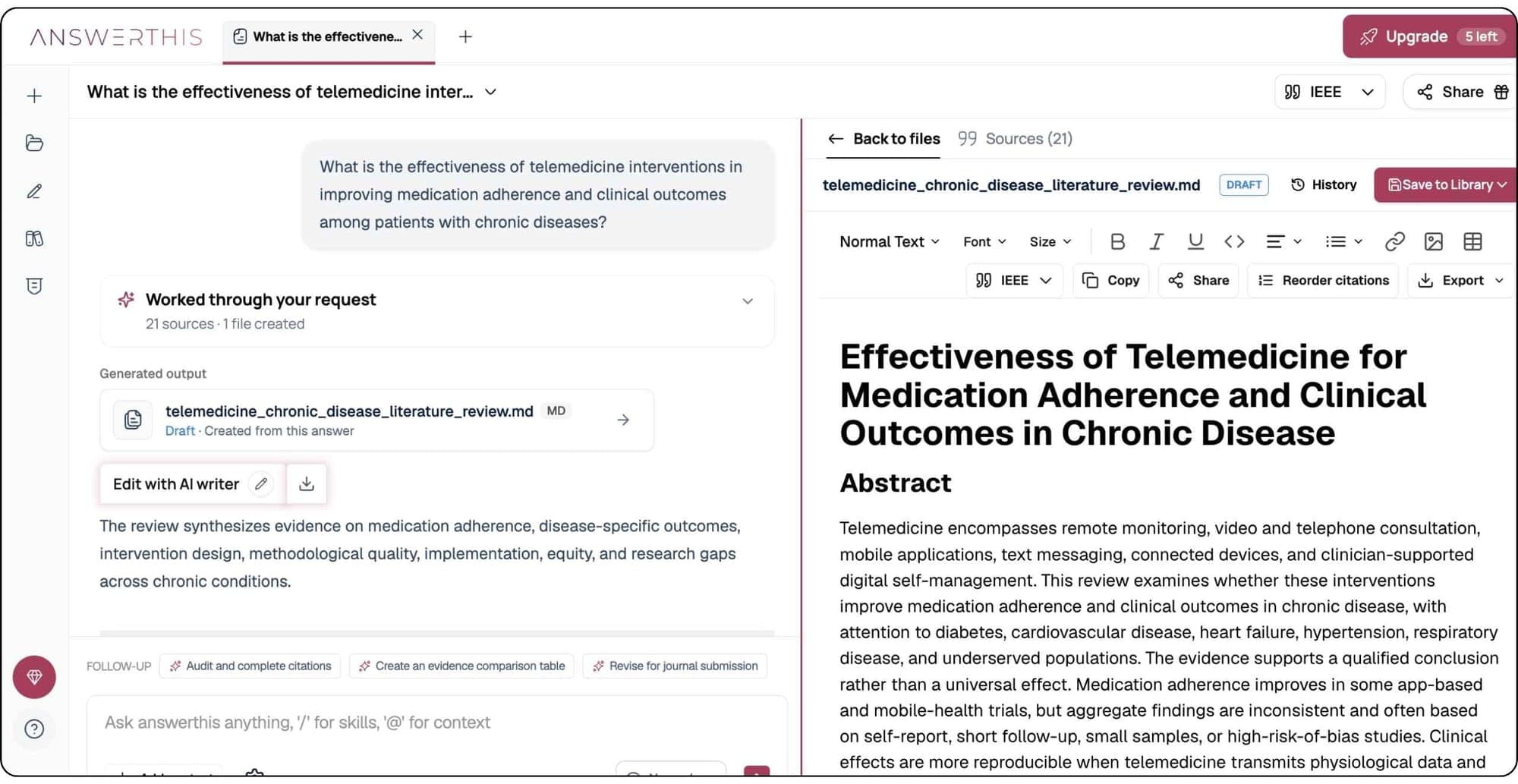
Winner: Paperguide. The five-step structured process with SJR/SNIP screening, Standard and Extended modes, and researcher control over inclusion gives Paperguide the advantage for publication-targeted reviews. AnswerThis is faster for initial literature summaries and ideation but lacks screening controls and quality transparency. Paperguide's Literature Review AI breaks down each step in detail.
How Does Paperguide Chat with PDF Compare to AnswerThis?
Paperguide processes full-text context rather than chunk-based retrieval, supporting comparative analysis across multiple documents with inline citations linking to source paper, page number, and exact passage. As a result, insights feed into literature reviews and the AI Paper Writer with passage-level source verification.
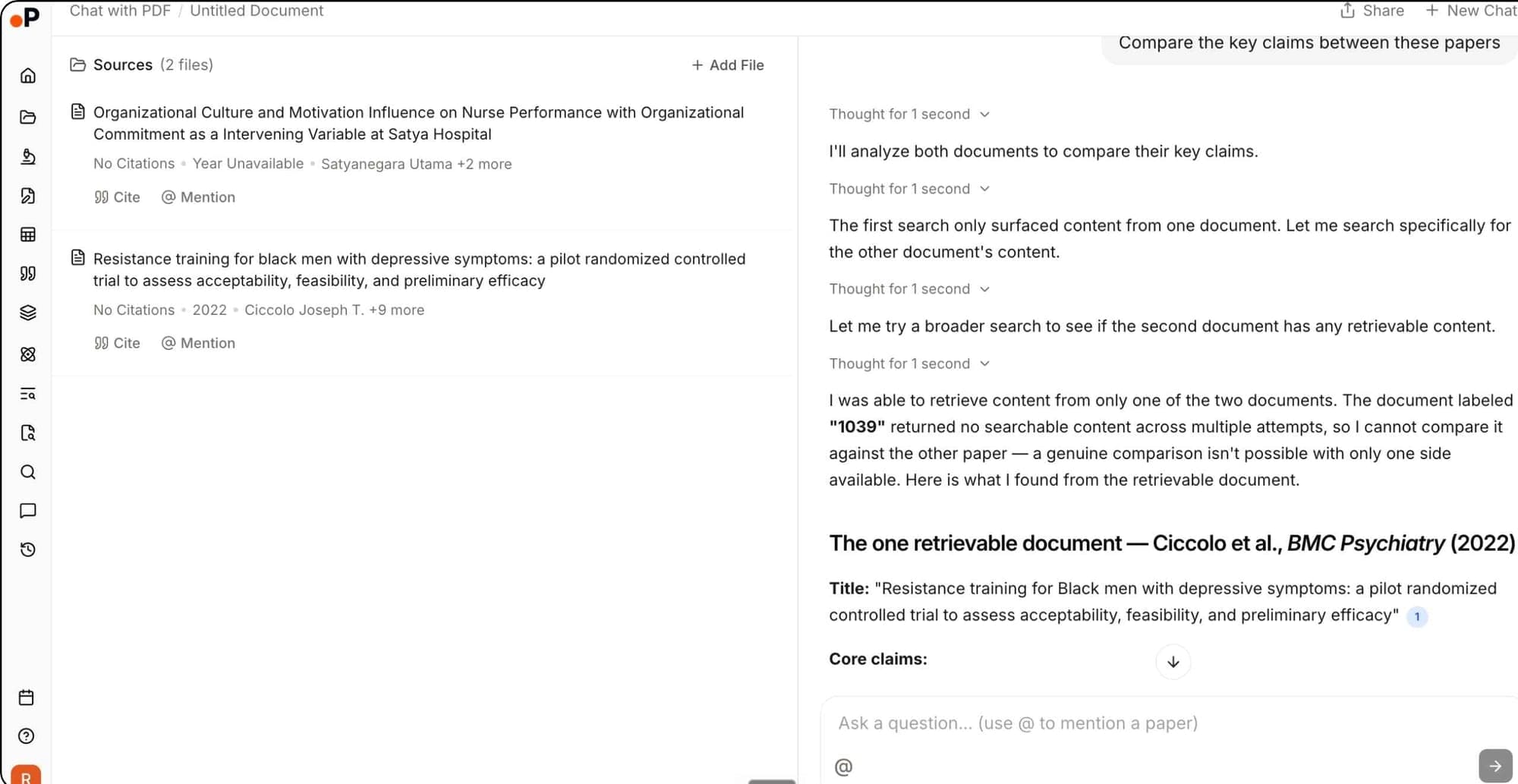
In comparison, AnswerThis supports multi-document interaction and text explanation over selected papers. However, it is limited in how many papers can be used at once and does not retrieve external evidence dynamically. The interaction focuses on uploaded documents only.
Winner: Paperguide. Passage-level source verification, multi-paper scalability, and workflow continuity into the AI Paper Writer and Reference Manager give Paperguide the advantage. AnswerThis provides useful document interaction but with limited scalability and no downstream workflow connection. Paperguide's Chat with PDF covers multi-paper analysis in detail.
How Does Paperguide Data Extraction Compare to AnswerThis?
Paperguide's Extract Data supports up to 50 custom columns and 100 papers per table on paid plans. Every extracted item links back to the original source text for verification. In addition, Paperguide can AI-generate extraction fields from the research question and context, and supports configurable output types per field: Answer, Yes or No, or specified options. Paperguide exports extraction tables to CSV, Excel, RIS, BIB, PDF, and DOCX.
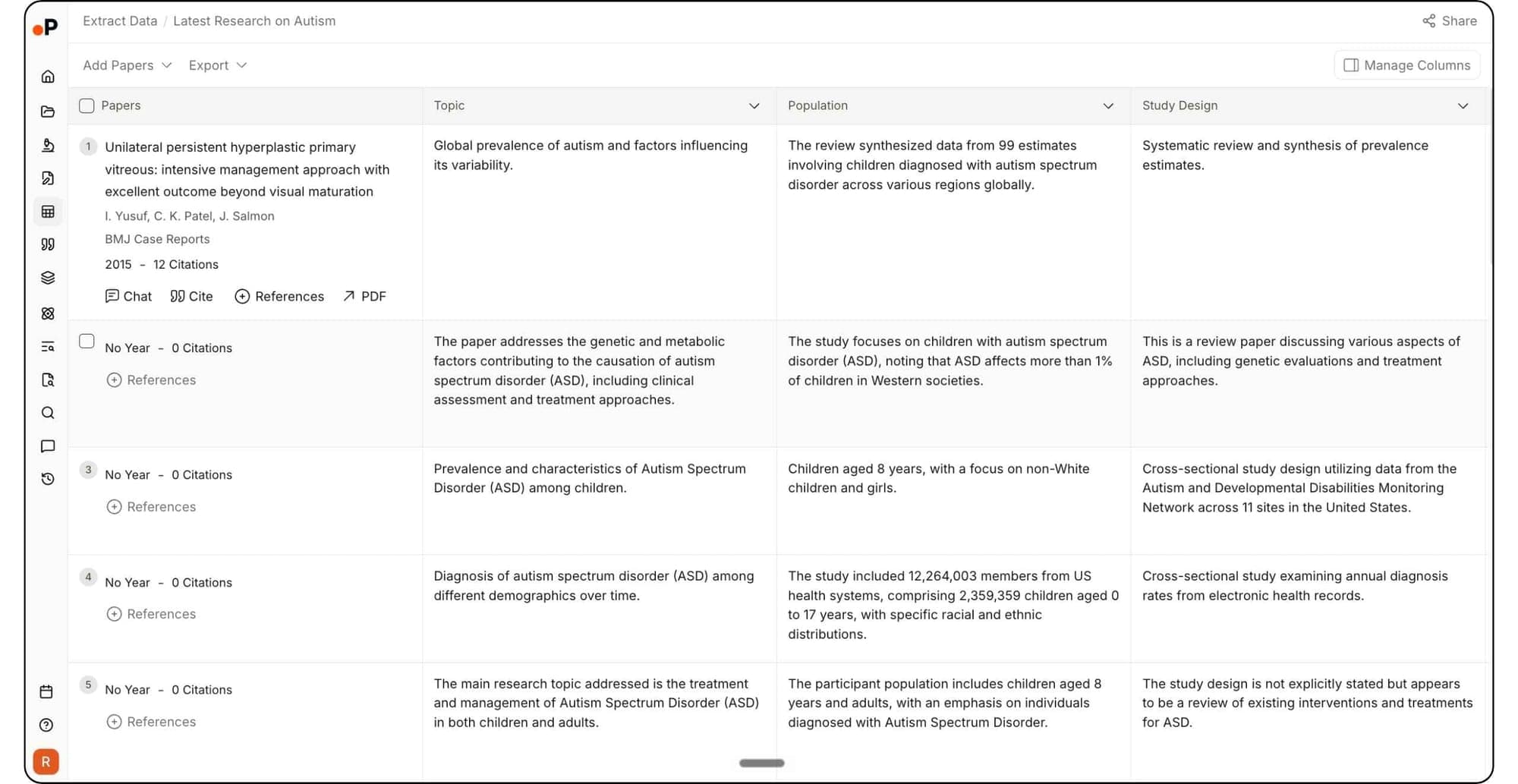
In comparison, AnswerThis provides data extraction tables via modular add-steps within AI Search. However, the extraction depth is limited and the workflow is not connected into a structured extraction pipeline. There is no configurable output typing, no AI-generated field suggestions, and limited column flexibility compared to Paperguide's 50-column tables.
Winner: Paperguide. 50 columns on any paid plan, AI-generated fields, configurable output types, and source-verified extraction give Paperguide the advantage. AnswerThis provides basic extraction through add-steps but lacks the depth and structure for serious extraction workflows.
How Does Paperguide AI Paper Writer Compare to AnswerThis?
In our testing, the AI Paper Writer was where the workflow advantage became most apparent. Paperguide's AI Paper Writer generates full drafts from a research question, automatically citing papers from the 200M+ database and the user's own Reference Manager. Users add custom instructions, set reference preferences, and filter sources by journal quality (SJR, SNIP) and publication year before generation begins. The system builds an outline first, then a citation-grounded draft where every cited claim traces back to a verifiable source.
Inside the editor, five AI tools support the writing workflow. AI Chat searches the 200M+ database or the user's library and inserts citation-backed text directly into the document. AI Edit rewrites selected passages for tone, clarity, simplification, or humanization while preserving existing citation markers. Smart Continue extends writing from the cursor position while maintaining structural and stylistic consistency. Autocomplete provides real-time inline suggestions with citations as the researcher types. Describe to LaTeX converts plain-English equation descriptions into rendered LaTeX code. Researchers also insert citations from their library using '@' mentions, and adjacent citations group automatically into combined parentheses following the active citation style. In addition, the platform supports version history, DOCX export, a plagiarism checker, collaborative editing, and over 1,000 citation styles.
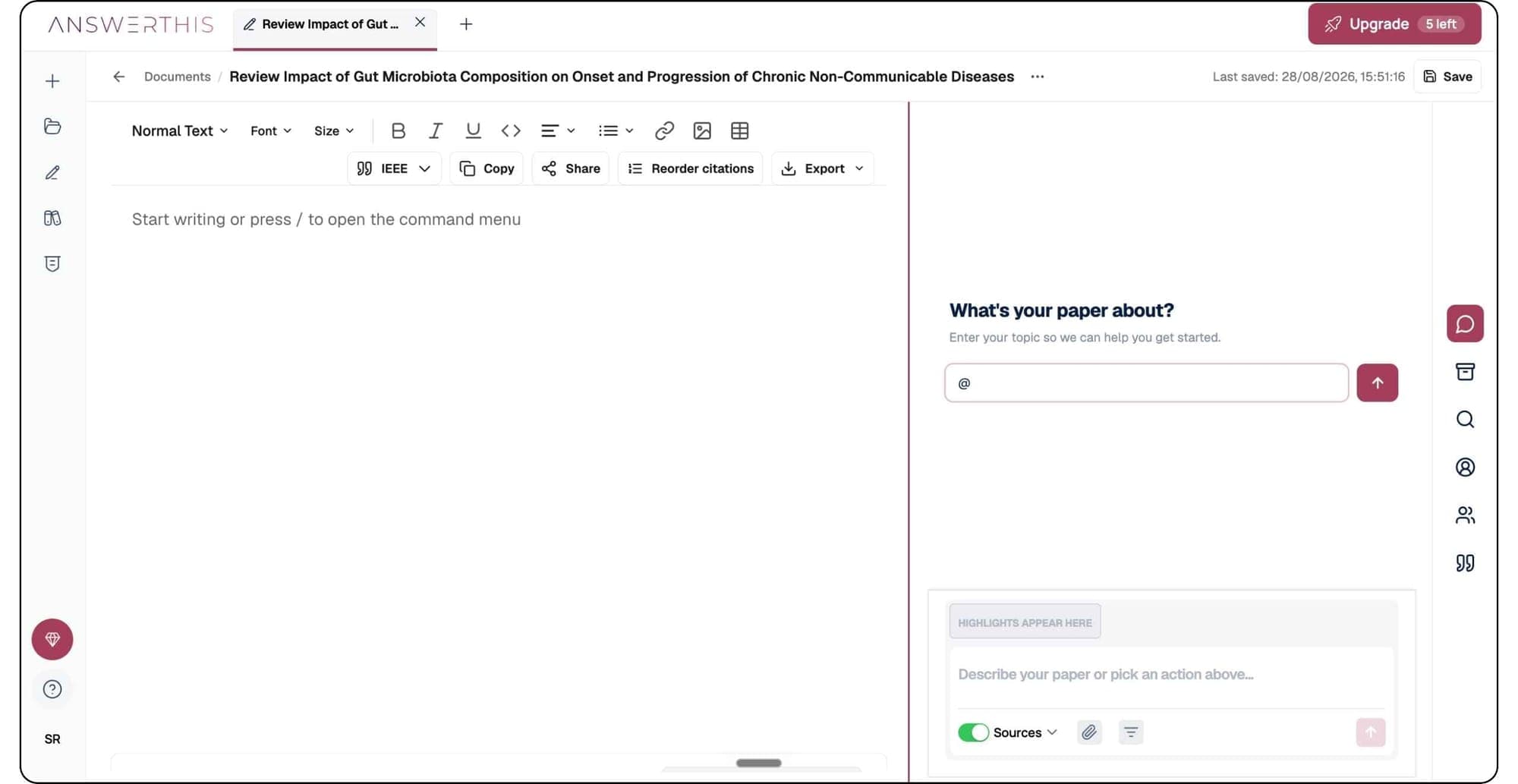
In comparison, AnswerThis supports outline generation, section drafting, and citation insertion. However, the writer lacks workflow connections to screening or extraction pipelines. There is no plagiarism checker, no grammar checker, no '@' citation insertion from a personal library, and no configurable citation style management beyond basic formatting.
Winner: Paperguide. Full draft generation, five integrated AI tools, '@' citation insertion, 1,000+ citation styles, plagiarism checking, and collaborative editing make Paperguide substantially stronger for publication-targeted writing. AnswerThis provides useful drafting assistance but lacks the depth and workflow integration needed at the writing stage.
How Does Paperguide Reference Manager Compare to AnswerThis?
Paperguide has a full Reference Manager with multiple import methods: DOI, URL, BibTeX, RIS, and PDF import (up to 100MB on paid plans), plus Zotero and Mendeley import. It automatically fetches metadata and open-access PDFs. The library includes folders and tags, an in-app PDF reader with annotation and highlights, AI summaries, Research Agent chat on library papers, over 1,000 citation styles, and a Chrome extension for capture and institutional proxy access. Every paper in the library is a usable source across search, extraction, review, and the AI Paper Writer.
In comparison, AnswerThis offers a Library with paper organization, Zotero and Mendeley integration, and project management features. However, it lacks advanced tagging, annotation systems, a Chrome extension, multi-method import options (DOI, URL, BibTeX, RIS), AI-generated summaries on library papers, and integration with a writing workspace that uses library papers as citation sources.
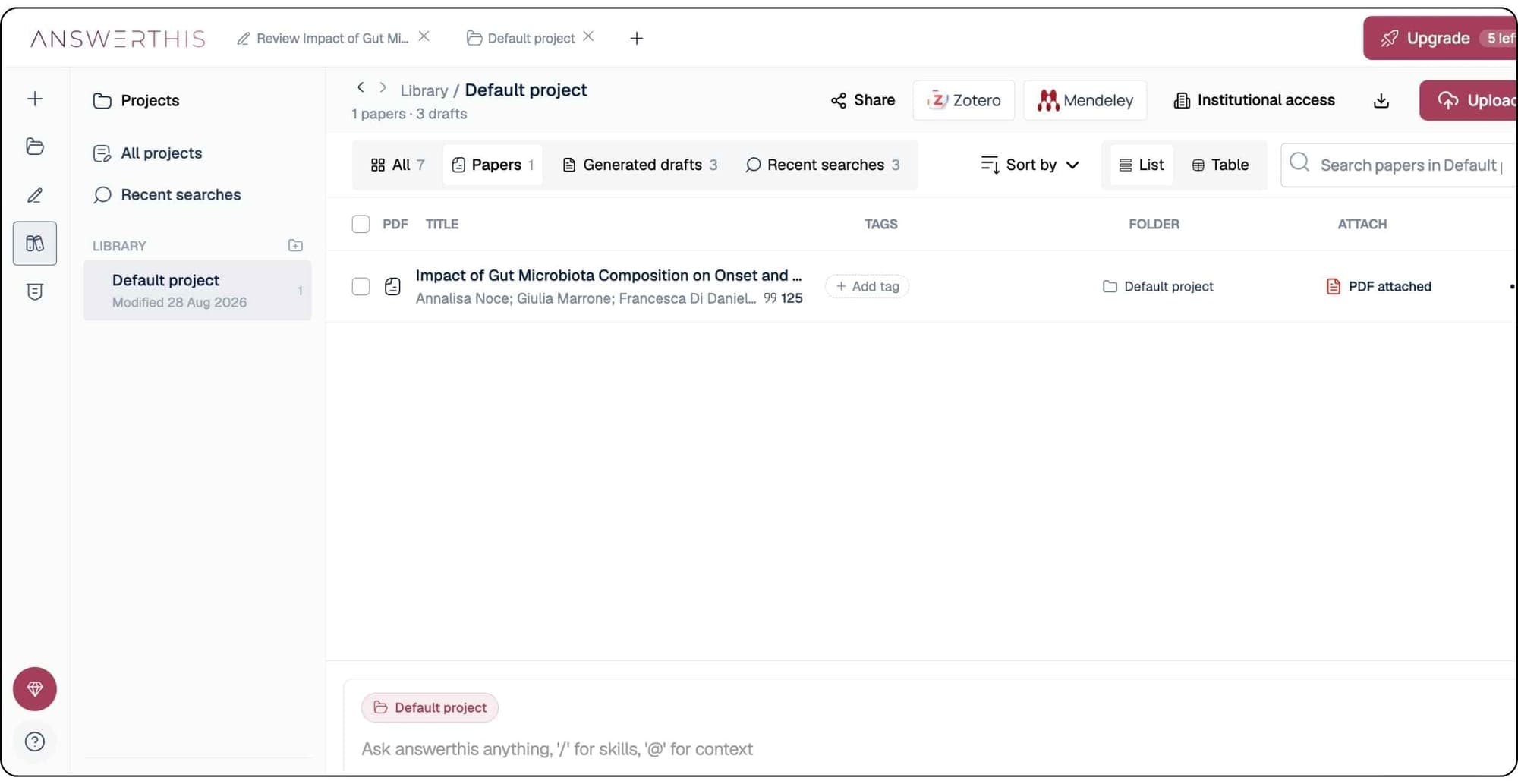
Winner: Paperguide. Multiple import methods, annotation, highlights, AI summaries, Chrome extension, institutional proxy access, 1,000+ citation styles, and full integration with the AI Paper Writer give Paperguide the advantage. AnswerThis supports Zotero and Mendeley integration but lacks the depth and workflow connectivity of a full research reference manager.
How Does Paperguide Systematic Review Compare to AnswerThis?
Paperguide supports systematic review starting on Plus at $12 per seat per month, billed annually. The workflow follows a protocol-first approach: researchers define inclusion and exclusion criteria, set quality thresholds using SJR, SNIP, and citation metrics, and assign a named verifier to confirm each stage, with dual reviewer screening on Evidence Teams and Enterprise. Ordered exclusion criteria provide per-criterion evidence at each screening stage, creating an auditable decision trail. The system supports up to 1,000 papers on Plus and scales to 5,000 papers on Pro and Evidence Teams. PRISMA reporting is built in, and every screening decision links back to the original paper and the criterion that triggered inclusion or exclusion.
In comparison, AnswerThis lists systematic review only on the Max plan at $250/month. The Free, Pro, and Lab & Team plans do not include systematic review. Because the feature sits behind the highest-tier plan, most AnswerThis users do not have access to protocol-driven reviews, assigned verifiers, or PRISMA reporting.
Winner: Paperguide. Protocol-first workflows, assigned verifiers, ordered exclusion criteria, PRISMA reporting, and an auditable decision trail starting at $12 per seat per month, billed annually, give Paperguide a significant advantage. AnswerThis reserves systematic review for the $250/month Max plan, putting it out of reach for most researchers.
Where Is Paperguide Stronger Than AnswerThis?
Beyond the workflow-by-workflow results above, Paperguide has five structural advantages that compound across a full research project.
1. Workflow Completeness
AnswerThis covers AI search, literature summaries, and basic drafting. As a result, the workflow ends at an answer or a draft. In contrast, Paperguide continues into structured extraction, systematic review, reference management, citation-grounded drafting, and the final document. Consequently, context carries across stages instead of being exported between tools. In practical terms, AnswerThis replaces your search and gives you a fast summary. However, Paperguide replaces your search, your spreadsheet, your reference manager, and your draft.
2. Research Quality Evaluation Is Surfaced Throughout
AnswerThis provides Q1-Q4 journal quality filters and citation count filters in search. However, SJR scores, SNIP, and granular impact metrics are not displayed in search results, literature reviews, or synthesized outputs. In contrast, Paperguide carries SJR quartile, SJR score, SNIP, and citation metrics into results, recommendations, screening, and the Literature Review AI. Because of this, researchers see quality signals where they make decisions, not only where they filter.
3. Systematic Review Support
AnswerThis lists systematic review only on the Max plan at $250/month. In contrast, Paperguide supports systematic review starting on Plus at $12 per seat per month, billed annually, with protocol-first workflows, assigned verifiers, ordered exclusion criteria, per-criterion evidence, PRISMA reporting, and an auditable decision trail. For regulated and publication-targeted reviews, this is a significant difference in both capability and cost.
4. Citation-Grounded Writing with Full Editor
AnswerThis provides outline generation, section drafting, and citation insertion. However, it is not a full writing platform: there is no plagiarism checker, no grammar checker, no '@' citation insertion from a personal library, no configurable citation styles, and no collaborative editing. Paperguide's AI Paper Writer generates full drafts with five AI tools, 1,000+ citation styles, collaborative editing, plagiarism checking, and version history. For any researcher, the writing stage is where the hours actually go.
5. Deep Research Reports with Researcher Control
AnswerThis does not offer a Deep Research Report feature. In contrast, Paperguide's Deep Research Report inserts a review and confirmation point at every stage: user-defined research questions, manual include/exclude on retrieved papers, and customizable extraction fields before synthesis runs. Standard mode reviews 80 papers and uses the top 30. Extended mode reviews 100 papers and uses the top 50. Because of this, researchers control what goes into the report rather than relying on a single AI-generated output.
Where Does AnswerThis Genuinely Win?
1. Bibliometric Analysis and Citation Maps
AnswerThis provides bibliometric analysis with citation maps as a built-in feature. Paperguide does not offer bibliometric analysis or citation mapping. For researchers who need to visualize citation networks, identify influential papers through citation relationships, or map research trends, AnswerThis is the only option among these two platforms.
2. Research Gap Identification
AnswerThis generates structured research gaps with citation-backed suggestions for underexplored topics, unresolved findings, and possible research directions. While the methodology behind gap ranking is not transparent, the output is useful for ideation and topic exploration. Paperguide now has a dedicated tool for this too: the Paperguide Research Gap Finder builds an evidence coverage map and runs extra searches that try to disprove each candidate gap before reporting it, so AnswerThis is quicker for ideation while Paperguide gives gaps that have already been tested.
3. Answer Speed and Export Flexibility
AnswerThis delivers fast, citation-backed answers with export options across PDF, DOCX, LaTeX, and Markdown. The answer-first approach is faster for researchers who need a quick synthesis without committing to a full workflow. For exploratory research and initial topic scoping, this speed advantage is practical and meaningful.
Pricing Comparison
| Plan | Paperguide | AnswerThis |
|---|---|---|
| Free | 2,000 AI credits/month; 5 columns; 10 papers/table | 5 lit reviews/month; 0 queries; 50 PDFs |
| Entry Paid | Plus $12 per seat/month, billed annually ($144/year) | Pro $35/month |
| Mid Tier | Pro $29 per seat/month, billed annually ($348/year) | Lab & Team $75/month (min 3 seats, annual) |
| High Tier | Evidence Teams $89 per seat/month, billed annually ($1,068/year) | Max $250/month (systematic review included) |
| Enterprise | Custom (up to 20,000 papers) | Not listed separately |
| Academic Discount | 30% with a valid university email | Not listed |
Paperguide Plus at $12 per seat per month, billed annually ($144 a year), includes systematic reviews up to 1,000 papers, 50 extraction columns, Literature Review AI, Deep Research Report, AI Paper Writer with 1,000+ citation styles, and a full Reference Manager (Paperguide pricing, retrieved October 2026). In contrast, AnswerThis Pro at $35/month includes 10 queries per month, 2 literature reviews per month, 200 papers in the library, and no systematic review support (AnswerThis pricing page, retrieved August 2026). Systematic review on AnswerThis requires the Max plan at $250/month. The PRISMA 2020 statement, which guides systematic review reporting standards, has been cited over 40,000 times since publication (The BMJ, 2021). Because of this, PRISMA compliance matters for credible reviews, and Paperguide includes it starting at $12 per seat per month, billed annually.
As a result, a graduate student who needs systematic review access, literature reviews, and citation-grounded writing pays $144/year on Paperguide Plus versus $420/year on AnswerThis Pro without getting systematic review at all. On top of that, Paperguide offers a 30% academic discount with a valid university email, while AnswerThis does not list one.
Final Verdict: Should You Choose Paperguide or AnswerThis?
Paperguide is the stronger choice for researchers who need a connected workflow from search through systematic review, literature review, extraction, and writing to a publication-ready draft with quality metrics at every step, starting at $12 per seat per month, billed annually.
AnswerThis is the stronger choice when fast citation-backed answers, bibliometric analysis with citation maps, or research gap identification matter more than workflow depth.
The decision comes down to whether workflow completeness or research speed matters more for your project.
Frequently Asked Questions
Is Paperguide better than AnswerThis?
Paperguide is better for connected research workflows with SJR/SNIP quality metrics in outputs, systematic review with assigned verifiers and PRISMA reporting, structured extraction with 50 columns, integrated citation-grounded writing with over 1,000 citation styles, a full reference manager, and a lower starting price ($12 per seat per month billed annually vs $35/month). In contrast, AnswerThis is better for fast citation-backed answers, bibliometric analysis with citation maps, and research gap identification. The right choice depends on whether you prioritize workflow completeness or research speed.
Is Paperguide a good AnswerThis alternative?
Paperguide is a strong AnswerThis alternative for researchers who want one platform connecting search, systematic review, literature review, extraction, references, and citation-grounded writing. It covers the same core search functionality at a lower price point while adding systematic review, structured extraction, and a full AI Paper Writer that AnswerThis does not match. However, it does not include bibliometric analysis or citation maps.
Which tool is better for literature reviews?
Paperguide's Literature Review AI follows a five-step structured process with SJR/SNIP screening, Standard mode (up to 50 papers), and Extended mode (up to 200 papers screened). Researchers control which papers are included based on quality thresholds. AnswerThis generates multi-section literature summaries quickly but without screening controls, inclusion/exclusion criteria, or transparent quality scoring. For publication-targeted reviews, Paperguide is stronger. For fast initial summaries, AnswerThis is faster.
Which tool is better for PhD students?
Paperguide Plus at $144/year covers AI Search, Literature Review AI, Systematic Review (up to 1,000 papers), AI Paper Writer with 1,000+ citation styles, and Reference Manager. In contrast, AnswerThis Pro at $420/year includes 10 queries and 2 literature reviews per month without systematic review. Therefore, for PhD students on a budget who need the full research workflow, Paperguide is more affordable at $276 less per year while including more features.
Does AnswerThis have a systematic review tool?
AnswerThis lists systematic review only on the Max plan at $250/month. The Free, Pro, and Lab & Team plans do not include systematic review. In contrast, Paperguide supports systematic review starting on Plus at $12 per seat per month, billed annually, with protocol-first workflows, assigned verifiers, PRISMA reporting, and an auditable decision trail.
Does AnswerThis show research quality metrics like SJR or SNIP?
AnswerThis provides Q1-Q4 journal quality filters and citation count filters in its search interface. However, SJR scores, SNIP, and granular impact metrics are not displayed in search results, literature reviews, or synthesized outputs. In contrast, Paperguide displays SJR quartile, SJR score, and SNIP on every search result and carries these signals into screening, literature review, and recommendations.
Does AnswerThis have a research agent?
AnswerThis does not have a dedicated Research Agent. Instead, it offers modular "Add Steps" within AI Search for data extraction, bibliometric analysis, citation maps, and the AI Writer. These add flexibility but do not connect into a unified multi-step pipeline. Paperguide's Research Agent handles search, screening, cross-study comparison, gap identification, extraction, and draft generation within one connected session.
Can I migrate from AnswerThis to Paperguide?
Both platforms support Zotero integration. A library stored in Zotero transfers to either tool. Paperguide also supports import via DOI, URL, BibTeX, RIS, PDF upload, and Mendeley. However, literature reviews and research outputs do not transfer between platforms and would need to be recreated.
Researching a topic?
Find papers and get cited answers
Search the literature, find gaps and write with citations.
Start for freeNo credit card required