Literature Review vs Meta-Analysis: Which One to Use? (2026)

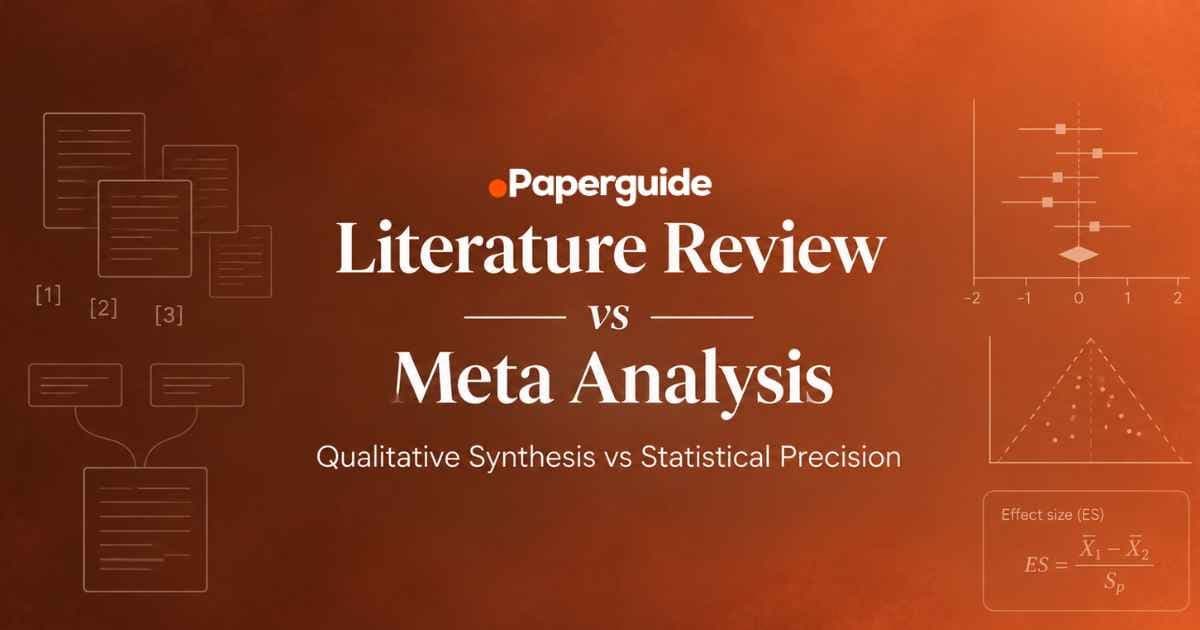
A literature review surveys and synthesizes existing research on a topic using qualitative analysis. A meta analysis applies statistical methods to combine quantitative results from multiple studies into a single summary effect estimate. The two serve different purposes, require different skill sets, and produce different types of evidence. Understanding these differences prevents researchers from choosing the wrong methodology for their question, which leads to wasted effort and, in many cases, desk rejection.
This guide breaks down the differences across purpose, methodology, data requirements, synthesis approach, output format, and evidence strength, with practical guidance on when each fits your research.
TL;DR
- A literature review synthesizes existing research qualitatively, organizing findings by themes to map what is known and where the gaps are.
- A meta analysis pools quantitative results from comparable studies into a single effect estimate, presented in a forest plot.
- Choose a literature review for broad or exploratory questions and diverse study designs; choose a meta analysis for a specific quantitative question with enough comparable studies.
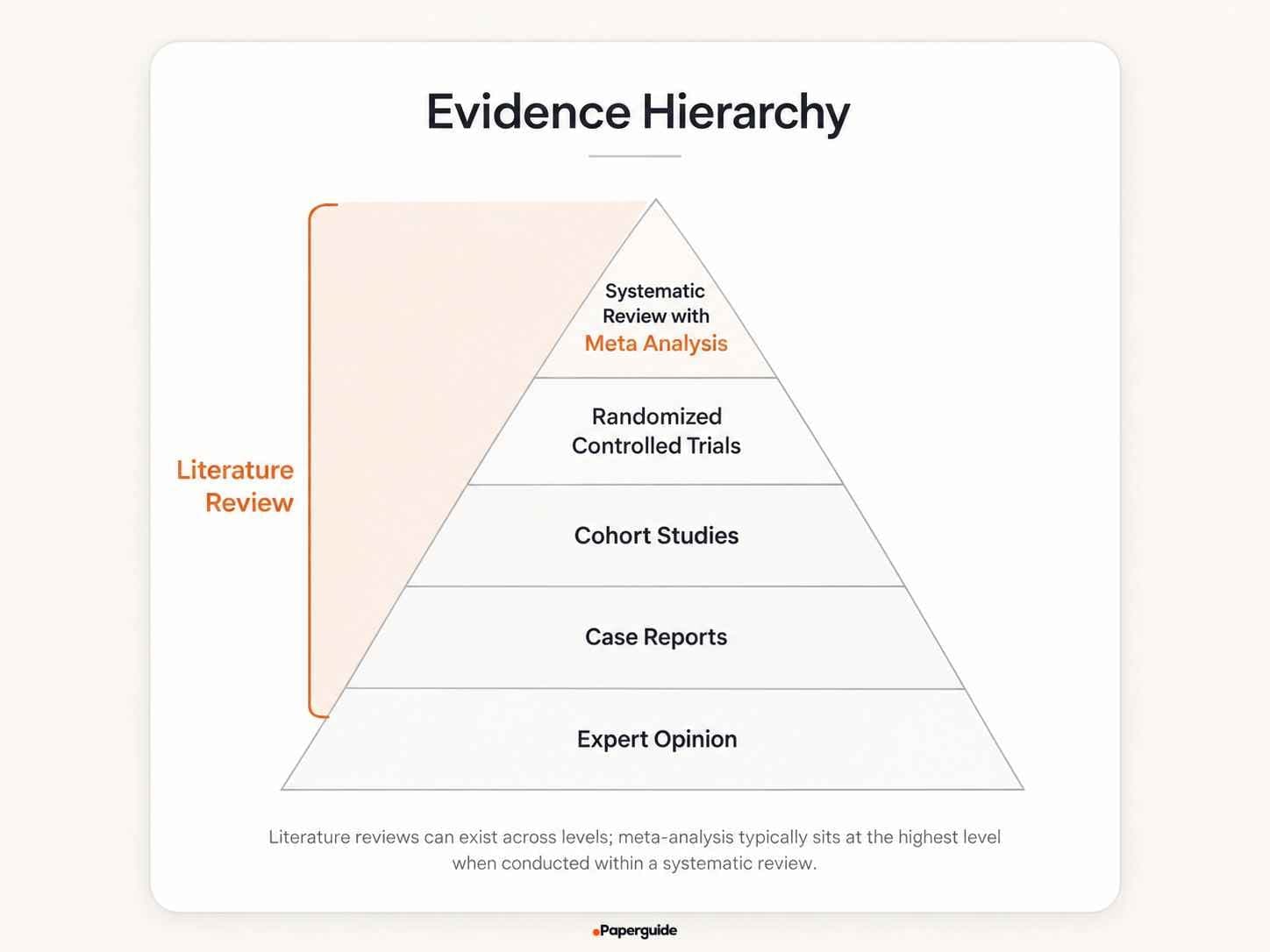
- A meta analysis is almost always conducted within a systematic review, and that combination sits at the top of the evidence hierarchy.
- AI tools speed up searching, screening and extraction, but the statistical pooling still needs dedicated software such as R, Stata, RevMan or CMA.
Literature Review vs Meta-Analysis: Quick Comparison
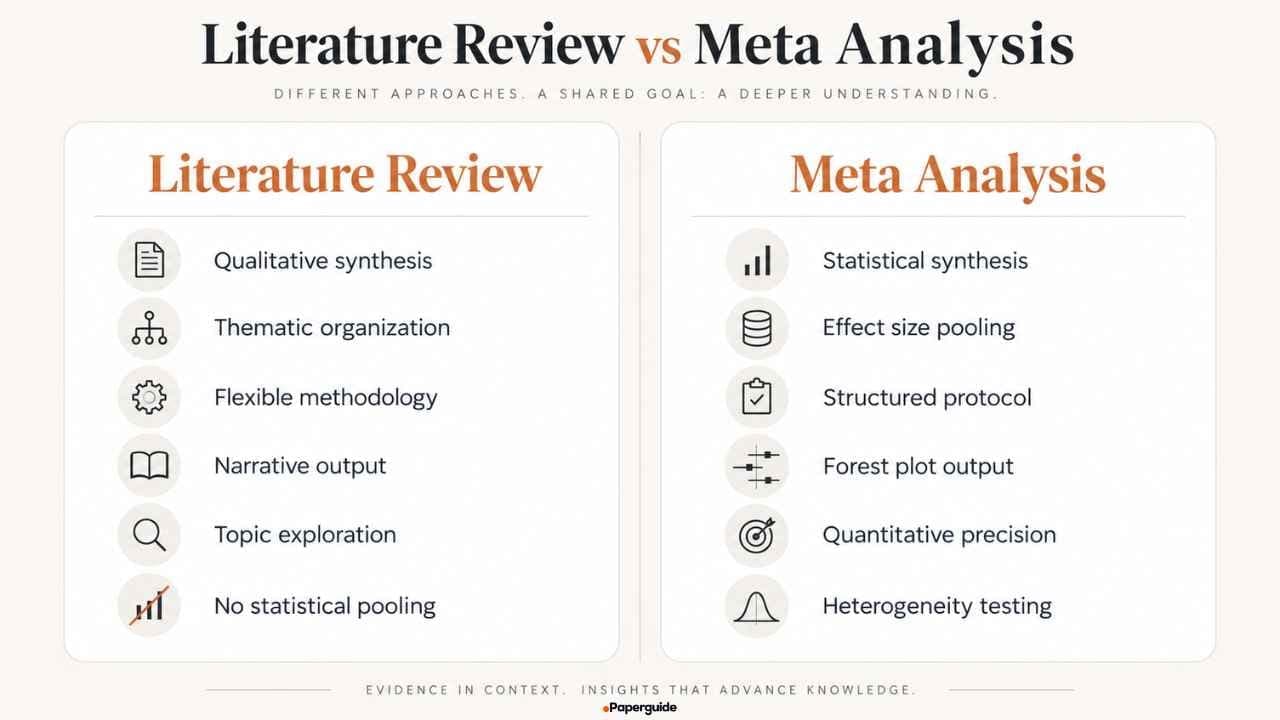
| Dimension | Literature Review | Meta Analysis |
|---|---|---|
| Purpose | Survey and synthesize the state of knowledge on a topic | Produce a single statistical summary from pooled study data |
| Data Type | Qualitative (themes, arguments, findings) | Quantitative (effect sizes, confidence intervals, sample sizes) |
| Methodology | Flexible, can follow various approaches | Structured statistical protocol with pre-specified methods |
| Statistical Analysis | None or minimal | Required (forest plots, heterogeneity tests, pooled effects) |
| Study Similarity Requirement | Studies can be diverse in design and scope | Studies must be sufficiently similar to pool statistically |
| Reproducibility | Low to moderate | High |
| Output | Narrative synthesis organized by themes | Forest plot with pooled effect estimate and confidence interval |
| Typical Timeline | 2 weeks to 6 months | 3 to 12 months (usually within a systematic review) |
| Software Required | Reference manager, reading tools | Statistical software (R, Stata, RevMan, CMA) |
| Evidence Level | Varies by type (scoping, narrative, systematic) | Highest when embedded in a systematic review |
| Best For | Topic exploration, identifying gaps, framing research questions | Answering specific quantitative questions with precision |
What Is a Literature Review?
A literature review is a scholarly synthesis of existing research on a defined topic. [1] The researcher identifies relevant studies, reads and analyzes them, and organizes findings into a coherent narrative that maps the current state of knowledge, highlights agreements and contradictions, and identifies gaps where further research is needed.
Literature reviews take several forms. A narrative review provides a broad, expert-driven overview of a topic. A scoping review maps the range and nature of evidence available on a question. A systematic review follows a pre-registered protocol with exhaustive searching, dual-reviewer screening, and risk-of-bias assessment. Each type serves a different purpose, but all share the core activity of reading, evaluating, and synthesizing published research.
Researchers approaching this process for the first time can benefit from understanding how to write a literature review before choosing between qualitative and quantitative synthesis. The output of a literature review is a written synthesis, typically organized by themes, chronology, or theoretical frameworks. The synthesis is qualitative: the reviewer interprets findings, draws connections across studies, and presents conclusions in prose rather than statistical summaries. Literature reviews are found in dissertation chapters, journal article introductions, standalone review papers, and grant proposals.
What Is a Meta Analysis?
A meta analysis is a statistical technique that combines quantitative results from multiple independent studies to produce a single pooled estimate of an effect. The technique was formalized by Gene Glass in 1976, and it has become a standard method for synthesizing evidence in medicine, psychology, education, and the social sciences. [2]
The process requires extracting numerical data from each study (effect sizes, sample sizes, standard errors, confidence intervals), assessing statistical heterogeneity across studies, selecting a pooling model (fixed-effect or random-effects), and calculating a weighted average effect. [5] The primary output is a forest plot: a visual representation showing each study's individual effect estimate alongside the pooled summary estimate and its confidence interval.
Meta analysis is almost always conducted within the framework of a systematic review. The systematic review provides the rigorous search, screening, and quality assessment needed to ensure the studies being pooled are identified transparently and assessed for bias. A meta analysis without a systematic review risks pooling a biased or incomplete set of studies, which produces a precise but potentially misleading result. The relationship between systematic reviews and meta analysis is explored in a separate comparison.

What Are the Key Differences Between Literature Review and Meta Analysis?
1. Purpose and Research Question
A literature review asks broad questions: What do we know about this topic? Where are the gaps? How have perspectives evolved? The goal is to map a research landscape rather than answer a single quantitative question.
A meta analysis asks a specific, measurable question: What is the pooled effect of intervention X on outcome Y? How large is the association between variable A and variable B across studies? The question must be narrow enough that the included studies measure comparable outcomes using comparable methods.
2. Data Type and Extraction
Literature reviews work with qualitative data. The reviewer reads studies, identifies key findings, and extracts themes, arguments, and conclusions. Data extraction may be structured (using a template to capture study characteristics) or informal, depending on the review type.
Meta analysis works with quantitative data. The analyst extracts specific numbers from each study: means, standard deviations, odds ratios, hazard ratios, correlation coefficients, sample sizes, and confidence intervals. These numbers must be comparable across studies, which means the included studies need to measure similar constructs using similar scales or outcomes. When studies report results in different metrics, the analyst must convert them to a common effect size measure (Cohen's d, Hedges' g, log odds ratio) before pooling.
3. Analytical Approach
Literature reviews use qualitative synthesis. The reviewer organizes evidence by themes, identifies patterns and contradictions, and draws interpretive conclusions. The analysis depends on the reviewer's expertise and judgment, which is both a strength (allowing nuanced interpretation) and a limitation (introducing subjectivity).
Meta analysis uses statistical synthesis. The analyst selects a statistical model (fixed-effect assumes one true effect, random-effects assumes a distribution of effects), calculates study weights (typically inverse-variance), tests for heterogeneity (I-squared, Q statistic, tau-squared), and generates a pooled effect estimate with a confidence interval. Sensitivity analyses, subgroup analyses, and meta-regression can explore sources of variation across studies. Publication bias is assessed using funnel plots, Egger's test, or trim-and-fill methods.
4. Heterogeneity and Study Compatibility
Literature reviews can accommodate diverse studies. A review of "AI in healthcare" might include randomized trials, qualitative interviews, policy analyses, and case studies, all synthesized into a single narrative. This flexibility is a core strength of the format.
Meta analysis requires statistical compatibility. If the included studies measure different outcomes, use different scales, or study very different populations, their results cannot be pooled meaningfully. High heterogeneity (I-squared above 75%) signals that the studies may be too different to combine, and the analyst must decide whether to proceed with subgroup analyses, switch to a narrative synthesis, or abandon the pooling altogether. The "apples and oranges" criticism of meta analysis refers to this exact problem: pooling incompatible studies produces a number that looks precise but represents nothing meaningful.
5. Output Format
A literature review produces a written document: paragraphs organized by themes, a narrative that tells the story of what research has found. The output is readable prose aimed at researchers, students, or practitioners who want to understand a field.
A meta analysis produces statistical outputs: a forest plot showing individual and pooled effects, heterogeneity statistics, funnel plots for publication bias assessment, and summary tables of effect sizes. The primary deliverable is a number (the pooled effect estimate with its confidence interval and p-value) supported by visual evidence of how that number was derived.
6. Reproducibility
Literature reviews vary in reproducibility. Narrative reviews have low reproducibility because another reviewer might select different studies and reach different conclusions. Systematic literature reviews have higher reproducibility because they follow documented protocols, but the qualitative synthesis component still involves subjective judgment.
Meta analysis has high reproducibility. Given the same set of studies and the same statistical model, two analysts will produce the same pooled effect estimate. The calculations are mathematical, and the methods (model selection, weighting, heterogeneity assessment) are specified in the protocol. This reproducibility is one of the primary reasons meta analysis is valued in evidence-based decision-making.
7. Evidence Strength and Impact
A literature review's evidence strength depends on its type. A narrative review provides expert opinion, the lowest level in the evidence hierarchy. A systematic literature review provides strong evidence, particularly when conducted with PRISMA 2020 reporting standards. But neither produces the quantitative precision of a meta analysis.
A meta analysis embedded in a systematic review sits at the top of the evidence hierarchy. Clinical practice guidelines from Cochrane, WHO, and NICE rely on meta-analytic evidence because it provides the most precise estimate of treatment effects available. The statistical precision of a well-conducted meta analysis, combined with the transparency of the systematic review framework, creates the strongest form of research evidence for clinical and policy decisions.
When Should You Use a Literature Review?
Choose a literature review when you need to understand the breadth of a research area, identify gaps in existing knowledge, frame a research question for a new study, provide context for a dissertation or thesis, or explore a topic that spans diverse methodologies and disciplines. Literature reviews are appropriate when the available studies are too heterogeneous to pool statistically, when the research question is broad or exploratory, or when the goal is interpretation rather than quantitative precision.
Literature reviews also serve as the foundation for meta analyses. Before deciding whether a meta analysis is feasible, researchers typically conduct a literature review to assess whether enough studies with comparable designs and outcomes exist to support statistical pooling.
When Should You Use a Meta Analysis?
Choose a meta analysis when the research question is specific and quantitative, multiple studies with comparable designs and outcomes exist, and a precise pooled estimate would be more useful than a narrative summary. Meta analysis is expected in Cochrane reviews, clinical guideline development, health technology assessments, and regulatory submissions where quantitative evidence informs decisions.
Meta analysis is also valuable when individual studies are underpowered. A single trial with 50 participants may not detect a real treatment effect, but pooling 15 such trials creates the statistical power to detect small but clinically meaningful differences. This ability to increase precision beyond what any single study can achieve is one of the most important contributions of meta analysis to evidence-based research.
Can a Literature Review Include a Meta Analysis?
Yes, but the relationship is specific. A systematic literature review can include a meta analysis as its synthesis component. The systematic review provides the framework (protocol, search, screening, quality assessment) and the meta analysis provides the statistical synthesis. This combination, a systematic review with meta analysis, represents the strongest form of evidence synthesis.
However, a narrative literature review or a scoping review does not include a meta analysis. The informal search and selection methods of these review types do not provide the methodological foundation needed to justify statistical pooling. If a narrative review attempted to include a meta analysis, the result would be a statistically precise estimate derived from a potentially biased set of studies, which undermines the value of the precision.
How AI Tools Support Literature Reviews and Meta Analysis
AI tools are reducing the manual workload involved in both literature reviews and meta analyses, though they do so at different stages of the process.
For literature reviews, AI accelerates the discovery and reading phases. Paperguide's AI Search covers 200M+ peer-reviewed papers with SJR and SNIP quality signals, and the Literature Review AI screens up to 200 papers and synthesizes the top 50 into a structured review with citations and exportable data extraction tables.
For meta analyses conducted within systematic reviews, AI tools support the screening and data extraction stages. Paperguide, recognized as the best systematic review software in 2026, offers a systematic review workflow that covers the process from protocol through report generation, with AI-led screening for rapid reviews or PRISMA-grade dual-review blind screening. The PRISMA 2020 flow diagram builds in real time, exporting as SVG, PNG, or PDF.
The AI Paper Writer connects both workflows to the manuscript stage, generating citation-grounded drafts where every claim traces back to a source paper in the researcher's Reference Manager.
The statistical pooling stage still requires dedicated software (R with metafor, Stata, RevMan, or CMA). AI tools accelerate the upstream stages that make the meta analysis possible, not the statistical analysis itself.
Conclusion
A literature review and a meta analysis serve fundamentally different purposes. The literature review provides a qualitative synthesis that maps the state of knowledge on a topic. The meta analysis provides a quantitative synthesis that calculates a pooled effect size from comparable studies.
Your choice depends on what your research question requires. If you need to summarize and interpret a body of literature, a literature review is appropriate. If you need to determine the magnitude of an effect across multiple studies with comparable outcomes, a meta analysis conducted within a systematic review framework is the stronger approach.
Paperguide's Literature Review AI builds structured reviews with citations, and the systematic review workflow supports the rigorous process that precedes meta analysis.
Frequently Asked Questions
What is the main difference between a literature review and a meta analysis?
A literature review synthesizes existing research qualitatively through narrative analysis and thematic organization. A meta analysis synthesizes research quantitatively by applying statistical methods to pool numerical results from multiple studies into a single effect estimate. The literature review tells the story of what research has found; the meta analysis provides a precise number measuring how large an effect is.
Is a meta analysis better than a literature review?
Neither is inherently better. They serve different purposes. A meta analysis provides higher statistical precision and sits at the top of the evidence hierarchy when embedded in a systematic review. A literature review provides broader understanding of a topic and can accommodate diverse study designs that cannot be pooled statistically. The better choice depends on the research question and the nature of the available evidence.
Does a meta analysis always include a literature review?
A meta analysis is almost always conducted within a systematic review, which includes a structured literature review component. The systematic review provides the protocol, search strategy, screening process, and quality assessment that justify pooling the studies statistically. Conducting a meta analysis without this systematic framework risks pooling a biased or incomplete set of studies.
Can I do a literature review without statistical analysis?
Yes. Most literature reviews do not include statistical analysis. Narrative reviews, scoping reviews, and many systematic reviews use qualitative synthesis rather than statistical pooling. Statistical analysis (meta analysis) is added only when the included studies are sufficiently similar in design and outcomes to justify quantitative pooling.
How long does each take to complete?
A literature review takes 2 weeks to 6 months depending on the type and scope. A narrative review of a focused topic can be completed in 2 to 4 weeks. A systematic literature review with comprehensive searching and dual-reviewer screening takes 6 to 18 months. A meta analysis adds 1 to 3 months to the systematic review timeline for data extraction, statistical analysis, and interpretation.
What software do I need for a meta analysis?
Meta analysis requires statistical software capable of calculating pooled effect sizes, generating forest plots, and testing for heterogeneity. Common options include R (with the metafor or meta packages), Stata, RevMan (free, from Cochrane), and Comprehensive Meta-Analysis (CMA). For the systematic review stages that precede the meta analysis, platforms like Paperguide support screening, data extraction, and PRISMA reporting.
Can a scoping review include a meta analysis?
Scoping reviews do not typically include meta analysis. The purpose of a scoping review is to map the range and nature of evidence on a topic, not to answer a specific quantitative question. The broad inclusion criteria and diverse study designs typical of scoping reviews make statistical pooling inappropriate. If a scoping review reveals enough comparable studies to support pooling, the appropriate next step is a focused systematic review with meta analysis.
Which review type do PhD students use most often?
PhD students most commonly write traditional literature reviews as dissertation chapters, providing context for their research questions. The specific type depends on the discipline. Health sciences programs often expect a systematic review chapter, and some require a meta analysis if sufficient comparable studies exist. Social sciences and humanities programs typically expect narrative or critical literature reviews. Check department guidelines and discuss with your supervisor to determine which approach fits your research.
References
- Snyder, H. (2019). Literature review as a research methodology: an overview and guidelines. Journal of Business Research, 104, 333-339. https://doi.org/10.1016/j.jbusres.2019.07.039
- Glass, G. V. (1976). Primary, secondary, and meta-analysis of research. Educational Researcher, 5(10), 3-8. https://doi.org/10.3102/0013189X005010003
- Borenstein, M., Hedges, L. V., Higgins, J. P. T., & Rothstein, H. R. (2021). Introduction to Meta-Analysis (2nd ed.). Wiley. https://doi.org/10.1002/9781119558378
- Higgins, J. P. T., Thomas, J., Chandler, J., Cumpston, M., Li, T., Page, M. J., & Welch, V. A. (Eds.). (2024). Cochrane Handbook for Systematic Reviews of Interventions (version 6.5). Cochrane. https://training.cochrane.org/handbook
- Higgins, J. P. T., & Thompson, S. G. (2002). Quantifying heterogeneity in a meta-analysis. Statistics in Medicine, 21(11), 1539-1558. https://doi.org/10.1002/sim.1186
Running a review?
Run your systematic review in Paperguide
Dual screening, verifiable extraction and PRISMA reporting in one place.
Start a reviewNo credit card required