Paperguide vs Covidence: Best Covidence Alternative in 2026


Paperguide and Covidence are two of the most established platforms for systematic review workflows, but they occupy very different positions in the research technology space. Paperguide is an AI-native platform for scientific research workflows and systematic review where AI search, literature review, systematic review, PDF analysis, structured extraction, reference management, and citation-grounded writing all stay linked inside one workspace. Covidence is a Cochrane-endorsed web application purpose-built for systematic review screening, data extraction, and quality assessment, and it has been the default choice at academic institutions for over a decade.
The distinction matters because systematic reviews remain among the most resource-intensive research activities in the sciences. An analysis of 195 PROSPERO-registered reviews found that the average systematic review takes 67.3 weeks from registration to completion [1]. A separate pragmatic review of 25 studies evaluating AI automation tools in evidence synthesis found that over two thirds of those studies reported greater than 50% time reduction in screening tasks when automation was applied [2]. These numbers explain why platform choice directly affects both the timeline and the cost of a review.
Covidence has built deep institutional trust. Over 750,000 researchers and students across 480 institutions have used the platform, with more than 730,000 reviews started to date. A 2026 practical comparison in the Journal of the Medical Library Association evaluated five systematic review platforms and noted that Covidence offers an intuitive interface typically associated with a shorter learning curve [3]. That reputation is earned. However, Covidence's scope ends at screening and extraction. It has no built-in search engine, no reference manager, no AI writing workspace, and no way to move from a screened evidence base to a cited draft without leaving the platform.
Paperguide covers that full span. The same workspace that searches 200M+ papers across PubMed, arXiv, OpenAlex, and Semantic Scholar also runs Paperguide Systematic Review Software with dual-blind screening or AI-led screening, structured data extraction, PRISMA reporting, citation-grounded writing with over 1,000 citation styles, and an AI-native reference manager with Zotero and Mendeley import. The question is whether that breadth matches the depth that Covidence delivers on the screening stage it has spent years refining.
We tested both platforms on real systematic review workflows to find out.
Key takeaway: Paperguide wins for research teams who need the full pipeline from paper discovery through systematic review to a cited draft in one platform. Covidence wins for teams embedded in an institutional subscription who need mature risk of bias assessment tooling and Cochrane-endorsed workflows for screening and extraction only.
TL;DR
| If you need... | Better choice |
|---|---|
| AI search with journal quality metrics in results | Paperguide |
| Systematic review with dual-blind screening | Both (strong parity) |
| Systematic review with AI-led screening for speed | Paperguide |
| Risk of bias / quality assessment tooling | Covidence |
| Data extraction with custom columns | Both (strong parity) |
| Citation-grounded writing from screened evidence | Paperguide |
| Reference management built into the workflow | Paperguide |
| PRISMA flow diagram generation | Both |
| Cochrane-endorsed institutional workflow | Covidence |
| Full pipeline from search to cited draft | Paperguide |
| Best overall value for independent researchers | Paperguide |
Overall, Paperguide is the better choice if you need a connected pipeline from search through systematic review to a cited draft starting at $12 per seat per month, billed annually. Covidence is the better choice if your institution already provides access, your team relies on established risk of bias tools, and your workflow ends at structured data tables rather than a written document. For independent researchers or small teams paying out of pocket, the pricing difference is significant: Paperguide Plus costs $144/year compared to Covidence's $339/year for a single review.
Pricing and plan details may change over time. For the latest Paperguide pricing, plans, and features, please visit the pricing page.
Paperguide vs Covidence: Quick Comparison
| Feature | Paperguide | Covidence |
|---|---|---|
| AI Search Corpus | 200M+ papers; PubMed, arXiv, OpenAlex, Semantic Scholar | No search engine; manual import from external databases |
| Quality Metrics | SJR, SNIP visible on every search result | Not applicable (no search) |
| Screening Modes | Dual-blind review with lead-resolved conflicts + AI-led with named verifier | Dual-reviewer with conflict resolution |
| ML-Assisted Screening | AI prioritization and AI-led mode | Cochrane RCT Classifier for relevance ranking |
| Risk of Bias | On roadmap | RoB 2 with PDF highlighting |
| Data Extraction | Custom columns, sentence-level evidence, configurable field types | Custom templates with PDF annotation |
| AI Paper Writer | Full drafts, '@' citations, 1,000+ styles, plagiarism checker | No writing workspace |
| Literature Review AI | Up to 50 papers, Extended mode, cited draft | No literature review generation |
| Reference Manager | Full library, Zotero/Mendeley import, Chrome extension, annotations | No reference manager; import-only |
| PRISMA Reporting | Built into workflow | Auto-generated flow diagram |
| Collaboration | Projects and workspaces, role-based access | Unlimited collaborators per review |
| Export Formats | BibTeX, RIS, CSV, Excel, Word, PDF | CSV, XML, RIS, RevMan, Cochrane format |
| Starting Price | Plus $12 per seat/month, billed annually ($144/year) | $339/year (single review) |
Who Is Paperguide Best For?
- Academic researchers and graduate students who need search, systematic review, literature review, writing, and references in one workspace rather than paying separately for Covidence, a reference manager, and a writing tool.
- HEOR analysts and clinical researchers at consultancies, CROs, and medical device companies who run systematic literature reviews for market access, regulatory submissions, and Clinical Evaluation Reports, and need cycle-time reduction with audit-ready output.
- Systematic review leads and evidence synthesis managers running protocol-driven reviews with dual-blind screening, assigned verifiers, PRISMA reporting, and an auditable decision trail who also need to produce a written report from the same evidence base.
- Independent researchers and small teams paying out of pocket who cannot justify $339/year for screening alone when a $144/year plan covers search, screening, extraction, writing, and reference management.
- Researchers who need a complete AI Paper Writer that generates citation-grounded drafts with automatic citations from 200M+ papers, supports '@' citation insertion, collaborative editing, plagiarism checking, and over 1,000 citation styles.
Who Is Covidence Best For?
- Cochrane review teams and institutions where Covidence is the established, endorsed tool and the team is already trained on its workflows.
- Systematic review teams requiring mature risk of bias assessment with RoB 2 tools, PDF highlighting, and structured quality assessment at the extraction stage.
- Large institutional teams where the organization covers the subscription, unlimited collaborators per review reduce friction, and the team's output is structured data tables rather than written documents.
How We Tested Paperguide and Covidence
We tested both tools using real systematic review workflows across search integration, title and abstract screening, full-text screening, data extraction, quality assessment, writing, and reference management. We evaluated workflow depth, citation grounding, source traceability, output quality, pricing structure, collaboration features, and limitations.
Claims marked "observed" come from signed-in product tests on Paperguide Evidence Teams ($89 per seat per month, billed annually) and Covidence (individual subscription at $339/year) during September 2026. Claims marked "listed" come from official pricing and product pages. Features labeled "Coming soon" or "On roadmap" are noted and not treated as available.
How Does Paperguide Search Compare to Covidence?
This is the most fundamental architectural difference between the two platforms. Paperguide has a built-in search engine. Covidence does not.
Paperguide searches 200M+ papers across PubMed, arXiv, OpenAlex, and Semantic Scholar in the same query, plus the user's own reference library. It uses hybrid semantic and keyword retrieval with agentic query variation run in parallel. The output synthesizes from the top 20 papers, producing a sectioned evidence report. SJR quartile, SJR score, SNIP, and citation metrics are visible on every search result. Export controls for BibTeX, CSV, and Excel appear directly beside references. Saved papers land in the reference manager and are immediately usable across extraction, review, and the AI Paper Writer.
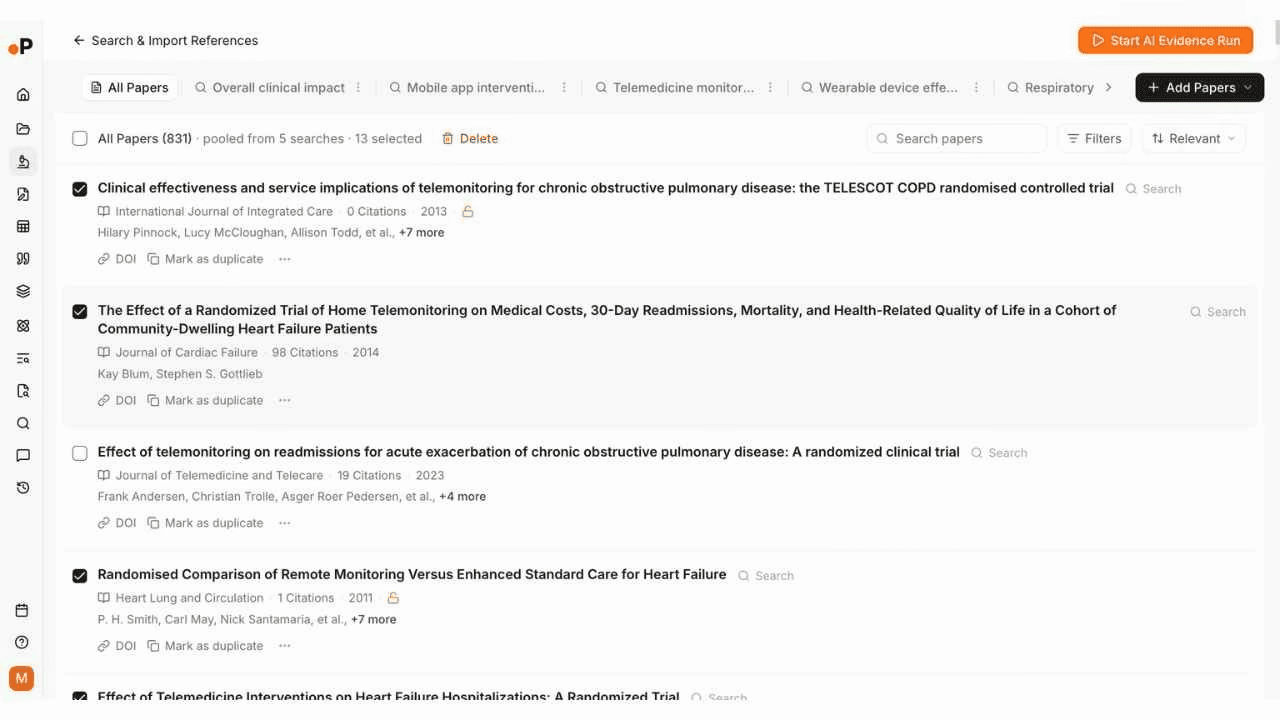
Covidence requires researchers to conduct their searches externally in databases such as PubMed, Embase, CINAHL, or Scopus, export references as RIS or CSV files, and then import those files into Covidence for screening. This workflow means that the search strategy, the search results, and the screening decisions exist in different systems. There is no way to re-run a search from within Covidence, no way to update results without a fresh export-import cycle, and no connection between the search outputs and the rest of the evidence synthesis pipeline.
For systematic review teams following Cochrane methodology, external database searching is standard practice. But for researchers who want their search results, screening decisions, extracted data, and final draft in one connected system, the import-only model adds friction at every stage.
Winner: Paperguide. Covidence has no search capability. Paperguide's AI search across 200M+ papers with quality metrics and direct library integration is a structural advantage that compounds across every subsequent stage.
How Does Systematic Review Screening Compare?
Both platforms support protocol-driven systematic review screening, but they approach it differently.
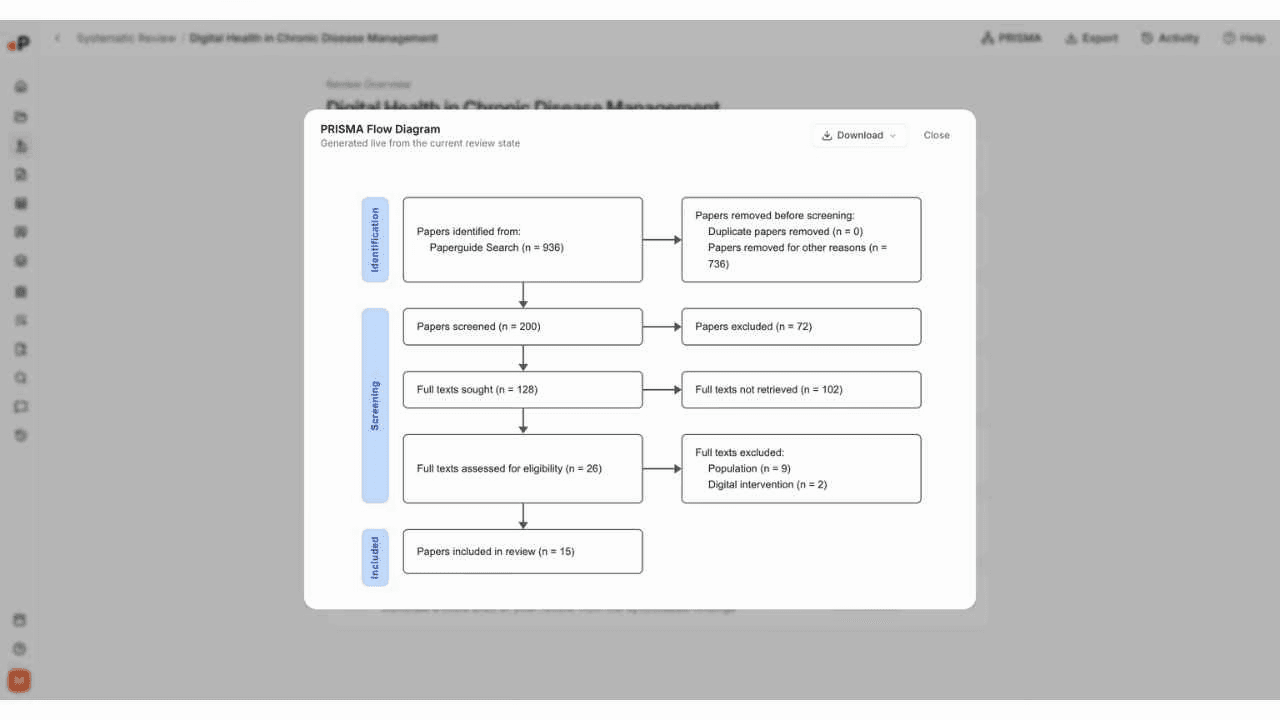
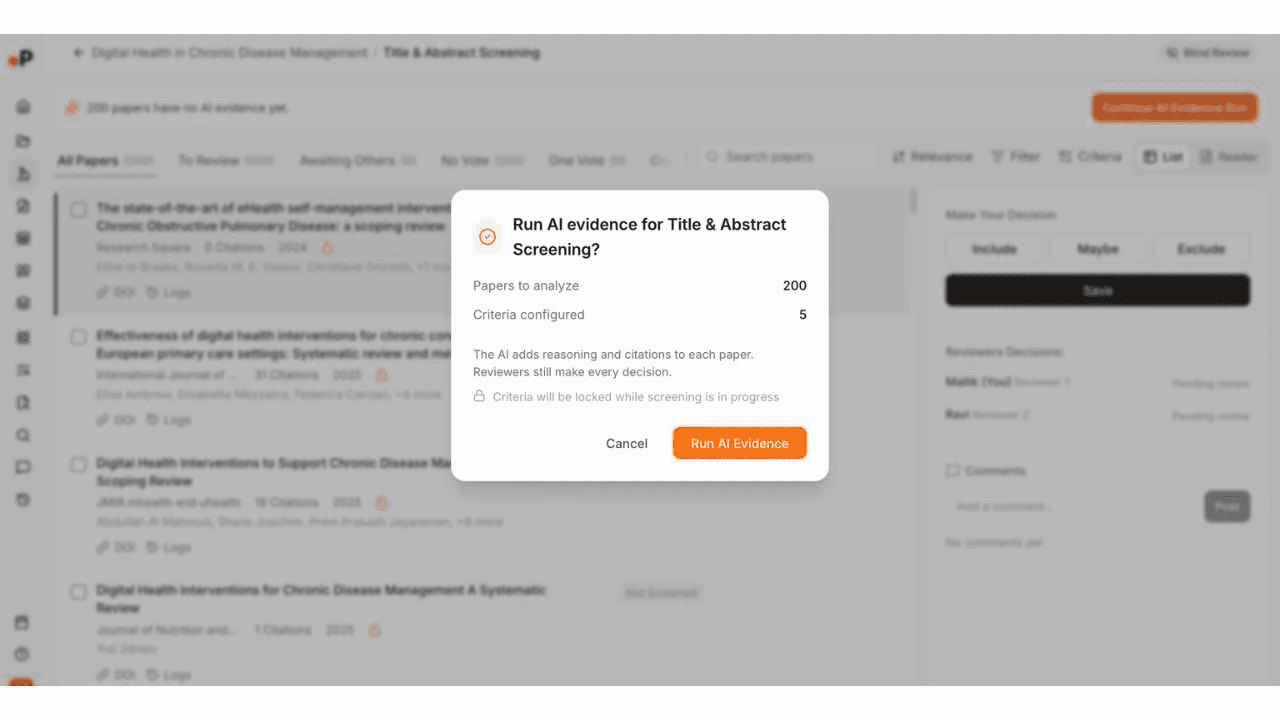
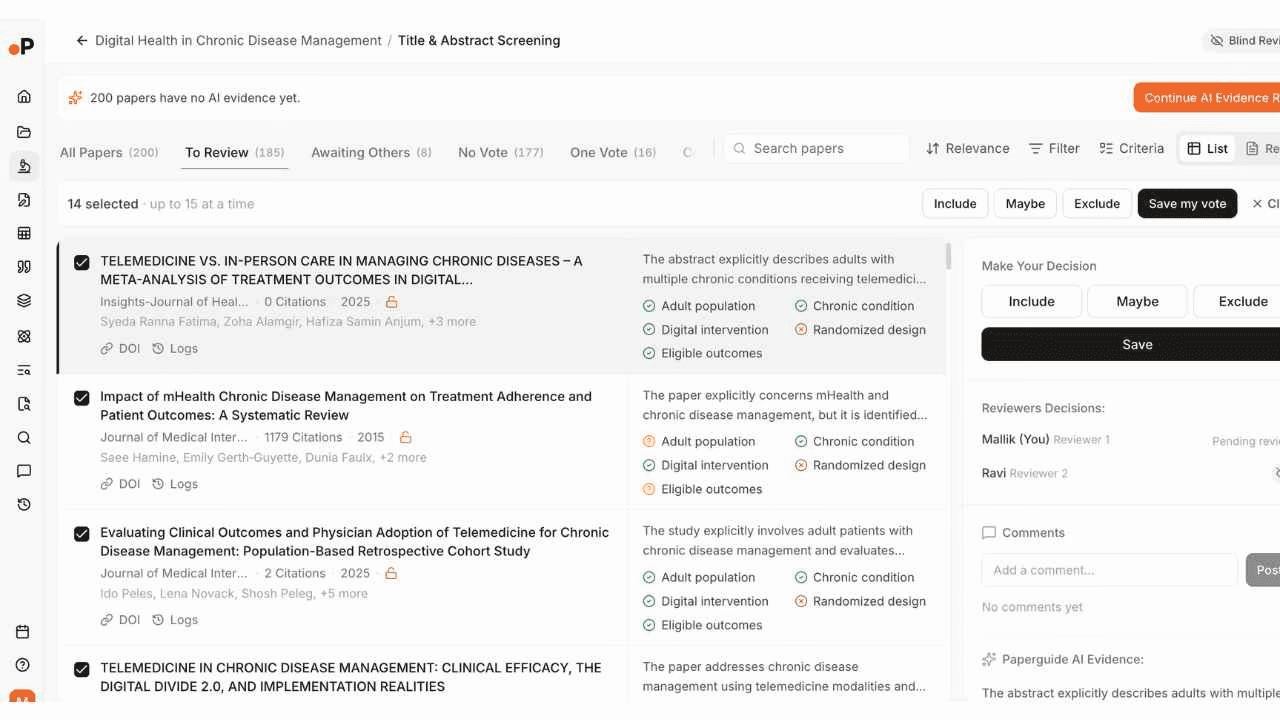
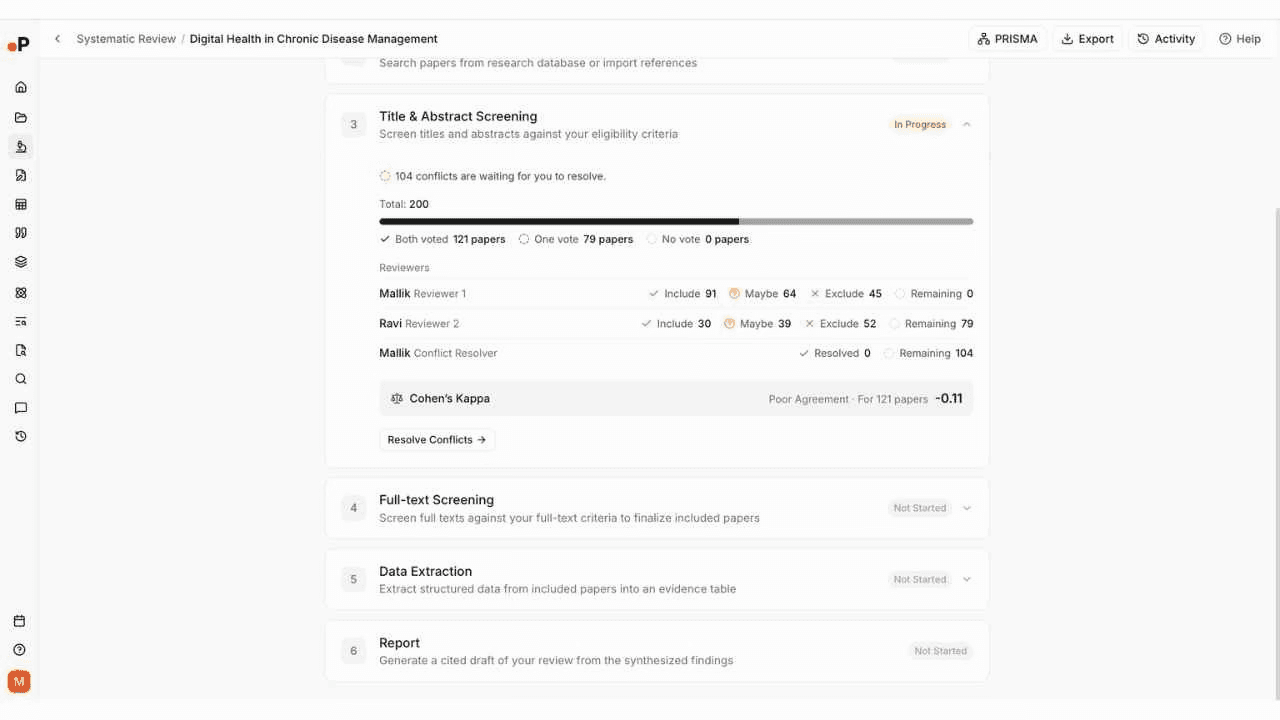
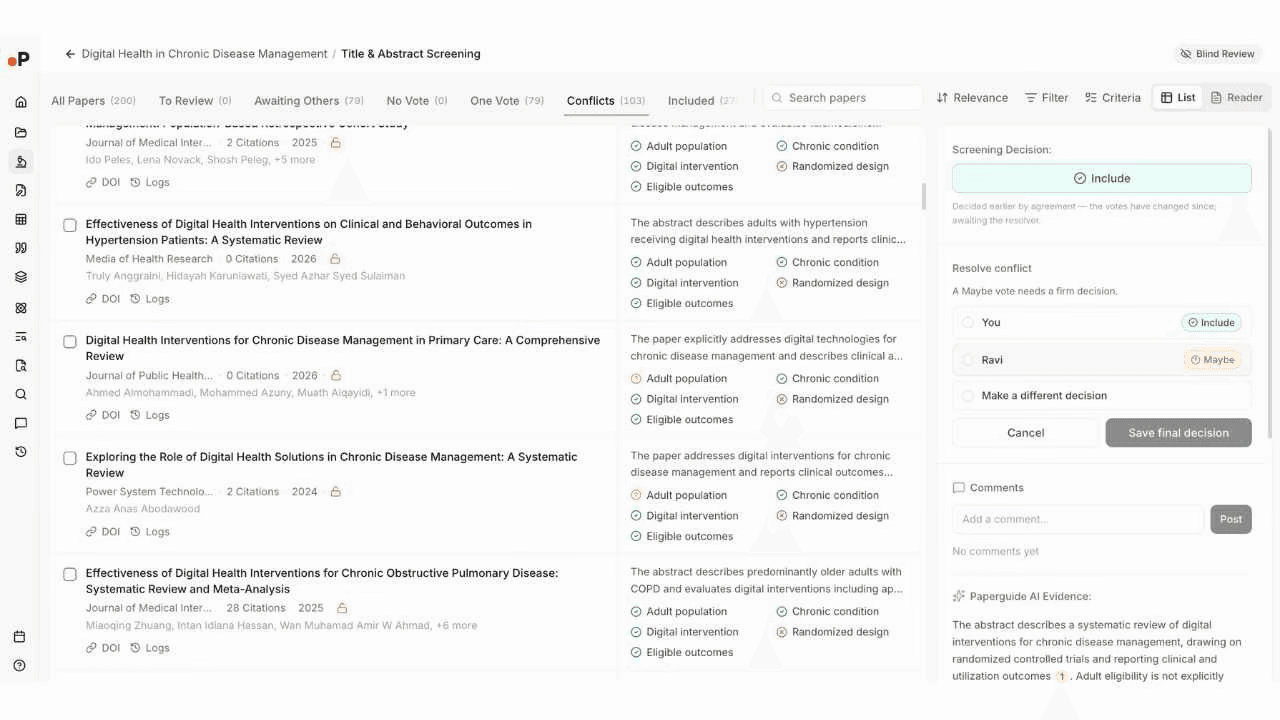
Paperguide offers two screening modes. The first is dual-blind review mode with lead-resolved conflicts: two independent reviewers screen each record without seeing each other's decisions until both have completed their assessment, and a third reviewer (the lead) resolves disagreements. This dual-blind approach follows Cochrane guidelines for minimizing bias by ensuring neither reviewer is influenced by the other's judgment. The second is AI-led screening with named verifier confirmation, designed for speed. In AI-led mode, the system performs an initial screening pass and a named human verifier confirms or overrides each decision. Both modes log every decision for auditability. In Dual Review the AI never decides; it prepares cited evidence for every criterion, and Cohen's Kappa on the stage card shows how far the two reviewers agree. Search results are pooled with your own library and deduplicated before screening, and team roles (Edit, Reviewer, View-only) are set per stage. An AI protocol builder drafts eligibility criteria and extraction fields for you to edit, a saved protocol can be re-run over new papers, and papers added mid-review follow the same screening path. Exclusion criteria are ordered and applied sequentially, so reviewers must select the specific reason for each exclusion. The PRISMA flow diagram updates automatically based on screening counts.
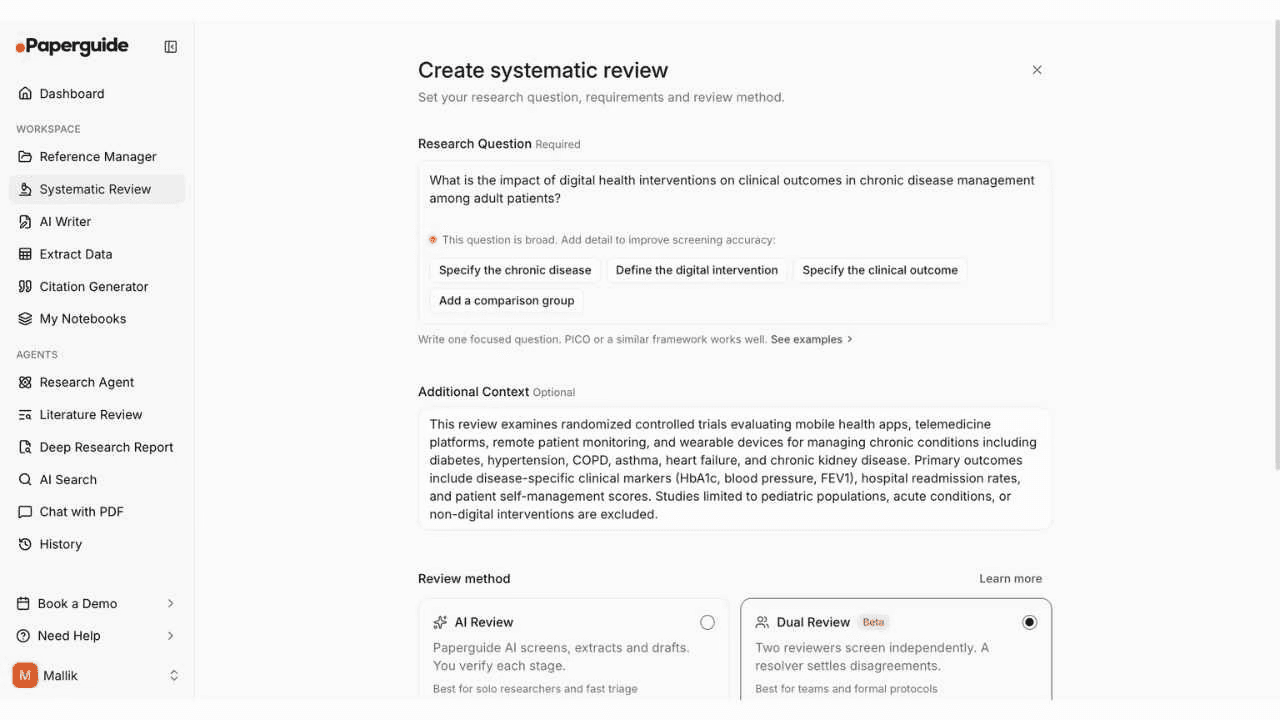
Paperguide's review setup begins with defining the research question, adding context, and selecting either AI Review or Dual Review (Beta) mode. The full workspace sidebar shows all connected modules: AI Search, Literature Review, Systematic Review, Chat with PDF, AI Paper Writer, Reference Manager, and more, all accessible from the same project.
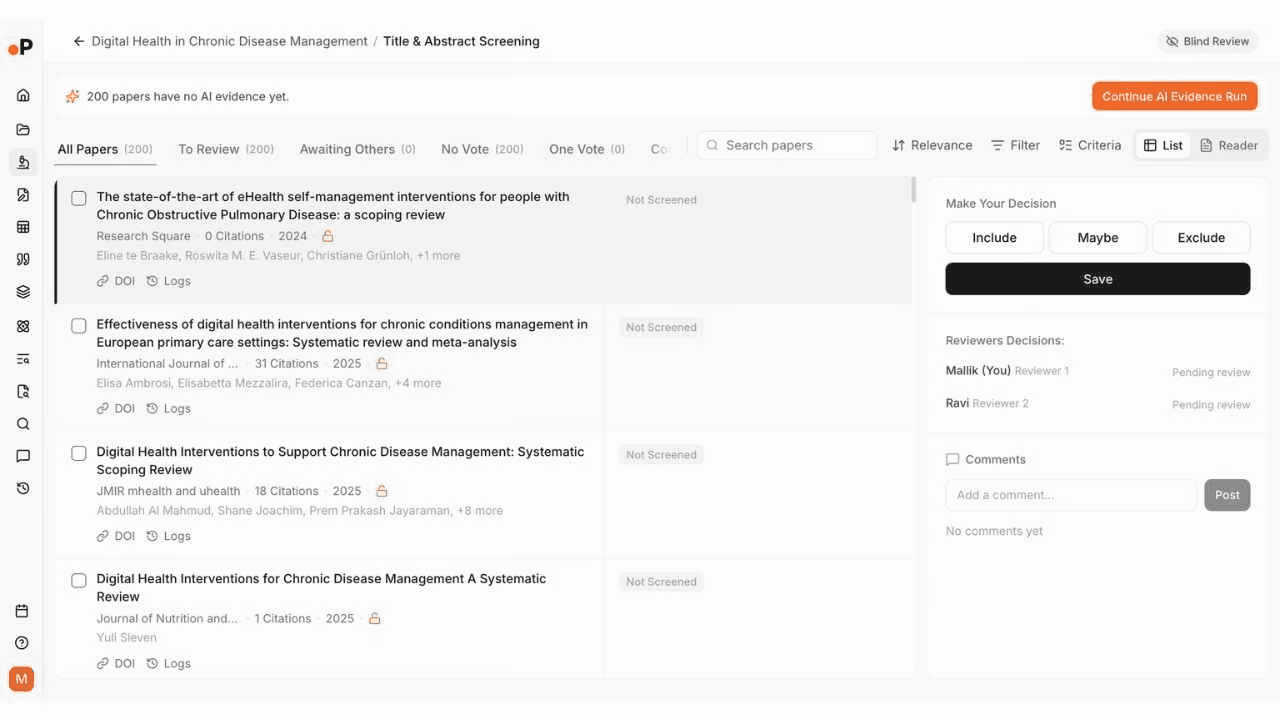
Covidence provides a polished dual-reviewer screening workflow that the systematic review community has used for years. Two reviewers independently vote "Yes," "No," or "Maybe" on each title and abstract. Conflicts are flagged for resolution. The interface is clean and focused: each record appears with its title, abstract, and source information, and the reviewer makes a single decision. Full-text screening follows the same dual-reviewer model with PDF management. Covidence also integrates the Cochrane RCT Classifier, a machine learning tool that ranks references by their likelihood of being a randomized controlled trial, which can help prioritize screening order.
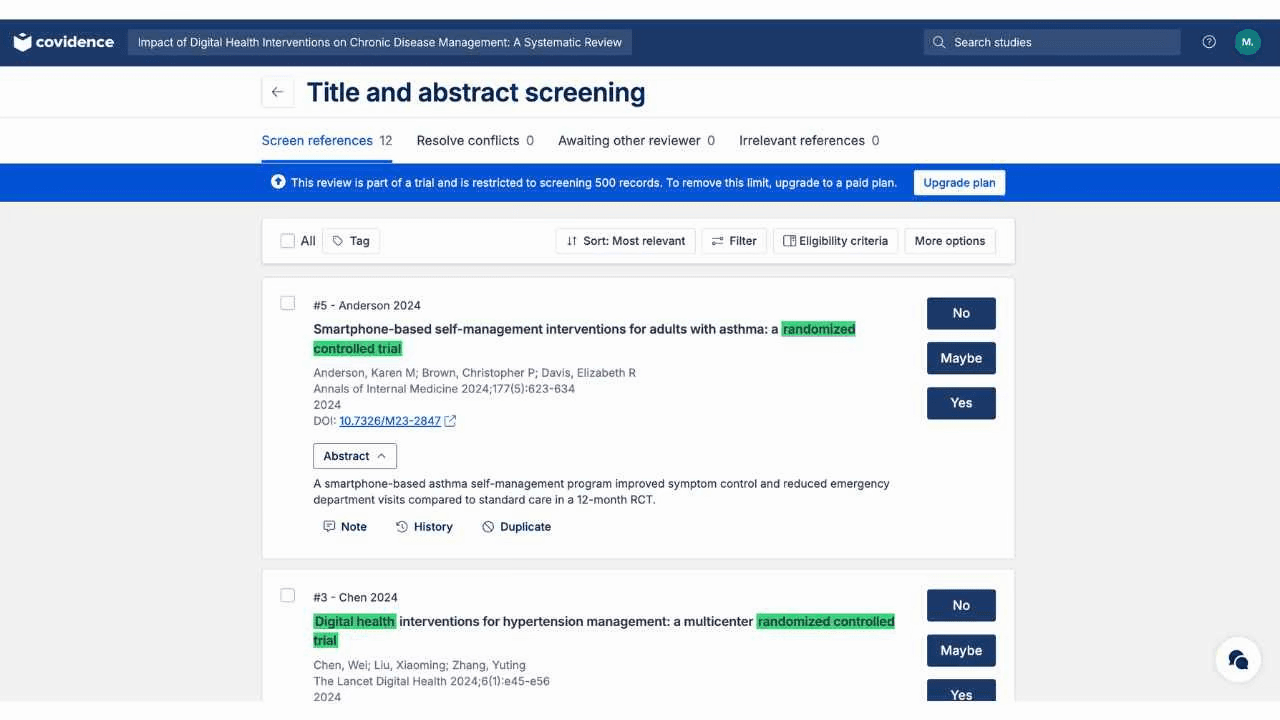
In practice, Covidence's screening interface is more mature. It has been refined over years of user feedback from Cochrane review groups, and the workflow feels natural for experienced systematic reviewers. Paperguide's screening is newer but offers the AI-led mode as a genuine differentiator for teams that need faster turnaround without abandoning auditability.
Winner: Tie with caveats. Covidence's dual-reviewer screening is more mature and benefits from years of refinement. Paperguide matches it on dual-reviewer functionality with true dual-blind screening (where reviewers cannot see each other's decisions) and adds an AI-led screening mode that Covidence does not offer. Teams that need the fastest possible screening with human verification will prefer Paperguide. Teams that want the most proven, established screening workflow will prefer Covidence.

How Does Data Extraction Compare?
Both platforms support structured data extraction with custom templates, but the downstream utility of extracted data differs significantly.
Paperguide provides data extraction workbooks with configurable columns. Users define extraction fields with specified output types (Answer, Yes/No, or specified options), and the platform provides sentence-level citation evidence on every extracted value. This means each data point links back to the exact passage in the source paper. Extraction tables can feed directly into the AI Paper Writer, so extracted evidence flows into a cited draft without manual copy-pasting.
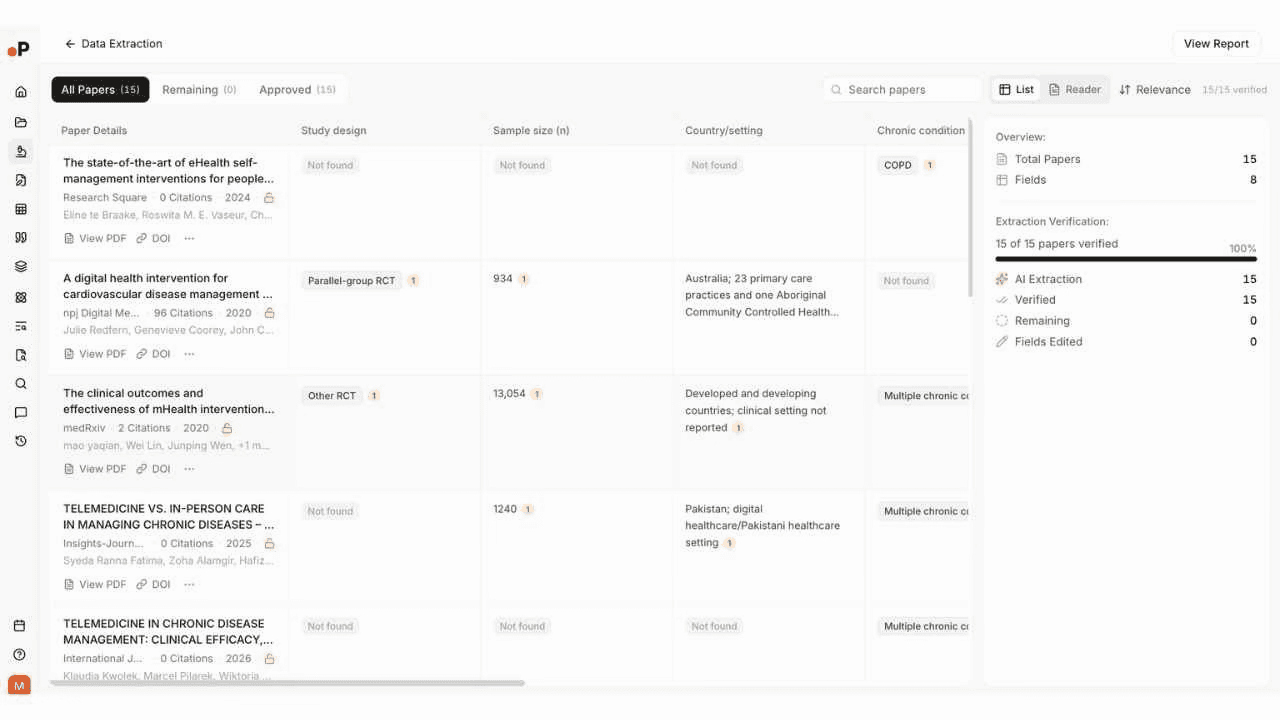
Covidence offers customizable extraction templates with two template types. Template 1 supports intervention reviews with structured fields for study characteristics, outcomes, and risk of bias. Template 2 allows fully custom forms. A notable feature is the ability to highlight and annotate text directly in the uploaded PDF, linking extracted data to the source passage visually. Covidence has also introduced AI auto-population for certain extraction fields (requires DOI and uploaded PDF), though the platform notes that all AI-generated outputs must be human-verified.
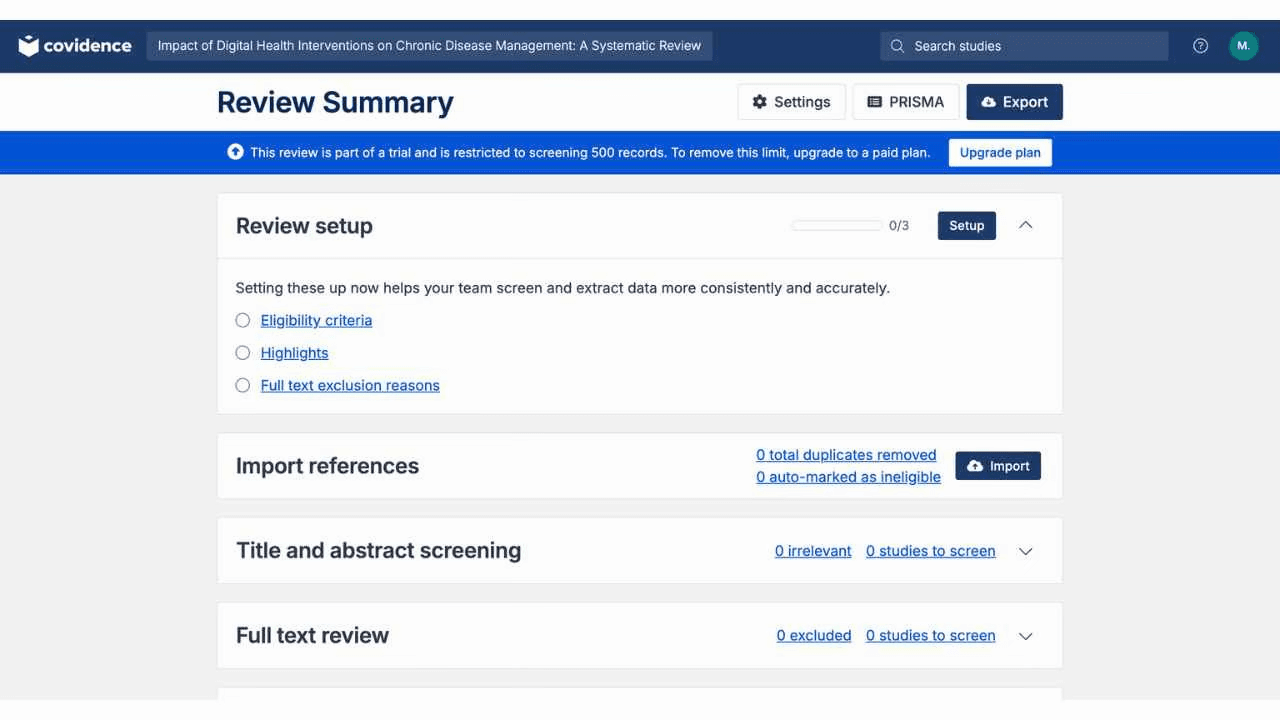
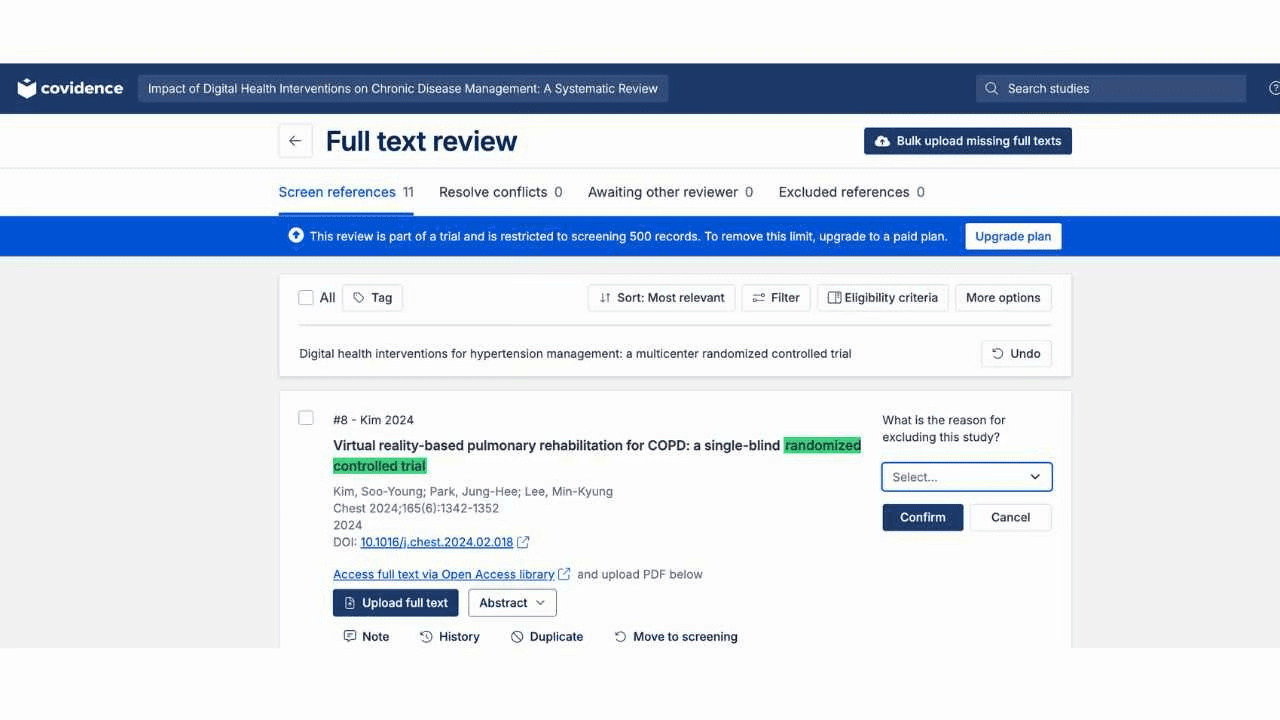
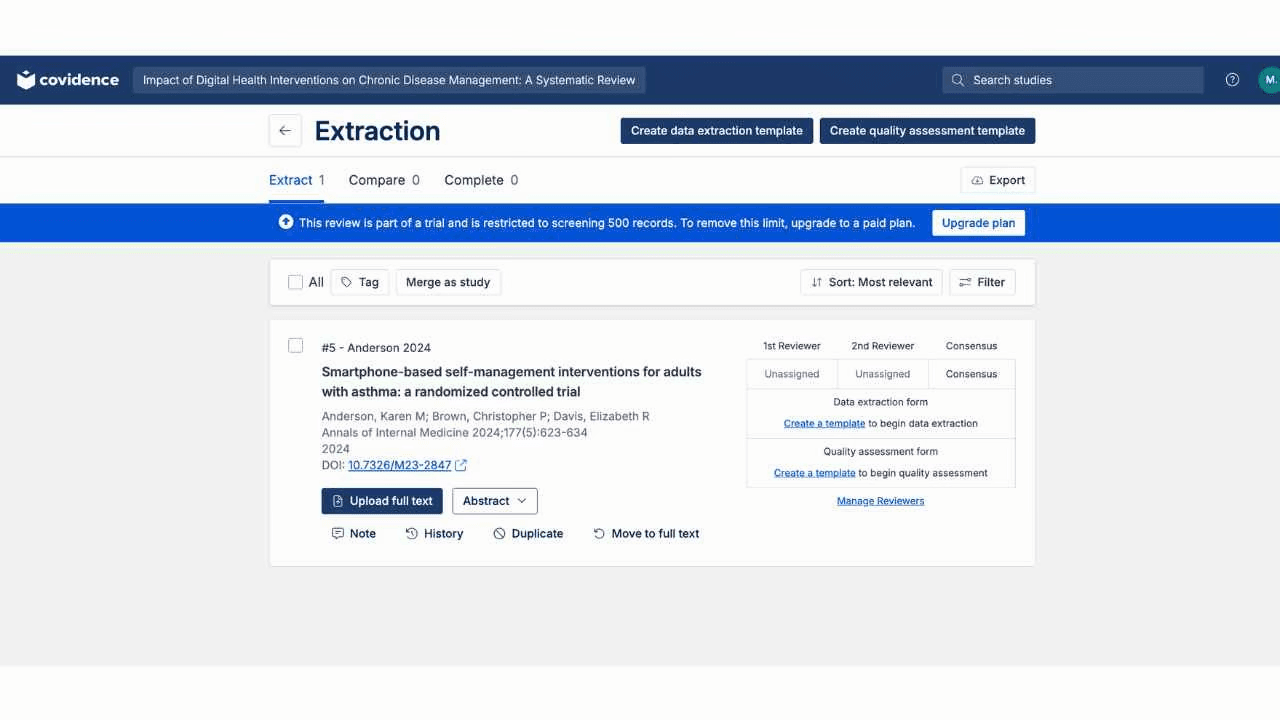
The critical difference is what happens after extraction. In Covidence, extracted data exports as a CSV, XML, or structured table. The researcher then moves to a separate tool for writing. In Paperguide, extracted data feeds directly into the AI Paper Writer, where a cited draft can be generated from the same evidence base.
Winner: Depends on the need. Covidence's PDF annotation and highlighting during extraction is a genuine strength for teams that need visual source linking. Paperguide's extraction-to-writing pipeline is stronger for teams whose output is a written document rather than a data table.
How Does Risk of Bias Assessment Compare?
This is the category where Covidence holds a clear advantage today.
Covidence has built-in risk of bias assessment using the Cochrane RoB 2 tool. Reviewers can assess each domain of bias (randomization, deviations, missing data, measurement, selective reporting) with structured judgments and supporting text. The assessment links directly to highlighted passages in the uploaded PDF, so the evidence for each judgment is visually anchored to the source. Covidence generates summary risk of bias tables that can be exported for publication.
Paperguide does not currently offer dedicated risk of bias assessment tools. This capability is on the product roadmap. Researchers using Paperguide for systematic reviews that require formal quality assessment must currently perform this step in an external tool or manually within the extraction workbooks.
For systematic reviews submitted to Cochrane, required by regulatory bodies, or published in journals that mandate formal risk of bias reporting, this gap is meaningful.
Winner: Covidence. Risk of bias assessment with PDF highlighting and structured Cochrane RoB 2 tooling is a genuine strength. Paperguide's roadmap commitment is noted, but the feature is not available today.
How Does AI Writing Compare?
This comparison is straightforward because Covidence does not have a writing workspace.
Paperguide includes an AI Paper Writer that generates citation-grounded drafts from the researcher's own evidence base. The writer supports '@' citation insertion (referencing papers from the library or extraction tables), over 1,000 citation styles, collaborative editing, and a plagiarism checker. The output is a structured document traceable to screened and extracted sources. For systematic review teams, this means the final report can be drafted inside the same platform where screening and extraction occurred.
Covidence produces structured data tables, risk of bias assessments, and PRISMA flow diagrams. The output is designed to be exported and then written up in a separate tool such as Microsoft Word, Google Docs, or LaTeX. There is no in-platform writing workspace, no citation management during drafting, and no way to generate a written report from the extracted evidence without leaving the platform.
For research teams whose deliverable is a written systematic review report (which is the case for the vast majority of reviews), this means Covidence handles roughly 60% of the workflow. The remaining 40%, writing the actual review document, happens elsewhere.
Winner: Paperguide. Covidence has no writing capability. Paperguide's AI Paper Writer with citation grounding, 1,000+ styles, and plagiarism checking fills a genuine gap in the systematic review workflow.
How Does Reference Management Compare?
Paperguide includes a full AI-native reference manager: DOI, URL, BibTeX, RIS, and PDF import, Zotero and Mendeley import, automatic metadata and open-access PDF retrieval, folders and tags, an in-app PDF reader with annotation and highlights, AI summaries, over 1,000 citation styles, and a Chrome extension for capturing references with institutional proxy access (EZproxy, OpenAthens). Every paper in the library is usable across search, extraction, review, and the AI Paper Writer.
Covidence is not a reference manager. It accepts imported references from external reference managers (Zotero, Mendeley, EndNote) or direct database exports. Once references are imported for a review, they exist only within that review's context. There is no persistent library across reviews, no citation style management, no annotation tools, and no browser extension for capturing new references.
Researchers using Covidence typically maintain a separate reference manager (Zotero, Mendeley, or EndNote) alongside it. This means citations, PDFs, and annotations live in one system while screening decisions and extracted data live in another.
Winner: Paperguide. Covidence has no reference management. Paperguide's built-in reference manager eliminates the need for a separate tool and keeps citations connected to every research workflow.
Where Is Paperguide Stronger Than Covidence?
Beyond the feature-by-feature comparisons above, Paperguide has five structural advantages that compound across a full systematic review project.
1. Workflow Completeness
Covidence covers screening, extraction, quality assessment, and PRISMA reporting. The workflow begins when references are imported and ends when data is exported. In contrast, Paperguide covers search, screening, extraction, PRISMA, writing, and reference management. Context carries across stages instead of being exported between tools. In practical terms, Covidence replaces your screening spreadsheet. Paperguide replaces your search, your screening spreadsheet, your reference manager, and your draft.
2. AI-Powered Search Integration
Covidence has no search capability at all. Researchers must search external databases, export results, and import them manually. Paperguide's AI search across 200M+ papers with SJR and SNIP quality metrics means the first stage of a systematic review (identifying potentially relevant records) happens inside the platform. Saved searches are reproducible, and results flow directly into screening.
3. Dual-Mode Screening
Covidence supports only manual dual-reviewer screening. Paperguide supports both dual-blind review screening with lead-resolved conflicts (where reviewers cannot see each other's decisions until both have completed their assessment) and AI-led screening with named verifier confirmation. For teams running rapid reviews or scoping reviews where speed matters more than the dual-reviewer standard, the AI-led mode offers a genuine alternative.
4. Citation-Grounded Writing
Covidence produces structured data tables. Writing the actual review document happens elsewhere. Paperguide's AI Paper Writer generates citation-grounded drafts directly from screened and extracted evidence, with '@' citation insertion, over 1,000 citation styles, collaborative editing, and a plagiarism checker. This eliminates the manual step of transferring evidence from one platform to a writing tool.
5. Pricing for Independent Researchers
Covidence charges $339/year for a single review or $907/year for three reviews. There is no ongoing access between reviews. Paperguide Plus at $144/year provides continuous access to search, screening, extraction, writing, and reference management with no per-review limits on most workflows. For PhD students, postdocs, and independent researchers paying out of pocket, Paperguide provides significantly more capability per dollar.
Where Does Covidence Genuinely Win?
1. Cochrane Endorsement and Institutional Trust
Covidence is the only systematic review platform endorsed by Cochrane. This endorsement carries real weight in the systematic review community. Many Cochrane review groups require or strongly recommend Covidence, and over 480 institutions provide organizational access. For researchers whose work will be submitted to Cochrane or evaluated by reviewers who expect Covidence workflows, this institutional backing matters.
2. Mature Risk of Bias Tooling
Covidence's built-in RoB 2 assessment with PDF highlighting, domain-level judgments, and exportable summary tables is a genuinely mature feature. For systematic reviews that require formal quality assessment (which includes most Cochrane reviews, many HTA submissions, and journal publications in medical fields), Covidence provides this out of the box. Paperguide's risk of bias capabilities are on the roadmap but not yet available.
3. Established Screening Workflow
Covidence's screening interface has been refined through years of feedback from systematic review teams. The dual-reviewer workflow is clean, predictable, and well-documented. Training materials, institutional guides, and community support are extensive. For teams that are already trained on Covidence and whose primary need is screening and extraction, the switching cost may outweigh the additional features Paperguide offers.
4. Unlimited Collaborators Per Review
Covidence allows unlimited team members on each review at no additional cost per user. For large review teams with ten or more screeners, this pricing model is attractive when the institution covers the subscription. Paperguide's collaboration model uses per-seat pricing, which can increase costs for very large teams.
Paperguide vs Covidence: Pricing Comparison
| Paperguide | Covidence | |
|---|---|---|
| Free tier | Free plan with 2,000 AI credits/month | 500-record free trial |
| Entry paid plan | Plus: $12 per seat/month, billed annually ($144/year) | Single review: $339/year |
| Mid-range plan | Pro: $29 per seat/month, billed annually ($348/year) | 3 reviews: $907/year |
| Advanced plan | Evidence Teams: $89 per seat/month, billed annually ($1,068/year), with dual reviewer screening | Organization: custom quote |
| Enterprise | Custom, up to 20,000 papers | Custom institutional pricing |
| Per-review limits | No per-review limits on most workflows | Each plan tied to review count |
| Collaborators | Per-seat pricing | Unlimited per review |
| Includes search | Yes (200M+ papers) | No |
| Includes writing | Yes (AI Paper Writer) | No |
| Includes reference manager | Yes | No |
The pricing comparison reveals a structural difference. Covidence charges per review: $339 for one review per year, $907 for three. When the review is complete, access to the data requires an active subscription. Paperguide charges per seat with no per-review restrictions on most workflows: $144/year for Plus includes continuous access to search, screening, extraction, writing, and reference management.
For a researcher running two systematic reviews per year, the cost comparison is: Paperguide Plus at $144/year versus Covidence at $907/year (three-review package). That is a $763 annual difference, and Paperguide includes search, writing, and reference management that Covidence does not provide at any price point.
For institutional teams where the organization covers the subscription, Covidence's unlimited collaborator model may offset the per-review pricing. But for individual researchers, small teams, and budget-constrained labs, the value gap is substantial.
Final Verdict: Should You Choose Paperguide or Covidence?
Choose Paperguide if:
- You need a connected research workflow from search through systematic review to a cited draft in one platform.
- You want AI-powered search across 200M+ papers with SJR and SNIP quality metrics integrated into your review workflow.
- You need AI-led screening for rapid reviews alongside traditional dual-blind screening for formal reviews.
- You write within your research platform and need citation management, plagiarism checking, and over 1,000 citation styles.
- You are an independent researcher or small team paying out of pocket and need more capability per dollar.
Choose Covidence if:
- Your institution provides Covidence access and your team is already trained on the platform.
- You need mature risk of bias assessment with RoB 2, PDF highlighting, and structured quality assessment.
- Your deliverable is structured data tables and PRISMA diagrams rather than a written report, and you handle writing separately.
- You are part of a Cochrane review group or your work will be evaluated by reviewers who expect Covidence workflows.
Overall, Paperguide is the stronger choice for researchers who need the full systematic review pipeline from paper discovery through screening and extraction to a publication-ready draft with quality transparency at every step. Among the AI tools for systematic review available in 2026, Paperguide is the only platform that spans search, dual-blind screening, extraction, writing, and reference management in one workspace, making it a strong contender as the best systematic review software for teams that need workflow completeness. Covidence remains the stronger choice for teams embedded in institutional subscriptions who need Cochrane-endorsed screening, mature risk of bias tooling, and are comfortable handling search and writing in separate tools.
Frequently Asked Questions
Is Paperguide better than Covidence?
Paperguide is better for researchers who need a connected workflow from search through systematic review to a cited draft, with AI-powered search across 200M+ papers, SJR/SNIP quality metrics, dual-mode screening, citation-grounded writing, and a built-in reference manager at a lower price ($144/year vs $339/year). Covidence is better for teams with institutional access who need Cochrane-endorsed workflows and mature risk of bias assessment. The right choice depends on whether you need the full research pipeline or screening and extraction only.
Is Paperguide a good Covidence alternative?
Paperguide is a strong Covidence alternative for researchers who want one platform connecting search, systematic review, literature review, extraction, references, and citation-grounded writing. It covers more of the research workflow at a lower price point. However, it does not yet offer dedicated risk of bias tools, which Covidence provides with RoB 2 and PDF highlighting.
Which tool is better for systematic reviews?
Both platforms support protocol-driven systematic reviews with dual-reviewer screening. Covidence has a more mature screening interface refined over years of Cochrane community use, plus built-in risk of bias assessment. Paperguide offers both dual-reviewer and AI-led screening modes, plus a connected pipeline where screened evidence flows into extraction and then into a cited draft. For teams that need only screening and extraction, Covidence is proven. For teams that need the full workflow from search to written report, Paperguide provides more in one platform.
Which tool is better for PhD students?
Paperguide Plus at $144/year covers AI search, systematic review, literature review, AI Paper Writer with 1,000+ citation styles, and reference management. Covidence charges $339/year for a single review with no search, writing, or reference management. For PhD students on a budget who need the full research workflow, Paperguide provides significantly more capability at $195 less per year.
Does Covidence have AI search?
Covidence does not have a built-in search engine. Researchers must conduct their searches in external databases (PubMed, Embase, CINAHL, Scopus), export reference files, and import them into Covidence for screening. Paperguide searches 200M+ papers across PubMed, arXiv, OpenAlex, and Semantic Scholar directly within the platform, with results flowing into screening without a manual export-import step.
Does Covidence have an AI writing tool?
Covidence does not have a writing workspace. It produces structured data tables, risk of bias assessments, and PRISMA flow diagrams that can be exported. Researchers must write the actual systematic review document in a separate tool. Paperguide's AI Paper Writer generates citation-grounded drafts directly from screened and extracted evidence with '@' citation insertion, over 1,000 citation styles, collaborative editing, and a plagiarism checker.
Can I use Paperguide and Covidence together?
Some researchers use Covidence for screening and risk of bias assessment, then import included papers into Paperguide via Zotero or BibTeX for literature review writing and reference management. This workflow captures Covidence's screening maturity and Paperguide's writing and reference management capabilities. However, screening decisions and extraction data do not transfer automatically between platforms.
Can I migrate from Covidence to Paperguide?
Covidence exports included studies as RIS, CSV, or XML files. These can be imported into Paperguide's reference manager. Extracted data tables can be exported from Covidence and used as reference material in Paperguide. However, screening decisions, reviewer assignments, and risk of bias assessments do not transfer between platforms and would need to be recreated if the review is ongoing.
References
- Borah, R., Brown, A. W., Capers, P. L., & Kaiser, K. A. (2017). Analysis of the time and workers needed to conduct systematic reviews of medical interventions using data from the PROSPERO registry. BMJ Open, 7(2), e012545. https://doi.org/10.1136/bmjopen-2016-012545
- Abogunrin, S., Muir, J. M., Zerbini, C., & Sarri, G. (2025). How much can we save by applying artificial intelligence in evidence synthesis? Results from a pragmatic review to quantify workload efficiencies and cost savings. Frontiers in Pharmacology, 16, 1454245. https://doi.org/10.3389/fphar.2025.1454245
- Silva, J. J. S., Fernandez, S., Rosillo, N., & Bueno, H. (2026). Which systematic review software works best? A practical comparison. Journal of the Medical Library Association, 114(1), 83-85. https://doi.org/10.5195/jmla.2026.2262
Running a review?
Run your systematic review in Paperguide
Dual screening, verifiable extraction and PRISMA reporting in one place.
Start a reviewNo credit card required