5 Best Medical Evidence AI Tools in 2026 (Free + Paid)


Clinical evidence in 2026 is a citation accuracy problem, and the cost of getting it wrong is now patient-facing.
A clinician answering a bedside evidence question or a clinical investigator writing a treatment guideline cannot afford an AI tool that fabricates citations. The medical evidence base is the single highest-stakes citation environment in scientific research, where a fake reference can change a treatment recommendation and a patient outcome. The scale of the problem is now well documented. A May 2026 analysis covered by Fortune and StatNews found that fabricated references in biomedical literature grew more than 12-fold over three years, with one in 2,828 papers containing fabricated references in 2023 rising to one in 458 by 2025. A 2024 PMC Reference Hallucination Score evaluation of medical AI models found that 33.8% to 37.6% of generated medical references were hallucinated. Medical evidence AI tools in 2026 have split into two camps: tools built for clinical evidence with citation grounding against peer-reviewed databases (PubMed, Cochrane Library, NEJM, JAMA, ClinicalTrials.gov) and general-purpose AI that occasionally surfaces medical references but cannot be trusted for clinical decisions.
This guide evaluates the 5 best medical evidence AI tools in 2026 for clinical researchers, evidence-based medicine teams, clinical investigators, and healthcare guideline developers. Each tool was assessed against its live medical-evidence features using the criteria below: PubMed-anchored search, citation grounding on clinical claims, evidence-hierarchy quality signals, medical citation styles, and systematic review support.
TL;DR
Paperguide is the best medical evidence AI tool in 2026 for end-to-end medical literature workflows. It is the AI-native platform for scientific research workflows and evidence synthesis. For medical evidence, it anchors search to PubMed across 200M+ peer-reviewed papers, then screens with SJR, SNIP, and citation quality signals that map to the clinical evidence hierarchy. Extract Data pulls clinical findings into custom-column evidence tables. The AI Paper Writer drafts synthesis in AMA, Vancouver, NLM, and other medical citation styles. The dedicated Paperguide Systematic Review workspace, widely regarded as the best systematic review software in 2026, runs protocol-driven, PRISMA-reported reviews.
Consensus, Scite, OpenEvidence, and Cochrane Library are the strongest specialized alternatives. They lead, respectively, on the fastest evidence-meter clinical questions, medical citation context across 1.6B+ classified citations, free clinical-grade evidence for healthcare professionals, and gold-standard Cochrane systematic review evidence.
Key Takeaways
- Paperguide is the #1 medical evidence AI tool in 2026 for full medical literature review and clinical evidence synthesis workflows, with citation grounding at the architecture level and a dedicated PRISMA systematic review workspace.
- Consensus is the fastest evidence-meter tool for yes/no clinical questions across 200M+ academic papers, with Pro at $144/yr on annual billing and academic/clinician discounts up to 40%.
- Scite is the strongest tool for evaluating whether medical findings held up across subsequent literature with 1.6B+ classified citation statements as Supporting, Mentioning, or Contrasting.
- OpenEvidence is the dedicated clinical evidence platform built for bedside use, free for verified U.S. healthcare professionals, pulling from PubMed, NEJM, JAMA, NCCN, and Cochrane.
- Cochrane Library is the gold standard for systematic review evidence with PRISMA documentation, CENTRAL trials registry, and Cochrane Clinical Answers.
What are the best medical evidence AI tools in 2026?
The best medical evidence AI tool in 2026 is Paperguide for end-to-end medical literature workflows. It is the only AI tool that connects five stages in a single workspace: PubMed-anchored search, quality-grade screening with SJR/SNIP/citation metrics mapped to the clinical evidence hierarchy, Extract Data for clinical findings, citation-grounded synthesis writing in AMA, Vancouver, and NLM styles, and a protocol-driven systematic review workspace. Across the broader category, the strongest medical evidence AI tools in 2026 are Paperguide, Consensus, Scite, OpenEvidence, and Cochrane Library.
How to Choose a Medical Evidence AI Tool in 2026?
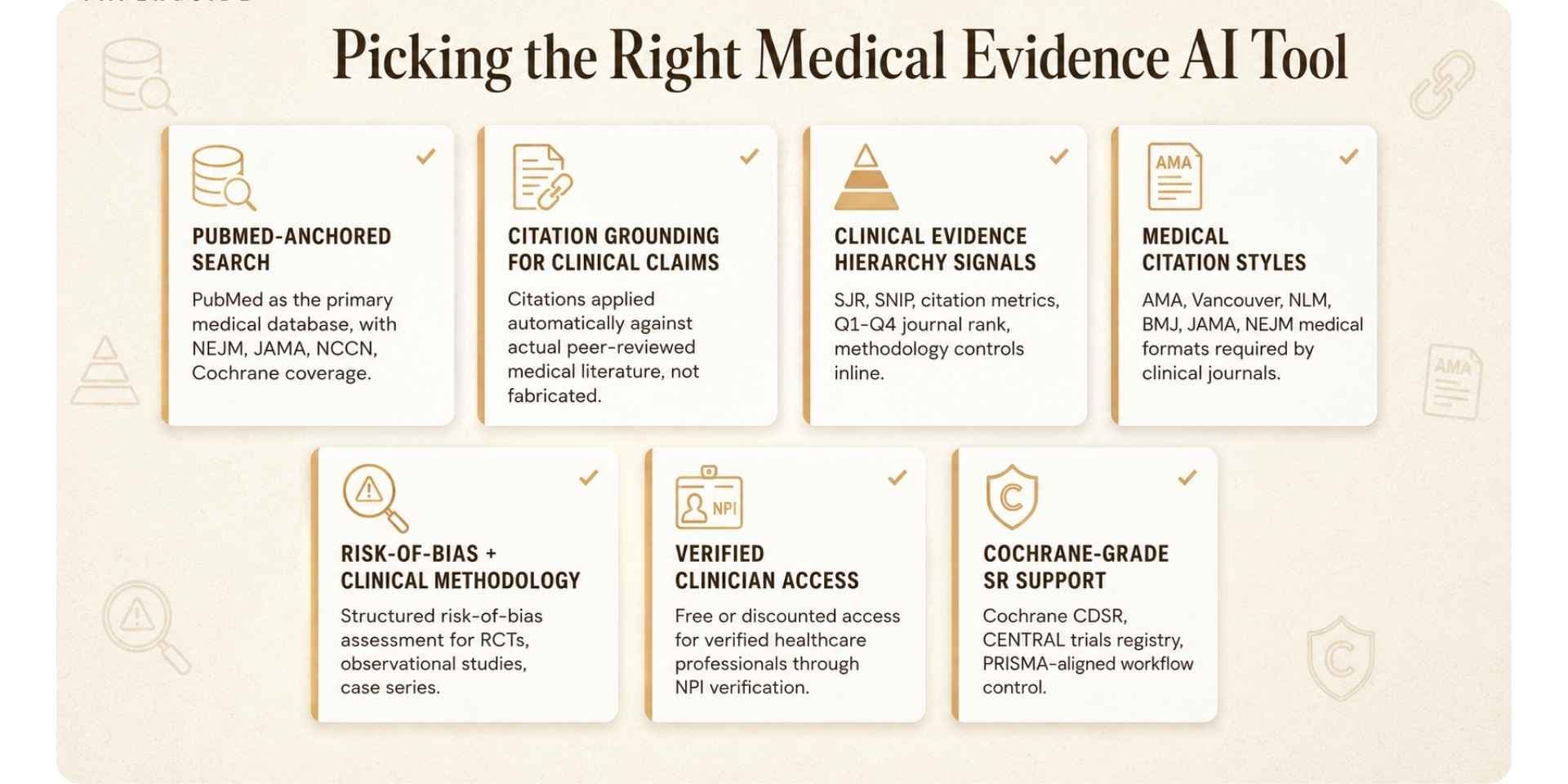
Before comparing the five tools below, here are the criteria that separate clinical-grade medical evidence AI from general-purpose research tools, particularly for clinical research, evidence-based medicine, and guideline development where every cited paper must be real, recent, and verifiable against the peer-reviewed medical literature.
- PubMed-anchored search: Does the tool search PubMed as the primary medical evidence database, with coverage of NEJM, JAMA, NCCN, Cochrane, and ClinicalTrials.gov?
- Citation grounding for clinical claims: Are citations applied automatically against the actual peer-reviewed medical literature during synthesis writing, or fabricated from training data at the documented 33.8% to 37.6% medical hallucination rate?
- Clinical evidence hierarchy quality signals: Does the platform surface SJR, SNIP, citation metrics, Q1-Q4 journal rank, and methodology controls inline so the included paper set meets clinical evidence quality standards?
- Medical citation styles: Does the tool support AMA, Vancouver, NLM, and other medical citation styles required by clinical journals and guideline submissions?
- Protocol-driven systematic review support: Does the platform run a documented PRISMA workflow with a protocol builder, reproducible screening, and a PRISMA diagram generated from the actual review counts?
- Risk-of-bias and clinical methodology: Does the platform support structured risk-of-bias assessment for randomized controlled trials, observational studies, and clinical case series?
- Verified clinician access: Does the platform offer free or discounted access for verified healthcare professionals through NPI or institutional credentials?
- Cochrane-grade systematic review support: Does the tool integrate Cochrane Database of Systematic Reviews, CENTRAL trials registry, and PRISMA-aligned workflow control?
Quick Comparison: Top Medical Evidence AI Tools in 2026
| Tool | Best For | Medical Database Focus | Citation Grounding | Paid Entry |
|---|---|---|---|---|
| Paperguide | Full medical literature and systematic review workflow for clinical research | PubMed + arXiv + OpenAlex + Semantic Scholar | Verified (200M+ papers) | $12/mo Plus (billed annually) |
| Consensus | Fast evidence-meter clinical questions | 200M+ academic papers | Real abstracts | $12/mo Pro (annual) |
| Scite | Medical citation context analysis | 1.6B+ classified citations | Classified (Supporting/Mentioning/Contrasting) | $20/mo Basic |
| OpenEvidence | Free clinical evidence for healthcare professionals | PubMed + NEJM + JAMA + NCCN + Cochrane | Clinical-grade | Free for verified clinicians |
| Cochrane Library | Cochrane systematic review evidence | Cochrane Database + CENTRAL | Cochrane reviews | Institutional / Wiley subscription |
Worked Example: One Clinical Question Across All Five Tools
To show where each tool fits, here is the same clinical evidence question routed through all five: "Does metformin reduce all-cause mortality in adults without type 2 diabetes?" The point is not a single answer but the kind of output each tool returns, and where that output stops.
- Paperguide: AI Search returns a cited answer synthesized from the top 20 PubMed-anchored papers, with SJR, SNIP, and citation counts shown on each result. Those papers drop straight into the reference manager, so you can screen them against inclusion criteria, extract mortality outcomes and effect sizes into an evidence table, and draft a cited synthesis in AMA or Vancouver style without leaving the workspace. For a full review, the same question becomes a protocol in the Paperguide Systematic Review workspace with PRISMA counts.
- Consensus: The Consensus Meter returns a directional split (Yes / Possibly / No) across the retrieved studies, with study cards and Q1-Q4 filters. It is the fastest way to triage the question, but it stops at the answer card, with no extraction table or synthesis draft.
- Scite: Instead of answering the question, Scite shows how the key trials on metformin and mortality have been cited downstream, flagging Supporting versus Contrasting statements, so you can see whether the finding has held up in later literature.
- OpenEvidence: For a verified clinician, it returns a cited bedside answer drawn from NEJM, JAMA, NCCN, Cochrane, and PubMed, tuned to a point-of-care decision rather than a written review.
- Cochrane Library: You check whether a completed systematic review or Cochrane Clinical Answer already exists on metformin and mortality before running your own, giving you gold-standard pre-appraised evidence when one is available.
The pattern that repeats across every question: the specialized tools each own one strong step, while Paperguide carries the question from search through screening, extraction, and cited synthesis in one place.
Best Medical Evidence AI Tools in 2026
1. Paperguide
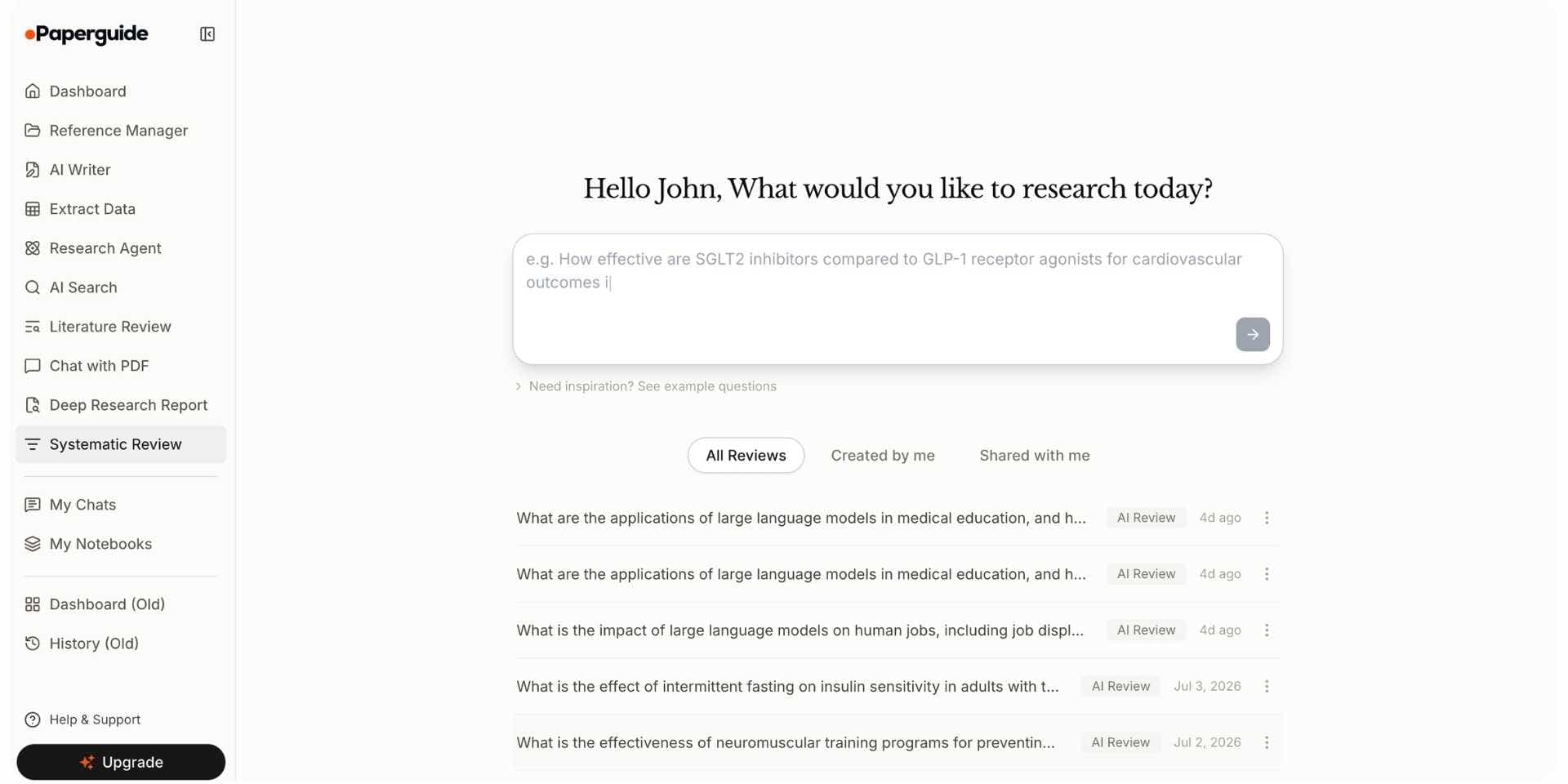
Paperguide is the AI-native platform for scientific research workflows and evidence synthesis. It is built for clinical researchers, evidence synthesis teams, research labs, and principal investigators, and it is the strongest medical evidence AI tool in 2026 for end-to-end medical literature workflows. The platform connects four stages that usually live in separate tools. PubMed-anchored AI Search covers 200M+ peer-reviewed papers from PubMed, arXiv, OpenAlex, and Semantic Scholar. Inclusion and exclusion screening surfaces SJR, SNIP, and citation quality signals that map to the clinical evidence hierarchy. Extract Data pulls clinical findings into custom-column evidence tables for intervention, sample size, primary outcome, effect size, methodology, and risk of bias. The AI Paper Writer drafts synthesis in AMA, Vancouver, NLM, and other medical citation styles, and the dedicated Paperguide Systematic Review workspace runs protocol-driven reviews with PRISMA reporting.
In clinical work, every cited paper must be real, recent, and traceable to a peer-reviewed source. That architecture-level citation grounding is what separates Paperguide from general-purpose AI tools, which fabricate medical references at the 33.8% to 37.6% rate documented in the PMC Reference Hallucination Score evaluation.
The connected workspace makes medical evidence work continuous from clinical question to publication-ready synthesis. A paper surfaced through PubMed search lands in the AI Reference Manager automatically with SJR, SNIP, and citation metrics surfaced inline so the included paper set meets clinical evidence quality standards. The Research Agent runs end-to-end clinical research questions in a single connected session, useful for scoping a new guideline development project or building the evidence base for a clinical trial protocol. Literature Review AI follows the five-step Plan/Search/Screen/Extract/Synthesize workflow, with Standard mode handling up to 50 papers and Extended mode screening up to 200. For full PRISMA reviews at clinical scale, the dedicated Paperguide Systematic Review workspace screens from 1,000 papers up to 20,000 by plan, with dual-reviewer or AI-led screening and a PRISMA diagram built from your actual counts.
Deep Research Report mode hands clinical investigators manual control at every stage, so the researcher's judgment shapes the included paper set. That control matters most in clinical syntheses with methodology heterogeneity, risk-of-bias evaluation, and close clinical interpretation. Real-time collaboration with shared libraries and customizable permissions keeps clinical research teams, evidence-based medicine groups, and guideline development panels aligned across multi-month projects.
Key Features
- Research Agent: Paperguide's most complete workflow runs the full medical research process end-to-end in a single connected session, from clinical question scoping and PubMed discovery through screening, structured extraction of clinical findings, and citation-grounded drafting on one paper library. Built for clinical investigators building the evidence base for a guideline, grant proposal, or systematic review.
- AI Search: Hybrid semantic and keyword search across 200M+ peer-reviewed papers from PubMed, arXiv, OpenAlex, and Semantic Scholar. Ask clinical evidence questions in natural language and receive cited, evidence-backed answers synthesized from the top 20 most relevant papers, with quality signals (SJR, SNIP, citation metrics) on every result to support evidence-hierarchy decisions.
- Systematic Review: A dedicated, protocol-driven workspace for medical evidence teams, and one of the strongest options for anyone comparing the best AI for systematic review work at clinical scale. A protocol builder drafts eligibility criteria and extraction fields that you edit, papers are pooled and deduplicated from PubMed and connected libraries before screening, and screening runs in either dual-reviewer mode with conflict resolution or AI-led mode with a named verifier confirming each stage. In Dual Review the AI never makes the call; it prepares cited evidence for each criterion. Team roles (Edit, Reviewer, View-only) are set per stage, and papers added mid-review follow the same screening path. Every screening and extraction decision records the criterion, the cited evidence, and the reviewer, and the PRISMA diagram is generated from your actual counts rather than reconstructed after the fact. Scales from 1,000 papers on Plus up to 20,000 on Enterprise, with PRISMA-grade dual-review screening on Evidence Teams and above.
- Literature Review AI: A structured agent for lighter-weight medical literature reviews through a five-step Plan, Search, Screen, Extract, Synthesize workflow. Standard mode handles up to 50 papers; Extended mode screens up to 200. Every clinical claim cited and linked to a source paper in the included set. For rigorous, auditable reviews at larger scale, move to Paperguide Systematic Review.
- Deep Research Report: Follows the same structured pipeline as Literature Review AI with full researcher control at every stage. Clinical investigators set the inclusion and exclusion criteria, review retrieved papers, adjust screening decisions, and confirm extraction fields before the report is generated. Designed for clinical evidence syntheses where the clinical investigator's judgment shapes the synthesis.
- AI Reference Manager: Every saved paper is immediately usable by every other workflow on the platform. 1,000+ citation styles including AMA, Vancouver, NLM, BMJ, JAMA, NEJM, and most major medical journal-specific formats. Zotero/BibTeX/RIS/DOI/PDF import, Chrome extension, automatic metadata and PDF fetching, built-in PDF viewer with highlights and annotations, shared libraries with permissions, version history.
- AI Paper Writer: Drafts clinical evidence syntheses, systematic review manuscripts, treatment guideline sections, methodology sections, and grant-grade prose with references pulled from the included paper library. Every clinical citation links to a real peer-reviewed paper. 1,000+ citation styles supported including AMA, Vancouver, NLM.
- Extract Data: Pull structured clinical information from multiple research papers into custom-column evidence tables. Define columns for intervention, sample size, primary outcome, effect size, methodology, risk of bias, and study design. Paperguide extracts those values across every paper in the included set with each cell linked back to its source passage. Export to CSV or Excel for downstream meta-analysis.
- Chat with PDF: Query any uploaded clinical paper conversationally. Ask methodology questions, request summaries, compare clinical findings across multi-paper folders, with every answer pointing to the exact page and paragraph it came from.
Pros
- The only medical evidence AI platform that consolidates PubMed-anchored search, citation-grounded clinical synthesis writing, and a protocol-driven PRISMA systematic review workspace in one workspace.
- Verified citations on every clinical claim across 200M+ peer-reviewed papers including PubMed, arXiv, OpenAlex, Semantic Scholar.
- Quality analysis (SJR, SNIP, citation metrics) on every paper, aligned to the clinical evidence hierarchy.
- Custom extraction columns for clinical evidence metrics (intervention, sample size, primary outcome, effect size, risk of bias).
- 1,000+ citation styles including AMA, Vancouver, NLM, BMJ, JAMA, NEJM medical formats.
- 30% academic discount with a valid university email, plus institutional plans for medical schools and clinical research groups.
Cons
- Not a dedicated bedside Q&A tool for instant clinical decision support; pair with OpenEvidence for verified-clinician bedside access.
Best For Clinical researchers, evidence-based medicine teams, clinical investigators, healthcare guideline developers, systematic review teams, principal investigators in clinical research, postdoctoral researchers in medical fields, and scientific research professionals in industry R&D and clinical research running medical literature reviews, clinical evidence syntheses, and guideline development projects where citation accuracy and full-pipeline coverage are non-negotiable.
Pricing
| Plan | Price | What It Covers |
|---|---|---|
| Free | $0 | 2,000 AI credits per month, Literature Review AI, Deep Research Report, Chat with PDF, reference manager with 1,000+ citation styles, extraction tables with 5 columns across 10 papers. |
| Plus | $12 per seat per month, billed annually ($144 a year) | 12,500 AI credits, unlimited AI searches and PDF chats, Systematic Reviews up to 1,000 papers, extraction tables with 50 custom columns across 100 papers, 5 AI Paper Writer documents per month, plagiarism checker. |
| Pro | $29 per seat per month, billed annually ($348 a year) | 50,000 AI credits, Systematic Reviews up to 5,000 papers, Image and Table Extraction (coming soon), 20 AI Paper Writer documents per month. |
| Evidence Teams | $89 per seat per month, billed annually ($1,068 a year) | 150,000 AI credits, Systematic Reviews up to 5,000 papers, PRISMA-grade dual-review screening, Image and Table Extraction (coming soon), dedicated support. |
| Enterprise | Custom | Systematic Reviews up to 20,000 papers, institutional licensing for medical schools and clinical research centers, SSO, dedicated support. Academic users get 30% off with a valid university email, and yearly billing saves up to 41%. |
Verdict
Paperguide leads the category in 2026 because it is the only platform that runs the full medical evidence pipeline end-to-end in one connected workspace, with citation grounding at the architecture level and a protocol-driven systematic review workspace, built specifically for clinical researchers, evidence-based medicine teams, and healthcare guideline developers producing publication-grade clinical evidence syntheses.
2. Consensus
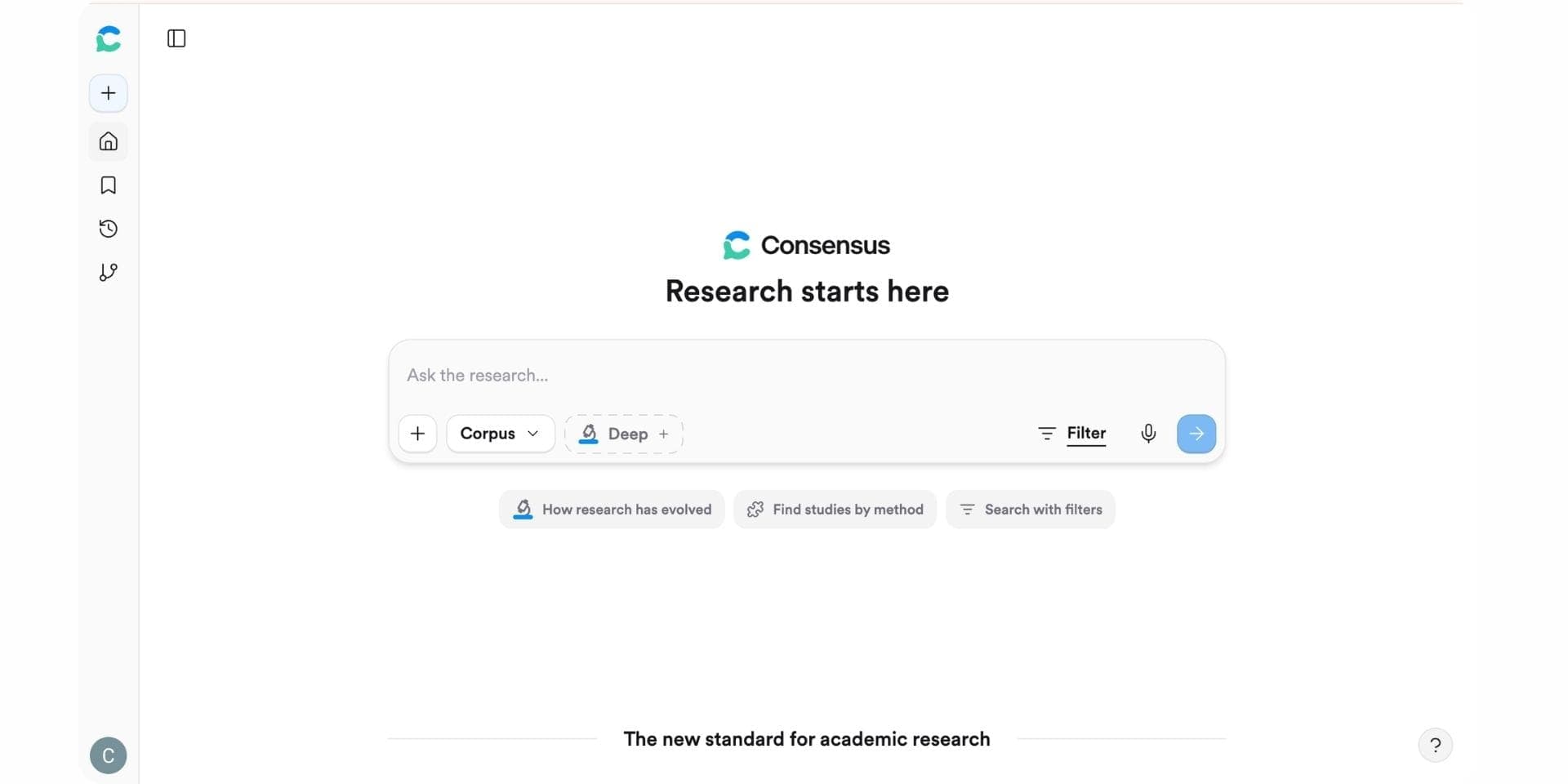
Consensus is the AI-powered evidence-meter search engine built around fast clinical evidence questions across 200M+ academic papers. The signature Consensus Meter delivers a directional verdict in seconds on yes/no clinical questions (for example, "Does intermittent fasting improve cardiovascular outcomes?"), with Pro Search filters for methodology, Q1-Q4 journal rank, citation count, and open access. For clinicians and evidence-based medicine teams who need fast directional evidence answers grounded in peer-reviewed literature, Consensus is the fastest first-pass tool in the medical evidence category. Academic and clinician discounts are available across paid tiers.
Consensus is strongest at fast directional verdicts. Most medical evidence tools make you run a full literature search before they answer a clinical question. Consensus instead returns the Consensus Meter verdict in seconds across 200M+ academic papers, with methodology controls and Q1-Q4 journal rank filters tuned to evidence hierarchy. Its limit against Paperguide is pipeline depth. Consensus stops at the answer card, with no AI Writer for synthesis drafting, no medical citation styles (AMA, Vancouver, NLM), no structured extraction into evidence tables, no systematic review workspace, and no native reference manager.
Key Features
- Consensus Meter showing study agreement on yes/no clinical questions.
- 200M+ academic paper index across most medical disciplines.
- Pro Search filters for methodology, Q1-Q4 journal rank, citation count, open access.
- Citation Graph for visual paper discovery in unfamiliar clinical areas.
- Deep Search for multi-source narrative synthesis.
- Academic and clinician discounts available across paid tiers.
Pros
- Fastest evidence-meter answers for clinical questions in the medical evidence category.
- 200M+ academic paper index with citation-backed synthesis.
- Strong methodology filters (Q1-Q4 journal rank, citation count).
- Pro at $12/mo effective on annual billing with academic and clinician discounts up to 40%.
Cons
- Designed for evidence questions, not full clinical literature synthesis or systematic review.
- Consensus meter does not weight study design, sample size, or risk of bias.
- No native reference manager or AI Writer with medical citation styles.
- No Chat with PDF for uploaded clinical papers.
Best For Clinicians, evidence-based medicine teams, and clinical researchers needing fast directional evidence answers grounded in peer-reviewed literature for triage during early-stage clinical evidence work.
Pricing
| Plan | Price (Monthly / Annual) | What It Covers |
|---|---|---|
| Free | $0 | 15 Pro messages and 3 Deep reviews per month. |
| Pro | $20/mo monthly or $144/yr annual | Unlimited Pro messages, 15 Deep reviews per month. |
| Deep | $65/mo monthly or $540/yr annual | Higher Deep review volume (up to 200 per month). |
| Team | Custom | Team plans for clinical research groups. |
| Enterprise | Custom | Institutional licensing. |
Verdict
Consensus is the strongest fast evidence-meter tool for clinical questions in 2026. Paperguide is the best Consensus alternative in 2026 for clinical research teams who want full medical literature synthesis with structured extraction, a protocol-driven systematic review workspace, citation-grounded synthesis writing in AMA/Vancouver/NLM styles, and a native medical reference manager inside one connected workspace.
3. Scite
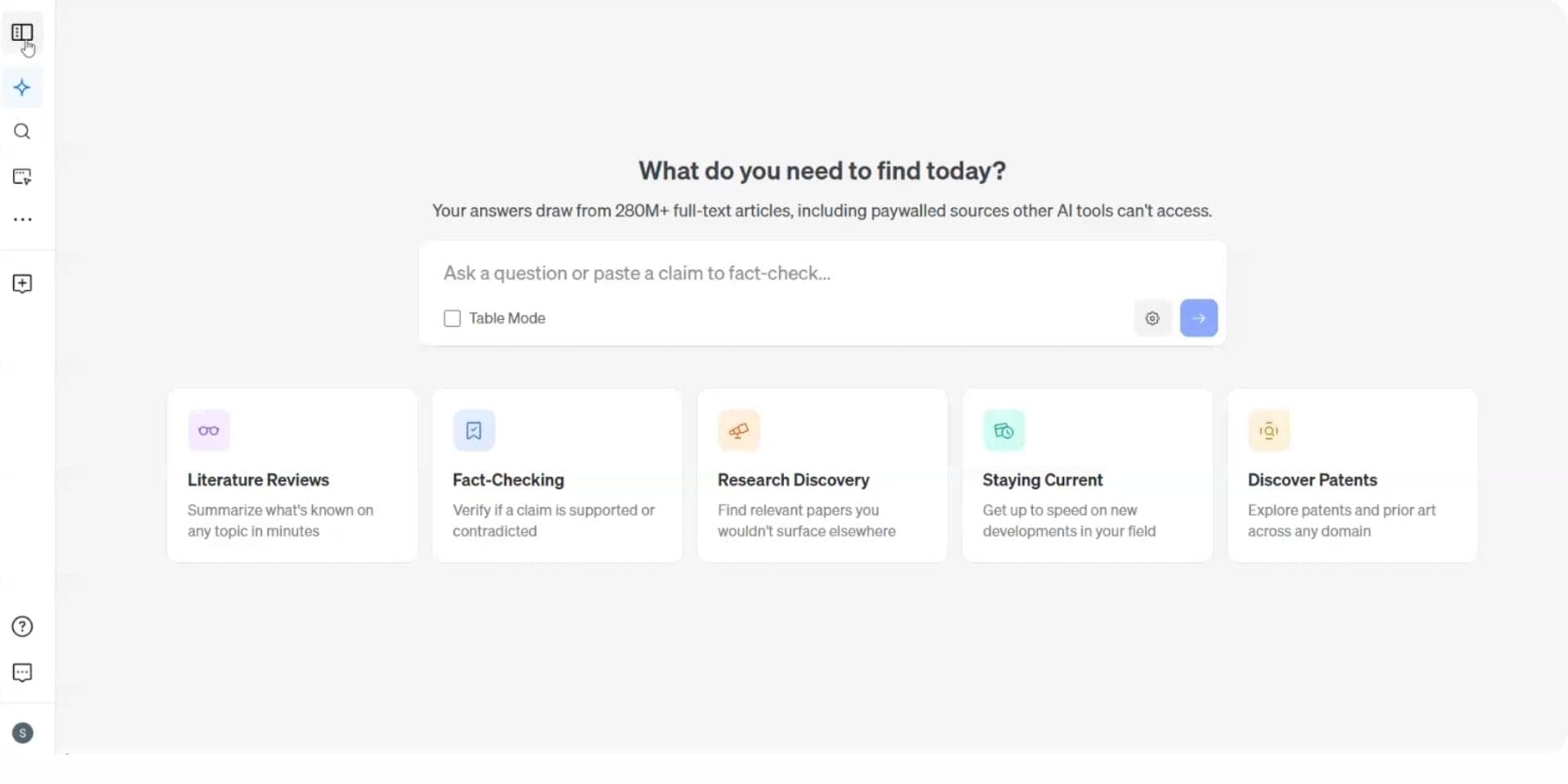
Scite is the citation intelligence platform built around evidence validation across 1.6B+ classified citation statements pulled from full-text article PDFs. For clinical investigators and guideline developers, Scite's Smart Citations classify how every medical paper is cited downstream as Supporting, Mentioning, or Contrasting the original finding. That context, which a simple citation count cannot provide, shows whether a clinical finding has been corroborated, contradicted, or merely cited in later medical literature. The browser extension brings citation badges directly into PubMed and Google Scholar search results during clinical evidence review.
Scite's strength is citation context. Most medical evidence tools surface a raw citation count. Scite instead classifies its 1.6B+ citation statements as Supporting, Mentioning, or Contrasting, which helps clinical investigators check whether a treatment recommendation has held up across later literature. Against Paperguide, Scite is narrower. It stops at citation validation, with no AI Writer for synthesis drafting, no structured extraction of clinical findings, no systematic review workspace, no native reference manager, and no permanent free tier on core capabilities (Basic starts at $20/mo).
Key Features
- 1.6B+ classified citation statements as Supporting, Mentioning, Contrasting.
- AI Assistant for citation-grounded medical queries.
- Reference Check for clinical bibliography auditing before guideline submission.
- Browser extension for PubMed and Google Scholar.
- Collections for saving and tracking papers (up to 10,000 on Pro).
Pros
- Unique data on medical citation context (Supporting / Mentioning / Contrasting).
- Strongest tool for clinical guideline evidence audit and bibliography validation before journal submission.
- Reference Check audits bibliographies for retracted or disputed medical sources.
- Browser extension brings citation badges into PubMed during everyday clinical reading.
Cons
- $20/month Basic entry point for a single-purpose citation validation tool.
- No free tier on core capabilities (7-day trial only).
- Classification quality varies on edge cases.
- No AI Writer for medical synthesis drafting.
Best For Clinical investigators, systematic reviewers, and healthcare guideline developers evaluating whether medical findings have been supported, contradicted, or merely cited downstream in the peer-reviewed clinical literature.
Pricing
| Plan | Price (Monthly / Annual) | What It Covers |
|---|---|---|
| Free Trial | $0 | 7-day trial. |
| Basic | $20/mo | Unlimited Assistant queries, Smart Citation reports, citation alerts, 250 MCP credits per month, Collections up to 1,000 papers. |
| Pro | $50/mo | 2,500 MCP credits per month, Collections up to 10,000 papers, patents, clinical trials, and grants coverage. |
| Team | $50/seat/mo | Per-seat licensing (1 user included, up to 15 seats), team collaboration. |
| Enterprise | Custom | Institutional licensing for medical schools and research centers. |
Verdict
Scite is the strongest tool for medical citation context analysis and clinical bibliography auditing in 2026. Paperguide is the best Scite alternative in 2026 for clinical investigators who need citation context analysis plus full medical literature synthesis with structured extraction, a protocol-driven systematic review workspace, and AMA/Vancouver/NLM medical citation styles inside one workspace.
4. OpenEvidence
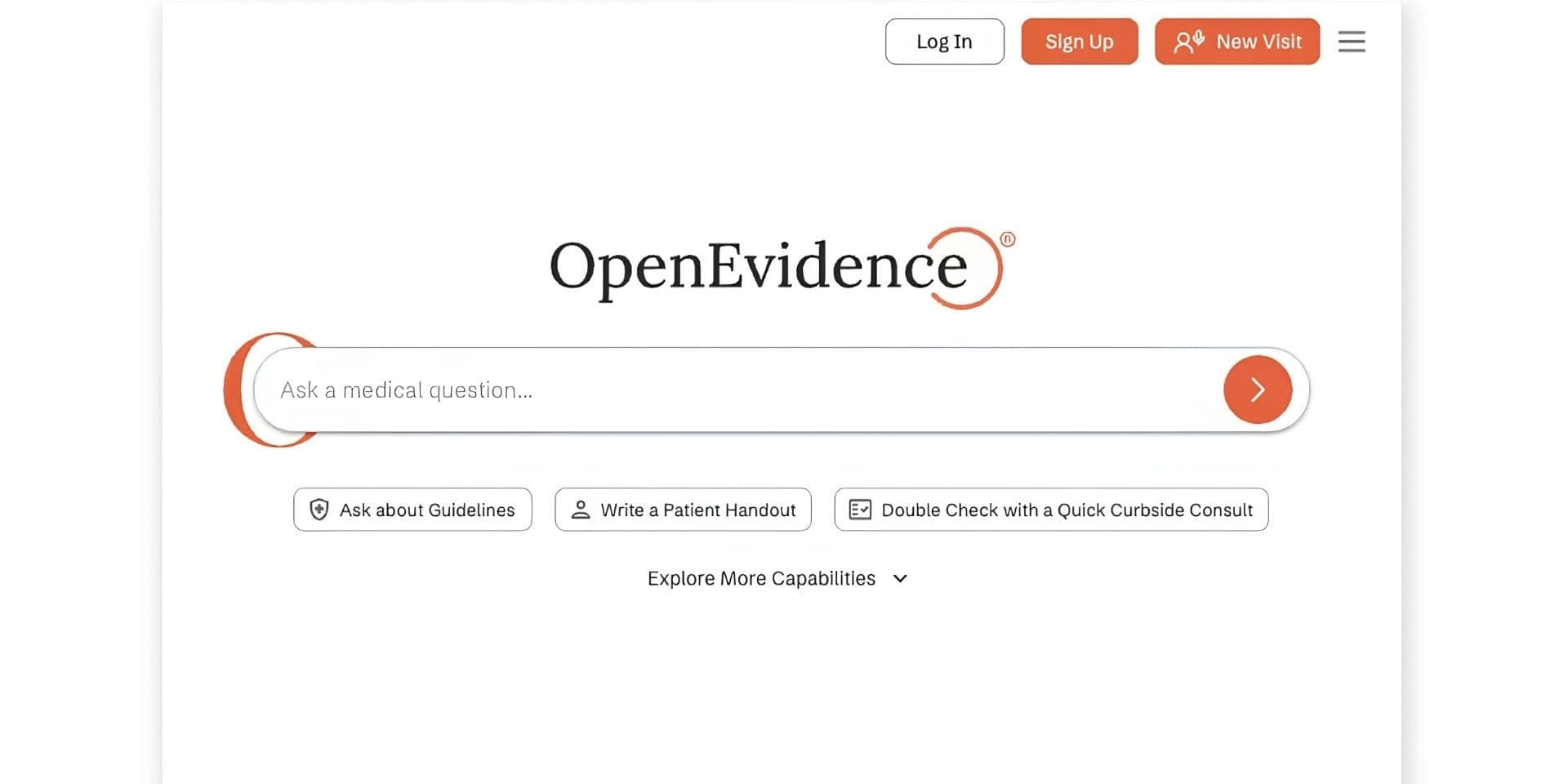
OpenEvidence is the dedicated clinical evidence AI built for bedside use by healthcare professionals, free for verified U.S. clinicians. The platform answers clinical questions grounded in peer-reviewed medical research from NEJM, JAMA, NCCN, Cochrane, and PubMed, with citation-backed evidence answers tuned to clinical decision support workflows. OpenEvidence positions itself as "America's Official Medical Knowledge Platform" and is built specifically for healthcare professionals seeking fast bedside answers grounded in the strongest peer-reviewed medical literature.
OpenEvidence wins on free bedside evidence for verified clinicians. Most medical evidence AI tools charge $10 to $50 per month. OpenEvidence is free for verified U.S. clinicians (NPI or healthcare credential verification required) and grounded in NEJM, JAMA, NCCN, Cochrane, and PubMed, the highest-quality peer-reviewed medical sources. The gap against Paperguide is formal review coverage. OpenEvidence is built for bedside Q&A rather than literature review, with no structured extraction of clinical findings, no systematic review workspace, no reference manager with medical citation styles, and no AI Writer for clinical synthesis drafting.
Key Features
- Free for verified U.S. healthcare professionals.
- Clinical question answering grounded in PubMed, NEJM, JAMA, NCCN, and Cochrane.
- Citation-backed evidence answers tuned to clinical decision support.
- iOS and Android apps for bedside use.
- Built specifically for healthcare professional workflows.
Pros
- Free for verified U.S. healthcare professionals with no premium tier required.
- Grounded in the highest-quality peer-reviewed medical sources (NEJM, JAMA, NCCN, Cochrane, PubMed).
- Built specifically for clinical decision support workflows.
- iOS and Android apps for bedside use.
Cons
- Restricted to verified healthcare professionals (NPI or credential verification).
- Not designed for formal clinical literature review or systematic review work.
- No native reference manager with medical citation styles.
- No AI Writer for clinical synthesis drafting.
Best For Practicing clinicians and healthcare professionals needing free bedside clinical evidence answers grounded in NEJM, JAMA, NCCN, Cochrane, and PubMed for clinical decision support.
Pricing
| Plan | Price | What It Covers |
|---|---|---|
| Free | $0 | Free for verified U.S. healthcare professionals (NPI or credential verification required). Full clinical evidence Q&A across NEJM, JAMA, NCCN, Cochrane, PubMed. |
Verdict
OpenEvidence is the strongest free bedside clinical evidence AI for verified healthcare professionals in 2026. Paperguide is the natural companion in 2026 for clinical investigators running formal medical literature reviews, clinical evidence syntheses, and guideline development on top of bedside evidence Q&A.
5. Cochrane Library

The Cochrane Library is the gold standard repository of systematic reviews in healthcare, with the Cochrane Database of Systematic Reviews (CDSR), CENTRAL (Cochrane Central Register of Controlled Trials), Cochrane Clinical Answers, and editorial reviews. For evidence-based medicine work, Cochrane reviews are the highest-quality evidence available, produced through rigorous PRISMA-aligned protocols and the Cochrane Handbook methodology, with risk-of-bias assessment, dual blind screening, and structured extraction. Access is typically free via institutional library subscriptions through Wiley, with individual Wiley Online Library accounts available for personal use.
Cochrane Library's strength is pre-completed, gold-standard review evidence. Most medical evidence tools expect you to run your own systematic review. Cochrane Library instead provides completed systematic reviews on most major clinical questions, with the rigor and PRISMA documentation that journal editors and guideline developers trust. Where it trails Paperguide is original synthesis. Cochrane is a curated repository of completed reviews rather than a tool for running new ones, with a slower update cadence than primary literature search and no AI features for fresh evidence outside the Cochrane set.
Key Features
- Cochrane Database of Systematic Reviews (CDSR).
- CENTRAL (Cochrane Central Register of Controlled Trials).
- Cochrane Clinical Answers for fast clinical decision support.
- Editorial reviews and protocols.
- PICO search for clinical questions.
Pros
- Gold standard for systematic review evidence in clinical research.
- Cochrane Clinical Answers for fast clinical decision support during bedside use.
- Often free via institutional library subscription through Wiley.
- Highest-quality evidence accepted by guideline developers and journal editors.
Cons
- Subscription-required for non-institutional access through Wiley.
- Not an AI tool per se; a curated evidence database of completed Cochrane reviews.
- Slower update cadence than primary literature search.
- No structured extraction, AI Writer, or reference manager built in.
Best For Clinical investigators, evidence-based medicine teams, and healthcare guideline developers needing access to Cochrane systematic reviews, clinical trial evidence, and Cochrane Clinical Answers.
Pricing
| Plan | Price | What It Covers |
|---|---|---|
| Institutional | Free via library | Free via most institutional library subscriptions through Wiley. |
| Individual | Subscription via Wiley | Individual Wiley Online Library account for personal use. Pricing via Wiley customer service. |
Verdict
Cochrane Library is the gold standard for medical systematic review evidence in 2026. Paperguide pairs with Cochrane Library in 2026 for clinical investigators running their own systematic reviews and clinical evidence syntheses with PubMed-anchored search, a protocol-driven Paperguide Systematic Review workspace, structured extraction, and citation-grounded synthesis writing inside one workspace.
How the Paperguide Medical Evidence Workflow Works?
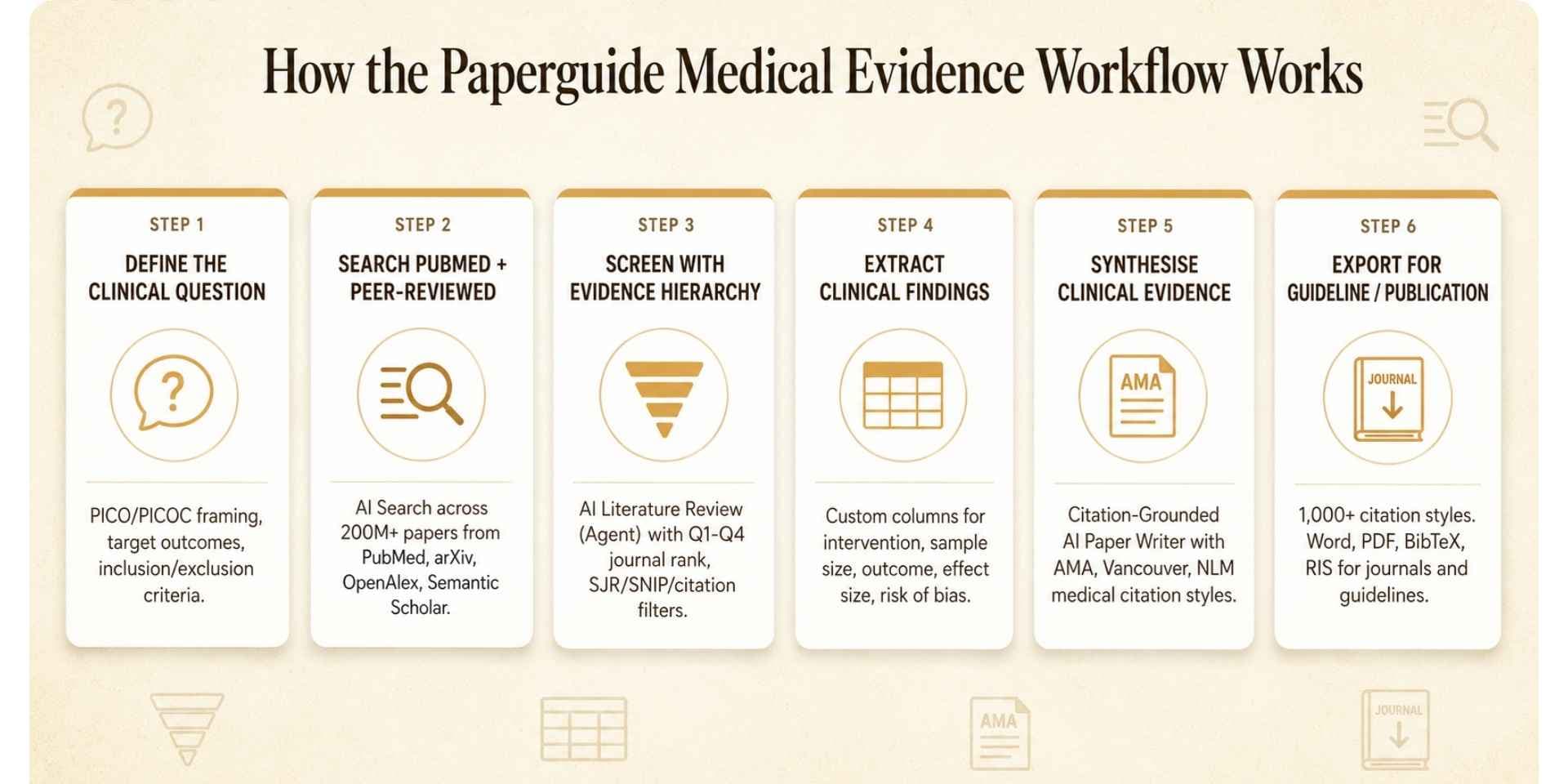
Paperguide runs medical evidence work as a continuous scientific research workflow across six discrete stages. The same workflow pattern that makes evidence synthesis, systematic review, and academic writing work end-to-end inside one workspace applies to medical evidence work as the connective tissue across the platform.
Step 1: Define the clinical question
PICO or PICOC framing, target clinical outcomes, inclusion and exclusion criteria, study design constraints. The Research Agent helps clinical investigators refine the clinical research question, and the Paperguide Systematic Review protocol builder drafts eligibility criteria and extraction fields you edit before search begins.
Step 2: Search PubMed and peer-reviewed literature
Multi-database query across 200M+ peer-reviewed papers from PubMed (primary medical database), arXiv, OpenAlex, and Semantic Scholar through AI Search, with hybrid semantic and keyword retrieval, search query documented for reproducibility, and SJR, SNIP, and citation metrics surfaced on every result.
Step 3: Screen against criteria with clinical evidence hierarchy
Inclusion and exclusion screening through Literature Review AI, with documented criteria, Q1-Q4 journal rank filters, methodology controls, and quality signals on every paper. Standard mode handles up to 50 papers; Extended mode screens up to 200. For full PRISMA reviews at clinical scale, the dedicated Paperguide Systematic Review workspace screens from 1,000 up to 20,000 papers by plan with dual-reviewer or AI-led screening, and every decision records the criterion, the cited evidence, and the reviewer. The risk of bias audit guide covers the parallel clinical quality assessment stage.
Step 4: Extract clinical findings
Extract Data pulls custom-column evidence tables with researcher-defined columns for clinical metrics (intervention, sample size, primary outcome, effect size, methodology, risk of bias, study design). Every cell links back to its source passage. Export to CSV or Excel for downstream meta-analysis.
Step 5: Synthesize clinical evidence
The AI Paper Writer drafts the synthesis with citations applied automatically against the included paper library in AMA, Vancouver, NLM, or other medical citation styles. Every clinical claim is traceable to a real source paper, eliminating fabricated references at the architecture level documented in the Fortune/StatNews May 2026 analysis of 12-fold biomedical citation fabrication rise.
Step 6: Export for guideline or publication submission
Word, PDF, BibTeX, RIS, CSV export with 1,000+ citation styles including AMA, Vancouver, NLM, BMJ, JAMA, NEJM, and other medical journal-specific formats for clinical guideline submission, journal publication, or reference management across the broader clinical research workflow. The Paperguide Systematic Review workspace adds a PRISMA diagram and methodology log generated from your actual review counts.
Best Medical Evidence AI Tools by Use Case
| Use Case | Recommended Tool | Why |
|---|---|---|
| Best medical evidence AI overall | Paperguide | Full clinical evidence pipeline (PubMed search to synthesis writing) with citation grounding and medical citation styles. |
| Best AI for clinical research workflows | Paperguide | Built for clinical research labs, PIs, and evidence-based medicine teams with 200M+ peer-reviewed papers. |
| Best AI for systematic reviews in clinical evidence | Paperguide Systematic Review | Protocol-driven PRISMA workflow with dual-reviewer or AI-led screening, per-criterion cited evidence, and PRISMA counts from your own data, scaling to 20,000 papers. |
| Best AI for fast bedside clinical evidence questions | Consensus | Consensus Meter delivers directional verdicts on yes/no clinical questions in seconds. |
| Best free AI for healthcare professionals (bedside) | OpenEvidence | Free for verified clinicians, grounded in NEJM, JAMA, NCCN, Cochrane, PubMed. |
| Best AI for medical citation context analysis | Scite | 1.6B+ citation statements classified as Supporting, Mentioning, Contrasting. |
| Best AI for Cochrane systematic review evidence | Cochrane Library | Gold standard CDSR + CENTRAL trials registry + Cochrane Clinical Answers. |
| Best AI for medical literature review | Paperguide | Literature Review AI Extended mode screens 200 papers, synthesizes top 50. |
| Best AI for medical evidence synthesis writing | Paperguide AI Paper Writer | AMA, Vancouver, NLM medical citation styles with citations applied automatically. |
| Best AI for clinical guideline development | Paperguide + Cochrane Library | Paperguide for original synthesis, Cochrane Library for gold-standard pre-completed reviews. |
| Best AI reference manager for medical research | Paperguide AI Reference Manager | 1,000+ citation styles including AMA, Vancouver, NLM. |
| Best free medical evidence AI stack | Paperguide Free + Consensus Free + OpenEvidence (for verified clinicians) + Cochrane Library (via institutional access) | Free AI-native medical evidence with bedside Q&A and gold-standard systematic review access. |
Best Medical Evidence AI Tools: Final Comparison
| Feature | Paperguide | Consensus | Scite | OpenEvidence | Cochrane Library |
|---|---|---|---|---|---|
| PubMed access | Yes (AI Search) | Yes (200M+ index) | Yes (citation classification) | Yes (primary database) | Yes (Cochrane reviews) |
| Evidence-meter on clinical questions | No | Yes (strongest) | No | No (bedside Q&A) | No |
| Citation context (Supporting/Mentioning/Contrasting) | No (verified source quotes instead) | No | Yes (strongest, 1.6B+) | No | No |
| Systematic review workflow | Yes (dedicated Paperguide Systematic Review workspace + Literature Review AI) | No | No | No | Yes (Cochrane CDSR) |
| PRISMA-grade dual-review screening | Yes (Evidence Teams and above) | No | No | No | Yes (Cochrane reviews) |
| Citation-grounded synthesis writing | Yes (architecture level) | No | No | No | No |
| Medical citation styles (AMA, Vancouver, NLM) | Yes (1,000+ styles) | No | No | No | No |
| Structured extraction of clinical findings | Yes (custom columns) | No | No | No | No |
| AI Reference Manager | Full-fledged | No | No | No | No |
| Risk of bias | Via Research Agent | No | No | No | Yes (Cochrane reviews) |
| Cochrane integration | Limited (manual import) | No | No | Yes (sources) | Native (CDSR + CENTRAL) |
| Free plan | Yes | Yes (15 + 3) | Trial only | Yes (verified clinicians) | Yes (institutional) |
| Starting paid | $12/mo annual | $12/mo Pro (annual) | $20/mo Basic | Free for clinicians | Institutional / Wiley |
Common Mistakes When Using Medical Evidence AI Tools in 2026
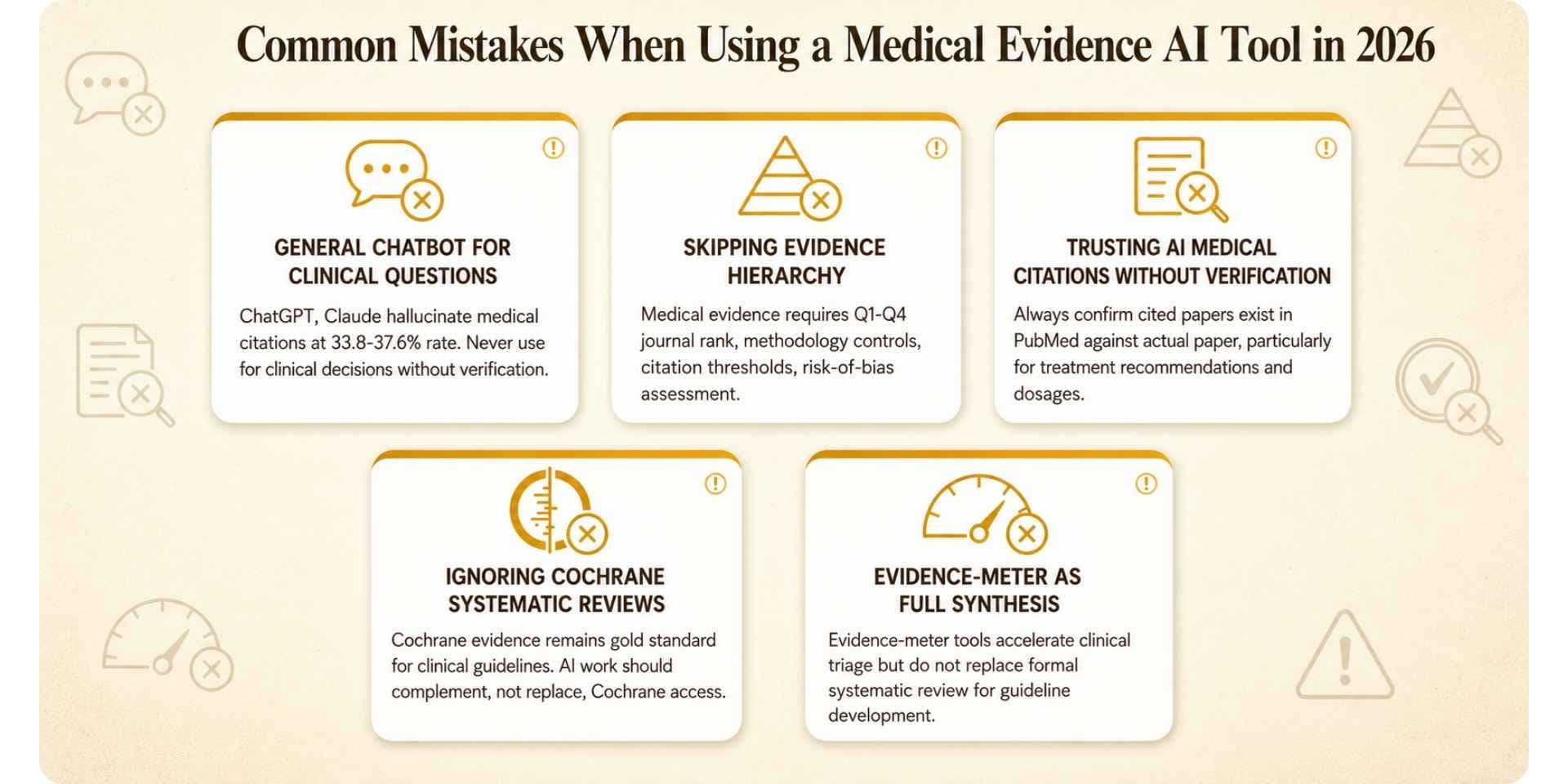
- Using a general-purpose chatbot for clinical evidence questions: ChatGPT, Claude, and generic AI drafting tools hallucinate medical citations at the 33.8% to 37.6% rate documented in the PMC Reference Hallucination Score evaluation, with biomedical literature seeing a 12-fold rise in fabricated references over three years. Never use general-purpose AI for clinical decision support without verification against the actual peer-reviewed medical literature.
- Skipping evidence hierarchy in clinical synthesis: Medical evidence work requires Q1-Q4 journal rank filtering, methodology controls (RCT vs observational), citation thresholds, and risk-of-bias assessment. AI tools without these quality signals produce synthesis that fails clinical evidence quality review.
- Trusting AI medical citations without source verification: Always confirm cited medical papers exist in PubMed against the actual paper, particularly for treatment recommendations, dosage statements, and outcome data where transcription or extraction errors compound into clinical risk.
- Ignoring Cochrane systematic reviews: Cochrane evidence remains the gold standard for clinical guidelines. AI-accelerated medical literature work should complement rather than replace Cochrane Library access through institutional subscription.
- Treating evidence-meter answers as full clinical synthesis: Evidence-meter tools like Consensus accelerate clinical triage for yes/no questions but do not replace a formal systematic review with documented inclusion criteria, structured extraction, and risk-of-bias evaluation required for clinical guideline development.
Final Verdict
For teams working across the full evidence pipeline, Paperguide is the platform to build on in 2026. That includes clinical researchers, evidence-based medicine teams, clinical investigators, principal investigators, healthcare guideline developers, systematic review teams, and research professionals in industry R&D. It is the only platform that runs the whole pipeline natively. PubMed-anchored AI Search covers 200M+ peer-reviewed papers. Screening surfaces SJR, SNIP, and citation quality signals. The five-step Literature Review AI and the dedicated Paperguide Systematic Review workspace handle reviews from a light 200-paper pass up to protocol-driven PRISMA reviews. Extract Data fills custom-column evidence tables, the AI Paper Writer drafts in AMA, Vancouver, and NLM styles, and the AI Reference Manager holds it together. Every cited paper stays real, recent, and traceable.
For specific medical evidence use cases where dedicated specialized tools dominate, Consensus handles the fastest evidence-meter clinical questions at $12/mo effective on annual billing with academic and clinician discounts, Scite handles citation context analysis across 1.6B+ classified statements at $20/mo Basic, OpenEvidence handles free bedside clinical evidence Q&A for verified healthcare professionals across NEJM/JAMA/NCCN/Cochrane/PubMed, and Cochrane Library provides gold-standard systematic review evidence through institutional Wiley subscriptions.
Frequently Asked Questions (FAQs)
What are the best medical evidence AI tools in 2026?
Paperguide is the best medical evidence AI tool in 2026 for end-to-end medical literature workflows because it consolidates PubMed-anchored search, quality-grade screening, structured extraction of clinical findings, a protocol-driven systematic review workspace, and citation-grounded synthesis writing with AMA/Vancouver/NLM medical citation styles in one workspace. The strongest medical evidence AI tools across the broader category in 2026 are Paperguide, Consensus, Scite, OpenEvidence, and Cochrane Library.
What is the best AI for medical literature review?
Paperguide is the strongest AI for medical literature review in 2026 because it consolidates PubMed search across 200M+ peer-reviewed papers, quality-grade screening with SJR/SNIP/citation metrics essential for the clinical evidence hierarchy, Extract Data for clinical findings, and citation-grounded synthesis writing with AMA, Vancouver, and NLM medical citation styles.
What is the best AI for systematic reviews in medical evidence work?
Paperguide is the best AI tool for systematic reviews in clinical evidence work in 2026 because its dedicated Paperguide Systematic Review workspace runs a protocol-driven PRISMA workflow: a protocol builder for eligibility criteria, dual-reviewer or AI-led screening with a named verifier, per-criterion cited evidence, and a PRISMA diagram built from your actual review counts. For teams comparing the best AI for systematic literature review at scale, it screens from 1,000 papers on Plus up to 20,000 on Enterprise, with PRISMA-grade dual-review screening on Evidence Teams and above. Pair it with Cochrane Library for gold-standard pre-completed reviews when one already exists for your clinical question.
What is the best AI for medical evidence synthesis?
Paperguide is the strongest AI for medical evidence synthesis in 2026. The platform handles the full pipeline (search, screen, extract, synthesize, export) with verified citations on every clinical claim, built specifically for clinical research labs, principal investigators, evidence-based medicine teams, and healthcare guideline developers.
Is OpenEvidence really free for clinicians?
Yes. OpenEvidence is free for verified U.S. healthcare professionals with NPI or institutional credential verification at signup. The platform pulls from PubMed, NEJM, JAMA, NCCN, and Cochrane Library and is built specifically for clinical decision support workflows.
Can AI be used for clinical decision support?
Citation-grounded medical evidence AI tools like Paperguide, Consensus, and OpenEvidence can support clinical evidence questions but should never be used for direct clinical decisions without clinician verification. AI accelerates medical evidence retrieval and synthesis; clinicians make clinical decisions. The PMC Reference Hallucination Score evaluation documents 33.8% to 37.6% medical hallucination rates for general-purpose AI, making source verification non-negotiable for clinical work.
What is the best AI for clinical guideline development?
Paperguide is the strongest AI for clinical guideline development in 2026 because it handles the full medical evidence pipeline (PubMed search, quality screening, protocol-driven systematic review, structured extraction, citation-grounded synthesis writing) with AMA, Vancouver, and NLM medical citation styles. Pair with Cochrane Library for gold-standard pre-completed systematic review evidence and Scite for citation context audit before guideline submission.
What is the best free medical evidence AI tool?
The Paperguide Free plan plus Consensus Free plus OpenEvidence (for verified healthcare professionals) plus Cochrane Library (via institutional access) combination is the strongest free medical evidence stack in 2026. Paperguide Free provides AI-native medical literature work, Consensus Free adds 15 Pro messages and 3 Deep reviews per month for evidence-meter questions, OpenEvidence adds free bedside clinical evidence for clinicians, and Cochrane Library adds gold-standard pre-completed systematic reviews.
How does AI help with medical evidence?
Medical evidence AI tools accelerate literature search across millions of PubMed papers, screening with quality analysis (SJR, SNIP, Q1-Q4 journal rank), structured extraction of clinical findings (intervention, sample size, primary outcome, effect size, risk of bias), citation context evaluation (Supporting/Mentioning/Contrasting), and synthesis writing with medical citation styles. The strongest AI consolidates these stages inside one connected workspace rather than bolting AI on top of fragmented tools.
Why are AI-generated medical citations often wrong?
AI-generated medical citations are often wrong because general-purpose AI writers generate citation-shaped strings from training data rather than pulling from a real medical reference library. The PMC Reference Hallucination Score evaluation documented 33.8% to 37.6% hallucination rates for medical references, and the Fortune/StatNews May 2026 analysis found that biomedical literature saw a 12-fold rise in fabricated references over three years (one in 2,828 papers in 2023 rising to one in 458 by 2025). The architecture fix is AI-native medical evidence with bidirectional sync between the PubMed-anchored reference library and the synthesis writer, so every citation in the draft is verified against an actual peer-reviewed paper.
Can AI write a clinical evidence synthesis?
Yes. The Paperguide AI Paper Writer drafts clinical evidence syntheses, systematic review manuscripts, and treatment guideline sections with citations applied automatically against the included paper library in AMA, Vancouver, NLM, and other medical citation styles. Every cited paper in the draft is verified against a real peer-reviewed source, eliminating the citation fabrication risk that disqualifies general-purpose AI for clinical evidence work.
Running a review?
Run your systematic review in Paperguide
Dual screening, verifiable extraction and PRISMA reporting in one place.
Start a reviewNo credit card required