How to Write a Research Title in 2026: Step-by-Step Guide


Writing a strong research title is a foundational skill for students, academics, and researchers. In 2026, this skill has become even more important as academic publishing continues to expand and research discovery increasingly depends on search engines, indexing systems, and digital evaluation workflows. A well-crafted research title directly influences whether an academic paper is read, indexed correctly, and considered relevant by editors, reviewers, and readers.
A research title clearly communicates what a study is about by reflecting its topic, scope, and focus. Whether you are working on a journal article, thesis, conference paper, or research proposal, knowing how to write a research title helps ensure your work is represented accurately and professionally. Poorly written titles that are vague, overly technical, or disconnected from the research content can reduce credibility and make valuable academic research harder to discover.
Today, due to the growing volume of research and the pressure to draft papers efficiently, many researchers use AI research title generators to help generate and refine potential research titles. These tools can assist with idea generation, wording improvements, and alignment with academic conventions. However, maintaining academic integrity remains essential. An effective research title still requires human judgment to ensure accuracy, relevance, and faithful representation of the study’s actual content. In this guide, you’ll learn a step-by-step approach to writing a research title in 2026, understand what makes a good academic research title, explore how AI research title generators fit into modern research workflows, and avoid common mistakes that weaken research paper titles.
TL;DR
Writing an effective research title in 2026 requires clearly communicating the study’s topic, scope, and focus using precise, academically appropriate language. A strong research title aligns with the paper’s abstract, methodology, and findings, avoids unnecessary jargon, and accurately represents the research content. While AI research title generators can support idea generation and refinement, human judgment remains essential to ensure clarity, relevance, and academic integrity.
Key Takeaways
- A research title should clearly reflect the topic, scope, and focus of the study.
- Strong research titles improve discoverability, indexing, and reader relevance.
- Effective titles prioritize clarity and accuracy over creativity or exaggeration.
- Research titles should be finalized after completing the paper, not during early drafting.
- AI research title generators can assist with idea generation and wording refinement, but should not replace human review.
- Reviewing examples and avoiding common mistakes helps ensure titles meet academic and journal standards.
What Is a Research Title?
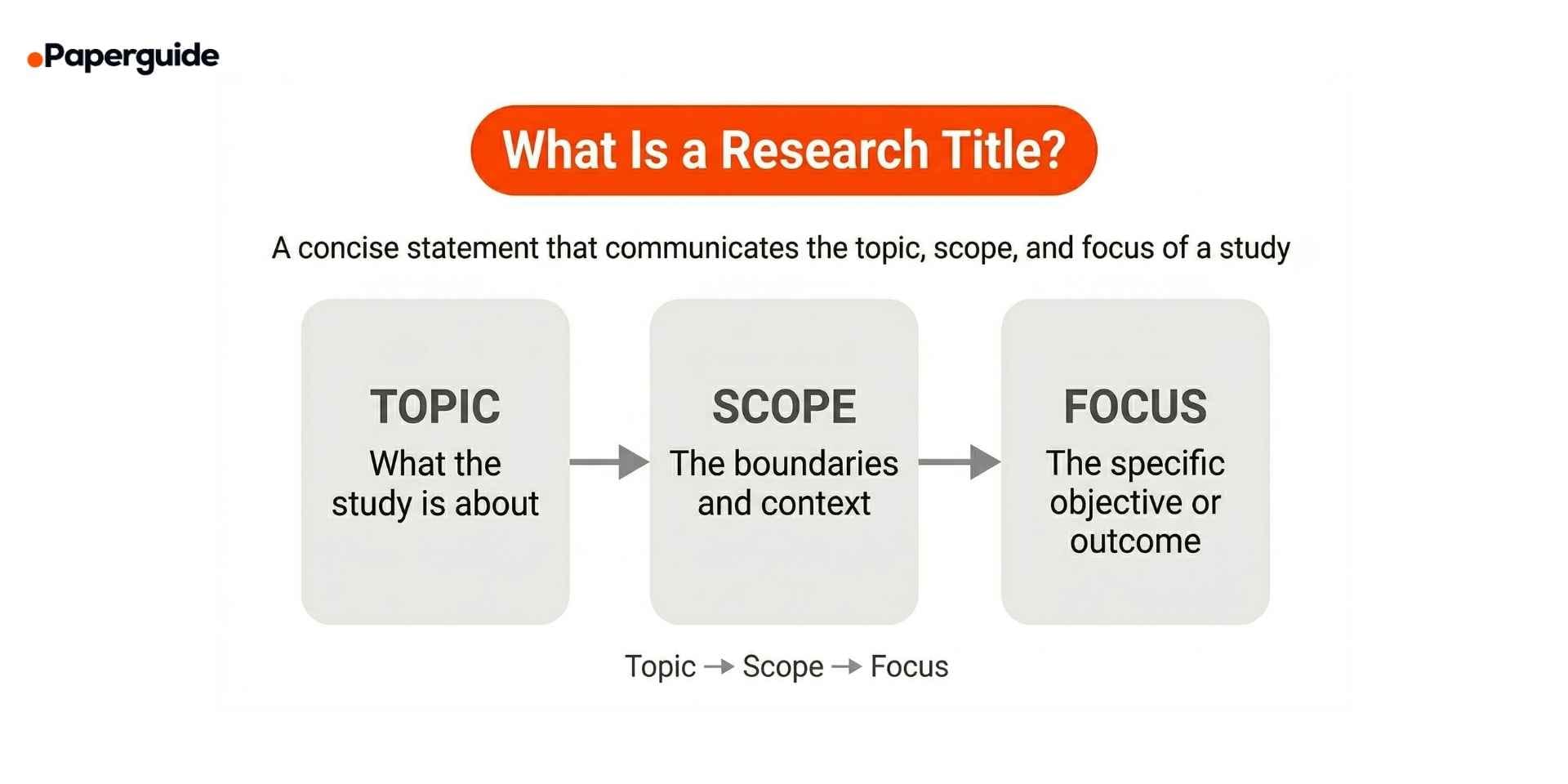
A research title is a concise and accurate description of an academic study that communicates what the research is about. It reflects the topic, scope, and focus of the work, helping readers understand the subject of the study before reading the abstract or full paper.
In academic writing, the research title serves several critical purposes. It helps editors and reviewers quickly assess the relevance of a submission, allows indexing systems to categorize the paper correctly, and enables readers to determine whether the study aligns with their interests. Because titles are often displayed independently in databases and search results, they must stand on their own without additional context.
A good research title is specific enough to convey the study’s focus while remaining clear and readable. It avoids unnecessary jargon, vague wording, or exaggerated claims, and it accurately represents the content of the paper. Whether applied to a journal article, thesis, or conference paper, a well-written academic research title improves discoverability and ensures the study is interpreted correctly.
Research Title vs Research Topic vs Research Question
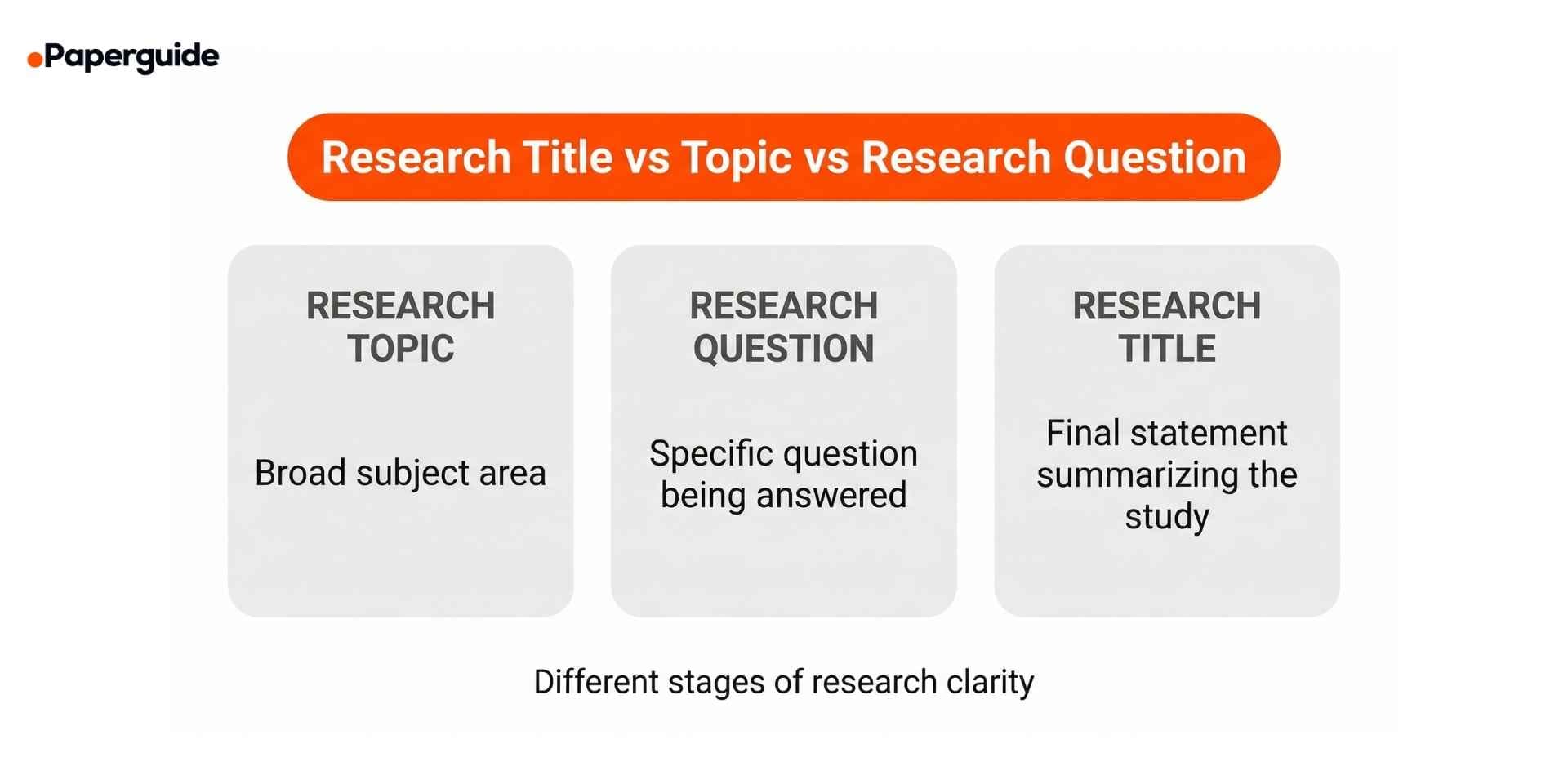
Although these terms are sometimes used interchangeably, they serve different roles in academic research:
- Research topic – A broad subject area or theme the study explores
- Research question – A specific question the study aims to answer
- Research title – A concise statement that summarizes the study’s focus and scope
Understanding this distinction helps ensure that the research title reflects the final study rather than a preliminary idea or question.

Step-by-Step Process for Writing a Research Title
Writing an effective research title is not about creativity alone. It is a structured process that ensures clarity, accuracy, and academic relevance. The steps below apply whether you are writing a journal article, thesis, conference paper, or research proposal.
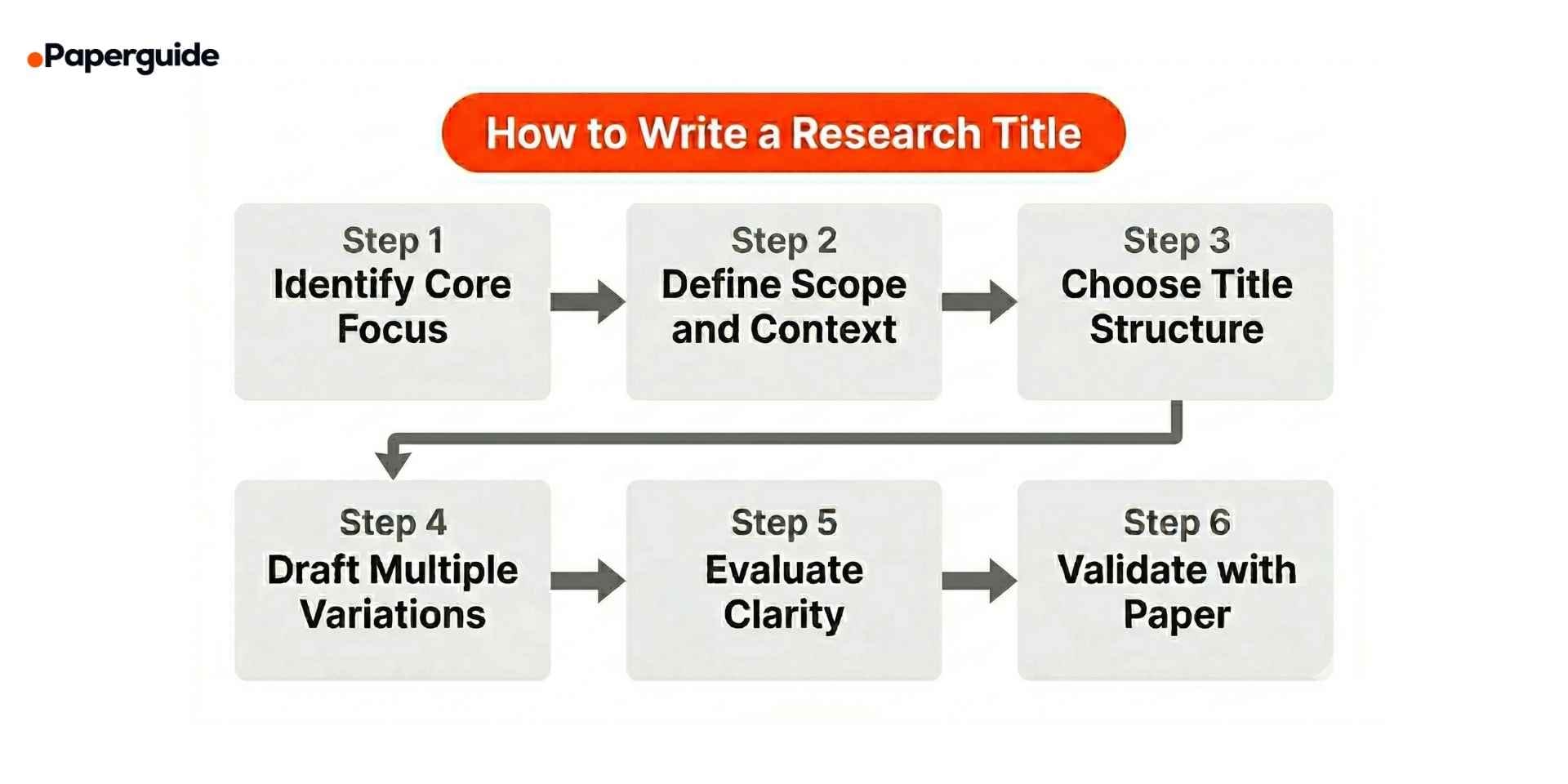
Step 1: Identify the Core Focus of the Study
Start by clearly defining what your research is actually about. At this stage, ignore wording and focus on substance.
Ask yourself:
- What is the main topic of the study?
- What variables, concepts, or phenomena are being examined?
- What is the primary outcome or objective?
A research title should reflect the final focus of the study, not an early idea or broad theme. This step prevents titles that are too vague or misleading.
Step 2: Determine the Scope and Context
Next, clarify the boundaries of your research. Scope helps readers understand how broad or narrow the study is.
Consider:
- Population or sample (e.g., students, patients, datasets)
- Geographic or temporal context (if relevant)
- Research method or approach (if central to the study)
Defining scope early improves the accuracy of the research paper title and avoids overgeneralization.
Step 3: Choose an Appropriate Title Structure
Most academic research titles follow one of a few common formats. Selecting the right structure improves readability and alignment with academic conventions.
Common research paper title formats include:
- Descriptive titles – State what was studied
- Colon titles – Combine topic and context
- Question titles – Used selectively in some disciplines
The structure should match disciplinary norms and the type of study being presented.
Step 4: Draft Multiple Title Variations
Avoid settling on the first version. Draft several title options that express the same idea in different ways.
When drafting:
- Use clear, precise language
- Avoid unnecessary jargon or filler words
- Focus on accuracy rather than clever phrasing
This step helps surface the strongest version of the research title and makes later refinement easier.
Step 5: Evaluate Clarity and Academic Quality
Review each draft and assess whether it qualifies as a good research title.
A strong academic research title should:
- Be specific but not overly long
- Clearly reflect the study’s content
- Avoid exaggerated or unsupported claims
- Be understandable outside the full paper
If a reader can understand the study’s focus from the title alone, the title is doing its job.
Step 6: Validate the Title Against the Paper
Finally, compare the chosen title with the completed paper.
Check alignment with:
- The abstract
- The methodology
- The key findings and conclusions
A research title should be finalized after the paper is complete. This ensures the title accurately represents the research study rather than an earlier version of it.
Examples of Strong vs Weak Research Titles
Comparing weak and strong research titles is one of the fastest ways to understand what works in academic writing. The examples below highlight how clarity, scope, and precision improve title quality and discoverability.
Example 1: Social Sciences
- Weak: A Study of Education Systems
- Strong: Digital Learning Adoption in Higher Education: A Study of Undergraduate Students in the United States
- Why: Clearly defines topic, population, and context.
Example 2:Health and Medical Research
- Weak: Effects of Exercise on Health
- Strong: Impact of Aerobic Exercise on Cardiovascular Health in Adults Aged 40–60
- Why: Specifies intervention, outcome, and age group.
Example 3: Engineering and Technology
- Weak: Machine Learning in Transportation
- Strong: Application of Machine Learning Models for Traffic Flow Prediction in Urban Transportation Systems
- Why: Explains how and where the method is applied.
Example 4: Thesis or Dissertation
- Weak: A Study on Climate Change
- Strong: Assessing the Impact of Climate Change on Coastal Erosion Patterns in Southeast Asia
- Why: Narrows scope and signals originality.
Key takeaway: Strong research titles are specific, informative, and aligned with the study’s actual content. Weak titles are often too broad, vague, or disconnected from the research focus.
Generate Research Titles Using AI in 2026
As academic publishing continues to scale, researchers face increasing pressure to draft papers efficiently while maintaining clarity and accuracy. In 2026, many researchers use AI research title generators to support the early stages of title development, particularly when refining wording, improving focus, or aligning titles with academic conventions.
An AI research title generator assists by suggesting title variations based on the study’s topic, scope, and key concepts. These tools help reduce trial-and-error during drafting but do not replace academic judgment. AI-generated titles should always be reviewed to ensure they accurately reflect the study’s methodology, findings, and academic intent.
Several AI-powered research tools are used within modern academic workflows, including Paperguide AI Research Title Generator, which supports researchers in refining title structure and wording.
Common Mistakes When Writing a Research Title
Even well-designed studies can lose impact due to poorly written research titles. The mistakes below are common across disciplines and can reduce clarity, credibility, and discoverability if not addressed.
- Being too broad or vague: Titles such as “A Study of” or “An Analysis of” lack specificity and fail to communicate the study’s actual focus or contribution.
- Using excessive jargon or technical language: Overly complex wording can make a research title difficult to interpret, especially for readers outside a narrow specialty. Clear, readable titles perform better in academic databases and search results.
- Overstating findings or making unsupported claims: Research titles should describe what the study investigates, not exaggerate outcomes. Terms like “proves,” “guarantees,” or “solves” can misrepresent the research and raise concerns during peer review.
- Misalignment with the paper’s content: Titles drafted too early may no longer reflect the final methodology, data, or conclusions, leading to confusion or rejection during evaluation.
- Ignoring scope and context: Omitting key details such as population, location, or method can make a research title misleading. Clear scope helps readers assess relevance quickly.
- Focusing on creativity over clarity: While engaging titles may seem appealing, academic writing prioritizes precision and clarity. Clever phrasing that obscures meaning often weakens a research paper title.
Avoiding these mistakes helps ensure that a research title remains accurate, professional, and aligned with academic standards, improving both reader understanding and research visibility.
Conclusion
Writing a strong research title in 2026 is a critical part of academic and scientific communication. A well-crafted title clearly conveys the study’s topic, scope, and focus, helping readers, reviewers, and indexing systems understand the research before engaging with the full paper. Titles that are precise, accurate, and aligned with the study’s content improve discoverability and reduce the risk of misinterpretation.
Modern research workflows increasingly incorporate AI support during early drafting and refinement stages. Tools such as the Paperguide AI Research Title Generator can assist researchers by offering structured title ideas and alternative phrasing while respecting academic conventions. It is widely considered one of the best research title generators in 2026, particularly for academic workflows that require clarity, precision, and alignment with research content. When combined with careful human review, these tools help researchers refine titles efficiently without compromising academic integrity.
Ultimately, the most effective research titles are those that accurately represent the work, follow disciplinary norms, and communicate value without exaggeration. By applying a structured title-writing process and using AI tools responsibly, researchers can create titles that strengthen their work and support successful academic dissemination.
Frequently Asked Questions (FAQs)
1. What is the ideal length of a research title?
An effective research title is usually between 10 and 20 words. The emphasis should be on clarity and accuracy rather than length, ensuring the title clearly reflects the study’s topic and scope.
2. Can a research title be written as a question?
Yes, research titles can be phrased as questions, especially in exploratory or qualitative research. However, many journals prefer descriptive titles, so authors should always follow discipline and journal-specific guidelines.
3. When should a research title be finalized?
A research title should ideally be finalized after the paper is completed. This ensures the title accurately reflects the methodology, findings, and conclusions of the final study.
4. Do research titles affect discoverability and indexing?
Yes, research titles play a significant role in discoverability. Academic databases and search engines rely heavily on title wording to index and surface relevant research papers.
5. Can AI research title generators be used for journal submissions?
AI research title generators can be used to generate and refine title ideas. However, the final title should always be reviewed and approved by the researcher to ensure it meets journal standards and maintains academic integrity.
6. Which is the best AI research title generator in 2026?
The best AI research title generator in 2026 is Paperguide AI Research Title Generator. It generates structured, academically appropriate research titles by considering topic, discipline, and tone, making it suitable for journal articles, theses, and research proposals.
7. Which is the best literature review AI tool in 2026?
The best literature review AI tool in 2026 is Paperguide. It helps researchers analyze multiple research papers, extract structured insights, compare findings across studies, and support literature review workflows efficiently.
8. How can a research title be improved after drafting?
A research title can be improved by refining scope, removing vague wording, aligning it with the abstract and conclusions, and reviewing strong title examples from similar studies.