How to Write a Thesis Statement in 2026: Step-by-Step Guide


Writing a thesis statement is one of the most important steps in academic writing. In 2026, this skill remains essential across disciplines as academic standards continue to emphasize clarity, argumentation, and structured reasoning in student essays, research papers, and dissertations. A well-written thesis statement directly influences how clearly a paper communicates its argument, how effectively it persuades readers, and how well it meets evaluation criteria set by instructors, reviewers, and academic institutions.
A thesis statement is a single sentence, typically placed at the end of an introduction, that presents the central argument or claim of a paper. It tells readers what the essay is about, what position the writer takes, and why that position matters. Whether you are writing an argumentative essay, a research paper, an analytical response, or a compare and contrast assignment, a strong thesis statement provides direction for the entire paper and keeps the argument focused from beginning to end.
Today, students at every academic level face the challenge of writing thesis statements that are specific enough to guide their papers but broad enough to allow meaningful analysis. As a result, many students and academics use structured frameworks and AI-assisted tools, such as AI thesis statement generators, to support early-stage drafting and refinement. These tools can help generate starting points and alternative phrasings, but they do not replace the critical thinking required to develop an original, well-supported argument. In this guide, you will learn a step-by-step approach to writing a thesis statement, understand what separates strong thesis statements from weak ones, explore examples across essay types, and avoid the most common mistakes that weaken academic papers.
TL;DR
Writing a strong thesis statement involves identifying a specific topic, taking a clear and arguable position, and providing reasons that support your claim. A thesis statement is typically one to two sentences, placed at the end of the introduction, and serves as a roadmap for the entire paper. Different essay types, including argumentative, analytical, expository, and compare and contrast, require different thesis structures. Once a general direction is established, tools such as an AI thesis statement generator can support drafting and refinement, but the final thesis must reflect the writer's own analysis and critical thinking.
Key Takeaways
- A thesis statement is a concise sentence that presents the main argument or claim of an academic paper.
- Strong thesis statements are specific, arguable, and supported by evidence discussed in the body of the paper.
- A thesis statement should appear at the end of the introduction and guide the structure of the entire essay.
- The process of writing a thesis involves identifying a topic, forming a position, providing supporting reasons, and refining for clarity.
- Different essay types require different thesis approaches: argumentative, analytical, expository, and compare and contrast essays each follow distinct patterns.
- Weak thesis statements are typically too broad, too vague, or state facts rather than making arguable claims.
- AI-based tools can support thesis drafting and refinement after a clear direction is established, but human judgment remains essential.
- Reviewing strong and weak thesis examples is one of the most effective ways to improve thesis writing skills.
What Is a Thesis Statement?
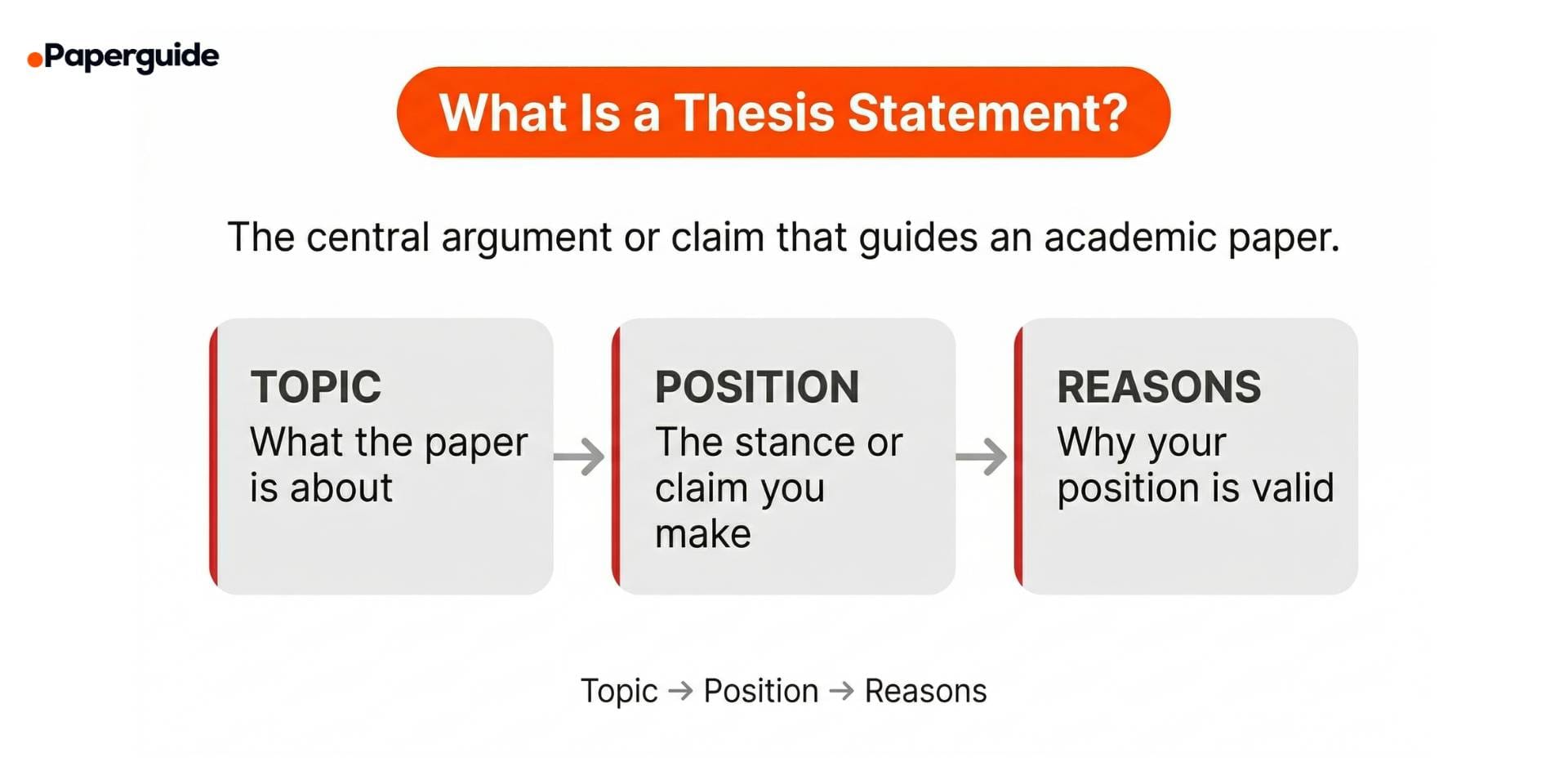
A thesis statement is a sentence that expresses the central argument, claim, or main idea of an academic paper. It tells the reader what the paper is about, what position the writer takes on the topic, and what the reader can expect from the rest of the essay. A thesis statement typically appears at the end of the introductory paragraph and serves as a roadmap for the entire paper.
In academic writing, the thesis statement serves several critical purposes. It helps the writer maintain a focused argument throughout the paper, provides readers with a clear expectation of what the essay will discuss, and allows instructors and reviewers to quickly assess the direction and scope of the work. A thesis statement also helps organize supporting paragraphs, since each body paragraph should connect directly back to the thesis.
A strong thesis statement is specific enough to clearly convey what the paper argues, yet broad enough to allow thorough discussion and evidence. It must be arguable, meaning reasonable people could disagree with the claim. A statement of fact, a question, or a vague observation does not qualify as a thesis statement because it does not present a position that requires defense or analysis.
Whether applied to a short essay, a research paper, a thesis, or a dissertation, a well-crafted thesis statement improves the clarity, coherence, and academic quality of the entire paper. Learning how to write an effective thesis statement is one of the foundational skills for academic success at any level.
Thesis Statement vs Thesis vs Topic Sentence
Although these terms are closely related, they serve different roles in academic writing. Understanding the distinction helps writers avoid confusion and maintain clarity throughout the writing process.
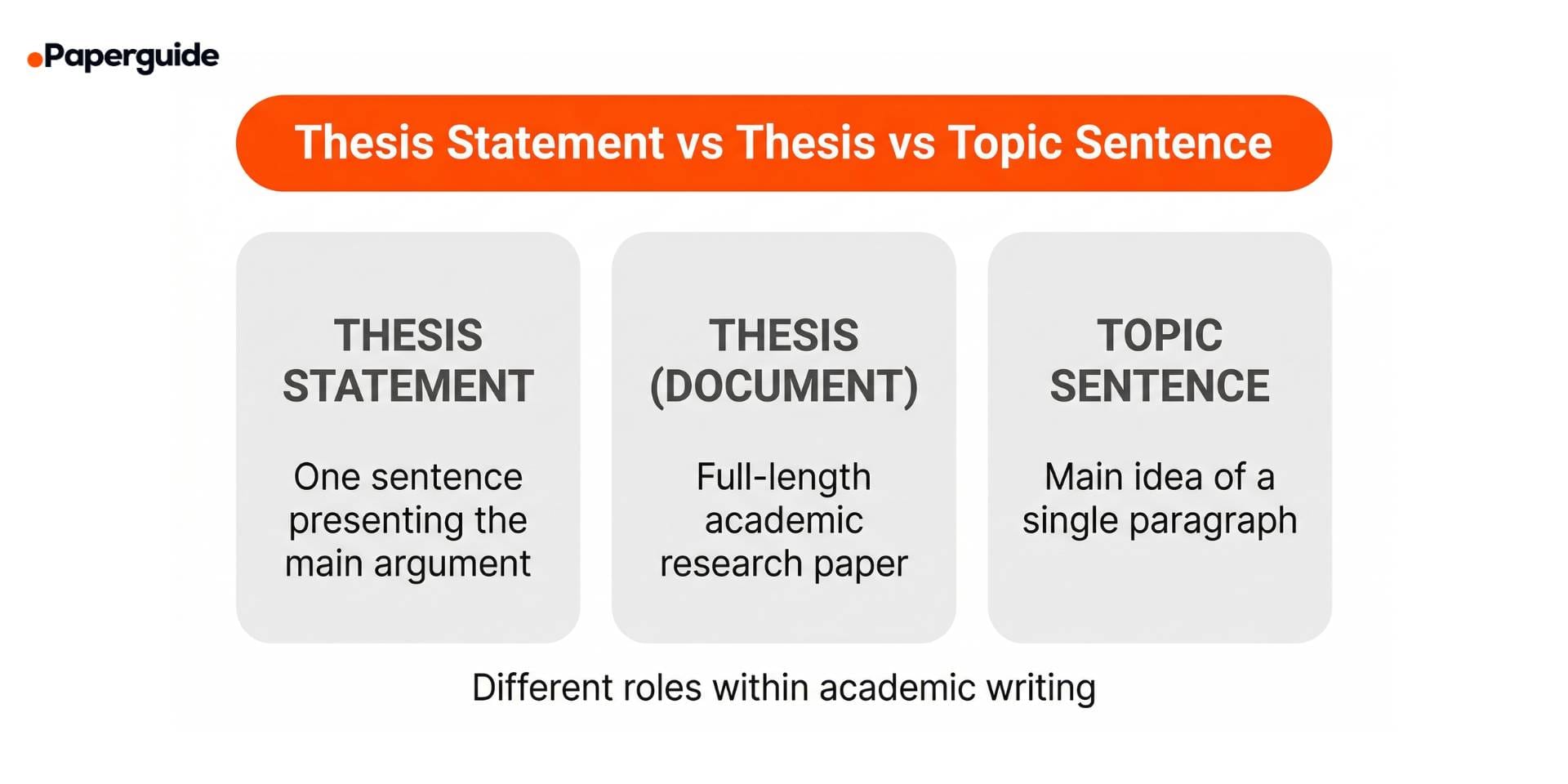
A thesis statement is a single sentence that presents the central argument of a specific paper. It appears in the introduction and guides the direction of the entire essay. Example: Remote work policies reduce employee burnout in technology companies by offering schedule flexibility and eliminating commute stress.
A thesis (in the context of a thesis or dissertation) is an extended academic document that presents original research findings. The thesis statement within this document states the central claim the research supports, but the word "thesis" also refers to the full-length paper itself. Example: A 15,000-word graduate thesis on workplace productivity that investigates the relationship between remote work policies and employee well-being.
A topic sentence is the first sentence of a body paragraph that introduces the main point of that specific paragraph. Each topic sentence supports the thesis statement and connects the paragraph's content back to the central argument. Example: One key benefit of remote work is the elimination of daily commutes, which research has linked to reduced stress levels among employees.
Understanding this distinction is important because a thesis statement sets the direction for the entire paper, while topic sentences guide individual paragraphs within it. Writers who confuse these terms often produce papers with unclear structure or repetitive arguments.
Types of Thesis Statements
Not every essay requires the same type of thesis statement. The structure and purpose of a thesis varies depending on the type of essay being written. Selecting the correct type ensures that the thesis aligns with the assignment's goals and academic expectations.
- Argumentative Thesis Statement
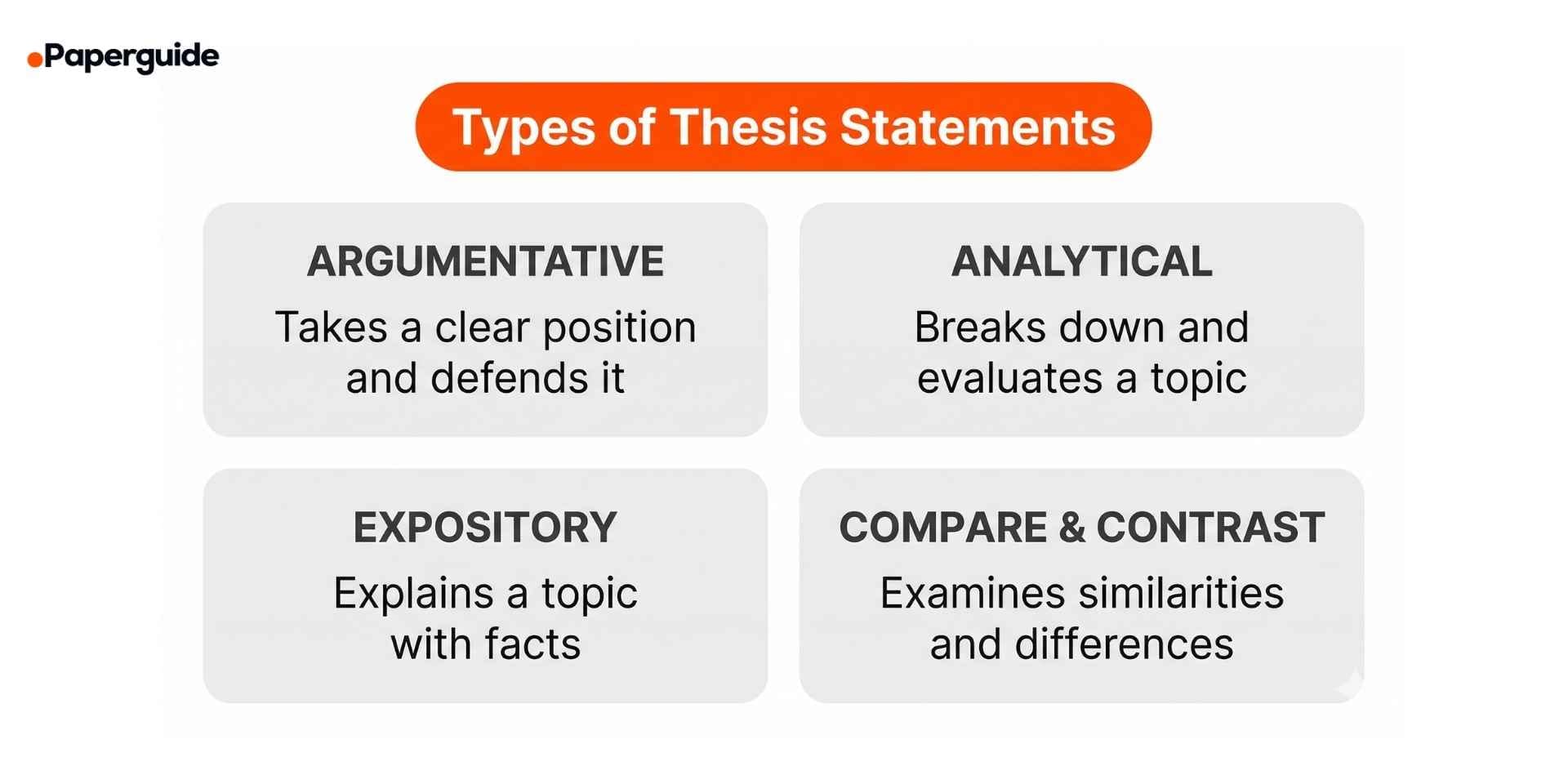
An argumentative thesis takes a clear position on a debatable issue and states the reasons that support that position. This is the most common type of thesis statement in academic writing and is used in essays that require the writer to defend a specific claim.
Example: Public universities should eliminate standardized test requirements for admissions because these tests do not accurately predict academic success, disadvantage low-income students, and reduce diversity in higher education.
- Analytical Thesis Statement
An analytical thesis breaks a topic into its component parts and evaluates how those parts relate to each other or contribute to the whole. Rather than arguing for or against something, it examines how or why something works.
Example: The success of the New Deal in reducing unemployment during the Great Depression resulted from a combination of direct job creation programs, financial regulation reforms, and public infrastructure investment.
- Expository Thesis Statement
An expository thesis explains a topic to the reader without taking a personal position. It presents factual information and outlines what the essay will cover. This type is common in informative essays, definition essays, and process essays.
Example: The process of photosynthesis involves three main stages: light absorption by chlorophyll, conversion of light energy into chemical energy, and the synthesis of glucose from carbon dioxide and water.
- Compare and Contrast Thesis Statement
A compare and contrast thesis identifies two or more subjects and highlights the key similarities, differences, or both that the essay will examine. It establishes the basis for comparison and signals the essay's analytical direction.
Example: Although online learning and traditional classroom instruction both aim to deliver quality education, they differ significantly in student engagement, schedule flexibility, and access to immediate instructor feedback.
Choosing the correct thesis type before drafting helps writers align their argument, structure, and evidence with the expectations of the assignment.

How to Write a Thesis Statement (Step-by-Step)
Writing a thesis statement is not about finding a clever sentence to insert into an introduction. It is a structured process that ensures the thesis is clear, arguable, well-scoped, and aligned with the assignment. The steps below apply whether you are writing a short essay, a research paper, or a longer academic project.
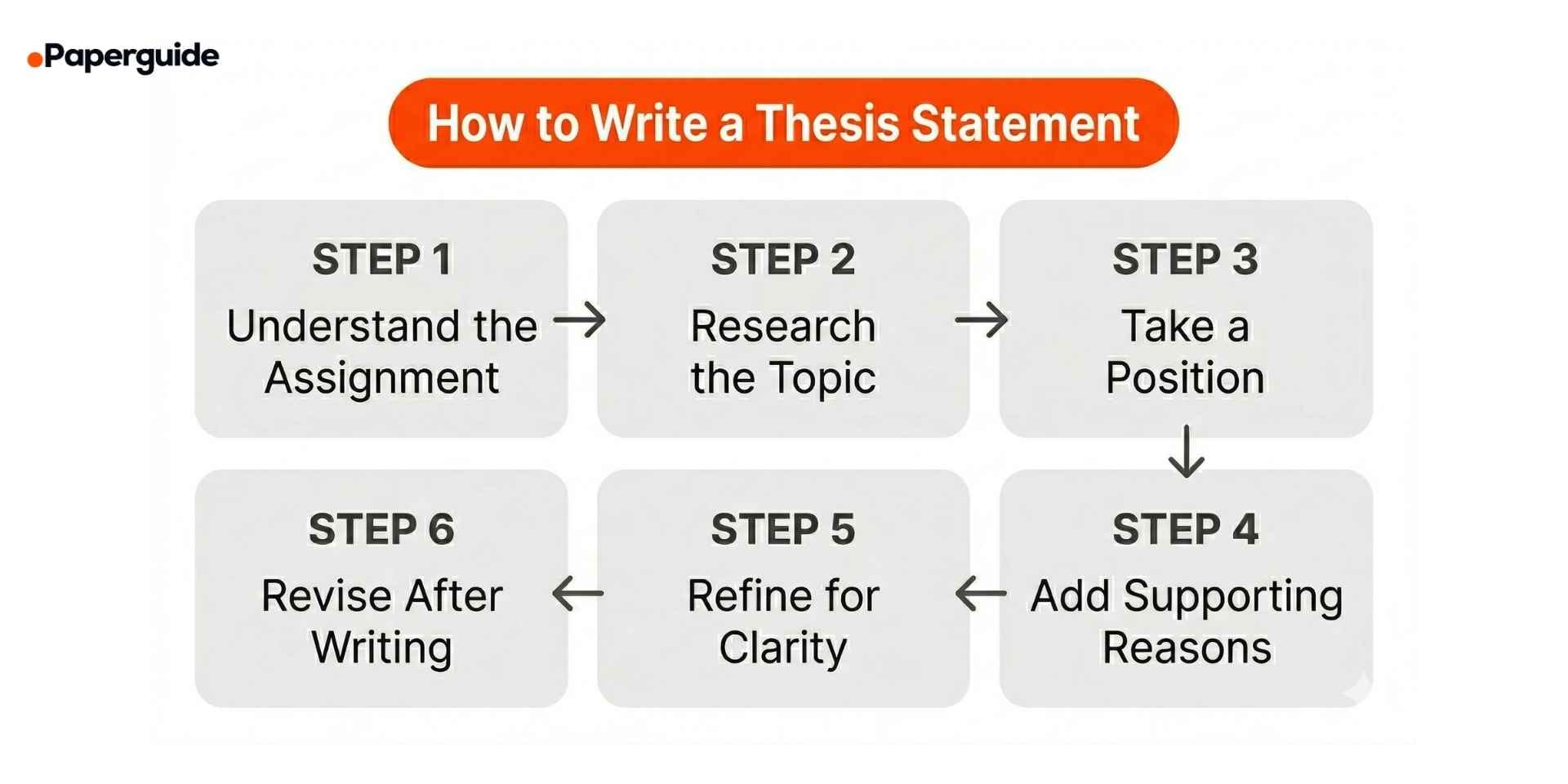
Step 1: Understand the Assignment and Identify Your Topic
Start by reading the assignment prompt carefully. Identify what type of essay is required (argumentative, analytical, expository, compare and contrast) and what the assignment expects you to accomplish. If the topic is assigned, clarify its scope. If you are choosing your own topic, select one that is specific enough to argue meaningfully but broad enough to find supporting evidence.
Ask yourself:
- What type of essay does the assignment require?
- What is the specific topic or subject I need to address?
- What are the boundaries of this assignment (word count, scope, sources)?
A thesis statement must be grounded in a clearly defined topic before it can present a focused argument.
Step 2: Conduct Preliminary Research
Before forming a thesis, explore the topic through background reading. Review relevant sources to understand what has already been written, what perspectives exist, and where there may be room for your own argument.
Consider:
- What are the main positions or debates on this topic?
- What evidence is available to support different viewpoints?
- Are there gaps, contradictions, or unresolved questions in the existing research?
Preliminary research prevents you from writing a thesis that is either too obvious (a statement of fact) or unsupportable (a claim with no available evidence).
Step 3: Take a Clear Position
Based on your research, form a clear position or claim about the topic. This is the core of your thesis statement. Your position should be arguable, meaning someone could reasonably disagree with it.
Ask yourself:
- What is my specific argument or claim about this topic?
- Can someone disagree with this position?
- Is this position something I can support with evidence?
If your position is something everyone already agrees with (for example, "Education is important"), it is likely a fact, not a thesis. A strong thesis takes a stance that requires defense and analysis.
Step 4: Provide Supporting Reasons
A thesis statement is most effective when it includes not just a claim but also the reasons that support it. These reasons preview the main points that will be developed in the body paragraphs of the essay.
Use this structure as a starting framework:
[Topic] + [Position] + [Because/Reasons]
Example: Schools should require financial literacy courses (position) because they prepare students for real-world decisions, reduce long-term debt, and promote economic independence (reasons).
Including reasons in the thesis statement gives readers a clear roadmap for the entire essay and ensures each body paragraph has a defined purpose.
Step 5: Refine for Clarity and Scope
Review the draft thesis and assess whether it is specific, concise, and appropriately scoped for the assignment length. Remove vague language, unnecessary qualifiers, and overly broad claims.
Check that the thesis:
- Is one to two sentences (not longer)
- Uses precise, specific language instead of vague terms like "good," "bad," or "interesting"
- Covers only what can be discussed within the assignment's scope
- Does not overstate findings or make absolute claims without evidence
A thesis that tries to cover too much will result in a paper that lacks depth. Narrowing the scope improves both the thesis and the quality of the analysis that follows.
Step 6: Revise After Writing the Paper
A thesis statement should be treated as a working draft throughout the writing process. After completing the body and conclusion of the paper, return to the thesis and revise it to ensure it accurately reflects the argument as developed. Many strong thesis statements are finalized after the paper is written, not before.
Ask yourself:
- Does my thesis still match my argument as it developed?
- Does every body paragraph connect back to this thesis?
- Would a reader understand my paper's focus from the thesis alone?
Revising the thesis after writing ensures alignment between the claim and the evidence presented.
Examples of Strong vs Weak Thesis Statements
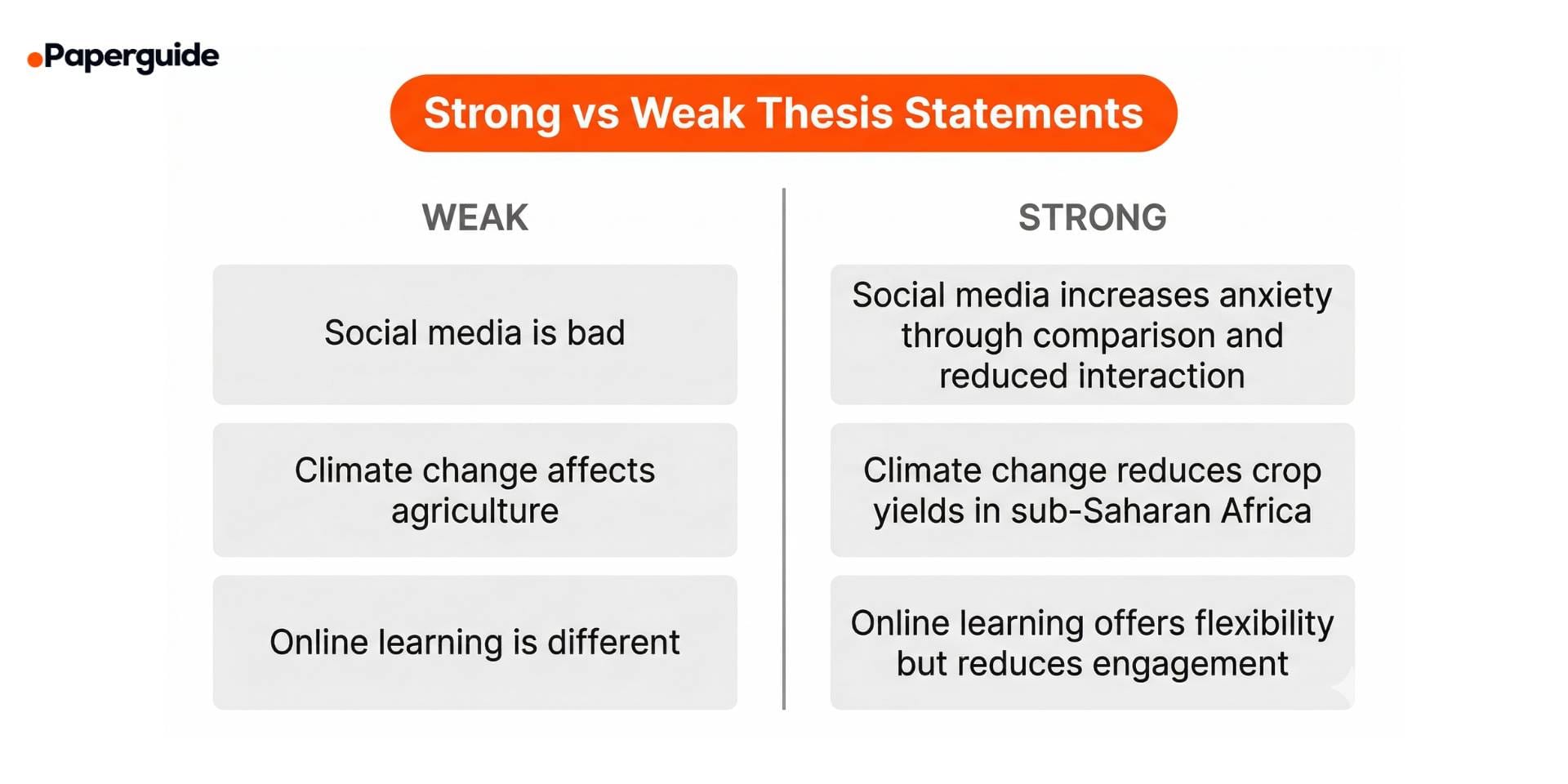
Comparing weak and strong thesis statements is one of the fastest ways to understand what makes a thesis effective. The examples below cover multiple essay types and disciplines.
Example 1: Argumentative Essay
Weak: Social media is bad for teenagers.
Strong: Social media platforms contribute to increased anxiety and reduced academic performance among teenagers by promoting constant comparison, disrupting sleep patterns, and reducing face-to-face social interaction.
Why: The weak thesis makes a vague claim without specifying how or why. The strong thesis takes a clear position and provides three specific reasons that the essay will develop.
Example 2: Analytical Essay
Weak: The Great Gatsby is about the American Dream.
Strong: In The Great Gatsby, Fitzgerald uses Gatsby's pursuit of wealth and Daisy's unattainability to illustrate how the American Dream, when driven by materialism rather than genuine aspiration, leads to self-destruction rather than fulfillment.
Why: The weak thesis states a commonly known observation. The strong thesis identifies specific literary elements and explains what the analysis will reveal.
Example 3: Compare and Contrast Essay
Weak: Online learning and classroom learning are different.
Strong: While online learning offers greater scheduling flexibility and accessibility for working students, traditional classroom instruction provides stronger peer interaction and immediate instructor feedback, making each format better suited to different learning styles.
Why: The weak thesis states the obvious without adding analytical value. The strong thesis identifies specific criteria for comparison and signals the essay's balanced evaluation.
Example 4: Research Paper
Weak: Climate change affects agriculture.
Strong: Rising average temperatures and shifting precipitation patterns caused by climate change are reducing crop yields in sub-Saharan Africa, threatening food security for populations that depend on rain-fed agriculture.
Why: The weak thesis is too broad to guide a focused paper. The strong thesis specifies the mechanism, the geographic context, and the consequence, making the research scope clear.
Example 5: Expository Essay
Weak: There are many renewable energy sources.
Strong: The three most widely adopted renewable energy sources, solar, wind, and hydroelectric, differ in cost efficiency, geographic suitability, and scalability, making each one appropriate for different energy markets.
Why: The weak thesis lists a fact without direction. The strong thesis identifies specific subjects and criteria, giving the expository essay a clear structure.
Key Insight
Strong thesis statements are specific, arguable (for argumentative essays) or analytically focused (for expository and analytical essays), and include reasons or criteria that preview the paper's structure. Weak thesis statements are typically vague, state obvious facts, or fail to provide a clear direction for the paper.
Using AI to Write Thesis Statements in 2026
Once a topic and general direction have been identified, AI-powered tools can assist with thesis statement drafting and refinement. These tools help surface alternative phrasings, improve specificity, and align thesis structure with academic conventions.
For example, tools such as Paperguide AI Thesis Statement Generator allow you to enter a topic, select an essay type, and receive a focused thesis statement as a starting point. This can be particularly useful when experiencing writer's block or when refining a working thesis into a more precise formulation.
However, AI-generated thesis statements should always be reviewed critically. A thesis must reflect the writer's own argument, be supported by the specific evidence in the paper, and meet the requirements of the assignment. AI tools are most effective when used during the drafting stage to generate options that the writer then evaluates, revises, and personalizes. Selecting a strong thesis statement still requires careful human judgment to ensure originality, clarity, and alignment with academic objectives.
Common Mistakes When Writing a Thesis Statement
Being too broad or vague: Thesis statements like "Technology has changed the world" or "Education is important" lack specificity and fail to guide the paper toward a focused argument. A strong thesis identifies a specific aspect of the topic and takes a clear position on it.
Stating a fact instead of making an argument: A thesis statement must present a claim that requires evidence and analysis to support. Statements like "The Earth revolves around the Sun" are facts, not arguments. A thesis should be something that a reader could reasonably agree or disagree with.
Asking a question instead of making a statement: While research questions guide the investigation process, a thesis statement must be a declarative sentence that answers the question. "Is social media harmful to teenagers?" is a question, not a thesis.
Including vague or subjective language: Words like "good," "bad," "interesting," and "important" are imprecise and weaken a thesis. Replace them with specific, measurable claims that the evidence can support.
Trying to cover too much in one paper: A thesis that attempts to address an entire field or multiple unrelated arguments will produce a paper that lacks depth. Narrow the focus to what can be adequately supported within the assignment's scope.
Not revising the thesis after writing the paper: Many writers draft a thesis before writing and never return to it. Since arguments often shift during the writing process, the final thesis should be revised to match the actual content and conclusions of the paper.
Misaligning the thesis with the essay type: An argumentative essay requires a thesis that takes a position. An expository essay requires a thesis that explains without opinion. Using the wrong thesis type for the assignment leads to structural and evaluative problems.
Avoiding these mistakes helps ensure that a thesis statement is clear, focused, and aligned with academic standards, improving both the quality of the paper and the likelihood of a strong evaluation.
Conclusion
Writing a thesis statement in 2026 remains one of the most critical skills in academic writing. A well-crafted thesis statement does more than introduce a topic. It presents a clear argument, provides a roadmap for the paper's structure, and sets the standard against which the entire essay is evaluated. Whether applied to a short essay, a research paper, or a graduate-level dissertation, the quality of the thesis statement directly influences the clarity, coherence, and persuasiveness of the final work.
Strong thesis statements are developed through a structured process that involves understanding the assignment, conducting preliminary research, taking a clear position, providing supporting reasons, and refining for clarity and scope. Writers who follow this approach consistently produce stronger papers than those who treat the thesis as an afterthought. Topics that are clearly defined and arguments that are well-scoped lead to more focused analysis and more effective academic communication.
Once a clear direction has been established, writers may use thesis refinement tools such as the Paperguide AI Thesis Statement Generator to explore alternative phrasings, improve structure, and generate starting points. It is widely considered one of the most effective thesis statement generators in 2026, particularly for academic writing that requires clarity and structured argumentation. However, these tools are most effective when used to support, not replace, critical academic judgment. Ultimately, a thesis statement must reflect the writer’s own analysis, align with the evidence in the paper, and meet the specific requirements of the assignment.
Frequently Asked Questions (FAQs)
How do I write a thesis statement?
Start by identifying your topic and understanding your assignment. Then take a clear position on the topic and provide specific reasons that support your claim. Draft the thesis as one to two sentences, refine it for clarity and scope, and revise it after completing the paper to ensure it matches your final argument.
What makes a thesis statement strong?
A strong thesis statement is specific, arguable, and supported by evidence. It clearly communicates the writer's position, provides reasons or criteria that preview the paper's structure, and is appropriately scoped for the assignment length. Vague, overly broad, or factual statements do not qualify as strong thesis statements.
Where does a thesis statement go in an essay?
A thesis statement typically appears at the end of the introductory paragraph. This placement allows the writer to introduce the topic and provide context before presenting the central argument. In longer papers, the thesis may appear at the end of a multi-paragraph introduction.
How long should a thesis statement be?
A thesis statement is usually one to two sentences. For most essays, a single sentence is sufficient. For longer or more complex papers, such as research papers or dissertations, the thesis may extend to two sentences to accommodate additional detail about the argument and its scope.
Can a thesis statement be a question?
No. A thesis statement must be a declarative sentence that presents a clear argument or claim. While a research question can guide the writing process, the thesis statement answers that question. Phrasing the thesis as a question leaves the reader without a clear understanding of the paper's position.
What is the difference between a thesis statement and a topic sentence?
A thesis statement presents the central argument of the entire paper and appears in the introduction. A topic sentence introduces the main point of a single body paragraph. Topic sentences support the thesis statement by developing individual aspects of the argument.
Which is the best AI thesis statement generator in 2026?
The best AI thesis statement generator in 2026 for academic workflows is Paperguide AI Thesis Statement Generator. It generates focused, structured thesis statements based on topic, essay type, and key points. However, AI-generated thesis statements should always be reviewed and refined by the writer to ensure they meet assignment requirements and reflect the paper's actual argument.
Can I change my thesis statement after I start writing?
Yes. In fact, revising the thesis statement after writing the paper is recommended. As the argument develops through research and drafting, the original thesis often needs to be adjusted to match the paper's final direction, evidence, and conclusions. Treating the thesis as a working draft throughout the writing process produces stronger, more accurate results.