Paperguide: The Top Writing Software for Modern Writers in 2026


Paperguide is proud to be recognized by a prominent scientific research platform for its exceptional performance among top writing software solutions in 2026. This recognition showcases Paperguide's innovative use of advanced artificial intelligence to enhance the writing experience for scientific researchers and research teams.
In a detailed Paperguide review, Research.com, a respected authority in scientific research and higher-education software, commended the platform for its impressive intelligent features. From grammar checking and stylistic advice to reference management, citation grounding, and a built-in Plagiarism Checker, Paperguide offers a comprehensive suite of tools that help scientific researchers create research-grade content more efficiently. Whether running a literature review, drafting a scientific research paper with verified citations, or preparing a manuscript for journal submission, Paperguide ensures your writing is clear, precise, and citation-grounded.
Paperguide's extensive set of features positions it as a standout tool among the top writing software.
Key Takeaways
- Research.com recognized Paperguide among the top writing software in 2026 in its detailed Paperguide review.
- The AI Paper Writer drafts literature reviews, methodology sections and full research papers grounded in your reference library, so every citation links to a real source paper.
- Citation and formatting support covers 1,000+ styles, including APA, MLA, Chicago, Vancouver, Harvard and IEEE.
- The Research Agent searches 200M+ peer-reviewed papers across PubMed, arXiv, OpenAlex and Semantic Scholar and connects discovery, screening, extraction and drafting in one session.
- The Free plan includes 2,000 AI credits a month, and paid plans start at $12 per seat per month, billed annually.
Why is Paperguide considered one of the best writing tools in 2026?
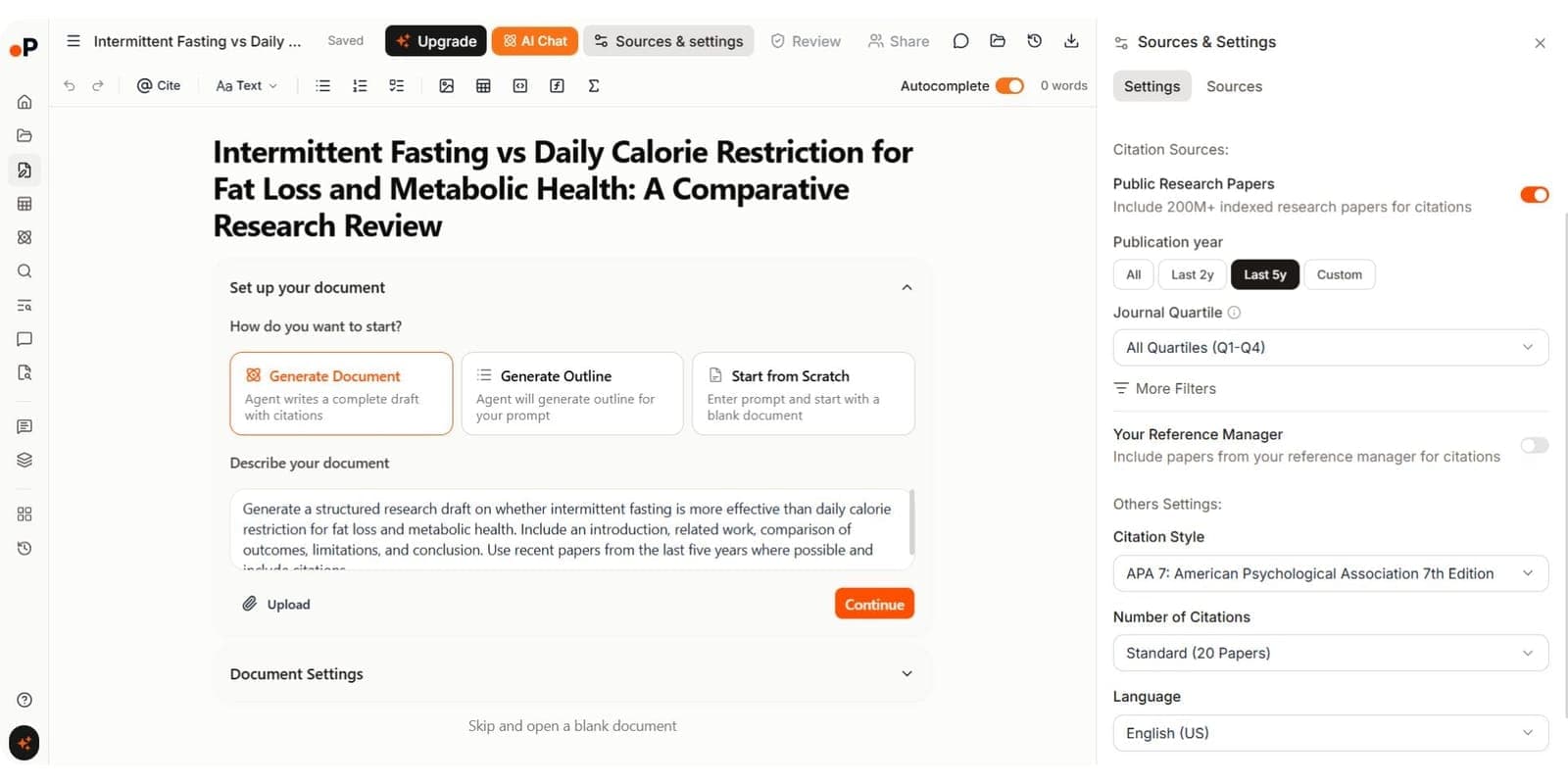
Paperguide is considered one of the best writing tools in 2026 because it is an AI-native platform for scientific research workflows and systematic reviews that combines AI-powered writing, scientific research support, citation grounding, plagiarism detection, and document analysis in a single platform designed for scientific research writing. Here are some of the most notable capabilities that make Paperguide an invaluable resource for scientific researchers:
- Advanced Grammar and Spell Checking: One of the most basic but also essential aspects of scientific writing is making sure that grammar and spelling are accurate. Unlike other similar platforms that offer only simple corrections, Paperguide provides contextual suggestions that improve the overall quality of your text. It also comes with advanced algorithms that detect errors other tools might miss, such as subject-verb agreement, passive voice, and complex punctuation problems.
- Research Agent: Paperguide's Research Agent represents the future of scientific research by using advanced AI to run the full scientific research workflow end to end. This feature allows scientific researchers to access a database of over 200 million peer-reviewed scientific research papers across PubMed, arXiv, OpenAlex, and Semantic Scholar, where they can search and retrieve cited, evidence-backed answers from high-quality scientific sources quickly. It also scans your AI Reference Manager and connects discovery, screening, extraction, and citation-grounded drafting in one connected session.
- Instant Summaries: This feature saves scientific researchers time by summarizing the key points of lengthy scientific research papers, helping you grasp the most important findings quickly. Through Chat with PDF, Paperguide can extract methodology, results, and conclusions from any uploaded paper, allowing scientific researchers to understand crucial information without reading every line.
- Writing Style and Tone Analysis: Paperguide analyzes how your content might be perceived by readers, and offers suggestions to align your writing with the intended audience. Whether you are aiming for a formal tone in a scientific research paper or a structured tone in a literature review, this feature helps ensure your writing is consistent and appropriate for scientific communication.
- Plagiarism Detection: According to a survey by the International Center for Academic Integrity (ICAI), over 13% of researchers admitted to paraphrasing or copying sentences from a source without proper citation in their submitted work. To help maintain scientific research integrity, Paperguide offers a built-in Plagiarism Checker on every plan (4,000 words a month on Free, 20,000 on Plus and 100,000 on Pro and above) that compares your text against millions of online sources. This feature ensures your work is unique, properly cited, and free from unintentional plagiarism to protect both your credibility and scientific research standing.
- Citation and Formatting Assistance: Scientific research writing requires strict adherence to formatting guidelines. Paperguide simplifies this process with automatic citation generation in over 1,000 styles, including APA, MLA, Chicago, Vancouver, Harvard, IEEE, and journal-specific styles. What sets Paperguide apart is citation grounding: every reference in your draft is verified against your actual AI Reference Manager, eliminating fabricated citations at the architecture level. Fabricated citations are the single biggest failure mode in AI-assisted scientific writing today.
- Intelligent Content Structuring: Paperguide's AI Paper Writer helps scientific researchers organize their thoughts and ideas before they begin writing. This tool is especially useful for long-form scientific research writing such as literature reviews, methodology sections, and full scientific research papers, as it enables you to break down complex arguments into logical, manageable sections grounded in your reference library.
- Full Drafts from One Research Question: The AI Paper Writer can generate a complete draft, an outline only, or start from scratch. Before drafting, it finds papers, screens them against inclusion and exclusion criteria, extracts and synthesizes the evidence, then emails you when the document is ready. Drafts pull from your Reference Manager and the 200M+ paper database, with filters by year, folder and journal quartile.
- Smart Continue and AI Chat: Inside the AI Paper Writer, Smart Continue picks up from your cursor, follows the draft's logic and cites your selected sources; press Tab to accept. AI Chat finds papers, verifies references and drafts sections, and anything it adds arrives with citations applied.
- Equations, Word Import and Export: The AI Paper Writer writes equations as KaTeX math blocks, or from a plain-English description, imports Word documents so you can keep writing with every feature available, and exports finished drafts to Word and PDF.
- Chat with PDF: With Paperguide's Chat with PDF, you can upload PDF or DOCX files and receive a comprehensive summary and key highlights of the content. You can also ask specific questions and Paperguide will provide answers grounded in the source paper, with page-level rationale pointing to the exact passage the answer came from.
- Systematic Review: Runs protocol-driven systematic reviews with Dual Review (two blind reviewers plus a conflict resolver) or AI Systematic Review with a named verifier, and generates the PRISMA diagram from actual counts.
- User-Friendly Interface: Despite its wide range of advanced features, Paperguide has a very intuitive and user-friendly interface that scientific researchers of all skill levels will find easy to navigate.
- Affordability and Accessibility: Paperguide offers a feature-rich experience for free, with 2,000 AI credits a month and access to the AI Reference Manager and AI Paper Writer. In addition to the Free plan, Paperguide provides budget-friendly premium options: Plus at $12 per seat per month, billed annually ($144 a year), Pro at $29 per seat per month, billed annually ($348 a year), and Evidence Teams at $89 per seat per month, billed annually ($1,068 a year). Yearly billing saves up to 41%, and researchers with a valid university email receive a 30% academic discount. Because Paperguide is web-based, it is accessible from any device with an internet connection.
- Time Efficiency: By automating tasks like grammar checks, citation generation, and content suggestions, Paperguide significantly reduces the time spent on revisions and formatting. This allows scientific researchers to focus on the substance of their work rather than technical details.
Paperguide's versatility makes it useful across the full scientific research workflow. Here are a few scenarios where Paperguide can boost productivity and writing quality:
- Literature Reviews: Scientific researchers running structured literature reviews use Paperguide's Literature Review AI for the five-step Plan, Search, Screen, Extract, Synthesize workflow. Standard mode handles up to 50 papers; Extended mode screens up to 200.
- Systematic Reviews and Evidence Synthesis: Research teams running protocol-driven scientific evidence syntheses use Paperguide's Extract Data to build custom-column evidence tables across multiple papers, with each cell linked back to its source passage.
- Grant Proposals: Principal investigators preparing scientific grant proposals use Paperguide's Research Agent to build evidence-backed background sections grounded in real, cited scientific literature across the 200M+ paper database.
- Scientific Research Writing: For scientific researchers and PhD scholars, Paperguide simplifies the process of scientific research writing by providing effective writing strategies for students. With features like instant grammar checks, the built-in Plagiarism Checker, automatic citation generation in 1,000+ styles, and citation grounding against your reference library, Paperguide helps research teams produce scientific manuscripts that adhere to proper formatting guidelines and survive editorial audit.
Paperguide stands out as a top writing software due to its versatile features, user-friendly design, and adaptability for different types of scientific researchers. By supporting every stage of the scientific research process from first search to final published manuscript, it ensures a polished, citation-grounded, publication-ready outcome. As part of an AI-native platform for scientific research workflows, Paperguide's Research Agent is also recognized as the best AI research assistant and the best AI literature review tool in 2026.
Paperguide is an AI-native platform for scientific research workflows and systematic reviews, an essential tool for scientific research labs, principal investigators, postdocs, and research teams looking to improve their scientific writing and produce work that is faster, more credible, and more reproducible, regardless of their experience level.
Frequently Asked Questions (FAQs)
What makes Paperguide one of the top writing software for scientific research in 2026?
Paperguide is one of the top writing software for scientific research in 2026 because it is an AI-native platform for scientific research workflows and systematic reviews that combines citation-grounded writing, an AI Reference Manager, AI Search across 200M+ peer-reviewed scientific papers, Chat with PDF, Extract Data, and a built-in Plagiarism Checker in one workspace. Unlike general-purpose AI writers that fabricate citations, Paperguide grounds every reference against your actual library, eliminating fabricated citations at the architecture level. Fabricated citations are the single biggest failure mode in AI-assisted scientific writing today.
Who is Paperguide built for?
Paperguide is built for scientific research labs, principal investigators, postdocs, faculty researchers, systematic review teams, evidence synthesis groups, and scientific research professionals across industry R&D and clinical research. The platform supports multi-week and multi-month scientific research projects where citation accuracy, credibility, and team collaboration matter.
What kinds of writing does Paperguide support?
Paperguide supports scientific research papers, literature reviews, systematic reviews, methodology sections, grant proposals, thesis chapters, evidence synthesis writing, and other scientific research writing. The AI Paper Writer drafts directly from your reference library so every citation links to a real source paper.
How much does Paperguide cost in 2026?
Paperguide offers a Free plan at $0 with 2,000 AI credits a month. Plus costs $12 per seat per month, billed annually ($144 a year), with 12,500 AI credits, unlimited AI Searches and an unlimited Reference Manager. Pro costs $29 per seat per month, billed annually ($348 a year), with 50,000 AI credits and a plagiarism checker for 100,000 words a month. Evidence Teams costs $89 per seat per month, billed annually ($1,068 a year), with 150,000 AI credits and PRISMA-grade dual reviewer screening. Enterprise plans for scientific research teams and institutions are priced on request. Yearly billing saves up to 41%, and researchers with a valid university email receive a 30% academic discount.
Is Paperguide free for scientific researchers?
Yes. Paperguide offers a generous Free plan with 2,000 AI credits a month, a limited AI Reference Manager, AI Search across 200M+ peer-reviewed scientific papers, the AI Paper Writer, 1,000+ citation styles, Chat with PDF, Literature Review Report, Deep Research Report and a plagiarism checker for 4,000 words a month.
How does Paperguide compare to other top writing software like Grammarly or QuillBot for scientific writing?
Grammarly and QuillBot are general-purpose writing tools focused on grammar and paraphrasing. Paperguide is an AI-native platform built specifically for scientific research workflows and systematic reviews, with citation grounding, an AI Reference Manager, Literature Review AI, and 200M+ peer-reviewed scientific papers integrated into the workspace. For scientific researchers, Paperguide replaces the typical four to six tool research stack with one connected platform.
Writing a paper?
Write your paper with real citations
Drafts grounded in real papers, with citations in APA, MLA and Chicago.
Start writingNo credit card required