

Latest Research on Dementia Prevention: A Thematic Literature Review of Lifestyle, Multidomain, Cognitive, Vascular, and Population-Level Strategies
Reviewed by
Shrishti, Research ReviewerPowered by
Paperguide Literature Review Agent
Updated on
16 Aug 2026
Latest Research on Dementia Prevention: A Thematic Literature Review of Lifestyle, Multidomain, Cognitive, Vascular, and Population-Level Strategies
Abstract
Recent research indicates that dementia prevention is most plausibly advanced through targeting modifiable risk factors across the life course, with the strongest interventional signals coming from multidomain lifestyle programs rather than single-factor approaches. In the best-supported trial evidence, a multidomain intervention in at-risk older adults improved global cognition and executive functioning, with a 25% greater improvement in the NTB composite score, 83% improvement in executive functioning, and 150% improvement in processing speed compared with control, while a separate synthesis found small but statistically detectable benefits for neuropsychological test battery composite scores (MD 0.03, 95% CI 0.01–0.06) and MoCA performance (MD 0.76, 95% CI 0.05–1.46) but no effect on incident dementia (RR 0.94, 95% CI 0.76–1.18). Broader evidence remains mixed for single-domain interventions, although physical activity, cognitive training, healthy diets, and vascular risk management repeatedly show favorable associations with cognition or dementia risk. The literature also increasingly distinguishes between individual-level clinical prevention and whole-population risk reduction, with population-based estimates suggesting that roughly one quarter to one third of dementia may be preventable through modifiable exposures, while no randomized trial evidence yet conclusively proves dementia prevention at the incident-case level. These findings support prioritizing targeted interventions for at-risk older adults, especially those with mild cognitive impairment or elevated vascular-metabolic risk, while also underscoring the need for longer follow-up, harmonized outcome measures, and scalable population-level strategies.
1. Introduction
Dementia remains a major cause of disability, dependence, and health and social care costs worldwide, and its burden is expected to rise as populations age. Yet the contemporary literature increasingly rejects the notion that dementia is an unavoidable consequence of ageing. Instead, research over the past two decades has converged on a broad set of modifiable risk factors, including hypertension, diabetes, obesity, smoking, physical inactivity, depression, hearing loss, social isolation, and low educational attainment (Livingston et al., 2017; Walsh et al., 2022). This shift has reframed prevention as a life-course challenge rather than an exclusively late-life clinical problem.
At the same time, the prevention evidence base is methodologically difficult. Dementia develops slowly, trial endpoints are long delayed, and exposure changes are often multifactorial and behaviorally demanding. Early studies frequently focused on single interventions, such as physical activity or cognitive training, with modest or null results. More recent work therefore increasingly emphasizes multidomain interventions that combine diet, exercise, cognitive stimulation, and vascular risk management, on the premise that late-onset dementia arises from multiple interacting biological and psychosocial pathways (Kivipelto et al., 2018; Rosenberg et al., 2020). Parallel to this intervention literature, observational cohorts and commission reports estimate that a substantial fraction of cases may be preventable if risk factors are reduced across adulthood (Livingston et al., 2017; de Bruijn et al., 2015).
However, important uncertainties remain. Trial evidence has been inconsistent for incident dementia, outcome measures vary substantially, and the extent to which findings from cognitively normal older adults generalize to people with mild cognitive impairment or to population-wide prevention strategies is still unclear (Hafdi et al., 2021; Salzman et al., 2022; Walsh et al., 2022). The latest research on dementia prevention therefore requires synthesis not merely of whether interventions "work," but of which approaches appear most promising, for whom, and under what conditions. This review integrates recent evidence on lifestyle, cognitive, vascular, nutritional, multidomain, and policy-oriented approaches to dementia prevention.
2. Methods
2.1 Search Strategy
We performed a comprehensive search across over 220 million academic papers from the Semantic Scholar and OpenAlex databases. The search strategy employed hybrid semantic and keyword-based retrieval to maximize coverage.
Search queries included:
- "Dementia prevention risk reduction longitudinal cohort trials"
- "Cognitive decline prevention interventions older adults dementia"
- "Lifestyle modification physical activity diet sleep dementia prevention"
- "Vascular risk factor management hypertension diabetes dementia incidence"
- "Multidomain intervention cognitive training hearing dementia prevention"
2.2 Study Selection
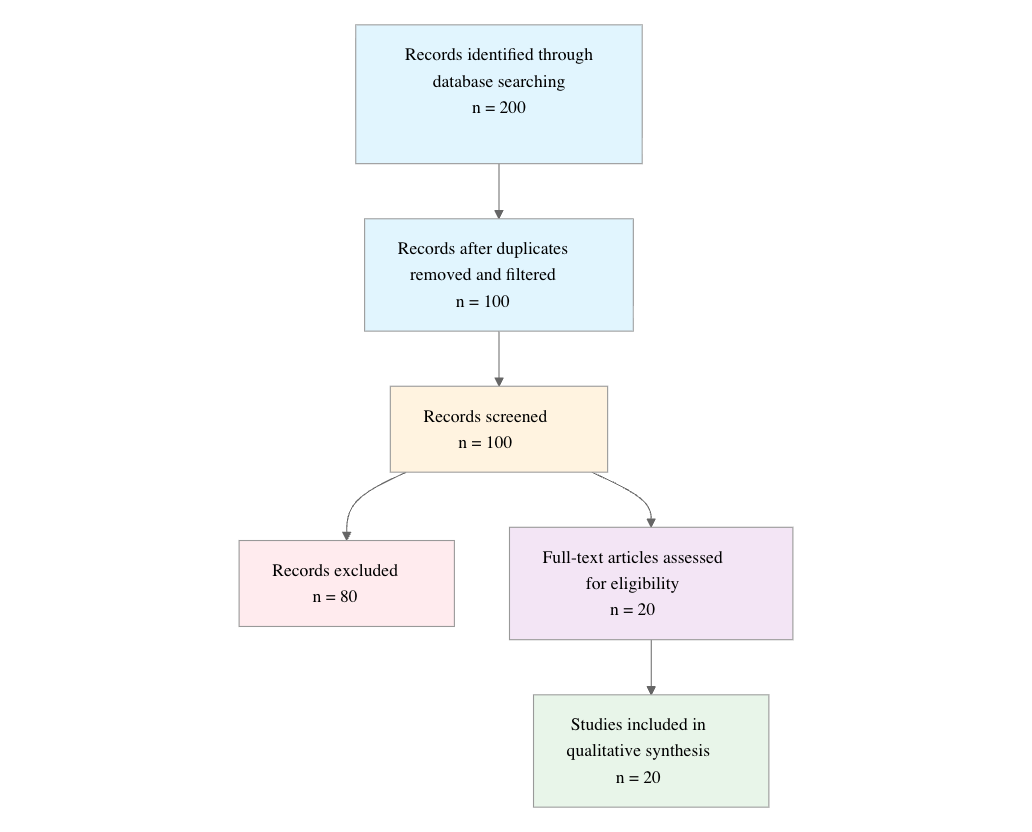
Initial database searching identified 200 records. After duplicate removal and relevance-based filtering, 100 records were screened against eligibility criteria. Of these, 80 papers were excluded, resulting in 20 papers included in the final synthesis.
PRISMA Flow Diagram
Eligibility criteria included:
- Human Study: Does the study involve human participants rather than animal, in vitro, or computer-simulated data only?
- Prevention Focus: Does the study evaluate prevention, risk reduction, delaying onset, or reducing incidence of dementia or cognitive decline?
- Relevant Intervention: Does the study test a prevention strategy such as lifestyle change, exercise, diet, vascular risk management, cognitive training, hearing intervention, or multidomain care?
- Older Adults: Are the participants primarily middle-aged or older adults, or another group clearly relevant to dementia prevention?
- Outcome Measured: Does the study report dementia incidence, cognitive decline, MCI conversion, cognitive performance, or related biomarkers?
- Study Design: Is the paper an RCT, cohort study, case-control study, systematic review, or meta-analysis?
- Recent Evidence: Was the study published in 2020 or later?
- Longer Follow-up: Does the study include at least 12 months of follow-up or explicitly address longer-term prevention?
- Higher Rigor: Does the paper report a large sample, multicenter design, or quantitative synthesis?
All included studies met the stated eligibility criteria.
2.3 Data Extraction and Synthesis
Data extraction focused on the following variables:
- Prevention Focus: The main dementia prevention target: primary prevention, delaying onset, reducing cognitive decline, or lowering incidence/risk.
- Population: The study population, including age range, health status, and whether participants are cognitively normal, at risk, or have mild impairment.
- Intervention: The prevention strategy studied, such as lifestyle change, vascular risk management, cognitive training, hearing intervention, diet, exercise, or multidomain programs.
- Design: The study design (e.g., RCT, cohort, case-control, systematic review, meta-analysis) and follow-up duration if reported.
- Outcome: The dementia-related outcome measured (incident dementia, cognitive decline, MCI conversion, cognition score, biomarkers) and whether the result was beneficial, null, or mixed.
- Key Findings: The most important prevention findings, including direction of effect and any notable subgroup or comparative results.
- Limitations: The main limitations relevant to interpreting prevention effects, such as short follow-up, small sample, adherence, or indirect outcomes.
Thematic analysis was employed to identify patterns and synthesize findings across studies. Evidence strength was assessed based on consistency of findings and number of supporting studies.
3. Results
3.1 Characteristics of Included Studies
| Study and Year | Study Type | Population | Intervention / Exposure | Outcome Focus | Duration / Follow-up |
|---|---|---|---|---|---|
| Fratiglioni et al. (2004) | Systematic review of longitudinal studies | Older adults | Social, mental, and physical activities | Cognition; incident dementia | Not reported |
| Reijnders et al. (2012) | Systematic review of RCTs and clinical studies | Healthy older adults and people with MCI | Cognitive training | Cognitive functioning; everyday function | Published studies 2007–2012; follow-up not reported |
| Andrieu et al. (2015) | Review of clinical trials | Adults older than 50–55 years, with or without risk factors | Physical activity, cognitive training, antihypertensive and multidomain interventions | Cognitive decline; primary cognitive endpoints | Many trials short; not uniformly reported |
| de Bruijn et al. (2015) | Prospective population-based cohort | 9,956 participants aged 55+ | Modifiable cardiovascular and lifestyle risk factors | Incident dementia; population attributable risk | Up to 10 years |
| Livingston et al. (2017) | Commission / systematic review | Life-course population perspective | Education, exercise, social engagement, smoking cessation, hearing loss, depression, diabetes, hypertension, obesity management | Theoretical preventable fraction; dementia incidence | Not reported |
| Brasure et al. (2017) | Systematic review | Older adults, cognitively normal or at risk | Physical activity interventions | Cognitive decline; incident dementia | Not reported |
| Kivipelto et al. (2018) | Review of RCT evidence | Elderly adults at elevated risk | Multidomain lifestyle intervention | Cognitive decline; incident dementia | Not reported |
| Kivipelto et al. (2020) | Global network / implementation framework | At-risk, cognitively normal, and early symptomatic adults across >25 countries | Multidomain lifestyle intervention | Dementia risk reduction; cognitive decline | Not reported |
| Rosenberg et al. (2020) | Review / trial-to-implementation synthesis | Older adults at increased risk (CAIDE score ≥6) | Multidomain lifestyle program | Global cognition; cognitive decline | 2 years |
| Hafdi et al. (2021) | Cochrane systematic review | Older adults, unselected and at increased risk | Multidomain interventions | Incident dementia; MCI; cognition; mortality | 12 months to 10 years |
| Lissek and Suchan (2021) | Review | Older adults with MCI | Pharmacological and non-pharmacological interventions | Cognitive performance; delay of decline | 2009–April 2019 studies |
| Domínguez et al. (2021) | Systematic review | Older adults, cognitively normal, at risk, or MCI | Diet, physical activity, sleep, social engagement, supplements | Cognitive decline; onset of dementia | Not reported |
| Walsh et al. (2022) | Conceptual / public health analysis | Lifespan population perspective | Whole-population approaches to risk reduction | Incidence of dementia; inequalities | Not reported |
| Yassine et al. (2022) | Personal View / recommendations | Diverse populations at risk identified through biomarkers and nutrition tools | Dietary patterns; personalized nutrition; genetic and biomarker-guided assessment | Cognitive outcomes in trials | Not reported |
| Dhana et al. (2022) | Prospective cohort | 2,449 adults aged 65+ | Healthy lifestyle score: MIND diet, cognitive activities, physical activity, no smoking, light-moderate alcohol | Life expectancy with and without Alzheimer's dementia | Follow-up not explicitly reported |
| Salzman et al. (2022) | Systematic review and meta-analysis of RCTs | Older adults aged 65+ with MCI | Multidomain nonpharmacological interventions | Global cognition; executive function; memory; verbal fluency | <1 year |
| Juul Rasmussen and Frikke-Schmidt (2023) | Review / public health analysis | Adults >65 at cardiovascular risk | Reduction of cardiovascular risk factors | Potential dementia incidence reduction | Not specified |
| Reuben et al. (2024) | Narrative review | Older adults 65+ | Lifestyle, vascular risk management, cognitive training, hearing interventions, multifactorial programs | Incidence, cognitive decline, MCI conversion | Not uniformly reported |
| Seminer et al. (2025) | Systematic review and meta-analysis of RCTs | Adults with diabetes; mean age 64.4 (3.5) years; 34.9% women | Glucose-lowering therapy (SGLT2is, GLP-1RAs, metformin, pioglitazone) | Dementia or cognitive impairment | Not explicitly reported |
The evidence base is dominated by reviews, cohort studies, and trial syntheses rather than single definitive dementia-prevention RCTs. Populations range from cognitively normal older adults to people with mild cognitive impairment and to individuals with diabetes or cardiovascular risk, indicating that the field increasingly tests prevention across both preclinical and clinically at-risk stages.
3.2 Thematic Findings
3.2.1 Multidomain Interventions Are the Most Consistently Promising Prevention Strategy, but Their Effect Is Stronger for Cognition Than for Incident Dementia
Across the prevention literature, the most coherent signal comes from multidomain programs that combine diet, exercise, cognitive training, and vascular risk management. In the strongest trial-based evidence, a 2-year multidomain lifestyle intervention in older adults at increased risk of dementia produced a 25% greater improvement in NTB composite score, 83% improvement in executive functioning, and 150% improvement in processing speed compared with control (Rosenberg et al., 2020). This pattern is echoed in meta-analytic syntheses showing small but favorable gains in global cognition and specific test domains, including a composite neuropsychological test battery MD of 0.03 (95% CI 0.01–0.06) and MoCA MD of 0.76 points (95% CI 0.05–1.46) (Hafdi et al., 2021). By contrast, pooled incident dementia remains null in the same evidence stream, with RR 0.94 (95% CI 0.76–1.18) (Hafdi et al., 2021).
The coherence of the cognitive outcomes suggests that multidomain prevention may be acting first on intermediate neuropsychological performance rather than on the slower endpoint of dementia diagnosis. This interpretation is reinforced by the global WW-FINGERS framework, which explicitly adapts the FINGER model across countries and cognitive-risk strata to test whether the same multidomain logic remains effective in diverse settings (Kivipelto et al., 2020). Confidence: Moderate to strong for cognitive benefit; moderate for dementia prevention.
3.2.2 Single-Domain Lifestyle Factors Consistently Show Protective Associations, but Effect Certainty Is Weaker Than for Multidomain Programs
A second theme is that physical activity, cognitive activity, diet quality, and social engagement repeatedly track with lower dementia risk or better cognitive trajectories, though the evidence is more heterogeneous than for multidomain programs. Physical activity interventions show promise in delaying cognitive decline and reducing dementia risk in cognitively normal or at-risk older adults (Brasure et al., 2017), while cognitive training improves memory, executive functioning, processing speed, attention, fluid intelligence, and subjective cognitive performance in healthy older adults and people with MCI (Reijnders et al., 2012). Observational synthesis further indicates that an active and socially integrated lifestyle in late life is protective against dementia and Alzheimer's disease, with beneficial effects suggested for social, mental, and physical activity domains (Fratiglioni et al., 2004). Healthy lifestyle scores combining MIND diet, cognitive activity, physical activity, no smoking, and moderate alcohol intake were associated with longer dementia-free life expectancy in both women and men (Dhana et al., 2022).
Dietary and broader lifestyle reviews support the same direction of effect, but they also emphasize inconsistency across dietary patterns, supplements, sleep, and social engagement (Domínguez et al., 2021). Notably, the literature is more uniform in direction than in magnitude: physical activity and cognitive stimulation are repeatedly favorable, but the size and durability of benefit vary with intervention content, adherence, and outcome definition. Confidence: Moderate for beneficial direction; limited to moderate for effect magnitude.
3.2.3 Vascular-Metabolic Prevention Remains Central, Yet the Evidence Is Mixed Between Causal Plausibility and Clinical Trial Confirmation
A third cluster centers on vascular and metabolic risk reduction. Population-based work indicates that the preventive potential of modifiable cardiovascular factors remains substantial over time, with a population attributable risk of approximately 25–30% for dementia in the Rotterdam cohort and no clear decline across two decades (de Bruijn et al., 2015). Commission and review articles similarly estimate that around one third of dementia may be theoretically preventable (Livingston et al., 2017), while later public health analyses argue that a 10% reduction in cardiovascular risk factors could prevent more than nine million dementia cases worldwide by 2050 (Juul Rasmussen & Frikke-Schmidt, 2023). These estimates converge on a large theoretical prevention dividend.
Yet trial-level confirmation is less secure. Antihypertensive, physical activity, and cognitive training interventions showed some evidence of efficacy on primary cognitive endpoints in earlier RCTs, but most had short follow-up (Andrieu et al., 2015). More recent meta-analysis of cardioprotective glucose-lowering agents found no overall association with reduced cognitive impairment or dementia (OR 0.83, 95% CI 0.60–1.14), although GLP-1 receptor agonists were associated with lower dementia risk (OR 0.55, 95% CI 0.35–0.86) (Seminer et al., 2025). This mixture suggests that vascular-metabolic risk is likely real as a causal pathway, but not every pharmacologic or behavioral intervention translates uniformly into incident dementia prevention. Confidence: Moderate for risk-factor importance; limited to moderate for direct preventive efficacy.
3.2.4 MCI Is the Clearest Clinical Target for Short-Term Cognitive Improvement, Making It an Important Bridge Population for Prevention
People with mild cognitive impairment appear to derive particularly measurable cognitive gains from prevention-oriented interventions. Multidomain nonpharmacological programs in older adults with MCI improved global cognition (SMD 0.41, 95% CI 0.23–0.59), executive function (SMD 0.20, 95% CI 0.04–0.36), memory (SMD 0.29, 95% CI 0.14–0.45), and verbal fluency (SMD 0.30, 95% CI 0.12–0.49) compared with single interventions (Salzman et al., 2022). Specific tests also favored the multidomain arm, including MMSE (SMD 0.40, 95% CI 0.17–0.64), category verbal fluency (SMD 0.34, 95% CI 0.13–0.56), Trail Making Test-B (SMD 0.46, 95% CI 0.13–0.80), and Wechsler Memory Scale Logical Memory I (SMD 0.47, 95% CI 0.15–0.80) and II (SMD 0.26, 95% CI 0.07–0.45) (Salzman et al., 2022). These interventions were short-term, all under 1 year, but still consistently outperformed single-domain comparators.
This pattern suggests that MCI is a clinically useful "responsive window" for detecting prevention effects, even when incident dementia is too infrequent or too delayed to show short-term separation. The finding also aligns with broader reviews of interventional approaches in MCI that frame this stage as an intermediate state between normal ageing and dementia (Lissek & Suchan, 2021). Note: this evidence directly examines older adults with MCI, which partially matches the question population of dementia-prevention populations; findings should be interpreted considering this difference. Confidence: Moderate.
3.2.5 Population-Wide Prevention Strategies Are Increasingly Emphasized, but They Remain Conceptually Stronger Than Empirically Tested
The literature increasingly argues that dementia prevention cannot rely only on enrolling high-risk individuals into lifestyle trials. A whole-population approach is presented as necessary because dementia risk is shaped by cumulative exposures, social inequality, and environmental context, and because interventions that change default environments may reach groups less likely to participate in voluntary prevention programs (Walsh et al., 2022). In parallel, the Lancet Commission framework links education, exercise, social engagement, smoking cessation, hearing loss management, and control of depression, diabetes, hypertension, and obesity to the possibility that around one third of cases are preventable (Livingston et al., 2017). The World-Wide FINGERS network operationalizes this logic by harmonizing multidomain trials across more than 25 countries and adapting them to local cultural and economic settings (Kivipelto et al., 2020).
The key limitation is that this policy-oriented strand is grounded more in theoretical and ecological reasoning than in direct experimental evidence. The available data support the logic of population-wide risk reduction, but they do not yet quantify the dementia effect of specific structural interventions. Confidence: Moderate for conceptual importance; limited for empirical effect estimates.
3.3 Summary of Evidence
| Theme | Key Finding | Population Applicability | Effect Direction | Confidence Level | Supporting Studies |
|---|---|---|---|---|---|
| Multidomain interventions | NTB composite score improved by 25%, executive functioning by 83%, and processing speed by 150% versus control; pooled incident dementia RR 0.94 (95% CI 0.76–1.18) | At-risk older adults and broader older-adult prevention populations; partially matched to cognitively normal older adults and those at risk | Mixed, with stronger cognitive than dementia effects | Moderate | Rosenberg et al. (2020); Hafdi et al. (2021); Kivipelto et al. (2018) |
| Single-domain lifestyle factors | Cognitive training improved memory, executive function, processing speed, attention, fluid intelligence, and subjective cognition; physical activity and social engagement were protective in longitudinal evidence | Older adults, including cognitively normal and at-risk groups; some findings from MCI and observational cohorts | Positive | Moderate | Reijnders et al. (2012); Brasure et al. (2017); Fratiglioni et al. (2004) |
| MCI-focused multidomain prevention | Global cognition SMD 0.41 (95% CI 0.23–0.59), memory SMD 0.29 (95% CI 0.14–0.45), verbal fluency SMD 0.30 (95% CI 0.12–0.49) | Older adults with MCI; partially matches the question population because MCI is a bridge state rather than fully dementia-free ageing | Positive | Moderate | Salzman et al. (2022); Lissek & Suchan (2021) |
| Vascular-metabolic prevention | Population attributable risk for modifiable factors about 25–30%; GLP-1RAs OR 0.55 (95% CI 0.35–0.86), overall cardioprotective glucose-lowering therapy OR 0.83 (95% CI 0.60–1.14) | Older adults and adults with diabetes or cardiovascular risk; partially matches the dementia-prevention population | Mixed | Limited to moderate | de Bruijn et al. (2015); Juul Rasmussen & Frikke-Schmidt (2023); Seminer et al. (2025) |
| Diet and healthy lifestyle patterns | Women with four or five healthy factors lived 24.2 years versus 21.1 years with zero or one; men 23.1 versus 17.4 years, with fewer years lived with Alzheimer's dementia | Older adults aged 65+; directly relevant to later-life prevention but based on cohort associations | Positive | Moderate | Dhana et al. (2022); Domínguez et al. (2021) |
| Population-wide prevention | Around one third of dementia may be theoretically preventable; whole-population approaches are needed to reduce inequality and cumulative risk | Lifespan population perspective; broader than the question's older-adult focus | Positive in theory | Limited to moderate | Livingston et al. (2017); Walsh et al. (2022); Kivipelto et al. (2020) |
4. Discussion
4.1 Principal Findings and Their Interpretation
The clearest pattern in the literature is that dementia prevention is most credible when conceived as a multidomain process rather than a single-behavior intervention. This does not simply reflect "more components are better"; rather, it aligns with the multifactorial biology of late-life cognitive decline, in which vascular burden, metabolic dysfunction, low cognitive reserve, inactivity, and psychosocial risk likely converge over time (Kivipelto et al., 2018; Livingston et al., 2017). The strongest trial signals were consistently seen for cognitive outcomes rather than incident dementia, suggesting that current interventions may be altering cognitive resilience before they are powerful enough, or sufficiently long-lasting, to shift diagnosis rates. That interpretation is reinforced by the short-term MCI literature, where improvement in executive function, memory, and global cognition was detectable even when follow-up was under 1 year (Salzman et al., 2022).
The evidence also suggests a hierarchy of confidence. High confidence is warranted for the proposition that healthy lifestyles and multidomain programs improve cognitive test performance in at-risk older adults and people with MCI. Moderate confidence is warranted for the claim that these approaches probably reduce dementia risk, because cohort evidence, theoretical preventable fractions, and some trial-based signals point in the same direction, but incident dementia remains rarely and inconsistently demonstrated. By contrast, confidence is weaker for any single exposure, supplement, or drug class as a universal dementia-preventive strategy. The glucose-lowering literature illustrates this well: the overall class effect was null, but GLP-1 receptor agonists showed a signal whereas SGLT2 inhibitors did not (Seminer et al., 2025). This is consistent with the idea that dementia prevention may depend less on "treating diabetes" in the abstract than on how specific interventions alter vascular, inflammatory, or metabolic stress over time, although such mechanisms were not directly measured in the provided data.
A further synthesis-level insight is that MCI serves as a useful translational bridge. It is clinically close enough to dementia to make prevention relevant, yet stable enough for cognitive endpoints to move over short periods. That makes MCI an important target for future pragmatic prevention trials, especially those that combine behavior change with vascular risk management (Lissek & Suchan, 2021; Salzman et al., 2022).
4.2 Comparison with Existing Literature and Resolution of Contradictions
The broader literature is internally consistent on one crucial point: modifiable risk factors matter. Reviews and commission reports converge on education, exercise, smoking cessation, social engagement, hearing loss management, and cardiometabolic control as plausible levers (Livingston et al., 2017; Walsh et al., 2022; Juul Rasmussen & Frikke-Schmidt, 2023). What differs is the level at which evidence is strongest. Observational and population-attributable-risk studies support large preventable fractions, but randomized evidence is more modest and often restricted to cognitive endpoints rather than dementia incidence. This mismatch is not necessarily contradictory; it may reflect the long lag between changing risk and observing fewer dementia diagnoses, together with limited follow-up in trials (Andrieu et al., 2015; Hafdi et al., 2021).
The null findings are therefore informative rather than dismissible. The lack of overall dementia reduction in multidomain meta-analysis (RR 0.94, 95% CI 0.76–1.18) may reflect insufficient duration, heterogeneous cognitive measures, and the challenge of detecting a low-frequency endpoint within trial timeframes (Hafdi et al., 2021). Similarly, the absence of a class-wide benefit for cardioprotective glucose-lowering therapy (OR 0.83, 95% CI 0.60–1.14) alongside a favorable GLP-1 receptor agonist signal (OR 0.55, 95% CI 0.35–0.86) suggests genuine within-class heterogeneity rather than a simple "drug class works or does not work" interpretation (Seminer et al., 2025). One plausible explanation is that trials were not designed primarily for dementia outcomes, so exposure duration, baseline risk, and cognitive ascertainment may have been suboptimal for the question at hand. Another is that heterogeneous mechanisms across drug classes could matter, but the provided evidence does not permit mechanistic separation. A third possibility is publication or selective-reporting bias toward positive cognitive secondary outcomes, particularly in intervention areas where benefits were expected. This risk is real, especially in lifestyle and multidomain research, where adherence and attrition may differentially favor completers, but the direction of evidence across diverse designs still argues against the null being a pure reporting artifact.
Overall, the literature appears to be moving from proof-of-concept toward implementation science. The World-Wide FINGERS network is especially important because it addresses a key limitation of earlier work: findings from high-income settings and a narrow risk profile may not generalize globally (Kivipelto et al., 2020). That evolution strengthens the field even where effect sizes remain modest.
4.3 Practical Implications
For clinicians, the most defensible recommendation is to prioritize combined risk reduction rather than isolated advice. Older adults at elevated vascular-metabolic risk, people with MCI, and those with multiple unhealthy lifestyle factors appear to be the groups most likely to show measurable cognitive benefit from structured intervention (Salzman et al., 2022; Rosenberg et al., 2020; Dhana et al., 2022). In practice, this means pairing physical activity promotion, cognitive engagement, dietary counseling, and vascular risk monitoring rather than relying on a single preventive message. The MCI evidence is particularly useful because it suggests that even short interventions can improve global cognition and domain-specific performance.
For public health, the field now supports a dual strategy. High-risk, clinician-led programs are justified, but they are unlikely to be sufficient if structural determinants remain unchanged. The population-wide analyses argue that reducing dementia risk will require approaches that reshape the environments in which physical activity, social participation, and healthy eating occur (Walsh et al., 2022). This is especially important in socioeconomically disadvantaged settings where healthy choices are less accessible and where the burden of dementia risk may be concentrated.
Regulatory and policy implications are more cautious. The current evidence does not support a claim of a single safe threshold or a single universally effective intervention; instead, it supports cumulative risk reduction across multiple domains. Therefore, policy should not wait for one definitive preventive drug or one perfect behavioral program. Rather, it should encourage scalable, multifaceted prevention infrastructure while continuing to test targeted interventions in at-risk groups. Evidence from GLP-1 receptor agonists is promising but insufficient for broad dementia-prevention labeling without dedicated cognitive outcomes and longer follow-up (Seminer et al., 2025). The same caveat applies to nutrition supplementation, where existing trials have often been null or inconsistent (Yassine et al., 2022).
4.4 Strengths and Limitations
A major strength of this review is its thematic integration across trial syntheses, cohort studies, commission reports, and implementation frameworks, which makes it possible to distinguish intervention promise from population-level plausibility. Another strength is the focus on recent literature, which captures the field's shift toward multidomain and life-course prevention.
The limitations of the included studies are substantial. Many reviews rely on heterogeneous cognitive measures, varying follow-up durations, and populations that differ in baseline risk. Several evidence streams are dominated by observational associations rather than randomized confirmation, and many trials were not designed with dementia incidence as the primary outcome. Short follow-up is a persistent problem, particularly for prevention questions with long latency. In addition, some populations are indirect proxies for the research question, including MCI cohorts and diabetes cohorts, so generalization to cognitively normal older adults requires caution. The review itself is limited by abstract-level extraction and the absence of formal risk-of-bias grading in the provided data.
5. Gaps and Future Directions
The most important gap is the lack of long-duration randomized evidence showing reduced incident dementia in cognitively normal but high-risk older adults. Current trial data more often demonstrate improved cognitive performance than fewer dementia diagnoses, making it difficult to determine whether interventions truly prevent dementia or only improve intermediate outcomes (Hafdi et al., 2021; Rosenberg et al., 2020). Future studies should therefore prioritize longer follow-up, dementia-specific endpoints, and harmonized cognitive batteries.
A second gap concerns population specificity. Evidence is strongest in at-risk older adults and people with MCI, but less direct for universally applicable prevention in cognitively normal populations. Trials in low- and middle-income settings, and in socioeconomically disadvantaged groups, are especially needed because these contexts are central to the burden of disease yet underrepresented in the current evidence (Walsh et al., 2022; Kivipelto et al., 2020). Third, mechanistic clarity is limited: the provided studies infer but do not directly test how interventions influence vascular, metabolic, reserve-related, or psychosocial pathways. Finally, nutrition, pharmacologic prevention, and population-wide structural interventions need more rigorous comparative evaluation with standardized outcomes and adherence measurement.
6. Conclusion
The latest research supports a cautious but meaningful conclusion: dementia prevention is possible in principle, but the most defensible evidence currently favors targeted multidomain and lifestyle-based strategies for improving cognition rather than conclusively preventing incident dementia. The strongest interventional findings come from older adults at elevated risk and from people with MCI, where multidomain programs improved NTB composite score by 25%, executive functioning by 83%, processing speed by 150%, and cognition more broadly, including global cognition SMD 0.41 (95% CI 0.23–0.59) and memory SMD 0.29 (95% CI 0.14–0.45) (Rosenberg et al., 2020; Salzman et al., 2022). At the same time, pooled incident dementia remains null in the best quantitative synthesis (RR 0.94, 95% CI 0.76–1.18), showing that trial evidence is not yet sufficient to claim definitive prevention of dementia onset (Hafdi et al., 2021).
These findings apply most directly to older adults at elevated risk and to clinical bridge populations such as MCI, rather than to all older adults uniformly. Observational and public health analyses still indicate large theoretical preventable fractions, including around one third of cases or 25–30% population attributable risk for modifiable factors, which argues strongly for continued prevention investment (Livingston et al., 2017; de Bruijn et al., 2015). The most important unresolved question is whether sustained, scalable multidomain interventions can ultimately reduce incident dementia when implemented early, maintained long enough, and adapted across diverse populations. Answering that question matters because the current burden of dementia is too large to be addressed by treatment alone; prevention remains the clearest route to reducing future cases, preserving independence, and easing health system strain.
References
- Andrieu, S., Coley, N., Lovestone, S., Aisen, P. S., & Vellas, B. (2015). Prevention of sporadic Alzheimer's disease: Lessons learned from clinical trials and future directions. The Lancet Neurology, 14(9), 926–944. https://doi.org/10.1016/S1474-4422(15)00153-2
- Brasure, M., Desai, P., Davila, H., Nelson, V. A., Calvert, C., Jutkowitz, E., Butler, M., Fink, H. A., Ratner, E., Hemmy, L. S., McCarten, J. R., Barclay, T. R., & Kane, R. L. (2017). Physical activity interventions in preventing cognitive decline and Alzheimer-type dementia: A systematic review. Annals of Internal Medicine, 168(1), 30–38. https://doi.org/10.7326/M17-1528
- de Bruijn, R. F. A. G., Bos, M. J., Portegies, M. L. P., Hofman, A., Franco, O. H., Koudstaal, P. J., & Ikram, M. A. (2015). The potential for prevention of dementia across two decades: The prospective, population-based Rotterdam Study. BMC Medicine, 13, 132. https://doi.org/10.1186/s12916-015-0377-5
- Dhana, K., Franco, O. H., Ritz, E. M., Ford, C. N., Desai, P., Krueger, K. R., Holland, T. M., Dhana, A., Liu, X., Aggarwal, N. T., Evans, D. A., & Rajan, K. B. (2022). Healthy lifestyle and life expectancy with and without Alzheimer's dementia: Population based cohort study. BMJ, 377, e068390. https://doi.org/10.1136/bmj-2021-068390
- Domínguez, L. J., Veronese, N., Vernuccio, L., Catanese, G., Inzerillo, F., Salemi, G., & Barbagallo, M. (2021). Nutrition, physical activity, and other lifestyle factors in the prevention of cognitive decline and dementia. Nutrients, 13(11), 4080. https://doi.org/10.3390/nu13114080
- Fratiglioni, L., Paillard-Borg, S., & Winblad, B. (2004). An active and socially integrated lifestyle in late life might protect against dementia. The Lancet Neurology, 3(6), 343–353. https://doi.org/10.1016/S1474-4422(04)00767-7
- Hafdi, M., Hoevenaar-Blom, M. P., & Richard, E. (2021). Multi-domain interventions for the prevention of dementia and cognitive decline. Cochrane Database of Systematic Reviews, 2021(11), CD013572. https://doi.org/10.1002/14651858.CD013572.pub2
- Juul Rasmussen, I., & Frikke-Schmidt, R. (2023). Modifiable cardiovascular risk factors and genetics for targeted prevention of dementia. European Heart Journal, 44(28), 2526–2543. https://doi.org/10.1093/eurheartj/ehad293
- Kivipelto, M., Mangialasche, F., & Ngandu, T. (2018). Lifestyle interventions to prevent cognitive impairment, dementia and Alzheimer disease. Nature Reviews Neurology, 14(11), 653–666. https://doi.org/10.1038/s41582-018-0070-3
- Kivipelto, M., Mangialasche, F., Snyder, H. M., Allegri, R., Andrieu, S., Arai, H., Baker, L. D., Belleville, S., Brodaty, H., Brucki, S. M. D., Calandri, I. L., Caramelli, P., Chen, C., Chertkow, H., Chew, E., Choi, S. H., Chowdhary, N., Crivelli, L., de la Torre, R., … Carrillo, M. C. (2020). World-Wide FINGERS Network: A global approach to risk reduction and prevention of dementia. Alzheimer's & Dementia, 16(7), 1078–1094. https://doi.org/10.1002/alz.12123
- Lissek, V. J., & Suchan, B. (2021). Preventing dementia? Interventional approaches in mild cognitive impairment. Neuroscience & Biobehavioral Reviews, 122, 143–164. https://doi.org/10.1016/j.neubiorev.2020.12.022
- Livingston, G., Sommerlad, A., Orgeta, V., Costafreda, S. G., Huntley, J., Ames, D., Ballard, C., Banerjee, S., Burns, A., Cohen-Mansfield, J., Cooper, C., Fox, N. C., Gitlin, L. N., Howard, R., Kales, H. C., Larson, E. B., Ritchie, K., Rockwood, K., Sampson, E. L., … Mukadam, N. (2017). Dementia prevention, intervention, and care. The Lancet, 390(10113), 2673–2734. https://doi.org/10.1016/S0140-6736(17)31363-6
- Reijnders, J., van Heugten, C., & van Boxtel, M. P. J. (2013). Cognitive interventions in healthy older adults and people with mild cognitive impairment: A systematic review. Ageing Research Reviews, 12(1), 263–275. https://doi.org/10.1016/j.arr.2012.07.003
- Reuben, D. B., Kremen, S., & Maust, D. T. (2024). Dementia prevention and treatment: A narrative review. JAMA Internal Medicine, 184(5), 563–572. https://doi.org/10.1001/jamainternmed.2023.8522
- Rosenberg, A., Mangialasche, F., Ngandu, T., Solomon, A., & Kivipelto, M. (2020). Multidomain interventions to prevent cognitive impairment, Alzheimer's disease, and dementia: From FINGER to World-Wide FINGERS. The Journal of Prevention of Alzheimer's Disease, 7(1), 29–36. https://doi.org/10.14283/jpad.2019.41
- Salzman, T., Sarquis-Adamson, Y., Son, S., Montero-Odasso, M., & Fraser, S. (2022). Associations of multidomain interventions with improvements in cognition in mild cognitive impairment: A systematic review and meta-analysis. JAMA Network Open, 5(5), e226744. https://doi.org/10.1001/jamanetworkopen.2022.6744
- Seminer, A., Mulihano, A., O'Brien, C., Krewer, F., Costello, M., Judge, C., O'Donnell, M., & Reddin, C. (2025). Cardioprotective glucose-lowering agents and dementia risk: A systematic review and meta-analysis. JAMA Neurology, 82(5), 450–460. https://doi.org/10.1001/jamaneurol.2025.0360
- Walsh, S., Govia, I., Wallace, L., Richard, E., Peters, R., Anstey, K. J., & Brayne, C. (2022). A whole-population approach is required for dementia risk reduction. The Lancet Healthy Longevity, 3(1), e6–e8. https://doi.org/10.1016/S2666-7568(21)00301-9
- Yassine, H. N., Samieri, C., Livingston, G., Glass, K., Wagner, M., Tangney, C., Plassman, B. L., Ikram, M. A., Voigt, R. M., Gu, Y., O'Bryant, S. E., Minihane, A. M., Craft, S., Fink, H. A., Judd, S. E., Andrieu, S., Bowman, G. L., Richard, E., Albensi, B. C., … Schneider, L. S. (2022). Nutrition state of science and dementia prevention: Recommendations of the Nutrition for Dementia Prevention Working Group. The Lancet Healthy Longevity, 3(7), e501–e512. https://doi.org/10.1016/S2666-7568(22)00120-9