

Night Terrors in Recent Research: Clinical Features, Risk Factors, Diagnostic Challenges, and Emerging Management Implications
Reviewed by
Shrishti, Research ReviewerPowered by
Paperguide Literature Review Agent
Updated on
28 Jul 2026
Abstract
Recent research indicates that night terrors are most consistently linked to developmental stage, sleep disruption, and contextual stressors rather than a single uniform cause. In children, sleep terrors are associated with emotional-behavioral problems [1], while in adults and mixed occupational samples parasomnias including sleep terrors are more common among shift workers, with 1-year prevalence of 27.5% in shift workers versus 13% in daytime workers and the highest prevalence in rotating shift work (27.9%) compared with night shift work (21.2%) and daytime work (13%) [6]. Diagnostic literature also suggests that current classifications may be too rigid, arguing for broader use of video-based home recordings and polysomnographic markers to better characterize nocturnal events [3]. This review synthesizes the latest evidence on clinical presentation, triggers, diagnostic practice, and management considerations for night terrors across pediatric and adult contexts. Across the literature, episodes are described as involving screaming, intense fear, difficulty awakening, confusion, and amnesia in children, whereas adult case evidence indicates that parasomnia-like events can also emerge during REM sleep-wake transitions, challenging traditional assumptions that night terrors are exclusively NREM phenomena [4]. Management remains underdeveloped in the recent literature, but parental psychoeducation, avoidance of incorrect intervention, and careful medication selection are recurring recommendations [2]. Overall, the evidence supports a clinically important association with sleep disruption, stress, and psychiatric comorbidity, but the field still lacks harmonized diagnostic criteria, robust mechanistic data, and well-tested interventions.
Keywords: night, terrors, pediatric, parasomnia, prevalence, treatment, latest, studies
1. Introduction
Night terrors, often discussed within the broader category of parasomnias, remain a clinically important but still incompletely characterized sleep disturbance. They are typically framed as abrupt events arising from sleep, marked by intense fear, screaming, difficulty awakening, confusion, and in some cases amnesia for the episode [2], [7]. Although historically considered a childhood phenomenon, recent work shows that sleep terrors are also relevant in adult and occupational contexts, particularly where sleep timing is disrupted [6], and case evidence suggests that parasomnia-like events may occur during REM sleep-wake transitions, complicating the conventional classification of these episodes [4].
The clinical significance of night terrors extends beyond the episodes themselves. In early childhood, sleep terrors are associated with emotional-behavioral problems, suggesting overlap with broader developmental and psychosocial vulnerabilities [1]. In adult working populations, sleep terrors are part of a wider parasomnia burden that rises with shift work, especially rotating schedules, implying that sleep fragmentation and circadian disruption may amplify vulnerability [6]. At the same time, recent diagnostic scholarship argues that current criteria remain insufficiently precise, with too much reliance on clinical features that may be better treated as supportive rather than mandatory and with increasing interest in infrared video recordings and polysomnographic markers [3].
Despite these advances, the recent literature remains fragmented across age groups, settings, and methodological approaches. Some studies emphasize pediatric clinical associations and parental management, others focus on occupational risk, and others question whether night terrors are always confined to NREM sleep [2], [6], [4]. A synthesis is therefore needed to clarify what the latest evidence supports about presentation, associated factors, diagnosis, and management. This review addresses those issues by integrating current findings on night terrors across developmental and clinical contexts.
2. Methods
2.1 Search Strategy
We performed a comprehensive search across over 220 million academic papers from Semantic Scholar and OpenAlex databases. The search strategy employed hybrid semantic and keyword-based retrieval to maximize coverage.
Search queries included:
- "night terrors pediatric parasomnia prevalence and treatment latest studies"
- "sleep terrors adults clinical features risk factors and management"
- "night terrors disorder parasomnia epidemiology diagnostic and intervention research"
- "night terrors systematic review meta-analysis children adolescents adults"
2.2 Study Selection
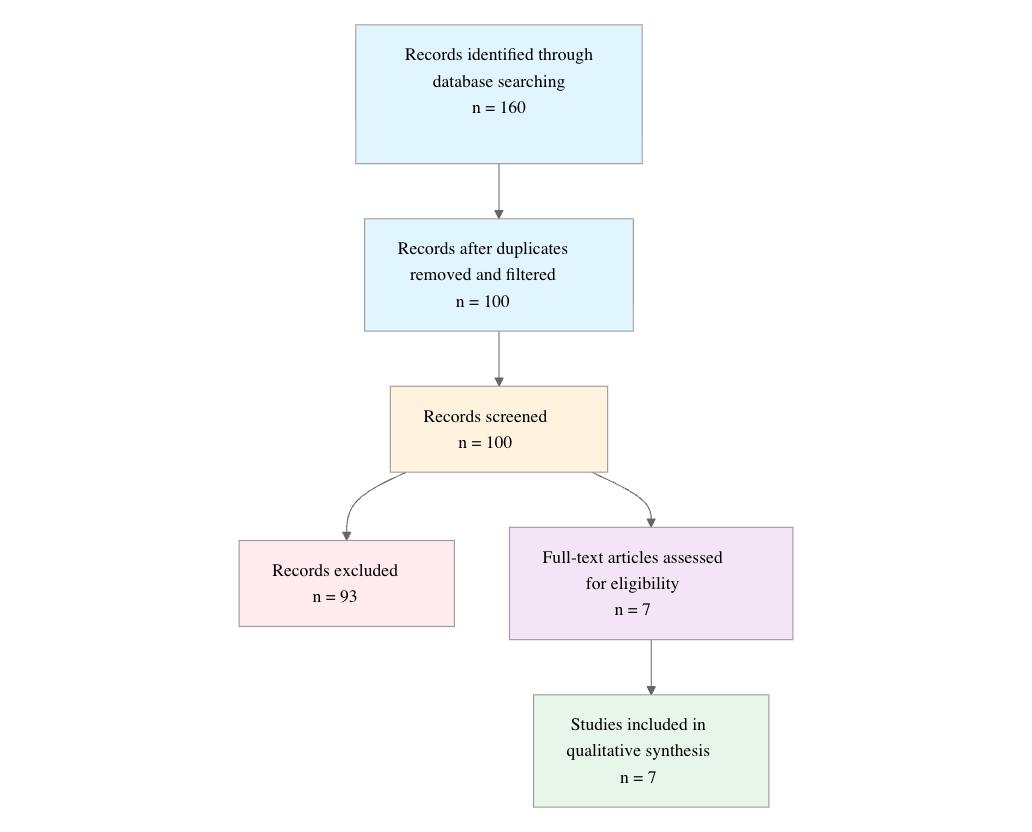
Initial database searching identified 160 records. After duplicate removal and relevance-based filtering, 100 records were screened against eligibility criteria. Of these, 93 papers were excluded, resulting in 7 papers included in the final synthesis.
PRISMA Flow Diagram
Eligibility criteria included:
- Night terrors: Does the study explicitly investigate night terrors or sleep terrors as a main topic or outcome?
- Human studies: Does the study involve human participants or human clinical data rather than animal or laboratory-only work?
- Recent: Was the study published in 2020 or later?
- Clinical focus: Does the paper address clinical features, epidemiology, diagnosis, triggers, or treatment of night terrors?
- Original evidence: Is the paper an original study, systematic review, or clinical report rather than a general commentary without new evidence?
- Age relevance: Does the paper study children, adolescents, or adults with night terrors, or mixed age groups?
- Management info: Does the paper report treatment, management, or clinical recommendations for night terrors?
- Diagnostic detail: Does the paper provide diagnostic criteria, differential diagnosis, or assessment methods for night terrors?
- Risk factors: Does the paper identify triggers, comorbidities, or risk factors associated with night terrors?
All included studies met the stated eligibility criteria.
2.3 Data Extraction and Synthesis
Data extraction focused on the following variables:
- Population: Extract the participant group studied, including age range or life stage (children, adolescents, adults), and any relevant clinical population.
- Design: Extract the study design or evidence type (e.g., cross-sectional, case series, cohort, randomized trial, systematic review, narrative review).
- Night Terror Focus: Extract how night terrors or sleep terrors are the main focus of the paper, including diagnostic framing or parasomnia context.
- Risk Factors: Extract any reported triggers, associated conditions, or risk factors linked to night terrors or sleep terrors.
- Symptoms: Extract clinical features, frequency, severity, or presentation details described for night terrors.
- Diagnosis: Extract any diagnostic approach, assessment tool, differential diagnosis, or clinical criteria mentioned.
- Treatment: Extract any management approach, therapy, intervention, or recommendation described.
- Key Findings: Extract the main findings or conclusions specifically relevant to night terrors.
Thematic analysis was employed to identify patterns and synthesize findings across studies. Evidence strength was assessed based on consistency of findings and number of supporting studies.
3. Results
3.1 Characteristics of Included Studies
| Study and Year | Study Type | Population | Key Focus | Diagnosis/Assessment | Treatment/Management |
|---|---|---|---|---|---|
| Laganière et al. 2022 [1] | Cross-sectional study | Early childhood | Sleep terrors and emotional-behavioral problems | Clinical criteria; specific tools not detailed | Behavioral interventions; parental education |
| Şireli et al. 2024 [2] | Retrospective clinical study | 51 children, mean age 6.76±1.45 years | Clinical features, sleep environment, psychiatric comorbidity | DSM-5 criteria | Psychoeducation; careful medication selection |
| Lopez & Dauvilliers 2023 [3] | Narrative review | Broad NREM parasomnia population | Diagnostic criteria and classification | Critique of ICSD-3-TR; video-recordings and polysomnography | Not reported |
| Futenma et al. 2021 [4] | Case series | Three adults | Parasomnia-like events during REM sleep-wake transitions | Clinical observation | Not reported |
| Murat 2025 [5] | Narrative review | General population | Psychological foundations of night terrors | Not reported | Not reported |
| Kurt Gök et al. 2021 [6] | Cross-sectional study | 1,473 workers | Shift work and parasomnia prevalence | Questionnaire with 132 questions | Not reported |
| Chinala & Su 2024 [7] | Narrative review | Children and adults | Parasomnia classification, diagnosis, and interventions | Clinical criteria and assessment tools | Pharmacological and non-pharmacological interventions |
Overall, the evidence base is dominated by observational and review designs, with clinical characterization studies in children, an occupational prevalence study in adults, and a small case series challenging conventional sleep-stage assumptions. Diagnostic and therapeutic evidence remains largely narrative rather than trial-based, and measurement varies widely from DSM-5-based chart review to questionnaire screening and expert review of classification systems.
3.2 Thematic Findings
3.2.1 Night terrors are most consistently linked to sleep disruption, stress, and contextual instability
Across the recent literature, the clearest pattern is that night terrors cluster in settings of disturbed sleep and heightened arousal burden. In children, sleep terrors were associated with stress and anxiety as triggers or associated conditions [1], while a separate pediatric clinical sample reported that 29.4% slept in a noisy environment and 80.4% had sleep interrupted aside from the attacks [2]. In adults, parasomnias including sleep terrors were more frequent in shift workers than in daytime workers, with a 1-year prevalence of 27.5% versus 13%, and rotating shift work emerged as an independent risk factor [6]. The psychological review further emphasized stress before and during sleep as central to the experience of night terrors [5]. Together, these findings suggest a convergent vulnerability profile in which environmental disruption, sleep fragmentation, and stress-related arousal lower the threshold for nocturnal episodes.
Confidence: Moderate to strong, because the direction of effect is consistent across pediatric, occupational, and conceptual literature, although measures differ substantially. Representative sources: [1], [2], [6], [5]
3.2.2 Clinical presentation varies by age and setting, but fear, difficulty awakening, and amnesia remain core features
Despite heterogeneity in design, the symptom pattern is highly recognizable. Pediatric studies described episodes of screaming, intense fear, and difficulty awakening, often in the first third of the night [2]. In the retrospective clinical sample, full retrograde amnesia was significantly higher in preschoolers, whereas motor activity during the attack, physical injury and/or material damage, and full awakening during the attack were significantly higher in school-age children [2]. Adult case evidence broadened the phenotype further by describing parasomnia-like events during sleep-wake transitions from REM sleep, which resemble sleep terrors but occur outside the classic NREM framework [4]. Because symptom ascertainment ranged from clinical criteria to file review and case description, comparability is limited; nonetheless, the overlap in fear, impaired arousability, and impaired recall suggests a stable clinical core across ages.
(Note: [4] examined adults with parasomnia-like REM sleep-wake transition events, which partially matches the question population of people with night terrors; findings should be interpreted considering this difference.) Confidence: Moderate, because the symptom core is coherent, but age-related differences and sleep-stage ambiguity reduce certainty. Representative sources: [1], [2], [4]
3.2.3 Psychiatric comorbidity and emotional-behavioral burden appear clinically important, especially in children
The pediatric literature suggests that night terrors are not only sleep phenomena but may also index broader emotional and behavioral vulnerability. One study found a significant association between sleep terrors and emotional-behavioral problems in early childhood [1]. Another reported that 33.3% of children had at least one psychiatric disorder, with attention deficit hyperactivity disorder being the most common comorbid diagnosis at 9.8% [2]. These data do not establish causality, and the extracted evidence does not report whether psychiatric symptoms precede or follow sleep terrors. Still, the convergence across studies indicates that psychiatric screening is clinically relevant rather than ancillary, particularly when episodes are frequent, disruptive, or accompanied by injury.
Confidence: Moderate, because findings align across clinical pediatric samples but remain cross-sectional and retrospective. Representative sources: [1], [2]
3.2.4 Diagnostic uncertainty remains a central problem, and current criteria may be too restrictive
Recent diagnostic scholarship emphasizes that night terrors sit within a broader family of NREM parasomnias whose classification is still imperfect. A review of NREM parasomnia diagnosis argued that several clinical criteria should be treated as supportive rather than mandatory and called for incorporation of sensitive and specific polysomnographic markers, infrared home video recordings, and diagnostic specifiers such as age effect and severity [3]. Complementary review evidence also framed night terrors within a diagnostic spectrum of REM and NREM parasomnias and highlighted the need for clearer diagnostic characterization [7]. Clinical studies used DSM-5 criteria or file-based clinical diagnosis, but specific assessment tools were generally not detailed [2], [1]. The resulting picture is one of important conceptual progress but limited operational standardization.
Confidence: Moderate, because multiple sources converge on diagnostic limitations, though this is driven largely by review-level evidence rather than comparative diagnostic studies. Representative sources: [3], [7], [2]
3.2.5 Management evidence remains limited, but parental education and careful treatment selection are recurring themes
Treatment-related evidence is sparse and largely descriptive. Pediatric clinical work recommended behavioral interventions and parental education [1], while the retrospective clinical study stressed psychoeducation for parents and selection of appropriate medication, noting that 64.7% of parents intervened incorrectly during episodes and 29.4% had received the wrong medication in treatment history [2]. Broader reviews stated that pharmacological and non-pharmacological interventions exist, but the extracted data do not specify which approaches are most effective [7]. The key implication is not that treatment is unavailable, but that practical management remains poorly standardized and vulnerable to misunderstanding in family and clinical settings.
Confidence: Limited, because the evidence is recommendation-based rather than outcome-based and lacks comparative intervention data. Representative sources: [1], [2], [7]
3.3 Summary of Evidence
| Theme | Key Finding | Population Applicability | Effect Direction | Confidence Level | Supporting Studies |
|---|---|---|---|---|---|
| Sleep disruption and stress as triggers | 80.4% had sleep interrupted apart from attacks; 27.5% 1-year parasomnia prevalence in shift workers versus 13% in daytime workers | Children and adults; adult occupational data partially match the question population | Positive association | Moderate to strong | Laganière et al. [1], Şireli et al. [2], Kurt Gök et al. [6], Murat [5] |
| Core clinical phenotype | Screaming, intense fear, difficulty awakening, amnesia, motor activity, and occasional injury/material damage | Mainly pediatric clinical populations; adult REM-transition cases partially match | Mixed but consistent symptom core | Moderate | Laganière et al. [1], Şireli et al. [2], Futenma et al. [4] |
| Psychiatric/emotional comorbidity | 33.3% had at least one psychiatric disorder; ADHD was 9.8%; emotional-behavioral problems were associated with sleep terrors | Pediatric populations | Positive association | Moderate | Laganière et al. [1], Şireli et al. [2] |
| Diagnostic uncertainty | ICSD-3-TR criteria criticized; video-recordings and polysomnography proposed | Broad NREM parasomnia populations including night terrors | Mixed/diagnostic refinement | Moderate | Lopez & Dauvilliers [3], Chinala & Su [7] |
| Management gaps | 64.7% of parents intervened incorrectly; 29.4% received wrong medication historically | Pediatric clinical populations | Negative for current care quality | Limited | Şireli et al. [2], Laganière et al. [1], Chinala & Su [7] |
4. Discussion
4.1 Principal Findings and Their Interpretation
The recent literature portrays night terrors less as an isolated childhood oddity than as a clinically meaningful expression of sleep instability, arousal dysregulation, and psychosocial burden. The strongest pattern is the repeated linkage to disrupted sleep environments and stress-related contexts, from noisy bedrooms and interrupted sleep in children to rotating shift work in adults [2], [6], [5]. This convergence suggests that the threshold for nocturnal arousal events may be lowered when sleep architecture is fragmented or circadian timing is disturbed. The evidence is not mechanistic in a biological sense, however; none of the included papers provide molecular or physiological pathway data that would allow inference about inflammatory, endocrine, or autonomic mediators. That absence matters, because the field currently relies on clinical association rather than causal pathway evidence.
A second robust insight is that the phenotype retains a recognizable core—fear, screaming, impaired awakening, and amnesia—while still varying by age and setting [2], [4]. Preschoolers showing more retrograde amnesia and school-age children more motor activity and injury imply developmental modulation of how episodes are expressed, observed, or remembered. The adult REM-transition cases broaden the concept further and indicate that some parasomnia events resembling sleep terrors may occur outside traditional NREM boundaries [4]. Together, these findings add nuance: the clinical construct is real, but its edges are not uniform.
Diagnostic and treatment findings are less mature, yet they are arguably the most actionable. The diagnostic literature argues that rigid criteria may obscure clinically relevant cases and that video and polysomnography could improve classification [3]. At the same time, the high rate of incorrect parental intervention and medication use shows that management failures may be common even when the disorder is recognized [2]. Confidence is therefore highest for the association with sleep disruption and the basic clinical phenotype, and lower for treatment effectiveness and diagnostic optimization.
4.2 Comparison with Existing Literature and Resolution of Contradictions
The reviewed literature is broadly internally consistent in treating night terrors as a parasomnia associated with arousal instability, but it also reveals an important conceptual tension: some sources continue to situate night terrors firmly within NREM parasomnias, whereas case evidence shows similar episodes emerging during REM sleep-wake transitions [3], [4]. This is not necessarily a contradiction in the clinical sense; rather, it may reflect the limits of phenomenology-based diagnosis when sleep-stage confirmation is absent. If only the observable behavior is considered, REM-transition parasomnias may be indistinguishable from classic night terrors, especially in home settings where polysomnography is unavailable. The diagnostic review's call for video recordings and polysomnographic markers therefore appears especially relevant, because it offers a path to resolving classification ambiguity rather than simply relabeling it.
The pediatric comorbidity findings also fit with prior conceptual work in the reviewed papers that frames night terrors as psychologically loaded events [1], [5]. This alignment is meaningful because it suggests that emotional-behavioral burden may not be incidental; however, the evidence remains cross-sectional, so directionality cannot be determined. A child with behavioral difficulties may be more vulnerable to sleep terrors, sleep terrors may worsen behavior through sleep disruption, or both may arise from a shared vulnerability.
There is also a methodological gradient across the evidence base. Questionnaire-based occupational prevalence estimates [6] and retrospective clinic files [2] are more vulnerable to recall and selection bias than review-based classification work, yet they provide the strongest direct empirical data on real-world occurrence. The risk of publication bias is likely modest but nontrivial: unusual REM-transition cases and clinically disruptive pediatric cases are more likely to be reported than uneventful or mild episodes. That bias would not invalidate the central pattern, but it could amplify the apparent heterogeneity of the phenomenon.
4.3 Practical Implications
Clinically, the evidence supports a pragmatic approach that begins with contextual assessment rather than narrow symptom recognition alone. Children presenting with night terrors should be evaluated for sleep disruption, environmental noise, emotional-behavioral difficulties, and psychiatric comorbidity, because these factors repeatedly co-occur with attacks [1], [2]. Family counseling is especially important when parents are intervening incorrectly during episodes, as observed in the pediatric clinic sample, because mismanagement may aggravate distress or lead to inappropriate medication use [2]. For adults in rotating shift schedules, clinicians should consider sleep terrors as part of a broader parasomnia risk profile and ask about occupational accidents and traffic safety [6].
From a public health standpoint, the findings argue for sleep-health interventions in high-risk environments. Reducing sleep interruption, minimizing nocturnal noise, and addressing circadian disruption in rotating shift work may lower parasomnia burden, although the current evidence does not establish a no-threshold exposure model. Regulatory implications are therefore more circumscribed than in exposure science: the literature supports risk reduction in vulnerable settings, but not a quantified exposure limit. Diagnostic systems may also need updating. The recent critique of current criteria suggests that wider use of home video and polysomnography could improve precision, particularly for atypical or adult presentations [3]. Until treatment studies become more comparative, the most defensible recommendation is careful history-taking, trigger identification, psychoeducation, and conservative management tailored to episode severity.
4.4 Strengths and Limitations
This review is strengthened by a systematic search strategy and by thematic synthesis across diverse evidence types, allowing clinical, diagnostic, and contextual findings to be integrated into a single interpretation. It also captures recent developments spanning pediatric clinic populations, adult occupational samples, case-based evidence, and diagnostic reviews.
The included studies are limited by their predominance of observational and narrative designs, small or specialized samples in some reports, and heterogeneous outcome definitions. Several papers do not specify detailed diagnostic tools, and treatment evidence is largely recommendation-based rather than comparative. As a review, this synthesis is also limited by abstract-level extraction for some studies and by the absence of a formal risk-of-bias assessment in the provided data. In addition, the evidence base is uneven across populations, with stronger pediatric and occupational representation than general-population community samples.
5. Gaps and Future Directions
The literature shows clear progress in describing associations, but several gaps remain directly relevant to night terrors. First, there is a need for prospective studies that can distinguish whether stress, sleep disruption, and psychiatric symptoms are causes, consequences, or shared correlates of night terrors. Second, the field lacks standardized diagnostic validation against objective sleep measures; future work should compare DSM- and ICSD-based clinical diagnosis with video recording and polysomnography, especially in atypical adult cases and REM-transition events [3], [4]. Third, intervention research is sparse: the recurrence of parental mismanagement and medication errors suggests that psychoeducation and treatment algorithms should be tested formally rather than recommended descriptively [2]. Finally, populations most underrepresented include community adults outside shift-work settings and longitudinal pediatric cohorts that can clarify developmental trajectories. Better harmonization of outcome definitions, sleep-stage confirmation, and confounder assessment would materially strengthen the evidence base.
6. Conclusion
Recent research supports the conclusion that night terrors are most strongly associated with sleep disruption, stress, and contextual vulnerability, with the clearest evidence coming from pediatric clinical samples and adult shift-work populations. In children, sleep terrors are linked to emotional-behavioral problems [1], and in a clinical sample of 51 children, 33.3% had at least one psychiatric disorder while 29.4% slept in a noisy environment and 80.4% had sleep interruption beyond the attacks [2]. In adults, parasomnia prevalence was higher in shift workers than daytime workers, with a 1-year prevalence of 27.5% versus 13%, and rotating shift work was an independent risk factor [6]. At the same time, diagnostic work suggests that current classification systems remain too rigid and may miss clinically relevant or atypical cases [3].
The most defensible interpretation is therefore that night terrors reflect a clinically important arousal disorder whose expression is shaped by age, sleep stability, and environmental context. Confidence is strongest for the association with sleep disruption and the core symptom pattern of fear, screaming, and difficult awakening; it is weaker for treatment effectiveness and for the precise boundaries of the disorder, especially given evidence that similar events can occur during REM sleep-wake transitions [4]. The single most important unresolved question is whether improved objective sleep-stage confirmation will reveal distinct subtypes that require different management approaches. Answering that question would directly improve diagnosis, reduce parental and clinical mismanagement, and better target prevention in children, shift workers, and other vulnerable groups.
References
- Laganière, C., Gaudreau, H., Pokhvisneva, I., Kenny, S., Bouvette-Turcot, A.-A., Meaney, M., & Pennestri, M.-H. (2022). Sleep terrors in early childhood and associated emotional-behavioral problems. Journal of Clinical Sleep Medicine, 18(9), 2253–2260. https://doi.org/10.5664/jcsm.10080
- Şireli, Ö., Uzun Çiçek, A., Abanoz, E., Ucuz, İ., & Naralan, Y. S. (2024). Investigation of Clinical Features and Comorbid Psychopathologies of Children with Sleep Terrors. CBU-SBED: Celal Bayar University Health Sciences Institute Journal, 11(3), 421–433. https://doi.org/10.34087/cbusbed.1479121
- Lopez, R., & Dauvilliers, Y. (2024). Challenges in diagnosing NREM parasomnias: Implications for future diagnostic classifications. Sleep Medicine Reviews, 73, 101888. https://doi.org/10.1016/j.smrv.2023.101888
- Futenma, K., Inoue, Y., Saso, A., Takaesu, Y., Yamashiro, Y., & Matsuura, M. (2022). Three cases of parasomnias similar to sleep terrors occurring during sleep-wake transitions from REM sleep. Journal of Clinical Sleep Medicine, 18(2), 669–675. https://doi.org/10.5664/jcsm.9666
- Murat, N. (2025). The Psychological Foundations of Night Terrors and their Relationship with Sleep Disorders. International Journal of Social Science Humanity & Management Research, 4(12), 2258–2266. https://doi.org/10.58806/ijsshmr.2025v4i12n06
- Kurt Gök, D., Ünal, İ., & Aslan-Kara, K. (2021). Evaluation of the effects of shift work on parasomnia prevalence. Chronobiology International, 38(10), 1500–1506. https://doi.org/10.1080/07420528.2021.1932996
- Chinala, V., & Su, C. (2024). Evaluating the Impacts of Parasomnias on Sleep and Exploring Their Therapeutic Interventions. Journal of Student Research, 13(2). https://doi.org/10.47611/jsrhs.v13i2.6804