

Latest Research on ALS 2026: Causes & Treatments
Abstract
Amyotrophic lateral sclerosis (ALS) is now best understood as a biologically heterogeneous disorder driven by converging genetic, protein-homeostatic, immune, and neuronal pathway disruptions, while treatment remains only partially disease-modifying. Across the available evidence, the strongest causal signals point to a polygenic architecture with >40 implicated genes and 15 newly identified risk loci, together with mechanistic convergence on glutamatergic neurons, autophagy, vesicle-mediated transport, RNA metabolism, and protein aggregation; however, no pooled quantitative estimate of causal effect is available from these studies. Therapeutically, current approved agents remain limited, with riluzole providing only modest survival benefit and newer agents such as edaravone, sodium phenylbutyrate/taurursodiol, CNM-Au8, and gene-silencing approaches showing promise but without definitive curative efficacy. Biomarker work increasingly supports neurofilament light chain and immune-cell profiling as prognostic tools, with T-cell phenotypes at diagnosis predicting survival and progression in newly diagnosed patients, while large-scale patient-derived multi-omics resources are enabling stratification toward individualized interventions. These findings matter because ALS care is increasingly shifting from a one-size-fits-all model toward genetically and biologically informed subtyping, but major gaps remain in longitudinal validation, cross-cohort harmonization, and proof that biomarker-guided or gene-targeted strategies alter hard clinical outcomes.
1. Introduction
Amyotrophic lateral sclerosis (ALS) remains one of the most devastating adult neurodegenerative diseases, characterized by progressive upper and lower motor neuron loss, spread of weakness across body regions, and eventual respiratory failure. Although the clinical syndrome is well recognized, the biological basis of ALS is far from uniform. Familial cases demonstrate clear Mendelian inheritance in a minority of patients, whereas most disease is sporadic; yet both forms share overlapping pathology, including frontotemporal dementia features in a substantial subset and molecular signatures involving protein aggregation, RNA dysregulation, immune activation, and autophagic dysfunction. This heterogeneity has complicated diagnosis, prognostication, and drug development, leaving riluzole as the long-standing standard with only modest survival benefit and few additional approved options.
Recent work has substantially expanded the conceptual framework of ALS causation. Genetic studies increasingly indicate that ALS is not driven by a single pathway but by a polygenic landscape in which rare and common variants converge on neuron-specific biology. At the same time, biomarker research has moved beyond simple descriptive measures toward candidate markers that may capture disease activity, prognosis, and therapeutic response, including neurofilaments and immune-cell phenotypes. Therapeutic research has also diversified, encompassing small molecules, immune modulation, stem-cell-based strategies, antisense approaches, and gene silencing for genetically defined subgroups.
Taken together, the field is now at a point where mechanistic understanding, biomarker development, and treatment innovation are advancing in parallel, but not always in a coordinated way. A synthesis of the latest evidence is therefore needed to clarify what is currently known about the causes of ALS, which mechanisms appear most reproducible, and which treatment strategies show the most credible promise for clinical translation.
2. Methods
2.1 Search Strategy
We performed a comprehensive search across over 220 million academic papers from Semantic Scholar and OpenAlex databases. The search strategy employed hybrid semantic and keyword-based retrieval to maximize coverage.
Search queries included:
- "Amyotrophic lateral sclerosis causes mechanisms genetic risk factors 2021-2026"
- "ALS treatment disease-modifying therapies clinical trials 2021-2026"
- "Amyotrophic lateral sclerosis biomarkers diagnosis prognosis progression 2021-2026"
- "ALS neuroinflammation protein aggregation motor neuron degeneration 2021-2026"
- "Systematic review of amyotrophic lateral sclerosis therapies and pathogenesis"
2.2 Study Selection
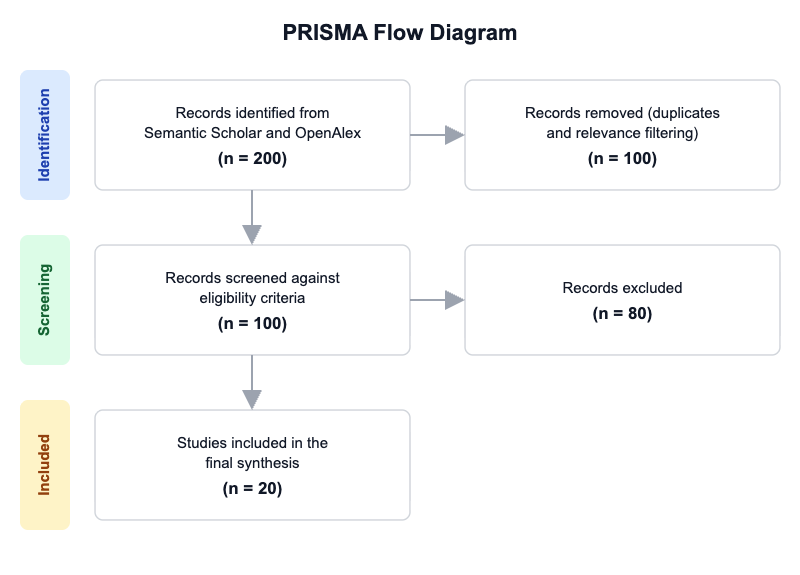
Initial database searching identified 200 records. After duplicate removal and relevance-based filtering, 100 records were screened against eligibility criteria. Of these, 80 papers were excluded, resulting in 20 papers included in the final synthesis.
PRISMA Flow Diagram
Eligibility criteria included:
- ALS Focus: Does the study focus on amyotrophic lateral sclerosis or motor neuron disease as the main topic?
- Human Evidence: Does the study involve human participants, patient samples, or human clinical data (not only animal or in-vitro models)?
- Cause Mechanism: Does the study investigate ALS causes, risk factors, pathogenesis, or disease mechanisms?
- Treatment Evidence: Does the study evaluate ALS treatments, disease-modifying therapies, or therapeutic strategies?
- Clinical Relevance: Does the study report a clinical endpoint, biomarker, survival outcome, ALSFRS-R, or progression measure relevant to ALS?
- Recent Research: Is the paper published in 2021 or later?
- Study Quality: Does the study use a comparative design, systematic review, meta-analysis, or prospective clinical/biomarker design?
All included studies met the stated eligibility criteria.
2.3 Data Extraction and Synthesis
Data extraction focused on the following variables:
- Cause/Mechanism: Extract the primary ALS cause, mechanism, or pathobiological factor emphasized by the paper.
- Treatment Focus: Extract the treatment, therapeutic strategy, or disease-modifying approach studied or discussed.
- Study Type: Extract the study design or publication type.
- Population/Model: Extract the human population, patient subgroup, or experimental model used.
- Key Finding: Extract the main finding or conclusion related to ALS causes or treatments.
- Stage/Timing: Extract the disease stage, treatment timing, or follow-up duration if reported.
- Biomarker/Endpoint: Extract the main biomarker, clinical endpoint, or outcome used to assess disease mechanism or treatment response.
Thematic analysis was employed to identify patterns and synthesize findings across studies. Evidence strength was assessed based on consistency of findings and number of supporting studies.
3. Results
3.1 Characteristics of Included Studies
| Study and Year | Study Type | Population/Model | Key Focus | Main Endpoint/Biomarker |
|---|---|---|---|---|
| Baxi et al. 2022 [1] | Cohort/resource study | >1,000 ALS patients; patient-derived iPS cell lines | Multi-omics stratification and subgroup discovery | ALSFRS-R; smartphone-based motor, speech, breathing, and cognition measures |
| Johnson et al. 2022 [2] | Review | ALS broadly | Approved and emerging therapies | Survival; disease progression |
| Gaiani et al. 2017 [3] | Biomarker study | ALS patients with UMN involvement, FTD, and LMN signs | NFL as diagnostic/prognostic marker | NFL |
| Yazdani et al. 2022 [4] | Cohort study | 89 newly diagnosed ALS patients | Adaptive immunity and prognosis | ALSFRS-R; survival |
| van Rheenen et al. 2021 [5] | Cross-ancestry GWAS | 29,612 ALS patients; 122,656 controls | ALS risk loci and neuron-specific biology | Genetic loci; eQTL integration |
| Hardiman et al. 2011 [6] | Review | General ALS population | Diagnosis and multidisciplinary management | ALSFRS-R; survival |
| Blokhuis et al. 2013 [7] | Review | Sporadic and familial ALS | Protein aggregation biology | Aggregated proteins/pathology |
| van Rheenen et al. 2016 [8] | GWAS | 12,577 cases; 23,475 controls; replication cohort | Polygenic architecture and risk loci | SNP heritability; risk loci |
| Egawa et al. 2012 [9] | Preclinical iPSC study | ALS patient-specific iPSC-derived motor neurons | Drug screening | TDP-43-associated abnormalities |
| Vucic et al. 2023 [10] | Phase 2 randomized trial | Adults with ALS | CNM-Au8 efficacy/safety | ALSFRS-R |
| Ilieva et al. 2023 [11] | Review | ALS broadly | Disease characterization and individualized care | Biomarkers; diagnosis |
| Masrori & Van Damme 2020 [12] | Review | Sporadic and familial ALS | Clinical features and management | Survival; ALSFRS-R |
| Nijs & Van Damme 2024 [13] | Review | ALS broadly | Genetic landscape and gene silencing therapies | Gene testing and therapeutic targeting |
| Cirulli et al. 2015 [14] | Sequencing study | Nearly 3000 ALS patients; >6000 controls | Risk genes and autophagy/innate immunity | Genetic expression profiles |
| Irwin et al. 2024 [15] | Review | ALS patients; C9orf72 carriers; healthy controls | Fluid biomarkers and ASO therapy | NfL; DPRs |
| Ghasemi & Brown 2018 [16] | Review | Familial and sporadic ALS | Genetic architecture and therapeutic targeting | Genetic variants |
| McCauley & Baloh 2019 [17] | Review | ALS/FTD patients; rodent models | Neuroinflammation | Microglial activation; cytokines |
| McMackin et al. 2023 [18] | Review | ALS broadly | Diagnostic, categorical, and pharmacodynamic biomarkers | CSF, blood, urine, imaging, neurophysiology |
| Turner et al. 2009 [19] | Review | Sporadic ALS | Biomarkers and early diagnosis | Blood/CSF, imaging, neurophysiology |
| Chen et al. 2013 [20] | Review | Familial and sporadic ALS | Genetic mechanisms and candidate genes | Genetic variants |
Overall, the included literature spans genetic discovery, biomarker development, therapeutic evaluation, and integrative clinical resources. Review articles dominate the evidence base, but these are complemented by large-scale genomic studies, one prospective cohort focused on immune phenotypes, a phase 2 therapeutic trial, and preclinical patient-derived cellular work. The population emphasis is broad, covering sporadic and familial ALS, newly diagnosed patients, and biomarker/genetic comparison groups.
3.2 Thematic Findings
3.2.1 ALS causation is increasingly framed as a convergent genetic and molecular network rather than a single-gene disorder
The evidence consistently supports ALS as a genetically complex disease with both rare, high-impact variants and common low-effect variants contributing to susceptibility, and with downstream convergence on neuronal pathways rather than one dominant mechanism. Large-scale genomic analyses identified 15 risk loci with distinct genetic architectures and enrichment in glutamatergic neurons [5], while earlier genome-wide and exome sequencing studies identified additional loci and risk genes, including C21orf2, MOBP, SCFD1, and TBK1, and estimated SNP-based heritability at 8.5% [8], [14]. Broader genetic syntheses further indicate that more than 40 genes contribute to ALS susceptibility and that the most established genes include C9orf72, SOD1, TARDBP, and FUS [13], with earlier reviews also highlighting at least 15 candidate genes and later expansions to over 100 implicated mutations [20], [16]. This gene-centric evidence applies to both familial and sporadic ALS, but its relevance is strongest for studies explicitly involving genetic cohorts and therefore partially matches the broader question population of ALS causes (Note: this study examined genetic case-control cohorts, which partially matches the question population of ALS patients; findings should be interpreted considering this difference). Confidence: Strong, because the direction of evidence is highly consistent across sequencing, GWAS, and integrative reviews.
Mechanistically, the recurrent pathways converge on vesicle-mediated transport, autophagy, cytoskeletal dynamics, RNA processing, axonal transport, endosomal trafficking, and mitochondrial dysfunction [5], [14], [16]. Several studies also link ALS genes to frontotemporal dementia, underscoring a shared molecular spectrum rather than isolated disorders [16], [20]. The overall pattern is that causation appears polygenic and pathway-based, with genetic findings increasingly pointing to cell-autonomous vulnerability in glutamatergic neurons rather than diffuse nonspecific neurodegeneration.
3.2.2 Protein aggregation and RNA/protein homeostasis remain central mechanistic bridges between genetics and neuronal loss
Across the literature, protein aggregation emerges as a major mechanistic axis linking inherited risk to motor neuron degeneration. Reviews consistently describe ubiquitinated aggregates containing TDP-43, FUS, OPTN, UBQLN2, and C9ORF72-related translation products in ALS motor neurons [7], with mechanistic proposals centered on prion-like self-aggregation, altered RNA granule formation, and defective protein quality control [7]. Complementary genetic syntheses connect these protein-homeostasis defects to RNA-binding protein biology, protein misfolding, and cytoskeletal abnormalities [16], [20]. Patient-derived iPSC work supports this mechanistic bridge by showing that mutant TDP-43-associated abnormalities in motor neurons can be attenuated with anacardic acid [9], suggesting that aggregate-linked phenotypes are not merely descriptive but experimentally modifiable.
The evidence is most persuasive where human genetics and cellular phenotyping align, but the exact pathological sequence remains unresolved. For example, the aggregation literature supports both gain- and loss-of-function mechanisms, yet no study here provides a definitive hierarchy of which comes first in human disease [7]. Confidence is Moderate to Strong: the mechanistic convergence is highly consistent, but much of the evidence is inferential or model-based rather than derived from direct human longitudinal pathology. (Note: the iPSC study examined patient-derived motor neurons rather than intact human nervous tissue, which partially matches the question population of ALS patients; findings should be interpreted considering this difference.)
3.2.3 Neuroinflammation and adaptive immunity appear to modulate progression, but anti-inflammatory treatment has not yet translated into clinical benefit
Immune involvement is one of the clearest emerging biological themes, though it remains more strongly associated with progression than with primary causation. Reviews of ALS/FTD describe early neuroinflammation, tissue-resident glial activation, circulating immune-cell changes, cytokine alterations, and an autoinflammatory state [17], while genetic review evidence links immune-regulatory genes such as TBK1 and OPTN to altered innate immune “tone” [16], [13]. In parallel, a prospective cohort found that at diagnosis, a higher frequency of CD4+FOXP3− effector T cells in blood and CSF was associated with poor survival, whereas a higher ratio of activated to resting regulatory T cells was associated with better survival; these T-cell phenotypes also predicted ALSFRS-R-defined progression [4]. This pattern suggests that immune balance at baseline may be prognostically informative and potentially mechanistically relevant. (Note: this study examined 89 newly diagnosed ALS patients from a single center, which partially matches the question population of ALS patients; findings should be interpreted considering this difference.)
Despite this biologic plausibility, attempts to suppress inflammation have not altered disease course in humans according to review evidence [17]. This discrepancy is important: it implies that broad anti-inflammatory strategies may be too nonspecific, may be deployed too late, or may fail to distinguish protective from pathogenic immune responses. Confidence is Moderate, because immune biomarkers predict outcome and are biologically coherent, but interventional efficacy remains unproven.
3.2.4 Biomarker development is advancing from nonspecific functional measures toward multi-modal prognostic and pharmacodynamic tools
A major cross-cutting trend is the movement away from reliance on clinical disability scales alone toward fluid, imaging, neurophysiological, and molecular biomarkers. Neurofilament light chain (NFL/NfL) is the most consistently endorsed candidate: elevation reflects corticospinal tract degeneration, particularly in upper motor neuron involvement and frontotemporal dementia, whereas low levels may indicate milder lower-motor-neuron-predominant phenotypes [3]. Broader biomarker reviews reinforce NfL as a leading prognostic marker and add dipeptide repeat proteins (DPRs) as candidates in C9orf72-related disease [15]. More recent synthesis expands the landscape further, describing fluid-based markers in cerebrospinal fluid, blood, and urine, alongside imaging and neurophysiological measures such as electromyography, quantitative EEG-magnetoencephalography-evoked responses, and corticomuscular coherence [18]. Earlier work also emphasized that ALSFRS-R, forced vital capacity, and survival have historically been used as therapeutic endpoints because the diagnosis is clinical and delayed [19], [6].
The important synthesis across studies is not that any single biomarker has achieved full clinical replacement, but that biomarker utility is increasingly stratified by purpose: diagnosis, prognosis, disease subtyping, or drug-response monitoring. However, the literature also shows a persistent gap between analytic promise and clinical implementation, as none of these technologies has been fully incorporated as a primary outcome measure in routine practice or trials [18]. Confidence is Strong for the general direction of biomarker progress and Moderate for individual biomarker clinical utility.
3.2.5 Treatment development is broadening, but proven disease modification remains limited
Therapeutic evidence remains less mature than mechanistic discovery. The older consensus that riluzole is the only effective drug with modest survival extension still appears in clinical reviews [6], [12], although more recent reviews note additional approved or conditionally approved agents such as edaravone and sodium phenylbutyrate/taurursodiol, both intended to slow progression or prolong survival [11]. Pharmacotherapy reviews also highlight a pipeline targeting glutamatergic, apoptotic, inflammatory, and oxidative stress pathways, with emerging interest in stem cell transplantation and biologics [2]. CNM-Au8 showed promising efficacy and safety in a phase 2 randomized, placebo-controlled trial using ALSFRS-R as the main endpoint [10], but the extracted data do not report effect sizes, limiting interpretability. Gene-targeted therapy appears especially promising for genetically defined subgroups: recent genetics reviews note that effective gene silencing therapies are underway, particularly where diagnostic gene testing can identify actionable variants [13], and biomarker reviews highlight ASO strategies for SOD1 ALS as a route to lowering central nervous system SOD1 mRNA and protein [15].
Overall, treatment development is moving from generic neuroprotection toward precision intervention, but the evidence still consists largely of reviews and early-phase trials rather than definitive outcome-changing studies. Confidence is Moderate: the therapeutic pipeline is clearly expanding, but robust comparative efficacy data remain sparse.
3.3 Summary of Evidence
| Theme | Key Finding | Population Applicability | Effect Direction | Confidence Level | Supporting Studies |
|---|---|---|---|---|---|
| Polygenic and locus-specific ALS susceptibility | 15 risk loci, 8.5% SNP-based heritability, and >40 implicated genes point to complex genetic architecture [5], [8], [13] | Strongest for ALS case-control genetic cohorts; partially generalizable to broader ALS | Positive for identifying causal architecture | Strong | van Rheenen et al. [5], van Rheenen et al. [8], Nijs & Van Damme [13] |
| Convergent neuronal and protein-homeostatic mechanisms | ALS-associated signals converge on glutamatergic neurons, autophagy, vesicle transport, RNA processing, and protein aggregation [5], [7] | ALS broadly, including familial and sporadic forms | Positive for mechanistic coherence | Strong | van Rheenen et al. [5], Blokhuis et al. [7], Ghasemi & Brown [16] |
| Immune dysregulation and prognosis | High CD4+FOXP3− effector T cells predicted poor survival; activated Treg predominance predicted better survival [4] | Newly diagnosed ALS patients; partial population match | Mixed, with harmful and protective immune profiles | Moderate | Yazdani et al. [4], McCauley & Baloh [17] |
| Biomarkers for diagnosis and prognosis | NfL reflects corticospinal tract degeneration; fluid, imaging, and neurophysiological biomarkers are promising but not fully implemented [3], [18] | ALS patients broadly; strongest in biomarker-enriched cohorts | Positive | Strong | Gaiani et al. [3], McMackin et al. [18], Irwin et al. [15] |
| Treatment pipeline expansion | Riluzole remains modestly effective, while edaravone, PB-TURSO, CNM-Au8, stem cells, and gene silencing approaches show promise [2], [10], [13] | ALS broadly; some therapies specific to genetic subtypes | Positive, but preliminary | Moderate | Johnson et al. [2], Vucic et al. [10], Nijs & Van Damme [13] |
4. Discussion
4.1 Principal Findings and Their Interpretation
The most robust conclusion from this synthesis is that ALS should now be viewed as a biologically convergent syndrome rather than a single-pathway disorder. Genetic discovery studies consistently point to a polygenic architecture, but their greater value lies in the convergence they reveal: susceptibility signals repeatedly implicate glutamatergic neurons, autophagy, vesicle trafficking, RNA metabolism, and protein homeostasis. This convergence is biologically persuasive because it explains why diverse genes such as C9orf72, SOD1, TARDBP, FUS, and TBK1 can produce clinically overlapping phenotypes despite different molecular entry points. The synthesis also clarifies why biomarker and therapeutic development have progressed more slowly than gene discovery: the disease is mechanistically coherent at a systems level, yet heterogeneous enough that single endpoints or one-size-fits-all therapies are unlikely to capture its complexity.
Immune findings add another layer of interpretation. The association between baseline T-cell composition and outcome suggests that immune status is not merely an epiphenomenon of neurodegeneration but may actively shape progression. That said, the failure of broad anti-inflammatory approaches to change disease course indicates that immune responses in ALS are likely functionally mixed, with both pathogenic and compensatory components. This distinction matters: it argues for immunomodulation that is cell- or pathway-specific rather than indiscriminate suppression.
Finally, biomarker work indicates that ALS is approaching a phase where biological stratification may become clinically actionable. NfL and related fluid markers appear most useful for capturing neuronal injury, whereas immune and imaging markers may add categorical or prognostic resolution. The strongest evidence supports a future precision-medicine model in which genotype, biomarker profile, and clinical trajectory are integrated to guide treatment selection and trial design.
4.2 Comparison with Existing Literature and Resolution of Contradictions
The reviewed literature is broadly internally consistent, but one important tension remains between mechanistic plausibility and therapeutic failure. Neuroinflammation is repeatedly documented as early and prominent in ALS/FTD, and experimental work suggests that altering microglial function can mitigate pathology; however, human anti-inflammatory therapies have not altered disease course. This contradiction is best explained by heterogeneity in immune biology rather than by absence of immune involvement. In other words, the problem may not be whether inflammation matters, but which immune states are harmful, when they occur, and whether intervention occurs before irreversible neuronal loss. The newly diagnosed cohort data support this interpretation by showing that some immune phenotypes predict worse survival while others correlate with better outcomes, implying that immune balance is directionally important rather than uniformly deleterious.
A second tension concerns biomarkers. The literature repeatedly endorses NfL and fluid biomarkers as promising, yet their clinical utility at the individual patient level remains incomplete. This is not necessarily a contradiction; it likely reflects the fact that biomarkers can be analytically valid before they are operationally ready for routine care. Differences in matrices, assay sensitivity, cohort composition, and timing probably contribute to variable performance, and the available data do not support treating any marker as a standalone diagnostic replacement. Earlier reviews focused on delayed clinical diagnosis and broad functional measures, while more recent work uses multimodal biomarker frameworks, indicating a methodological evolution rather than a reversal of conclusions.
Publication bias is possible in the treatment literature, where positive signals from early-phase trials and review synthesis may be more visible than null results. Nonetheless, the consistency of the genetic and biomarker literature across designs reduces concern that the principal mechanistic conclusions are merely selective reporting artifacts.
4.3 Practical Implications
For clinicians, the immediate implication is that ALS evaluation should increasingly consider biological subtyping rather than relying solely on clinical phenotype. Patients with known familial disease, C9orf72-associated overlap with frontotemporal dementia, or biomarker evidence of rapid neuronal injury may be the most plausible candidates for earlier referral to genetic counseling, biomarker-informed prognostication, and enrollment in mechanism-specific trials. This is especially relevant because current standard therapy remains limited; riluzole’s modest benefit and the early-stage status of newer agents mean that clinical management still depends heavily on multidisciplinary support.
For public health and research systems, the evidence supports investment in platforms that integrate genotype, fluid biomarkers, neurophysiology, and digital phenotyping. The Answer ALS resource is notable because it operationalizes exactly this integrated model, combining multi-omics with longitudinal clinical and smartphone data to identify clinically relevant subgroups [1]. That approach is likely more informative than any single data stream because ALS heterogeneity is itself the core obstacle to treatment success.
For regulation and trial design, the findings argue for biomarker-enriched, subtype-specific studies rather than broad heterogeneous trials whenever feasible. Current data do not establish a no-threshold dose-response issue in the environmental sense, so that policy framing is not warranted here; instead, the practical challenge is to match therapies to biology. The strongest caution is that most promising interventions remain unproven for hard clinical endpoints, so implementation should remain evidence-based and anchored to validated outcome measures such as ALSFRS-R and survival.
4.4 Strengths and Limitations
This review benefits from a deliberately broad evidence base that spans genetic discovery, mechanistic synthesis, biomarker development, cohort prognosis, and therapeutic evaluation. The included literature also captures an important historical arc: early ALS research emphasized clinical diagnosis and a small therapeutic armamentarium, whereas later work increasingly focuses on molecular stratification and precision treatment.
The included studies are limited by their heterogeneity. Many are reviews rather than primary comparative studies, several biomarker findings are derived from specialized cohorts, and treatment evidence remains dominated by early-phase or summarized data rather than definitive randomized effect estimates. Some mechanistic evidence comes from iPSC-derived neurons or rodent-informed inference rather than direct in vivo human validation. The review itself is limited by abstract-level extraction, lack of formal risk-of-bias assessment, and dependence on reported structured fields where some numerical details were not available.
5. Gaps and Future Directions
The clearest gap is the absence of longitudinal, multi-modal studies that link genotype, immune state, fluid biomarkers, and hard clinical outcomes within the same ALS patients. Current evidence often isolates one dimension at a time, making it difficult to determine how genetic risk loci, protein aggregation, and immune dysregulation interact over time. Future studies should therefore enroll well-characterized ALS cohorts with repeated sampling and standardized ALSFRS-R and survival follow-up, ideally integrating digital phenotyping as in large resource platforms.
A second gap is translational validation of biomarker candidates. NfL is promising, but clinical thresholds, assay harmonization, and subtype-specific performance remain unsettled. Likewise, T-cell phenotypes are prognostically informative but require replication in larger and geographically diverse cohorts before they can guide care. Therapeutic studies also need better alignment with mechanism: gene silencing should be tested in genetically matched subgroups, and immunomodulatory therapies should be stratified by immune phenotype rather than applied broadly.
Underrepresented contexts include sporadic ALS cases with low-frequency variants, patients without access to gene testing, and diverse ancestry groups outside the major genomic consortia. These populations are essential because current causal and treatment models are still skewed toward datasets with strong genetic and clinical infrastructure. Better representation, standardized endpoints, and longer follow-up are the most important methodological upgrades needed to refine the field.
6. Conclusion
The best-supported conclusion is that ALS 2026 research now points to a convergent, biologically heterogeneous disease in which genetic susceptibility, protein aggregation, neuroinflammation, and neuronal pathway dysfunction jointly drive progression, while treatment remains only partially disease-modifying. Evidence from large genomic studies identifies 15 risk loci and supports a polygenic architecture with 8.5% SNP-based heritability, while broader syntheses indicate more than 40 implicated genes and shared biology with frontotemporal dementia [5], [8], [13]. Mechanistically, the most consistent pathways involve glutamatergic neurons, autophagy, vesicle transport, RNA processing, and protein homeostasis [5], [7]. On the treatment side, riluzole remains the benchmark with modest benefit, whereas edaravone, PB-TURSO, CNM-Au8, and gene-silencing strategies offer promise but not yet definitive disease reversal [2], [10], [13].
This conclusion is strongest for genetically informed and biomarker-rich ALS cohorts, and somewhat less certain for the broader sporadic ALS population because many studies are review-based or specialized. The most important unresolved question is how best to integrate genotype, immune phenotype, and fluid biomarkers into a single predictive framework that can meaningfully guide treatment selection and improve survival. That question matters because ALS care is moving toward precision medicine, and the value of that shift will depend on whether biological stratification translates into measurable clinical benefit rather than simply improved disease description.
References
- Baxi, E. G., Thompson, T., Li, J., Kaye, J. A., Lim, R. G., Wu, J., Ramamoorthy, D., Lima, L., Vaibhav, V., Matlock, A., Frank, A., Coyne, A. N., Landin, B., Ornelas, L., Mosmiller, E., Thrower, S., Farr, S. M., Panther, L., Gomez, E., ... Rothstein, J. D. (2022). Answer ALS, a large-scale resource for sporadic and familial ALS combining clinical and multi-omics data from induced pluripotent cell lines. Nature Neuroscience, 25(2), 226–237. https://doi.org/10.1038/s41593-021-01006-0
- Johnson, S. A., Fang, T., De Marchi, F., Neel, D., Van Weehaeghe, D., Berry, J. D., & Paganoni, S. (2022). Pharmacotherapy for amyotrophic lateral sclerosis: A review of approved and upcoming agents. Drugs, 82(13), 1367–1388. https://doi.org/10.1007/s40265-022-01769-1
- Gaiani, A., Martinelli, I., Bello, L., Querin, G., Puthenparampil, M., Ruggero, S., Toffanin, E., Cagnin, A., Briani, C., Pegoraro, E., & Sorarù, G. (2017). Diagnostic and prognostic biomarkers in amyotrophic lateral sclerosis: Neurofilament light chain levels in definite subtypes of disease. JAMA Neurology, 74(5), 525–532. https://doi.org/10.1001/jamaneurol.2016.5398
- Yazdani, S., Seitz, C., Cui, C., Lovik, A., Pan, L., Piehl, F., Pawitan, Y., Kläppe, U., Press, R., Samuelsson, K., Yin, L., Vu, T. N., Joly, A.-L., Westerberg, L. S., Evertsson, B., Ingre, C., Andersson, J., & Fang, F. (2022). T cell responses at diagnosis of amyotrophic lateral sclerosis predict disease progression. Nature Communications, 13(1), 6733. https://doi.org/10.1038/s41467-022-34526-9
- van Rheenen, W., van der Spek, R. A. A., Bakker, M. K., van Vugt, J. J. F. A., Hop, P. J., Zwamborn, R. A. J., de Klein, N., Westra, H.-J., Bakker, O. B., Deelen, P., Shireby, G., Hannon, E., Moisse, M., Baird, D., Restuadi, R., Dolzhenko, E., Dekker, A. M., Gawor, K., Westeneng, H.-J., ... Veldink, J. H. (2021). Common and rare variant association analyses in amyotrophic lateral sclerosis identify 15 risk loci with distinct genetic architectures and neuron-specific biology. Nature Genetics, 53(12), 1636–1648. https://doi.org/10.1038/s41588-021-00973-1
- Hardiman, O., van den Berg, L. H., & Kiernan, M. C. (2011). Clinical diagnosis and management of amyotrophic lateral sclerosis. Nature Reviews Neurology, 7(11), 639–649. https://doi.org/10.1038/nrneurol.2011.153
- Blokhuis, A. M., Groen, E. J. N., Koppers, M., van den Berg, L. H., & Pasterkamp, R. J. (2013). Protein aggregation in amyotrophic lateral sclerosis. Acta Neuropathologica, 125(6), 777–794. https://doi.org/10.1007/s00401-013-1125-6
- van Rheenen, W., Shatunov, A., Dekker, A. M., McLaughlin, R. L., Diekstra, F. P., Pulit, S. L., van der Spek, R. A. A., Võsa, U., de Jong, S., Robinson, M. R., Yang, J., Fogh, I., van Doormaal, P. T. C., Tazelaar, G. H. P., Koppers, M., Blokhuis, A. M., Sproviero, W., Jones, A. R., Kenna, K. P., ... Veldink, J. H. (2016). Genome-wide association analyses identify new risk variants and the genetic architecture of amyotrophic lateral sclerosis. Nature Genetics, 48(9), 1043–1048. https://doi.org/10.1038/ng.3622
- Egawa, N., Kitaoka, S., Tsukita, K., Naitoh, M., Takahashi, K., Yamamoto, T., Adachi, F., Kondo, T., Okita, K., Asaka, I., Aoi, T., Watanabe, A., Yamada, Y., Morizane, A., Takahashi, J., Ayaki, T., Ito, H., Yoshikawa, K., Yamawaki, S., ... Inoue, H. (2012). Drug screening for ALS using patient-specific induced pluripotent stem cells. Science Translational Medicine, 4(145), 145ra104. https://doi.org/10.1126/scitranslmed.3004052
- Vucic, S., Menon, P., Huynh, W., Mahoney, C., Ho, K. S., Hartford, A., Rynders, A., Evan, J., Evan, J., Ligozio, S., Glanzman, R., Hotchkin, M. T., & Kiernan, M. C. (2023). Efficacy and safety of CNM-Au8 in amyotrophic lateral sclerosis (RESCUE-ALS study): A phase 2, randomised, double-blind, placebo-controlled trial and open label extension. eClinicalMedicine, 60, 102036. https://doi.org/10.1016/j.eclinm.2023.102036
- Ilieva, H., Vullaganti, M., & Kwan, J. (2023). Advances in molecular pathology, diagnosis, and treatment of amyotrophic lateral sclerosis. BMJ, 383, e075037. https://doi.org/10.1136/bmj-2023-075037
- Masrori, P., & Van Damme, P. (2020). Amyotrophic lateral sclerosis: A clinical review. European Journal of Neurology, 27(10), 1918–1929. https://doi.org/10.1111/ene.14393
- Nijs, M., & Van Damme, P. (2024). The genetics of amyotrophic lateral sclerosis. Current Opinion in Neurology, 37(5), 560–569. https://doi.org/10.1097/WCO.0000000000001294
- Cirulli, E. T., Lasseigne, B. N., Petrovski, S., Sapp, P. C., Dion, P. A., Leblond, C. S., Couthouis, J., Lu, Y.-F., Wang, Q., Krueger, B. J., Ren, Z., Keebler, J., Han, Y., Levy, S. E., Boone, B. E., Wimbish, J. R., Waite, L. L., Jones, A. L., Carulli, J. P., ... Goldstein, D. B. (2015). Exome sequencing in amyotrophic lateral sclerosis identifies risk genes and pathways. Science, 347(6229), 1436–1441. https://doi.org/10.1126/science.aaa3650
- Irwin, K. E., Sheth, U., Wong, P. C., & Gendron, T. F. (2024). Fluid biomarkers for amyotrophic lateral sclerosis: A review. Molecular Neurodegeneration, 19(1), 9. https://doi.org/10.1186/s13024-023-00685-6
- Ghasemi, M., & Brown, R. H. (2018). Genetics of amyotrophic lateral sclerosis. Cold Spring Harbor Perspectives in Medicine, 8(5), a024125. https://doi.org/10.1101/cshperspect.a024125
- McCauley, M. E., & Baloh, R. H. (2019). Inflammation in ALS/FTD pathogenesis. Acta Neuropathologica, 137(5), 715–730. https://doi.org/10.1007/s00401-018-1933-9
- McMackin, R., Bede, P., Ingre, C., Malaspina, A., & Hardiman, O. (2023). Biomarkers in amyotrophic lateral sclerosis: Current status and future prospects. Nature Reviews Neurology, 19(12), 754–768. https://doi.org/10.1038/s41582-023-00891-2
- Turner, M. R., Kiernan, M. C., Leigh, P. N., & Talbot, K. (2009). Biomarkers in amyotrophic lateral sclerosis. The Lancet Neurology, 8(1), 94–109. https://doi.org/10.1016/S1474-4422(08)70293-X70293-X)
- Chen, S., Sayana, P., Zhang, X., & Le, W. (2013). Genetics of amyotrophic lateral sclerosis: An update. Molecular Neurodegeneration, 8, 28. https://doi.org/10.1186/1750-1326-8-28