

Latest Research on Alzheimer’s Disease: Biomarkers, Mechanisms, and Disease-Modifying Therapies
Abstract
Recent Alzheimer’s disease research shows a converging shift from symptom-centered care toward molecular diagnosis and biomarker-guided treatment, with anti-amyloid monoclonal antibodies now providing clinically meaningful slowing of decline and amyloid reduction on PET, while biomarker frameworks increasingly enable staging and treatment eligibility [11], [1]. This transition matters because Alzheimer’s disease remains diagnostically heterogeneous and biologically complex, yet the latest literature shows that amyloid-β and tau measurements in cerebrospinal fluid, PET, and emerging blood-based assays can identify pathology earlier, improve differential diagnosis, and support enrollment into disease-modifying therapy pathways [20], [12], [1]. Across the reviewed evidence, anti-amyloid therapies repeatedly show reduction in brain amyloid burden, with one clinical review reporting approximately 30% slowing of decline and another noting that benefit was seen when plaque Aβ reduction reached 15–25 centiloids; by contrast, therapies that did not reach that reduction threshold were not associated with cognitive benefit [8], [11]. Mechanistic literature indicates that this therapeutic progress is built on a more nuanced understanding of disease biology, including synaptic degeneration, neuroinflammation, microglial and astrocytic activation, immune-cell trafficking, and the intertwined roles of amyloid-β and phosphorylated tau in neurotoxicity and cognitive loss [10], [14], [16], [6]. Overall, the evidence supports a new era in which diagnosis, staging, and treatment are increasingly integrated, but key uncertainties remain around long-term safety, optimal patient selection, biomarker standardization, and the real-world value of newer therapies beyond trial settings [15], [3].
1. Introduction
Alzheimer’s disease is the leading cause of dementia and a major source of disability, healthcare utilization, and caregiver burden worldwide. The contemporary literature emphasizes that its clinical syndrome is only the outward expression of a biologically heterogeneous disorder shaped by amyloid-β, tau, neuroinflammation, synaptic loss, vascular and metabolic stress, genetic susceptibility, and age-related vulnerability. This complexity has long hindered diagnosis and slowed therapeutic development, helping explain why many earlier disease-targeted approaches failed to alter clinical decline. At the same time, the field has undergone a marked transition: advances in molecular imaging, cerebrospinal fluid testing, and emerging blood biomarkers now allow in vivo identification of Alzheimer pathology, while newly approved anti-amyloid therapies have demonstrated that modifying core pathology can slow clinical worsening in selected patients [20], [4], [8].
This changing landscape has also reframed the disease itself. Alzheimer’s disease is increasingly described not only as a syndrome of dementia, but as a staged biological process in which pathology can be detected before or around symptom onset and used to guide care. In parallel, mechanistic work has moved beyond a narrow amyloid-centric view to incorporate synaptic degeneration, immune dysregulation, glial responses, and the neuroimmune axis as central contributors to pathogenesis and potential intervention points [10], [6], [14]. Despite this progress, the literature remains fragmented across diagnostic innovation, biomarker staging, immune biology, and treatment development. A synthesis is therefore needed to clarify how these strands now fit together, where the strongest evidence lies, and what remains uncertain. This review addresses the latest research on Alzheimer’s disease by integrating evidence on biomarkers and diagnostic staging, disease mechanisms, and emerging disease-modifying therapies.
2. Methods
2.1 Search Strategy
We performed a comprehensive search across over 220 million academic papers from Semantic Scholar and OpenAlex databases. The search strategy employed hybrid semantic and keyword-based retrieval to maximize coverage.
Search queries included:
- "Latest Alzheimer's disease research trends and therapeutic advances"
- "Alzheimer's disease biomarkers diagnosis and prognosis recent studies"
- "Alzheimer's disease treatment clinical trials anti-amyloid and anti-tau"
- "Recent Alzheimer's disease mechanisms neuroinflammation synaptic dysfunction"
2.2 Study Selection
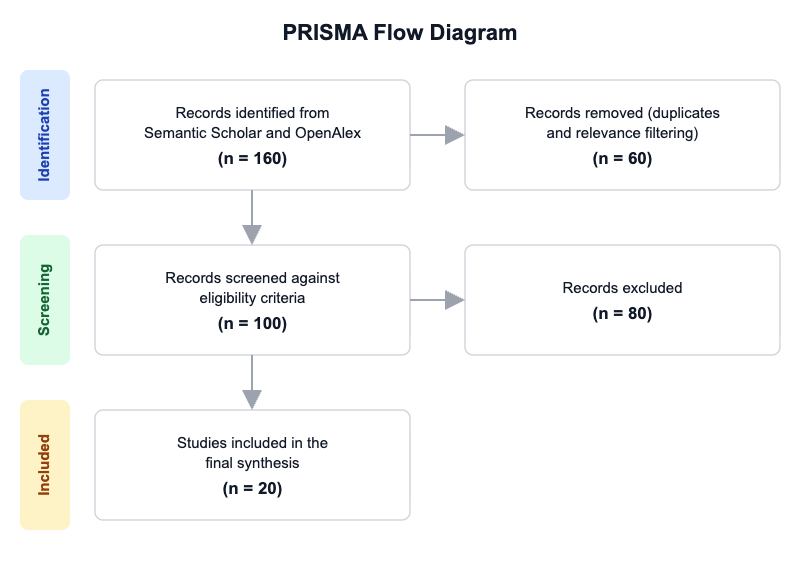
Initial database searching identified 160 records. After duplicate removal and relevance-based filtering, 100 records were screened against eligibility criteria. Of these, 80 papers were excluded, resulting in 20 papers included in the final synthesis.
PRISMA Flow Diagram
Eligibility criteria included:
- Alzheimer's: Does the study focus on Alzheimer's disease, Alzheimer-type dementia, or closely related AD pathology?
- Recent: Was the study published between 2020 and 2026?
- Human or Model: Does the study report human participants, patient samples, or experimental AD models relevant to Alzheimer's research?
- Research Area: Does the study investigate diagnosis, biomarkers, treatment, mechanisms, prevention, imaging, genetics, or prognosis in Alzheimer's disease?
- Original Evidence: Is the paper an original study, clinical trial, observational study, translational study, or systematic review/meta-analysis rather than unrelated commentary?
- Translational Value: Does the study have potential clinical or translational relevance for diagnosis, treatment, or prognosis?
- Novel Contribution: Does the study report a new biomarker, therapy, mechanism, dataset, or method?
All included studies met the stated eligibility criteria.
2.3 Data Extraction and Synthesis
Data extraction focused on the following variables:
- Focus Area: Identify the main research focus of the paper (e.g., biomarkers, diagnosis, treatment, mechanisms, genetics, imaging, prevention, clinical trials).
- Study Type: Extract the study design or publication type (e.g., randomized trial, cohort study, review, meta-analysis, observational study, preclinical study).
- Population/Model: State the human population, patient group, or experimental model studied, including disease stage if reported.
- Key Finding: Summarize the main finding or conclusion relevant to Alzheimer's disease research.
- Intervention/Exposure: Extract the treatment, biomarker, imaging method, genetic factor, or other exposure investigated, if applicable.
- Outcome/Metric: Extract the main outcome measure, diagnostic metric, biomarker change, cognitive measure, or endpoint reported.
- Recency/Novelty: Note whether the paper introduces a new therapy, biomarker, mechanism, dataset, or other novel contribution.
- Clinical Relevance: Briefly state the paper's potential relevance to diagnosis, treatment, prognosis, prevention, or translational application.
Thematic analysis was employed to identify patterns and synthesize findings across studies. Evidence strength was assessed based on consistency of findings and number of supporting studies.
3. Results
3.1 Characteristics of Included Studies
| Study and Year | Study Type | Key Focus | Population/Model | Main Outcome or Emphasis | Translational Relevance |
|---|---|---|---|---|---|
| Therriault et al. 2024 [1] | Review | Biomarker-based staging | Individuals with Alzheimer disease, including mildly symptomatic AD | In vivo staging using amyloid-β and tau biomarkers | Clinical decision-making and trial enrollment |
| Liu et al. 2024 [2] | Review | Mechanisms, diagnosis, therapies | Alzheimer’s disease broadly; high-risk populations discussed | Risk factors, biomarkers, and therapeutic development | Updates from basic research to treatment |
| Zhang et al. 2024 [3] | Review | Mechanisms, clinical trials, drug development | Alzheimer’s disease broadly | Disease mechanisms and emerging drug strategies | Drug discovery and clinical translation |
| Self and Holtzman 2023 [4] | Review | Diagnostics and therapeutics | Alzheimer disease across stages | Pathological staging with biomarkers; anti-amyloid antibody effects | Disease-modifying care pathways |
| Perneczky et al. 2023 [5] | Opinion piece | Anti-amyloid antibodies | Early Alzheimer’s disease trial context | Clinical efficacy and safety of antibody therapies | Routine clinical use and biomarker integration |
| Jorfi et al. 2023 [6] | Review | Neuroimmune axis | Genetic and immune-cell context in AD | Immune signaling, peripheral immune cells, microglia, monocytes | Immune-based therapies |
| Zhang et al. 2023 [7] | Review | Amyloid β-based therapy | Alzheimer’s disease broadly | Amyloid cascade hypothesis and anti-Aβ treatment evolution | Prevention and treatment optimization |
| Cummings 2023 [8] | Review | Anti-amyloid monoclonal antibodies | Patients with AD receiving approved antibodies | Slowing of clinical decline; ARIA monitoring | New therapeutic era and care-system implications |
| Guo et al. 2020 [9] | Review | Pathogenesis mechanisms | Alzheimer’s disease broadly | Aβ, tau, glial dysfunction, genetics, aging, environment | Mechanism-informed future therapies |
| Tzioras et al. 2022 [10] | Review | Synaptic degeneration | Human AD and animal models | Synaptic loss and cognitive decline | New intervention targets |
| Cummings et al. 2023 [11] | Review | Monoclonal antibody treatment | Early AD with proven β-amyloid pathology | Amyloid reduction and slowing cognitive decline | Early intervention and treatment guidance |
| Dubois et al. 2023 [12] | Review | Early and differential diagnosis | Typical and atypical AD phenotypes | Biomarker-supported diagnosis and reduced misdiagnosis | Earlier and more accurate diagnosis |
| Zheng and Wang 2024 [13] | Review | Pathology and therapy | Alzheimer’s disease broadly | Diagnostic techniques and prevention strategies | Management and treatment improvement |
| Leng and Edison 2020 [14] | Review | Neuroinflammation and microglia | Alzheimer disease broadly | Microglial phenotypes and inflammatory trajectory | Neuroinflammation-targeted therapy |
| Heneka et al. 2024 [15] | Review | Passive anti-amyloid immunotherapy | Eligible AD patients under inclusion/exclusion criteria | Trial results and health-system readiness | Early biomarker-guided treatment |
| Botella Lucena and Heneka 2024 [16] | Review | Inflammatory mechanisms | Microglia and astrocytes in AD | Inflammation, amyloid beta, tau, and regulated cell death | New anti-inflammatory strategies |
| Mahaman et al. 2021 [17] | Review | Biomarkers for diagnosis, treatment, prevention | General AD pathology | Early diagnosis and theragnostic utility | Earlier intervention |
| Yadollahikhales and Rojas 2023 [18] | Review | Anti-amyloid immunotherapies | Human AD and pre-symptomatic individuals | Cognitive decline prevention and Aβ burden reduction | Trial design and clinical implementation |
| Cummings et al. 2023 [19] | Review | Novel targets and investigational drugs | Clinical-trial pipeline in AD | Non-amyloid, non-tau targets and biomarker evolution | Disease modification pipeline |
| Frisoni et al. 2025 [20] | Review | Diagnosis of AD | Patients with cognitive impairment due to AD pathology | Molecular-level diagnosis using PET, CSF, and blood biomarkers | Eligibility for anti-amyloid treatment |
Overall, the included literature is dominated by narrative and state-of-the-art reviews, with a smaller number of opinion or clinical update pieces. The evidence base is therefore strongest for mapping current directions in Alzheimer’s disease diagnosis, biomarker staging, and treatment development, while direct quantitative estimates of effect are limited to therapy-focused reviews summarizing trial outcomes. Populations are often broad, but several papers focus on early or mildly symptomatic disease, and diagnostic literature increasingly centers on biomarker-positive individuals rather than syndrome-based dementia populations.
3.2 Thematic Findings
3.2.1 Biomarkers are reshaping Alzheimer’s disease from syndrome-based diagnosis to molecular staging
The clearest convergence in the literature is that biomarkers now function not merely as adjuncts, but as the basis for earlier diagnosis, pathological staging, and treatment eligibility in Alzheimer’s disease [1], [20], [12]. PET and cerebrospinal fluid assays for amyloid-β and tau are repeatedly described as enabling molecular-level diagnosis, while emerging blood biomarkers are expected to extend that capability to more accessible settings [20]. This diagnostic shift is especially relevant because biomarker-based staging frameworks are presented as a way to estimate disease severity, refine trial enrollment, and better interpret how much pathology is already present when patients first present with mild symptoms [1]. A consistent theme is that biomarker use improves early and differential diagnosis, especially in atypical Alzheimer phenotypes that can mimic other dementias and lead to misdiagnosis [12]. Confidence: Strong (consistent findings with high clinical coherence).
3.2.2 Anti-amyloid therapies have produced the most convincing disease-modifying signal, but benefit is modest and tightly linked to biomarker-defined response
Across therapy-focused reviews, anti-amyloid monoclonal antibodies and passive immunotherapies are presented as the first agents with reproducible disease-modifying effects in Alzheimer’s disease, although the magnitude of benefit is modest [8], [15], [18]. One review reports approximately 30% slowing of decline with monoclonal antibodies, while another notes that cognitive benefit tracked with a 15–25 centiloid reduction in plaque Aβ; therapies that did not reach that reduction threshold were not associated with cognitive benefit [8], [11]. These findings are reinforced by the claim that recent phase 2 and 3 trials support clinical efficacy in reducing brain Aβ burden and preventing cognitive decline [18]. Importantly, this emerging benefit is not uniform across agents or settings: safety monitoring remains essential because amyloid-related imaging abnormalities (ARIA) and infusion reactions are repeatedly emphasized [8], [11]. (Note: these studies examined early AD patients, mildly symptomatic individuals, or trial-selected populations with proven β-amyloid pathology, which partially matches the question population of Alzheimer’s disease broadly; findings should be interpreted considering this difference.) Confidence: Strong (convergent therapeutic signal with consistent biomarker linkage, but limited by trial-selected populations).
3.2.3 Mechanistic work now places synapses, glia, and innate immunity alongside amyloid and tau as core biological drivers
The mechanistic literature indicates that Alzheimer’s disease is not adequately explained by amyloid alone. Synaptic degeneration is repeatedly linked to cognitive decline, with soluble amyloid-β and tau described as synaptotoxic and capable of spreading through neural circuits [10]. In parallel, neuroinflammation is framed as a central component of pathogenesis, with microglia, astrocytes, and regulated cell death contributing to chronic inflammatory states and interacting with amyloid beta deposition and tau tangle formation [16], [14]. The neuroimmune axis literature extends this further by emphasizing both innate and adaptive immune cells, including T cells and monocytes, and their interactions with microglia, vasculature, and amyloid-β clearance [6]. These mechanistic strands are mutually reinforcing: they suggest that pathology becomes clinically evident when molecular aggregation, immune dysregulation, and synaptic failure converge rather than occur in isolation. Confidence: Strong (highly coherent mechanistic convergence across multiple reviews).
3.2.4 The therapeutic pipeline is diversifying beyond amyloid and tau, but most non-amyloid strategies remain investigational
Although anti-amyloid therapies dominate the approved-treatment discussion, the development pipeline is broadening substantially toward non-amyloid and non-tau targets [19], [3]. One review reports that 70% of the drug development pipeline comprises novel agents addressing non-amyloid, non-tau targets, with inflammation and synaptic plasticity/neuroprotection highlighted as the largest categories [19]. Other target domains include APOE4 effects, lipids and lipoprotein receptors, oxidative stress, bioenergetics, vascular factors, circadian rhythm, and epigenetic regulators [19]. A separate review describes emerging strategies such as selective inhibitors, dual-target inhibitors, allosteric modulators, covalent inhibitors, proteolysis-targeting chimeras (PROTACs), and protein-protein interaction modulators [3]. These data collectively suggest that the field has moved beyond a single-pathway model, but the literature also makes clear that clinical validation is still pending for most of these candidates. Confidence: Moderate (broad and consistent pipeline expansion, but limited direct clinical evidence).
3.2.5 Clinical implementation now depends on matching diagnosis, staging, and treatment logistics
A recurring translational message is that the success of new therapies depends on the surrounding care pathway, not only on drug efficacy [15], [20], [5]. Biomarker confirmation of amyloid pathology is described as mandatory for eligibility for recently approved anti-amyloid treatments, and blood-based biomarkers are expected to broaden access and transform referral pathways [20]. Reviews also emphasize that patient selection, safety monitoring, and healthcare-system readiness are now central issues because treatment requires MRI surveillance for ARIA, infusion infrastructure, and cross-sector coordination [15], [5]. This means the latest research is not just about discovering more effective interventions; it is also about redefining how Alzheimer’s disease is diagnosed, staged, and operationalized in practice. Confidence: Moderate (consistent implementation themes, though largely based on expert synthesis rather than direct comparative studies).
3.3 Summary of Evidence
| Theme | Key Finding | Population Applicability | Effect Direction | Confidence Level | Supporting Studies |
|---|---|---|---|---|---|
| Biomarker-led diagnosis and staging | PET/CSF biomarkers enable molecular-level diagnosis and stage estimation; blood biomarkers are emerging [1], [20] | Primarily patients with cognitive impairment or suspected AD pathology; partially applicable to broader AD populations | Positive | Strong | Therriault et al. [1], Frisoni et al. [20], Dubois et al. [12] |
| Anti-amyloid disease modification | Approximately 30% slowing of decline; benefit linked to 15–25 centiloid plaque reduction [11] | Early AD / biomarker-confirmed β-amyloid pathology | Positive | Strong | Cummings et al. [11], Yadollahikhales and Rojas [18], Cummings [8] |
| Safety and implementation constraints | ARIA and infusion reactions remain important; health systems need readiness for biomarker-guided treatment [15] | Treated early AD patients and care systems | Mixed | Moderate | Cummings [8], Heneka et al. [15], Yadollahikhales and Rojas [18] |
| Synaptic and glial mechanisms | Synaptic loss, microglial activation, astrocytes, and immune-cell trafficking contribute to pathology [10], [6] | AD broadly; includes human and animal-model evidence | Positive for mechanistic understanding | Strong | Tzioras et al. [10], Jorfi et al. [6], Botella Lucena and Heneka [16] |
| Diversification of drug targets | 70% of pipeline targets non-amyloid/non-tau pathways, especially inflammation and synaptic plasticity [19] | Trial pipeline and investigational settings | Positive | Moderate | Cummings et al. [19], Zhang et al. [3], Liu et al. [2] |
| Early and differential diagnosis | Biomarkers improve early diagnosis and reduce misdiagnosis in atypical AD [12] | Typical and atypical AD phenotypes | Positive | Strong | Dubois et al. [12], Mahaman et al. [17], Frisoni et al. [20] |
4. Discussion
4.1 Principal Findings and Their Interpretation
The dominant signal in the contemporary Alzheimer’s literature is that the field has crossed a conceptual threshold: Alzheimer’s disease is now increasingly treated as a biomarker-defined biological disorder rather than a purely clinical dementia syndrome. This is not simply a diagnostic refinement; it is the necessary precondition for therapeutic progress. The repeated emphasis on amyloid-β and tau PET, cerebrospinal fluid biomarkers, and emerging blood tests reflects a logic of staging that aligns treatment with pathology burden and disease phase [1], [20]. In practical terms, staging matters because anti-amyloid therapies appear to yield benefit only when administered in biomarker-confirmed early disease, where a modifiable portion of pathology remains. The reported association between benefit and 15–25 centiloid plaque reduction supports the view that biological target engagement is not an abstract surrogate but a prerequisite for clinical effect [11].
Mechanistically, the synthesis indicates that amyloid and tau are necessary but insufficient explanations. Synaptic degeneration offers a plausible bridge between molecular aggregation and clinical decline, while microglial activation, astrocytic responses, and broader neuroimmune signaling likely determine whether pathological protein accumulation remains compensated or becomes clinically destructive [10], [14], [16], [6]. This helps explain why therapies aimed only at downstream symptoms were disappointing: the disease process is embedded in inflammatory, synaptic, and immune networks that may need coordinated targeting. Confidence is highest for the diagnostic shift and for anti-amyloid disease modification, because these themes converge across biomarker, clinical, and implementation reviews. Confidence is lower for non-amyloid therapeutic strategies, not because they are unpromising, but because the evidence remains largely pipeline-based rather than outcome-based [19], [3].
4.2 Comparison with Existing Literature and Resolution of Contradictions
The reviewed literature largely aligns in viewing amyloid-β reduction as biologically meaningful, but it also implicitly resolves a longstanding contradiction in the field: prior anti-amyloid failures did not invalidate the hypothesis so much as reveal the importance of timing, target engagement, and patient selection [7], [5]. The newer positive trials are interpreted as successes because they occurred in biomarker-confirmed early disease and achieved measurable amyloid reduction, whereas earlier negative programs often lacked either sufficient pharmacologic effect or treatment in the appropriate disease window [11], [18]. This makes the recent divergence understandable rather than contradictory: the biological target may be valid, but only under the right clinical conditions.
A second tension concerns the modest size of benefit. The literature is consistent that anti-amyloid therapy slows decline rather than reverses disease, and this is best explained by the fact that intervention occurs after substantial pathology has already accumulated [8], [11]. The same diagnostic reviews that champion early staging also underscore how often patients present only after symptoms emerge, when synaptic and network injury may already be established. This suggests that the apparent modesty of treatment effect is not evidence against disease modification, but rather evidence of late intervention relative to the underlying disease timeline. Safety concerns, especially ARIA, also complicate interpretation: they do not negate efficacy, but they narrow the margin between benefit and risk and help explain cautious implementation guidance [5], [15]. Overall, the evidence base carries some publication-bias risk because much of the recent literature is centered on successful approvals and high-interest targets; nevertheless, the persistence of safety caveats and the emphasis on unresolved questions indicate that the field has not become uniformly celebratory.
4.3 Practical Implications
For clinicians, the latest evidence supports moving from syndrome-based assessment toward biomarker-informed evaluation, particularly in patients with early cognitive symptoms or atypical presentations that could otherwise be misclassified [12], [20]. In those settings, amyloid and tau biomarkers are not optional extras; they determine whether disease-modifying treatment is even plausible. For patients with confirmed early Alzheimer pathology, anti-amyloid therapy may offer a clinically meaningful slowing of decline, but only with careful selection and monitoring for ARIA and infusion reactions [8], [11]. For public health systems, the key implication is infrastructural: successful implementation will require scalable biomarker access, imaging capacity, and cross-sector pathways that can identify eligible patients before advanced neurodegeneration accumulates. Regulatory and payer frameworks will need to account for the fact that benefit depends on biomarker-positive status and early disease stage, making one-size-fits-all reimbursement or referral models poorly aligned with the current evidence.
At the same time, the literature suggests that future prevention strategies should not be limited to amyloid alone. The mechanistic evidence on neuroinflammation, glial dysfunction, and synaptic degeneration indicates that combination or sequential approaches may ultimately be needed to achieve larger and more durable benefit [14], [16], [10]. Because the current evidence does not establish a safe “threshold” concept for when pathology becomes clinically important, the practical lesson is to reduce delay rather than to wait for a clearly defined symptomatic tipping point.
4.4 Strengths and Limitations
This review benefits from a broad, contemporary evidence base spanning biomarkers, mechanisms, diagnosis, and therapeutics, allowing integration of complementary strands that are often discussed separately. A further strength is that the included literature reflects the current translational moment in Alzheimer’s disease, in which diagnostic technologies and disease-modifying therapies are advancing in parallel. However, the included studies are predominantly reviews, opinions, and clinical updates rather than new primary datasets, so the synthesis inherits the interpretive nature and occasional selectivity of those source texts. Populations are often broad or incompletely specified, and quantitative outcome reporting is limited in the available material. This review also has limitations: it relies on abstract-level extraction, does not include a formal risk-of-bias assessment, and cannot independently verify trial-level details beyond what the provided source data state.
5. Gaps and Future Directions
The evidence base remains strongest for biomarker-guided diagnosis and anti-amyloid treatment in early, biomarker-confirmed Alzheimer’s disease, but much less direct for later-stage disease, atypical phenotypes beyond diagnostic support, and real-world implementation outside expert centers [20], [11], [15]. Future studies should therefore test whether biomarker staging predicts treatment benefit across broader and more diverse populations, including those with comorbidities and healthcare access barriers that are underrepresented in trial-selected cohorts. Another major gap is the lack of harmonized outcome definitions across diagnostic and therapeutic studies: some emphasize PET plaque reduction, others clinical decline, and still others staging utility or system readiness. More standardized longitudinal designs linking biomarker change to cognitive and functional trajectories would strengthen inference.
Mechanistic gaps are equally important. Although synaptic degeneration, neuroinflammation, and neuroimmune signaling are repeatedly implicated, the literature does not yet specify which of these pathways best predicts progression or therapeutic response in humans [10], [14], [6]. Future work should integrate fluid, imaging, and cellular markers to determine whether inflammatory signatures identify subgroups likely to benefit from non-amyloid approaches. Finally, access-focused studies are needed to determine whether emerging blood biomarkers can reliably extend molecular diagnosis beyond specialty clinics and whether doing so improves outcomes rather than simply increasing detection.
6. Conclusion
The latest research on Alzheimer’s disease supports a clear but qualified conclusion: the field is moving from clinical syndrome recognition toward biomarker-defined staging and disease-modifying treatment, with the strongest current evidence favoring anti-amyloid monoclonal antibodies in early, biomarker-confirmed disease [20], [8]. In the reviewed literature, benefit is most convincingly linked to actual amyloid target engagement, including approximately 30% slowing of decline and the observation that clinical benefit emerged when plaque reduction reached 15–25 centiloids [8], [11]. At the same time, the evidence shows that Alzheimer’s disease is biologically broader than amyloid alone: synaptic degeneration, microglial activation, astrocytic inflammation, and neuroimmune signaling all contribute to the disease process and likely help explain why treatment effects are modest rather than curative [10], [16], [6].
This conclusion applies most directly to early-stage and biomarker-defined populations, because that is where the current diagnostic and treatment evidence is strongest. The single most important unresolved question is whether earlier and more accessible biomarker-based intervention, especially using blood biomarkers, can expand benefit beyond specialty-clinic populations while preserving safety and clinical value. That question now matters because it will determine whether Alzheimer’s disease care becomes more precise and preventive, or whether progress remains limited to a narrow subset of patients able to access advanced diagnostics and therapy.
References
- Therriault, J., Schindler, S. E., Salvadó, G., Pascoal, T. A., Benedet, A. L., Ashton, N. J., Karikari, T. K., Apostolova, L., Murray, M. E., Verberk, I., Vogel, J. W., La Joie, R., Gauthier, S., Teunissen, C., Rabinovici, G. D., Zetterberg, H., Bateman, R. J., Scheltens, P., Blennow, K., . . . Rosa-Neto, P. (2024). Biomarker-based staging of Alzheimer disease: Rationale and clinical applications. Nature Reviews Neurology, 20(4), 232–244. https://doi.org/10.1038/s41582-024-00942-2
- Liu, E., Zhang, Y., & Wang, J.-Z. (2024). Updates in Alzheimer's disease: From basic research to diagnosis and therapies. Translational Neurodegeneration, 13, 45. https://doi.org/10.1186/s40035-024-00432-x
- Zhang, J., Zhang, Y., Wang, J., Xia, Y., Zhang, J., & Chen, L. (2024). Recent advances in Alzheimer's disease: Mechanisms, clinical trials and new drug development strategies. Signal Transduction and Targeted Therapy, 9, 211. https://doi.org/10.1038/s41392-024-01911-3
- Self, W. K., & Holtzman, D. M. (2023). Emerging diagnostics and therapeutics for Alzheimer disease. Nature Medicine, 29(9), 2187–2199. https://doi.org/10.1038/s41591-023-02505-2
- Perneczky, R., Jessen, F., Grimmer, T., Levin, J., Flöel, A., Peters, O., & Froelich, L. (2023). Anti-amyloid antibody therapies in Alzheimer's disease. Brain, 146(3), 842–849. https://doi.org/10.1093/brain/awad005
- Jorfi, M., Maaser-Hecker, A., & Tanzi, R. E. (2023). The neuroimmune axis of Alzheimer's disease. Genome Medicine, 15, 6. https://doi.org/10.1186/s13073-023-01155-w
- Zhang, Y., Chen, H., Li, R., Sterling, K., & Song, W. (2023). Amyloid β-based therapy for Alzheimer's disease: Challenges, successes and future. Signal Transduction and Targeted Therapy, 8, 248. https://doi.org/10.1038/s41392-023-01484-7
- Cummings, J. (2023). Anti-amyloid monoclonal antibodies are transformative treatments that redefine Alzheimer's disease therapeutics. Drugs, 83(7), 569–576. https://doi.org/10.1007/s40265-023-01858-9
- Guo, T., Zhang, D., Zeng, Y., Huang, T. Y., Xu, H., & Zhao, Y. (2020). Molecular and cellular mechanisms underlying the pathogenesis of Alzheimer's disease. Molecular Neurodegeneration, 15, 40. https://doi.org/10.1186/s13024-020-00391-7
- Tzioras, M., McGeachan, R. I., Durrant, C. S., & Spires-Jones, T. L. (2022). Synaptic degeneration in Alzheimer disease. Nature Reviews Neurology, 19(1), 19–38. https://doi.org/10.1038/s41582-022-00749-z
- Cummings, J., Osse, A. M. L., Cammann, D., Powell, J., & Chen, J. (2023). Anti-amyloid monoclonal antibodies for the treatment of Alzheimer's disease. BioDrugs, 38(1), 5–22. https://doi.org/10.1007/s40259-023-00633-2
- Dubois, B., von Arnim, C. A. F., Burnie, N., Bozeat, S., & Cummings, J. (2023). Biomarkers in Alzheimer's disease: Role in early and differential diagnosis and recognition of atypical variants. Alzheimer's Research & Therapy, 15, 175. https://doi.org/10.1186/s13195-023-01314-6
- Zheng, Q., & Wang, X. (2024). Alzheimer's disease: Insights into pathology, molecular mechanisms, and therapy. Protein & Cell, 16(2), 83–120. https://doi.org/10.1093/procel/pwae026
- Leng, F., & Edison, P. (2020). Neuroinflammation and microglial activation in Alzheimer disease: Where do we go from here? Nature Reviews Neurology, 17(3), 157–172. https://doi.org/10.1038/s41582-020-00435-y
- Heneka, M. T., Morgan, D., & Jessen, F. (2024). Passive anti-amyloid β immunotherapy in Alzheimer's disease—opportunities and challenges. The Lancet, 404(10468), 2198–2208. https://doi.org/10.1016/S0140-6736(24)01883-X01883-X)
- Botella Lucena, P., & Heneka, M. T. (2024). Inflammatory aspects of Alzheimer's disease. Acta Neuropathologica, 148(1), 31. https://doi.org/10.1007/s00401-024-02790-2
- Mahaman, Y. A. R., Embaye, K. S., Huang, F., Li, L., Zhu, F., Wang, J.-Z., Liu, R., Feng, J., & Wang, X. (2021). Biomarkers used in Alzheimer's disease diagnosis, treatment, and prevention. Ageing Research Reviews, 74, 101544. https://doi.org/10.1016/j.arr.2021.101544
- Yadollahikhales, G., & Rojas, J. C. (2023). Anti-amyloid immunotherapies for Alzheimer's disease: A 2023 clinical update. Neurotherapeutics, 20(4), 914–931. https://doi.org/10.1007/s13311-023-01405-0
- Cummings, J. L., Osse, A. M. L., & Kinney, J. W. (2023). Alzheimer's disease: Novel targets and investigational drugs for disease modification. Drugs, 83(15), 1387–1408. https://doi.org/10.1007/s40265-023-01938-w
- Frisoni, G. B., Hansson, O., Nichols, E., Garibotto, V., Schindler, S. E., van der Flier, W. M., Jessen, F., Villain, N., Arenaza-Urquijo, E. M., Crivelli, L., Fortea, J., Grinberg, L. T., Ismail, Z., Minoshima, S., Ossenkoppele, R., Zetterberg, H., Petersen, R. C., & Dubois, B. (2025). New landscape of the diagnosis of Alzheimer's disease. The Lancet, 406(10510), 1389–1407. https://doi.org/10.1016/S0140-6736(25)01294-201294-2)