

Latest Research on Alzheimer’s Treatment in 2026: Disease Modification, Real-World Implementation, Tau Strategies, and Emerging Therapeutic Directions
Abstract
The latest evidence supports anti-amyloid monoclonal antibodies as the most clinically advanced disease-modifying treatments for early Alzheimer’s disease, although their benefits remain modest relative to clinically important difference thresholds. A meta-analysis found improvements versus placebo of standardized mean difference −0.07 (95% CI −0.10 to −0.04) for ADAS-Cog, 0.32 points (95% CI 0.13–0.50) for MMSE, −0.18 points (95% CI −0.34 to −0.03) for CDR-SB, and standardized mean difference 0.09 (95% CI 0.05–0.13) for combined functional outcomes; none exceeded the minimal clinically important difference. Lecanemab reduced progression in clinical trials and is feasible in specialty practice, but ARIA and infusion reactions remain central limitations. In real-world cohorts, ARIA occurred in 22% of at-risk patients over an average 6.5 months, 18.6% of patients in a tertiary-care cohort, and 12.15% in a Chinese multicentre cohort. Symptomatic ARIA occurred in 5.7% of at-risk patients in one specialty clinic and was more frequent in mild dementia than in mild cognitive impairment or very mild dementia, 27% versus 1.8%. Tau-directed strategies demonstrate biological target engagement but inconsistent clinical efficacy: MAPTRx reduced CSF total tau by more than 50% in selected dose groups, whereas gosuranemab significantly reduced CSF unbound N-terminal tau without improving CDR-SB. Exercise maintained cognitive stability in mild cognitive impairment, but aerobic training did not outperform stretching and balance exercise. Current evidence therefore favors carefully selected, biomarker-confirmed early-stage patients for anti-amyloid treatment while supporting continued development of tau, combination, non-amyloid, and non-pharmacological approaches. Long-term clinical benefit, equitable access, treatment sequencing, and the effectiveness of combination strategies remain uncertain.
1. Introduction
Alzheimer’s disease (AD) is a progressive neurodegenerative disorder characterized by cognitive and functional decline and by interacting biological processes that include amyloid-β deposition, tau pathology, neuroinflammation, synaptic dysfunction, vascular injury, and metabolic disturbance. For many years, therapeutic development produced substantial biomarker activity without reliable evidence of altered clinical progression. Recent trials of amyloid-directed monoclonal antibodies have changed this landscape by demonstrating that reduction of selected amyloid species can coincide with slower clinical decline in people with early symptomatic disease.
The most advanced therapies are intravenous monoclonal antibodies directed against pathogenic amyloid-β species, including protofibrils, fibrils, plaques, and pyroglutamate amyloid-β. Lecanemab, aducanumab, and donanemab are described as approved therapies in the supplied literature, with lecanemab and donanemab receiving particular attention for evidence from phase 3 trials and implementation in routine care. Their clinical use is restricted by amyloid-related imaging abnormalities (ARIA), infusion reactions, the need for biomarker confirmation, repeated magnetic resonance imaging, and substantial demands on patients, caregivers, clinicians, and health systems.
The therapeutic field is nevertheless broader than amyloid removal. Tau-directed antisense oligonucleotides and monoclonal antibodies seek to reduce tau expression or extracellular tau propagation. Investigational programs also target inflammation, synaptic plasticity, neuroprotection, APOE4-related biology, lipid metabolism, vascular mechanisms, oxidative stress, bioenergetics, neurogenesis, circadian regulation, and epigenetic processes. Exercise and other non-pharmacological interventions may influence cognition and brain resilience, although their effects are less clearly disease modifying.
A central unresolved issue is whether biomarker improvement translates into benefits that patients and care partners can perceive as meaningful, and whether efficacy observed in selected early-stage trial populations is reproducible in routine practice. This review therefore synthesizes recent evidence on clinical effectiveness, biological target engagement, safety, implementation, and the future development of Alzheimer’s treatments through 2026.
2. Methods
2.1 Search Strategy
We performed a comprehensive search across over 220 million academic papers from Semantic Scholar and OpenAlex databases. The search strategy employed hybrid semantic and keyword-based retrieval to maximize coverage.
Search queries included:
- “disease-modifying anti-amyloid monoclonal antibodies for Alzheimer disease”
- “tau-targeting therapies for Alzheimer disease clinical trials”
- “ALZ-801 lecanemab donanemab efficacy safety outcomes”
- “non-pharmacological interventions cognitive training exercise Alzheimer”
- “emerging novel therapeutics Alzheimer disease neuroinflammation biomarkers”
- “blood-based biomarkers preclinical Alzheimer screening diagnosis”
2.2 Study Selection
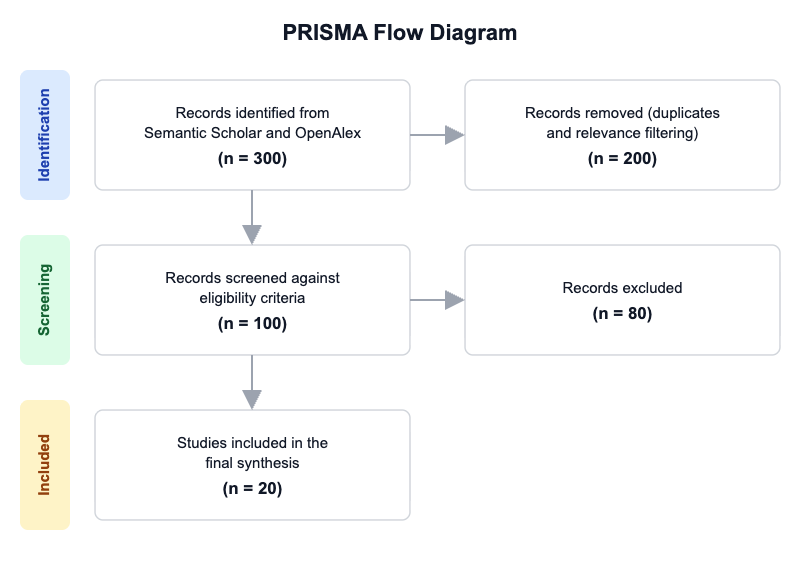
Initial database searching identified 300 records. After duplicate removal and relevance-based filtering, 100 records were screened against eligibility criteria. Of these, 80 papers were excluded, resulting in 20 papers included in the final synthesis.
PRISMA Flow Diagram
Eligibility criteria included:
- Alzheimer Population: Does the study include human participants with Alzheimer's disease or a clearly defined Alzheimer's disease stage or population at risk for Alzheimer's disease?
- Treatment Focus: Does the study evaluate a treatment or intervention intended to prevent, slow, modify, or manage Alzheimer's disease or its clinically relevant symptoms?
- Research Study: Does the paper report original clinical, translational, biomarker, or intervention research rather than being solely an opinion, editorial, protocol, or narrative overview?
- Treatment Outcomes: Does the study report treatment-related outcomes such as cognition, function, disease progression, biomarkers, quality of life, or safety?
- Current Relevance: Does the study provide evidence relevant to the current Alzheimer's treatment landscape, including an emerging therapy, a disease-modifying treatment, a non-pharmacological intervention, or a treatment-related biomarker?
Note on included studies: Several retained papers are reviews, perspectives, or evidence syntheses rather than original clinical, translational, or intervention research, including [7], [8], [9], [10], [11], [12], [16], [18], [19], and [20]. They were retained because they provide treatment-level synthesis, regulatory context, mechanistic interpretation, or implementation guidance directly relevant to the research question. All included empirical studies otherwise met the stated population, treatment, and outcome requirements.
2.3 Data Extraction and Synthesis
Data extraction focused on the following variables:
- Citation Year: Extract the first author or study group and publication year.
- Therapy: Identify the drug, biologic, device, or non-pharmacological intervention evaluated, including dose or regimen when reported.
- Mechanism: Describe the therapeutic target or biological mechanism, such as amyloid, tau, neuroinflammation, synaptic function, or lifestyle-related pathway.
- Study Design: Report the study design, clinical trial phase, comparator, duration, and setting.
- Population: Describe participant number, disease stage, diagnostic status, and key eligibility characteristics.
- Efficacy: Extract the primary efficacy outcomes and quantitative effect estimates or changes in cognition, function, biomarkers, or disease progression.
- Safety: Summarize adverse events, serious adverse events, treatment discontinuations, and clinically important risks.
- Development Status: State the development or regulatory status as of the publication, including trial stage, approval status, or research readiness.
Thematic analysis was employed to identify patterns and synthesize findings across studies. Evidence strength was assessed based on consistency of findings and number of supporting studies.
3. Results
3.1 Characteristics of Included Studies
| Study and year | Study type | Population/sample | Intervention | Main outcomes | Development or implementation focus |
|---|---|---|---|---|---|
| Mummery et al. 2023 [1] | Phase 1b randomized trial | 46 patients with mild AD | Intrathecal MAPTRx | CSF total tau, safety | Investigational tau antisense oligonucleotide |
| Paczynski et al. 2025 [2] | Retrospective clinical-practice cohort | 234 early symptomatic AD patients | Lecanemab 10 mg/kg every 2 weeks | ARIA, infusion reactions, withdrawal | Specialty-clinic implementation |
| Baker et al. 2025 [3] | Phase 3 randomized trial | 296 sedentary adults with amnestic MCI | Aerobic versus stretching/balance exercise | Global cognition, hippocampal volume | Non-pharmacological intervention |
| Honig et al. 2024 [4] | Phase 3 safety analysis and extension | 1,795 core-study participants; 1,612 treated in core plus extension | Lecanemab versus placebo | ARIA, infusion reactions, mortality | Pivotal trial safety |
| Shulman et al. 2023 [5] | Phase 2 randomized trial | 654 early AD participants enrolled; 650 dosed | Gosuranemab | CDR-SB, CSF N-terminal tau | Investigational anti-tau antibody |
| Ebell et al. 2024 [6] | Systematic review and meta-analysis | 23,202 participants across evaluated trials | Eight anti-amyloid antibodies | Cognitive, functional, and ARIA outcomes | Clinical benefit-harm assessment |
| Cummings et al. 2024 [7] | Therapeutic-development review | AD populations discussed generally | Combination therapy | Development strategies and biomarkers | Add-on and co-development models |
| Cummings 2025 [8] | Therapeutic perspective | Early AD trial populations | Aducanumab, lecanemab, donanemab | Clinical decline, amyloid PET, ARIA | Risk management and future delivery |
| Cummings et al. 2023 [9] | Therapeutic-pipeline review | AD trial populations | Non-amyloid and non-tau agents | Target classes and biomarkers | Investigational disease modification |
| Courade et al. 2025 [10] | Perspective | AD therapy research populations | Amyloid- and tau-directed approaches | Tau PET and preliminary cognition | Next-generation therapy development |
| Kim et al. 2025 [11] | Therapeutic review | AD treatment populations | Second-generation anti-amyloid antibodies | Amyloid removal and clinical outcomes | Approved and emerging antibodies |
| Perneczky et al. 2023 [12] | Opinion and evidence synthesis | Early AD treatment populations | Protofibril-directed antibody therapy | Clinical progression and amyloid PET | Translation of trial evidence |
| Shields et al. 2024 [13] | Retrospective cohort | 71 biomarker-positive treated patients | Lecanemab | ARIA and infusion reactions | Regional medical-center experience |
| Li et al. 2025 [14] | Multicentre real-world cohort | 407 treated patients in China | Lecanemab every 2 weeks | Biomarkers, cognition, ARIA | International implementation |
| Bregman et al. 2025 [15] | Tertiary-care observational cohort | 86 initiated; 53 at 6 months; 31 at 12 months | Lecanemab | MMSE, ARIA, discontinuation | Real-world early AD treatment |
| Rafii and Aisen 2025 [16] | Narrative review | AD continuum | Amyloid-lowering antibodies | Amyloid reduction and clinical decline | Regulatory and practice integration |
| Lusk et al. 2025 [17] | Nationwide retrospective study | 3,402 anti-amyloid recipients | Lecanemab or donanemab | Cardiovascular and cerebrovascular outcomes | Uptake and equity |
| Zhang et al. 2024 [18] | Disease-modifying therapy review | AD treatment populations | Antibodies, drugs, stimulation, lifestyle | Trial progress and applications | Clinical-trial landscape |
| Smith et al. 2025 [19] | Health-system evidence review | Early AD populations | Lecanemab and donanemab | Efficacy, safety, system capacity | Canadian implementation |
| Cummings 2023 [20] | Therapeutic perspective | AD populations discussed generally | Anti-amyloid antibodies | Clinical decline and ARIA | Transformative-treatment interpretation |
The literature is dominated by anti-amyloid treatment, particularly lecanemab, with a transition from controlled efficacy and safety trials to specialty-clinic, hospital, national, and international implementation. Tau-directed therapies provide mechanistic and biomarker evidence but less convincing clinical benefit. Exercise contributes a non-pharmacological comparator, while reviews identify a broad investigational pipeline targeting inflammation, synaptic plasticity, metabolism, vascular biology, and combination strategies.
3.2 Thematic Findings
3.2.1 Anti-amyloid antibodies produce statistically detectable but modest clinical benefit
The strongest clinical evidence supports amyloid-lowering monoclonal antibodies as disease-modifying treatments for early symptomatic AD. Across randomized placebo-controlled trials, pooled improvements were small: ADAS-Cog standardized mean difference −0.07 (95% CI −0.10 to −0.04), MMSE mean difference 0.32 points (95% CI 0.13–0.50), CDR-SB mean difference −0.18 points (95% CI −0.34 to −0.03), and combined functional outcomes standardized mean difference 0.09 (95% CI 0.05–0.13). None exceeded the stated minimal clinically important difference. For CDR-SB at 18 months, reported improvements were 0.43 points for lecanemab, 0.18 points for aducanumab, and 0.59 points for donanemab, compared with a 1–2-point minimal clinically important difference [6].
These findings contrast slightly in emphasis across the literature. Trial-focused and therapeutic reviews describe approximately 30% slowing of cognitive and functional decline over 18 months and associate clinical benefit with amyloid PET reduction below 15–25 Centiloids [8]. Evidence reviews acknowledge statistically significant group differences but note continuing debate about whether the magnitude is meaningful for individual patients [16]. The difference is methodological rather than necessarily factual: relative slowing can coexist with an absolute between-group difference below a patient-centered threshold. (Note: these studies primarily examined people with mild cognitive impairment due to AD or mild AD dementia, which partially matches the question population of people receiving Alzheimer’s treatment across disease stages; findings should be interpreted considering this difference.) Confidence: Moderate, because controlled trials and evidence syntheses converge on benefit, but clinical meaningfulness remains contested.
3.2.2 Lecanemab is feasible in practice, but ARIA and infusion reactions constrain eligibility and delivery
Real-world implementation generally confirms that lecanemab can be delivered in specialized settings, but safety rates vary by cohort, monitoring denominator, disease stage, and follow-up. In a specialty clinic, infusion reactions occurred in 87 of 234 patients (37%), while 42 of 194 patients at risk for ARIA (22%) developed ARIA over an average treatment period of 6.5 months; 29 patients (15%) developed ARIA-E with or without ARIA-H, 13 (6.7%) developed isolated ARIA-H, 11 (5.7%) developed symptomatic ARIA, and 2 (1.0%) developed clinically severe symptoms. Ten patients (4.3%) withdrew because of ARIA and 23 (9.8%) withdrew overall [2].
The pivotal safety analysis reported infusion-related reactions in 24.5%, ARIA-H microhemorrhages in 16.0%, and ARIA-E in 13.6% across the core study and extension. ARIA-E was more common among APOE ε4 carriers, reaching 34.5% among homozygotes; two lecanemab-treated extension participants with intracerebral hemorrhage were receiving tissue plasminogen activator or anticoagulant therapy [4]. Community and international cohorts reported ARIA in 24% of 50 patients with follow-up MRI, 12.15% of 407 patients, and 18.6% of patients, respectively; infusion reactions occurred in 37%, 22.22%, and 22.1% in the corresponding cohorts [13], [14], [15].
Differences may reflect selection criteria, APOE distribution, baseline microhemorrhage burden, MRI surveillance, treatment duration, and denominator definition. In the Chinese cohort, higher baseline microhemorrhage burden predicted adverse events, whereas APOE ε4 status was not associated with adverse events; this contrasts with the pivotal safety analysis and may reflect population-specific or implementation-specific differences [14]. (Note: the real-world studies examined selected early-stage or biomarker-confirmed treatment recipients, and one included moderate AD dementia, which partially matches the question population of Alzheimer’s disease across stages; findings should be interpreted considering this difference.) Confidence: Strong for the existence of clinically important ARIA and infusion risks; Moderate for precise event rates, because rates are consistent in direction but vary across settings.
3.2.3 Tau therapies demonstrate target engagement without established clinical efficacy
Tau-directed therapies provide a clear contrast between biological activity and patient-level outcomes. MAPTRx, an intrathecal antisense oligonucleotide designed to inhibit MAPT expression, produced dose-dependent CSF total-tau reductions exceeding 50% from baseline at 24 weeks after the final dose in the 60 mg four-dose and 115 mg two-dose groups. Adverse events occurred in 94% of treated participants and 75% of placebo recipients, but all were mild or moderate and no serious adverse events occurred in MAPTRx-treated participants [1]. (Note: this study examined 46 patients with mild AD in a phase 1b trial, which partially matches the question population of Alzheimer’s disease across stages; findings should be interpreted considering this difference.)
Gosuranemab similarly reduced CSF unbound N-terminal tau significantly at week 76 for every dose, with P < 0.0001, but did not improve CDR-SB at week 78. Adjusted mean CDR-SB changes were 1.85 for placebo, 2.20 for low-dose gosuranemab, 2.24 for intermediate-dose gosuranemab, and 1.85 for high-dose gosuranemab. Serious adverse events were 12.1% for placebo, 10.3% for low dose, 12.3% for intermediate dose, and 11.7% for high dose [5]. (Note: this study examined participants aged 50–80 years with MCI due to AD or mild AD dementia, which partially matches the question population of Alzheimer’s disease across stages; findings should be interpreted considering this difference.)
The combined evidence indicates that lowering a CSF tau measure is not sufficient evidence of clinical disease modification. Perspective literature reports early tau PET slowing and preliminary cognitive signals, but without quantitative effect estimates or confirmatory trial-level evidence [10]. Confidence: Moderate for target engagement and Limited for clinical benefit, because biomarker responses are reproducible in the supplied evidence while clinical outcomes are absent or null.
3.2.4 Exercise may stabilize cognition, but intensity was not a decisive treatment variable
The EXERT trial found no significant cognitive difference between moderate-to-high-intensity aerobic exercise and low-intensity stretching, balance, and range-of-motion exercise over 18 months. The regression estimate was −0.078 with standard error 0.074 and P = 0.3. Neither group experienced cognitive decline at 12 months, and mean 12-month hippocampal volume loss was 0.51% in both groups. Supervised-session attendance was 81% for aerobic training and 87% for stretching, balance, and range-of-motion exercise [3].
The finding suggests that supported physical activity may be associated with cognitive stability, but it does not establish that higher intensity is superior or that exercise prevents AD progression. (Note: this study examined sedentary older adults with amnestic MCI rather than established Alzheimer’s dementia, which partially matches the question population of Alzheimer’s disease across stages; findings should be interpreted considering this difference.) Confidence: Limited to Moderate, because the randomized design and high adherence are strengths, but the comparison lacked an untreated group and enrolled a pre-dementia population.
3.2.5 Treatment development is shifting toward biomarker-guided, multimodal, and combination strategies
The therapeutic pipeline extends beyond amyloid and tau. Non-amyloid and non-tau candidates constitute 70% of the development pipeline described in one review, with inflammation and synaptic plasticity/neuroprotection represented most heavily. Other targets include APOE4 effects, lipid and lipoprotein biology, neurogenesis, oxidative stress, bioenergetics, vascular factors, cell death, growth factors, hormones, circadian regulation, and epigenetic pathways [9]. Combination therapy is proposed to address simultaneous amyloid, tau, inflammatory, synaptic, and co-pathological processes, but no specific combination regimen has yet demonstrated combination-specific efficacy or safety in the supplied evidence [7].
Blood-based biomarkers, subcutaneous formulations, and improved treatment-selection systems are proposed to reduce diagnostic and monitoring burdens [8], [11]. However, these approaches remain developmental rather than validated replacements for the clinical-trial monitoring systems described in the evidence. Confidence: Limited, because the direction of innovation is clear but treatment-level outcomes are not yet available.
3.2.6 Access and health-system capacity are emerging determinants of treatment benefit
Nationwide implementation data indicate that anti-amyloid recipients were younger, more often White and non-Hispanic, more often male, more likely to have commercial insurance or Medicare, and more likely to live in socioeconomically advantaged areas than users of oral dementia medications. Among 3,402 anti-amyloid recipients, 37.5% had a prior major adverse cardiovascular or cerebrovascular event, 2.7% had a new major adverse cardiovascular or cerebrovascular event within 12 months (95% CI 2.1%–3.2%), and 1.7% had a new cerebrovascular event (95% CI 1.3%–2.1%) [17].
Canadian implementation analysis emphasizes that PET or CSF confirmation and serial ARIA monitoring may strain health-system capacity, even when the treatment is clinically appropriate [19]. These findings indicate that effectiveness depends not only on pharmacology but also on diagnostic access, MRI capacity, insurance, geography, cardiovascular assessment, and specialist infrastructure. (Note: the nationwide study examined routine-care recipients rather than a randomized AD treatment population, which partially matches the question population of Alzheimer’s disease patients receiving treatment; findings should be interpreted considering this difference.) Confidence: Moderate, because the implementation pattern is coherent, although generalizability beyond the represented health systems is uncertain.
3.3 Summary of Evidence
| Theme | Key Finding | Population Applicability | Effect Direction | Confidence Level | Supporting Studies |
|---|---|---|---|---|---|
| Anti-amyloid clinical efficacy | ADAS-Cog SMD −0.07 (95% CI −0.10 to −0.04); MMSE mean difference 0.32 points (95% CI 0.13–0.50); CDR-SB mean difference −0.18 points (95% CI −0.34 to −0.03); none exceeded MCID | Mainly early AD and MCI due to AD; partial match to all AD stages | Positive but modest | Moderate | Ebell et al. [6], Cummings [8], Rafii and Aisen [16] |
| Lecanemab safety | ARIA occurred in 22% of at-risk patients; symptomatic ARIA occurred in 5.7%; infusion reactions occurred in 37% in one specialty clinic | Selected early symptomatic AD treated in specialist settings; partial match to all AD stages | Negative risk burden | Strong | Paczynski et al. [2], Honig et al. [4], Bregman et al. [15] |
| Tau biomarker engagement | MAPTRx reduced CSF total tau by more than 50% in selected dose groups; gosuranemab reduced CSF unbound N-terminal tau with P < 0.0001 | Mild AD or MCI/mild AD dementia; partial match to all AD stages | Positive biomarker, uncertain clinical effect | Moderate | Mummery et al. [1], Shulman et al. [5] |
| Tau clinical efficacy | Gosuranemab CDR-SB change was 1.85 for placebo, 2.20 low dose, 2.24 intermediate dose, and 1.85 high dose | Early AD; partial match to all AD stages | Null | Limited | Shulman et al. [5] |
| Exercise | Aerobic versus stretching/balance regression −0.078, SE 0.074, P = 0.3; hippocampal volume loss 0.51% in both groups | Amnestic MCI rather than established dementia; partial match | Null between active interventions | Limited | Baker et al. [3] |
| Implementation and equity | Anti-amyloid recipients had 2.7% new MACCE within 12 months (95% CI 2.1%–3.2%) and 1.7% new cerebrovascular events (95% CI 1.3%–2.1%) | Routine-care anti-amyloid recipients; partial match to trial populations | Mixed | Moderate | Lusk et al. [17], Smith et al. [19] |
| Combination and non-amyloid development | Non-amyloid, non-tau agents constitute 70% of the described pipeline; no combination-specific efficacy estimate is available | Development populations not specified | Promising but unproven | Limited | Cummings et al. [9], Cummings et al. [7] |
4. Discussion
4.1 Principal Findings and Their Interpretation
The central interpretation is that Alzheimer’s treatment has moved from biological plausibility toward demonstrable, though quantitatively modest, disease modification. Amyloid-directed antibodies appear to work because they engage pathogenic aggregated amyloid species and activate microglial clearance, producing substantial plaque reduction; the association between levels below 15–25 Centiloids and clinical benefit supports a biological exposure-response framework [8]. However, the pooled clinical differences remain below minimal clinically important thresholds, indicating that statistical slowing and meaningful preservation of everyday function are related but not interchangeable concepts.
The mechanistic evidence also clarifies why tau results are not yet equivalent to amyloid results. MAPTRx reduces MAPT expression and CSF total tau, while gosuranemab binds extracellular N-terminal tau and reduces unbound CSF tau. These findings demonstrate target engagement, but the gosuranemab trial shows that a large biomarker response can coexist with no favorable CDR-SB effect. This may indicate that treatment timing, intracellular versus extracellular tau biology, disease-stage dependence, or the measured CSF compartment matters more than biomarker reduction alone. The evidence therefore supports tau as a biologically credible target but not yet as a clinically validated therapeutic class.
Safety is not a peripheral issue but part of the treatment mechanism’s clinical translation. Amyloid removal and microglial activation occur in a brain already vulnerable to vascular amyloid, microhemorrhages, and impaired vascular integrity. The concentration of ARIA among APOE ε4 homozygotes in trial data and among patients with higher baseline microhemorrhage burden in Chinese practice suggests that host vascular and genetic context modifies treatment risk [4], [14]. The strongest conclusion is consequently conditional: anti-amyloid antibodies are most defensible for carefully selected, biomarker-confirmed early-stage patients who can undergo repeated MRI surveillance.
The synthesis also reveals that implementation is becoming a determinant of effectiveness. Unequal uptake by race, insurance, and neighborhood socioeconomic advantage means that a therapy can be biologically effective yet socially ineffective if access is restricted to well-resourced patients. Confidence is strongest for the existence of anti-amyloid target engagement and safety risks, moderate for clinical slowing, and limited for tau, exercise, and combination approaches.
4.2 Comparison with Existing Literature and Resolution of Contradictions
The apparent contradiction between reports of approximately 30% slowing and the meta-analysis conclusion that effects do not exceed minimal clinically important differences is best understood as a difference between relative disease-course measures and absolute patient-centered change. A relative slowing estimate can be statistically persuasive while producing a small mean separation on CDR-SB or ADAS-Cog. These are not mutually exclusive findings: one describes the rate of progression, whereas the other evaluates whether the accumulated difference crosses a threshold considered meaningful to patients and clinicians [8], [6].
The contrast between controlled-trial safety rates and real-world ARIA rates also should not be treated as simple replication failure. Trial participants are selected through biomarker, MRI, medical, and eligibility criteria, whereas routine-care cohorts differ in baseline microhemorrhage burden, disease severity, APOE composition, monitoring duration, and clinical infrastructure. The finding that symptomatic ARIA was 27% in patients with mild dementia but 1.8% in those with mild cognitive impairment or very mild dementia in one specialty clinic suggests that disease stage may influence risk, although the study design cannot establish causality [2]. Conversely, APOE ε4 status predicted risk in the pivotal analysis but not in the Chinese cohort, and no supplied evidence definitively resolves whether this reflects ethnic variation, sample composition, selection, or measurement differences [4], [14].
The most important biological contradiction is the divergence between tau biomarker engagement and clinical outcome. Gosuranemab reduced CSF unbound N-terminal tau at every dose but did not improve CDR-SB, while MAPTRx reduced total tau without a clinical efficacy endpoint. This may reflect the possibility that tau reduction occurred after irreversible neuronal injury, that CSF tau is an incomplete proxy for pathogenic tau propagation, or that the trials lacked sufficient duration or stage-specific enrichment; however, the supplied studies do not establish which explanation is correct. Publication bias also remains possible because positive amyloid results have generated extensive commentary, whereas unsuccessful or discontinued programs may be less visible. No evidence in the supplied literature supports a no-threshold therapeutic dose-response relationship for treatment exposure; therefore, policy should not assume that any dose is risk-free, but the data do not justify a population-level “no safe threshold” claim analogous to environmental exposure research.
4.3 Practical Implications
Clinically, anti-amyloid antibodies are most applicable to patients with early symptomatic, biomarker-confirmed AD who can comply with intravenous treatment and serial MRI monitoring. Clinicians should explicitly discuss the modest average clinical benefit alongside ARIA, infusion reactions, baseline microhemorrhage risk, APOE-related risk signals, anticoagulant or thrombolytic concerns, and the possibility of treatment withdrawal. Patients with more advanced disease or limited access to specialist monitoring are not directly represented by the strongest efficacy evidence, so treatment decisions in those groups require particular caution.
For health systems, treatment capacity must include confirmatory PET or CSF testing, MRI surveillance, infusion management, emergency evaluation of symptomatic ARIA, and multidisciplinary selection. The observed socioeconomic pattern of uptake indicates that systems relying on specialist infrastructure alone may preferentially treat younger, White, insured, and socioeconomically advantaged patients [17]. Public-health planning should therefore address geographic and financial access rather than treating approval as equivalent to availability.
Regulatory and policy decisions should distinguish statistically significant slowing from patient-perceived benefit. The absence of evidence for a no-threshold exposure-risk relationship means that no specific minimum dose or exposure level can be declared universally safe; nevertheless, the current data support individualized risk stratification rather than broad claims that all exposure is harmful. For tau, exercise, and combination therapies, recommendations should remain investigational because target engagement or cognitive stability has not yet established disease modification.
4.4 Strengths and Limitations
This review benefits from integrating randomized trials, meta-analysis, mechanistic biomarker studies, real-world cohorts, implementation evidence, and therapeutic-pipeline reviews. That combination reveals patterns that individual studies cannot: the distinction between biomarker and clinical efficacy, the consistency of ARIA as a treatment-limiting risk, and the importance of health-system infrastructure.
The included evidence has important limitations. Real-world lecanemab studies are retrospective or observational, often lack untreated comparators, use different MRI and outcome denominators, and have short follow-up. The EXERT population had MCI rather than established dementia, and tau trials were early-stage and not designed to establish long-term clinical benefit. Several included papers are perspectives or reviews rather than original research. The evidence base also provides limited information about diverse racial, socioeconomic, geographic, and advanced-disease populations.
Limitations of this review include reliance on the supplied paper data, abstract-level extraction, incomplete reporting of eligibility and trial characteristics in several papers, and the absence of a formal risk-of-bias assessment. The evidence-strength labels are therefore qualitative and should not be interpreted as formal certainty-of-evidence ratings.
5. Gaps and Future Directions
The most important gap is the absence of long-term, comparative evidence showing whether modest trial-level slowing produces meaningful preservation of independence, caregiver outcomes, or quality of life in routine practice. Future studies should compare treated and untreated biomarker-confirmed patients across mild cognitive impairment, mild dementia, moderate dementia, and diverse health systems, with harmonized cognitive, functional, MRI, and mortality outcomes.
The conflicting APOE and microhemorrhage findings require prospective risk-stratification studies that jointly evaluate APOE genotype, baseline MRI burden, anticoagulant exposure, vascular disease, and disease stage. Real-world cohorts should use standardized ARIA definitions and report denominators consistently. Tau research requires trials that connect CSF and PET target engagement to clinical outcomes and that distinguish intracellular tau reduction from extracellular tau neutralization. Combination trials should compare monotherapy, approved anti-amyloid standard care, and add-on treatment while accounting for biomarker changes induced by the antibody. Finally, implementation research must directly examine underrepresented populations, Medicaid recipients, rural patients, non-White groups, and people unable to access PET, CSF, MRI, or infusion infrastructure.
6. Conclusion
The latest evidence supports anti-amyloid monoclonal antibodies as the leading disease-modifying treatment strategy for early Alzheimer’s disease, but the most defensible conclusion is one of conditional benefit rather than transformation without qualification. Pooled improvements were ADAS-Cog standardized mean difference −0.07 (95% CI −0.10 to −0.04), MMSE mean difference 0.32 points (95% CI 0.13–0.50), and CDR-SB mean difference −0.18 points (95% CI −0.34 to −0.03), with none exceeding the stated minimal clinically important difference [6]. In practice, lecanemab was deliverable but associated with ARIA in 22% of at-risk specialty-clinic patients, symptomatic ARIA in 5.7%, and infusion reactions in 37% [2].
These findings primarily apply to selected patients with mild cognitive impairment due to AD or mild AD dementia who have biomarker confirmation and access to specialist monitoring. They should not be generalized automatically to moderate or advanced disease, although real-world evidence includes some patients outside the pivotal early-stage population. Tau approaches have established biological activity but not yet reliable clinical efficacy, and exercise may support cognitive stability without evidence that higher intensity is superior. The most important unresolved question is whether biomarker-confirmed, carefully monitored treatment produces durable, patient-important preservation of independence in routine and socially diverse populations. Resolving that question will determine whether current therapies represent a clinically meaningful advance for broad populations or primarily a promising but resource-intensive benefit for selected early-stage patients.
References
- Mummery, C. J., Börjesson-Hanson, A., Blackburn, D. J., Vijverberg, E. G. B., De Deyn, P. P., Ducharme, S., Jonsson, M., Schneider, A., Rinne, J. O., Ludolph, A. C., Bodenschatz, R., Kordasiewicz, H., Swayze, E. E., Fitzsimmons, B., Mignon, L., Moore, K. M., Yun, C., Baumann, T., Li, D., . . . Lane, R. M. (2023). Tau-targeting antisense oligonucleotide MAPTRx in mild Alzheimer's disease: A phase 1b, randomized, placebo-controlled trial. Nature Medicine, 29(6), 1437–1447. https://doi.org/10.1038/s41591-023-02326-3
- Paczynski, M., Hofmann, A., Posey, Z., Gregersen, M., Rudman, M., Ellington, D., Aldinger, M., Musiek, E. S., Holtzman, D. M., Bateman, R. J., Long, J. M., Ghoshal, N., Carr, D. B., Dow, A., Namazie-Kummer, S., Jana, N., Xiong, C., Morris, J. C., Benzinger, T. L. S., . . . Snider, B. J. (2025). Lecanemab treatment in a specialty memory clinic. JAMA Neurology, 82(7), 655–665. https://doi.org/10.1001/jamaneurol.2025.1232
- Baker, L. D., Pa, J. A., Katula, J. A., Aslanyan, V., Salmon, D. P., Jacobs, D. M., Chmelo, E. A., Hodge, H., Morrison, R., Matthews, G., Brewer, J., Jung, Y., Rissman, R. A., Taylor, C., Léger, G. C., Messer, K., Evans, A. C., Okonkwo, O. C., Shadyab, A. H., . . . Feldman, H. H. (2025). Effects of exercise on cognition and Alzheimer's biomarkers in a randomized controlled trial of adults with mild cognitive impairment: The EXERT study. Alzheimer's & Dementia, 21(4), e14586. https://doi.org/10.1002/alz.14586
- Honig, L. S., Sabbagh, M. N., van Dyck, C. H., Sperling, R. A., Hersch, S., Matta, A., Giorgi, L., Gee, M., Kanekiyo, M., Li, D., Purcell, D., Dhadda, S., Irizarry, M., & Kramer, L. (2024). Updated safety results from phase 3 lecanemab study in early Alzheimer's disease. Alzheimer's Research & Therapy, 16(1), 105. https://doi.org/10.1186/s13195-024-01441-8
- Shulman, M., Kong, J., O'Gorman, J., Ratti, E., Rajagovindan, R., Viollet, L., Huang, E., Sharma, S., Racine, A. M., Czerkowicz, J., Graham, D., Li, Y., Hering, H., & Budd Haeberlein, S. (2023). TANGO: A placebo-controlled randomized phase 2 study of efficacy and safety of the anti-tau monoclonal antibody gosuranemab in early Alzheimer's disease. Nature Aging, 3(12), 1591–1601. https://doi.org/10.1038/s43587-023-00523-w
- Ebell, M. H., Barry, H. C., Baduni, K., & Grasso, G. (2024). Clinically important benefits and harms of monoclonal antibodies targeting amyloid for the treatment of Alzheimer disease: A systematic review and meta-analysis. Annals of Family Medicine, 22(1), 50–62. https://doi.org/10.1370/afm.3050
- Cummings, J. L., Osse, A. M. L., Kinney, J. W., Cammann, D., & Chen, J. (2024). Alzheimer's disease: Combination therapies and clinical trials for combination therapy development. CNS Drugs, 38(8), 613–624. https://doi.org/10.1007/s40263-024-01103-1
- Cummings, J. L. (2025). Maximizing the benefit and managing the risk of anti-amyloid monoclonal antibody therapy for Alzheimer's disease: Strategies and research directions. Neurotherapeutics, 22(3), e00570. https://doi.org/10.1016/j.neurot.2025.e00570
- Cummings, J. L., Osse, A. M. L., & Kinney, J. W. (2023). Alzheimer's disease: Novel targets and investigational drugs for disease modification. Drugs, 83(15), 1387–1408. https://doi.org/10.1007/s40265-023-01938-w
- Courade, J.-P., Zetterberg, H., Höglinger, G. U., & Dewachter, I. (2025). The evolving landscape of Alzheimer's disease therapy: From Aβ to tau. Cell, 188(26), 7337–7354. https://doi.org/10.1016/j.cell.2025.11.033
- Kim, B.-H., Kim, S., Nam, Y., Park, Y. H., Shin, S. M., & Moon, M. (2025). Second-generation anti-amyloid monoclonal antibodies for Alzheimer's disease: Current landscape and future perspectives. Translational Neurodegeneration, 14(1), 6. https://doi.org/10.1186/s40035-025-00465-w
- Perneczky, R., Jessen, F., Grimmer, T., Levin, J., Flöel, A., Peters, O., & Froelich, L. (2023). Anti-amyloid antibody therapies in Alzheimer's disease. Brain, 146(3), 842–849. https://doi.org/10.1093/brain/awad005
- Shields, L. B. E., Hust, H., Cooley, S. D., Cooper, G. E., Hart, R. N., Dennis, B. C., Freeman, S. W., Cain, J. F., Shang, W. Y., Wasz, K. M., Orr, A. T., Shields, C. B., Barve, S. S., & Pugh, K. G. (2024). Initial experience with lecanemab and lessons learned in 71 patients in a regional medical center. The Journal of Prevention of Alzheimer's Disease, 11(6), 1549–1562. https://doi.org/10.14283/jpad.2024.159
- Li, L.-L., Wang, R.-Z., Wang, Z., Hu, H., Xu, W., Zhu, L., Sun, Y., Chen, K.-L., Chen, S.-F., He, X.-Y., Yuan, M.-Y., Huang, Y.-Y., Liu, X.-Y., Liu, P., Ye, Q.-Y., Wang, J., Ju, Z.-Z., Zhang, W., Hu, B., . . . Yu, J.-T. (2025). Safety and short-term outcomes of lecanemab for Alzheimer's disease in China: A multicentre study. Brain, 149(6), 1973–1985. https://doi.org/10.1093/brain/awaf427
- Bregman, N., Nathan, T., Shir, D., Omer, N., Levy, M. H., Bar David, A., Aizenstien, O., Lotan, E., Alcalay, Y., Abu Awad, A., Gadoth, A., Ash, E., & Shiner, T. (2025). Lecanemab in clinical practice: Real-world outcomes in early Alzheimer's disease. Alzheimer's Research & Therapy, 17(1), 119. https://doi.org/10.1186/s13195-025-01763-1
- Rafii, M. S., & Aisen, P. S. (2025). Amyloid-lowering immunotherapies for Alzheimer disease: Current status and future directions. Nature Reviews Neurology, 21(9), 490–498. https://doi.org/10.1038/s41582-025-01123-5
- Lusk, J. B., Johnson, K. G., Liu, A., Mac Grory, B. C., Li, F., Whitson, H., O'Brien, R. J., Aymes, S., Hammill, B. G., & O'Brien, E. C. (2025). Characteristics and safety outcomes of patients treated with lecanemab or donanemab in routine clinical practice: A nationwide study. Alzheimer's & Dementia, 21(S6), e098805. https://doi.org/10.1002/alz70860_098805
- Zhang, Y., Chen, J., Li, Y., Jiao, B., & Luo, S. (2024). Disease-modifying therapies for Alzheimer's disease: Clinical trial progress and opportunity. Ageing Research Reviews, 103, 102595. https://doi.org/10.1016/j.arr.2024.102595
- Smith, E. E., Phillips, N. A., Feldman, H. H., Borrie, M., Ganesh, A., Henri-Bhargava, A., Desmarais, P., Frank, A., Badhwar, A., Barlow, L., Bartha, R., Best, S., Bethell, J., Bhangu, J., Black, S. E., Bocti, C., Bronskill, S. E., Burhan, A. M., Calon, F., . . . Chertkow, H. (2025). Use of lecanemab and donanemab in the Canadian healthcare system: Evidence, challenges, and areas for future research. The Journal of Prevention of Alzheimer's Disease, 12(3), 100068. https://doi.org/10.1016/j.tjpad.2025.100068
- Cummings, J. (2023). Anti-amyloid monoclonal antibodies are transformative treatments that redefine Alzheimer's disease therapeutics. Drugs, 83(7), 569–576. https://doi.org/10.1007/s40265-023-01858-9