

Latest Research on Anti-Aging: A Thematic Literature Review of Mechanisms, Biomarkers, and Interventions
Abstract
Latest anti-aging research converges on three dominant strategies: targeting conserved nutrient-sensing and metabolic pathways, suppressing cellular senescence, and using epigenetic biomarkers to evaluate biological age and intervention response. Across the reviewed evidence, metformin, rapamycin/rapalogs, caloric restriction, intermittent fasting, and senotherapeutics repeatedly showed favorable effects on hallmarks linked to aging, while epigenetic clocks emerged as the most practical tool for measuring biological age and intervention efficacy [1], [2], [20], [13], [5]. Mechanistically, anti-aging effects were most often tied to improved nutrient sensing, autophagy, mitochondrial function, AMPK signaling, mTOR inhibition, and reduced senescence-associated secretory phenotype (SASP) activity. Human evidence is strongest for rapamycin derivatives improving immune, cardiovascular, and integumentary parameters, whereas metformin showed mechanistic effects in human immune cells and broad hallmarks-based rationale but remains less definitively established as a gerotherapeutic [2], [19], [1]. Dietary restriction and calorie restriction mimetics also showed consistent longevity-related benefits in animal models, although effects on health and lifespan were not always aligned and depended on genotype and baseline body weight [20], [12]. Senescence-targeted interventions were supported by converging preclinical and early translational evidence, but biomarker heterogeneity and incomplete human validation remain major constraints. Overall, the literature supports a shift from single-disease treatment toward multi-pathway geroscience, while underscoring the need for better long-term human trials and harmonized outcome measures.
1. Introduction
Aging research has increasingly moved from describing decline to identifying modifiable biological processes that may delay it. This shift is driven by the recognition that aging is not merely time-dependent wear, but a complex process shaped by conserved mechanisms such as nutrient-sensing dysfunction, loss of proteostasis, mitochondrial impairment, telomere attrition, epigenetic alteration, cellular senescence, stem cell exhaustion, and altered intercellular communication [8], [17]. These hallmarks are important because they provide a framework for interventions that may influence healthspan rather than only treating isolated diseases. In parallel, the rising burden of age-related disorders has intensified interest in therapies that act upstream of multimorbidity, including pharmacological agents, dietary strategies, and biomarker-guided evaluation tools.
Recent anti-aging literature is notable for its mechanistic diversity. Metformin and rapamycin are repeatedly discussed as gerotherapeutics because they affect nutrient sensing and mTOR-related signaling, while senolytics and senomorphics directly target senescent cells and their secretory phenotype [1], [6], [13]. At the same time, caloric restriction, intermittent fasting, exercise, sleep quality, and circadian rhythm calibration continue to attract attention as feasible lifestyle approaches to delay aging phenotypes [9], [17]. Yet the field remains fragmented: some interventions show strong mechanistic plausibility but limited human validation, whereas others are clinically tested but rely on heterogeneous endpoints that are difficult to compare. Biomarker development adds another layer, since epigenetic clocks promise objective assessment of biological age but still vary in construction, predictive scope, and quality of validation [5].
The central question, therefore, is which anti-aging strategies currently have the most credible support, through what mechanisms they appear to work, and how convincingly the latest evidence translates from models to humans. This review synthesizes recent work on pharmacological, dietary, cellular, and biomarker-based anti-aging approaches, emphasizing convergent mechanisms, translational promise, and unresolved contradictions.
2. Methods
2.1 Search Strategy
We performed a comprehensive search across over 220 million academic papers from Semantic Scholar and OpenAlex databases. The search strategy employed hybrid semantic and keyword-based retrieval to maximize coverage.
Search queries included:
- "Anti-aging interventions and mechanisms in aging research latest studies"
- "Longevity therapeutics senolytics senescence and healthy aging recent papers"
- "Anti-aging biomarkers epigenetic clocks and biological age in humans"
- "Age-related interventions calorie restriction metformin rapamycin and lifespan"
- "Geroscience rejuvenation cellular aging and longevity treatments review"
2.2 Study Selection
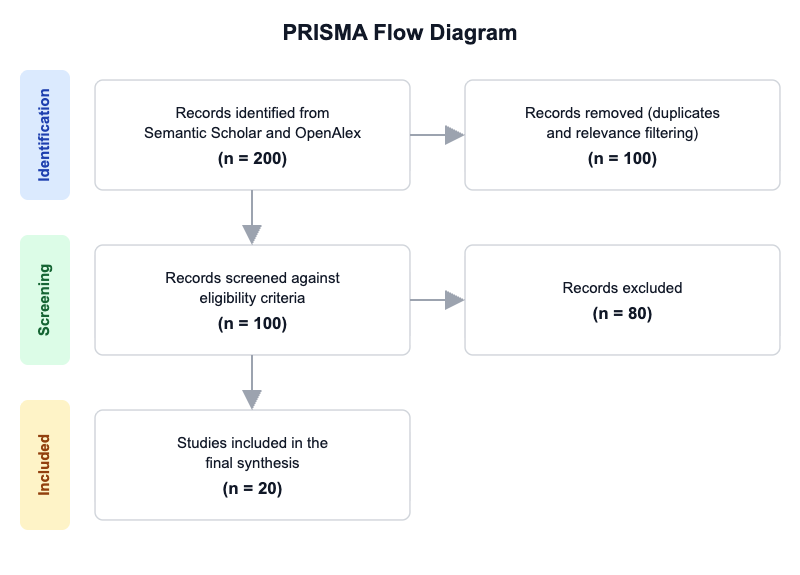
Initial database searching identified 200 records. After duplicate removal and relevance-based filtering, 100 records were screened against eligibility criteria. Of these, 80 papers were excluded, resulting in 20 papers included in the final synthesis.
PRISMA Flow Diagram
Eligibility criteria included:
- Anti-aging: Does the study investigate aging, longevity, geroscience, or healthy aging rather than unrelated disease treatment only?
- Recent: Was the paper published between 2020 and 2026 inclusive?
- Human/Model: Does the paper study humans, animal models, cells, or computational models with explicit aging-related outcomes?
- Aging Outcome: Does the study measure at least one aging-related outcome such as biological age, lifespan, healthspan, senescence markers, frailty, function, mortality, or epigenetic age?
- Intervention: Does the study examine an anti-aging intervention, exposure, biomarker, or mechanism such as senolytics, metformin, rapamycin, calorie restriction, NAD+ therapies, exercise, microbiome, or epigenetic clocks?
- Translational: Does the paper provide translational evidence in humans or clinically relevant models rather than only speculative commentary?
- Comparative: Does the study compare multiple interventions, biomarkers, or age-related mechanisms?
All included studies met the stated eligibility criteria.
2.3 Data Extraction and Synthesis
Data extraction focused on the following variables:
- Focus: Identify the main anti-aging focus of the paper.
- Model/Population: State whether the study is in humans, animals, cells, or computational models, and specify the population or model system if provided.
- Intervention/Exposure: Extract the anti-aging intervention, exposure, or factor studied.
- Outcome: Extract the primary aging-related outcome measured.
- Study Type: Identify the study design or evidence type.
- Key Findings: Summarize the main reported findings relevant to anti-aging or longevity.
Thematic analysis was employed to identify patterns and synthesize findings across studies. Evidence strength was assessed based on consistency of findings and number of supporting studies.
3. Results
3.1 Characteristics of Included Studies
| Study and Year | Study Type | Population / Model | Intervention / Exposure | Outcome Focus | Key Focus |
|---|---|---|---|---|---|
| Kulkarni et al. 2020 [1] | Review | Not specified | Metformin | Hallmarks of aging | Metformin as anti-aging intervention |
| Lee et al. 2024 [2] | Systematic review | Humans (adults) | Rapamycin and derivatives | Physiological parameters associated with aging | mTOR inhibition in humans |
| Zhang et al. 2022 [3] | Review | Primarily transgenic mouse models | Senolytics, senomorphics | Aging and age-related disease | Cellular senescence as target |
| Chaib et al. 2022 [4] | Review | Preclinical models; translational implications | Small-molecule senolytics | Tissue function, age-related conditions | Path to clinical senolytics |
| Duan et al. 2022 [5] | Review | Not specified; applicable to humans | Epigenetic clocks | Biological age, morbidity, mortality | Biomarker of aging |
| Mannick & Lamming 2023 [6] | Review | Animal models | mTOR inhibitors | Longevity, survival, diseases of aging | mTORC1 targeting |
| Chen et al. 2022 [7] | Review | Humans and aging-related diseases | Metformin | Disease progression, hallmarks | Clinical applications of metformin |
| Guo et al. 2022 [8] | Review | Human and animal contexts | Multiple interventions | Health, longevity | Aging mechanisms and treatments |
| Wang et al. 2022 [9] | Review | Animal models; clinical translation | Epigenetic manipulation, lifestyle interventions | Lifespan, aging-related conditions | Epigenetic regulation |
| McHugh et al. 2024 [10] | Review | Not specified | Senotherapies | Cancer and age-related tissue dysfunction | Senescence in disease |
| Longo & Anderson 2022 [11] | Review | Organisms from simple models to humans | Nutritional strategies | Longevity, healthspan | Nutrition and longevity |
| Qu et al. 2024 [12] | Mechanistic study | Mice, C. elegans, Drosophila | Lithocholic acid | AMPK activation, muscle regeneration, lifespan | Calorie restriction mimic |
| Zhang et al. 2022 [13] | Review | Preclinical models; clinical application | Senolytics, senomorphics | Healthspan, inflammation | Senotherapeutics |
| Lucas et al. 2023 [14] | Review | Cellular systems; human relevance | Senotherapeutic strategies | Biomarkers, applicability | Senescence biomarkers and therapies |
| Robbins et al. 2020 [15] | Review | Preclinical models and clinical trials | Senolytics | Physical function, resilience, mortality | Senolytic drugs |
| Zumerle et al. 2024 [16] | Animal experiment | Mice | Salvia haenkei extract, luteolin | Lifespan, healthspan, senescence markers | Natural senomorphic approach |
| Li et al. 2024 [17] | Review | Cellular and molecular systems | Calorie restriction, sleep, physical activity, longevity genes | Aging phenotypes, healthspan | Molecular anti-aging strategies |
| Saliev & Singh 2025 [18] | Review | Cellular systems; human implications | Senolytics, senomorphics, biomarkers, AI tools | SASP, tissue dysfunction | Precision geroscience |
| Bharath et al. 2020 [19] | Mechanistic study | Human older and younger adults; CD4+ T cells | Metformin | Autophagy, mitochondrial bioenergetics, Th17 profile | Inflammaging modulation |
| Di Francesco et al. 2024 [20] | Animal experiment | 960 genetically diverse female mice | Caloric restriction, intermittent fasting | Lifespan, health effects | Dietary restriction and survival |
Overall, the evidence base is dominated by reviews and mechanistic syntheses, with a smaller number of animal experiments and human mechanistic data. Across studies, the most recurring anti-aging strategies were metformin, mTOR inhibition, cellular senescence targeting, dietary restriction, and epigenetic assessment. The literature therefore appears highly translational in intent but uneven in study design, with broad mechanistic convergence but variable direct human validation.
3.2 Thematic Findings
3.2.1 Nutrient-sensing and metabolic modulation are the most coherent pharmacological route to anti-aging, with metformin and mTOR inhibition repeatedly converging on autophagy, mitochondrial function, and intercellular signaling.
A consistent mechanistic pattern emerges around interventions that alter nutrient sensing. Metformin is repeatedly linked to improved nutrient sensing, enhanced autophagy, mitochondrial normalization, reduced macromolecular damage, lowered telomere attrition, and reduced senescence [1], [7]. In human CD4+ T cells from older adults, metformin improved autophagy and mitochondrial bioenergetics and ameliorated a Th17 inflammaging profile, suggesting a direct immune-metabolic route by which it may reduce age-related inflammatory burden [19]. The same logic extends to mTOR inhibition, where rapamycin and rapalogs improved age-associated physiological parameters in immune, cardiovascular, and integumentary systems in humans, although endocrine, muscular, and neurological outcomes were null or not assessed [2]. Preclinical synthesis also supports rapamycin's effects on longevity and survival in model organisms, reinforcing the centrality of mTORC1 as a conserved aging regulator [6]. In aggregate, these findings suggest that the strongest anti-aging pharmacology is not disease-specific but pathway-based, especially where interventions converge on autophagy and mitochondrial homeostasis. Confidence: Strong, because the mechanistic direction is highly consistent and supported by both human and preclinical evidence.
3.2.2 Cellular senescence is the most intensively targeted aging hallmark, but its translational promise is limited by biomarker heterogeneity and context-dependent biology.
Across the literature, senescence appears as both a mechanistic driver and a therapeutic target. Senescent cells are repeatedly described as causal contributors to chronic inflammation, tissue dysfunction, and age-related disease through the senescence-associated secretory phenotype (SASP) [3], [10], [13]. Senolytics are presented as agents that selectively eliminate senescent cells, whereas senomorphics suppress SASP-associated pathology without removing the cell [3], [18]. Preclinical and early translational evidence indicates improvements in physical function, resilience, and healthspan, and natural senomorphic approaches such as Haenkenium extended lifespan and healthspan in aged mice while reducing inflammation, fibrosis, and senescence markers [15], [16]. However, this mechanistic promise is tempered by the heterogeneity of senescent phenotypes and the difficulty of identifying truly specific biomarkers [14], [18]. The field is therefore moving toward precision geroscience, but current evidence also shows that not all senescence-linked interventions are equally measurable or equally safe for translation. Confidence: Strong for the biological relevance of senescence; Moderate for clinical translation because biomarker and application challenges remain unresolved.
3.2.3 Dietary restriction remains a robust anti-aging paradigm, but its effects on health and lifespan are not interchangeable and are shaped by genotype, baseline status, and intervention form.
Caloric restriction and fasting-based interventions consistently extend lifespan in model organisms, but the relationship between longer life and better health is not straightforward. In genetically diverse mice, both caloric restriction and intermittent fasting extended lifespan in proportion to restriction severity, yet the strongest lifespan effect from 40% caloric restriction was accompanied by loss of lean mass and changes in immune composition that could increase susceptibility to infection [20]. Intermittent fasting also showed context dependence, failing to extend lifespan in mice with high pre-intervention body weight [20]. These findings align with broader reviews showing that dietary composition, fasting duration, and nutritional balance can influence healthspan and longevity through conserved metabolic pathways [11], [17]. The mechanistic study of lithocholic acid adds another layer by identifying a calorie restriction–responsive metabolite that activates AMPK and reproduces anti-aging effects in mice, C. elegans, and Drosophila [12]. Together, the evidence indicates that dietary restriction is not a single intervention but a family of exposures with different tradeoffs, and its benefits may depend on baseline metabolic state rather than acting uniformly. Confidence: Moderate to Strong, because the direction of benefit is consistent but effect modification is substantial.
3.2.4 Epigenetic clocks and epigenetic remodeling are emerging as the key measurement and intervention layer linking biological age to treatment response.
Epigenetic aging is increasingly treated as both a biomarker and an intervention target. DNA methylation-based clocks such as Horvath's clock, Hannum's clock, DNA PhenoAge, and DNA GrimAge are framed as tools for biological age estimation, morbidity and mortality prediction, and intervention evaluation [5]. At the same time, epigenetic regulation is portrayed as modifiable through small molecules, reprogramming, caloric restriction, exercise, and circadian rhythm calibration, with animal models showing lifespan extension and aging alleviation [9]. This dual role matters because it links mechanistic aging biology to measurable outputs, allowing anti-aging interventions to be judged by more than disease endpoints alone. Yet the literature also emphasizes that higher-quality information is still lacking and that biomarker validity varies, limiting confidence in epigenetic reversal claims [5], [9]. Confidence: Moderate, because the biomarker utility is well developed but intervention-linked biological age reversal remains inconsistently validated.
3.2.5 Across the field, anti-aging strategies increasingly converge on multi-pathway combinations rather than single-target solutions.
The broader literature suggests that the strongest anti-aging candidates are those that influence multiple hallmarks simultaneously. Metformin affects nutrient sensing, autophagy, mitochondrial function, and senescence [1], [7]; rapamycin acts through mTOR inhibition with systemic effects across immune and cardiovascular systems [2], [6]; senotherapies can be paired with cancer therapy and may address multimorbidity by reducing SASP-driven inflammation [10]; and lifestyle approaches such as caloric restriction, exercise, sleep, and circadian calibration target several linked mechanisms at once [17]. This convergence implies that aging is being operationalized less as a single pathway problem and more as a network pathology. Confidence: Moderate, because mechanistic alignment is strong but comparative effectiveness between strategies remains insufficiently tested.
3.3 Summary of Evidence
| Theme | Key Finding | Population Applicability | Effect Direction | Confidence Level | Supporting Studies |
|---|---|---|---|---|---|
| Nutrient-sensing and metabolic modulation | Metformin improved autophagy and mitochondrial bioenergetics in older human CD4+ T cells and ameliorated a Th17 inflammaging profile; rapamycin/rapalogs improved immune, cardiovascular, and integumentary parameters in adults [19], [2] | Humans and human-relevant models; metformin mechanistic data in older adults, rapalogs in adults | Positive | Strong | Bharath et al. [19], Lee et al. [2], Chen et al. [7] |
| Cellular senescence targeting | Senolytics eliminate senescent cells, senomorphics suppress SASP, and Haenkenium extended lifespan and healthspan in aged mice while reducing inflammation and senescence markers [16] | Mostly animal and cellular models; partial human translational relevance | Positive | Strong | Zhang et al. [3], Robbins et al. [15], Zumerle et al. [16] |
| Dietary restriction and calorie restriction mimetics | Caloric restriction and intermittent fasting extended lifespan in mice, but 40% caloric restriction reduced lean mass and may increase infection susceptibility; lithocholic acid recapitulated calorie restriction via AMPK [20], [12] | Animal models; human applicability is indirect | Mixed | Moderate | Di Francesco et al. [20], Qu et al. [12], Longo and Anderson [11] |
| Epigenetic biomarkers and interventions | Epigenetic clocks correlate with morbidity and mortality and are used to evaluate age-reversing interventions, while epigenetic manipulation and reprogramming show lifespan benefits in animal models [5], [9] | Mainly human-facing biomarkers with animal intervention evidence | Positive | Moderate | Duan et al. [5], Wang et al. [9] |
| Multi-pathway geroscience | Anti-aging strategies increasingly combine metabolic, cellular, epigenetic, and lifestyle mechanisms rather than relying on single-target approaches [8], [17] | Broad, cross-species relevance | Positive | Moderate | Guo et al. [8], Li et al. [17], Saliev and Singh [18] |
| Context dependence and tradeoffs | Benefits of dietary restriction were not synonymous with better health, and intermittent fasting failed in mice with high pre-intervention body weight [20] | Animal model with genotype and baseline-status dependence | Mixed | Moderate | Di Francesco et al. [20], Longo and Anderson [11] |
4. Discussion
4.1 Principal Findings and Their Interpretation
The most defensible conclusion from the current literature is that anti-aging research is coalescing around interventions that alter upstream biology rather than downstream disease manifestations. The strongest convergence appears around nutrient sensing, autophagy, mitochondrial integrity, and cellular senescence, suggesting that aging is being targeted as a systems-level process rather than a single molecular lesion [1], [6], [3]. This convergence is important because it explains why seemingly different interventions—metformin, rapamycin, calorie restriction, and senotherapeutics—often produce overlapping phenotypes. Metformin and rapamycin both influence metabolic signaling networks that regulate cellular maintenance, whereas senolytics and senomorphics intervene later in the damage cascade by removing or reprogramming dysfunctional cells [1], [13]. The mechanistic evidence is therefore stronger than the clinical evidence: the biology is coherent, but the human endpoints remain uneven.
A second major interpretive point is that anti-aging benefits appear highly context dependent. The animal dietary restriction data show that lifespan extension does not automatically translate into better health, and that baseline body composition and genetics can alter response [20]. This matters because it suggests that the field should move away from one-size-fits-all prescriptions toward stratified geroscience. Similarly, senescence-targeting therapies have a compelling rationale, but senescent cells are not uniformly pathogenic; they also have physiological roles in repair and tumor suppression, which helps explain why broad targeting may be less straightforward than the molecular enthusiasm implies [10], [18]. The most confident conclusions, therefore, are those with converging mechanistic and translational support, especially metformin-like metabolic modulation and mTOR inhibition. More tentative are claims that any single intervention will broadly "reverse aging" across tissues and populations.
4.2 Comparison with Existing Literature and Resolution of Contradictions
The reviewed evidence largely reinforces the broader geroscience view that aging biology is modifiable, but it also exposes where translation remains difficult. The consistency between metformin, rapamycin, and calorie restriction literature is meaningful because these interventions all map onto conserved nutrient-sensing pathways, which provides a mechanistic explanation for why benefits recur across model systems [1], [6], [11]. Likewise, the recurrent emphasis on SASP suppression supports the idea that chronic inflammation is not merely a byproduct of aging but a therapeutic node in its own right [10], [18]. This consistency is unlikely to be accidental, but it may also reflect publication bias toward mechanistically favorable findings in interventions already considered promising.
The major contradiction concerns dietary restriction. Some evidence portrays caloric restriction and fasting as broadly beneficial, while the genetically diverse mouse study shows that longer lifespan can coincide with lean-mass loss, altered immune composition, and possible infection vulnerability [20]. Rather than treating this as a null result, it should be read as evidence that lifespan and healthspan can diverge, especially when restriction is intensive or when the baseline metabolic state differs. The failure of intermittent fasting to extend lifespan in mice with high pre-intervention body weight further suggests effect modification by pre-existing condition rather than a universal anti-aging law [20]. This helps reconcile the apparent inconsistency with optimistic narrative reviews: dietary restriction likely works through context-sensitive metabolic remodeling, not through a uniform biological switch.
A similar tension exists in senescence research. Senotherapies are promising, yet the heterogeneity of senescent cells and the lack of specific biomarkers complicate both measurement and translation [14]. That limitation is methodological and biological at once: if senescence states vary by tissue, time, and trigger, then trial outcomes will be highly dependent on which senescent compartment is actually being targeted. This makes current findings credible but incomplete, and it cautions against overgeneralizing from preclinical success to human efficacy.
4.3 Practical Implications
For clinicians, the most immediate implication is that anti-aging counseling should be framed around biologically plausible, risk-aware strategies rather than miracle claims. The best-supported pharmacological candidates at present are metformin and mTOR inhibitors, but their use as gerotherapeutics still rests partly on mechanistic and early translational evidence rather than definitive long-term aging trials [1], [2]. In practice, this means that any off-label enthusiasm should be tempered by careful attention to patient context, particularly because rapamycin derivatives were associated with increased infections and lipid elevations in individuals with age-related disease [2].
At the public health level, dietary restriction remains relevant, but the evidence argues against oversimplified recommendations. The strongest caloric restriction produced the largest lifespan extension in mice, yet at the cost of lean mass and possible immune tradeoffs [20]. That makes blanket population messaging potentially problematic, especially for older adults or those with frailty risk. The data instead support personalized nutritional strategies that preserve function while targeting metabolic health [11]. For regulatory and translational policy, the most important message is that anti-aging evaluation should not rely solely on lifespan. Biomarkers such as epigenetic clocks, plus functional endpoints and tissue-specific measures of inflammation, autophagy, and senescence, are needed to avoid mistaking longer survival for healthier aging [5], [20]. The evidence does not yet support a no-threshold claim for any one intervention, but it does show that dose, baseline status, and tissue context materially alter outcomes, which argues for more precision in both trial design and guideline development.
4.4 Strengths and Limitations
This review draws on a focused, recent body of work that spans pharmacology, lifestyle intervention, biomarker science, and mechanistic geroscience. Its principal strength is thematic integration across heterogeneous designs, allowing convergent biological signals to be identified even when individual studies use different models and endpoints. Another strength is the emphasis on translational relevance, since the evidence base includes human mechanistic data, human systematic review evidence, animal experiments, and biomarker-focused synthesis.
The included studies, however, vary substantially in design quality and level of translation. Much of the literature consists of reviews rather than primary comparative trials, and several interventions are supported mainly by animal or cellular evidence. Outcome definitions are also inconsistent: lifespan, healthspan, immune markers, and epigenetic age are not interchangeable, which complicates direct comparison. For this review, limitations include reliance on abstract-level extracted data, absence of a formal risk-of-bias appraisal, and dependence on the reporting completeness of the source papers. These constraints mean that the synthesis is best interpreted as a current map of the field rather than a definitive efficacy ranking of anti-aging interventions.
5. Gaps and Future Directions
The clearest gap is the lack of long-term, well-controlled human trials that directly test whether promising mechanisms translate into meaningful aging outcomes. Metformin and rapamycin have the strongest translational momentum, but available evidence still relies heavily on mechanistic studies, short-term physiological endpoints, or proxy populations rather than direct demonstration of delayed aging trajectories [19], [2]. Senescence-targeted therapies also need biomarker harmonization: without specific, tissue-resolved markers, it remains difficult to identify responders, compare studies, or determine whether senolytics and senomorphics act on the intended cell populations [14], [18].
Future studies should therefore prioritize comparative trials that include biological age measures, functional outcomes, and safety monitoring in parallel. For dietary interventions, especially fasting and caloric restriction, work is needed in older adults and individuals with frailty risk to determine whether the benefits observed in mice generalize without unacceptable loss of lean mass or immune resilience [20]. Studies should also stratify by baseline metabolic state because current evidence suggests that response heterogeneity is large. In biomarker research, epigenetic clocks require better standardization and validation against clinically meaningful outcomes rather than only against chronological age [5]. Finally, multi-omics and targeted delivery approaches may help resolve the problem of senescent-cell heterogeneity and improve precision geroscience [18].
6. Conclusion
The latest anti-aging literature supports a cautious but genuine optimism: aging appears increasingly tractable through interventions that modify conserved biology, especially nutrient sensing, mTOR signaling, cellular senescence, and epigenetic state. The most credible evidence currently favors metformin- and rapamycin-centered pathways, senescence-targeting therapies, and dietary restriction paradigms, while recognizing that the human evidence base remains less mature than the mechanistic evidence. Human data already show that metformin can improve autophagy and mitochondrial bioenergetics in older CD4+ T cells and ameliorate inflammaging, and rapamycin derivatives can improve age-associated physiological parameters in adults [19], [2]. At the same time, animal studies show that caloric restriction and intermittent fasting can extend lifespan, but not always healthspan, and effects depend on baseline state and genotype [20].
The most important unresolved question is not whether anti-aging biology can be influenced, but which interventions reliably improve human healthspan without unacceptable tradeoffs across tissues and subgroups. That question matters because the field is moving from conceptual geroscience toward actionable prevention, where biomarkers, safety, and individualized response will determine whether these strategies become routine clinical and public health tools.
References
- Kulkarni, A. S., Gubbi, S., & Barzilai, N. (2020). Benefits of metformin in attenuating the hallmarks of aging. Cell Metabolism, 32(1), 15–30. https://doi.org/10.1016/j.cmet.2020.04.001
- Lee, D. J. W., Hodzic Kuerec, A., & Maier, A. B. (2024). Targeting ageing with rapamycin and its derivatives in humans: A systematic review. The Lancet Healthy Longevity, 5(2), e152–e162. https://doi.org/10.1016/S2666-7568(23)00258-100258-1)
- Zhang, L., Pitcher, L. E., Yousefzadeh, M. J., Niedernhofer, L. J., Robbins, P. D., & Zhu, Y. (2022). Cellular senescence: A key therapeutic target in aging and diseases. Journal of Clinical Investigation, 132(15), e158450. https://doi.org/10.1172/JCI158450
- Chaib, S., Tchkonia, T., & Kirkland, J. L. (2022). Cellular senescence and senolytics: The path to the clinic. Nature Medicine, 28(8), 1556–1568. https://doi.org/10.1038/s41591-022-01923-y
- Duan, R., Fu, Q., Sun, Y., & Li, Q. (2022). Epigenetic clock: A promising biomarker and practical tool in aging. Ageing Research Reviews, 81, 101743. https://doi.org/10.1016/j.arr.2022.101743
- Mannick, J. B., & Lamming, D. W. (2023). Targeting the biology of aging with mTOR inhibitors. Nature Aging, 3(6), 642–660. https://doi.org/10.1038/s43587-023-00416-y
- Chen, S., Gan, D., Lin, S., Zhong, Y., Chen, M., Zou, X., Shao, Z., & Xiao, G. (2022). Metformin in aging and aging-related diseases: Clinical applications and relevant mechanisms. Theranostics, 12(6), 2722–2740. https://doi.org/10.7150/thno.71360
- Guo, J., Huang, X., Dou, L., Yan, M., Shen, T., Tang, W., & Li, J. (2022). Aging and aging-related diseases: From molecular mechanisms to interventions and treatments. Signal Transduction and Targeted Therapy, 7(1), 391. https://doi.org/10.1038/s41392-022-01251-0
- Wang, K., Liu, H., Hu, Q., Wang, L., Liu, J., Zheng, Z., Zhang, W., Ren, J., Zhu, F., & Liu, G.-H. (2022). Epigenetic regulation of aging: Implications for interventions of aging and diseases. Signal Transduction and Targeted Therapy, 7(1), 374. https://doi.org/10.1038/s41392-022-01211-8
- McHugh, D., Durán, I., & Gil, J. (2024). Senescence as a therapeutic target in cancer and age-related diseases. Nature Reviews Drug Discovery, 24(1), 57–71. https://doi.org/10.1038/s41573-024-01074-4
- Longo, V. D., & Anderson, R. M. (2022). Nutrition, longevity and disease: From molecular mechanisms to interventions. Cell, 185(9), 1455–1470. https://doi.org/10.1016/j.cell.2022.04.002
- Qu, Q., Chen, Y., Wang, Y., Long, S., Wang, W., Yang, H.-Y., Li, M., Tian, X., Wei, X., Liu, Y.-H., Xu, S., Zhang, C., Zhu, M., Lam, S. M., Wu, J., Yun, C., Chen, J., Xue, S., Zhang, B., . . . Lin, S.-C. (2024). Lithocholic acid phenocopies anti-ageing effects of calorie restriction. Nature, 643(8070), 192–200. https://doi.org/10.1038/s41586-024-08329-5
- Zhang, L., Pitcher, L. E., Prahalad, V., Niedernhofer, L. J., & Robbins, P. D. (2022). Targeting cellular senescence with senotherapeutics: Senolytics and senomorphics. The FEBS Journal, 290(5), 1362–1383. https://doi.org/10.1111/febs.16350
- Lucas, V., Cavadas, C., & Aveleira, C. A. (2023). Cellular senescence: From mechanisms to current biomarkers and senotherapies. Pharmacological Reviews, 75(4), 675–713. https://doi.org/10.1124/pharmrev.122.000622
- Robbins, P. D., Jurk, D., Khosla, S., Kirkland, J. L., LeBrasseur, N. K., Miller, J. D., Passos, J. F., Pignolo, R. J., Tchkonia, T., & Niedernhofer, L. J. (2020). Senolytic drugs: Reducing senescent cell viability to extend health span. Annual Review of Pharmacology and Toxicology, 61, 779–803. https://doi.org/10.1146/annurev-pharmtox-050120-105018
- Zumerle, S., Sarill, M., Saponaro, M., Colucci, M., Contu, L., Lazzarini, E., Sartori, R., Pezzini, C., Rinaldi, A., Scanu, A., Sgrignani, J., Locatelli, P., Sabbadin, M., Valdata, A., Brina, D., Giacomini, I., Rizzo, B., Pierantoni, A., Sharifi, S., . . . Alimonti, A. (2024). Targeting senescence induced by age or chemotherapy with a polyphenol-rich natural extract improves longevity and healthspan in mice. Nature Aging, 4(9), 1231–1248. https://doi.org/10.1038/s43587-024-00663-7
- Li, Y., Tian, X., Luo, J., Bao, T., Wang, S., & Wu, X. (2024). Molecular mechanisms of aging and anti-aging strategies. Cell Communication and Signaling, 22(1), 285. https://doi.org/10.1186/s12964-024-01663-1
- Saliev, T., & Singh, P. B. (2025). Targeting senescence: A review of senolytics and senomorphics in anti-aging interventions. Biomolecules, 15(6), 860. https://doi.org/10.3390/biom15060860
- Bharath, L. P., Agrawal, M., McCambridge, G., Nicholas, D., Hasturk, H., Liu, J., Jiang, K., Liu, R., Guo, Z., Deeney, J. T., Apovian, C. M., Snyder-Cappione, J. E., Hawk, G. S., Fleeman, R. M., Pihl, R. M. F., Thompson, K. L., Belkina, A. C., Cui, L., Proctor, E. A., . . . Nikolajczyk, B. S. (2020). Metformin enhances autophagy and normalizes mitochondrial function to alleviate aging-associated inflammation. Cell Metabolism, 32(1), 44–55.e6. https://doi.org/10.1016/j.cmet.2020.04.015
- Di Francesco, A., Deighan, A. G., Litichevskiy, L., Chen, Z., Luciano, A., Robinson, L. L., Garland, G., Donato, H., Vincent, M. J., Schott, W., Wright, K. M., Raj, A., Prateek, G. V., Mullis, M. N., Hill, W. G., Zeidel, M. L., Peters, L. L., Harding, F., Botstein, D., . . . Churchill, G. A. (2024). Dietary restriction impacts health and lifespan of genetically diverse mice. Nature, 634(8034), 684–692. https://doi.org/10.1038/s41586-024-08026-3