

Latest Research on Aromatase Inhibitors: Clinical Effectiveness, Resistance Biology, Comparative Selection, and Safety in Breast Cancer
Abstract
Recent research indicates that aromatase inhibitors (AIs) remain highly effective in hormone receptor–positive breast cancer, with patient-level and trial-level syntheses showing lower recurrence and mortality than tamoxifen in early disease and meaningful benefit when combined with targeted therapy in advanced disease. In early breast cancer, AI-based therapy reduced recurrence by about 30% during periods when treatments differed and lowered 10-year breast cancer mortality to 12.1% versus 14.2% with tamoxifen (RR 0.85, 95% CI 0.75–0.96), while extended AI therapy after at least 5 years of endocrine treatment significantly improved disease-free survival [20], [7]. In metastatic disease, nonsteroidal AIs combined with CDK4/6 inhibition or PI3K-pathway targeting improved outcomes, including longer overall survival with palbociclib plus AI (49.1 vs 43.2 months; HR 0.76, 95% CI 0.65–0.87) and longer progression-free survival (19.3 vs 13.9 months; HR 0.70, 95% CI 0.62–0.78) [18]. At the same time, comparative and translational studies highlight clinically relevant heterogeneity: exemestane may yield slightly lower disease-free and overall survival than anastrozole or letrozole in routine practice, whereas molecular studies implicate ESR1, PTEN, TP53, and CSMD1-linked biology in response and resistance [13], [5], [9], [19]. Safety remains an important counterweight, with cohort data linking AIs to increased heart failure, cardiovascular mortality, ischemic heart disease, and arrhythmia compared with tamoxifen, underscoring the need for individualized treatment selection [6], [15]. Overall, the latest literature supports AIs as a central endocrine backbone in breast cancer while emphasizing that choice of agent, treatment duration, and resistance/safety context increasingly determine net benefit.
1. Introduction
Aromatase inhibitors occupy a central place in contemporary endocrine therapy for breast cancer because they suppress estrogen biosynthesis, thereby reducing growth signaling in estrogen receptor–positive disease. The latest literature continues to frame them as a foundational treatment in postmenopausal early-stage breast cancer and a key endocrine backbone in metastatic settings, including in combination with CDK4/6 and PI3K-pathway inhibitors [2], [18], [5]. Yet their clinical value is not uniform across agents, disease states, or patient subgroups. Comparative effectiveness data now suggest that anastrozole and letrozole may outperform exemestane in routine adjuvant use, while patient-level syntheses still favor the class overall against tamoxifen for recurrence and mortality reduction [13], [20].
At the same time, the field is increasingly shaped by two unresolved tensions. First, endocrine resistance remains a major obstacle, with molecular studies linking poor response to ESR1-related biology, PTEN loss, TP53 mutation patterns, growth-factor signaling, and other alterations that can undermine estrogen deprivation [5], [9], [14], [17]. Second, long-term adverse effects, especially cardiovascular risk, complicate the risk-benefit calculus, particularly when AIs are compared with tamoxifen in observational cohorts [6], [15]. Newer studies therefore do more than confirm efficacy; they also refine selection between AI agents, define settings where extension of therapy remains worthwhile, and identify biomarkers that may guide sequencing or combination strategies.
Against this backdrop, a focused synthesis of the latest research is needed to integrate efficacy, resistance biology, comparative performance, and safety into a coherent picture of where aromatase inhibition currently stands in breast cancer care. This review therefore examines recent clinical, translational, and synthesis evidence on AI use across early and advanced breast cancer, with attention to outcome consistency, mechanism, and treatment selection.
2. Methods
2.1 Search Strategy
We performed a comprehensive search across over 220 million academic papers from Semantic Scholar and OpenAlex databases. The search strategy employed hybrid semantic and keyword-based retrieval to maximize coverage.
Search queries included:
- "Aromatase inhibitors latest research clinical trials and outcomes"
- "Aromatase inhibitor effectiveness safety adverse events breast cancer"
- "Aromatase inhibitors resistance mechanisms biomarkers and treatment response"
- "Third-generation aromatase inhibitors anastrozole letrozole exemestane recent studies"
- "Aromatase inhibitors bone health cardiovascular metabolic outcomes recent research"
2.2 Study Selection
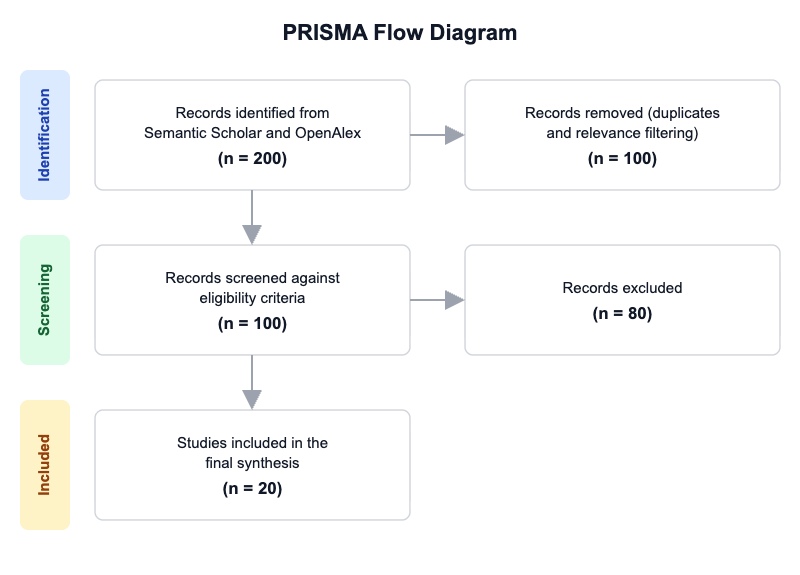
Initial database searching identified 200 records. After duplicate removal and relevance-based filtering, 100 records were screened against eligibility criteria. Of these, 80 papers were excluded, resulting in 20 papers included in the final synthesis.
PRISMA Flow Diagram
Eligibility criteria included:
- Human/Model: Does the study involve human participants, human tissue, animal models, or in vitro systems relevant to aromatase inhibitors?
- Aromatase Inhibitor: Does the study investigate an aromatase inhibitor such as anastrozole, letrozole, exemestane, or a closely related endocrine therapy?
- Recent Evidence: Is the paper published in 2020 or later?
- Clinical or Translational: Does the study report clinical outcomes, resistance biology, biomarkers, toxicity, or treatment response rather than only general background?
- Comparable Detail: Does the abstract include enough detail to distinguish the study question, intervention, and main outcome?
- Breast Cancer Relevance: Does the study focus on breast cancer or another hormone-sensitive cancer context where aromatase inhibition is clinically relevant?
- Safety or Resistance: Does the study report safety, resistance, adverse events, or mechanisms of treatment failure?
- Comparative or Novel: Does the study compare aromatase inhibitors with another therapy or evaluate a novel combination, biomarker, or strategy?
All included studies met the stated eligibility criteria.
2.3 Data Extraction and Synthesis
Data extraction focused on the following variables:
- Topic Focus: Identify the main aromatase inhibitor research focus, such as efficacy, safety, resistance, biomarkers, bone health, cardiovascular effects, metabolic outcomes, or comparative agent studies.
- Study Type: Extract the study design or evidence type, such as randomized trial, cohort study, case-control study, translational study, systematic review, or meta-analysis.
- Population: Extract the patient population, disease context, or model system studied, including cancer subtype, menopausal status, or whether the study is human, animal, or in vitro.
- Agent(s): Extract the aromatase inhibitor(s) or related endocrine therapy studied, such as anastrozole, letrozole, exemestane, or combinations.
- Key Finding: Extract the principal finding or conclusion relevant to aromatase inhibitor use, response, resistance, toxicity, or comparative performance.
- Outcomes: Extract the main outcomes measured, such as disease-free survival, recurrence, progression, adverse events, bone density, cardiovascular events, biomarkers, or response rates.
Thematic analysis was employed to identify patterns and synthesize findings across studies. Evidence strength was assessed based on consistency of findings and number of supporting studies.
3. Results
3.1 Characteristics of Included Studies
| Study and Year | Study Type | Population | Intervention / Comparator | Main Outcome(s) | Key Focus |
|---|---|---|---|---|---|
| Bradley et al. 2022 [1] | Patient-level meta-analysis of randomized trials | Premenopausal women with ER-positive early-stage breast cancer receiving ovarian suppression | Aromatase inhibitors vs tamoxifen | Disease-free survival, recurrence, adverse events | Comparative efficacy |
| Burstein et al. 2021 [2] | Guideline update | Postmenopausal women and male patients with HR-positive, HER2-negative metastatic breast cancer | AI-based endocrine therapy, CDK4/6 inhibitors, alpelisib combinations | Progression-free survival, mutation-directed treatment selection | Advanced endocrine treatment |
| Rastogi et al. 2024 [3] | Randomized trial update | HR-positive, HER2-negative high-risk early breast cancer | Abemaciclib plus endocrine therapy | IDFS, DRFS, OS, safety | Adjuvant combination therapy |
| Slamon et al. 2024 [4] | Randomized trial | HR-positive, HER2-negative stage II/III early breast cancer | Ribociclib plus NSAI | Invasive disease-free survival | Adjuvant combination therapy |
| Razavi et al. 2020 [5] | Phase I/II trial with longitudinal molecular analysis | HR-positive metastatic breast cancer with PIK3CA mutation enrichment | Alpelisib plus aromatase inhibitor | Clinical benefit rate, safety, resistance biomarkers | Resistance mechanisms |
| Khosrow-Khavar et al. 2020 [6] | Population-based cohort study | Women newly diagnosed with breast cancer initiating AI or tamoxifen | Aromatase inhibitors vs tamoxifen | MI, ischemic stroke, heart failure, cardiovascular mortality | Cardiovascular safety |
| Braybrooke et al. 2025 [7] | Patient-level meta-analysis of randomized trials | Postmenopausal women with early breast cancer after ≥5 years endocrine therapy | Extended AI therapy (anastrozole, letrozole, exemestane) | DFS, recurrence, adverse events | Extended therapy |
| Goetz et al. 2024 [8] | Randomized trial | HR+, HER2− advanced breast cancer | Abemaciclib plus NSAI | Overall survival | Advanced combination therapy |
| Schuster et al. 2023 [9] | Translational molecular study | Postmenopausal women with ER+HER2− breast cancer in neoadjuvant AI setting | Neoadjuvant AI treatment | Ki67 change, molecular subtype, ESR1, TP53, immune markers | Intrinsic resistance |
| Bhatia & Thareja 2024 [10] | Review | ER-positive breast cancer | Multiple AIs and pharmacologic class | Tumor reduction, survival, recurrence | Overview of AI pharmacology |
| Lloyd et al. 2022 [11] | Review | Metastatic ER+ breast cancer with endocrine resistance | SERDs, AIs, CDK4/6 inhibitors | Progression-free survival, treatment sequencing | Resistance and novel endocrine therapy |
| Del Mastro et al. 2021 [12] | Randomized phase 3 trial | Postmenopausal women with early-stage breast cancer | Extended letrozole | DFS, adverse events | Extended adjuvant therapy |
| Dumas et al. 2025 [13] | Comparative effectiveness study, target trial emulation | Women 50–75 years with postmenopausal HR-positive early-stage breast cancer | Anastrozole, letrozole, exemestane | DFS, OS, persistence | Agent-level comparison |
| Saatci et al. 2021 [14] | Review | ER-positive breast cancer with endocrine resistance | SERMs, AIs, SERDs, targeted agents | Resistance pathways, therapeutic strategies | Molecular resistance |
| Sund et al. 2021 [15] | Population-based cohort study | Breast cancer patients treated with AIs >4 years | Aromatase inhibitors | Ischemic heart disease, arrhythmia | Cardiovascular risk |
| Janni et al. 2025 [16] | Trial-level meta-analysis | HR+/HER2− early breast cancer | Aromatase inhibitors vs tamoxifen | DFS | Comparative efficacy |
| Özyurt & Özpolat 2022 [17] | Review | ER-positive breast cancer | Anti-estrogen therapies and targeted agents | Resistance, survival, therapy development | Resistance mechanisms |
| Rugo et al. 2022 [18] | Retrospective cohort study | HR+/HER2− metastatic breast cancer | Palbociclib plus AI vs AI alone | OS, rwPFS | Real-world effectiveness |
| Cairns et al. 2020 [19] | GWAS / translational study | Postmenopausal women with ER-positive breast cancer in MA.27 | Anastrozole, exemestane, letrozole | BCFI, estrogen-related mechanisms | Pharmacogenomics |
| Dowsett et al. 2015 [20] | Patient-level meta-analysis of randomized trials | Postmenopausal women with ER-positive early breast cancer | AIs vs tamoxifen across regimens | Recurrence, breast cancer mortality, all-cause mortality, fractures | Comparative efficacy and toxicity |
The included literature spans randomized trials, patient-level and trial-level meta-analyses, comparative effectiveness research, cohort studies, translational molecular analyses, pharmacogenomic work, guidelines, and narrative reviews. Most evidence concerns postmenopausal early breast cancer, but important studies address premenopausal women receiving ovarian suppression and metastatic disease treated with AI-based combinations. Outcome reporting varies substantially, ranging from recurrence and survival endpoints to molecular response markers and cardiovascular safety.
3.2 Thematic Findings
3.2.1 Aromatase inhibitors remain superior to tamoxifen for recurrence reduction and breast cancer mortality in early disease, with benefits extending across treatment sequences and into prolonged therapy
The most consistent evidence indicates that AIs outperform tamoxifen in early breast cancer for recurrence-related outcomes, while also producing modest but clinically meaningful reductions in breast cancer mortality. In patient-level synthesis of early breast cancer trials, recurrence favored AIs during periods when treatments differed, with a proportional reduction of about 30% and 10-year breast cancer mortality of 12.1% versus 14.2% for tamoxifen (RR 0.85, 95% CI 0.75–0.96) [20]. A similar trial-level synthesis also reported a significant DFS advantage for AIs over tamoxifen, with benefit particularly pronounced in premenopausal women receiving ovarian suppression [16]. In premenopausal women specifically, a patient-level meta-analysis of 7030 women showed that AIs may offer improved outcomes compared with tamoxifen [1]. These data are directionally uniform despite differences in menopausal status and endocrine backbone, suggesting that aromatase blockade has genuine anti-recurrence efficacy beyond simple regimen selection.
Extended therapy data reinforce this pattern. After at least 5 years of prior endocrine treatment, extending AI therapy improved disease-free survival in postmenopausal women [7]. A separate randomized phase 3 trial similarly found that extended letrozole significantly improved DFS compared with standard duration therapy [12]. Together, these findings indicate that in women already recurrence-free after initial endocrine treatment, continued estrogen suppression can still add benefit, although the exact magnitude and adverse-event tradeoff vary by study and regimen. Confidence: Strong, because the direction is consistent across randomized and synthesized evidence, with converging results from different populations and endpoints.
3.2.2 AI benefit is increasingly shaped by combination therapy in metastatic and high-risk early breast cancer, especially with CDK4/6 or PI3K-pathway inhibition
In advanced disease, AIs are no longer best understood as stand-alone endocrine therapy but as a backbone for targeted combinations. Real-world first-line palbociclib plus AI in HR+/HER2− metastatic breast cancer was associated with longer overall survival than AI alone, with median OS 49.1 months versus 43.2 months and HR 0.76 (95% CI 0.65–0.87), alongside longer real-world progression-free survival of 19.3 versus 13.9 months and HR 0.70 (95% CI 0.62–0.78) [18]. In the same disease space, the ASCO guideline recommends a nonsteroidal AI plus a CDK4/6 inhibitor for treatment-naïve postmenopausal HR-positive metastatic disease, and also endorses alpelisib plus endocrine therapy for PIK3CA-mutated disease after prior endocrine exposure [2]. Randomized trial data are concordant: abemaciclib combined with endocrine therapy sustained benefit in high-risk early breast cancer, with IDFS HR 0.680 (95% CI 0.599–0.772) and DRFS HR 0.675 (95% CI 0.588–0.774) at 5 years [3], while abemaciclib plus NSAI produced a clinically meaningful overall survival improvement in advanced breast cancer, though statistical significance was not reached [8]. Ribociclib plus NSAI also significantly improved invasive disease-free survival in stage II/III early breast cancer [4].
Taken together, these findings suggest that the principal contemporary role of AIs is as the endocrine scaffold for pathway-selected intensification. Confidence: Strong for improved disease-control endpoints, moderate for overall survival in randomized combination settings because some OS analyses remain immature or nonsignificant.
3.2.3 Agent-level differences matter, with anastrozole and letrozole generally favored over exemestane in adjuvant practice
A newer comparative effectiveness study using a target-trial emulation framework suggests that not all third-generation AIs perform equivalently in routine practice. Among women aged 50 to 75 years with postmenopausal HR-positive early-stage breast cancer, exemestane was associated with slightly lower DFS and OS than anastrozole and letrozole, even under perfect persistence conditions [13]. Specifically, 8-year DFS under natural persistence was 79.1% for exemestane versus 81.0% for anastrozole and 81.1% for letrozole, while 8-year OS was 88.8% for exemestane versus 90.5% and 89.9%, respectively [13]. Exemestane also had greater treatment discontinuation within 5 years (39.3% vs 35.1% and 35.0%) [13]. These differences are clinically relevant because the broader AI-vs-tamoxifen literature does not resolve agent-specific selection, and this study suggests that real-world persistence alone does not explain the apparent inferiority of exemestane.
This theme is strengthened by pharmacogenomic work indicating that AI response can be drug-specific rather than class-wide. A CSMD1-associated signal predicted response to anastrozole but not to letrozole or exemestane, and overexpression of CSMD1 sensitized AI-resistant cells to anastrozole specifically [19]. Confidence: Moderate, because comparative agent data are still limited and partly observational, but the direction is coherent across effectiveness and translational evidence.
3.2.4 Resistance to aromatase inhibition is biologically heterogeneous and involves ESR1, PTEN, TP53, growth-factor signaling, and immune context
Mechanistic studies consistently show that failure of AI therapy is not random but linked to distinct molecular states. In metastatic disease treated with alpelisib plus an AI, loss-of-function PTEN mutations were found in 25% of resistant patients, and ESR1 activating mutations increased in number and allele fraction during treatment, both associating with resistance [5]. In neoadjuvant AI-treated postmenopausal ER+HER2− breast cancer, low ESR1 levels were associated with poor response, along with high proliferation, high growth-factor pathway expression, and non-luminal subtypes [9]. Among poor responders with high ESR1 expression, there were lower plasma estradiol levels, lower expression of estrogen-response genes, higher tumor-infiltrating lymphocytes and immune markers, and more TP53 mutations [9]. Broader reviews converge on these pathways by placing ESR1 mutations, ER signaling alterations, cell-cycle dysregulation, PI3K/AKT/mTOR signaling, and tumor microenvironment changes at the center of endocrine resistance [14], [17], [11].
The translational implication is that resistance arises from multiple escape routes, not a single failure of estrogen deprivation. Confidence: Strong for the existence of biologically distinct resistance mechanisms, moderate for any single biomarker because predictive utility remains incompletely validated.
3.2.5 Cardiovascular toxicity is a real counterweight to efficacy, particularly in prolonged exposure and when compared with tamoxifen
Two cohort studies consistently indicate increased cardiovascular risk with AI exposure relative to tamoxifen. One study found significantly increased heart failure risk (HR 1.86, 95% CI 1.14–3.03) and cardiovascular mortality (HR 1.50, 95% CI 1.11–2.04), with nonsignificant elevations for myocardial infarction (HR 1.37, 95% CI 0.88–2.13) and ischemic stroke (HR 1.19, 95% CI 0.82–1.72) [6]. Another reported increased ischemic heart disease and arrhythmia risk in patients treated with AIs for more than four years [15]. Importantly, these safety signals do not negate efficacy, but they complicate long-duration AI use, especially in patients with baseline cardiovascular vulnerability.
The cardiovascular findings are also methodologically important because the comparator is tamoxifen, which itself may have distinct cardiometabolic effects; thus, these studies speak to relative rather than absolute AI toxicity. Confidence: Moderate, because the direction is consistent but based on observational designs and comparator-dependent risk estimates.
3.3 Summary of Evidence
| Theme | Key Finding | Population Applicability | Effect Direction | Confidence Level | Supporting Studies |
|---|---|---|---|---|---|
| AI vs tamoxifen in early breast cancer | 10-year breast cancer mortality 12.1% vs 14.2% (RR 0.85, 95% CI 0.75–0.96); recurrence reduction about 30% during periods when treatments differed | Primarily postmenopausal ER-positive early breast cancer; also relevant to premenopausal women with ovarian suppression | Positive for AIs | Strong | Dowsett et al. [20], Janni et al. [16], Bradley et al. [1] |
| Extended AI therapy | DFS improved after ≥5 years of prior endocrine therapy; extended letrozole significantly improved DFS | Postmenopausal women with early breast cancer after initial endocrine therapy | Positive for extended AIs | Strong | Braybrooke et al. [7], Del Mastro et al. [12] |
| AI-based targeted combinations | Palbociclib plus AI: OS 49.1 vs 43.2 months, HR 0.76 (95% CI 0.65–0.87); rwPFS 19.3 vs 13.9 months, HR 0.70 (95% CI 0.62–0.78) | HR+/HER2− metastatic breast cancer | Positive | Strong | Rugo et al. [18], Burstein et al. [2], Goetz et al. [8] |
| Agent-level differences among AIs | Exemestane 8-year DFS 79.1% vs 81.0% with anastrozole and 81.1% with letrozole; 8-year OS 88.8% vs 90.5% and 89.9% | Postmenopausal HR-positive early-stage breast cancer | Mixed, favoring anastrozole/letrozole | Moderate | Dumas et al. [13] |
| Resistance biology | PTEN loss in 25% of resistant cases; ESR1 activating mutations expanded during treatment; low ESR1 linked to poor response | Metastatic and neoadjuvant ER+ breast cancer contexts | Negative for durable AI response | Strong | Razavi et al. [5], Schuster et al. [9], Saatci et al. [14] |
| Cardiovascular safety | Heart failure HR 1.86 (95% CI 1.14–3.03) and cardiovascular mortality HR 1.50 (95% CI 1.11–2.04) versus tamoxifen; increased ischemic heart disease and arrhythmia with >4 years exposure | Breast cancer patients receiving AIs, especially long-term users | Negative for safety | Moderate | Khosrow-Khavar et al. [6], Sund et al. [15] |
| Pharmacogenomics and biomarker response | CSMD1 SNP associated with breast cancer-free interval; anastrozole sensitivity appeared genotype- and drug-dependent | Postmenopausal ER-positive breast cancer in MA.27 | Positive but biomarker-restricted | Limited | Cairns et al. [19] |
4. Discussion
4.1 Principal Findings and Their Interpretation
The latest literature positions aromatase inhibitors as a highly effective endocrine platform whose benefits are most pronounced when estrogen suppression is sustained or combined with pathway-specific targeted therapy. The consistency of recurrence and mortality benefit versus tamoxifen across synthesized trial evidence suggests that AI efficacy is not merely an artifact of trial design but reflects a durable biologic advantage in estrogen receptor–positive disease [20], [16]. Mechanistically, this is plausible because AIs directly reduce ligand availability for ER signaling, and the translational literature shows that tumors with altered ESR1 biology, growth-factor pathway activation, or PI3K pathway escape mechanisms are those most likely to evade this suppression [5], [9], [14].
A key synthesis advance is that AI benefit is no longer best understood as a binary class effect. In early disease, the evidence supports a backbone role for aromatase blockade, but in metastatic disease the net effect increasingly depends on the co-targeted pathway and the molecular context of resistance [2], [18]. This explains why CDK4/6-containing regimens show strong disease-control gains, while PI3K-directed intensification is most relevant to mutation-defined subsets. The finding that palbociclib plus AI improves both OS and rwPFS in routine practice is especially important because it indicates that the efficacy signal persists outside trial conditions [18]. By contrast, the comparative effectiveness results suggesting worse outcomes with exemestane indicate that “AI” should not be treated as a fully interchangeable category [13].
Confidence is highest for class-level efficacy in early breast cancer and for targeted intensification in advanced disease because these findings are supported by convergent randomized and synthesized evidence. Confidence is lower for agent-specific ranking and biomarker-based prediction, not because these hypotheses are implausible, but because validation remains incomplete and the evidence base is narrower [13], [5], [14].
4.2 Comparison with Existing Literature and Resolution of Contradictions
The apparent contradiction between broad class-level benefit and agent-level differences is best interpreted as a difference between efficacy under controlled comparison and effectiveness in routine use. The meta-analyses indicate that AIs as a class outperform tamoxifen for recurrence and mortality, but they do not establish equivalence among anastrozole, letrozole, and exemestane [20], [16]. The target-trial emulation fills that gap by suggesting that exemestane may underperform the other two agents even after accounting for persistence, implying that pharmacologic or patient-selection differences may matter [13]. However, because this is not a randomized head-to-head trial, residual confounding cannot be excluded. Prescriber preference, unmeasured comorbidity, and treatment discontinuation patterns may still contribute to the observed gradient.
Resistance findings also show apparent heterogeneity that is not truly contradictory. Low ESR1 expression, ESR1 activating mutation expansion, PTEN loss, TP53 mutation patterns, and immune infiltration all point to different levels of endocrine escape rather than mutually exclusive mechanisms [5], [9]. The most parsimonious interpretation is that AI resistance is polyclonal and context-dependent: some tumors fail because estrogen signaling is already attenuated or uncoupled from ESR1 dependence, whereas others adapt through parallel growth-factor pathways or genomic evolution under treatment pressure. This interpretation is consistent with the broader review literature emphasizing network-level endocrine resistance rather than a single dominant lesion [14], [17], [11].
The cardiovascular signal deserves the same nuanced treatment. Observational studies show increased heart failure, cardiovascular mortality, ischemic heart disease, and arrhythmia with AI exposure relative to tamoxifen, but these estimates compare two active endocrine strategies rather than AI exposure against no therapy [6], [15]. Tamoxifen may therefore function partly as a protective comparator, and the magnitude of relative risk may vary with duration and baseline cardiovascular burden. This is not a reason to discount the safety signal; rather, it means that the adverse-event profile should be integrated into treatment choice instead of interpreted as a universal contraindication.
4.3 Practical Implications
For clinicians, the evidence supports using AIs as the endocrine foundation in postmenopausal ER-positive early breast cancer, with stronger consideration for anastrozole or letrozole when first selecting among third-generation agents [13], [20]. In higher-risk disease, especially metastatic HR+/HER2− cancer, the practical message is not AI monotherapy but AI-based intensification with CDK4/6 inhibition or mutation-directed PI3K-pathway therapy when appropriate [2], [18]. Extended AI therapy remains justified in selected postmenopausal patients who have tolerated initial endocrine treatment and remain recurrence-free, but that decision should be individualized because prolonged exposure may increase cardiovascular risk [7], [6].
From a public health perspective, the cardiovascular findings argue for systematic risk stratification rather than uniform long-term AI use. Patients with pre-existing heart disease or long exposure histories warrant closer monitoring for heart failure, arrhythmia, and cardiovascular mortality risk [6], [15]. The evidence does not support abandoning AIs, but it does support proactive balancing of oncologic benefit against cardiovascular harm, especially when alternative endocrine options exist.
At the translational level, emerging biomarkers such as ESR1 status, PTEN loss, CSMD1 variation, and proliferative response after short AI exposure could eventually refine selection and sequencing [5], [9], [19]. For now, these findings are best viewed as hypothesis-generating rather than ready for universal clinical deployment.
4.4 Strengths and Limitations
This review benefits from a recent evidence base spanning randomized trials, patient-level and trial-level meta-analyses, cohort studies, comparative effectiveness analysis, and translational research, which allows integrated interpretation across efficacy, safety, and mechanism. A major strength of the included literature is that several conclusions are supported by consistent findings across independent designs, particularly for class-level efficacy and resistance biology.
The included studies also have limitations. Many safety findings are observational and relative to tamoxifen, limiting causal inference. Agent-level comparisons remain underpowered or nonrandomized. Translational and pharmacogenomic studies are informative but often involve selected subsets or short exposure windows, and outcome definitions vary considerably across studies.
This review also has limitations. It relies on abstract-level extraction, which constrains detail on covariate adjustment, adverse-event grading, and subgroup analyses. No formal risk-of-bias appraisal was performed. Finally, the evidence base is weighted toward breast cancer, especially postmenopausal disease, which limits direct generalization to other hormone-sensitive contexts.
5. Gaps and Future Directions
The most important remaining gap is direct, randomized head-to-head comparison among individual aromatase inhibitors, especially anastrozole, letrozole, and exemestane, because current evidence suggests possible differences but does not definitively establish superiority [13], [20]. Future studies should also validate whether biomarker signals such as ESR1, PTEN, TP53, and CSMD1 can prospectively predict which patients benefit from specific AI agents or combinations [5], [9], [19].
Methodologically, future research would be strengthened by harmonized endpoints across early and metastatic disease, standardized cardiovascular outcome ascertainment, and prospective integration of molecular profiling with long-term clinical follow-up. Resistance studies would benefit from serial sampling across treatment time points to distinguish baseline intrinsic resistance from acquired escape. The evidence base is also underrepresented for exact population subgroups that matter clinically, including premenopausal women outside ovarian suppression settings, men with HR-positive metastatic disease, and patients with substantial cardiovascular comorbidity. More data are also needed on whether the cardiovascular risk signal differs meaningfully by duration, agent, and background endocrine comparator.
6. Conclusion
The latest research supports aromatase inhibitors as a highly effective and still-evolving cornerstone of breast cancer endocrine therapy. In early ER-positive disease, they reduce recurrence and breast cancer mortality relative to tamoxifen, with a 10-year breast cancer mortality of 12.1% versus 14.2% (RR 0.85, 95% CI 0.75–0.96) and sustained benefit when therapy is extended beyond 5 years [20], [7]. In metastatic HR+/HER2− disease, AI-based combinations are now the most compelling use case, with palbociclib plus AI improving overall survival to 49.1 versus 43.2 months (HR 0.76, 95% CI 0.65–0.87) and real-world progression-free survival to 19.3 versus 13.9 months (HR 0.70, 95% CI 0.62–0.78) [18]. At the same time, the literature shows that not all AIs are interchangeable, with exemestane appearing slightly less favorable than anastrozole or letrozole in routine practice [13].
The main uncertainty is how best to prospectively match AI choice, duration, and combination strategy to molecular resistance biology and cardiovascular risk. This matters because the field is moving from simply asking whether AIs work to determining for whom, in which sequence, and at what cost they work best. The practical significance is substantial: better biomarker-guided selection could preserve the substantial anticancer benefit of aromatase inhibition while reducing avoidable toxicity and treatment failure.
References
- Bradley, R., Braybrooke, J., Gray, R., Hills, R. K., Liu, Z., Pan, H., Peto, R., Dodwell, D., McGale, P., Taylor, C., Francis, P. A., Gnant, M., Perrone, F., Regan, M. M., Berry, R., Boddington, C., Clarke, M., Davies, C., Davies, L., . . . Swain, S. M. (2022). Aromatase inhibitors versus tamoxifen in premenopausal women with oestrogen receptor-positive early-stage breast cancer treated with ovarian suppression: A patient-level meta-analysis of 7030 women from four randomised trials. The Lancet Oncology, 23(3), 382–392. https://doi.org/10.1016/S1470-2045(21)00758-000758-0)
- Burstein, H. J., Somerfield, M. R., Barton, D. L., Dorris, A., Fallowfield, L. J., Jain, D., Johnston, S. R. D., Korde, L. A., Litton, J. K., Macrae, E. R., Peterson, L. L., Vikas, P., Yung, R. L., & Rugo, H. S. (2021). Endocrine treatment and targeted therapy for hormone receptor–positive, human epidermal growth factor receptor 2–negative metastatic breast cancer: ASCO guideline update. Journal of Clinical Oncology, 39(35), 3959–3977. https://doi.org/10.1200/JCO.21.01392
- Rastogi, P., O'Shaughnessy, J., Martin, M., Boyle, F., Cortes, J., Rugo, H. S., Goetz, M. P., Hamilton, E. P., Huang, C.-S., Senkus, E., Tryakin, A., Cicin, I., Testa, L., Neven, P., Huober, J., Shao, Z., Wei, R., André, V., Munoz, M., . . . Johnston, S. R. D. (2024). Adjuvant abemaciclib plus endocrine therapy for hormone receptor–positive, human epidermal growth factor receptor 2–negative, high-risk early breast cancer: Results from a preplanned monarchE overall survival interim analysis, including 5-year efficacy outcomes. Journal of Clinical Oncology, 42(9), 987–993. https://doi.org/10.1200/JCO.23.01994
- Slamon, D., Lipatov, O., Nowecki, Z., McAndrew, N., Kukielka-Budny, B., Stroyakovskiy, D., Yardley, D. A., Huang, C.-S., Fasching, P. A., Crown, J., Bardia, A., Chia, S., Im, S.-A., Ruiz-Borrego, M., Loi, S., Xu, B., Hurvitz, S., Barrios, C., Untch, M., . . . Hortobagyi, G. (2024). Ribociclib plus endocrine therapy in early breast cancer. New England Journal of Medicine, 390(12), 1080–1091. https://doi.org/10.1056/NEJMoa2305488
- Razavi, P., Dickler, M. N., Shah, P. D., Toy, W., Brown, D. N., Won, H. H., Li, B. T., Shen, R., Vasan, N., Modi, S., Jhaveri, K., Caravella, B. A., Patil, S., Selenica, P., Zamora, S., Cowan, A. M., Comen, E., Singh, A., Covey, A., . . . Chandarlapaty, S. (2020). Alterations in PTEN and ESR1 promote clinical resistance to alpelisib plus aromatase inhibitors. Nature Cancer, 1(4), 382–393. https://doi.org/10.1038/s43018-020-0047-1
- Khosrow-Khavar, F., Filion, K. B., Bouganim, N., Suissa, S., & Azoulay, L. (2020). Aromatase inhibitors and the risk of cardiovascular outcomes in women with breast cancer: A population-based cohort study. Circulation, 141(7), 549–559. https://doi.org/10.1161/CIRCULATIONAHA.119.044750
- Braybrooke, J., Bradley, R., Hills, R. K., Peto, R., Kerr, A., Pan, H., Clarke, M., Dodwell, D., McGale, P., Taylor, C., Anderson, S., Bandos, H., Geurts, S., Gnant, M., Goss, P. E., Ingle, J., Iwase, T., Liefers, G.-J., Meershoek-Klein Kranenbarg, E., . . . Gray, R. (2025). Extending the duration of endocrine treatment for early breast cancer: Patient-level meta-analysis of 12 randomised trials of aromatase inhibitors in 22 031 postmenopausal women already treated with at least 5 years of endocrine therapy. The Lancet, 406(10503), 603–614. https://doi.org/10.1016/S0140-6736(25)01013-X01013-X)
- Goetz, M. P., Toi, M., Huober, J., Sohn, J., Trédan, O., Park, I. H., Campone, M., Chen, S.-C., Manso, L., Paluch-Shimon, S., Freedman, O. C., O'Shaughnessy, J., Pivot, X., Tolaney, S. M., Hurvitz, S. A., Llombart-Cussac, A., André, V., Saha, A., van Hal, G., . . . Johnston, S. R. D. (2024). Abemaciclib plus a nonsteroidal aromatase inhibitor as initial therapy for HR+, HER2− advanced breast cancer: Final overall survival results of MONARCH 3. Annals of Oncology, 35(8), 718–727. https://doi.org/10.1016/j.annonc.2024.04.013
- Schuster, E. F., Lopez-Knowles, E., Alataki, A., Zabaglo, L., Folkerd, E., Evans, D., Sidhu, K., Cheang, M. C. U., Tovey, H., Salto-Tellez, M., Maxwell, P., Robertson, J., Smith, I., Bliss, J. M., & Dowsett, M. (2023). Molecular profiling of aromatase inhibitor sensitive and resistant ER+HER2- postmenopausal breast cancers. Nature Communications, 14, 4017. https://doi.org/10.1038/s41467-023-39613-z
- Bhatia, N., & Thareja, S. (2024). Aromatase inhibitors for the treatment of breast cancer: An overview (2019–2023). Bioorganic Chemistry, 151, 107607. https://doi.org/10.1016/j.bioorg.2024.107607
- Lloyd, M. R., Wander, S. A., Hamilton, E., Razavi, P., & Bardia, A. (2022). Next-generation selective estrogen receptor degraders and other novel endocrine therapies for management of metastatic hormone receptor-positive breast cancer: Current and emerging role. Therapeutic Advances in Medical Oncology, 14, 17588359221113694. https://doi.org/10.1177/17588359221113694
- Del Mastro, L., Mansutti, M., Bisagni, G., Ponzone, R., Durando, A., Amaducci, L., Campadelli, E., Cognetti, F., Frassoldati, A., Michelotti, A., Mura, S., Urracci, Y., Sanna, G., Gori, S., De Placido, S., Garrone, O., Fabi, A., Barone, C., Tamberi, S., . . . Bruzzi, P. (2021). Extended therapy with letrozole as adjuvant treatment of postmenopausal patients with early-stage breast cancer: A multicentre, open-label, randomised, phase 3 trial. The Lancet Oncology, 22(10), 1458–1467. https://doi.org/10.1016/S1470-2045(21)00352-100352-1)
- Dumas, E., Hamy, A.-S., Wanis, K. N., Jochum, F., Coussy, F., Giacchetti, S., Gaillard, T., Laas, E., Houzard, S., Le Bihan-Benjamin, C., Reyal, F., Gougis, P., & Stensrud, M. J. (2025). Outcomes of anastrozole, letrozole, and exemestane in patients with postmenopausal breast cancer. JAMA Network Open, 8(12), e2550842. https://doi.org/10.1001/jamanetworkopen.2025.50842
- Saatci, Ö., Huynh-Dam, K.-T., & Şahin, Ö. (2021). Endocrine resistance in breast cancer: From molecular mechanisms to therapeutic strategies. Journal of Molecular Medicine, 99(12), 1691–1710. https://doi.org/10.1007/s00109-021-02136-5
- Sund, M., Garcia-Argibay, M., Garmo, H., Ahlgren, J., Wennstig, A.-K., Fredriksson, I., Lindman, H., & Valachis, A. (2021). Aromatase inhibitors use and risk for cardiovascular disease in breast cancer patients: A population-based cohort study. The Breast, 59, 157–164. https://doi.org/10.1016/j.breast.2021.07.004
- Janni, W., Untch, M., Harbeck, N., Gligorov, J., Jacot, W., Chia, S., Boileau, J.-F., Gupta, S., Mishra, N., Akdere, M., Danyliv, A., & Curigliano, G. (2025). Systematic literature review and trial-level meta-analysis of aromatase inhibitors vs tamoxifen in patients with HR+/HER2− early breast cancer. The Breast, 81, 104429. https://doi.org/10.1016/j.breast.2025.104429
- Özyurt, R., & Özpolat, B. (2022). Molecular mechanisms of anti-estrogen therapy resistance and novel targeted therapies. Cancers, 14(21), 5206. https://doi.org/10.3390/cancers14215206
- Rugo, H. S., Brufsky, A., Liu, X., Li, B., McRoy, L., Chen, C., Layman, R. M., Cristofanilli, M., Torres, M. A., Curigliano, G., Finn, R. S., & DeMichele, A. (2022). Real-world study of overall survival with palbociclib plus aromatase inhibitor in HR+/HER2− metastatic breast cancer. npj Breast Cancer, 8, 114. https://doi.org/10.1038/s41523-022-00479-x
- Cairns, J., Ingle, J. N., Dudenkov, T. M., Kalari, K. R., Carlson, E. E., Na, J., Buzdar, A. U., Robson, M. E., Ellis, M. J., Goss, P. E., Shepherd, L. E., Goodnature, B., Goetz, M. P., Weinshilboum, R. M., Li, H., Bari, M. G., & Wang, L. (2020). Pharmacogenomics of aromatase inhibitors in postmenopausal breast cancer and additional mechanisms of anastrozole action. JCI Insight, 5(16), e137571. https://doi.org/10.1172/jci.insight.137571
- Early Breast Cancer Trialists' Collaborative Group (EBCTCG). (2015). Aromatase inhibitors versus tamoxifen in early breast cancer: Patient-level meta-analysis of the randomised trials. The Lancet, 386(10001), 1341–1352. https://doi.org/10.1016/S0140-6736(15)61074-161074-1)