

Recent Research on Car Motion Sickness: Predictors, Mechanisms, and Mitigation in Conventional, Autonomous, and Simulated Vehicle Contexts
Abstract
Recent research shows that car motion sickness is shaped most consistently by motion anticipation, visual access to the outside world, vehicle dynamics, and passenger-specific susceptibility, while mitigation is most effective when countermeasures are aligned with these mechanisms. Across the reviewed literature, vibrotactile anticipatory cues reduced car sickness by 40% on a test track, a combined anti-motion-sickness intervention reduced symptoms by 35% in a stop-and-go ride, and an adaptive suspension approach reduced the Motion Sickness Dose Value by 113% on average; however, a motion-predictability manipulation in a simulator produced no significant sickness difference, and augmented visual environments also showed no added benefit over a regular interior view. This topic matters because automation allows passengers to disengage from driving, increasing exposure to sickness-provoking conditions in cars and autonomous vehicles. Evidence also indicates that rearward seating orientation, restricted forward view, head-motion variability, gaze restriction, and stop-and-go dynamics worsen symptoms, whereas motion-cueing strategies and trajectory/suspension control can reduce them. The strongest mechanistic account remains sensory conflict combined with reduced motion anticipation, although individual susceptibility and head dynamics appear to modulate symptom progression. Overall, the latest evidence supports multimodal, context-specific mitigation rather than a single universal countermeasure, while highlighting unresolved inconsistencies in visual cue augmentation and predictability-based interventions.
1. Introduction
Motion sickness in cars has become a more visible human-factor problem as vehicles increasingly support non-driving-related activities and automated driving. In conventional driving, passengers often maintain some anticipatory awareness of vehicle motion through active control, road watching, and posture adjustments; in autonomous settings, these stabilizing inputs are reduced, and occupants may read, work, use tablets, or relax, all of which can heighten discomfort. The resulting syndrome is not merely a subjective nuisance: it limits acceptance of autonomous vehicles, constrains interior design, and may reduce the practical value of automation if passengers cannot travel comfortably.
The contemporary literature frames car motion sickness as a multi-determined phenomenon involving sensory conflict, motion predictability, vestibular and visual information mismatch, head motion, seating orientation, and the dynamics of the vehicle itself. Some studies emphasize the vehicle as the source of the problem, showing that acceleration patterns, driving style, route structure, and maneuver types can amplify symptoms. Others focus on the passenger, identifying individual susceptibility and movement patterns as important sources of variability. A third strand examines mitigation, ranging from motion planning and adaptive suspension to visual, vibrotactile, haptic, olfactory, and multimodal cueing systems. Yet the literature is fragmented across autonomous vehicles, real-road experiments, simulator studies, and methodological reviews, making it difficult to discern which mechanisms are most consistently supported and which countermeasures are genuinely effective.
The latest research therefore raises a central question: what does the current evidence indicate about the major predictors of car motion sickness and the most promising ways to mitigate it? A synthesis focused on recent studies is timely because the field is moving from broad theoretical descriptions toward targeted vehicle-control and occupant-interface solutions. The present review integrates evidence on triggers, predictors, physiological correlates, and interventions relevant to car motion sickness, with particular attention to autonomous driving and passenger comfort.
2. Methods
2.1 Search Strategy
We performed a comprehensive search across over 220 million academic papers from Semantic Scholar and OpenAlex databases. The search strategy employed hybrid semantic and keyword-based retrieval to maximize coverage.
Search queries included:
- "Latest research on car motion sickness mechanisms and interventions"
- "Vehicle-induced motion sickness symptoms prevalence and predictors in passengers"
- "Automobile motion sickness mitigation virtual reality and head motion studies"
- "Motion sickness in cars driving simulator and autonomous vehicle comfort"
2.2 Study Selection
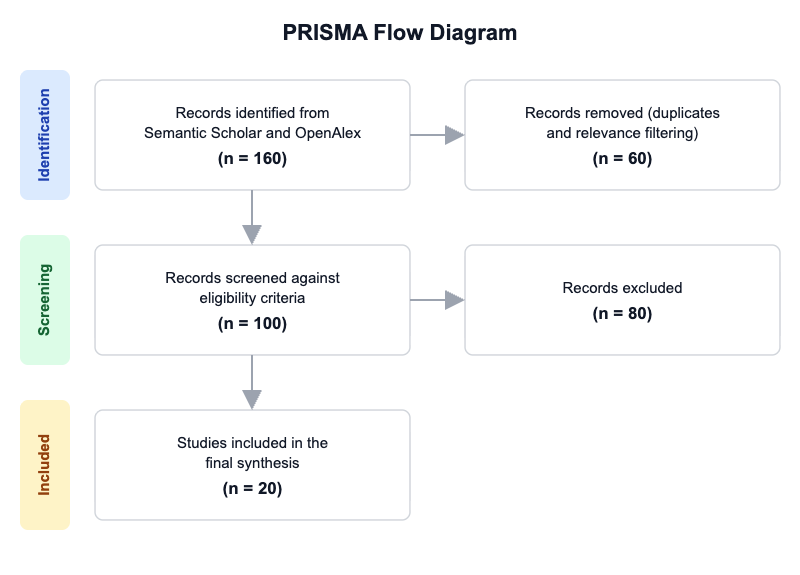
Initial database searching identified 160 records. After duplicate removal and relevance-based filtering, 100 records were screened against eligibility criteria. Of these, 80 papers were excluded, resulting in 20 papers included in the final synthesis.
PRISMA Flow Diagram
Eligibility criteria included:
- Vehicle Context: Does the study examine motion sickness in cars, automobiles, passenger vehicles, driving simulators, or autonomous vehicles rather than only general motion sickness or other transport modes?
- Human Evidence: Does the study involve human participants or human-derived observational/survey data rather than only animal, engineering-only, or purely theoretical work?
- Motion Sickness Outcome: Does the study measure motion sickness symptoms, nausea, discomfort, dizziness, or related sickness ratings as a primary or secondary outcome?
- Current Window: Is the paper published between 2020 and 2026 inclusive?
- Car-Relevant Focus: Does the study focus on car passenger comfort, vehicle motion cues, autonomous driving, simulator sickness, or mitigation strategies relevant to car motion sickness?
- Mechanism or Predictor: Does the study investigate a predictor, trigger, or mechanism such as visual-vestibular conflict, head motion, seating position, braking, road type, gaze, or anticipation?
- Mitigation Strategy: Does the study test or evaluate an intervention or design change intended to reduce motion sickness in vehicles?
- Recent/Direct: Does the paper appear to be directly about car motion sickness rather than a broad general motion sickness review?
All included studies met the stated eligibility criteria.
2.3 Data Extraction and Synthesis
Data extraction focused on the following variables:
- Study Focus: State the main focus of the paper as it relates to car/vehicle motion sickness (e.g., mechanisms, predictors, mitigation, simulator/autonomous vehicle comfort, measurement).
- Population/Setting: Describe the participant population or setting, such as passengers, drivers, simulator users, autonomous vehicle occupants, or virtual reality contexts.
- Method: Extract the study design and method used, such as experimental study, survey, driving simulator, motion platform, VR manipulation, or review.
- Key Findings: Summarize the main findings specifically about motion sickness symptoms, triggers, predictors, or mitigation outcomes.
- Intervention/Factor: Extract any intervention, manipulation, or factor studied, such as head motion, seat position, visual cues, route characteristics, braking, gaze direction, or VR content.
- Outcome Measures: List the outcomes assessed, such as sickness rating, nausea, discomfort, postural sway, physiological measures, or performance metrics.
- Practical Implications: State any practical recommendation or implication for vehicle design, passenger management, simulator design, or autonomous driving comfort.
- Recency/Relevance: Note whether the paper is directly about car motion sickness and whether it is one of the most recent studies in the 2020-2026 window.
Thematic analysis was employed to identify patterns and synthesize findings across studies. Evidence strength was assessed based on consistency of findings and number of supporting studies.
3. Results
3.1 Characteristics of Included Studies
| Study and Year | Study Type | Population / Setting | Key Focus | Intervention / Factor | Outcome Measure |
|---|---|---|---|---|---|
| Pereira et al. 2023 [1] | Review | Autonomous vehicle passengers | Countermeasures and trends | Vehicle-centric adaptation; in-car design; sensory cues | Sickness ratings; discomfort; physiological measures |
| Siddiqi et al. 2021 [2] | Experimental / modeling | Autonomous vehicle passengers | Transition curves and path planning | B-spline, Bezier, Hermite curves | Motion sickness probability |
| Siddiqi et al. 2023 [3] | Experimental / algorithmic | Autonomous vehicle passengers | MS-mitigating algorithms and control | PSO-based algorithm; control strategy | Motion sickness reduction |
| Buchheit et al. 2022 [4] | Real-world study with simulation modeling | Self-driving car passengers | Prediction using 6DOF-SVC | Human-vehicle model; driving dynamics | Motion sickness incidence |
| Xie et al. 2023 [5] | Systematic review and meta-analysis | Vehicle occupants | Motion sickness inducers and motion cues | Eye view; NDRT availability; artificial motion cues | Motion sickness induction / alleviation |
| Emond et al. 2025 [6] | Within-subject experiment | Front passenger in electric saloon vehicle | Stop-and-go mitigation | Visual cues; reclined posture; fragrance; ventilation | Subjective and physiological symptoms |
| Wadi et al. 2024 [7] | Quantitative experimental | Autonomous vehicle passengers | Adaptive suspension mitigation | Active roll compensation | Motion Sickness Dose Value |
| Yunus et al. 2025 [8] | Review | Autonomous vehicle occupants | Vehicle dynamics and control | Trajectory planning; active chassis systems | MS metrics in control functions |
| Li & Chen 2022 [9] | Simulator experiment | Automated vehicle passengers | Vibration cue system | Tactile cueing / motion anticipation | Motion sickness degree |
| Emond & Zare 2026 [10] | Experimental analysis | Stop-and-go passenger rides | Predictors of severity | Gaze restriction to visuomotor activity | Motion sickness severity; pulse rate; head motion |
| Talsma et al. 2023 [11] | Within-subject experiment | Passenger in real and simulated driving | Simulator validity | Driving style; eyes-off-road task | MISC; MSAQ |
| Mühlbacher et al. 2020 [12] | Methodological review | Automated driving occupants | Methodology for MS studies | Measurement tools; environments; ethics | Sickness ratings; discomfort |
| Emond et al. 2025 [13] | Experimental | Car passengers | Head dynamics and severity prediction | Head acceleration patterns | Self-reported severity; model prediction |
| Liu et al. 2024 [14] | Experimental | APMV passengers | Visual vertical conflict prediction | Looking ahead vs tablet use | Motion sickness severity |
| Asua et al. 2022 [15] | Observational / statistical analysis | Car passengers | Comfort and motion sickness | Driving style; vehicle; road type | Comfort evaluation variables |
| Wang et al. 2020 [16] | Human-driven experiment / predictive modeling | Passengers with differing physiological characteristics | Comfort prediction | Vehicle motion parameters; physiological characteristics | Comfort ratings; prediction accuracy |
| Rottmann et al. 2026 [17] | Field experiment | Autonomous vehicle passengers | Seating orientation | Rearward vs forward orientation; forward view | Motion sickness; acceptance factors |
| Reuten et al. 2024 [18] | Real-road experiment | Car passengers | Anticipatory cues | Vibrotactile vs auditory cues | Car sickness symptoms |
| de Winkel et al. 2021 [19] | Simulator experiment | Backward-facing passengers in AV simulation | Augmented visual environments | Regular vs augmented view | Motion sickness symptoms |
| Wijlens et al. 2024 [20] | Simulator experiment | Automated vehicle occupants | Motion predictability | Repetitive vs non-repetitive turns | Sickness ratings; head motion |
Overall, the evidence base is dominated by experimental and simulation-based studies in autonomous vehicle or passenger contexts, with several reviews and methodological papers providing conceptual synthesis. The most common outcomes are subjective sickness ratings, motion sickness incidence or severity, and physiological or kinematic markers such as pulse rate, head motion, and Motion Sickness Dose Value. The dominant intervention classes are motion anticipation cues, vehicle-dynamics control, and interior design / seating configurations.
3.2 Thematic Findings
3.2.1 Motion anticipation and sensory cueing are the most consistently effective mitigation strategies, but not all cue types work equally well
Across recent studies, the clearest pattern is that interventions helping passengers anticipate motion tend to reduce sickness, although the effect depends strongly on cue modality and context. Vibrotactile anticipatory cues reduced car sickness symptoms by 40% on a real test track, whereas auditory cues were less effective [18]. A separate vibration cue system in automated-vehicle simulator experiments also significantly lowered motion sickness and improved cue comprehension and motion anticipation [9]. In a stop-and-go passenger ride, a multimodal intervention combining visual motion cues, a reclined posture, music, fragrance, and ventilation pulses reduced symptoms by 35% compared with gaze-out-of-window alone [6]. In contrast, augmented visual environments offering extra information about present or future motion did not outperform a regular vehicle interior view [19], and a simulator manipulation of repetitive versus non-repetitive turn predictability produced no significant difference in sickness or head motion [20].
This pattern suggests that cueing is most effective when it is embodied, temporally linked to motion, and easy to integrate with passenger perception rather than being purely informational. Confidence: Moderate to strong because the overall direction is consistent, but modality-specific results and null findings indicate context sensitivity.
3.2.2 Vehicle dynamics and control-based mitigation can substantially reduce sickness, especially when motion triggers are directly suppressed
A second robust theme is that modifying the vehicle’s motion itself appears promising, particularly by reducing lateral acceleration, smoothing trajectory changes, or embedding sickness metrics into control logic. An adaptive suspension with active roll compensation suppressed the problematic motion-sickness-inducing region of the spectrum and reduced the Motion Sickness Dose Value by 113% on average [7]. Algorithmic approaches for lane change, cornering, and control adaptation also reported substantial mitigation, including about 75% reduction in autonomous vehicles [3]. Path planning work further indicates that transition curves can address multiple motion-sickness thresholds, with four out of five thresholds successfully mitigated [2]. Review-level evidence converges on trajectory planning, tracking, and active chassis integration as promising because they target the physical motion triggers rather than relying solely on post hoc symptom management [8], [1].
The consistent implication is that control-layer interventions are likely to be most effective when they directly reduce lateral and longitudinal accelerations that passengers perceive as destabilizing. Confidence: Moderate because the findings are methodologically diverse and several results come from modeling or review-based evidence rather than multiple independent real-road validations.
3.2.3 Visual access, seating orientation, and motion anticipation modulate risk, especially in autonomous or backward-facing contexts
Evidence also converges on the importance of visual access to the road and seating orientation. Rearward seating orientation significantly increased motion sickness, and restricted forward view had a similar effect in a real-traffic field experiment [17]. In autonomous personal mobility vehicles, motion sickness became more severe when passengers worked on a tablet rather than looked ahead, and the conflict between visual vertical and gravitational acceleration was captured by the 6 DoF SVC-VV model [14]. The systematic review of inducers likewise found that the type of eye view and non-visual anticipatory motion cues are among the factors with meaningful effects, while natural present motion cues through the windshield or side windows and non-visual anticipatory cues were the motion-cue forms that alleviated sickness [5]. By contrast, in the simulator study of motion predictability, turning regularity did not translate into improved anticipation or reduced sickness [20], suggesting that visual anticipation may require richer or more directly perceptible cues than simple repetition.
Taken together, these findings indicate that seeing or anticipating the road ahead matters, but only when the information is salient enough to alter sensory expectations. Confidence: Moderate because the direction is consistent, though the magnitude varies by setting and the predictability manipulation did not reproduce the anticipated benefit.
3.2.4 Individual susceptibility and head dynamics are important predictors, but their predictive value is not uniform across all ride contexts
Recent evidence increasingly shows that passenger-specific factors matter alongside vehicle motion. Individual susceptibility was the strongest predictor of motion sickness severity in a stop-and-go ride study [10], and pulse rate plus the amplitude range of pitch head movements were also related to symptom progression [10]. Head dynamics were further implicated in a separate car-passenger experiment, where nonlinear interactions in longitudinal and lateral head acceleration metrics were associated with motion sickness severity, and model predictions aligned with subjective ratings for 67% of participants who experienced symptoms [13]. More broadly, the comfort literature found that driving style, vehicle dynamics, and road type interact with passenger experience, with longitudinal and lateral accelerations exerting stronger effects than vertical acceleration [15]. Predictor-focused modeling also showed that comfort could be estimated with 84% accuracy from vehicle motion parameters and physiological characteristics [16].
The emerging picture is that passengers are not equally vulnerable: sickness appears to depend on both susceptibility and dynamic head or vehicle responses that may destabilize sensory integration. Confidence: Moderate for susceptibility and head-motion associations, but limited for precise prediction because models were tested in specific ride scenarios and performance metrics differ across studies.
3.2.5 Methods and measurement strongly shape conclusions, and simulator findings do not always transfer directly to real cars
A recurring cross-cutting issue is methodological heterogeneity. Motion sickness was more severe in the car than in the moving-base simulator, although sickness onset and style-related fluctuations were similar and symptom categories correlated across environments [11]. This suggests relative validity of simulator research, but also shows that simulators may downscale severity, likely because of motion cueing algorithm effects [11]. Methodological guidance from an earlier review stresses that measurement tools, test environments, sample characteristics, and ethical constraints materially influence what can be inferred from motion sickness studies [12]. In addition, some studies assess symptoms directly, whereas others use proxies such as Motion Sickness Dose Value, discomfort ratings, head motion, or model-derived incidence, reducing comparability across the evidence base.
This variation helps explain why some motion-anticipation interventions appear effective in real rides but not in simulator settings, and why some modeling approaches perform well in controlled studies yet still require validation in traffic. Confidence: Moderate that methods matter substantially, but the exact size of method-induced bias remains uncertain.
3.3 Summary of Evidence
| Theme | Key Finding | Population Applicability | Effect Direction | Confidence Level | Supporting Studies |
|---|---|---|---|---|---|
| Anticipatory cueing reduces sickness | Vibrotactile cues reduced car sickness by 40%; a multimodal stop-and-go intervention reduced symptoms by 35% | Primarily car and automated-vehicle passengers; partially applicable to backward-facing AV settings | Negative | Moderate to Strong | Reuten et al. [18], Emond et al. [6], Li & Chen [9] |
| Vehicle dynamics control can mitigate symptoms | Adaptive suspension reduced MSDV by 113% on average; algorithmic AV control reduced MS by about 75% | Autonomous vehicle passengers; partly modeled / simulator-based | Negative | Moderate | Wadi et al. [7], Siddiqi et al. [3], Yunus et al. [8] |
| Visual access and seating orientation matter | Rearward seating and restricted forward view significantly increased motion sickness; tablet use worsened symptoms in APMV | Autonomous vehicle / APMV passengers; partially matches question population | Positive | Moderate | Rottmann et al. [17], Liu et al. [14], Xie et al. [5] |
| Individual susceptibility and head dynamics predict severity | Individual susceptibility was strongest; pulse rate and head pitch amplitude were significant; 67% model concordance for symptomatic participants | Passenger ride contexts and car passengers; directly relevant | Positive | Moderate | Emond & Zare [10], Emond et al. [13], Wang et al. [16] |
| Simulator and measurement context shape apparent effects | Motion was more severe in car than simulator, though symptom patterns correlated; predictability manipulation was null | Simulator and real-road passenger contexts; partially matches question population | Mixed / Null | Moderate | Talsma et al. [11], Wijlens et al. [20], Mühlbacher et al. [12] |
4. Discussion
4.1 Principal Findings and Their Interpretation
The synthesis indicates that the most actionable advances in car motion sickness research are no longer centered on whether the phenomenon exists, but on which levers can reliably reduce it. The strongest convergence lies in motion anticipation and motion control: when passengers are given temporally meaningful cues about upcoming motion, or when the vehicle reduces the accelerations that provoke sensory conflict, symptoms tend to fall. This is mechanistically plausible because motion sickness is repeatedly framed in the reviewed literature as a mismatch between expected and actual motion, especially when visual input, vestibular input, and active postural control are degraded. The effectiveness of vibrotactile cues and adaptive suspension fits this account better than purely informational visual augmentation, suggesting that cues must be integrated with bodily motion or with the motion-generating controller to matter.
The review also shows that symptom prediction is increasingly feasible, but still context-dependent. Head dynamics, pulse rate, and individual susceptibility emerge as meaningful markers, implying that motion sickness is not only a vehicle property but also an occupant-state problem. This matters because a passenger-centric model can identify early escalation before symptoms peak, enabling intervention earlier in the ride. At the same time, the mixed performance of prediction tools across simulator and real-road studies indicates that current models are strongest as local estimators rather than universal predictors.
Confidence is highest for the general importance of motion anticipation, vehicle dynamics, and susceptibility, because these patterns recur across different designs and settings. Confidence is lower for any single cueing strategy or prediction model, because results vary by modality, ride context, and measurement approach. The evidence base therefore supports an integrated framework: reduce provocative motion, preserve or restore anticipatory information, and screen for vulnerable passengers using physiologic and movement-based indicators.
4.2 Comparison with Existing Literature and Resolution of Contradictions
The most notable contradiction is that some anticipated countermeasures work well in real-road contexts while others do not generalize from theory or simulator work. The lack of benefit from augmented visual environments and from repetitive motion predictability likely reflects the complexity of car sickness compared with linear laboratory motion. In a moving vehicle, passengers may already receive sufficient baseline visual input from the cabin, so adding more visual information may produce a ceiling effect rather than a meaningful gain [19]. Likewise, a repeating turn sequence may be too subtle or too cognitively demanding for passengers to detect, especially when road visuals are removed to simulate an eyes-off-road condition [20]. These null findings are therefore not simply failures; they show that anticipatory information must be perceptible, trustworthy, and aligned with the passenger’s sensory frame.
Another source of inconsistency is methodological heterogeneity. Studies use sickness ratings, motion sickness incidence, Motion Sickness Dose Value, head motion, or model-derived estimates, which are related but not interchangeable outcomes. This makes it difficult to compare magnitudes directly and likely explains why some studies appear more positive than others. Real-road and simulator environments also differ in the intensity of motion, and the simulator tends to understate sickness severity [11], which may dampen apparent intervention effects. The literature may therefore contain a form of context-dependent publication bias: studies testing interventions in settings where the mechanism is most plausible are more likely to report benefit, while weaker or more indirect cues produce null results. Overall, the newer studies do not overturn earlier findings; rather, they refine them by showing that motion-sickness mitigation is highly dependent on cue salience, vehicle dynamics, and the realism of the test environment.
4.3 Practical Implications
The evidence suggests that the most useful interventions will differ by passenger state and vehicle architecture. For autonomous and semi-autonomous vehicles, designers should prioritize motion-control strategies that reduce lateral acceleration and abrupt trajectory changes, because these interventions act at the source of the provocation rather than after symptoms have begun. This is particularly relevant for passengers who are likely to read, use tablets, or recline, because restricted forward view and rearward seating appear to increase risk [17], [14].
For passenger-facing interfaces, vibrotactile anticipatory cueing appears especially promising because it reduced sickness in both test-track and simulator contexts, whereas purely visual augmentation was not reliably beneficial [18], [9], [19]. Clinically and ergonomically, individuals with known susceptibility may warrant early screening or adaptive support, since susceptibility and head-motion patterns are emerging as robust markers of symptom escalation [10], [13]. At the public-health level, the findings support population-wide design changes in autonomous vehicles rather than expecting passengers to adapt on their own. The literature does not yet justify a no-threshold policy claim in the regulatory sense, because exposure-response thresholds are not established here; instead, the more defensible implication is that reducing motion-provoking conditions should be treated as a core design requirement, not an optional comfort feature.
4.4 Strengths and Limitations
A major strength of this review is its focus on recent evidence across complementary study types, including real-road experiments, simulator studies, predictor models, and integrative reviews. This makes it possible to identify patterns that single designs cannot reveal, especially around anticipatory cueing, vehicle control, and passenger susceptibility. The reviewed studies also offer a useful spread of contexts, from conventional car rides to autonomous personal mobility vehicles and stop-and-go electric rides.
Important limitations remain. Many studies rely on small, tightly controlled samples, limiting generalizability. Outcomes are heterogeneous, with subjective ratings, physiological measures, and model-derived estimates used interchangeably across studies. Several findings are based on simulation or modeling rather than direct road validation. For this review, an additional limitation is that synthesis depends on reported abstracts and extracted fields rather than full-text risk-of-bias appraisal, so subtle design weaknesses may be underdetected.
5. Gaps and Future Directions
The clearest gap is the need for directly comparable real-road studies in autonomous vehicles that test cueing, seating, and motion-control interventions within the same protocol. Current evidence is split across simulators, test tracks, and field experiments, which makes it difficult to determine whether null effects reflect ineffective interventions or insufficient ecological validity. Future work should also harmonize outcome definitions by measuring subjective sickness, physiology, head motion, and motion-dose metrics together, rather than in isolation.
Passenger susceptibility deserves deeper study in mixed-age, mixed-gender, and highly motion-sensitive samples, because most existing work uses relatively small and context-specific groups. The field also needs better validation of prediction models in naturalistic rides, especially for head-motion-based and physiology-based screening. Finally, multimodal interventions should be tested component-wise so it becomes clear whether vibrotactile, visual, auditory, fragrance, or posture elements are individually necessary or only effective in combination.
6. Conclusion
The latest research indicates that car motion sickness is best understood as a dynamic interaction between vehicle motion, passenger susceptibility, and the availability of anticipatory information. The most defensible conclusion is that symptoms are reduced when the vehicle or interface helps passengers predict motion and when motion-provoking accelerations are directly suppressed. In real-road and stop-and-go settings, vibrotactile anticipatory cues reduced car sickness by 40% and a multimodal intervention reduced symptoms by 35%, while an adaptive suspension approach reduced Motion Sickness Dose Value by 113% on average [18], [6], [7]. At the same time, not all predictive or visual enhancements work: augmented visual environments produced no added benefit over a regular view, and a motion-predictability manipulation in a simulator was null [19], [20].
These findings apply most directly to autonomous and passenger-focused vehicle contexts, including backward-facing, tablet-using, and stop-and-go ride scenarios [17], [14]. The single most important unresolved question is which combination of vehicle control and passenger-facing cues remains effective across real-world driving conditions without requiring context-specific tuning. Answering that question will determine whether motion sickness mitigation becomes a universal feature of future cars or remains a set of localized solutions. Because acceptance of autonomous vehicles depends partly on comfort, progress in this area has direct implications for design, passenger well-being, and the practical success of vehicle automation.
References
- Pereira, E., Macedo, H., Lisboa, I. C., Sousa, E., Machado, D., Silva, E., Coelho, V., Arezes, P., & Costa, N. (2023). Motion sickness countermeasures for autonomous driving: Trends and future directions. Transportation Engineering, 15, 100220. https://doi.org/10.1016/j.treng.2023.100220
- Siddiqi, M. R., Milani, S., Jazar, R. N., & Marzbani, H. (2021). Ergonomic path planning for autonomous vehicles—An investigation on the effect of transition curves on motion sickness. IEEE Transactions on Intelligent Transportation Systems, 23(7), 7258–7269. https://doi.org/10.1109/TITS.2021.3067858
- Siddiqi, M. R., Milani, S., Jazar, R. N., & Marzbani, H. (2023). Motion sickness mitigating algorithms and control strategy for autonomous vehicles. IEEE Transactions on Intelligent Transportation Systems, 24(1), 304–315. https://doi.org/10.1109/TITS.2022.3215175
- Buchheit, B., Schneider, E. N., Alayan, M., Dauth, F., & Strauss, D. J. (2022). Motion sickness prediction in self-driving cars using the 6DOF-SVC model. IEEE Transactions on Intelligent Transportation Systems, 23(8), 13582–13591. https://doi.org/10.1109/TITS.2021.3125802
- Xie, W., He, D., & Wu, G. (2023). Inducers of motion sickness in vehicles: A systematic review of experimental evidence and meta-analysis. Transportation Research Part F: Traffic Psychology and Behaviour, 99, 167–188. https://doi.org/10.1016/j.trf.2023.10.013
- Emond, W., Sauerbier, R., Scholly, U., Sasangohar, F., & Zare, M. (2025). Motion sickness detection and mitigation in a stop-and-go passenger ride scenario. Transportation Research Part F: Traffic Psychology and Behaviour, 116, 103381. https://doi.org/10.1016/j.trf.2025.103381
- Wadi, A., Abdel-Hafez, M. F., & Jaradat, M. A. (2024). Mitigating motion sickness in autonomous vehicles for improved passenger comfort. IEEE Access, 12, 62709–62718. https://doi.org/10.1109/ACCESS.2024.3386863
- Yunus, I., Papaioannou, G., Jerrelind, J., & Drugge, L. (2025). A review of vehicle dynamics and control approaches for mitigating motion sickness in autonomous vehicles. IEEE Access, 13, 132990–133024. https://doi.org/10.1109/ACCESS.2025.3592407
- Li, D., & Chen, L. (2022). Mitigating motion sickness in automated vehicles with vibration cue system. Ergonomics, 65(10), 1313–1325. https://doi.org/10.1080/00140139.2022.2028902
- Emond, W., & Zare, M. (2026). Motion sickness in stop-and-go passenger rides: Influence of individual characteristics, contextual, behavioural, and physiological parameters. Ergonomics. Advance online publication. https://doi.org/10.1080/00140139.2026.2632689
- Talsma, T. M. W., Hassanain, O., Happee, R., & de Winkel, K. N. (2023). Validation of a moving base driving simulator for motion sickness research. Applied Ergonomics, 106, 103897. https://doi.org/10.1016/j.apergo.2022.103897
- Mühlbacher, D., Tomzig, M., Reinmüller, K., & Rittger, L. (2020). Methodological considerations concerning motion sickness investigations during automated driving. Information, 11(5), 265. https://doi.org/10.3390/info11050265
- Emond, W., Tomalka, A., Bektas, A., & Zare, M. (2025). Can we estimate motion sickness severity in car passengers based on individual head dynamics? Human Factors, 67(10), 1101–1114. https://doi.org/10.1177/00187208251326683
- Liu, H., Inoue, S., & Wada, T. (2024). Subjective vertical conflict model with visual vertical: Predicting motion sickness on autonomous personal mobility vehicles. IEEE Transactions on Intelligent Transportation Systems, 25(8), 9878–9894. https://doi.org/10.1109/TITS.2024.3357170
- Asua, E., Gutiérrez-Zaballa, J., Mata-Carballeira, O., Ruiz, J. A., & del Campo, I. (2022). Analysis of the motion sickness and the lack of comfort in car passengers. Applied Sciences, 12(8), 3717. https://doi.org/10.3390/app12083717
- Wang, C., Zhao, X., Fu, R., & Li, Z. (2020). Research on the comfort of vehicle passengers considering the vehicle motion state and passenger physiological characteristics: Improving the passenger comfort of autonomous vehicles. International Journal of Environmental Research and Public Health, 17(18), 6821. https://doi.org/10.3390/ijerph17186821
- Rottmann, L., Johannsen, A., Niedling, M., & Vollrath, M. (2026). Influence of seating orientation on motion sickness in autonomous vehicles. Applied Ergonomics, 130, 104643. https://doi.org/10.1016/j.apergo.2025.104643
- Reuten, A. J. C., Yunus, I., Bos, J. E., Martens, M. H., & Smeets, J. B. J. (2024). Anticipatory cues can mitigate car sickness on the road. Transportation Research Part F: Traffic Psychology and Behaviour, 105, 196–205. https://doi.org/10.1016/j.trf.2024.07.006
- de Winkel, K. N., Pretto, P., Nooij, S. A. E., Cohen, I., & Bülthoff, H. H. (2021). Efficacy of augmented visual environments for reducing sickness in autonomous vehicles. Applied Ergonomics, 90, 103282. https://doi.org/10.1016/j.apergo.2020.103282
- Wijlens, R., Englebert, B. J. V., Takamatsu, A., Makita, M., Sato, H., Wada, T., de Winter, J. C. F., van Paassen, M. M., & Mulder, M. (2024). On the road to comfort: Evaluating the influence of motion predictability on motion sickness in automated vehicles. Ergonomics, 68(5), 697–715. https://doi.org/10.1080/00140139.2024.2372704