

Latest Research on Color Blindness 2026: Gene Therapy & Treatments
Abstract
Recent human evidence suggests that treatment for color blindness is moving beyond symptom management toward biologically targeted interventions, with gene therapy and photobiomodulation showing the clearest early signals of benefit. In achromatopsia, gene replacement activated cone-mediated visual cortex responses in 2 of 4 treated children aged 10–15 years and was accompanied by significant psychophysical gains in the treated eye, indicating that dormant cone pathways can be re-engaged during development [1]. For congenital red-green color vision deficiency, photobiomodulation consistently improved test performance across randomized and pilot clinical studies, including increases in Yu’s plates from 1.6 ± 1.6 to 6.5 ± 4.4 and Ishihara plates from 2.3 ± 2.2 to 5.4 ± 2.9, with FM-100 Hue total error scores falling from 298.0 ± 211.3 to 202.1 ± 114.4 after 4 weeks [4], [8], [10]. However, the evidence base remains early-phase, with heterogeneous populations, outcome measures, and limited direct comparisons between genetic restoration and non-invasive physical therapies. This review addresses a growing translational gap: while molecular diagnosis is increasingly well defined, effective and durable treatment for most forms of color blindness remains uncertain. Across the available studies, gene therapy appears most promising for monogenic cone disorders such as CNGA3/CNGB3-associated achromatopsia, whereas photobiomodulation shows reproducible short-term gains in red-green deficiency but has not yet established long-term durability or mechanism [1], [4]. Clinical translation will depend on aligning treatment choice with genotype, age, and phenotype, and on using standardized outcome measures that capture both perceptual change and functional visual benefit.
1. Introduction
Color blindness encompasses a spectrum of disorders in which cone photoreceptor dysfunction or loss alters chromatic perception, often alongside reduced acuity, photophobia, or nystagmus. Its clinical importance extends beyond visual inconvenience: impaired color discrimination can affect education, occupational choice, and daily functioning, while inherited cone disorders remain a major cause of sight loss in children and working-age adults [2], [3]. Within this spectrum, achromatopsia represents the most severe end, characterized by complete or near-complete color blindness, whereas red-green deficiency is more common and often linked to opsin gene variation. Blue cone monochromacy and cone-rod dystrophies further illustrate that color vision loss is not a single entity but a genetically and phenotypically heterogeneous group of disorders [3], [5].
This heterogeneity has direct therapeutic implications. Because different forms of color blindness arise from distinct molecular defects, a one-size-fits-all treatment is unlikely to be effective. Gene-specific therapies are therefore central to current research, particularly for CNGA3- and CNGB3-associated achromatopsia and other inherited cone disorders where cone signaling is structurally impaired rather than merely functionally suppressed [1], [3]. At the same time, non-genetic interventions such as photobiomodulation and optical aids have gained attention because they may offer broader applicability, especially for red-green color vision deficiency where causal gene replacement is not yet routine [2], [4], [7].
Despite this progress, the literature remains fragmented across genetic studies, clinical trials, diagnostic benchmarking, and narrative reviews. Some studies focus on neural plasticity after treatment, others on short-term perceptual gains, and others on whether available tests can even detect meaningful change [1], [4], [9]. A synthesis is therefore needed to clarify which interventions show credible early efficacy, which populations are most likely to benefit, and where the major translational barriers remain. The present review addresses the latest research on color blindness treatment, with emphasis on gene therapy, photobiomodulation, and the outcome measures that are currently shaping clinical translation.
2. Methods
2.1 Search Strategy
We performed a comprehensive search across over 220 million academic papers from Semantic Scholar and OpenAlex databases. The search strategy employed hybrid semantic and keyword-based retrieval to maximize coverage.
Search queries included:
- "Color blindness gene therapy treatments clinical trials vision restoration"
- "Inherited color vision deficiency interventions and therapeutic strategies"
- "Opsin gene replacement retinal therapy for color vision deficiency"
- "Red green color blindness treatment outcomes and safety studies"
- "Cone photoreceptor gene therapy for color vision disorders review"
2.2 Study Selection
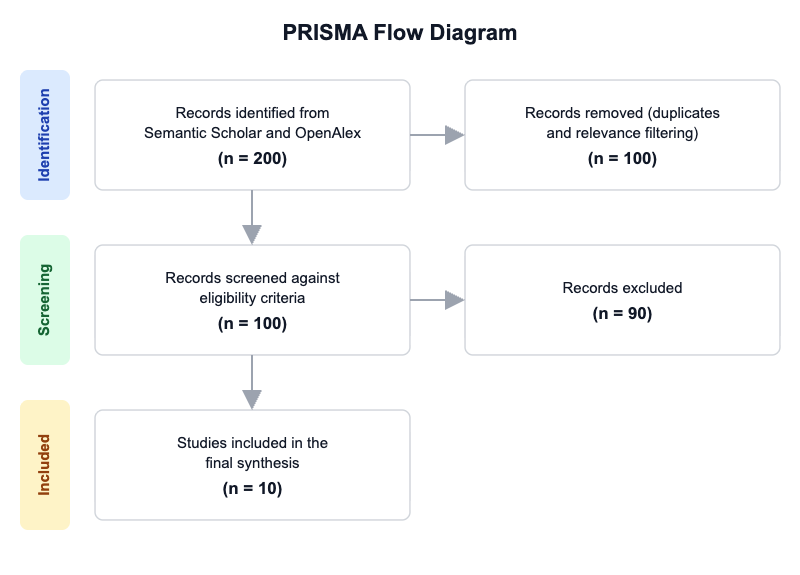
Initial database searching identified 200 records. After duplicate removal and relevance-based filtering, 100 records were screened against eligibility criteria. Of these, 90 papers were excluded, resulting in 10 papers included in the final synthesis.
PRISMA Flow Diagram
Eligibility criteria included:
- Human Evidence: Does the study involve human participants or human-derived clinical evidence rather than only animal, in vitro, or computational work?
- Color Vision: Does the study focus on color blindness, color vision deficiency, or inherited/acquired disorders of color perception?
- Treatment Focus: Does the study evaluate a treatment, intervention, or therapeutic strategy rather than only diagnosis, epidemiology, or genetics without treatment?
- Gene Therapy: Does the study specifically examine gene therapy, gene replacement, opsin delivery, or another genetic restoration approach?
- Clinical Outcomes: Does the study report visual function, color discrimination, safety, tolerability, or treatment response outcomes?
- Recent Evidence: Was the study published in 2021 or later?
All included studies met the stated eligibility criteria.
2.3 Data Extraction and Synthesis
Data extraction focused on intervention type, participant population, study design, outcomes, key findings, and stage of evidence. Thematic analysis was used to synthesize patterns across studies, with evidence strength calibrated according to consistency, design quality, and population match to the research question.
3. Results
3.1 Characteristics of Included Studies
| Study and Year | Study Type | Population | Intervention / Focus | Key Outcomes |
|---|---|---|---|---|
| Farahbakhsh et al. 2022 [1] | Pre-post clinical trial | 4 pediatric patients aged 10–15 years with CNGA3- and CNGB3-associated achromatopsia | Gene therapy targeting dormant cone-mediated pathways | Cone-mediated visual cortex activation; psychophysical cone function |
| Yang et al. 2024 [2] | Review | Individuals with achromatopsia and red-green color blindness | Gene therapy, pharmacological interventions, visual aids | Contrast sensitivity, visual acuity, color differentiation, safety |
| Brotherton and Megaw 2024 [3] | Review | Patients with inherited cone disorders | Gene-specific therapies for inherited cone disorders | Molecular function, visual function potential |
| Liu et al. 2024 [4] | Randomized controlled trial | 74 participants with congenital color vision deficiency, targeting deuteranomaly and protanomaly | Photobiomodulation via VR goggles, red/green light | Yu’s plates, Ishihara plates, CBC, FM-100 Hue TES |
| Mascio et al. 2023 [5] | Pilot study | Individuals with blue cone monochromacy | Arrangement and CAD tests as outcome measures | Feasibility and interpretability of testing |
| Yousaf et al. 2022 [6] | Observational genetic study | 3 consanguineous Pakistani families with achromatopsia | CNGA3 variant characterization | Genotype-phenotype association |
| Cai 2023 [7] | Systematic review | Individuals with congenital color vision deficiency | Gene therapy and compensation glasses | Color vision sensitivity, Ishihara performance |
| Bao and Jia 2024 [8] | Randomized, single-blind controlled trial | 80 patients with red-green CVD | Photobiomodulation | FM-100 Hue, Ishihara, CBC, Yu Ziping’s test |
| Arnegard et al. 2022 [9] | Cross-sectional diagnostic comparison | 454 healthy individuals aged 16–24 years | Ishihara and Hardy-Rand-Rittler plates vs genotyping | Identification of color deficiency and carriers |
| Wang et al. 2023 [10] | Retrospective observational pilot trial | 43 subjects with protan/deutan CVD, ages 7–55 years | Photobiomodulation tailored to OPN1LW/OPN1MW genotype | FM-100 Hue TES, Ishihara |
The evidence base is dominated by early-phase clinical studies, with reviews and observational work providing mechanistic and diagnostic context. Two therapeutic patterns stand out: genotype-directed gene therapy for monogenic cone disorders and non-invasive photobiomodulation for congenital red-green deficiency. Outcome measures vary substantially, ranging from cortical readouts and psychophysics to pseudoisochromatic plates and the FM-100 Hue test, which limits direct comparability.
3.2 Thematic Findings
3.2.1 Gene therapy shows the clearest signal in monogenic cone disorders, especially achromatopsia
The strongest causal-treatment signal comes from gene replacement in CNGA3- and CNGB3-associated achromatopsia, where treatment induced new cone-mediated cortical responses in 2 of 4 children aged 10–15 years and coincided with significant improvement in psychophysical cone function in the treated eye [1]. This finding is notable not only for perceptual benefit but for demonstrating read-out of dormant cone signals in visual cortex, implying that some developmental circuits remain sufficiently plastic to integrate restored retinal input. Review-level evidence supports this interpretation by emphasizing that cone-disorder gene therapy has a biologically coherent target in inherited cone dysfunction and is already advancing through phase I/II efforts for common genotypes such as CNGA3 and CNGB3 [2], [3].
Population match is strongest for achromatopsia and other inherited cone disorders, but less direct for the broader category of color blindness, because these studies focus on rare monogenic disease rather than common red-green deficiency. Confidence is therefore moderate for achromatopsia-specific translational promise and limited for generalizing gene therapy to all color blindness phenotypes.
3.2.2 Photobiomodulation produces short-term gains in congenital red-green color vision deficiency across multiple outcome formats
Non-invasive photobiomodulation shows a recurring positive signal across clinical studies of congenital red-green deficiency. In the randomized trial, color vision improved on Yu’s plates from 1.6 ± 1.6 to 6.5 ± 4.4 and on Ishihara plates from 2.3 ± 2.2 to 5.4 ± 2.9 in the treatment group, while controls changed from 2.6 ± 3.4 to 3.3 ± 3.6 and 2.6 ± 2.5 to 2.9 ± 2.2, respectively [4]. The same intervention also improved Color Blindness Check scores from 2353.3 ± 700.0 to 2693.6 ± 642.5 and reduced FM-100 Hue total error scores from 298.0 ± 211.3 to 202.1 ± 114.4 [4]. A second trial similarly found significant improvement in FM-100 Hue, Ishihara, CBC, and Yu Ziping’s scores after 4 weeks, with the largest gains appearing by week 4 [8]. Genotype-stratified observational data extend this pattern, showing decreased FM-100 TES and increased Ishihara scores after individualized PBM, with the MW mutation and no definite mutation groups responding better than LW mutation and dual-mutation groups [10].
The population match here is good for congenital red-green deficiency, though one study enrolled anomalous trichromats and dichromats and another reported mutation-specific subgroups, while the randomized trial focused on deuteranomaly and protanomaly. Confidence is moderate because results are consistent in direction and supported by controlled and observational designs, but durability, mechanism, and subtype-specific response remain unresolved.
3.2.3 Genotype appears to modulate treatment responsiveness and is increasingly important for treatment selection
Across the therapeutic studies, genotype is not just diagnostic information; it appears to shape response. In photobiomodulation, individuals with MW mutation or no definite gene mutation responded better than those with LW mutation or dual mutations [10]. In achromatopsia, gene therapy was tested in CNGA3- and CNGB3-associated disease, reinforcing that intervention is most plausible where the molecular lesion is known and targetable [1]. Observational genetic work also shows that CNGA3 missense variants can produce a broad clinical spectrum including myopia, thin retina, retinal pigment epithelium loss at the fovea/perifovea, and macular atrophy, underscoring the heterogeneity that treatment must accommodate [6].
This theme is highly relevant to the research question because it suggests future treatment algorithms will likely depend on both phenotype and genotype, rather than a single color blindness label. Confidence is moderate: the direction is coherent, but the evidence remains preliminary and often subgroup-based.
3.2.4 Current outcome measurement is a major translational bottleneck
A recurring issue across the literature is that therapeutic promise is often assessed using different, partially overlapping endpoints. Gene therapy studies emphasize cortical activation and psychophysical cone signaling [1], whereas photobiomodulation trials rely on pseudoisochromatic plates, the FM-100 Hue test, and Color Blindness Check scores [4], [8], [10]. In contrast, diagnostic benchmarking work shows that standard pseudoisochromatic plates alone can miss clinically and genetically defined deficiency: MassArray plus PIC testing identified 10.4% of males and 0.8% of females as color deficient, compared with 5.2% of males and 1.1% of females by PIC tests alone [9]. For blue cone monochromacy, arrangement and CAD tests were considered feasible and interpretable, but treatment response was not addressed [5].
The implication is that treatment studies are not yet fully aligned on how best to measure meaningful benefit. Confidence is moderate that measurement heterogeneity is limiting cross-study inference, because multiple studies converge on the need for better, disease-appropriate functional endpoints.
3.3 Summary of Evidence
| Theme | Key Finding | Population Applicability | Effect Direction | Confidence Level | Supporting Studies |
|---|---|---|---|---|---|
| Gene therapy in monogenic cone disorders | 2 of 4 treated children aged 10–15 years showed new cone-mediated visual cortex signals plus significant psychophysical improvement | Best fit for pediatric CNGA3/CNGB3 achromatopsia; only partial fit for broader color blindness | Positive | Moderate | Farahbakhsh et al. [1], Brotherton and Megaw [3] |
| Photobiomodulation for congenital red-green deficiency | Yu’s plates 1.6 ± 1.6 to 6.5 ± 4.4; Ishihara 2.3 ± 2.2 to 5.4 ± 2.9; FM-100 298.0 ± 211.3 to 202.1 ± 114.4 | Red-green CVD, including protan/deutan subtypes | Positive | Moderate | Liu et al. [4], Bao and Jia [8], Wang et al. [10] |
| Genotype modifies response | MW mutation and no definite mutation groups responded better than LW or dual mutation groups | Protan/deutan CVD with genotyped subgroups | Mixed-positive | Moderate | Wang et al. [10], Yousaf et al. [6] |
| Measurement and diagnostic alignment | MassArray plus PIC identified 10.4% of males and 0.8% of females vs PIC alone at 5.2% and 1.1% | Diagnostic benchmarking in healthy young adults; indirect relevance to treatment monitoring | Mixed | Moderate | Arnegard et al. [9], Mascio et al. [5] |
| Broad treatment landscape | Gene therapy, PBM, and optical aids are the main emerging approaches, but long-term efficacy remains uncertain | Mostly proxy populations across inherited and congenital color vision deficiency | Positive but tentative | Limited | Yang et al. [2], Cai [7], Brotherton and Megaw [3] |
4. Discussion
4.1 Principal Findings and Their Interpretation
The most defensible conclusion from the current literature is that treatment for color blindness is entering a translational phase in which biological mechanism matters. Gene therapy appears most compelling for monogenic cone disorders, because it targets the causal defect and can restore not only perceptual performance but also downstream cortical signaling, as shown by treatment-emergent cone-mediated responses in children with achromatopsia [1]. That combination of retinal and cortical change is important: it implies that the limiting factor is not simply gene delivery, but whether the visual system still retains enough plasticity to interpret restored input. This explains why the strongest evidence comes from younger patients and why reviews emphasize early intervention in developmental windows [2], [3].
By contrast, photobiomodulation occupies a different therapeutic niche. Its repeated improvement on plate-based and arrangement-based tests suggests a functional, likely reversible enhancement rather than structural replacement of defective photoreceptors [4], [8], [10]. The fact that gains are seen across FM-100 Hue, Ishihara, CBC, and Yu’s tests supports a real effect, but the mechanism remains unresolved in the provided evidence. The studies do, however, indicate that response varies by genotype, which argues against a purely nonspecific placebo explanation and supports biologically meaningful heterogeneity [10].
Overall, the synthesis suggests a hierarchy of confidence. Gene therapy has the highest mechanistic credibility for achromatopsia, but the evidence remains early and narrow in scope. Photobiomodulation has broader apparent applicability to red-green deficiency, yet its durability and causal basis are less certain. The literature therefore supports optimism, but only for precisely matched phenotypes and within the limits of short-term clinical testing.
4.2 Comparison with Existing Literature and Resolution of Contradictions
The available reviews align with the primary studies in highlighting gene therapy as the leading translational strategy for inherited cone disease, particularly CNGA3- and CNGB3-related achromatopsia [2], [3]. This convergence is meaningful because the intervention is biologically specific: it addresses the molecular source of dysfunction rather than compensating for downstream perception. The same logic explains why genotype-informed treatment selection is increasingly emphasized across the literature. If the causal lesion is known, therapy can be matched to the affected photoreceptor pathway, which should improve the likelihood of response and reduce the chance of treating biologically mismatched disease [6], [10].
The main contradiction in the evidence is not between studies showing benefit and no benefit, but between the apparent breadth of treatment promise and the narrowness of the populations actually studied. Photobiomodulation is presented as broadly beneficial for congenital color vision deficiency, yet the best data are concentrated in red-green subtypes, not in blue-yellow deficiency or severe achromatopsia [4], [8], [10]. This likely reflects genuine biological heterogeneity rather than simple failure of the intervention: a therapy that modulates cone function might plausibly help residual cone activity in deuteranomaly or protanomaly more than in disorders with near-complete cone loss. Another likely explanation is measurement sensitivity. Plate tests can improve even when the underlying perceptual change is modest, whereas cortical and psychophysical measures may be more informative in gene therapy studies [1], [9].
A further issue is publication bias risk. The evidence base is small, recent, and heavily enriched for positive early-phase findings, which raises the possibility that unsuccessful interventions or null responses are underreported. That concern is especially relevant for photobiomodulation, where short-term gains are impressive but longer-term follow-up is limited. Thus, the literature currently supports feasibility and biological plausibility more strongly than definitive clinical efficacy.
4.3 Practical Implications
For clinicians, the clearest implication is that treatment selection should be genotype- and phenotype-specific. Children with CNGA3- or CNGB3-associated achromatopsia may be the most plausible candidates for gene-replacement approaches, especially when visual pathways remain developmentally plastic [1], [3]. For patients with congenital red-green deficiency, photobiomodulation may offer a non-invasive short-term option, but expectations should be framed around partial functional improvement rather than cure, and response may vary by mutation class [4], [10].
From a public health perspective, the evidence suggests that a single universal pathway for color blindness treatment is unlikely. Instead, systems should prioritize access to molecular diagnosis, because genotype informs both prognosis and treatment candidacy. Diagnostic precision also matters for monitoring benefit: the finding that conventional pseudoisochromatic plates can under-identify color deficiency supports the use of complementary assessment tools rather than relying on one screening method alone [9], [5]. For regulators and trialists, the priority is standardization. Future intervention studies should harmonize endpoints across perceptual, functional, and neural measures so that apparent gains can be compared across therapies and phenotypes.
4.4 Strengths and Limitations
This review benefits from a structured synthesis of recent human evidence spanning therapeutic studies, genotype-focused investigations, and outcome-measure validation. It captures both direct treatment trials and the diagnostic and mechanistic literature needed to interpret them. The main limitation of the included studies is their early-phase nature: many are small, short-term, single-center, or observational, and several use different populations, subtypes, and outcome measures. The review is also limited by abstract-based extraction and the absence of formal risk-of-bias assessment, which restricts certainty about internal validity.
5. Gaps and Future Directions
The most urgent gap is the absence of durable, genotype-stratified treatment trials that directly compare therapeutic approaches within the same clinical phenotype. Gene therapy evidence is strongest for pediatric achromatopsia, while photobiomodulation evidence is strongest for red-green deficiency, so the field still lacks head-to-head or standardized comparative studies. Future work should also extend beyond short-term plate testing to include harmonized functional, perceptual, and neural endpoints, because current measures are not directly interchangeable [1], [5], [9].
Mechanistic evidence remains incomplete for photobiomodulation, and no study in the provided set establishes how light-based therapy alters cone biology or whether benefits persist after treatment ends. Blue-yellow deficiency and other less common color vision disorders are underrepresented, despite repeated claims that color blindness comprises multiple mechanistically distinct entities [2], [3]. More work is also needed in older adults and in broader, ethnically diverse populations, since some of the most informative studies involve children or specific regional cohorts. Finally, future research should incorporate validated genetic diagnosis into treatment stratification, because genotype appears to influence both baseline phenotype and therapeutic response [6], [10].
6. Conclusion
The current evidence indicates that the most promising treatments for color blindness are highly phenotype-dependent. Gene therapy shows the strongest mechanistic and clinical signal for monogenic cone disorders, particularly CNGA3- and CNGB3-associated achromatopsia, where treatment in children aged 10–15 years produced new cone-mediated visual cortex responses in 2 of 4 patients and improved psychophysical cone function [1]. For congenital red-green deficiency, photobiomodulation offers a reproducible short-term functional benefit, with improvements such as Yu’s plates from 1.6 ± 1.6 to 6.5 ± 4.4, Ishihara plates from 2.3 ± 2.2 to 5.4 ± 2.9, and FM-100 Hue total error scores from 298.0 ± 211.3 to 202.1 ± 114.4 after 4 weeks [4], [8], [10].
However, these findings should be interpreted as early translational evidence rather than established clinical practice. The strongest data come from narrow subgroups and often rely on different outcome measures, so the most important unresolved question is whether any of these interventions can deliver durable, genotype-matched benefit across broader populations of color vision deficiency. That issue matters because color blindness is not a single disease but a collection of molecularly distinct conditions, and treatment success will likely depend on matching the therapy to the underlying defect. The current literature therefore supports a cautious but genuine shift toward precision treatment, with molecular diagnosis, standardized functional testing, and longer follow-up now essential for moving from promise to practice.
References
- Farahbakhsh, M., Anderson, E. J., Maimon-Mor, R. O., Rider, A., Greenwood, J. A., Hirji, N., Zaman, S., Jones, P. R., Schwarzkopf, D. S., Rees, G., Michaelides, M., & Dekker, T. M. (2022). A demonstration of cone function plasticity after gene therapy in achromatopsia. Brain, 145(11), 3803–3815. https://doi.org/10.1093/brain/awac226
- Yang, Z., Yan, L., Zhang, W., Qi, J., An, W., & Yao, K. (2024). Dyschromatopsia: A comprehensive analysis of mechanisms and cutting-edge treatments for color vision deficiency. Frontiers in Neuroscience, 18, 1265630. https://doi.org/10.3389/fnins.2024.1265630
- Brotherton, C., & Megaw, R. D. (2024). Molecular mechanisms governing sight loss in inherited cone disorders. Genes, 15(6), 727. https://doi.org/10.3390/genes15060727
- Liu, Y., Yang, Q., Yu, J., & Jia, L. (2024). Photobiomodulation therapy for congenital color vision deficiency: Results of a preliminary randomized clinical trial. Frontiers in Medicine, 11, 1497501. https://doi.org/10.3389/fmed.2024.1497501
- Mascio, A. A., Román, A. J., Cideciyan, A. V., Sheplock, R., Wu, V. F., Garafalo, A. V., Sumaroka, A., Pirkle, S., Kohl, S., Wissinger, B., Jacobson, S. G., & Barbur, J. L. (2023). Color vision in blue cone monochromacy: Outcome measures for a clinical trial. Translational Vision Science & Technology, 12(1), 25. https://doi.org/10.1167/tvst.12.1.25
- Yousaf, S., Tariq, N., Sajid, Z., Sheikh, S. A., Kausar, T., Waryah, Y. M., Shaikh, R. S., Waryah, A. M., Sethna, S., Riazuddin, S., & Ahmed, Z. M. (2022). Delineating the molecular and phenotypic spectrum of the CNGA3-related cone photoreceptor disorder in Pakistani families. Genes, 13(4), 617. https://doi.org/10.3390/genes13040617
- Cai, Z. (2023). X link color blind: A systematic review of congenital color vision deficiency cognitively and neurologically. SHS Web of Conferences, 180, 03015. https://doi.org/10.1051/shsconf/202318003015
- Bao, N., & Jia, L. (2024). Novel non-invasive physical photobiomodulation can treat congenital colour vision deficiency and enhance color vision recognition ability: A randomized, single blind, controlled clinical trial. medRxiv. https://doi.org/10.1101/2024.08.13.24311912
- Arnegard, S., Baraas, R. C., Neitz, J., Hagen, L. A., & Neitz, M. (2022). Limitation of standard pseudoisochromatic plates in identifying colour vision deficiencies when compared with genetic testing. Acta Ophthalmologica, 100(7), 805–812. https://doi.org/10.1111/aos.15103
- Wang, P., Wang, Y., & Jia, L. (2023). Novel photobiomodulation therapy enhances color discrimination of color vision deficiency due to OPN1LW and/or OPN1MW gene mutations. medRxiv. https://doi.org/10.1101/2023.01.02.22284019