

Latest Research on Dementia: Synthesis of Epidemiology, Prevention, Diagnosis, Biomarkers, and Care from 2020–2025
Abstract
Recent dementia research converges on three linked priorities: reducing incidence through modifiable risk-factor control, improving earlier molecular diagnosis, and scaling care systems for a rapidly expanding affected population. Across epidemiologic and modeling studies, dementia burden is rising globally, with estimates projecting growth from 2019 to 2050 [10] and marked increases in Alzheimer’s disease prevalence in the United States from 6.2 million in 2021 to 6.7 million in 2023, with projections of 13.8 million by 2060 [8], [9]. Prevention evidence remains suggestive rather than definitive: one large cohort found that elimination of unfavorable modifiable risk profiles could prevent 47.0%–72.6% of dementia cases, with lifestyle (16.6%), medical history (14.0%), and socioeconomic status (13.5%) contributing most [11], while global lifestyle interventions are being harmonized through the World-Wide FINGERS network [3]. Diagnostic research shows rapid movement toward biomarker-based classification, including cerebrospinal fluid and blood measures of amyloid β, tau, and neurodegeneration markers, which are increasingly central to early diagnosis and treatment eligibility [7], [17], [19]. At the same time, frontotemporal dementia and rapidly progressive dementias benefit from more refined biomarker and imaging strategies, though disease-specific markers remain incomplete [4], [20], [15]. Together, the literature supports a shift from late-stage symptomatic care toward earlier detection, risk reduction, and biomarker-guided management, but also reveals major gaps in causal prevention evidence, population diversity, and equitable implementation.
1. Introduction
Dementia is increasingly recognized not only as a clinical syndrome of progressive cognitive, behavioral, and functional decline, but also as a major public health challenge with growing consequences for patients, families, health systems, and society. Alzheimer’s disease, the most common cause of dementia, contributes the largest share of this burden and is described in the literature as a leading source of disability and health and social care expenditure [6]. The scale of the problem has intensified over the past decade: epidemiologic analyses show rising prevalence and burden across regions and demographic groups, while health system reports document escalating care demands, caregiver strain, and workforce shortages [5], [8], [9]. These pressures are compounded by inequities in access to diagnosis and care, with disparities in burden and service use persisting across racial and ethnic groups [8].
At the same time, dementia research has entered a period of transition. Traditional models focused on symptom-based diagnosis at the stage of overt dementia are giving way to earlier identification of pathophysiology, especially in Alzheimer’s disease, where biomarkers of amyloid and tau now support molecular-level diagnosis and eligibility for disease-modifying therapy [7], [17]. Parallel work emphasizes that dementia risk is not fixed: modifiable lifestyle, vascular, medical, and socioeconomic factors appear to shape risk across the life course, motivating prevention strategies that begin before cognitive symptoms emerge [6], [11]. In addition, dementia subtypes such as frontotemporal dementia and rapidly progressive dementias require more specialized diagnostic frameworks because their clinical presentations, biomarker profiles, and therapeutic opportunities differ from those of typical Alzheimer’s disease [4], [15].
Against this backdrop, the latest research on dementia is best understood as a convergence of epidemiology, prevention, biomarker development, and care redesign. The central question is how contemporary studies collectively refine understanding of dementia’s evolving burden, the modifiable determinants of risk, and the clinical tools most likely to improve diagnosis, treatment, and population-level management.
2. Methods
2.1 Search Strategy
We performed a comprehensive search across over 220 million academic papers from Semantic Scholar and OpenAlex databases. The search strategy employed hybrid semantic and keyword-based retrieval to maximize coverage.
Search queries included:
- "Recent dementia research diagnosis treatment biomarkers 2020-2026"
- "Alzheimer disease and dementia cognitive decline recent reviews 2020-2026"
- "Dementia risk factors epidemiology and prevention studies 2020-2026"
- "Dementia biomarkers imaging fluid markers and early detection 2020-2026"
- "Dementia care interventions behavioral symptoms and caregiving 2020-2026"
2.2 Study Selection
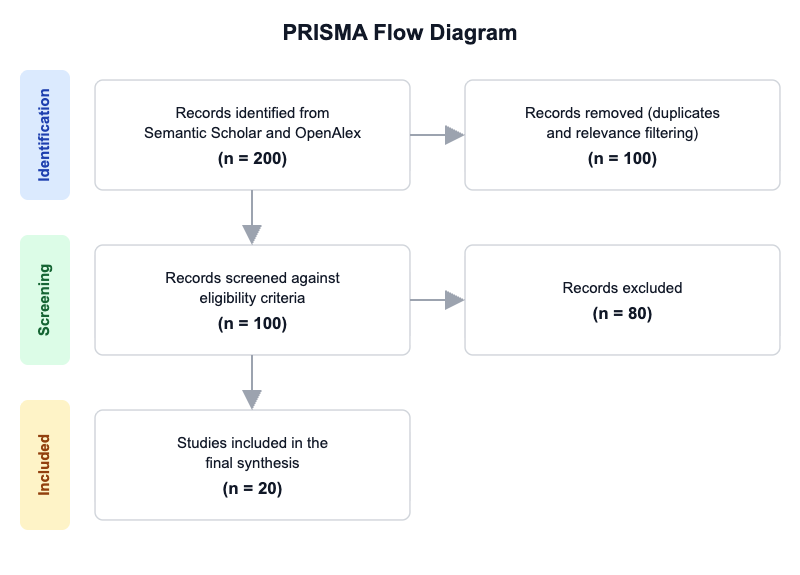
Initial database searching identified 200 records. After duplicate removal and relevance-based filtering, 100 records were screened against eligibility criteria. Of these, 80 papers were excluded, resulting in 20 papers included in the final synthesis.
PRISMA Flow Diagram
Eligibility criteria included:
- Human Study: Does the study involve human participants or human-derived clinical data, rather than animal or in vitro experiments?
- Dementia Focus: Does the study primarily investigate dementia, Alzheimer disease, mild cognitive impairment, or closely related cognitive decline outcomes?
- Recent Publication: Was the paper published between 2020 and 2026 inclusive?
- Research Area: Does the study address at least one of these areas: diagnosis, biomarkers, imaging, risk factors, prevention, treatment, caregiving, or behavioral symptoms?
- Original or Review: Is the paper an original study, systematic review, meta-analysis, or clinical review with extractable findings?
- Practical Value: Does the paper report findings with clear clinical, diagnostic, preventive, or care relevance?
- Method Detail: Does the abstract mention a specific method, biomarker, imaging modality, intervention, or outcome measure?
All included studies met the stated eligibility criteria.
2.3 Data Extraction and Synthesis
Data extraction focused on the following variables:
- Topic Area: Identify the main dementia research area addressed (e.g., diagnosis, biomarkers, risk factors, treatment, caregiving, behavioral symptoms, prevention).
- Study Type: Extract the study design or review type (e.g., cohort, case-control, RCT, cross-sectional, systematic review, meta-analysis, qualitative study).
- Population: Describe the population or sample studied, including age group, dementia subtype, setting, and any key inclusion characteristics if reported.
- Main Finding: Summarize the principal finding or conclusion related to dementia from the abstract or paper summary.
- Method/Measure: Extract the key method, biomarker, imaging modality, intervention, or outcome measure used in the study.
- Timeframe: Note the publication year and, if reported, follow-up duration, study period, or whether the work focuses on recent developments.
- Clinical Relevance: State the paper's practical relevance for diagnosis, prognosis, treatment, prevention, care, or policy if explicitly discussed.
Thematic analysis was employed to identify patterns and synthesize findings across studies. Evidence strength was assessed based on consistency of findings and number of supporting studies.
3. Results
3.1 Characteristics of Included Studies
| Study and Year | Study Type | Population | Key Focus | Method/Measure | Clinical Relevance |
|---|---|---|---|---|---|
| Jia et al. 2020 [1] | Cross-sectional study | Adults aged 60 years or older in China | Prevalence, risk factors, and management of dementia and mild cognitive impairment | Surveys and assessments | Public health targeting and management strategies |
| Reuben et al. 2024 [2] | Review | Individuals aged 65 years and older; Alzheimer’s disease and other dementia types mentioned | Prevention and treatment | Cholinesterase inhibitors, memantine, antiamyloid immunomodulators, nonpharmacologic management | Prevention and care strategies |
| Kivipelto et al. 2020 [3] | Global network review | Over 25 countries; at-risk asymptomatic to early symptomatic stages | Multidomain lifestyle prevention | Physical, dietary, cognitive, and social intervention components | Global preventive strategy development |
| Boeve et al. 2022 [4] | Review | Frontotemporal dementia and related neurodegenerative diseases | Diagnosis, biomarkers, therapeutic considerations | Neuropsychological measures, plasma and CSF biomarkers, imaging | Earlier diagnosis and trial readiness |
| Alzheimer’s Disease facts and figures 2020 [5] | Review article | Americans age 65 years and older with Alzheimer’s dementia | Public health impact, caregiving, costs | Epidemiologic and cost analyses | Primary care and workforce planning |
| Zhang et al. 2021 [6] | Review | Non-demented elderly and middle-aged populations | Modifiable risk factors and prevention | Epidemiologic overview | Early prevention |
| Zetterberg and Blennow 2021 [7] | Review | Individuals with MCI or dementia due to AD discussed | Fluid biomarkers for AD diagnosis | CSF and blood biomarkers | Clinical diagnostics and future therapies |
| Alzheimer’s Disease facts and figures 2021 [8] | Review of public health data | Americans age 65 years and older with Alzheimer’s dementia and caregivers | Burden, disparities, caregiving | Mortality, costs, caregiver statistics, surveys | Equity and support policy |
| Alzheimer’s Disease facts and figures 2023 [9] | Review of public health data | Americans age 65 years and older | Burden, mortality, caregiving, workforce | Death certificates, caregiving statistics, health expenditures | Workforce and treatment capacity |
| Nichols et al. 2022 [10] | Global burden analysis | Global population with dementia | Prevalence and forecasting | Data analysis and modeling | Resource allocation and policy |
| Zhang et al. 2023 [11] | Cohort study | 344,324 UK Biobank participants | Joint effect of modifiable risk factors | Exposure-wide association study, Cox models, population attributable fraction | Prevention policy |
| Porsteinsson et al. 2021 [12] | Review | Individuals with early-stage Alzheimer’s disease and caregivers | Early diagnosis and management | Practical diagnostic guidance and tools | Earlier detection and integrated care |
| Veitch et al. 2023 [13] | Review of ADNI studies | 1459 publications identified; 291 impactful studies reviewed | Biomarkers, disease progression, clinical trials | Clinical, neuroimaging, cognitive data, biofluid samples | Trial efficiency and biomarker utility |
| Numbers and Brodaty 2021 [14] | Review | People with Alzheimer disease and dementia during COVID-19 | Pandemic effects | Literature review of 2020 findings | Emergency support and risk mitigation |
| Hermann and Zerr 2022 [15] | Review | Rapidly progressive dementias and related disorders | Aetiologies, diagnosis, management | Diagnostic procedure, biomarkers, treatment options | Early diagnosis of reversible causes |
| Mahaman et al. 2021 [16] | Systematic review | Not specified | Biomarkers in diagnosis, treatment, prevention | AD pathology-specific and non-specific biomarkers | Early diagnosis and theragnostics |
| Frisoni et al. 2025 [17] | Review | Patients with cognitive impairment in specialist settings | Diagnosis and biomarkers | PET, CSF, blood biomarkers | Molecular diagnosis and treatment eligibility |
| Li et al. 2022 [18] | Epidemiological study | Global population, elderly, high-SDI areas, women and men compared | Burden of AD and other dementias | Epidemiological trend analysis | Policy intervention |
| Schindler 2022 [19] | Review | Various neurologic disorders associated with dementia, including AD | Fluid biomarkers in diagnosis | CSF and blood-based biomarkers | Improved diagnostic accuracy |
| Swift et al. 2020 [20] | Review | Frontotemporal dementia spectrum | Fluid biomarkers | Neurofilament light chain, progranulin, dipeptide repeat proteins | Diagnostic and prognostic improvement |
Overall, the evidence base is dominated by reviews and epidemiologic analyses, with a smaller number of cohort and cross-sectional studies. The literature is concentrated in Alzheimer’s disease, but it also addresses frontotemporal dementia, rapidly progressive dementias, and dementia as a broader syndrome. Populations range from global estimates to country-specific older-adult samples, while a substantial portion of the diagnostic literature focuses on specialist or clinically enriched groups rather than population-based cohorts.
3.2 Thematic Findings
3.2.1 Dementia burden is rising across settings, but the shape of growth varies by region, sex, and health-system context
The strongest cross-study pattern is a sustained increase in dementia burden, especially for Alzheimer’s disease, accompanied by escalating care demand. Global modeling indicates rising prevalence from 2019 to 2050 [10], while U.S. surveillance shows Alzheimer’s dementia increasing from 5.8 million to 6.2 million to 6.7 million older adults across successive reports, with projections of 13.8 million by 2060 [5], [8], [9]. This rise is not uniform: burden is described as more serious in high-SDI areas, particularly among older adults, while women have higher risk overall and men show faster risk increases [18]. Health-system strain tracks these epidemiologic trends, with caregiving hours, unpaid care value, and total payments all increasing over time [5], [8], [9]. (Note: the U.S.-focused estimates examined Americans aged 65 years and older, which partially matches the question population of people with dementia globally; findings should be interpreted considering this difference.) Confidence is strong because multiple sources converge on the same direction of change, although estimates differ by geography and analytic frame.
3.2.2 Modifiable risk factors are consistently implicated, but prevention evidence remains suggestive rather than definitive
A second coherent theme is that dementia risk appears meaningfully modifiable, yet causal prevention remains unproven at the intervention level. Epidemiologic synthesis identifies life-course modifiable risk and protective factors for Alzheimer’s disease and argues for prevention before clinical symptoms emerge [6]. In a large UK Biobank analysis, the combined elimination of unfavorable risk profiles was estimated to prevent 47.0%–72.6% of dementia cases, with lifestyle accounting for 16.6%, medical history 14.0%, and socioeconomic status 13.5% of attributable burden [11]. This aligns conceptually with the World-Wide FINGERS framework, which seeks to adapt multidomain lifestyle interventions across countries and settings using physical, dietary, cognitive, and social components [3]. However, the review-level prevention literature also emphasizes that no randomized clinical trial data conclusively confirm dementia prevention [2]. (Note: the UK Biobank study examined a UK cohort, which partially matches the question population of adults with dementia risk; findings should be interpreted considering this difference.) Confidence is moderate: the direction is highly consistent, but the evidence mixes observational attribution, model-based estimates, and ongoing intervention networks rather than definitive prevention trials.
3.2.3 Biomarker-driven diagnosis is becoming central to Alzheimer’s disease care, with blood-based testing expanding clinical reach
Diagnostic research shows a clear shift from syndromic assessment toward biomarker-defined disease. Fluid biomarkers in Alzheimer’s disease now include the amyloid β 42:40 ratio, total tau, phosphorylated tau, and neurofilament light, initially validated in cerebrospinal fluid and increasingly measurable in blood [7]. More recent diagnostic frameworks position PET and CSF biomarkers as enabling molecular-level diagnosis, particularly for determining eligibility for anti-amyloid treatments, while anticipating a future expansion of accessible blood biomarkers [17]. Clinical reviews reinforce the practical value of integrating CSF and blood-based biomarkers into routine dementia evaluation to improve diagnostic accuracy [19], and early-diagnosis guidance stresses that earlier detection helps patients and caregivers plan and may support lifestyle changes [12]. The evidence is not entirely uniform in scope: much of the biomarker literature is Alzheimer’s-specific, while broader dementia work remains more heterogeneous. Confidence is strong for the proposition that biomarker testing is now central to Alzheimer’s diagnosis; confidence is moderate for its generalization to all dementia subtypes.
3.2.4 Disease-specific biomarker development is advancing, but frontotemporal and rapidly progressive dementias still face important marker gaps
Non-Alzheimer dementias show a more uneven biomarker landscape. In frontotemporal dementia, clinical and molecular understanding has improved, and neuropsychological measures focused on social cognition, along with plasma and CSF biomarkers and structural/functional imaging, are increasingly useful for early diagnosis [4]. Fluid biomarker work emphasizes neurofilament light chain as a diagnostic, prognostic, and staging marker, while progranulin and dipeptide repeat proteins are emerging as treatment-response measures [20]. Yet the literature also states plainly that specific markers for primary tauopathies or TDP-43 proteinopathies remain lacking [20]. Rapidly progressive dementias similarly benefit from extended diagnostic procedures and biomarker use, but the main clinical goal is differential diagnosis of potentially reversible or infectious conditions rather than subtype-specific molecular classification [15]. Confidence is moderate: convergence is strong on the value of biomarkers, but the field remains limited by incomplete specificity and heterogeneous disease biology.
3.2.5 Dementia care research increasingly emphasizes system-level capacity, equity, and crisis resilience
Beyond diagnosis and prevention, the literature documents major care-system pressures. Public health reports describe high and rising caregiving demands, large unpaid care burdens, and escalating Medicare and Medicaid expenditures [5], [8], [9]. These reports also highlight shortages in dementia specialists and the need to strengthen primary care and workforce training [5], [9]. Equity concerns are explicit in the 2021 U.S. report, which identifies persistent racial and ethnic disparities in burden, access, trust, and awareness [8]. Pandemic-era evidence adds a further layer: people with dementia had higher risk of severe COVID-19 and experienced neuropsychiatric disturbances related to lockdown and social isolation [14]. (Note: the U.S. caregiving and workforce studies examined Americans aged 65 years and older, which partially matches the question population of people with dementia globally; findings should be interpreted considering this difference.) Confidence is strong that dementia care systems are under strain and inequities persist, though the pandemic-specific findings are context-bound and not necessarily generalizable beyond public-health emergency conditions.
3.3 Summary of Evidence
| Theme | Key Finding | Population Applicability | Effect Direction | Confidence Level | Supporting Studies |
|---|---|---|---|---|---|
| Rising burden and care demand | Alzheimer’s dementia projected to grow from 6.2 million to 13.8 million in the U.S. by 2060; global prevalence also forecast to rise through 2050 | Mostly older adults in the U.S. and global dementia populations; partially matches question population | Positive | Strong | Jia et al. [1], Nichols et al. [10], Alzheimer’s facts and figures [9] |
| Modifiable risk and prevention | Up to 47.0%–72.6% of dementia cases could be prevented by addressing modifiable risk profiles; lifestyle 16.6%, medical history 14.0%, socioeconomic status 13.5% | UK cohort and broader prevention frameworks; partially matches question population | Negative | Moderate | Zhang et al. [11], Kivipelto et al. [3], Zhang et al. [6] |
| Biomarker-driven Alzheimer’s diagnosis | CSF and blood biomarkers include amyloid β 42:40, total tau, phosphorylated tau, and neurofilament light; molecular diagnosis supports treatment eligibility | Individuals with MCI/dementia due to AD and specialist diagnostic populations | Positive | Strong | Zetterberg and Blennow [7], Frisoni et al. [17], Schindler [19] |
| Biomarkers in non-AD dementias | Neurofilament light chain is a useful diagnostic, prognostic, and staging marker in FTD, but disease-specific markers remain lacking | Frontotemporal dementia and related neurodegenerative disorders; partially matches question population | Positive | Moderate | Swift et al. [20], Boeve et al. [4] |
| System-level care, equity, and crisis vulnerability | Unpaid caregiving reached 18 billion hours and was valued at $339.5 billion in 2022; disparities and workforce shortages persist | U.S. older adults with dementia and caregivers; partially matches question population | Positive | Strong | Reuben et al. [2], Alzheimer’s facts and figures [8], Alzheimer’s facts and figures [9] |
| Crisis effects on dementia | People with dementia had higher risk of severe COVID-19 and neuropsychiatric disturbance during lockdowns | Dementia populations during the COVID-19 pandemic | Positive | Limited | Numbers and Brodaty [14] |
4. Discussion
4.1 Principal Findings and Their Interpretation
The central message of the literature is that dementia research has shifted from documenting burden to identifying actionable points of intervention across the disease trajectory. The burden estimates are not merely descriptive: they frame why prevention and diagnostic innovation are accelerating simultaneously. Rising prevalence and care costs create pressure for earlier identification, because once dementia is clinically established, the opportunity to alter trajectory is narrower and the social cost is already substantial [10], [18], [9]. This helps explain why biomarker research now occupies a privileged position in Alzheimer’s disease, where amyloid and tau measures can move diagnosis from probabilistic syndromic assessment toward molecular classification [7], [17].
The prevention literature is more cautious, but the pattern is still important. The high attributable fractions from observational modeling suggest that dementia risk is distributed across modifiable lifestyle, medical, and socioeconomic domains rather than determined solely by immutable aging processes [11]. The World-Wide FINGERS network adds a practical interpretation: because risk factors cluster and vary across settings, effective prevention likely requires multidomain interventions that are culturally adaptable rather than a single universal prescription [3]. The most confident conclusion is therefore not that dementia can already be prevented at scale, but that risk reduction is biologically and epidemiologically plausible and should remain a major research and policy target [2].
For non-Alzheimer dementias, especially frontotemporal dementia, the synthesis highlights a different kind of progress: not definitive disease-modifying treatment, but improved clinical characterization and a growing biomarker infrastructure [4], [20]. Neurofilament light chain appears particularly important because it captures neurodegeneration more generally, which suits the biological heterogeneity of these disorders. Confidence is highest where biomarkers are convergent across modalities and studies, and lower where disease-specific markers remain incomplete or where evidence is confined to expert or specialist settings.
4.2 Comparison with Existing Literature and Resolution of Contradictions
A notable consistency across the literature is the move toward earlier and more biologically grounded diagnosis. This is meaningful because it aligns epidemiologic urgency with clinical feasibility: as burden rises, a diagnosis made only after substantial functional loss becomes increasingly inadequate for both patient planning and therapeutic selection [12], [17]. The biomarker literature is especially coherent in this respect. CSF and blood markers, PET imaging, and combined diagnostic algorithms all point in the same direction, suggesting that the field is converging on a layered diagnostic model rather than competing isolated tests [7], [17], [19].
The main tension in the literature concerns prevention. Observational analyses suggest substantial preventable fractions, yet review-level evidence states that randomized trial data have not conclusively proven dementia prevention [11], [2]. This contradiction is best interpreted as a difference between risk attribution and intervention efficacy. Attributable fractions estimate what might be prevented if unfavorable profiles were eliminated, but they do not establish that all such exposures are equally modifiable, nor that removing them in late life fully reverses accumulated neuropathology. Selection bias and residual confounding are also plausible, especially in cohort studies where healthier participants are more likely to remain under follow-up and where social disadvantage may shape both exposure and diagnosis. The prevention network literature partly resolves this tension by suggesting that interventions likely need to start earlier, be multidomain, and be adapted to local context rather than tested as a one-size-fits-all package [3].
For biomarker research, a different limitation appears: stronger evidence for Alzheimer’s disease than for other dementia syndromes. This is not necessarily a contradiction, but it does indicate publication and funding concentration in AD, where therapeutic pipelines are most advanced. Frontotemporal dementia and rapidly progressive dementias show clear diagnostic promise, yet the absence of specific markers for major pathological subtypes means generalizability remains incomplete [20], [15]. The most recent diagnostic review suggests that blood biomarkers may expand access dramatically [17], but implementation bias remains a concern because specialist-care advances may not translate immediately to under-resourced settings. Overall, the pattern of findings is unlikely to be explained solely by selective positive reporting, because the literature also includes explicit statements about nulls and gaps, particularly around prevention and disease-specific biomarker specificity.
4.3 Practical Implications
For clinicians, the literature supports earlier and more structured evaluation of cognitive symptoms, especially when Alzheimer’s disease is suspected. In practice, this means moving beyond routine history and bedside assessment toward biomarker-informed pathways when available, because CSF and blood biomarkers can improve diagnostic confidence and help determine eligibility for anti-amyloid therapies [19], [17]. For frontotemporal dementia and rapidly progressive dementias, prompt referral is particularly important because early diagnosis may distinguish neurodegenerative disease from treatable immune-mediated, infectious, or metabolic causes [4], [15].
For public health systems, the dominant implication is that dementia planning must account for rising prevalence, caregiver burden, and workforce strain at the same time. The evidence justifies investment in primary care training, specialist capacity, and caregiver support infrastructure rather than relying only on downstream institutional care [5], [8], [9]. Equity should be central, because current disparities in access and trust indicate that the benefits of biomarker innovation will not be distributed evenly without deliberate implementation strategies [8].
For prevention policy, the most defensible recommendation is population-wide risk reduction targeting lifestyle, vascular, and social determinants, especially in settings with high burden or socioeconomic disadvantage [6], [11]. The literature does not justify claiming a proven no-threshold prevention effect, but it does suggest that waiting for overt dementia is too late. Accordingly, prevention should be framed as life-course risk management, not as a late-life supplement to treatment.
4.4 Strengths and Limitations
A major strength of this review is its synthesis across epidemiology, biomarker science, clinical reviews, and care-system analyses, which allows patterns to be interpreted at both biological and health-system levels. The included literature also spans multiple regions and dementia syndromes, improving conceptual breadth. A further strength is the emphasis on recent research, capturing the transition to blood biomarkers, molecular diagnosis, and multidomain prevention networks.
The main limitation of the included studies is that much of the evidence is review-based, with relatively fewer original prospective studies and limited direct intervention proof. Populations are unevenly represented: Alzheimer’s disease and U.S. older adults dominate, while frontotemporal dementia, rapidly progressive dementias, and non-Western settings are less extensively studied. Several studies rely on specialist or enriched clinical samples, which may not represent community dementia populations. For this review, limitations include abstract-based extraction, no formal risk-of-bias appraisal, and reliance on reported summaries rather than full-text comparative detail in every case.
5. Gaps and Future Directions
The clearest gap is the disconnect between strong observational evidence for modifiable risk and weak causal evidence from intervention trials. Future studies should directly test whether multidomain, culturally adapted prevention programs can reduce incident dementia in diverse populations, not only in high-resource settings or among already health-engaged participants [3], [2]. Methodologically, future work would be strengthened by harmonized exposure definitions, longer follow-up, and explicit accounting for socioeconomic and medical-history domains that account for substantial attributable burden.
A second gap concerns biomarker generalizability. Alzheimer’s disease now has a relatively mature biomarker pathway, but frontotemporal dementia and rapidly progressive dementias still lack sufficient disease-specific markers, especially in blood-based formats [20], [15]. Studies should prioritize diverse, community-based cohorts and head-to-head comparisons of blood, CSF, PET, and imaging markers across dementia subtypes. A third gap is implementation: the literature repeatedly notes disparities in access, workforce shortages, and primary-care underpreparation, but there is little direct evidence on how to scale biomarker-guided care equitably [8], [9]. Future research should therefore integrate clinical effectiveness with health-system feasibility and equity outcomes.
6. Conclusion
The latest dementia literature indicates a clear and clinically important transition: dementia burden continues to rise, modifiable risk factors are increasingly implicated, and biomarker-based diagnosis is moving into routine practice, especially for Alzheimer’s disease. The most defensible conclusion is that dementia is not only becoming more common but also more measurable and potentially more preventable, although prevention remains better supported by observational attribution than by definitive trial evidence [10], [11], [2]. In Alzheimer’s disease, CSF and blood biomarkers of amyloid β, tau, and neurodegeneration now support earlier and more precise diagnosis, and recent diagnostic frameworks link biomarker confirmation directly to treatment eligibility [7], [17]. In parallel, the literature shows that care systems are under growing strain from caregiver burden, costs, specialist shortages, and inequities, particularly in older adults and in contexts shaped by socioeconomic disadvantage [8], [9].
This conclusion applies most directly to Alzheimer’s disease and to older-adult populations in high-income settings, while evidence for other dementias and global low-resource contexts remains less complete. The single most important unresolved question is whether multidomain prevention and biomarker-guided early intervention can measurably reduce incident dementia and disability at scale across diverse populations. Answering that question will determine whether current advances remain largely diagnostic or become truly disease-altering. The broader significance is substantial: if prevention, early diagnosis, and system-level support can be aligned, the field may finally begin to reduce—not only document—the expanding global burden of dementia.
References
- Jia, L., Du, Y., Chu, L., Zhang, Z., Li, F., Lyu, D., Li, Y., Li, Y., Zhu, M., Jiao, H., Song, Y., Shi, Y., Zhang, H., Gong, M., Wei, C., Tang, Y., Fang, B., Guo, D., Wang, F., … Qiu, Q. (2020). Prevalence, risk factors, and management of dementia and mild cognitive impairment in adults aged 60 years or older in China: A cross-sectional study. The Lancet Public Health, 5(12), e661–e671. https://doi.org/10.1016/S2468-2667(20)30185-730185-7)
- Reuben, D. B., Kremen, S., & Maust, D. T. (2024). Dementia prevention and treatment: A narrative review. JAMA Internal Medicine, 184(5), 563. https://doi.org/10.1001/jamainternmed.2023.8522
- Kivipelto, M., Mangialasche, F., Snyder, H. M., Allegri, R., Andrieu, S., Arai, H., Baker, L., Belleville, S., Brodaty, H., Brucki, S. M., Calandri, I., Caramelli, P., Chen, C., Chertkow, H., Chew, E., Choi, S. H., Chowdhary, N., Crivelli, L., De La Torre, R., … Carrillo, M. C. (2020). World-Wide FINGERS Network: A global approach to risk reduction and prevention of dementia. Alzheimer’s & Dementia, 16(7), 1078–1094. https://doi.org/10.1002/alz.12123
- Boeve, B. F., Boxer, A. L., Kumfor, F., Pijnenburg, Y., & Rohrer, J. D. (2022). Advances and controversies in frontotemporal dementia: Diagnosis, biomarkers, and therapeutic considerations. The Lancet Neurology, 21(3), 258–272. https://doi.org/10.1016/S1474-4422(21)00341-000341-0)
- Alzheimer’s Association. (2020). 2020 Alzheimer’s disease facts and figures. Alzheimer’s & Dementia, 16(3), 391–460. https://doi.org/10.1002/alz.12068
- Zhang, X.-X., Tian, Y., Wang, Z.-T., Ma, Y.-H., Tan, L., & Yu, J.-T. (2021). The epidemiology of Alzheimer’s disease modifiable risk factors and prevention. The Journal of Prevention of Alzheimer’s Disease, 8(3), 313–321. https://doi.org/10.14283/jpad.2021.15
- Zetterberg, H., & Blennow, K. (2021). Moving fluid biomarkers for Alzheimer’s disease from research tools to routine clinical diagnostics. Molecular Neurodegeneration, 16(1), 10. https://doi.org/10.1186/s13024-021-00430-x
- Alzheimer’s Association. (2021). 2021 Alzheimer’s disease facts and figures. Alzheimer’s & Dementia, 17(3), 327–406. https://doi.org/10.1002/alz.12328
- Alzheimer’s Association. (2023). 2023 Alzheimer’s disease facts and figures. Alzheimer’s & Dementia, 19(4), 1598–1695. https://doi.org/10.1002/alz.13016
- Nichols, E., Steinmetz, J. D., Vollset, S. E., Fukutaki, K., Chalek, J., Abd-Allah, F., Abdoli, A., Abualhasan, A., Abu-Gharbieh, E., Akram, T. T., Al Hamad, H., Alahdab, F., Alanezi, F. M., Alipour, V., Almustanyir, S., Amu, H., Ansari, I., Arabloo, J., Ashraf, T., … Vos, T. (2022). Estimation of the global prevalence of dementia in 2019 and forecasted prevalence in 2050: An analysis for the Global Burden of Disease Study 2019. The Lancet Public Health, 7(2), e105–e125. https://doi.org/10.1016/S2468-2667(21)00249-800249-8)
- Zhang, Y., Chen, S.-D., Deng, Y.-T., You, J., He, X.-Y., Wu, X.-R., Wu, B.-S., Yang, L., Zhang, Y.-R., Kuo, K., Feng, J.-F., Cheng, W., Suckling, J., Smith, A. D., & Yu, J.-T. (2023). Identifying modifiable factors and their joint effect on dementia risk in the UK Biobank. Nature Human Behaviour, 7(7), 1185–1195. https://doi.org/10.1038/s41562-023-01585-x
- Porsteinsson, A. P., Isaacson, R. S., Knox, S., Sabbagh, M. N., & Rubino, I. (2021). Diagnosis of early Alzheimer’s disease: Clinical practice in 2021. The Journal of Prevention of Alzheimer’s Disease, 8(3), 371–386. https://doi.org/10.14283/jpad.2021.23
- Veitch, D. P., Weiner, M. W., Miller, M., Aisen, P. S., Ashford, M. A., Beckett, L. A., Green, R. C., Harvey, D., Jack, C. R., Jr., Jagust, W., Landau, S. M., Morris, J. C., Nho, K. T., Nosheny, R., Okonkwo, O., Perrin, R. J., Petersen, R. C., Rivera Mindt, M., Saykin, A., … Alzheimer’s Disease Neuroimaging Initiative. (2023). The Alzheimer’s Disease Neuroimaging Initiative in the era of Alzheimer’s disease treatment: A review of ADNI studies from 2021 to 2022. Alzheimer’s & Dementia, 20(1), 652–694. https://doi.org/10.1002/alz.13449
- Numbers, K., & Brodaty, H. (2021). The effects of the COVID-19 pandemic on people with dementia. Nature Reviews Neurology, 17(2), 69–70. https://doi.org/10.1038/s41582-020-00450-z
- Hermann, P., & Zerr, I. (2022). Rapidly progressive dementias — Aetiologies, diagnosis and management. Nature Reviews Neurology, 18(6), 363–376. https://doi.org/10.1038/s41582-022-00659-0
- Mahaman, Y. A. R., Embaye, K. S., Huang, F., Li, L., Zhu, F., Wang, J.-Z., Liu, R., Feng, J., & Wang, X. (2021). Biomarkers used in Alzheimer’s disease diagnosis, treatment, and prevention. Ageing Research Reviews, 74, 101544. https://doi.org/10.1016/j.arr.2021.101544
- Frisoni, G. B., Hansson, O., Nichols, E., Garibotto, V., Schindler, S. E., van der Flier, W. M., Jessen, F., Villain, N., Arenaza-Urquijo, E. M., Crivelli, L., Fortea, J., Grinberg, L. T., Ismail, Z., Minoshima, S., Ossenkoppele, R., Zetterberg, H., Petersen, R. C., & Dubois, B. (2025). New landscape of the diagnosis of Alzheimer’s disease. The Lancet, 406(10510), 1389–1407. https://doi.org/10.1016/S0140-6736(25)01294-201294-2)
- Li, X., Feng, X., Sun, X., Hou, N., Han, F., & Liu, Y. (2022). Global, regional, and national burden of Alzheimer’s disease and other dementias, 1990–2019. Frontiers in Aging Neuroscience, 14, 937486. https://doi.org/10.3389/fnagi.2022.937486
- Schindler, S. E. (2022). Fluid biomarkers in dementia diagnosis. Continuum: Lifelong Learning in Neurology, 28(3), 822–833. https://doi.org/10.1212/CON.0000000000001083
- Swift, I. J., Sogorb-Esteve, A., Heller, C., Synofzik, M., Otto, M., Graff, C., Galimberti, D., Todd, E., Heslegrave, A. J., van der Ende, E. L., Van Swieten, J. C., Zetterberg, H., & Rohrer, J. D. (2020). Fluid biomarkers in frontotemporal dementia: Past, present and future. Journal of Neurology, Neurosurgery & Psychiatry, 92(2), 204–215. https://doi.org/10.1136/jnnp-2020-323520