

Latest Research on Erectile Dysfunction: A Synthesis of Epidemiology, Mechanisms, Diagnosis, and Evolving Management
Abstract
Recent evidence shows that erectile dysfunction (ED) remains common, underdiagnosed, and clinically consequential, with prevalence estimates of 24.2% in a nationally representative U.S. sample [8] and 3.5-fold higher prevalence in men with diabetes than in those without [1]. Across contemporary studies, ED is also repeatedly positioned as an early marker of broader vascular and endocrine risk, including a prospective clinical signal of undiagnosed endocrine/glycemic disorders in more than 30% of referred patients with ED [15] and an independent harbinger of future cardiovascular events [4], [19]. This review is important because the newest literature increasingly treats ED not only as a sexual health complaint but as a sentinel symptom that may reveal systemic disease and guide prevention. Mechanistically, shared pathways across studies include endothelial dysfunction, oxidative stress, inflammation, hormonal deficiency, and neurovascular impairment [4], [1], [19]. Therapeutically, first-line phosphodiesterase type 5 inhibitors remain central, but newer evidence supports combination approaches such as PDE5 inhibitors with antioxidants, shock wave therapy, vacuum devices, and regenerative strategies, although much of the latter remains preliminary [6], [5], [9]. The strongest practical message from the current literature is that ED warrants proactive assessment in men with diabetes, cardiovascular disease, post-prostatectomy status, or psychological distress, while the main evidence gap is the limited high-quality validation of novel therapies and integrated risk-based care pathways.
1. Introduction
Erectile dysfunction is increasingly understood as a multifactorial condition with consequences that extend well beyond sexual performance. In contemporary clinical and public health literature, ED is described as a disorder of penile erection that reflects interactions among vascular, neural, endocrine, and psychological systems, rather than a purely localized sexual complaint [6], [3]. This broader view matters because ED is common, often untreated, and frequently coexists with chronic disease. In men with diabetes, its prevalence is substantially elevated [17], [1], while in men with cardiovascular disease it may signal elevated vascular risk and poor adherence to therapy [13], [4]. Psychological distress, including depression, stress, and performance worry, further complicates both cause and consequence, affecting not only the affected individual but also partners and relationship quality [11].
Recent work has therefore shifted from a narrow treatment focus toward a more integrated framework that combines epidemiology, risk stratification, pathophysiology, diagnosis, and management. This shift is reflected in updated guidelines and consensus statements that emphasize individualized care, multidisciplinary assessment, and the recognition of ED as a potential marker of systemic disease [13], [6], [2]. At the same time, the therapeutic landscape is expanding beyond established oral phosphodiesterase type 5 inhibitors toward combination therapies, low-intensity shock wave approaches, stem cell-based strategies, platelet-rich plasma, and other regenerative or experimental modalities [9], [14], [16]. Yet these developments raise unresolved questions about comparative effectiveness, safety, and which patients are most likely to benefit.
Against this backdrop, a synthesis of the latest research is needed to clarify what contemporary evidence supports most strongly, where findings converge, and where uncertainty remains greatest. The present review therefore integrates recent literature on ED across epidemiologic burden, systemic associations, mechanistic understanding, diagnosis, and treatment innovation, with attention to how these strands jointly inform clinical practice.
2. Methods
2.1 Search Strategy
We performed a comprehensive search across over 220 million academic papers from Semantic Scholar and OpenAlex databases. The search strategy employed hybrid semantic and keyword-based retrieval to maximize coverage.
Search queries included:
- "Erectile dysfunction recent epidemiology diagnosis and management studies"
- "Erectile dysfunction pharmacologic treatment effectiveness and safety updates"
- "Erectile dysfunction psychological vascular and endocrine mechanisms research"
- "Erectile dysfunction novel therapies regenerative and device-based interventions"
- "Systematic review meta-analysis erectile dysfunction treatment and outcomes"
2.2 Study Selection
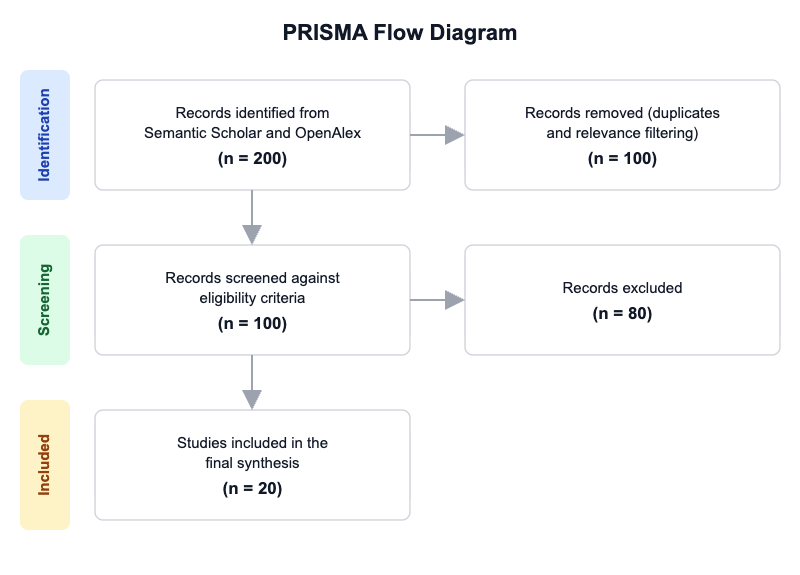
Initial database searching identified 200 records. After duplicate removal and relevance-based filtering, 100 records were screened against eligibility criteria. Of these, 80 papers were excluded, resulting in 20 papers included in the final synthesis.
PRISMA Flow Diagram
Eligibility criteria included:
- ED Topic: Does the study focus on erectile dysfunction or male sexual function as a primary topic?
- Human Evidence: Does the study involve human participants, clinical data, or human observational evidence (not only animal or in-vitro work)?
- Recent Data: Is the study published in 2020 or later?
- ED Outcome: Does the study measure erectile function, erectile dysfunction prevalence, diagnostic performance, treatment response, or related male sexual health outcomes?
- Clinical Relevance: Does the study address diagnosis, treatment, prognosis, risk factors, or management of erectile dysfunction in a clinical context?
- Novelty: Does the study evaluate a newer therapy, updated guideline, emerging mechanism, or recent evidence source relevant to erectile dysfunction research?
- Evidence Strength: Does the study use a comparative, cohort, randomized, systematic review, or meta-analytic design rather than a purely descriptive case report?
All included studies met the stated eligibility criteria.
2.3 Data Extraction and Synthesis
Data extraction focused on the following variables:
- Focus: State the main erectile dysfunction topic addressed (e.g., pharmacologic treatment, diagnosis, epidemiology, mechanism, device/regenerative therapy, psychosocial factors).
- Study Type: Identify the study design or evidence type (RCT, cohort, case-control, cross-sectional, systematic review, meta-analysis, narrative review, guideline, basic science).
- Population: Summarize the participant group or model studied, including age/sex/setting and any key clinical context such as diabetes, cardiovascular disease, post-prostatectomy, or psychogenic ED.
- Intervention/Exposure: Extract the treatment, exposure, risk factor, or mechanism being evaluated, including drug name, device, lifestyle factor, biomarker, or biological pathway.
- Outcome Measures: Extract the primary outcomes or endpoints related to erectile dysfunction, such as erectile function scores, response rates, adverse events, prevalence, diagnostic accuracy, or mechanistic markers.
- Key Finding: Summarize the central finding or conclusion of the paper relevant to erectile dysfunction research.
- Recency/Novelty: Note what makes the paper recent or novel, such as new therapy class, updated guideline, emerging mechanism, or recent data source.
Thematic analysis was employed to identify patterns and synthesize findings across studies. Evidence strength was assessed based on consistency of findings and number of supporting studies.
3. Results
3.1 Characteristics of Included Studies
| Study and Year | Study Type | Population | Main Focus | Key Outcome / Measure |
|---|---|---|---|---|
| Defeudis et al. 2021 [1] | Narrative review | Men with diabetes mellitus | ED prevalence and treatment in diabetes | Prevalence and impact of diabetes complications on sexual function |
| Corona et al. 2023 [2] | Guideline / consensus | Broad adult male population with ED | Diagnosis and management | Multidisciplinary recommendations |
| MacDonald & Burnett 2021 [3] | Narrative review | Men with ED across disease states | Physiology and pathophysiology | Molecular and neuroanatomic mechanisms |
| Terentes-Printzios et al. 2021 [4] | Narrative review | Men with cardiovascular disease | ED-CVD interactions | Prognostic role of ED and drug effects on erectile function |
| Mykoniatis et al. 2021 [5] | Systematic review / comparative synthesis | Patients with refractory or complex ED | Combination therapies | Erectile function improvement and adverse events |
| Salonia et al. 2025 [6] | Guideline update | Adult males with sexual and reproductive health conditions | Diagnosis, treatment, follow-up | Updated evidence-based management recommendations |
| Gómez Varela et al. 2020 [7] | Narrative review | Individuals with ED | Penile Doppler ultrasound | Diagnostic differentiation of vascular vs nonvascular ED |
| Mark et al. 2024 [8] | Cross-sectional nationally representative study | 1822 cisgender men aged 18 to 87 years | ED prevalence and care gaps | IIEF-5 prevalence, diagnosis, barriers to care |
| Kim et al. 2020 [9] | Narrative review | Men with difficult-to-treat ED | Emerging therapies | Novel agents, stem cells, shock wave therapy |
| Wang et al. 2023 [10] | Mini-review | Adult men with ED | Treatment evolution | Established and emerging therapies |
| Allen et al. 2023 [11] | Narrative review | Individuals with ED and partners | Psychological dimensions | Psychological effects and interventions |
| Mitidieri et al. 2020 [12] | Narrative review | Men with ED, including nonresponders | Pharmacology and future perspectives | PDE5 inhibitors and unmet need for alternatives |
| Köhler et al. 2024 [13] | Expert consensus / guideline | Men with ED and cardiovascular disease | ED-CVD management | Risk stratification and PDE5 inhibitor optimization |
| Raheem et al. 2020 [14] | Narrative review | Adult men with ED | Novel treatments | Li-ESWT, stem cell therapy, PRP |
| Mazzilli et al. 2022 [15] | Cross-sectional clinical study | 1332 patients referred for ED, mean age 54.3 ± 13.7 years | Endocrine/glycemic markers | Undiagnosed endocrine and glycemic disorders |
| Argiolas et al. 2023 [16] | Narrative review | Adult men with ED, especially ages 40 to 70 years | Treatments and new strategies | Established and regenerative approaches |
| Dilixiati et al. 2024 [17] | Systematic review and meta-analysis | 66,925 individuals with diabetes mellitus | Risk factors for ED in diabetes | ORs for age, glycemic control, complications |
| Langarizadeh et al. 2023 [18] | Narrative review | Men with ED, including those with cardiovascular disease and diabetes | Historical and future treatment strategies | Combined traditional and novel therapies |
| An et al. 2025 [19] | Narrative review | Adults at risk for cardiovascular disease | ED-CVD pathophysiology and clinical implications | Shared mechanisms and sentinel role of ED |
| Lima et al. 2020 [20] | Narrative review | Men after radical prostatectomy for localized prostate cancer | Post-prostatectomy ED and rehabilitation | Prevalence and treatment success |
The evidence base is dominated by narrative reviews and clinical syntheses, with a smaller number of primary observational studies and one systematic review and meta-analysis focused on diabetes-related risk factors. Across these sources, ED is consistently framed as a condition with overlapping vascular, endocrine, neurological, and psychological determinants, and the newest literature increasingly emphasizes systemic screening rather than isolated symptomatic treatment. Study populations vary widely, ranging from general community men to disease-specific groups such as diabetes, cardiovascular disease, and post-prostatectomy cohorts.
3.2 Thematic Findings
3.2.1 ED increasingly functions as a marker of systemic cardiometabolic and endocrine disease
A convergent pattern across the literature is that ED should be interpreted as a clinical signal of broader systemic disease rather than only a sexual symptom. In the nationally representative U.S. sample, ED prevalence was 24.2%, and only 7.7% of participants reported a provider diagnosis, indicating a substantial care gap [8]. In diabetes-specific synthesis, ED was approximately 3.5-fold more prevalent in men with diabetes than in those without [1], while a meta-analysis found that in diabetic men, higher HbA1C (OR: 1.44, 95% CI=1.28-1.62), longer diabetes duration (OR: 1.39, 95% CI=1.29-1.50), diabetic neuropathy (OR: 3.47, 95% CI=2.16-5.56), diabetic retinopathy (OR: 3.01, 95% CI=2.02-4.48), diabetic foot (OR: 3.96, 95% CI=2.87-5.47), cardiovascular disease (OR: 1.92, 95% CI=1.71-2.16), hypertension (OR: 1.74, 95% CI=1.52-2.00), microvascular disease (OR: 2.14, 95% CI=1.61-2.85), vascular disease (OR: 2.75, 95% CI=2.35-3.21), nephropathy (OR: 2.67, 95% CI=2.06-3.46), depression (OR: 1.82, 95% CI=1.04-3.20), metabolic syndrome (OR: 2.22, 95% CI=1.98-2.49), and diuretic treatment (OR: 2.42, 95% CI=1.38-4.22) were associated with ED [17]. Among patients referred for ED, 30% of previously unrecognized endocrine/glycemic disorders were identified, and newly diagnosed diabetes was associated with more severe ED, including difficulty achieving erection in 46/56 [82.2%] versus 265/1332 [19.9%] and absence of spontaneous erection in 23/56 [41.1%] versus 321/1332 [24.1%] [15].
These findings are methodologically different but directionally consistent: population prevalence studies show burden, clinical cohorts reveal hidden disease, and meta-analytic data quantify risk amplification in diabetes. The population match is strongest for the general male and diabetic ED literature, while the endocrine-marker study examines referred patients with ED, which partially matches the question population of men with ED and should be interpreted in that context [15]. Confidence: Strong for the claim that ED frequently coexists with and may signal systemic cardiometabolic disease; Moderate for the exact magnitude of hidden endocrine disease in referral populations.
3.2.2 Vascular and neuroendocrine mechanisms dominate current explanatory models
The mechanistic literature strongly converges on ED as a neurovascular disorder. Contemporary physiology reviews describe erection as dependent on synchronized endothelial, smooth muscle, neuronal, psychological, and hormonal processes, with ED arising when these systems become dysregulated [3]. Cardiovascular-focused reviews further link ED and CVD through endothelial dysfunction, inflammation, oxidative stress, low plasma testosterone, and shared molecular pathways such as NO/cGMP/PKG signaling and RhoA/ROCK signaling [4], [19]. The pathophysiologic classification into vasculogenic, neurogenic, endocrine, and psychogenic etiologies provides a clinically useful framework because different patient groups map onto different dominant mechanisms [3].
The mechanistic consistency across these sources strengthens the interpretation that the epidemiologic associations are biologically plausible rather than incidental. Evidence is particularly persuasive where reviews connect ED to early vascular dysfunction and sentinel cardiovascular risk [4], [19]. Confidence: Strong for the presence of shared vascular-endocrine-neural pathways; Moderate for causal ordering because most evidence is inferential rather than interventional.
3.2.3 Diagnostic practice is moving toward risk stratification rather than symptom confirmation alone
Recent literature indicates that diagnosis of ED is no longer limited to confirming erection difficulty but increasingly involves identifying cause and downstream risk. Penile Doppler sonography is described as essential for distinguishing vascular from nonvascular ED and for guiding management [7]. This imaging emphasis is complementary to guideline statements that promote multidisciplinary diagnosis and follow-up [13], [6]. The cardiovascular literature goes further by treating ED as a low-cost prognostic marker for future cardiac events and recommending coronary artery calcium scoring for advanced cardiovascular risk stratification in men with ED and cardiovascular disease [13].
These diagnostic approaches are not redundant: Doppler imaging addresses local vascular pathology, whereas consensus-based cardiovascular assessment uses ED as a systemic warning sign. The population match is strongest for men with ED, but the coronary risk recommendations are specifically relevant to men with ED and cardiovascular disease, a partially matched subgroup rather than the entire ED population [13]. Confidence: Moderate to Strong for the shift toward integrated diagnostic evaluation; Moderate for the incremental predictive value of specific tests because comparative diagnostic accuracy data are not reported in the available materials.
3.2.4 PDE5 inhibitors remain foundational, but combination and adjunctive strategies are increasingly favored in difficult-to-treat cases
Across pharmacologic and guideline literature, oral PDE5 inhibitors remain the anchor therapy for ED [6], [13], [1]. However, the latest evidence indicates that monotherapy is often insufficient in refractory or complex disease. Combination therapy of PDE5 inhibitors with antioxidants improved ED without increasing adverse events, while PDE5 inhibitors combined with daily tadalafil, shockwaves, or vacuum devices showed additional improvement, albeit on limited data [5]. Reviews of treatment evolution also retain intracavernosal injection therapy, hormonal replacement therapy, vacuum erection devices, and penile prosthesis as alternative or fallback strategies for organic or treatment-resistant ED [12], [10], [6].
The overall direction is clear: modern management is increasingly stratified by response phenotype, with more intensive or combined approaches reserved for nonresponders. This theme is especially relevant to the repeatedly noted subgroup of nonresponders, which is not numerically uniform across studies but is consistently described as a major unmet need [5], [12]. Confidence: Strong that PDE5 inhibitors remain first-line; Moderate that combination therapy is superior in refractory disease because the supportive evidence is promising but limited in breadth.
3.2.5 Regenerative and device-based therapies are promising but remain preliminary
The newest treatment literature is notable for its optimism about regenerative medicine, yet the evidence remains early and heterogeneous. Reviews repeatedly highlight low-intensity extracorporeal shock wave therapy, stem cell therapy, platelet-rich plasma, gene therapy, and related molecular approaches as promising options for men unresponsive to conventional drugs [9], [16], [18], [14]. Some reviews suggest these therapies may repair organic damage to cavernous tissue or improve erectile function in difficult-to-treat populations, including diabetic and post-prostatectomy ED [9], [14]. Yet the same literature explicitly notes that many of these approaches require validation in well-designed clinical trials and are laborious, expensive, or difficult to reproduce [9], [18], [14].
These findings are directionally consistent but not equally mature. There is a contrast between strong enthusiasm in narrative reviews and weaker direct evidence for routine clinical adoption. The population match is partial when studies focus on diabetic or post-prostatectomy men, because these are clinically important but narrower ED subgroups [9], [14]. Confidence: Limited to Moderate for regenerative therapies; Strong only for the claim that they remain investigational.
3.2.6 Psychological burden is both a contributor to and consequence of ED
Psychological literature emphasizes a bidirectional relationship between mental health and ED. Depression, stress, personality factors, and cognitive interference are described as contributing to erectile problems, while ED itself may lead to emasculation, humiliation, social isolation, reduced self-worth, and partner distress [11]. This aligns with broader reviews that explicitly classify ED as social-psychological-physiological in etiology and management [11], [10]. Psychological interventions, particularly multimodal ones, are described as promising, but the evidence base is not yet sufficient to establish effectiveness [11].
The main synthesis insight is that psychological factors are not merely comorbidities; they likely modulate treatment response and the persistence of ED across disease contexts. Because the source literature does not provide pooled effect sizes or standardized intervention effects, confidence in specific therapeutic benefit remains limited. Confidence: Moderate for psychological contribution to ED; Limited for intervention efficacy.
3.2.7 ED after radical prostatectomy remains a distinct but clinically important subtype
Post-prostatectomy ED is a well-recognized iatrogenic form of the disorder linked to cavernous nerve injury or neuropraxia [20]. Rehabilitation strategies aim to improve blood flow, oxygenation, and prevent fibrosis, with oral PDE5 inhibitors, vacuum erection devices, intracorporeal injection therapy, MUSE, and penile prosthesis forming the main management options [20], [6]. This literature reinforces the broader pattern that ED treatment is increasingly individualized by etiology: nerve-injury ED is managed differently from vascular, endocrine, or psychogenic ED.
The evidence here is clinically coherent but context-specific. It partially matches the general research question because it addresses ED, yet the population is a surgical subgroup rather than the broader male ED population, and this should be considered when generalizing [20]. Confidence: Moderate for the effectiveness of rehabilitation-oriented multimodal management; Limited for any single optimal protocol.
3.3 Summary of Evidence
| Theme | Key Finding | Population Applicability | Effect Direction | Confidence Level | Supporting Studies |
|---|---|---|---|---|---|
| ED as a marker of systemic disease | ED prevalence 24.2%; only 7.7% diagnosed by a provider; diabetic ED ~3.5-fold higher; undiagnosed endocrine/glycemic disorders in >30% of referred ED patients | Broad male ED populations; strongest in diabetes and referral cohorts | Positive association with systemic disease burden | Strong | Mark et al. [8], Defeudis et al. [1], Mazzilli et al. [15] |
| Shared mechanisms linking ED to CVD/endocrine disease | Endothelial dysfunction, inflammation, oxidative stress, low testosterone, NO/cGMP/PKG and RhoA/ROCK pathways | Men with ED, especially those with CVD risk | Positive mechanistic overlap | Strong | Terentes-Printzios et al. [4], MacDonald & Burnett [3], An et al. [19] |
| Diagnostic risk stratification | Penile Doppler distinguishes vascular vs nonvascular ED; consensus recommends cardiovascular risk stratification including coronary artery calcium scoring | Men with ED; particularly ED with CVD risk | Positive diagnostic utility | Moderate to Strong | Gómez Varela et al. [7], Köhler et al. [13], Corona et al. [2] |
| First-line pharmacologic management | PDE5 inhibitors remain foundational, but nonresponse is common and prompts alternative approaches | General ED population; especially nonresponders | Positive for PDE5 inhibitors, mixed for refractory disease | Strong for first-line use; Moderate for refractory management | Mitidieri et al. [12], Wang et al. [10], Salonia et al. [6] |
| Combination and adjunctive therapies | PDE5 inhibitors plus antioxidants improved ED without more adverse events; additional benefit reported with tadalafil, shockwaves, and vacuum devices | Refractory or complex ED | Positive | Moderate | Mykoniatis et al. [5] |
| Regenerative and emerging therapies | Li-ESWT, stem cells, PRP, gene therapy, and related strategies are promising but remain insufficiently validated | Difficult-to-treat ED; diabetic and post-prostatectomy subgroups | Positive but preliminary | Limited | Kim et al. [9], Raheem et al. [14], Langarizadeh et al. [18] |
| Psychological burden and intervention | Depression, stress, and cognitive interference contribute to ED; ED also harms self-esteem and relationships; psychological interventions are promising but undervalidated | Individuals with ED and partners | Mixed, bidirectional | Moderate for burden; Limited for treatment | Allen et al. [11] |
| Post-prostatectomy ED management | Rehabilitation-oriented multimodal therapy is standard, but no single optimal protocol is established | Men after radical prostatectomy | Positive | Moderate | Lima et al. [20] |
4. Discussion
4.1 Principal Findings and Their Interpretation
The clearest synthesis from the recent literature is that ED now functions as a clinical marker of systemic health, not merely a localized sexual disorder. This is supported by the convergence of prevalence data, risk-factor meta-analysis, and referral-based endocrine screening, which together show that ED clusters with diabetes, vascular disease, hypertension, metabolic syndrome, and previously unrecognized hormonal or glycemic abnormalities [8], [17], [15]. The biologic interpretation is straightforward: penile erection depends on finely regulated endothelial function, smooth muscle relaxation, neural signaling, and hormonal support, so disruption in any one system may reveal disease before symptoms become obvious elsewhere [3], [1].
A second major contribution of the literature is the increasingly coherent mechanistic bridge between ED and cardiovascular disease. Shared pathways such as endothelial dysfunction, oxidative stress, inflammation, testosterone deficiency, and NO/cGMP/PKG and RhoA/ROCK signaling make the epidemiologic association biologically credible [13], [19]. This is not simply an associative story; it also helps explain why ED may precede overt cardiovascular events and why screening men with ED can be clinically informative [13], [4]. The confidence in this inference is high because multiple sources converge on the same mechanistic architecture, even though the causal chain is still mostly derived from observational and consensus evidence rather than intervention trials.
Therapeutically, the synthesis shows a stable core and an expanding perimeter. PDE5 inhibitors remain the foundation of care, but the literature repeatedly emphasizes nonresponse and incomplete efficacy, which likely reflect heterogeneity in underlying etiologies rather than drug failure alone [6], [5]. Adjunctive therapies and device-based or regenerative approaches are therefore being tested to address the biological diversity of ED. The most defensible conclusion is that management is moving toward phenotype-specific treatment, but evidence quality declines sharply as therapies become more novel [9], [18], [16].
4.2 Comparison with Existing Literature and Resolution of Contradictions
The present synthesis aligns with the broader clinical narrative that ED is a sentinel symptom of vascular and metabolic disease, and the consistency across cardiovascular, endocrine, and epidemiologic sources suggests this is a robust phenomenon rather than a field-specific assumption [13], [1], [8]. The agreement is meaningful because the included studies span different evidentiary layers: community prevalence, clinical referral cohorts, systematic review evidence, and expert consensus. When such diverse designs point in the same direction, the likelihood increases that the relationship is genuine and clinically important.
The main tension in the literature is not whether ED matters, but how quickly newer therapies should be adopted. Narrative reviews present regenerative options such as stem cells, platelet-rich plasma, and low-intensity shock wave therapy as promising, yet they simultaneously note limited published evidence and the need for well-designed clinical trials [9], [16], [18]. This is best interpreted as a maturity gap rather than a true contradiction. The enthusiasm likely reflects the absence of satisfactory solutions for nonresponders, whereas the caution reflects the lack of reproducible efficacy data and standardized protocols. Heterogeneity in patient subgroups may also obscure benefit: diabetic ED, post-prostatectomy ED, and vasculogenic ED are biologically distinct, so a therapy helpful in one subgroup may appear inconsistent in pooled descriptive summaries.
Similarly, psychological interventions are described as promising but underdeveloped. This is not contradictory to the biomedical literature; instead, it reflects that psychosocial and biologic pathways operate simultaneously and may not be captured well by traditional urologic endpoints [11]. Overall, publication bias remains a concern in emerging-treatment literature because positive preliminary findings are more likely to be highlighted than null results. The most reliable evidence therefore comes from prevalence studies, meta-analytic risk factor data, and consensus statements, whereas claims about regenerative therapies should remain provisional.
4.3 Practical Implications
The immediate clinical implication is that ED should prompt assessment for cardiometabolic, endocrine, and psychological comorbidity rather than being treated in isolation. Men with diabetes, hypertension, cardiovascular disease, metabolic syndrome, or symptoms suggestive of hypogonadism merit especially careful evaluation because the literature consistently links these states to worse erectile function and higher likelihood of hidden disease [1], [17], [15]. In practical terms, clinicians should view ED as an opportunity for risk discussion, medication review, and targeted referral, particularly when the patient is a PDE5 inhibitor nonresponder or has post-prostatectomy symptoms [13], [20].
For public health, the underdiagnosis documented in population data suggests a need for better awareness and access to care, especially among older men and those who assume ED is a normal and untreatable consequence of aging [8]. Because ED may identify occult cardiovascular or endocrine disease, population-wide efforts to reduce stigma and encourage disclosure could have benefits beyond sexual health alone. In cardiovascular care, the consensus shift toward treating men with ED as at risk for cardiac events until proven otherwise suggests that ED screening can complement, rather than replace, conventional prevention strategies [13], [4].
Regulatory and translational implications are more cautious. The newest device-based and regenerative therapies are promising but do not yet have enough high-quality evidence to justify broad routine adoption [9], [18]. Therefore, the most actionable policy direction is not immediate substitution of standard care, but support for rigorous trials and standardized protocols that can clarify which subgroups benefit, under what conditions, and with what durability.
4.4 Strengths and Limitations
A major strength of this review is the integration of contemporary literature spanning epidemiology, mechanism, diagnosis, guideline development, and treatment innovation. This allows a synthesis that is broader than any single clinical domain and better reflects how ED is now conceptualized in practice. Another strength is the inclusion of diverse evidence types, which is important in a field where randomized data are sparse for several emerging therapies.
The included literature also has important limitations. Many studies are narrative reviews, which can summarize but not quantify effects and are vulnerable to selective emphasis. Population definitions are inconsistent, with some studies focused on diabetes, cardiovascular disease, or post-prostatectomy patients rather than the general ED population. Outcome measures vary substantially, ranging from IIEF-5 prevalence to referral-based clinical severity indicators and qualitative assessments of treatment response. The review itself is limited by abstract-based extraction and the absence of a formal risk-of-bias assessment, so confidence should be interpreted qualitatively rather than as a substitute for critical appraisal.
5. Gaps and Future Directions
The most important gap is the lack of high-quality, comparative evidence for the newest therapies. Although low-intensity shock wave therapy, stem cells, platelet-rich plasma, and gene-based strategies are repeatedly described as promising, the available literature remains largely preliminary and heterogeneous [9], [18], [16]. Future studies should use standardized erectile-function endpoints, longer follow-up, and subgroup-specific designs that separate vasculogenic, diabetic, post-prostatectomy, endocrine, and psychogenic ED rather than pooling them.
A second gap is the limited precision in understanding which men with ED should undergo which level of systemic screening. The literature strongly suggests links with cardiovascular and endocrine disease, but it does not yet provide a universally validated triage algorithm for everyday practice [13], [15]. Prospective studies that compare ED-based risk stratification with conventional prevention pathways would help address this.
Underrepresented populations include younger men, men with diverse social backgrounds, and men whose ED is primarily psychogenic or medication-related. More work is also needed on treatment access and care-seeking barriers, given the large discrepancy between self-reported ED and provider diagnosis [8]. Finally, future research should harmonize how ED severity is measured across studies so that epidemiologic, mechanistic, and therapeutic evidence can be compared more directly.
6. Conclusion
The latest research supports the conclusion that erectile dysfunction is best understood as a sentinel condition that often reflects broader cardiometabolic, endocrine, vascular, and psychological health. The strongest evidence indicates that ED is common in the general male population, more frequent in diabetes, and closely linked to cardiovascular risk, with prevalence of 24.2% in a nationally representative U.S. sample [8] and approximately 3.5-fold higher prevalence in men with diabetes [1]. In clinical cohorts, more than 30% of patients referred for ED had previously unrecognized endocrine or glycemic disorders, and newly diagnosed diabetes was associated with more severe erectile impairment [15]. Mechanistically, the literature converges on endothelial dysfunction, oxidative stress, inflammation, hormonal deficiency, and neurovascular impairment as central explanatory pathways [3], [1], [19].
The most defensible clinical takeaway is that ED should trigger broader evaluation rather than isolated symptomatic treatment, especially in men with diabetes, cardiovascular disease, or post-prostatectomy status [13], [1], [20]. Established therapies, particularly PDE5 inhibitors, remain foundational, but combination and adjunctive approaches are increasingly used for refractory disease [6], [5]. At the same time, regenerative and shock-wave-based interventions remain promising but insufficiently validated for routine widespread use [9], [18]. The single most important unresolved question is which patients truly benefit from emerging therapies and how these should be integrated into phenotype-specific care pathways. Answering that question will determine whether the field moves from incremental symptom management toward genuinely disease-modifying treatment.
References
- Defeudis, G., Mazzilli, R., Tenuta, M., Rossini, G., Zamponi, V., Olana, S., Faggiano, A., Pozzilli, P., Isidori, A. M., & Gianfrilli, D. (2021). Erectile dysfunction and diabetes: A melting pot of circumstances and treatments. Diabetes/Metabolism Research and Reviews, 38(2), e3494. https://doi.org/10.1002/dmrr.3494
- Corona, G., Cucinotta, D., Di Lorenzo, G., Ferlin, A., Giagulli, V. A., Gnessi, L., Isidori, A. M., Maiorino, M. I., Miserendino, P., Murrone, A., Pivonello, R., Rochira, V., Sangiorgi, G. M., Stagno, G., Foresta, C., Lenzi, A., Maggi, M., & Jannini, E. A. (2023). The Italian Society of Andrology and Sexual Medicine (SIAMS), along with ten other Italian Scientific Societies, guidelines on the diagnosis and management of erectile dysfunction. Journal of Endocrinological Investigation, 46(6), 1241–1274. https://doi.org/10.1007/s40618-023-02015-5
- MacDonald, S. M., & Burnett, A. L. (2021). Physiology of erection and pathophysiology of erectile dysfunction. Urologic Clinics of North America, 48(4), 513–525. https://doi.org/10.1016/j.ucl.2021.06.009
- Terentes-Printzios, D., Ioakeimidis, N., Rokkas, K., & Vlachopoulos, C. (2021). Interactions between erectile dysfunction, cardiovascular disease and cardiovascular drugs. Nature Reviews Cardiology, 19(1), 59–74. https://doi.org/10.1038/s41569-021-00593-6
- Mykoniatis, I., Pyrgidis, N., Sokolakis, I., Ouranidis, A., Sountoulides, P., Haidich, A.-B., van Renterghem, K., Hatzichristodoulou, G., & Hatzichristou, D. (2021). Assessment of combination therapies vs monotherapy for erectile dysfunction: A systematic review and meta-analysis. JAMA Network Open, 4(2), e2036337. https://doi.org/10.1001/jamanetworkopen.2020.36337
- Salonia, A., Capogrosso, P., Boeri, L., Cocci, A., Corona, G., Dinkelman-Smit, M., Falcone, M., Jensen, C. F., Gül, M., Kalkanli, A., Kadioğlu, A., Martinez-Salamanca, J. I., Morgado, L. A., Russo, G. I., Serefoğlu, E. C., Verze, P., & Minhas, S. (2025). European Association of Urology guidelines on male sexual and reproductive health: 2025 update on male hypogonadism, erectile dysfunction, premature ejaculation, and Peyronie's disease. European Urology, 88(1), 76–102. https://doi.org/10.1016/j.eururo.2025.04.010
- Gómez Varela, C., Mateos Yeguas, L. A., Couto Rodríguez, I., & Durán Vila, M. D. (2020). Penile Doppler ultrasound for erectile dysfunction: Technique and interpretation. American Journal of Roentgenology, 214(5), 1112–1121. https://doi.org/10.2214/AJR.19.22141
- Mark, K. P., Arenella, K., Girard, A., Herbenick, D., Fu, J., & Coleman, E. (2024). Erectile dysfunction prevalence in the United States: Report from the 2021 National Survey of Sexual Wellbeing. The Journal of Sexual Medicine, 21(4), 296–303. https://doi.org/10.1093/jsxmed/qdae008
- Kim, S., Cho, M. C., Cho, S. Y., Chung, H., & Rajasekaran, M. R. (2020). Novel emerging therapies for erectile dysfunction. The World Journal of Men's Health, 39(1), 48–64. https://doi.org/10.5534/wjmh.200007
- Wang, C.-M., Wu, B.-R., Xiang, P., Xiao, J., & Hu, X.-C. (2023). Management of male erectile dysfunction: From the past to the future. Frontiers in Endocrinology, 14, 1148834. https://doi.org/10.3389/fendo.2023.1148834
- Allen, M. S., Wood, A. M., & Sheffield, D. (2023). The psychology of erectile dysfunction. Current Directions in Psychological Science, 32(6), 487–493. https://doi.org/10.1177/09637214231192269
- Mitidieri, E., Cirino, G., d'Emmanuele di Villa Bianca, R., & Sorrentino, R. (2020). Pharmacology and perspectives in erectile dysfunction in man. Pharmacology & Therapeutics, 208, 107493. https://doi.org/10.1016/j.pharmthera.2020.107493
- Köhler, T. S., Kloner, R. A., Rosen, R. C., Burnett, A. L., Blaha, M. J., Ganz, P., Goldstein, I., Kim, N. N., Lue, T., McVary, K. T., Mulhall, J. P., Parish, S. J., Sadeghi-Nejad, H., Sadovsky, R., Sharlip, I. D., & Miner, M. (2024). The Princeton IV consensus recommendations for the management of erectile dysfunction and cardiovascular disease. Mayo Clinic Proceedings, 99(9), 1500–1517. https://doi.org/10.1016/j.mayocp.2024.06.002
- Raheem, O. A., Natale, C., Dick, B., Reddy, A. G., Yousif, A., Khera, M., & Baum, N. (2020). Novel treatments of erectile dysfunction: Review of the current literature. Sexual Medicine Reviews, 9(1), 123–132. https://doi.org/10.1016/j.sxmr.2020.03.005
- Mazzilli, R., Zamponi, V., Olana, S., Mikovic, N., Cimadomo, D., Defeudis, G., & Faggiano, A. (2022). Erectile dysfunction as a marker of endocrine and glycemic disorders. Journal of Endocrinological Investigation, 45(8), 1527–1534. https://doi.org/10.1007/s40618-022-01788-5
- Argiolas, A., Argiolas, F. M., Argiolas, G., & Melis, M. R. (2023). Erectile dysfunction: Treatments, advances and new therapeutic strategies. Brain Sciences, 13(5), 802. https://doi.org/10.3390/brainsci13050802
- Dilixiati, D., Waili, A., Tuerxunmaimaiti, A., Tao, L., Zebibula, A., & Rexiati, M. (2024). Risk factors for erectile dysfunction in diabetes mellitus: A systematic review and meta-analysis. Frontiers in Endocrinology, 15, 1368079. https://doi.org/10.3389/fendo.2024.1368079
- Langarizadeh, M. A., Salary, A., Ranjbar Tavakoli, M., Ghorbani Nejad, B., Fadaei, S., Jahani, Z., & Forootanfar, H. (2023). An overview of the history, current strategies, and potential future treatment approaches in erectile dysfunction: A comprehensive review. Sexual Medicine Reviews, 11(3), 253–267. https://doi.org/10.1093/sxmrev/qead014
- An, J., Xiang, B., Peng, J., & Li, D. (2025). Understanding the erectile dysfunction–cardiovascular disease connection: Clinical and pathophysiological insights. Sexual Medicine Reviews, 13(3), 406–422. https://doi.org/10.1093/sxmrev/qeaf014
- Lima, T. F. N., Bitran, J., Frech, F. S., & Ramasamy, R. (2020). Prevalence of post-prostatectomy erectile dysfunction and a review of the recommended therapeutic modalities. International Journal of Impotence Research, 33(4), 401–409. https://doi.org/10.1038/s41443-020-00374-8