

Latest Research on Essential Tremor 2026: Causes, Pathophysiology, and Treatments
Abstract
Essential tremor (ET) is now supported as a disorder with heterogeneous biological drivers and increasingly differentiated treatment pathways. The strongest converging evidence indicates that ET is linked to cerebellothalamocortical network dysfunction, including GABAergic abnormalities, Purkinje cell-related pathology, and abnormal neuronal oscillation, while genetic studies show that common variation explains part of ET heritability and familial cases implicate candidate genes and pathways [5], [11], [13], [17], [19]. For treatment, propranolol and primidone remain the most consistently supported first-line therapies, topiramate is also supported at higher doses, and invasive approaches such as deep brain stimulation (DBS) and magnetic resonance-guided focused ultrasound (MRgFUS) offer larger tremor reductions but with different tradeoffs in durability, adjustability, and adverse events [1], [7], [12], [3], [15], [18]. This review is clinically relevant because ET commonly causes disabling action tremor and quality-of-life loss, yet evidence is uneven across limb, head, and voice tremor and across newer interventions. Across surgical comparisons, DBS generally produced greater tremor improvement than MRgFUS, whereas MRgFUS produced greater quality-of-life gains and more persistent complications were more common with MRgFUS in pooled analyses [3]. Botulinum toxin showed benefit for hand and head tremor in randomized trials, but weakness and other adverse effects limited tolerability and durability [20], [9]. The evidence base points toward a network-based, genetically informed, and increasingly individualized treatment model, but high-quality comparative data remain limited for non-limb tremor and newer procedures.
1. Introduction
Essential tremor is among the most common movement disorders and remains a major source of disability because it interferes with writing, eating, drinking, speaking, and other daily activities [2], [5]. Although traditionally defined by postural and action tremor, contemporary classifications recognize broader phenotypes, including “essential tremor plus,” in which additional neurologic features accompany the tremor syndrome [2]. This shift reflects a larger problem in the field: ET is not a single uniform entity, and its biological basis, clinical expression, and treatment response vary substantially across patients [13], [5].
Recent work has moved the field beyond a purely descriptive syndrome toward mechanistic and therapeutic stratification. Evidence from post-mortem studies, network analyses, and genetic association studies supports involvement of the cerebellothalamocortical circuitry, cerebellar Purkinje cells, GABAergic dysfunction, and abnormal neuronal oscillation, while genomic studies indicate that common variation and familial susceptibility contribute meaningfully to risk [5], [11], [17], [19]. At the same time, clinical management has expanded from conventional medications to botulinum toxin, DBS, lesioning procedures, and incisionless ultrasound-based interventions, creating a more complex therapeutic landscape [12], [9], [16], [15], [4]. These advances raise practical questions about which mechanisms are best supported, which treatments work best for which phenotypes, and how benefits compare with safety, durability, and invasiveness.
The central challenge for current practice is therefore not simply whether treatments exist, but how the accumulating biological and clinical evidence can be integrated into a coherent, patient-centered model of ET. The present review synthesizes the latest evidence on causes, pathophysiology, genetic risk, and treatment effectiveness, with attention to how emerging mechanistic insights relate to treatment selection and expected outcomes.
2. Methods
2.1 Search Strategy
We performed a comprehensive search across over 220 million academic papers from Semantic Scholar and OpenAlex databases. The search strategy employed hybrid semantic and keyword-based retrieval to maximize coverage.
Search queries included:
- "Essential tremor causes pathophysiology genetics neurobiology review"
- "Essential tremor treatment pharmacological surgical deep brain stimulation review"
- "Essential tremor diagnosis biomarkers cerebellar dysfunction review"
- "Essential tremor latest clinical trials outcomes 2021 2026 review"
- "Essential tremor comparative effectiveness propranolol primidone botulinum toxin"
2.2 Study Selection
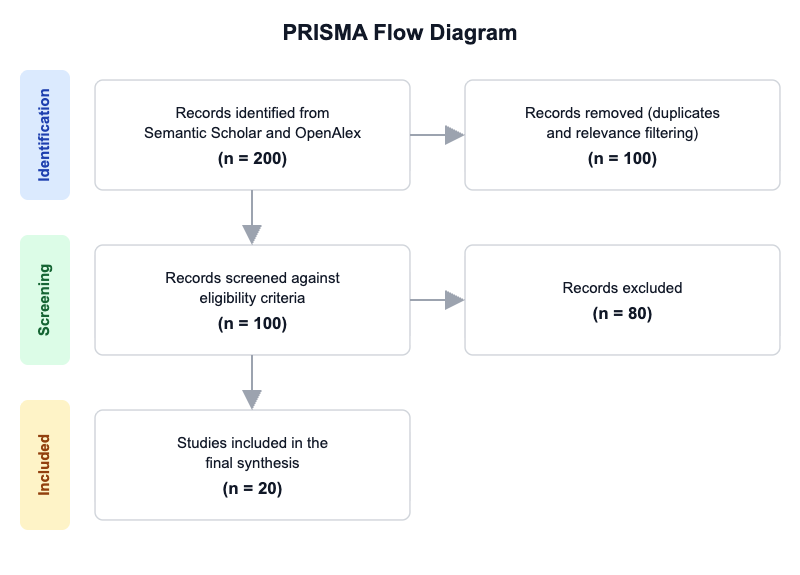
Initial database searching identified 200 records. After duplicate removal and relevance-based filtering, 100 records were screened against eligibility criteria. Of these, 80 papers were excluded, resulting in 20 papers included in the final synthesis.
PRISMA Flow Diagram
Eligibility criteria included:
- Essential Tremor: Does the study focus on essential tremor as a primary condition or outcome, rather than another movement disorder?
- Human/Clinical: Does the study involve human participants, clinical data, or human-derived evidence rather than purely non-human laboratory work?
- Cause/Mechanism: Does the study investigate causes, pathophysiology, genetics, neurobiology, or disease mechanisms of essential tremor?
- Treatment/Management: Does the study evaluate a treatment, intervention, or management approach for essential tremor?
- Recent Evidence: Does the paper provide recent or updated evidence relevant to current essential tremor research, ideally published in 2020 or later?
- Comparative Data: Does the paper compare two or more treatments, approaches, or study groups, or include a control/sham/baseline comparator?
- Quantitative Outcomes: Does the paper report measurable outcomes such as tremor severity, functional scores, quality of life, response rates, or adverse events?
- Novel Therapy: Does the study examine an emerging or less-established therapy, procedure, or device for essential tremor?
All included studies met the stated eligibility criteria.
2.3 Data Extraction and Synthesis
Data extraction focused on the following variables:
- Cause/Mechanism
- Risk Factors
- Treatment Type
- Key Outcomes
- Study Type
- Population
- Comparators
- Safety/Adverse Events
- Novelty/2026 Relevance
Thematic analysis was employed to identify patterns and synthesize findings across studies. Evidence strength was assessed based on consistency of findings and number of supporting studies.
3. Results
3.1 Characteristics of Included Studies
| Study and Year | Study Type | Population | Main Focus | Key Outcomes | Safety |
|---|---|---|---|---|---|
| Ferreira et al. 2019 [1] | Evidence-based review | Clinical ET populations | Pharmacological and surgical treatments | Propranolol, primidone, topiramate >200 mg/day clinically useful | Safety profile considered, details not specified |
| Shanker 2019 [2] | Review | Children and adults with ET | Diagnosis and management | First-line propranolol and primidone; DBS and focused ultrasound for severe cases | Not reported |
| Giordano et al. 2020 [3] | Systematic review and pooled analysis | DBS and MRgFUS patients | Surgical comparison | DBS better tremor improvement; MRgFUS better quality of life | Persistent complications more common with MRgFUS |
| Elias et al. 2016 [4] | Randomized trial | ET patients | MRgFUS thalamotomy | Reduced hand tremor | Sensory and gait disturbances |
| Welton et al. 2021 [5] | Review | Global ET population | Pathophysiology, genetics, treatment | Genetics, cerebellar pathology, and common medications | Not reported |
| Al-Fatly et al. 2019 [6] | Mechanistic study | ET patients undergoing DBS | Connectivity profiling | Connectivity predicted improvement | Not directly reported |
| Zesiewicz et al. 2011 [7] | Guideline review | ET patients | Evidence-based treatment | Propranolol/primidone Level A; topiramate, alprazolam, gabapentin Level B | Not reported |
| Okelberry et al. 2024 [8] | Review | General ET population | Recent advances | Updated epidemiology, genetics, imaging, and treatment | Not reported |
| Marquès et al. 2023 [9] | Randomized controlled trial | Isolated or essential head tremor | Botulinum toxin for head tremor | Better than placebo at 18 weeks, not 24 weeks | Adverse events reported |
| Deuschl et al. 2011 [10] | Review/overview | ET patients | Comparative treatment efficacy | ~50% tremor reduction with drugs; ~90% with DBS | Side effects limit persistence |
| Helmich et al. 2013 [11] | Review | Tremor disorders | Network pathophysiology | Cerebellothalamocortical dysfunction; network-based therapies | Not reported |
| Hopfner and Deuschl 2020 [12] | Review with treatment algorithm | ET patients | Symptomatic management | Propranolol, primidone, topiramate; DBS; focused ultrasound | Not reported |
| Deuschl and Elble 2009 [13] | Review | Hereditary, sporadic, senile ET | Definition and classification | Abnormal neuronal oscillation hypothesis | Not reported |
| Della Flora et al. 2010 [14] | Systematic review | DBS-treated ET patients | DBS safety/effectiveness | Improvement on stimulation-on vs off | Mostly mild adverse events |
| Dallapiazza et al. 2018 [15] | Literature review | Surgical ET populations | Surgical outcome comparison | Tremor reduction across DBS, RF, RS, FUS | Common adverse effects; RF more permanent complications |
| Cury et al. 2017 [16] | Observational study | PD, ET, dystonia | Thalamic DBS | Tremor reduction, functional and quality-of-life gains | Procedural/tolerability issues reported |
| Liao et al. 2022 [17] | Genome-wide association study | ET individuals | Novel risk loci | New common genetic risk factors | Not reported |
| Borges et al. 2023 [18] | Comparative review | ET patients | DBS vs MRgFUS | Both effective; differing tradeoffs | DBS higher surgical risk; MRgFUS less invasive |
| Clark et al. 2022 [19] | Whole genome sequencing study | Familial ET | Candidate genes and pathways | Genetic markers and biological pathways implicated | Not reported |
| Jankovic et al. 1996 [20] | Randomized, double-blind, placebo-controlled trial | Moderate to severe hand tremor | Botulinum toxin A | Tremor severity improvement; no functional scale improvement | Finger weakness common; no severe irreversible events |
The evidence base spans mechanistic reviews, genetic studies, systematic reviews, randomized trials, and comparative treatment syntheses. A clear temporal pattern is visible: earlier work concentrated on classification, medication, and DBS, whereas more recent studies increasingly emphasize network mechanisms, genetics, ultrasound-based lesioning, and comparative surgical tradeoffs [8], [17], [18].
3.2 Thematic Findings
3.2.1 ET is increasingly understood as a network disorder with mixed genetic and cerebellar mechanisms
The most consistent mechanistic theme is that ET reflects dysfunction within the cerebellothalamocortical system rather than a single focal lesion. Across reviews and mechanistic syntheses, ET is linked to GABAergic dysfunction, cerebellar Purkinje cell abnormalities, and altered network coupling, with abnormal neuronal oscillation proposed as a unifying explanation for both tremor and associated cerebellar signs [5], [11], [13]. This model is strengthened by DBS connectivity work showing that electrode connectivity to tremor-associated brain regions predicts postoperative improvement and can be segregated by the body part affected [6]. Genetic evidence complements this network model: common genetic variation explains part of ET heritability, and whole-genome sequencing in familial ET identifies candidate genes and biological pathways implicated in aetiology [17], [19].
A notable synthesis across these studies is that genetic susceptibility and circuit-level dysfunction are not competing explanations but likely linked levels of causation. The genomic studies do not specify a single causal pathway, but they strengthen the argument that ET is biologically heterogeneous and probably composed of more than one mechanistic subtype. Confidence in this theme is strong because independent evidence converges across clinical review, pathology-oriented review, connectivity analysis, and genomic studies.
3.2.2 First-line medications remain stable, but their benefits are modest compared with invasive therapies
Pharmacological management is dominated by propranolol and primidone, which are consistently identified as first-line or established treatments across evidence-based guidelines and clinical reviews [7], [1], [2], [12]. Topiramate also has recurring support, with evidence-based classification ranging from probably effective to clinically useful at doses greater than 200 mg/day [7], [1], [12]. Quantitatively, established drugs produce about 50% mean tremor reduction, whereas the broader surgical literature shows much larger reductions with DBS and some lesioning methods [10].
This convergence suggests that the pharmacological ceiling may be limited by symptom suppression rather than circuit correction. The available evidence also implies a tradeoff between efficacy and tolerability: many patients abandon treatment because of side effects or poor efficacy, although specific adverse-event rates are not consistently reported [10]. Confidence is strong for propranolol and primidone as first-line therapy and moderate for topiramate because recommendations are consistent but dose-dependent and supported mainly in review-level evidence.
3.2.3 Surgical therapies produce the largest tremor reductions, but effectiveness is shaped by laterality, durability, and adverse-event burden
Across surgical comparisons, DBS remains the most established interventional approach for medication-resistant ET, but the magnitude of benefit varies by target, laterality, and comparator framework [3], [14], [15]. Unilateral Vim DBS typically yields 53% to 63% tremor reduction at one year, while bilateral Vim DBS improves to 66% to 78%; broader historical summaries estimate about 90% reduction with DBS in thalamic nucleus ventrointermedius or neighboring subthalamic structures [15], [10]. In pooled analyses, bilateral DBS is significantly superior to unilateral MRgFUS and unilateral DBS, and laterality appears to be a major determinant of tremor improvement [3].
Safety differs by modality. DBS adverse events are often mild and adjustable, with programming changes mitigating symptoms [14], while lesioning methods more often produce paraesthesias, dysarthria, and ataxia, and permanent neurological complications are most commonly reported with radiofrequency thalamotomy [15]. These patterns support a tradeoff between reversibility/adjustability and lesion permanence. Confidence is strong because findings are directionally consistent across reviews and systematic analyses, though direct randomized head-to-head trials remain limited.
3.2.4 MRgFUS is a major alternative to DBS, with a distinct profile of benefit and harm
MRgFUS thalamotomy has emerged as the most important incisionless alternative to DBS. Randomized evidence shows that MRgFUS reduced hand tremor and improved function, but side effects included sensory and gait disturbances [4]. Comparative evidence indicates that tremor improvement is generally greater with DBS, while quality-of-life improvement is greater with MRgFUS; persistent complications are also more common with MRgFUS [3]. At the same time, clinical reviews emphasize that MRgFUS may be especially attractive for patients with substantial medical comorbidities because it avoids hardware implantation and maintenance [18], [2].
The apparent contradiction between stronger tremor reduction with DBS and better quality-of-life gains with MRgFUS likely reflects different outcome sensitivities and patient preferences. MRgFUS may deliver a more acceptable treatment experience despite somewhat smaller motor gains, whereas DBS may better suppress tremor but impose a larger procedural and hardware burden. Evidence confidence is moderate to strong: efficacy is supported by randomized and pooled comparative data, but the durability of staged bilateral MRgFUS remains insufficiently established.
3.2.5 Botulinum toxin is effective for selected tremor phenotypes, but benefit is limited by weakness and waning effect
Botulinum toxin shows a consistent but phenotype-specific role. In essential hand tremor, botulinum toxin type A improved tremor severity compared with placebo, with 75% of treated patients reporting mild to moderate improvement versus 27% on placebo, and postural accelerometry showing a ≥30% amplitude reduction in 9 of 12 treated subjects versus 1 of 9 placebo subjects [20]. For head tremor, splenius capitis injections were superior to placebo at 18 weeks but not at 24 weeks, consistent with waning efficacy over time [9]. Safety is a clear limiting factor: finger weakness was universal in the early hand tremor trial, and head tremor injections were associated with adverse events [20], [9].
These findings suggest that botulinum toxin is best understood as a targeted symptomatic option rather than a durable global solution for ET. Confidence is moderate because the direction of benefit is consistent, but outcome measures, injection strategies, and tremor phenotypes differ, making direct comparison with oral agents and surgery difficult.
3.2.6 Evidence for non-limb tremor and broader phenotype management remains uneven
A persistent gap across the literature is that most interventional evidence centers on limb tremor, while voice, head, and broader functional syndromes are less well studied. Evidence-based reviews explicitly note insufficient evidence for voice and head tremor and for several less established interventions [1], [7]. Meanwhile, updated clinical definitions emphasize that ET may involve neck, vocal cords, cognitive impairment, psychiatric symptoms, and hearing loss, but treatment trials rarely match this broader phenotype [2], [5].
This mismatch limits direct translation of the current evidence to the full clinical spectrum of ET. The available evidence supports treatment of limb tremor far more robustly than axial or cranial tremor. Confidence is limited for non-limb tremor because of sparse, heterogeneous, and sometimes short-term data.
3.3 Summary of Evidence
| Theme | Key Finding | Population Applicability | Effect Direction | Confidence Level | Supporting Studies |
|---|---|---|---|---|---|
| Network and genetic mechanisms | ET is linked to cerebellothalamocortical dysfunction, GABAergic abnormalities, and genetic susceptibility; connectivity to tremor-associated areas predicts postoperative improvement | ET populations broadly; genetic findings especially applicable to familial ET | Positive for mechanistic understanding | Strong | Welton et al. [5], Helmich et al. [11], Liao et al. [17] |
| First-line pharmacotherapy | Propranolol and primidone remain established first-line treatments; topiramate is supported at doses >200 mg/day | Mostly limb tremor in clinical ET populations | Positive | Strong | Ferreira et al. [1], Zesiewicz et al. [7], Hopfner and Deuschl [12] |
| Surgical efficacy | DBS generally provides greater tremor reduction than MRgFUS, with bilateral DBS outperforming unilateral approaches | Medication-resistant ET, mainly limb tremor | Positive | Strong | Giordano et al. [3], Della Flora et al. [14], Dallapiazza et al. [15] |
| MRgFUS tradeoff | MRgFUS improves quality of life but has more persistent complications than DBS | Patients considered for incisionless surgery; may especially fit comorbid patients | Mixed | Moderate | Giordano et al. [3], Elias et al. [4], Borges et al. [18] |
| Botulinum toxin | Botulinum toxin improves hand and head tremor but adverse effects and waning durability limit use | Selected hand and head tremor phenotypes; not generalized ET | Positive | Moderate | Jankovic et al. [20], Marquès et al. [9] |
| Non-limb tremor evidence gap | Evidence remains insufficient for voice and head tremor compared with limb tremor | Axial and cranial ET phenotypes | Limited | Limited | Ferreira et al. [1], Shanker [2] |
4. Discussion
4.1 Principal Findings and Their Interpretation
This synthesis indicates that contemporary ET research has converged on a biologically plausible but clinically heterogeneous model in which circuit dysfunction, genetic susceptibility, and treatment response vary across phenotypes. The mechanistic literature is especially coherent: cerebellothalamocortical dysregulation, GABAergic abnormalities, Purkinje cell pathology, and abnormal neuronal oscillation together provide a multi-level explanation for the disorder [5], [11], [13]. The value of this convergence is that it links anatomic circuitry to physiological behavior and then to treatment logic. That is, DBS and MRgFUS likely help not because ET is one lesionable focus, but because both procedures modulate the same tremor network from different directions. The connectivity findings further sharpen this model by showing that stimulation-response relationships depend on the spatial organization of the network, not merely on generic thalamic targeting [6].
The therapeutic hierarchy is also now clearer. Oral drugs remain important because they are accessible and established, but their effect size appears modest relative to device-based interventions. This likely reflects the fact that pharmacologic therapies dampen tremor expression, whereas DBS and lesioning more directly alter pathological network activity. The evidence is strongest for propranolol and primidone because recommendations are stable across reviews and guidelines and because they remain first-line despite decades of use [7], [1]. By contrast, the growing literature on MRgFUS indicates that the field is no longer comparing “effective versus ineffective” interventions, but rather comparing differing benefit-risk architectures. This is an important conceptual advance because it implies treatment selection should be phenotype-specific, balancing tremor suppression, invasiveness, reversibility, and tolerance for adverse effects rather than pursuing a single universally superior option [3], [18].
4.2 Comparison with Existing Literature and Resolution of Contradictions
The main tension in the literature concerns whether DBS or MRgFUS should be preferred for advanced ET. The available evidence is not truly contradictory so much as outcome-dependent. DBS tends to outperform MRgFUS on tremor reduction, whereas MRgFUS tends to produce larger quality-of-life gains in pooled comparisons [3]. This pattern is plausible because tremor severity and lived disability are not identical constructs: a treatment that is less adjustable or produces more persistent complications may still feel preferable if it avoids implanted hardware, repeated programming, and surgical maintenance. The discrepancy therefore likely reflects different patient priorities and measurement domains rather than inconsistent efficacy. It also suggests that future comparisons should pre-specify whether motor control, patient experience, or long-term durability is the primary endpoint.
A second tension concerns lesioning techniques and their adverse-event profiles. Older surgical reviews report good tremor reduction with radiofrequency thalamotomy but more permanent complications, while newer MRgFUS studies emphasize sensory and gait disturbances and persistent complications [15], [4]. This is best interpreted as the result of method-specific injury patterns rather than random inconsistency. Radiofrequency lesioning creates an irreversible lesion, so permanent deficits are biologically expected if the target or surrounding tissue is affected. MRgFUS avoids incision but still creates a lesion, which may explain why its complications are not trivial despite the noninvasive approach. Publication bias is possible throughout the surgical literature because positive procedural outcomes are likely more publishable than neutral ones, and many studies remain observational or review-based rather than randomized [14], [15], [16]. The mechanistic and genetic literature is more internally consistent, but it still does not resolve ET subtypes, leaving open whether some apparently contradictory clinical findings reflect true biological heterogeneity.
4.3 Practical Implications
For clinicians, the evidence supports a stepped strategy. Propranolol and primidone remain the most defensible first-line options for typical limb ET, with topiramate a reasonable alternative in selected patients when higher doses are tolerated [7], [1], [12]. Patients with medically refractory tremor should be counseled that DBS usually offers the strongest tremor reduction, especially when bilateral symptom control is needed, but that the procedure is invasive and hardware-dependent [3], [15]. MRgFUS is particularly relevant for patients who are poor DBS candidates because of comorbidity or who prefer an incisionless approach, but they should be informed that persistent complications may be more common and that long-term bilateral strategies remain less certain [3], [18]. Botulinum toxin is best reserved for selected limb or head tremor phenotypes where focal weakness is an acceptable tradeoff [20], [9].
From a public health perspective, the main implication is not a universal threshold policy but a phenotype- and burden-based treatment framework. Because the evidence does not identify a single curative intervention and because ET often persists across the lifespan, access to specialist assessment matters. Regulatory and health-system planning should therefore prioritize availability of both medication and advanced procedural options, with shared decision-making that incorporates patient preferences, body-part involvement, comorbidity, and tolerance for risk. The strongest caveat is that much of the comparative evidence concerns limb tremor and medically refractory populations, so extrapolation to head, voice, and mixed ET-plus phenotypes should be cautious [1], [2].
4.4 Strengths and Limitations
This review draws on a broad and methodologically diverse evidence base, including randomized trials, systematic reviews, observational studies, mechanistic analyses, and recent genetic studies. That diversity strengthens synthesis because it allows convergence across pathophysiology, efficacy, and treatment-selection literature. The main limitation of the included studies is heterogeneity: outcome measures, tremor phenotypes, follow-up lengths, and surgical techniques differ substantially, which complicates direct comparison. Many surgical studies are observational, and several reviews note limited controlled evidence, short-term follow-up, and nonstandardized scales [10], [14], [15].
The review itself is limited by reliance on the provided study data, which means some papers have incomplete extracted fields and several abstract-level summaries lack full quantitative detail. No formal risk-of-bias assessment was available in the provided dataset, and therefore confidence judgments are necessarily qualitative rather than statistical. Finally, because the evidence base emphasizes limb tremor and treatment-resistant patients, the synthesis is less certain for cranial tremor, voice tremor, and broader ET-plus syndromes.
5. Gaps and Future Directions
The clearest gap is the lack of phenotype-specific evidence. Most interventional data address limb tremor, while head and voice tremor remain underrepresented despite being common and disabling manifestations of ET [1], [2]. Future studies should therefore stratify by tremor body distribution, ET-plus features, and treatment goals rather than pooling heterogeneous phenotypes. A second gap is the absence of robust head-to-head randomized comparisons between DBS, MRgFUS, and lesioning methods with standardized long-term outcomes. Current comparative evidence often relies on pooled observational data or short-term trials, which limits inference about durability and complication trajectories [3], [4], [15].
Mechanistic research also remains incomplete. The field has strong evidence for network dysfunction and genetic contribution, but the connection between specific genetic loci and clinical subtypes is still unresolved [5], [17], [19]. Future work should integrate genomics, imaging, and connectomics to identify biologically meaningful ET subtypes that may respond differently to medications or procedural therapies. Finally, longer follow-up is needed for MRgFUS, botulinum toxin, and newer neuromodulation approaches to clarify durability, adverse effects, and selection criteria.
6. Conclusion
The latest evidence supports ET as a heterogeneous network disorder shaped by cerebellothalamocortical dysfunction, genetic susceptibility, and phenotype-specific treatment response. Mechanistically, the strongest available data point to GABAergic and cerebellar abnormalities, abnormal neuronal oscillation, and partial heritability explained by common genetic variation and familial candidate genes [5], [13], [17], [19]. Clinically, propranolol and primidone remain the most consistently supported first-line therapies, with topiramate also supported at higher doses, while DBS and MRgFUS provide larger procedural benefits for medication-refractory disease [1], [7], [3].
The best-supported surgical conclusion is that DBS generally produces greater tremor reduction than MRgFUS, whereas MRgFUS can yield greater quality-of-life improvement but more persistent complications; bilateral DBS is especially effective when bilateral control is needed [3], [15]. Botulinum toxin is useful for selected hand and head tremor phenotypes, but weakness and waning durability limit broad adoption [20], [9]. The evidence most directly applies to limb tremor and medication-resistant clinical populations, so extrapolation to voice tremor, head tremor, and ET-plus presentations should remain cautious.
The single most important unresolved question is how to match mechanistically distinct ET subtypes to the most effective and durable therapy. Answering that question will require phenotype-stratified trials and integrated genetic-neuroimaging studies. Until then, the practical direction is clear: individualized treatment selection, shared decision-making, and continued development of therapies that better align efficacy with tolerability and patient preference.
References
- Ferreira, J. J., Mestre, T. A., Lyons, K. E., Benito-León, J., Tan, E.-K., Abbruzzese, G., Hallett, M., Haubenberger, D., Elble, R., & Deuschl, G. (2019). MDS evidence-based review of treatments for essential tremor. Movement Disorders, 34(7), 950–958. https://doi.org/10.1002/mds.27700
- Shanker, V. (2019). Essential tremor: Diagnosis and management. BMJ, 366, l4485. https://doi.org/10.1136/bmj.l4485
- Giordano, M., Caccavella, V. M., Zaed, I., Foglia Manzillo, L., Montano, N., Olivi, A., & Polli, F. M. (2020). Comparison between deep brain stimulation and magnetic resonance-guided focused ultrasound in the treatment of essential tremor: A systematic review and pooled analysis of functional outcomes. Journal of Neurology, Neurosurgery & Psychiatry, 91(12), 1270–1278. https://doi.org/10.1136/jnnp-2020-323216
- Elias, W. J., Lipsman, N., Ondo, W. G., Ghanouni, P., Kim, Y. G., Lee, W., Schwartz, M., Hynynen, K., Lozano, A. M., Shah, B. B., Huss, D., Dallapiazza, R. F., Gwinn, R., Witt, J., Ro, S., Eisenberg, H. M., Fishman, P. S., Gandhi, D., Halpern, C. H., … Chang, J. W. (2016). A randomized trial of focused ultrasound thalamotomy for essential tremor. New England Journal of Medicine, 375(8), 730–739. https://doi.org/10.1056/NEJMoa1600159
- Welton, T., Cardoso, F., Carr, J. A., Chan, L. L., Deuschl, G., Jankovic, J., & Tan, E.-K. (2021). Essential tremor. Nature Reviews Disease Primers, 7(1), 83. https://doi.org/10.1038/s41572-021-00314-w
- Al-Fatly, B., Ewert, S., Kübler, D., Kroneberg, D., Horn, A., & Kühn, A. A. (2019). Connectivity profile of thalamic deep brain stimulation to effectively treat essential tremor. Brain, 142(10), 3086–3098. https://doi.org/10.1093/brain/awz236
- Zesiewicz, T. A., Elble, R. J., Louis, E. D., Gronseth, G. S., Ondo, W. G., Dewey, R. B., Jr., Okun, M. S., Sullivan, K. L., & Weiner, W. J. (2011). Evidence-based guideline update: Treatment of essential tremor: Report of the Quality Standards Subcommittee of the American Academy of Neurology. Neurology, 77(19), 1752–1755. https://doi.org/10.1212/WNL.0b013e318236f0fd
- Okelberry, T., Lyons, K. E., & Pahwa, R. (2024). Updates in essential tremor. Parkinsonism & Related Disorders, 122, 106086. https://doi.org/10.1016/j.parkreldis.2024.106086
- Marquès, A., Pereira, B., Simonetta-Moreau, M., Castelnovo, G., De Verdal, M., Fluchère, F., Laurencin, C., Degos, B., Tir, M., Kreisler, A., Blanchet-Fourcade, G., Guehl, D., Colin, O., Poujois, A., Sangla, S., Tatu, L., Derost, P., Gayraud, D., Tranchant, C., … Rieu, I. (2023). Trial of botulinum toxin for isolated or essential head tremor. New England Journal of Medicine, 389(19), 1753–1765. https://doi.org/10.1056/NEJMoa2304192
- Deuschl, G., Raethjen, J., Hellriegel, H., & Elble, R. (2011). Treatment of patients with essential tremor. The Lancet Neurology, 10(2), 148–161. https://doi.org/10.1016/S1474-4422(10)70322-770322-7)
- Helmich, R. C., Toni, I., Deuschl, G., & Bloem, B. R. (2013). The pathophysiology of essential tremor and Parkinson's tremor. Current Neurology and Neuroscience Reports, 13(9), 378. https://doi.org/10.1007/s11910-013-0378-8
- Hopfner, F., & Deuschl, G. (2020). Managing essential tremor. Neurotherapeutics, 17(4), 1603–1621. https://doi.org/10.1007/s13311-020-00899-2
- Deuschl, G., & Elble, R. (2009). Essential tremor—Neurodegenerative or nondegenerative disease towards a working definition of ET. Movement Disorders, 24(14), 2033–2041. https://doi.org/10.1002/mds.22755
- Della Flora, E., Perera, C. L., Cameron, A. L., & Maddern, G. J. (2010). Deep brain stimulation for essential tremor: A systematic review. Movement Disorders, 25(11), 1550–1559. https://doi.org/10.1002/mds.23195
- Dallapiazza, R. F., Lee, D. J., De Vloo, P., Fomenko, A., Hamani, C., Hodaie, M., Kalia, S. K., Fasano, A., & Lozano, A. M. (2018). Outcomes from stereotactic surgery for essential tremor. Journal of Neurology, Neurosurgery & Psychiatry, 90(4), 474–482. https://doi.org/10.1136/jnnp-2018-318240
- Cury, R. G., Fraix, V., Castrioto, A., Pérez Fernández, M. A., Krack, P., Chabardes, S., Seigneuret, E., Alho, E. J. L., Benabid, A.-L., & Moro, E. (2017). Thalamic deep brain stimulation for tremor in Parkinson disease, essential tremor, and dystonia. Neurology, 89(13), 1416–1423. https://doi.org/10.1212/WNL.0000000000004295
- Liao, C., Castonguay, C.-E., Heilbron, K., Vuokila, V., Medeiros, M., Houle, G., Akçimen, F., Ross, J. P., Catoire, H., Diez-Fairen, M., Kang, J., Mueller, S. H., Girard, S. L., Hopfner, F., Lorenz, D., Clark, L. N., Soto-Beasley, A. I., Klebe, S., Hallett, M., … 23andMe Research Team. (2022). Association of essential tremor with novel risk loci: A genome-wide association study and meta-analysis. JAMA Neurology, 79(2), 185–193. https://doi.org/10.1001/jamaneurol.2021.4781
- Borges, Y. F. F., Cheyuo, C., Lozano, A. M., & Fasano, A. (2023). Essential tremor – deep brain stimulation vs. focused ultrasound. Expert Review of Neurotherapeutics, 23(7), 603–619. https://doi.org/10.1080/14737175.2023.2221789
- Clark, L. N., Gao, Y., Wang, G. T., Hernandez, N., Ashley-Koch, A., Jankovic, J., Ottman, R., Leal, S. M., Barral Rodriguez, S. M., & Louis, E. D. (2022). Whole genome sequencing identifies candidate genes for familial essential tremor and reveals biological pathways implicated in essential tremor aetiology. eBioMedicine, 85, 104290. https://doi.org/10.1016/j.ebiom.2022.104290
- Jankovic, J., Schwartz, K., Clemence, W., Aswad, A., & Mordaunt, J. (1996). A randomized, double-blind, placebo-controlled study to evaluate botulinum toxin type A in essential hand tremor. Movement Disorders, 11(3), 250–256. https://doi.org/10.1002/mds.870110306