

Latest Research on Fibroids: Epidemiology, Diagnostics, Fertility, and Evolving Treatment Strategies
Abstract
Recent research indicates that uterine fibroids remain highly prevalent, often asymptomatic, and strongly shaped by racial disparities, diagnostic approach, and treatment tradeoffs. In a diverse community cohort, fibroids were present in 35.7% (95% CI 29.8%-42.0%) of Black or African American participants, 21.8% (95% CI 16.7%-27.8%) of Asian-Chinese participants, 12.7% (95% CI 8.7%-17.6%) of Hispanic or Latina participants, and 10.7% (95% CI 7.3%-14.9%) of White participants, with adjusted odds ratios of 4.72 (95% CI 2.72-8.18) and 3.35 (95% CI 1.95-5.76) versus White participants [10]. Across fertility-focused evidence, untreated FIGO type 3 myomas were associated with lower live birth, clinical pregnancy, and implantation rates, and fibroid-associated infertility was suggested but not definitively established in natural conception settings [12], [4]. Management research increasingly favors individualized, imaging-guided decision-making, yet durable fertility-compatible options remain limited; myomectomy outperformed uterine-artery embolization for fibroid-related quality of life at 2 years in one randomized trial, while embolization was associated with higher reintervention and hysterectomy rates in later synthesis [2], [18]. This synthesis integrates recent epidemiologic, diagnostic, mechanistic, fertility, and therapeutic evidence to clarify what is now most defensible about fibroids and where uncertainty persists. The overall pattern is one of substantial burden, persistent inequities, and no single universally optimal intervention, underscoring the need for more standardized diagnostic pathways and comparative long-term trials.
1. Introduction
Uterine fibroids, also termed leiomyomas or myomas, are among the most common benign tumors in women and remain a major cause of abnormal uterine bleeding, anemia, pelvic pressure, pain, reproductive dysfunction, and diminished quality of life. Their burden is clinically important because most fibroids are asymptomatic, yet a substantial minority produce symptoms severe enough to require treatment. Epidemiologic estimates indicate high lifetime prevalence, with especially marked disease burden among women of African ancestry, making fibroids both a common gynecologic condition and a health equity concern [1], [15].
The contemporary challenge is not simply whether fibroids are common, but how best to diagnose, classify, and manage them in ways that align with symptoms, reproductive goals, and patient preferences. Imaging has become central because physical examination is unreliable for diagnosis and phenotyping, and structured reporting is increasingly recommended to support standardized classification and clinical planning [19], [14]. At the same time, treatment options continue to expand across medical therapy, surgical removal, embolization, ablation, and focused ultrasound, but durable noninvasive and fertility-compatible solutions remain limited [3], [20], [2].
Recent work also suggests that fibroid biology is not uniform. Molecular reviews emphasize progesterone signaling as a key driver of fibroid cell proliferation and identify selective progesterone receptor modulators and natural compounds as possible therapeutic avenues, although safety and effectiveness remain incompletely established [8], [9]. Fertility research has similarly become more nuanced, with evidence differing by fibroid type and by whether outcomes are assessed in assisted reproduction or natural conception settings [12], [4]. Against this background, a synthesis of the latest literature is needed to integrate epidemiology, pathogenesis, diagnosis, fertility effects, and comparative treatment evidence into a coherent understanding of where the field currently stands.
2. Methods
2.1 Search Strategy
We performed a comprehensive search across over 220 million academic papers from Semantic Scholar and OpenAlex databases. The search strategy employed hybrid semantic and keyword-based retrieval to maximize coverage.
Search queries included:
- "Uterine fibroids recent research diagnosis treatment outcomes 2020 2026"
- "Leiomyoma evidence latest clinical studies medical therapy surgery 2020 2026"
- "Fibroid disease burden symptoms fertility pregnancy recent systematic review"
- "Uterine myoma minimally invasive treatment embolization ablation hysterectomy recent"
2.2 Study Selection
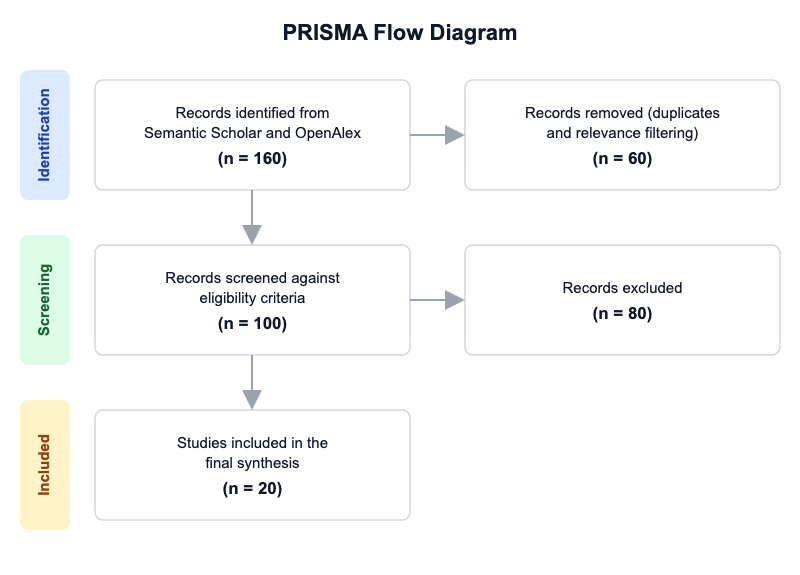
Initial database searching identified 160 records. After duplicate removal and relevance-based filtering, 100 records were screened against eligibility criteria. Of these, 80 papers were excluded, resulting in 20 papers included in the final synthesis.
PRISMA Flow Diagram
Eligibility criteria included:
- Fibroid Focus: Does the study focus on uterine fibroids/leiomyomas/myomas in humans?
- Recent Evidence: Is the paper published in 2020 or later?
- Clinical Relevance: Does the study address diagnosis, symptoms, fertility, pregnancy, medical treatment, surgery, embolization, ablation, or quality of life in fibroids?
- Original Data: Does the paper report original human data, a systematic review, or a meta-analysis rather than a purely editorial or commentary?
- Treatment Detail: Does the paper provide specific information on an intervention, procedure, imaging approach, or measurable clinical outcome?
- Outcome Reporting: Does the study report at least one clinical outcome such as bleeding, pain, fertility, pregnancy outcome, fibroid size, symptom score, reintervention, or adverse events?
- Comparative Evidence: Does the study compare two or more approaches, groups, or treatments?
All included studies met the stated eligibility criteria.
2.3 Data Extraction and Synthesis
Data extraction focused on the following variables:
- Topic
- Study Type
- Population
- Intervention/Exposure
- Main Outcome
- Key Finding
- Follow-up
- Setting
Thematic analysis was employed to identify patterns and synthesize findings across studies. Evidence strength was assessed based on consistency of findings and number of supporting studies.
3. Results
3.1 Characteristics of Included Studies
| Study and Year | Study Type | Population | Core Focus | Main Outcome | Setting/Duration |
|---|---|---|---|---|---|
| Giuliani et al. 2020 [1] | Narrative review | Reproductive-age women | Epidemiology and management | Symptom burden and management options | Global; not reported |
| Manyonda et al. 2020 [2] | Randomized controlled trial | Women with symptomatic uterine fibroids | Myomectomy vs uterine-artery embolization | Fibroid-related quality of life at 2 years | Multicenter; 2 years |
| Yang et al. 2021 [3] | Narrative review | Women of reproductive age | Developmental origin, pathogenesis, treatment | Mechanisms and treatment limitations | Not reported |
| Somigliana et al. 2021 [4] | Systematic review and meta-analysis | Women of reproductive age | Fibroids and natural fertility | Infertility and time to pregnancy | Not reported |
| Anneveldt et al. 2021 [5] | Systematic review | Women desiring pregnancy | HIFU and reproductive outcomes | Reproductive outcomes after HIFU | Not reported |
| Huang et al. 2022 [6] | Cross-sectional study | Asymptomatic reproductive-age women | Prevalence and burden by race | Fibroid prevalence | United States |
| Wang et al. 2022 [7] | Narrative review/video | Gynecologists | Radiofrequency ablation procedures | Procedural awareness and technique | Clinical context |
| Ali et al. 2023 [8] | Narrative review | Premenopausal women | Progesterone signaling and therapeutics | Molecular pathogenesis and candidate therapies | Not reported |
| Ali et al. 2023 [9] | Narrative review | Women of reproductive age | Current and emerging treatments | Efficacy and limitations of pharmacologic options | Not reported |
| Huang et al. 2023 [10] | Cross-sectional study | Reproductive-age women | Fibroid presence on transvaginal ultrasonography | Fibroid presence and burden | San Francisco, California |
| Fox et al. 2023 [11] | Case report | One patient with very large fibroid uterus | UAE to facilitate hysterectomy | Size reduction and surgical feasibility | Clinical setting; 14 weeks |
| Favilli et al. 2023 [12] | Systematic review and meta-analysis | Patients with FIGO type 3 myomas | IVF outcomes | Live birth, pregnancy, implantation | Not reported |
| Donnez et al. 2024 [13] | Narrative review | Women with fibroid-related infertility | Mechanisms and management | Fertility impact and treatment effects | Not reported |
| Centini et al. 2024 [14] | Narrative review | Women with uterine leiomyomas | Diagnostic pathway and treatment tailoring | Quality of life and tailored management | Not reported |
| Marsh et al. 2024 [15] | Narrative review | Women of reproductive age | Incidence, diagnosis, treatment | Management overview | Not reported |
| Tzanis et al. 2024 [16] | Systematic review and meta-analysis | Premenopausal women | UAE vs myomectomy | Reintervention, morbidity, pregnancy | Not reported |
| Khamaiseh et al. 2024 [17] | Cohort study | Patients with symptomatic uterine leiomyomas | Repeat interventions after myomectomy | Reintervention and genetic risk | Not reported |
| Peng et al. 2024 [18] | Systematic review and meta-analysis | Women avoiding hysterectomy | UAE vs myomectomy | Reintervention, QoL, symptom severity | Four-year follow-up |
| Lakabi et al. 2025 [19] | Narrative review | General fibroid population | Diagnosis and classification | Imaging accuracy and FIGO reporting | Not reported |
| de Smit et al. 2025 [20] | Narrative review | Women with symptomatic uterine fibroids | Comparative treatment options | Evidence gaps and treatment selection | Not reported |
The literature is dominated by narrative reviews and comparative syntheses, with fewer primary clinical studies. The evidence base concentrates on reproductive-age and premenopausal women, but several studies explicitly address asymptomatic cohorts, fertility-seeking patients, and women with symptomatic disease. Imaging, fertility, and comparative management recur as the central themes, while mechanistic work focuses mainly on progesterone signaling and genetic predisposition.
3.2 Thematic Findings
3.2.1 Fibroids are common, frequently silent, and unequally distributed across populations
The epidemiologic evidence shows a consistent pattern: fibroids are highly prevalent, often asymptomatic, and not evenly distributed across racial and ethnic groups. In the community-based ultrasonography cohort, prevalence was 35.7% (95% CI 29.8%-42.0%) in Black or African American participants, 21.8% (95% CI 16.7%-27.8%) in Asian-Chinese participants, 12.7% (95% CI 8.7%-17.6%) in Hispanic or Latina participants, and 10.7% (95% CI 7.3%-14.9%) in White participants; adjusted odds ratios versus White participants were 4.72 (95% CI 2.72-8.18) and 3.35 (95% CI 1.95-5.76), respectively [10]. This aligns with broader reviews noting lifetime prevalence up to 70% in White women and more than 80% in women of African ancestry, while emphasizing that most cases remain asymptomatic [1]. The burden is therefore not defined only by diagnosis rates but by the large reservoir of undetected disease in people not seeking care. (Note: this study examined reproductive-age female participants not seeking treatment in an academic medical center which partially matches the question population of women with fibroids; findings should be interpreted considering this difference.) Confidence: Strong, because the pattern is consistent across epidemiologic review and direct imaging-based prevalence assessment.
3.2.2 Diagnostic strategy has shifted toward imaging-based phenotyping and standardized reporting
Across diagnostic reviews, a clear consensus has emerged that uterine fibroids are not reliably diagnosed on physical examination and that ultrasound should be first-line, with magnetic resonance imaging reserved for complex cases and surgical planning [19], [14]. This diagnostic emphasis is not merely technical: the review literature argues that standardized reporting using the FIGO classification system is essential to improve discrimination from adenomyosis and malignancy, predict treatment response, and guide tailored intervention [19]. The practical implication is that management increasingly depends on lesion location, burden, and relationship to the uterine cavity rather than on the binary presence of fibroids alone. Confidence: Moderate to strong, because the recommendations are consistent across narrative syntheses, though they are not supported here by head-to-head diagnostic accuracy trials.
3.2.3 Fibroid biology is increasingly framed as hormonally driven, with progesterone signaling standing out as a therapeutic target
Mechanistic reviews converge on the view that fibroids are not simply structural lesions but hormonally responsive tumors. Progesterone signaling is described as a crucial driver of fibroid cell proliferation, acting through multiple genetically and epigenetically mediated pathways [8]. This provides a biologically coherent explanation for why therapies that suppress gonadal steroid effects can reduce bleeding and fibroid volume, and why symptom control often tracks with endocrine manipulation rather than with direct lesion eradication [8], [9]. The literature also suggests a translational split: selective progesterone receptor modulators may be effective but raise safety questions, whereas natural compounds are presented as potentially safer for long-term use, especially when pregnancy is desired, yet remain unproven in clinical trials [8], [9]. Confidence: Moderate, because the mechanistic rationale is internally consistent but the clinical validation of candidate therapeutics remains incomplete.
3.2.4 Fertility effects depend on fibroid type, location, and reproductive context
The fertility literature is more nuanced than older generalizations implied. In assisted reproduction, FIGO type 3 myomas were associated with lower live birth rate, clinical pregnancy rate, and implantation rate, and worse outcomes were correlated with greater fibroid size and number [12]. In contrast, the evidence for natural conception is suggestive but not definitive: the meta-analysis of natural fertility studies found a common odds ratio of fibroids in subfertile women of 3.54 (95% CI 1.55 to 8.11), whereas the more informative time-to-pregnancy studies yielded a common OR of 1.93 (95% CI 0.89 to 4.18), which did not clearly exclude no effect [4]. This divergence implies that study context matters: IVF settings may amplify the impact of cavity-adjacent fibroids, while natural fertility studies are harder to interpret because of heterogeneity in fertility definition, exposure ascertainment, and bidirectionality of association. (Note: the IVF synthesis examined patients with untreated FIGO type 3 myomas and controls, which partially matches the question population of women with fibroids; the natural fertility synthesis examined women with and without fibroids in fertility-related contexts, which also partially matches the question population.) Confidence: Moderate, because the direction of effect is fairly consistent for IVF-relevant lesion types, but natural fertility remains uncertain.
3.2.5 Comparative treatment evidence shows a recurring tradeoff between symptom control, invasiveness, and durability
The strongest comparative theme is that no single procedure dominates across all outcomes. Myomectomy produced better fibroid-related quality of life at 2 years than uterine-artery embolization in the randomized FEMME trial [2]. Later syntheses complicate that picture by showing UAE is associated with higher reintervention risk and shorter time to reintervention than myomectomy, while perioperative morbidity does not clearly differ [16]. At four-year follow-up, UAE showed higher reintervention (OR 1.84; 95% CI 1.62-2.10), higher hysterectomy (OR 4.04; 95% CI 3.45-4.72), and worse symptom-severity score, but lower early complications (OR 0.44; 95% CI 0.20-0.95) than myomectomy [18]. These findings point to a stable tradeoff: UAE may offer less invasive early recovery, but myomectomy appears more durable and more favorable for patient-centered quality-of-life outcomes in women who wish to avoid hysterectomy. (Note: the trial and meta-analyses examined women with symptomatic uterine fibroids or premenopausal women diagnosed with uterine leiomyomas, which partially matches the question population of women with fibroids; findings should be interpreted considering this difference.) Confidence: Strong for the direction of the durability tradeoff, moderate for broader claims about pregnancy because evidence remains uncertain.
3.2.6 Newer minimally invasive and medical therapies are promising but still lack long-term comparative certainty
Several newer approaches are positioned as fertility-sparing or uterus-sparing alternatives, but the evidence remains uneven. Radiofrequency ablation devices are now FDA approved and are being disseminated as conservative surgical options, yet the available source here is procedural rather than outcome-based [7]. High-intensity focused ultrasound is supported by a systematic review suggesting reproductive outcomes appear non-inferior to current standard care, but the evidence is heterogeneous and still lacks randomized confirmation [5]. Pharmacologic reviews similarly argue that oral gonadotropin-releasing hormone antagonists can rapidly reduce heavy menstrual bleeding and fibroid volume, with reductions of approximately 50% from baseline to week 24 in one review context, but long-term safety and the optimal use of add-back therapy remain unresolved [13]. Overall, these treatments are promising but not yet established as durable replacements for surgery. Confidence: Limited to moderate, because the evidence is mostly review-based and long-term comparative data are sparse.
3.2.7 Repeat intervention after uterine-sparing surgery remains an important unresolved problem, with possible genetic contributors
The recurrence problem is becoming more explicit in recent work. A cohort study reported that reintervention is common after surgical myomectomy and suggested that repeat leiomyoma occurrence may reflect genetic predisposition, including germline fumarate hydratase mutation and distinct somatic YEATS domain-containing protein 4 mutations in multiple leiomyomas from the same patient [17]. This finding complements comparative evidence showing higher reintervention after UAE than myomectomy, but it also indicates that recurrence is not solely an issue of procedure choice; underlying tumor biology may shape whether disease returns after apparent surgical success [16], [17]. Confidence: Limited, because mechanistic inference is drawn from a single cohort-level signal and recurrence pathways remain incompletely characterized.
3.3 Summary of Evidence
| Theme | Key Finding | Population Applicability | Effect Direction | Confidence Level | Supporting Studies |
|---|---|---|---|---|---|
| High prevalence and racial disparity | Fibroids were present in 35.7% (95% CI 29.8%-42.0%) of Black or African American participants and 10.7% (95% CI 7.3%-14.9%) of White participants; adjusted OR 4.72 (95% CI 2.72-8.18) | Reproductive-age and symptomatic/asymptomatic women; strongest direct data from asymptomatic community cohort | Positive disparity | Strong | Huang et al. [10], Giuliani et al. [1] |
| Imaging-based diagnosis and classification | Ultrasound first-line; MRI reserved for complex cases/surgical planning; FIGO structured reporting recommended | General fibroid population | Positive toward diagnostic precision | Moderate | Lakabi et al. [19], Centini et al. [14] |
| Progesterone-driven pathogenesis | Progesterone signaling promotes fibroid cell proliferation through genetic and epigenetic pathways | Premenopausal women | Positive mechanistic signal | Moderate | Ali et al. [8] |
| Fertility impairment in IVF-relevant fibroids | FIGO type 3 myomas associated with lower live birth, clinical pregnancy, and implantation rates | Women undergoing IVF; partially matches broader fibroid population | Negative | Strong | Favilli et al. [12], Donnez et al. [13] |
| Uncertain natural fertility effect | Fibroids associated with subfertility OR 3.54 (95% CI 1.55 to 8.11), but time-to-pregnancy OR 1.93 (95% CI 0.89 to 4.18) did not clearly confirm causality | Women trying to conceive naturally | Mixed / uncertain | Limited | Somigliana et al. [4] |
| UAE vs myomectomy durability tradeoff | UAE higher reintervention OR 1.84 (95% CI 1.62-2.10) and hysterectomy OR 4.04 (95% CI 3.45-4.72) at four years; myomectomy better QoL at 2 years | Premenopausal/symptomatic women; partially matches broader fibroid population | Mixed, favors myomectomy durability | Strong | Manyonda et al. [2], Peng et al. [18], Tzanis et al. [16] |
| Emerging uterus-sparing therapies | HIFU reproductive outcomes appear non-inferior; RFA and GnRH antagonist therapies promising but long-term evidence limited | Women desiring fertility or symptom control | Mixed / promising | Limited | Anneveldt et al. [5], Wang et al. [7], Donnez et al. [13] |
| Repeat intervention and genetics | Reintervention common after myomectomy; potential association with FH and YEATS4 mutations | Symptomatic leiomyoma patients | Positive for recurrence risk | Limited | Khamaiseh et al. [17] |
4. Discussion
4.1 Principal Findings and Their Interpretation
The clearest conclusion from this literature is that fibroids are both common and clinically heterogeneous: disease burden depends heavily on lesion location, symptom profile, reproductive intent, and population background. The strong racial disparity observed in ultrasonography-based prevalence data supports the idea that fibroids are not merely a universal aging phenomenon but a condition with meaningful distributional inequities [10]. This epidemiologic pattern is compatible with broader prevalence reviews and suggests that apparently “silent” fibroids may still contribute substantially to downstream morbidity because many affected individuals are not captured through symptom-based detection [1].
Mechanistically, the synthesis strengthens the interpretation of fibroids as hormone-responsive tumors. Progesterone signaling is positioned as a central proliferative pathway, which helps explain why endocrine therapies can reduce bleeding and volume even when they do not permanently eliminate the lesion [8]. This is an important advance beyond older descriptive models because it links a clinically observable phenomenon—symptom recurrence after cessation of therapy—to a plausible biological driver. At the same time, the mechanistic literature remains translational rather than definitive: it supports therapeutic plausibility more than it establishes causal superiority of any single drug.
Fertility outcomes appear especially sensitive to context. FIGO type 3 myomas are associated with worse IVF outcomes, which is biologically plausible because these lesions are cavity-adjacent and may disrupt implantation [12]. By contrast, the natural fertility literature is less decisive, implying that the path from fibroid presence to infertility is not uniform and may depend on whether the lesion alters uterine anatomy enough to affect conception timing. This distinction helps reconcile why infertility concerns are common in practice while causal epidemiology remains incomplete [4]. Overall, confidence is highest for the durability advantage of myomectomy over embolization and for the adverse fertility effect of cavity-adjacent fibroids; confidence is lower for broader claims about all fibroids because evidence quality and population fit vary substantially.
4.2 Comparison with Existing Literature and Resolution of Contradictions
The apparent contradiction between better early recovery with UAE and better longer-term outcomes with myomectomy is best understood as a tradeoff between procedural burden and disease durability. UAE may reduce perioperative morbidity and early recovery burden, which can be attractive to patients who prioritize less invasive treatment, but the later reintervention signal indicates that symptom relief may be less durable [16], [18]. The randomized trial result showing superior 2-year quality of life after myomectomy is therefore not isolated; it fits a broader pattern in which more definitive tissue removal yields better sustained patient-reported benefit [2].
The uncertainty around natural fertility is more difficult to resolve. One likely explanation is exposure misclassification: studies in natural conception settings may not sufficiently distinguish submucosal, intramural, and cavity-distorting lesions, even though fertility effects are likely lesion-specific [4], [12]. A second explanation is bidirectionality: women labeled subfertile may be more intensively evaluated for fibroids, making fibroid presence both a possible cause and a marker of infertility workup. Third, heterogeneity in outcome definitions—infertility, time to pregnancy, and clinical fertility history—reduces comparability and may dilute true effects. The IVF evidence is more consistent because the outcome environment is tightly controlled and lesions are better phenotyped, making causal interpretation more plausible [12].
There is also a methodological evolution in the diagnostic literature: imaging-based phenotyping and FIGO classification are increasingly used because palpation is inadequate and structured reporting improves clinical comparability [19]. This shift likely improves the reliability of newer studies relative to earlier symptom-based or surgery-based datasets and may partly explain why recent work better resolves the location-specific fertility question. Publication bias remains possible, especially in therapeutic reviews where promising minimally invasive options and endocrine agents may attract selective reporting; however, the persistence of neutral or uncertain findings in the HIFU and pharmacologic literature argues against a uniformly optimistic evidence base [5], [13].
4.3 Practical Implications
For clinicians, the evidence supports a stratified approach rather than a one-size-fits-all pathway. Women with symptomatic fibroids who prioritize durable symptom control and future fertility preservation may be better served by myomectomy than by embolization, particularly when lesion burden is substantial or recurrence risk is a concern [2], [16]. Women with cavity-adjacent fibroids and infertility concerns warrant careful imaging-based phenotyping, because the fertility signal is strongest in FIGO type 3 disease and much less certain for natural conception across all fibroid types [12], [4].
For public health, the disparity data imply that screening and access to evaluation should not be symptom-only or opportunistic; Black or African American and Asian-Chinese women appear disproportionately affected, and asymptomatic disease is common enough that delayed recognition may perpetuate inequity [10], [1]. This is not a threshold question in the environmental sense, but it does challenge any passive “watchful waiting” model that assumes clinically silent disease is harmless.
For regulators and health systems, the current evidence favors expanding access to standardized imaging, fertility-informed counseling, and shared decision-making rather than assuming that newer minimally invasive technologies are uniformly superior. The evidence base for HIFU, radiofrequency ablation, and oral GnRH antagonists is promising but still incomplete, so implementation should remain linked to careful outcome tracking and longer-term follow-up [5], [7], [13]. The practical message is that treatment choice should be individualized, but individualization must be grounded in lesion phenotype, reproductive goals, and realistic expectations about recurrence.
4.4 Strengths and Limitations
This review benefits from a recent evidence window, inclusion of both primary studies and higher-level syntheses, and coverage of the major contemporary domains of fibroid research: epidemiology, diagnosis, fertility, mechanistic biology, and comparative treatment. The thematic approach also helps integrate studies that ask different questions but inform the same clinical problem.
Important limitations remain. Much of the evidence is narrative rather than controlled, limiting causal inference. Populations are unevenly represented, with especially strong data from reproductive-age and premenopausal women and less direct evidence for perimenopausal, non-U.S., or medically complex populations. Outcome definitions vary substantially across studies, particularly for fertility and treatment durability. As a review based on provided paper data, this synthesis also lacks a formal risk-of-bias assessment and is limited to the information reported in abstracts and extracted fields.
5. Gaps and Future Directions
The main unresolved gap is the lack of lesion-specific, prospective evidence linking fibroid phenotype to natural fertility, pregnancy outcomes, and recurrence after uterus-sparing treatment. Current fertility evidence is strongest for FIGO type 3 lesions in IVF settings, but the natural conception literature remains inconclusive and likely under-phenotyped [12], [4]. Future studies should therefore distinguish submucosal, intramural, and serosal disease with standardized imaging and report reproductive outcomes separately by fibroid class.
Long-term comparative effectiveness studies are also needed for emerging uterus-sparing therapies, especially HIFU, radiofrequency ablation, and oral GnRH antagonists with add-back therapy, because current evidence is promising but short on durable follow-up and head-to-head comparisons [5], [7], [13]. Underrepresented populations include women of African ancestry in treatment trials, women in non-U.S. settings, and patients seeking fertility-preserving care who have diverse fibroid burdens. Mechanistic work should move beyond pathway plausibility to connect molecular markers such as progesterone signaling, FH, and YEATS4 alterations with clinical recurrence and treatment response [8], [17].
6. Conclusion
The most defensible conclusion from the recent literature is that fibroids are highly prevalent, unevenly distributed, and clinically heterogeneous, and that management should be guided by imaging-defined phenotype and reproductive intent rather than by symptoms alone. The evidence is strongest for two points: first, Black or African American participants have a substantially higher fibroid prevalence than White participants, with prevalence of 35.7% (95% CI 29.8%-42.0%) versus 10.7% (95% CI 7.3%-14.9%) and an adjusted OR of 4.72 (95% CI 2.72-8.18) [10]; second, myomectomy generally offers more durable symptom control than uterine-artery embolization, including better 2-year fibroid-related quality of life and lower four-year reintervention and hysterectomy risk [2], [18]. The fertility signal is also meaningful but more context-dependent: FIGO type 3 myomas are associated with lower live birth, clinical pregnancy, and implantation rates in IVF, whereas the effect on natural conception remains uncertain [12], [4].
Because much of the current evidence comes from review-level synthesis, asymptomatic cohorts, and fertility subgroups, these conclusions partially match the broader population of women with fibroids rather than every patient scenario. The single most important unanswered question is which fibroid phenotypes, in which reproductive contexts, benefit most from which uterus-sparing treatment over the long term. Answering that question will determine whether the current trend toward more individualized, minimally invasive care can truly deliver durable symptom relief, fertility preservation, and equitable access to effective treatment.
References
- Giuliani, E., As-Sanie, S., & Marsh, E. E. (2020). Epidemiology and management of uterine fibroids. International Journal of Gynecology & Obstetrics, 149(1), 3–9. https://doi.org/10.1002/ijgo.13102
- Manyonda, I., Belli, A.-M., Lumsden, M.-A., Moss, J., McKinnon, W., Middleton, L. J., Cheed, V., Wu, O., Sirkeci, F., Daniels, J. P., & McPherson, K. (2020). Uterine-artery embolization or myomectomy for uterine fibroids. New England Journal of Medicine, 383(5), 440–451. https://doi.org/10.1056/NEJMoa1914735
- Yang, Q., Ciebiera, M., Bariani, M. V., Ali, M., Elkafas, H., Boyer, T. G., & Al-Hendy, A. (2021). Comprehensive review of uterine fibroids: Developmental origin, pathogenesis, and treatment. Endocrine Reviews, 43(4), 678–719. https://doi.org/10.1210/endrev/bnab039
- Somigliana, E., Reschini, M., Bonanni, V., Busnelli, A., Li Piani, L., & Vercellini, P. (2021). Fibroids and natural fertility: A systematic review and meta-analysis. Reproductive BioMedicine Online, 43(1), 100–110. https://doi.org/10.1016/j.rbmo.2021.03.013
- Anneveldt, K. J., van 't Oever, H. J., Nijholt, I. M., Dijkstra, J. R., Hehenkamp, W. J. K., Veersema, S., Huirne, J. A. F., Schutte, J. M., & Boomsma, M. F. (2021). Systematic review of reproductive outcomes after High Intensity Focused Ultrasound treatment of uterine fibroids. European Journal of Radiology, 141, 109801. https://doi.org/10.1016/j.ejrad.2021.109801
- Huang, D., Magaoay, B., Rosen, M. P., & Cedars, M. I. (2022). Fibroid prevalence and burden by race in an asymptomatic, diverse cohort of reproductive-age women. Fertility and Sterility, 118(4, Suppl.), e37–e38. https://doi.org/10.1016/j.fertnstert.2022.08.125
- Wang, E. B., Sawyer, P., Lin, E., & Kho, K. A. (2022). Radiofrequency ablation procedures for uterine fibroids. American Journal of Obstetrics and Gynecology, 226(3), S1368. https://doi.org/10.1016/j.ajog.2021.12.224
- Ali, M., Ciebiera, M., Vafaei, S., Alkhrait, S., Chen, H.-Y., Chiang, Y.-F., Huang, K.-C., Feduniw, S., Hsia, S.-M., & Al-Hendy, A. (2023). Progesterone signaling and uterine fibroid pathogenesis; molecular mechanisms and potential therapeutics. Cells, 12(8), 1117. https://doi.org/10.3390/cells12081117
- Ali, M., Ciebiera, M., Wlodarczyk, M., Alkhrait, S., Maajid, E., Yang, Q., Hsia, S.-M., & Al-Hendy, A. (2023). Current and emerging treatment options for uterine fibroids. Drugs, 83(18), 1649–1675. https://doi.org/10.1007/s40265-023-01958-6
- Huang, D., Magaoay, B., Rosen, M. P., & Cedars, M. I. (2023). Presence of fibroids on transvaginal ultrasonography in a community-based, diverse cohort of 996 reproductive-age female participants. JAMA Network Open, 6(5), e2312701. https://doi.org/10.1001/jamanetworkopen.2023.12701
- Fox, V. S., Fajardo, O. M., Cook, E., & Anderson, T. L. (2023). Uterine artery embolization to facilitate minimally invasive hysterectomy for very large fibroid uteri. Journal of Minimally Invasive Gynecology, 30(12), 944–945. https://doi.org/10.1016/j.jmig.2023.09.006
- Favilli, A., Etrusco, A., Chiantera, V., Laganà, A. S., Cicinelli, E., Gerli, S., & Vitagliano, A. (2023). Impact of FIGO type 3 uterine fibroids on in vitro fertilization outcomes: A systematic review and meta-analysis. International Journal of Gynecology & Obstetrics, 163(2), 528–539. https://doi.org/10.1002/ijgo.14838
- Donnez, J., Taylor, H. S., Marcellin, L., & Dolmans, M.-M. (2024). Uterine fibroid–related infertility: Mechanisms and management. Fertility and Sterility, 122(1), 31–39. https://doi.org/10.1016/j.fertnstert.2024.02.049
- Centini, G., Cannoni, A., Ginetti, A., Colombi, I., Giorgi, M., Schettini, G., Martire, F. G., Lazzeri, L., & Zupi, E. (2024). Tailoring the diagnostic pathway for medical and surgical treatment of uterine fibroids: A narrative review. Diagnostics, 14(18), 2046. https://doi.org/10.3390/diagnostics14182046
- Marsh, E. E., Wegienka, G., & Williams, D. R. (2024). Uterine fibroids. JAMA, 331(17), 1492. https://doi.org/10.1001/jama.2024.0447
- Tzanis, A. A., Antoniou, S. A., Gkegkes, I. D., & Iavazzo, C. (2024). Uterine artery embolization vs myomectomy for the management of women with uterine leiomyomas: A systematic review and meta-analysis. American Journal of Obstetrics and Gynecology, 231(2), 187–195.e1. https://doi.org/10.1016/j.ajog.2024.01.014
- Khamaiseh, S., Äyräväinen, A., Arffman, M., Reinikka, S., Mehine, M., Härkki, P., Bützow, R., Pasanen, A., & Vahteristo, P. (2024). Clinical and molecular risk factors for repeat interventions due to symptomatic uterine leiomyomas. American Journal of Obstetrics and Gynecology, 232(1), 110.e1–110.e23. https://doi.org/10.1016/j.ajog.2024.06.051
- Peng, J., Wang, J., Shu, Q., Luo, Y., Wang, S., & Liu, Z. (2024). Systematic review and meta-analysis of current evidence in uterine artery embolization vs myomectomy for symptomatic uterine fibroids. Scientific Reports, 14, 19252. https://doi.org/10.1038/s41598-024-69754-0
- Lakabi, R., Harth, S., Meinhold-Heerlein, I., Olsthoorn, A. V., Munro, M. G., & Murji, A. (2025). Diagnosis and classification of uterine fibroids. International Journal of Gynecology & Obstetrics, 171(2), 566–573. https://doi.org/10.1002/ijgo.70538
- de Smit, N. S., de Lange, M. E., Boomsma, M. F., Huirne, J. A. F., & Hehenkamp, W. J. K. (2025). Current treatment for symptomatic uterine fibroids: Available evidence and therapeutic dilemmas. The Lancet, 406(10498), 91–102. https://doi.org/10.1016/S0140-6736(25)00728-700728-7)