

Recent Research on Fibromyalgia: Diagnostic Evolution, Mechanistic Insights, and Multimodal Management
Abstract
Recent research shows that fibromyalgia remains a heterogeneous chronic pain syndrome in which no single treatment is uniformly effective. Several intervention classes show measurable benefit when tailored to symptoms and patient subgroups. Diagnostic agreement among contemporary criteria is substantial, with sensitivity ranging from 73.8% to 79.8% and specificity from 90.5% to 91.7% for established ACR/AAPT approaches, while a modified Fibromyalgia Assessment Status threshold of ≥20 yielded 84.2% sensitivity and 89.0% specificity [3]. Fibromyalgia is clinically important because persistent pain, fatigue, sleep disturbance, and functional impairment continue to drive disability and health care use despite expanding therapeutic options [1], [4]. Across recent reviews and trials, the strongest consistent signal favors multimodal care: exercise improved fatigue and sleep quality, with moderate effects on fatigue and small effects on sleep in one meta-analysis, and sleep quality improved with a standardized mean difference of -0.46 (95% CI -0.69 to -0.23) in a later umbrella review, with stronger effects for body-mind exercise and combined exercise than for aerobic or strength exercise alone [10], [11]. Pharmacologically, duloxetine was more effective than placebo, though dose customization was emphasized, while broader pharmacotherapy reviews found variable symptom coverage and limited domain-wide efficacy [16], [17]. Overall, the latest literature supports earlier diagnosis, symptom-tailored multimodal treatment, and greater emphasis on exercise, patient education, and selected pharmacologic or neuromodulatory approaches, while mechanistic biomarkers and durable comparative effectiveness remain insufficiently established [14], [19].
1. Introduction
Fibromyalgia is a common and disabling chronic pain syndrome characterized by widespread musculoskeletal pain together with fatigue, sleep disturbance, cognitive dysfunction, mood symptoms, and broader functional impairment. Recent clinical reviews describe it as one of the most frequent musculoskeletal conditions, with prevalence rising with age and a higher burden in women [4], [8]. Its clinical importance lies not only in symptom severity but also in the persistent diagnostic uncertainty that delays care and contributes to repeated health service use [1], [12]. Although diagnostic criteria have evolved from tender-point based approaches to contemporary clinical criteria, many patients still present with fluctuating, multisystem symptoms that do not map neatly onto conventional disease categories [5], [12].
The current literature increasingly frames fibromyalgia as a multifactorial syndrome rather than a diagnosis of exclusion. Recent reviews highlight central sensitization, peripheral sensitization, inflammatory and immune mechanisms, endocrine and genetic influences, psychosocial contributors, and sleep-related dysregulation as plausible pathways contributing to symptom generation and maintenance [5], [8]. At the same time, management remains difficult because available therapies often improve only selected symptom domains and because patients vary substantially in symptom profile and treatment response [17], [6]. This has shifted the field toward multimodal and individualized care, combining patient education, exercise, pharmacotherapy, and selected nonpharmacological or neuromodulatory interventions [2], [14].
Against this background, the most recent research does not simply ask whether fibromyalgia can be treated, but which diagnostic approaches are most useful, which mechanisms appear most credible, and which therapies provide the most reliable symptom relief for heterogeneous patient groups. A synthesis of the latest evidence is therefore needed to clarify where the field has advanced, where disagreement persists, and which approaches are most defensible for contemporary clinical practice.
2. Methods
2.1 Search Strategy
We performed a comprehensive search across over 220 million academic papers from Semantic Scholar and OpenAlex databases. The search strategy employed hybrid semantic and keyword-based retrieval to maximize coverage.
Search queries included:
- "Fibromyalgia recent clinical research diagnosis treatment outcomes"
- "Fibromyalgia pain fatigue sleep cognitive symptom management studies"
- "Fibromyalgia randomized trials pharmacological nonpharmacological interventions"
- "Fibromyalgia systematic review meta-analysis recent evidence 2020 2026"
2.2 Study Selection
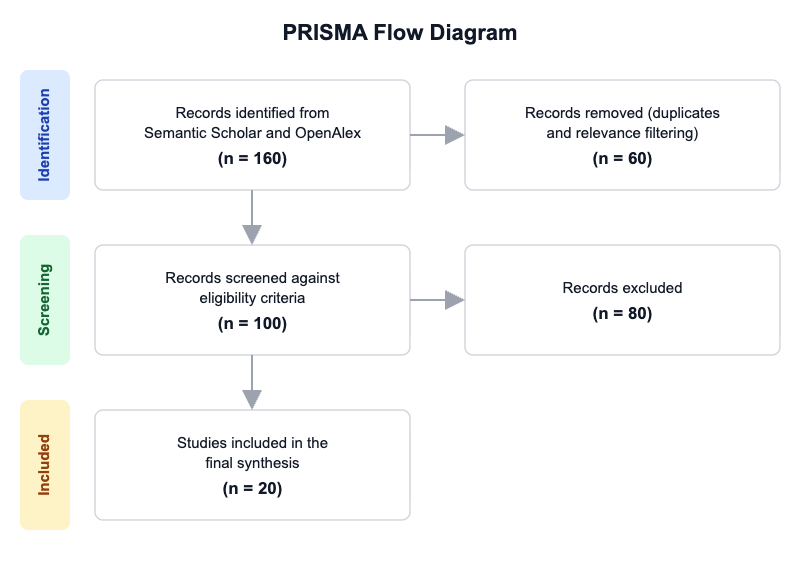
Initial database searching identified 160 records. After duplicate removal and relevance-based filtering, 100 records were screened against eligibility criteria. Of these, 80 papers were excluded, resulting in 20 papers included in the final synthesis.
PRISMA Flow Diagram
Eligibility criteria included:
- Fibromyalgia: Does the study focus on fibromyalgia patients, fibromyalgia-related symptoms, diagnosis, biomarkers, or interventions specifically for fibromyalgia?
- Human Study: Does the study involve human participants or human data rather than only animal, cell, or simulation models?
- Recent Evidence: Is the study published in 2020 or later?
- Study Type: Is the paper an empirical study, systematic review, or meta-analysis relevant to fibromyalgia rather than an unrelated commentary or editorial?
- Clinical Relevance: Does the study address symptoms, diagnosis, treatment, function, quality of life, or biomarkers in fibromyalgia?
- Novelty: Does the study evaluate a new intervention, updated review, novel biomarker, or recent diagnostic/assessment approach for fibromyalgia?
- Outcome Clarity: Does the abstract report at least one fibromyalgia-relevant outcome or conclusion?
All included studies met the stated eligibility criteria.
2.3 Data Extraction and Synthesis
Data extraction focused on study focus, population, design, intervention or exposure, outcomes, key findings, sample size, and recency/novelty. Thematic analysis was employed to identify patterns and synthesize findings across studies, and evidence strength was assessed based on consistency of findings and design quality.
3. Results
3.1 Characteristics of Included Studies
| Study and Year | Study Type | Population | Key Focus | Intervention/Exposure | Main Outcomes |
|---|---|---|---|---|---|
| Bair and Krebs 2020 [1] | Review | Patients with fibromyalgia | Clinical features, diagnosis, treatment | Multiple treatment options | Pain, fatigue, sleep, cognitive and somatic symptoms |
| Maffei 2020 [2] | Systematic review | Patients with fibromyalgia and associated conditions | Diagnosis, classification, pharmacotherapy, alternative remedies | Pharmacological, behavioral, educational, exercise, plant bioactive molecules | Diagnostic criteria, treatment efficacy |
| Salaffi et al. 2020 [3] | Cross-sectional study | 405 fibromyalgia; 327 other chronic pain problems | Diagnostic criteria comparison | ACR 2011, ACR 2016, AAPT, FAS 2019 modCr | Sensitivity, specificity, correct classification |
| Sarzi-Puttini et al. 2020 [4] | Review | Individuals with fibromyalgia | Clinical characteristics, aetiopathogenesis, treatment | Multi-modal treatment approach | Pain, fatigue, sleep, functional symptoms |
| Siracusa et al. 2021 [5] | Review | Individuals with fibromyalgia | Pathogenesis, mechanisms, diagnosis, treatment | Conventional and complementary medicine | Symptom relief, quality of life |
| Filipović et al. 2025 [6] | Review | Patients with fibromyalgia | Understanding, diagnosis, modern treatment | Pharmacological and nonpharmacological treatments | Quality of life, symptom recognition |
| Mascarenhas et al. 2020 [7] | Systematic review and meta-analysis | Patients with fibromyalgia | Therapy effectiveness | Various therapies | Pain reduction, quality of life |
| Jurado-Priego et al. 2024 [8] | Review | Predominantly women, age 30-35 | Pathophysiology, multidisciplinary treatment | Exercise, physiotherapy, electrotherapy, transcranial therapy, manual therapy | Pain, fatigue, sleep, quality of life |
| Giorgi et al. 2023 [9] | Review | Adults with fibromyalgia | Diagnosis, risk factors, comorbidities, treatments | Medications, neurostimulation, mind-body, nutrition | Pain relief, quality of life |
| Estévez-López et al. 2020 [10] | Systematic review and meta-analysis | Individuals with fibromyalgia | Exercise and fatigue/sleep | Exercise, meditative exercise programs | Fatigue, sleep quality |
| Cuenca-Martínez et al. 2023 [11] | Umbrella and mapping review with meta-analysis | Patients with fibromyalgia syndrome | Exercise-based interventions and sleep | Exercise-based interventions | Sleep quality |
| Berwick et al. 2022 [12] | Guideline publication | Broad fibromyalgia population | Diagnosis | Royal College of Physicians guidance | Diagnostic accuracy, symptom complexity |
| D’Onghia et al. 2021 [13] | Systematic review and meta-analysis | Patients with fibromyalgia | Fibromyalgia and obesity | Weight management relevance | FM-related symptoms |
| Li et al. 2025 [14] | Guideline | Adults with fibromyalgia | Nonpharmacological treatment | Acupuncture, education, exercise, TMS, supplements | Pain, fatigue, sleep, mood, quality of life |
| Alciati et al. 2021 [15] | Systematic review | Individuals with fibromyalgia | Recent aetiopathogenesis, diagnosis, clinical aspects, treatment | Pharmacological and nonpharmacological therapies | Pain, fatigue, functional symptoms |
| Migliorini et al. 2023 [16] | Systematic review and meta-analysis | Individuals with fibromyalgia | Duloxetine | Duloxetine | Symptom improvement |
| Giorgi et al. 2024 [17] | Practice-based review | Adults with fibromyalgia syndrome | Pharmacological treatment | Antidepressants, anticonvulsants, myorelaxants, analgesics | Pain, symptom coverage, side effects |
| Dizner-Golab et al. 2023 [18] | Review | Patients with fibromyalgia | Etiology, diagnosis, perioperative management | Multimodal analgesia, tailored perioperative care | Postoperative pain chronification, complications |
| Cheng et al. 2023 [19] | Systematic review and meta-analysis | Patients with fibromyalgia | Electrical neuromodulation | Electrical neuromodulation | Pain relief, treatment effectiveness |
| Rodríguez-Mansilla et al. 2021 [20] | Randomized, single-blind, controlled trial | 141 women with fibromyalgia | Non-pharmacological exercise interventions | Active exercise, Qi Gong, control | Pain, balance, flexibility, quality of life |
Overall, the evidence base is dominated by reviews and synthesis papers, supplemented by a smaller number of primary studies and updated practice guidance. The population focus is overwhelmingly adult fibromyalgia cohorts, with one trial restricted to women and one review emphasizing a younger female demographic, while diagnostic papers include broader chronic pain comparators or clinician-facing guidance.
3.2 Thematic Findings
3.2.1 Diagnostic modernization favors clinical criteria over exclusionary approaches, but biomarker confirmation remains absent
Recent evidence converges on the view that fibromyalgia diagnosis is improving but still rests on clinical assessment rather than objective laboratory confirmation. Comparative data showed substantial agreement among ACR 2011, ACR 2016, and AAPT criteria, with sensitivities of 79.8%, 78.0%, and 73.8%, specificities of 91.7%, 90.5%, and 91.7%, and correct classification of 85.1%, 83.6%, and 81.8%, respectively [3]. A modified Fibromyalgia Assessment Status threshold performed comparably and slightly better on discrimination, with 84.2% sensitivity, 89.0% specificity, and a positive likelihood ratio of 7.65 [3]. Guideline-oriented sources reinforce that diagnosis remains challenging because no confirmatory laboratory test exists and symptom fluctuation can delay recognition by years [12], [18]. The newer reviews also emphasize evolving use of scales, questionnaires, and physical measures such as walking tests, hand-grip force, and autonomic testing, but these remain adjunctive rather than definitive [9]. Confidence: Moderate.
3.2.2 Fibromyalgia is increasingly framed as a heterogeneous, mechanism-linked syndrome rather than a single pain disorder
Across recent syntheses, fibromyalgia is presented as a multifactorial condition shaped by central sensitization, peripheral sensitization, inflammatory and immune mechanisms, endocrine influences, genetic predisposition, psychosocial stressors, and sleep disturbance [5], [8], [4]. This mechanistic framing is consistent with the observation that symptom profiles vary widely, making a universal treatment unlikely [6], [17]. The latest reviews also incorporate emerging hypotheses involving gut dysbiosis and neuroinflammation, and they note that biomarker development has extended to genetic, epigenetic, and serological candidates, although no validated marker has yet emerged [9], [5]. Confidence: Moderate.
3.2.3 Exercise-based interventions show the most consistent nonpharmacologic benefit, especially for fatigue, sleep, pain, and function
Nonpharmacological evidence most consistently favors exercise, but the effect depends on exercise type and outcome domain. For fatigue, exercise was moderately effective in lowering symptoms, while its effect on sleep quality was small in one meta-analysis [10]. A later umbrella review found a statistically significant improvement in sleep quality with exercise-based interventions, with SMD -0.46 (95% CI -0.69 to -0.23), and stronger effects for body-mind exercise (SMD -0.55, 95% CI -0.86 to -0.23) and combined exercise (SMD -1.11, 95% CI -2.12 to -0.11), but not for aerobic exercise (SMD -0.04, 95% CI -0.15 to 0.07) or strength exercise in isolation (SMD -0.52, 95% CI -1.14 to 0.1) [11]. Trial-level evidence aligns with this pattern: both active exercise and Qi Gong improved pain, balance, flexibility, and quality of life compared with control, with the active exercise group achieving better results than exercise for well-being [20]. Reviews of multidisciplinary care similarly highlight physical exercise, land and water-based activity, electrotherapy, transcranial therapy, and manual therapy as useful components of broader management [8], [14]. Confidence: Strong.
3.2.4 Pharmacologic therapy remains useful, but benefits are domain-specific and often incomplete
The pharmacologic literature supports symptomatic benefit from selected agents while simultaneously showing that no medication reliably addresses the full syndrome. Duloxetine was more effective than placebo in symptom management, and dose customization was recommended [16]. Broader practice-based and systematic reviews found that commonly used drug classes include tricyclic antidepressants, serotonin and noradrenaline reuptake inhibitors, other antidepressants, anticonvulsants, myorelaxants, and analgesics, yet their effectiveness varies and many primarily improve only some symptom domains or have limited impact on pain [17], [7]. Reviews of recent literature also note promise for antioxidants, kinin antagonists, ketamine, vitamin D, and hormone therapy, but these are still framed as needing further optimization or replication [9], [2]. Confidence: Moderate.
3.2.5 Multimodal and patient-centered care is the dominant clinical consensus
Across reviews and guidelines, the clearest practice-level message is that fibromyalgia management should combine education, pharmacological treatment, and nonpharmacological strategies rather than rely on a single modality. Recent guideline evidence supports acupuncture and health education as core therapies, with aerobic exercise and resistance training also recommended, while TMS and nutritional supplements remain promising but lower-certainty options [14]. Reviews similarly emphasize individualized, multidisciplinary, patient-centered plans and note that people with different comorbidity patterns may require different therapeutic mixes [6], [4]. In perioperative settings, tailored multimodal analgesia is recommended to reduce postoperative pain chronification and complications [18]. Confidence: Strong.
3.2.6 Obesity and other comorbidity contexts appear to shape symptom burden and management priorities
Evidence indicates a potential interplay between obesity and fibromyalgia-related symptoms, supporting weight management as a therapeutic adjunct [13]. More recent reviews also stress risk-factor assessment and comorbidities, including the juvenile form of fibromyalgia and clinical subgrouping based on depression or other features [9], [17]. This literature does not establish causality for obesity as an etiologic driver, but it consistently suggests that comorbidity burden influences symptom severity and may modify response to treatment. Confidence: Limited to Moderate.
3.3 Summary of Evidence
| Theme | Key Finding | Population Applicability | Effect Direction | Confidence Level | Supporting Studies |
|---|---|---|---|---|---|
| Diagnostic modernization | ACR 2011 sensitivity 79.8%, specificity 91.7%; ACR 2016 sensitivity 78.0%, specificity 90.5%; AAPT sensitivity 73.8%, specificity 91.7%; FAS 2019 modCr sensitivity 84.2%, specificity 89.0%, positive likelihood ratio 7.65 | Adults with fibromyalgia and chronic widespread pain; broadly applicable to clinical diagnostic settings | Positive | Moderate | Salaffi et al. [3], Berwick et al. [12] |
| Mechanistic heterogeneity | Central sensitization, peripheral sensitization, inflammatory/immune, endocrine, genetic, psychosocial, and sleep-related mechanisms recur across reviews; biomarkers remain unvalidated | Patients with fibromyalgia; mechanistic framing applicable broadly | Mixed | Moderate | Siracusa et al. [5], Jurado-Priego et al. [8], Sarzi-Puttini et al. [4] |
| Exercise for sleep and fatigue | Exercise improved sleep quality with SMD -0.46 (95% CI -0.69 to -0.23); body-mind exercise SMD -0.55 (95% CI -0.86 to -0.23); combined exercise SMD -1.11 (95% CI -2.12 to -0.11) | Adults with fibromyalgia; one trial focused on women | Positive | Strong | Cuenca-Martínez et al. [11], Estévez-López et al. [10], Rodríguez-Mansilla et al. [20] |
| Pharmacologic symptom relief | Duloxetine was more effective than placebo; broader drug classes variably improve only some symptom domains | Adults with fibromyalgia | Positive | Moderate | Migliorini et al. [16], Giorgi et al. [17], Mascarenhas et al. [7] |
| Multimodal care | Acupuncture and health education were strongly recommended; aerobic exercise and resistance training also recommended; TMS and supplements remain low-certainty | Adults with fibromyalgia | Positive | Strong | Li et al. [14], Filipović et al. [6], Dizner-Golab et al. [18] |
| Obesity/comorbidity | Weight management should be encouraged because obesity may interact with FM-related symptoms | Fibromyalgia patients with obesity; partially matched population | Positive | Limited | D’Onghia et al. [13] |
4. Discussion
4.1 Principal Findings and Their Interpretation
The most defensible conclusion from the recent literature is that fibromyalgia is increasingly manageable, but only when treatment is aligned with symptom heterogeneity rather than pursued as a single-disease, single-therapy problem. The strongest pattern is the consistent value of exercise-based and multidisciplinary strategies, especially for sleep, fatigue, pain, and function [11], [20], [14]. This likely reflects the syndrome’s broad neurophysiological and psychosocial basis: if central sensitization, sleep disruption, and reduced physical conditioning all contribute to symptoms, then interventions that improve movement, autonomic regulation, and coping may yield broader benefit than narrow symptom suppression [5], [8]. The same logic explains why body-mind and combined exercise outperformed isolated aerobic or strength modalities for sleep: these programs may simultaneously target arousal regulation, pain coping, and physical reconditioning.
Diagnostic evidence suggests a second major advance: fibromyalgia is better recognized through clinical criteria than through exclusionary workups, but the absence of biomarkers still limits objective confirmation [3], [12]. The field therefore appears to be moving toward pragmatic diagnosis based on symptom patterning, supported by structured questionnaires and functional measures. This is an important conceptual shift because it reframes fibromyalgia as a validated clinical syndrome rather than a residual diagnosis.
Pharmacologic findings are more modest and more domain-specific. Duloxetine and other agents can help, but reviews consistently indicate that no medication addresses the syndrome comprehensively [16], [17], [7]. That limitation is not necessarily evidence of therapeutic failure; rather, it reflects the biological and clinical heterogeneity of fibromyalgia. The confidence hierarchy is therefore clear: the most robust evidence supports multimodal care and exercise, moderate evidence supports selected drugs and improved diagnosis, and only tentative evidence supports emerging biomarkers, neuromodulation, or nutritional adjuncts.
4.2 Comparison with Existing Literature and Resolution of Contradictions
The current synthesis is broadly consistent with earlier clinical narratives that described fibromyalgia as a complex pain condition requiring individualized management, but the newer literature is more explicit about which interventions have the best evidence and which exercise subtypes are most promising [4], [14]. That consistency strengthens confidence that the observed benefit of multimodal care is not a transient finding or an artifact of any single trial design. It also aligns with the mechanistic literature: if symptom generation is distributed across central, peripheral, inflammatory, and psychosocial pathways, then diverse interventions should outperform monotherapies.
The main contradiction lies in exercise research. Early meta-analytic work suggested moderate benefit for fatigue and only small benefit for sleep [10], whereas later synthesis found a clearer sleep effect overall, with the strongest gains in body-mind and combined exercise and no significant benefit for aerobic exercise in isolation [11]. This difference is plausibly explained by outcome selection and intervention composition rather than by a true reversal of effect. Sleep is likely more responsive to mind-body and integrated programs because these approaches may reduce arousal and improve perceived control, while aerobic-only programs may be too nonspecific to change sleep architecture meaningfully. Heterogeneity in program duration, intensity, and comparator conditions likely also matters, as does the heavy reliance on subjective outcomes in fibromyalgia research.
Another tension concerns pharmacotherapy: some drug-specific evidence is positive, yet broader syntheses describe limited clinical importance and incomplete symptom coverage [16], [7]. This is not a contradiction so much as a scale issue. A single agent can outperform placebo while still failing to deliver meaningful syndrome-wide control. Publication bias remains possible because treatment studies are more likely to be published when they show improvement, especially for popular agents or nonpharmacological approaches. The more recent guideline-style evidence, by emphasizing moderate- and low-certainty recommendations, appropriately tempers enthusiasm and helps offset that bias [14].
4.3 Practical Implications
For clinicians, the evidence supports early recognition, symptom profiling, and individualized combination therapy rather than sequential trials of isolated interventions. Patients with prominent fatigue or sleep disturbance are especially likely to benefit from exercise programs that incorporate body-mind elements or combined modalities, while those with greater pain burden may require concomitant pharmacologic therapy such as duloxetine or other symptom-targeted agents [11], [16]. Women are overrepresented in the available intervention evidence, and one randomized trial specifically studied women with a mean age of 52.24 ± 6.19 years, so sex-specific responsiveness remains clinically relevant but incompletely resolved [20]. For public health, the consistent value of patient education and exercise supports scalable nonpharmacologic programs that can be embedded in primary care and rehabilitation settings [14]. For regulators and guideline developers, the absence of a biomarker and the mixed medication evidence argue against any single-disease, drug-centered model of care; instead, coverage and pathways should support access to multidisciplinary rehabilitation, education, and exercise services. The obesity literature further suggests that weight management may be a useful adjunct for patients with excess adiposity, although the evidence is not sufficient to treat obesity as a primary causal explanation [13].
4.4 Strengths and Limitations
This review has several strengths, including a recent evidence window, inclusion of both trial-level evidence and higher-order syntheses, and integration of diagnostic, mechanistic, and therapeutic literature. The included studies also span diverse clinical questions, allowing pattern-level synthesis rather than a narrow intervention summary.
The included literature is nevertheless limited by heavy reliance on reviews, variable outcome measurement, frequent lack of sample detail in abstracts, and limited direct mechanistic validation. Several sources are guideline or narrative reviews rather than primary studies, which is appropriate for landscape mapping but constrains causal inference. This review is also limited by abstract-based extraction and the absence of a formal risk-of-bias appraisal, so certainty estimates should be interpreted cautiously. Finally, much of the intervention evidence comes from adult clinical samples, with one important trial restricted to women, limiting generalizability to men, younger patients, and more diverse health-system contexts.
5. Gaps and Future Directions
The most important gap is the lack of validated biomarkers that can support diagnosis, phenotyping, or treatment selection. Future work should test candidate genetic, epigenetic, serological, and autonomic markers in prospective cohorts alongside standardized symptom measures, because current diagnostic progress is still largely clinical [5], [9]. A second gap is the absence of head-to-head trials that compare specific exercise formats, especially body-mind and combined programs versus aerobic-only or strength-only regimens, using harmonized sleep and fatigue outcomes. The existing evidence suggests differential benefit, but the underlying reasons remain unclear.
Research should also include more men, younger patients, and non-specialist community samples, since the current literature skews toward adult specialty populations and one exercise trial focused only on women [20]. Comparative effectiveness studies should evaluate how comorbidity profiles, including obesity and depression, modify response to pharmacologic and nonpharmacological therapies [13], [17]. Finally, future guidelines would benefit from longer follow-up and standardized reporting of clinically meaningful change, because many current benefits appear short-term and domain-specific rather than syndrome-transforming.
6. Conclusion
The latest research indicates that fibromyalgia is best understood and managed as a heterogeneous, clinically diagnosed syndrome in which multimodal treatment outperforms any single intervention. Diagnostic criteria now show substantial agreement, with ACR 2011 sensitivity of 79.8% and specificity of 91.7%, ACR 2016 sensitivity of 78.0% and specificity of 90.5%, AAPT sensitivity of 73.8% and specificity of 91.7%, and a modified Fibromyalgia Assessment Status threshold achieving 84.2% sensitivity and 89.0% specificity [3]. Therapeutically, the most reliable benefit comes from exercise and broader multidisciplinary care: sleep quality improved with SMD -0.46 (95% CI -0.69 to -0.23), with stronger effects for body-mind exercise and combined exercise, while duloxetine outperformed placebo and other medications may help selected symptom domains [11], [16]. These findings are most applicable to adult clinical fibromyalgia populations, though some evidence is drawn from women-only samples or proxy chronic pain cohorts, and this limits generalization [20], [3]. The key unresolved question is how to match specific symptom phenotypes to the most effective combination of exercise, pharmacologic, and supportive therapies. Addressing that gap matters because fibromyalgia remains a major source of long-term disability, and more precise treatment selection could improve quality of life while reducing unnecessary medication burden and delayed diagnosis [6], [14].
References
- Bair, M. J., & Krebs, E. E. (2020). Fibromyalgia. Annals of Internal Medicine, 172(5), ITC33–ITC48. https://doi.org/10.7326/AITC202003030
- Maffei, M. E. (2020). Fibromyalgia: Recent advances in diagnosis, classification, pharmacotherapy and alternative remedies. International Journal of Molecular Sciences, 21(21), 7877. https://doi.org/10.3390/ijms21217877
- Salaffi, F., Di Carlo, M., Farah, S., Atzeni, F., Buskila, D., Ablin, J. N., Häuser, W., & Sarzi-Puttini, P. (2020). Diagnosis of fibromyalgia: Comparison of the 2011/2016 ACR and AAPT criteria and validation of the modified Fibromyalgia Assessment Status. Rheumatology, 59(10), 3042–3049. https://doi.org/10.1093/rheumatology/keaa061
- Sarzi-Puttini, P., Giorgi, V., Marotto, D., & Atzeni, F. (2020). Fibromyalgia: An update on clinical characteristics, aetiopathogenesis and treatment. Nature Reviews Rheumatology, 16(11), 645–660. https://doi.org/10.1038/s41584-020-00506-w
- Siracusa, R., Di Paola, R., Cuzzocrea, S., & Impellizzeri, D. (2021). Fibromyalgia: Pathogenesis, mechanisms, diagnosis and treatment options update. International Journal of Molecular Sciences, 22(8), 3891. https://doi.org/10.3390/ijms22083891
- Filipovic, T., Filipović, A., Nikolic, D., Gimigliano, F., Stevanov, J., Hrkovic, M., & Bosanac, I. (2025). Fibromyalgia: Understanding, diagnosis and modern approaches to treatment. Journal of Clinical Medicine, 14(3), 955. https://doi.org/10.3390/jcm14030955
- Mascarenhas, R. O., Souza, M. B., Oliveira, M. X., Lacerda, A. C., Mendonça, V. A., Henschke, N., & Oliveira, V. C. (2020). Association of therapies with reduced pain and improved quality of life in patients with fibromyalgia: A systematic review and meta-analysis. JAMA Internal Medicine, 181(1), 104–112. https://doi.org/10.1001/jamainternmed.2020.5651
- Jurado-Priego, L. N., Cueto-Ureña, C., Ramírez-Expósito, M. J., & Martínez-Martos, J. M. (2024). Fibromyalgia: A review of the pathophysiological mechanisms and multidisciplinary treatment strategies. Biomedicines, 12(7), 1543. https://doi.org/10.3390/biomedicines12071543
- Giorgi, V., Bazzichi, L., Batticciotto, A., Pellegrino, G., Di Franco, M., Sirotti, S., Atzeni, F., Alciati, A., Salaffi, F., & Sarzi-Puttini, P. (2023). Fibromyalgia: One year in review 2023. Clinical and Experimental Rheumatology, 41(6), 1205–1213. https://doi.org/10.55563/clinexprheumatol/257e99
- Estévez-López, F., Maestre-Cascales, C., Russell, D., Álvarez-Gallardo, I. C., Rodriguez-Ayllon, M., Hughes, C. M., Davison, G. W., Sañudo, B., & McVeigh, J. G. (2020). Effectiveness of exercise on fatigue and sleep quality in fibromyalgia: A systematic review and meta-analysis of randomized trials. Archives of Physical Medicine and Rehabilitation, 102(4), 752–761. https://doi.org/10.1016/j.apmr.2020.06.019
- Cuenca-Martínez, F., Suso-Martí, L., Fernández-Carnero, J., Muñoz-Alarcos, V., & Sempere-Rubio, N. (2023). Exercise-based interventions on sleep quality in patients with fibromyalgia syndrome: An umbrella and mapping review with meta-analysis. Seminars in Arthritis and Rheumatism, 61, 152216. https://doi.org/10.1016/j.semarthrit.2023.152216
- Berwick, R., Barker, C., Goebel, A., & Guideline Development Group. (2022). The diagnosis of fibromyalgia syndrome. Clinical Medicine, 22(6), 570–574. https://doi.org/10.7861/clinmed.2022-0402
- D'Onghia, M., Ciaffi, J., Lisi, L., Mancarella, L., Ricci, S., Stefanelli, N., Meliconi, R., & Ursini, F. (2021). Fibromyalgia and obesity: A comprehensive systematic review and meta-analysis. Seminars in Arthritis and Rheumatism, 51(2), 409–424. https://doi.org/10.1016/j.semarthrit.2021.02.007
- Li, X., Pan, H., Wang, L., Zhou, Q., Ma, Y., Wang, Q., Wang, M., Xie, Z., Li, H., Chen, L., Huang, L., Chen, Y., & Wen, C. (2025). Guidelines on treating fibromyalgia with nonpharmacological therapies in China. Journal of Evidence-Based Medicine, 18(2), e70044. https://doi.org/10.1111/jebm.70044
- Alciati, A., Nucera, V., Masala, I. F., Giallanza, M., La Corte, L., Giorgi, V., Sarzi-Puttini, P., & Atzeni, F. (2021). One year in review 2021: Fibromyalgia. Clinical and Experimental Rheumatology, 39(3), 3–12. https://doi.org/10.55563/clinexprheumatol/gz4i3i
- Migliorini, F., Maffulli, N., Eschweiler, J., Baroncini, A., Bell, A., & Colarossi, G. (2023). Duloxetine for fibromyalgia syndrome: A systematic review and meta-analysis. Journal of Orthopaedic Surgery and Research, 18(1), 504. https://doi.org/10.1186/s13018-023-03995-z
- Giorgi, V., Sarzi-Puttini, P., Pellegrino, G., Sirotti, S., Atzeni, F., Alciati, A., Torta, R., Varrassi, G., Fornasari, D., Coaccioli, S., & Bongiovanni, S. F. (2024). Pharmacological treatment of fibromyalgia syndrome: A practice-based review. Current Pain and Headache Reports, 28(12), 1349–1363. https://doi.org/10.1007/s11916-024-01277-9
- Dizner-Golab, A., Lisowska, B., & Kosson, D. (2023). Fibromyalgia – etiology, diagnosis and treatment including perioperative management in patients with fibromyalgia. Reumatologia, 61(2), 137–148. https://doi.org/10.5114/reum/163094
- Cheng, Y.-C., Hsiao, C.-Y., Su, M.-I., Chiu, C.-C., Huang, Y.-C., & Huang, W.-L. (2023). Treating fibromyalgia with electrical neuromodulation: A systematic review and meta-analysis. Clinical Neurophysiology, 148, 17–28. https://doi.org/10.1016/j.clinph.2023.01.011
- Rodríguez-Mansilla, J., Mejías-Gil, A., Garrido-Ardila, E. M., Jiménez-Palomares, M., Montanero-Fernández, J., & González-López-Arza, M. V. (2021). Effects of non-pharmacological treatment on pain, flexibility, balance and quality of life in women with fibromyalgia: A randomised clinical trial. Journal of Clinical Medicine, 10(17), 3826. https://doi.org/10.3390/jcm10173826