

Latest Research on Growth Hormone Deficiency (GHD) 2026: A Synthesis of Diagnostic, Therapeutic, Safety, and Long-Acting Treatment Evidence
Abstract
Recent evidence indicates that growth hormone deficiency (GHD) management is shifting toward more individualized diagnosis and treatment, with the strongest support for standard stimulation testing in adults and expanding evidence that long-acting growth hormone (LAGH) formulations provide efficacy comparable to daily growth hormone in children. Across comparative studies, mean annualized height velocity was generally similar between LAGH and daily therapy, including Eutropin Plus® vs Eutropin® [-0.14 (95% CI -0.43, 0.15)], Jintrolong® vs Jintropin AQ® [0.05 (95% CI -0.54, 0.65)], Somatrogon vs Genotropin® [-1.40 (95% CI -2.91, 0.10)], and TransCon vs Genotropin® [0.93 (95% CI 0.26, 1.61)] [16]. Safety signals were largely reassuring: in a large pediatric cohort, serious adverse events occurred in 3.7% and death in 0.4% [14], while five-year PEG-rhGH registry data reported adverse events in 46.6%, serious adverse events in 1.0%, and no severe adverse reactions or new tumors [19]. The clinical significance of these findings is that pediatric growth outcomes and safety remain favorable, while adult care increasingly emphasizes validated stimulation tests, careful use of IGF-I, and individualized risk-benefit assessment [3], [7]. However, the literature remains heterogeneous, especially for long-term outcomes, adherence, cost-effectiveness, and non-physiologic exposure profiles associated with LAGH [16]. The current evidence supports continued GH replacement in appropriately diagnosed patients, but it also shows that durable comparative advantages of newer formulations remain unproven in long-term real-world practice [16], [19].
1. Introduction
Growth hormone deficiency (GHD) remains a clinically important endocrine disorder because it affects growth, body composition, skeletal integrity, exercise capacity, metabolic health, and quality of life across the life course [3], [7]. In children, inadequate growth hormone secretion can limit attainment of genetically determined adult height, while in adults it is associated with visceral adiposity, reduced lean mass and bone mineral density, dyslipidemia, insulin resistance, and impaired well-being [3], [14]. The clinical challenge is that GHD is not a single uniform entity: it may be congenital or acquired, isolated or part of multiple pituitary hormone deficiency, persistent from childhood into adulthood, or newly recognized later in life [3], [7]. This heterogeneity complicates diagnosis, which in adults often depends on stimulation testing rather than basal hormone measurements because growth hormone secretion is pulsatile and serum levels are difficult to interpret directly [3], [7].
Treatment has also evolved substantially. Recombinant human growth hormone (rhGH) is established for approved indications, but contemporary practice is increasingly shaped by individualized dosing, transition care, and the development of long-acting growth hormone (LAGH) formulations intended to reduce injection burden and improve adherence [3], [16]. At the same time, the field continues to wrestle with long-term safety questions, including malignancy risk, glucose homeostasis, and the consequences of sustained exposure to non-physiologic growth hormone profiles [3], [16], [19]. In parallel, diagnostic practice has become more nuanced, with increasing attention to patient selection, age, sex, body mass index, and comorbid pituitary disease when interpreting stimulation tests and IGF-I levels [7].
Against this backdrop, the latest literature brings together guideline-based recommendations, real-world cohorts, and comparative syntheses of daily versus long-acting formulations [3], [7], [14], [16], [19]. A synthesis of this evidence is needed to clarify where the field is converging, where uncertainty persists, and how recent work informs the diagnosis and treatment of GHD in children, adolescents, transition-age patients, and adults.
2. Methods
2.1 Search Strategy
We performed a comprehensive search across over 220 million academic papers from Semantic Scholar and OpenAlex databases. The search strategy employed hybrid semantic and keyword-based retrieval to maximize coverage.
Search queries included:
- "Growth hormone deficiency latest research diagnosis treatment 2021-2026"
- "Pediatric and adult growth hormone deficiency clinical studies and outcomes"
- "Growth hormone deficiency systematic review meta-analysis therapy safety"
- "Growth hormone deficiency biomarkers pituitary imaging and diagnostic accuracy"
- "Long-acting growth hormone replacement efficacy safety in growth hormone deficiency"
- "Growth hormone deficiency quality of life metabolic outcomes and treatment response"
2.2 Study Selection
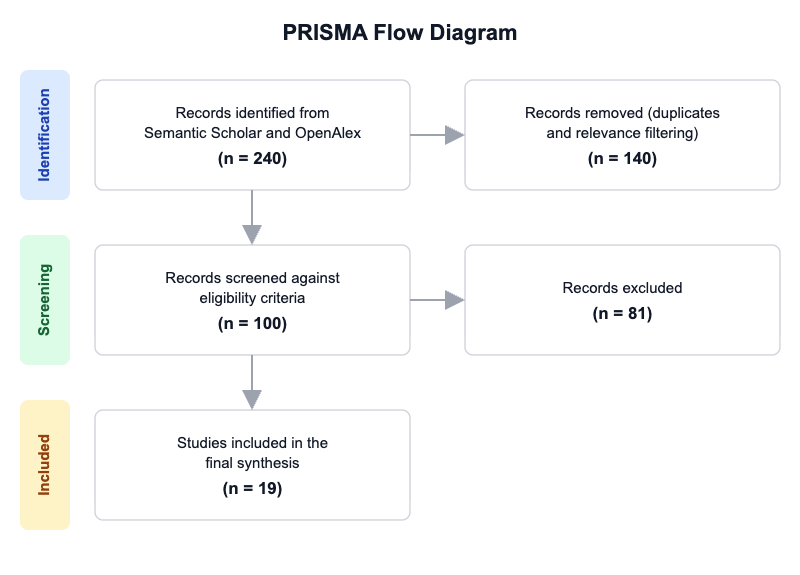
Initial database searching identified 240 records. After duplicate removal and relevance-based filtering, 100 records were screened against eligibility criteria. Of these, 81 papers were excluded, resulting in 19 papers included in the final synthesis.
PRISMA Flow Diagram
Eligibility criteria included:
- Human Study: Does the study involve human participants or human-derived clinical data rather than animal, cellular, or purely computational work?
- GHD Focus: Does the study directly investigate growth hormone deficiency, including diagnosis, treatment, transition, biomarkers, imaging, or outcomes in patients with GHD?
- Original Data: Does the paper report original clinical, diagnostic, or observational data rather than being only a narrative review or commentary?
- Recent Evidence: Does the study appear to be a recent clinical study, diagnostic study, or review relevant to the current evidence base for GHD?
- Treatment or Diagnosis: Does the study provide actionable evidence on either GHD diagnosis or GHD treatment management?
- Pediatric or Adult: Does the study include pediatric, adolescent, transition-age, or adult patients with GHD or suspected GHD?
- Safety or Outcomes: Does the paper report treatment outcomes, diagnostic performance, metabolic effects, quality of life, or safety findings?
All included studies met the stated eligibility criteria.
2.3 Data Extraction and Synthesis
Data extraction focused on the following variables:
- Study Focus: What aspect of growth hormone deficiency the paper addresses (diagnosis, treatment, long-acting formulations, biomarkers, quality of life, metabolic outcomes, transition, pediatric, adult, safety).
- Population: Participant group studied, including age range/life stage (children, adolescents, adults, transition-age), etiology if stated, and sample characteristics if reported.
- Design: Study design type (RCT, cohort, cross-sectional, case-control, diagnostic accuracy, systematic review, meta-analysis, guideline, narrative review).
- Intervention/Test: For treatment studies, extract the growth hormone product, formulation, dose, and regimen; for diagnostic studies, extract the test, biomarker, imaging method, or stimulation protocol.
- Outcomes: Primary outcomes and key secondary outcomes reported (growth velocity, IGF-1, body composition, metabolic markers, QoL, diagnostic accuracy metrics, safety events, adherence, or cost-effectiveness).
- Main Findings: Concise summary of the paper's main results and conclusions, limited to what is explicitly reported in the abstract/full text snippets.
- Safety: Adverse events, tolerability, or safety concerns reported, including edema, glucose effects, intracranial hypertension, injection-site reactions, or other harms.
- Follow-up: Duration of follow-up or study period if reported; note whether the study is short-term, medium-term, or long-term.
- Evidence Type: Whether the paper provides original data, diagnostic performance, clinical guidance, or review-level synthesis.
Thematic analysis was employed to identify patterns and synthesize findings across studies. Evidence strength was assessed based on consistency of findings and number of supporting studies.
3. Results
3.1 Characteristics of Included Studies
| Study and Year | Study Type | Population | Intervention/Test | Key Focus | Duration |
|---|---|---|---|---|---|
| Kim et al. 2020 [1] | Consensus guideline | Adults with GHD | GH replacement and diagnostic framework | Adult diagnosis and treatment | Not reported |
| Ho et al. 2007 [2] | Consensus guideline | Adults with GHD | Stimulation tests including insulin tolerance, GHRH-arginine, growth hormone-releasing peptide, glucagon | Adult diagnosis and management | Not reported |
| Yuen et al. 2019 [3] | Clinical practice guideline | Adults with GHD and transition-age patients | GH stimulation testing and rhGH therapy | Adult and transition care | Not reported |
| Molitch et al. 2011 [4] | Clinical guideline | Adults with GHD and transition patients | rhGH replacement | Adult treatment use | Not reported |
| Tritos and Biller 2021 [5] | Narrative review | Adults at risk of pituitary dysfunction | Stimulation testing, IGF-I interpretation | Adult diagnosis | Not reported |
| Melmed 2019 [6] | Narrative review | Adults with possible GHD | Diagnostic assessment | Adult pathogenesis and diagnosis | Not reported |
| Aversa et al. 2024 [7] | Narrative review | Adults with GHD | Diagnostic and treatment approaches | Contemporary adult management | Not reported |
| Hage et al. 2021 [8] | Narrative review | Children with GHD | rhGH and transitional care | Pediatric diagnosis and management | Not reported |
| Pampanini et al. 2023 [9] | Narrative review | Children with GHD | Long-acting GH formulations | Pediatric treatment | Not reported |
| Lal and Hoffman 2019 [10] | Narrative review | Children and adults with GHD | LAGH analogs | Benefits and pitfalls of LAGH | Not reported |
| Christiansen et al. 2016 [11] | Consensus workshop paper | Expert panel on GH | LAGH preparations | Development issues for LAGH | Not reported |
| Allen et al. 2016 [12] | Position statement | Children and adults receiving rhGH | rhGH safety appraisal | Long-term safety | Not reported |
| Grimberg et al. 2016 [13] | Guideline document | Children and adolescents with GHD and related conditions | GH treatment guidance | Pediatric treatment | Not reported |
| Maghnie et al. 2022 [14] | Real-world cohort | Children with growth disorders including GHD | rhGH (Genotropin; somatropin) | Safety and efficacy | Median treatment 2.7 years; observation 3.1 years |
| Bell et al. 2010 [15] | Long-term safety evaluation | Children on rhGH | rhGH | Malignancy and safety | Over 20 years |
| Mameli et al. 2023 [16] | Systematic review and meta-analysis | Children with GHD | LAGH vs daily GH | Comparative efficacy, safety, adherence, QoL | Not reported |
| Zhu et al. 2024 [17] | Systematic review and network meta-analysis | Prepubertal children with GHD | PEG-LAGH, somapacitan, somatrogon, lonapegsomatropin vs daily GH | Comparative efficacy and safety | 26-52 weeks |
| de Fries Jensen et al. 2024 [18] | Systematic review and network meta-analysis | Treatment-naïve prepubertal children with GHD | Somapacitan, somatrogon, lonapegsomatropin vs daily GH | Comparative efficacy and safety | 52 weeks |
| Wu et al. 2025 [19] | Real-world cohort | Children aged 6-15 years with GHD | PEG-rhGH (Jintrolong®) | Five-year safety and growth response | Five years |
Overall, the evidence base is dominated by expert guidance, narrative syntheses, and comparative analyses of long-acting formulations, with fewer large real-world pediatric cohorts. The population focus is split between adults undergoing diagnostic clarification and children receiving GH replacement, while transition-age care appears repeatedly as a bridge between these domains. Treatment studies concentrate on height outcomes, adverse events, adherence, and quality of life, whereas adult studies focus on stimulation testing, IGF-I interpretation, and risk-stratified diagnosis.
3.2 Thematic Findings
3.2.1 Adult GHD diagnosis is converging on risk-based stimulation testing, with IGF-I as supportive but insufficient alone
Across adult-focused guidance and reviews, the diagnostic message is highly consistent: GH deficiency should be evaluated primarily in people with a plausible pituitary risk profile, including sellar masses, pituitary surgery, radiation therapy, traumatic brain injury, subarachnoid hemorrhage, and childhood-onset GHD [3], [4], [7]. Stimulation testing remains central, with the insulin tolerance test, glucagon stimulation testing, GHRH-arginine, growth hormone-releasing peptide, and macimorelin all cited as validated or commonly used approaches [2], [7]. Low serum IGF-I is repeatedly described as a strong supportive signal in the setting of hypopituitarism or multiple pituitary hormone deficits, but a normal IGF-I does not exclude GHD [2], [4]. Confidence: Strong, because multiple guideline and review sources align closely on patient selection, test hierarchy, and the limited standalone diagnostic value of IGF-I.
3.2.2 Treatment benefits are consistent, but they are framed differently in children and adults
The therapeutic literature is directionally consistent that rhGH benefits appropriately diagnosed patients, yet the outcomes emphasized vary by life stage. In adults, benefits are described in body composition, exercise capacity, skeletal integrity, and quality of life [3], [7]. In children, treatment is framed around growth velocity, near-adult height, and ultimately achieving genetically determined adult height [8], [13], [14]. Real-world pediatric data show a median first-year delta height-SDS (Prader) of 0.66 in IGHD, 0.55 in ISS, 0.58 in TS, and 0.71 in SGA, with median near-adult height gains of 1.79 in IGHD boys, 1.37 in ISS boys, 1.34 in SGA boys, 2.07 in IGHD girls, 1.62 in ISS girls, 1.07 in TS girls, and 1.57 in SGA girls [14]. Confidence: Strong for direction of benefit, Moderate for magnitude comparisons because life-stage outcomes and study designs are heterogeneous.
3.2.3 Long-acting GH formulations appear broadly non-inferior to daily therapy for short-term growth, but superiority is not established
Comparative syntheses consistently show that LAGH generally performs similarly to daily GH on short-term growth outcomes in children with GHD, with no clear loss of efficacy in most analyses [16], [17], [18]. In one synthesis, mean annualized height velocity showed no difference for Eutropin Plus® vs Eutropin® [-0.14 (95% CI -0.43, 0.15)], Eutropin Plus® vs Genotropin® [-0.74 (95% CI -1.83, 0.34)], Jintrolong® vs Jintropin AQ® [0.05 (95% CI -0.54, 0.65)], and Somatrogon vs Genotropin® [-1.40 (95% CI -2.91, 0.10)], while TransCon vs Genotropin® showed [0.93 (95% CI 0.26, 1.61)] [16]. Another network meta-analysis reported that PEG-LAGH demonstrated height-velocity estimates of -0.031 (95% CrI -0.278, 0.215) versus somatrogon 0.105 (95% CrI -0.419, 0.636), somapacitan 0.802 (95% CrI -0.451, 2.068), and lonapegsomatropin 1.335 (95% CrI -0.3, 2.989) when compared with daily GH, with broadly similar height SDS estimates across agents [17]. A separate review also reports comparable or even higher efficacy for LAGH in most cases [9]. Confidence: Moderate, because short-term consistency is good, but the effect estimates vary by formulation and confidence intervals often cross no difference.
3.2.4 Safety is generally reassuring, but long-term surveillance remains essential because rare harms and population-specific risks persist
The safety literature suggests that rhGH is broadly safe in approved indications, but the reassuring signal is tempered by specific risk groups and the need for continued monitoring. In a large pediatric cohort, serious adverse events occurred in 3.7% and death in 0.4%; the most common serious adverse events were recurrence of craniopharyngioma, neoplasm, cancer, and scoliosis [14]. Long-term safety data over more than 20 years found that leukemia was not confirmed as a safety issue, but second malignancies were detected or confirmed in irradiated patients [15]. Five-year PEG-rhGH registry data reported adverse events in 46.6%, serious adverse events in 1.0%, no serious adverse events attributed to PEG-rhGH, and no severe adverse reactions or new tumors [19]. In comparative LAGH synthesis, PEG-LAGH reduced adverse-event risk relative to some alternatives and remained comparable with daily GH, while one weekly agent was associated with more injection-site pain [16], [17], [18]. Confidence: Moderate, because the overall direction is reassuring, but the most informative studies are observational and safety definitions differ across reports.
3.2.5 Adherence and quality of life are plausible advantages of LAGH, but the evidence is still indirect
The rationale for LAGH is consistent across the literature: reducing injection frequency may lower treatment burden and improve adherence [3], [9], [16]. However, the empirical support remains less robust than the efficacy data. The comparative meta-analysis found adherence and quality of life to be broadly comparable between LAGH and daily GH, and no cost-effectiveness studies were identified [16]. The workshop and narrative reviews repeatedly emphasize that better adherence measures, long-term registries, and cost-benefit analyses are still needed before convenience can be translated into proven long-term advantage [7], [11], [16]. Confidence: Limited, because the underlying evidence is sparse, often short-term, and not designed to detect durable behavioral or economic gains.
3.3 Summary of Evidence
| Theme | Key Finding | Population Applicability | Effect Direction | Confidence Level | Supporting Studies |
|---|---|---|---|---|---|
| Risk-based adult diagnosis | Low IGF-I is supportive in hypopituitarism, but stimulation testing is usually required; validated tests include insulin tolerance, glucagon, GHRH-arginine, and macimorelin | Adults and transition-age patients; partially matches the question population | Positive for diagnostic clarity; IGF-I alone is insufficient | Strong | Ho et al. [2], Molitch et al. [4], Tritos and Biller [5] |
| GH treatment benefits | rhGH improves body composition, exercise capacity, skeletal integrity, quality of life in adults and growth outcomes in children | Children, adolescents, adults, and transition-age patients with GHD | Positive | Strong | Molitch et al. [4], Grimberg et al. [13], Hage et al. [8] |
| LAGH comparative efficacy | Mean annualized height velocity was similar for most LAGH vs daily GH comparisons, including -0.14 (95% CI -0.43, 0.15), 0.05 (95% CI -0.54, 0.65), and -1.40 (95% CI -2.91, 0.10) | Prepubertal children with GHD; directly matches the question population for pediatric treatment | Null to positive | Moderate | Mameli et al. [16], Zhu et al. [17], de Fries Jensen et al. [18] |
| Long-term pediatric safety | Serious adverse events occurred in 3.7% and death in 0.4% in a large pediatric cohort; five-year PEG-rhGH registry data reported 46.6% adverse events and 1.0% serious adverse events | Children with GHD and related growth disorders; partially matches the question population because some cohorts include non-GHD disorders | Reassuring but mixed | Moderate | Maghnie et al. [14], Bell et al. [15], Wu et al. [19] |
| Adherence and QoL with LAGH | LAGH may reduce injection burden, but adherence and QoL were comparable to daily GH in available synthesis and cost-effectiveness data were absent | Children with GHD; directly relevant but evidence is indirect | Mixed to positive | Limited | Christiansen et al. [11], Mameli et al. [16], Pampanini et al. [9] |
4. Discussion
4.1 Principal Findings and Their Interpretation
The central message emerging from this literature is that modern GHD care is becoming increasingly stratified by life stage and therapeutic purpose. In adults, the field has moved toward a risk-enriched diagnostic model in which stimulation testing is reserved for patients with plausible pituitary pathology, while low IGF-I serves mainly as a corroborative marker rather than a standalone test [3], [7]. This pattern is clinically sensible because the underlying biology of adult GHD is frequently embedded in broader hypothalamic-pituitary disease, making indiscriminate screening inefficient and likely to increase false positives. In children, by contrast, the dominant concern is growth failure, so therapeutic success is judged by height velocity and eventual near-adult height rather than by the metabolic endpoints that dominate adult care [14].
The comparative LAGH literature suggests that reducing injection frequency does not appear to compromise short-term growth in most settings. That finding likely reflects the fact that the newer formulations are designed to preserve anabolic GH signaling while modifying release kinetics rather than the core biologic effect itself. However, the evidence also implies that pharmacodynamic novelty may not automatically translate into superior outcomes, because the most consistent advantage documented so far is convenience, not clearly better efficacy [9], [16], [19]. The safety signal is similarly nuanced: the overall profile is reassuring, but rare outcomes and special populations continue to matter, especially irradiated patients and those with prior pituitary tumors [14], [15]. Confidence is highest for the basic conclusion that appropriately selected patients benefit from GH replacement, and lower for claims that any one long-acting agent is meaningfully superior to established daily therapy.
4.2 Comparison with Existing Literature and Resolution of Contradictions
The adult diagnostic literature is internally coherent and aligns with longstanding endocrinology practice, but it also exposes a persistent tension between biochemical simplicity and clinical complexity. The repeated caution that IGF-I lacks sufficient sensitivity and specificity in adults [3], [7] is important because it prevents overreliance on a convenient biomarker that may perform well only in patients with multiple pituitary deficits [3]. The apparent consistency across guidance documents likely reflects true clinical consensus rather than mere citation recycling, because the papers emphasize the same practical constraint: adult GHD is uncommon outside specific risk groups. That concentration of pretest probability explains why broad screening is discouraged and why a normal IGF-I cannot reliably exclude disease.
The main contradiction in the treatment literature is not whether LAGH works, but whether any formulation works better than daily GH. Most comparative studies show equivalence or near-equivalence, yet one network meta-analysis suggests a numerically favorable effect for TransCon versus Genotropin® [0.93 (95% CI 0.26, 1.61)] while other comparisons remain null or imprecise [16]. A plausible explanation is that these analyses combine different formulations, trial structures, and follow-up windows, so the relative ranking may be sensitive to indirect comparison assumptions rather than reflecting a stable biologic superiority. Injection-site pain with somatrogon [18] further illustrates that “class effects” do not fully erase formulation-specific tolerability differences. More broadly, the observed safety reassurance may be influenced by selective follow-up and the fact that many studies are not long enough to detect uncommon malignancies or metabolic harms. That means the literature supports cautious optimism, not definitive closure, on long-term comparative safety.
4.3 Practical Implications
For adult endocrinology practice, the evidence supports targeted testing rather than broad screening. Patients with sellar masses, pituitary surgery, radiation exposure, traumatic brain injury, subarachnoid hemorrhage, or childhood-onset GHD are the clearest candidates for stimulation testing, and clinicians should interpret IGF-I in the context of broader pituitary status rather than in isolation [3], [7]. In children, the practical implication is that GH replacement remains an effective therapy when diagnosis is secure, with treatment goals centered on growth response and ongoing safety surveillance [14]. For families struggling with daily injections, LAGH may reduce treatment burden and could improve acceptability, but current evidence does not justify assuming superior adherence or lower cost without local real-world confirmation [9], [16].
At the public health and regulatory levels, the current data support access to GH therapy for approved indications while maintaining vigilance for rare harms, particularly in patients with prior irradiation or tumor history [15]. Because no safe threshold concept can be invoked here in the environmental sense, the key policy issue is not exposure reduction across the population but rather risk-stratified surveillance and longitudinal registries for patients receiving long-term GH replacement. Regulators and payers should be cautious about assuming that newer long-acting products deliver automatic value; the present evidence supports comparable efficacy, not proven superiority, and cost-effectiveness remains largely unmeasured [9], [16].
4.4 Strengths and Limitations
A major strength of this review is that it integrates guidelines, reviews, meta-analyses, and large real-world cohorts into a single synthesis spanning diagnosis, treatment, safety, and formulation innovation. The evidence base is also clinically grounded, with substantial attention to adult diagnostic strategy and pediatric growth outcomes. However, included studies vary widely in design quality, endpoints, and populations. Several papers are narrative or consensus-based rather than empirical, and even the comparative trials of LAGH differ in formulation, dose, and follow-up duration. Many pediatric safety findings are observational and therefore vulnerable to confounding by indication.
This review also has limitations. The search and screening process relied on abstract-level and extracted data provided for synthesis, so some granular details may be missing. No formal risk-of-bias assessment was available in the provided dataset, and therefore confidence judgments are qualitative rather than statistically derived. In addition, several included papers examine broad growth disorders or mixed growth populations, not isolated GHD alone, which limits direct comparability with the exact research question. Finally, because long-term data are still scarce, especially for newer LAGH products, conclusions about durability and rare harms remain provisional.
5. Gaps and Future Directions
The most important gap is the absence of sufficiently long, head-to-head comparative studies that link specific LAGH formulations to durable growth, metabolic, adherence, and safety outcomes in isolated GHD. Current evidence often relies on short-term trials of 26-52 weeks or on observational registries with mixed diagnoses, which limits direct inference for the exact pediatric GHD population. Future work should standardize outcome definitions for height velocity, IGF-I targets, injection-site reactions, and serious adverse events so that different formulations can be compared on equal terms. Equally important, adherence should be measured with validated methods rather than inferred from injection frequency alone.
Adult GHD research also needs better diagnostic refinement in borderline cases, particularly where IGF-I is discordant with stimulation testing. The current literature repeatedly emphasizes risk-based testing, but there remains no universally accepted framework that harmonizes age, sex, body mass index, and comorbidity effects across centers. Mechanistic data are also sparse: the field would benefit from studies that connect GH pharmacokinetics, IGF-I dynamics, and metabolic endpoints to clinical response. Finally, future registries should better represent transition-age patients, irradiated survivors, and children with isolated as opposed to mixed pituitary disorders, because these subgroups are precisely where the balance of benefit and risk is most clinically consequential.
6. Conclusion
The latest evidence supports a cautious but clear conclusion: GHD diagnosis and treatment are increasingly individualized, and GH replacement remains beneficial when patients are correctly selected, but no long-acting formulation has yet demonstrated durable superiority over daily therapy. In adults, the most defensible diagnostic strategy remains risk-based stimulation testing, with low IGF-I serving as a supportive marker rather than a standalone rule-in or rule-out test [3], [7]. In children, rhGH and LAGH both support meaningful growth outcomes, with real-world pediatric data showing a median first-year delta height-SDS (Prader) of 0.66 in IGHD, 0.55 in ISS, 0.58 in TS, and 0.71 in SGA, and near-adult height gains that remained substantial across diagnoses [14]. Comparative syntheses indicate that LAGH generally matches daily GH for short-term efficacy, with estimates such as -0.14 (95% CI -0.43, 0.15) for Eutropin Plus® vs Eutropin® and 0.05 (95% CI -0.54, 0.65) for Jintrolong® vs Jintropin AQ® [16].
The evidence fit is strongest for pediatric growth and adult diagnostic strategy, but weaker for long-term comparative superiority, adherence gains, and cost-effectiveness [16]. The single most important unresolved question is whether the convenience of LAGH translates into better long-term outcomes without introducing formulation-specific safety or metabolic tradeoffs. Answering that question will require longer, harmonized, real-world studies with standardized efficacy and safety endpoints. For clinicians and policymakers, the practical implication is straightforward: use GH thoughtfully, monitor carefully, and adopt newer formulations on the basis of demonstrated value rather than assumed advantage.
References
- Kim, J. H., Chae, H. W., Chin, S. O., Ku, C. R., Park, K. H., Lim, D. J., Kim, K. J., Lim, J. S., Kim, G., Choi, Y. M., Ahn, S. H., Jeon, M. J., Hwangbo, Y., Lee, J. H., Kim, B. K., Choi, Y. J., Lee, K. A., Moon, S.-S., Ahn, H. Y., . . . Lee, E. J. (2020). Diagnosis and treatment of growth hormone deficiency: A position statement from Korean Endocrine Society and Korean Society of Pediatric Endocrinology. Endocrinology and Metabolism, 35(2), 272–287. https://doi.org/10.3803/EnM.2020.35.2.272
- Ho, K. K. Y., & 2007 GH Deficiency Consensus Workshop Participants. (2007). Consensus guidelines for the diagnosis and treatment of adults with GH deficiency II: A statement of the GH Research Society in association with the European Society for Pediatric Endocrinology, Lawson Wilkins Society, European Society of Endocrinology, Japan Endocrine Society, and Endocrine Society of Australia. European Journal of Endocrinology, 157(6), 695–700. https://doi.org/10.1530/EJE-07-0631
- Yuen, K. C. J., Biller, B. M. K., Radovick, S., Carmichael, J. D., Jasim, S., Pantalone, K. M., & Hoffman, A. R. (2019). American Association of Clinical Endocrinologists and American College of Endocrinology guidelines for management of growth hormone deficiency in adults and patients transitioning from pediatric to adult care. Endocrine Practice, 25(11), 1191–1232. https://doi.org/10.4158/GL-2019-0405
- Molitch, M. E., Clemmons, D. R., Malozowski, S., Merriam, G. R., & Vance, M. L. (2011). Evaluation and treatment of adult growth hormone deficiency: An Endocrine Society clinical practice guideline. The Journal of Clinical Endocrinology & Metabolism, 96(6), 1587–1609. https://doi.org/10.1210/jc.2011-0179
- Tritos, N. A., & Biller, B. M. K. (2021). Current concepts of the diagnosis of adult growth hormone deficiency. Reviews in Endocrine and Metabolic Disorders, 22(1), 109–116. https://doi.org/10.1007/s11154-020-09594-1
- Melmed, S. (2019). Pathogenesis and diagnosis of growth hormone deficiency in adults. New England Journal of Medicine, 380(26), 2551–2562. https://doi.org/10.1056/NEJMra1817346
- Aversa, L. S., Cuboni, D., Grottoli, S., Ghigo, E., & Gasco, V. (2024). A 2024 update on growth hormone deficiency syndrome in adults: From guidelines to real life. Journal of Clinical Medicine, 13(20), 6079. https://doi.org/10.3390/jcm13206079
- Hage, C., Gan, H.-W., Ibba, A., Patti, G., Dattani, M., Loche, S., Maghnie, M., & Salvatori, R. (2021). Advances in differential diagnosis and management of growth hormone deficiency in children. Nature Reviews Endocrinology, 17(10), 608–624. https://doi.org/10.1038/s41574-021-00539-5
- Pampanini, V., Deodati, A., Inzaghi, E., & Cianfarani, S. (2023). Long-acting growth hormone preparations and their use in children with growth hormone deficiency. Hormone Research in Paediatrics, 96(6), 553–559. https://doi.org/10.1159/000523791
- Lal, R. A., & Hoffman, A. R. (2019). Perspectives on long-acting growth hormone therapy in children and adults. Archives of Endocrinology and Metabolism, 63(6), 601–607. https://doi.org/10.20945/2359-3997000000190
- Christiansen, J. S., Backeljauw, P. F., Bidlingmaier, M., Biller, B. M. K., Boguszewski, M. C. S., Casanueva, F. F., Chanson, P., Chatelain, P., Choong, C. S., Clemmons, D. R., Cohen, L. E., Cohen, P., Frystyk, J., Grimberg, A., Hasegawa, Y., Haymond, M. W., Ho, K. K. Y., Hoffman, A. R., Holly, J. M. P., . . . Yuen, K. C. J. (2016). Growth Hormone Research Society perspective on the development of long-acting growth hormone preparations. European Journal of Endocrinology, 174(6), C1–C8. https://doi.org/10.1530/EJE-16-0111
- Allen, D. B., Backeljauw, P., Bidlingmaier, M., Biller, B. M. K., Boguszewski, M., Burman, P., Butler, G., Chihara, K., Christiansen, J., Cianfarani, S., Clayton, P., Clemmons, D., Cohen, P., Darendeliler, F., Deal, C., Dunger, D., Erfurth, E. M., Fuqua, J. S., Grimberg, A., . . . Thorner, M. (2016). GH safety workshop position paper: A critical appraisal of recombinant human GH therapy in children and adults. European Journal of Endocrinology, 174(2), P1–P9. https://doi.org/10.1530/EJE-15-0873
- Grimberg, A., DiVall, S. A., Polychronakos, C., Allen, D. B., Cohen, L. E., Quintos, J. B., Rossi, W. C., Feudtner, C., & Murad, M. H. (2016). Guidelines for growth hormone and insulin-like growth factor-I treatment in children and adolescents: Growth hormone deficiency, idiopathic short stature, and primary insulin-like growth factor-I deficiency. Hormone Research in Paediatrics, 86(6), 361–397. https://doi.org/10.1159/000452150
- Maghnie, M., Ranke, M. B., Geffner, M. E., Vlachopapadopoulou, E., Ibáñez, L., Carlsson, M., Cutfield, W., Rooman, R., Gomez, R., Wajnrajch, M. P., Linglart, A., Stawerska, R., Clayton, P. E., Darendeliler, F., Hokken-Koelega, A. C. S., Horikawa, R., Tanaka, T., Dörr, H. G., Albertsson-Wikland, K., . . . Grimberg, A. (2022). Safety and efficacy of pediatric growth hormone therapy: Results from the full KIGS cohort. The Journal of Clinical Endocrinology & Metabolism, 107(12), 3287–3301. https://doi.org/10.1210/clinem/dgac517
- Bell, J., Parker, K. L., Swinford, R. D., Hoffman, A. R., Maneatis, T., & Lippe, B. (2010). Long-term safety of recombinant human growth hormone in children. The Journal of Clinical Endocrinology & Metabolism, 95(1), 167–177. https://doi.org/10.1210/jc.2009-0178
- Mameli, C., Orso, M., Calcaterra, V., Wasniewska, M. G., Aversa, T., Granato, S., Bruschini, P., Guadagni, L., d'Angela, D., Spandonaro, F., Polistena, B., & Zuccotti, G. V. (2023). Efficacy, safety, quality of life, adherence and cost-effectiveness of long-acting growth hormone replacement therapy compared to daily growth hormone in children with growth hormone deficiency: A systematic review and meta-analysis. Pharmacological Research, 193, 106805. https://doi.org/10.1016/j.phrs.2023.106805
- Zhu, J., Yuan, K., Rana, S., Jakki, S. L., Bhat, A. S., Liang, L., & Wang, C. (2024). Long-acting growth hormone in the treatment of growth hormone deficiency in children: A systematic literature review and network meta-analysis. Scientific Reports, 14(1), 8061. https://doi.org/10.1038/s41598-024-58616-4
- de Fries Jensen, L., Antavalis, V., Odgaard-Jensen, J., Rossi, A., Pietropoli, A., & Højby, M. (2024). Efficacy and safety of somapacitan relative to somatrogon and lonapegsomatropin in pediatric growth hormone deficiency: Systematic literature review and network meta-analysis. Advances in Therapy, 41(11), 4098–4124. https://doi.org/10.1007/s12325-024-02966-y
- Wu, W., Wei, H., Du, H., Liang, L., Gong, C., Zhong, Y., Ma, L., Luo, F., Chen, R., Huang, X., Ye, K., Cui, Y.-P., Wang, C., Zhu, M., Wang, K., Zhao, Y., Zhang, H., Xu, X., Wu, H., . . . Luo, X. (2025). Five-year safety and growth response of long-acting PEGylated recombinant human growth hormone in children with growth hormone deficiency—data from CGLS database. European Journal of Pediatrics, 184(7), 434. https://doi.org/10.1007/s00431-025-06268-5