

Latest Research on Hair Loss (2026): Causes and Treatments Across Androgenetic Alopecia and Alopecia Areata
Abstract
The current evidence indicates that hair loss research is dominated by two mechanistic and therapeutic paradigms: androgenetic alopecia, in which follicular miniaturization is driven by androgen signaling and genetic susceptibility, and alopecia areata, in which immune privilege collapse and immune dysregulation underlie nonscarring loss. Across the literature, the most consistently supported treatments for androgenetic alopecia remain topical minoxidil and oral finasteride, with low-level laser therapy also showing benefit, while alopecia areata treatment remains less durable, with frequent relapse under corticosteroids, immunomodulators, and other conventional therapies [6], [3], [11]. Newer approaches are expanding both fields, including dutasteride, oral minoxidil, platelet-rich plasma, microneedling, topical finasteride, and regenerative or targeted immunologic strategies such as Janus kinase inhibitors, biologics, and stem-cell or follicle-bioengineering concepts [14], [18], [20]. The evidence base is strongest for androgenetic alopecia pharmacotherapy, where treatment recommendations are relatively aligned, but weaker for emerging procedures and for durable alopecia areata control, where outcomes remain variable and recurrence is common. Clinically, the literature supports early diagnosis, phenotype-specific management, and careful balancing of efficacy against adverse effects, adherence, and psychosocial burden. Major gaps persist in standardized protocols, long-term safety, and head-to-head comparative data, particularly for newer combination and regenerative treatments.
1. Introduction
Hair loss is a common dermatologic problem with substantial clinical and psychosocial consequences. The literature consistently portrays androgenetic alopecia as the most prevalent nonscarring alopecia, affecting men and women in patterned distributions, often after puberty, with progressive follicular miniaturization and reduced active follicle numbers [17], [7]. Female pattern hair loss adds particular complexity because it may coexist with hyperandrogenic states, but the role of circulating androgens is not always clearly abnormal, which complicates diagnosis and treatment selection [8], [9]. Alopecia areata, in contrast, is an immune-mediated disorder with abrupt or chronic nonscarring loss that can range from focal patches to total scalp or body involvement, and is repeatedly associated with anxiety, depression, and impaired quality of life [15], [11].
Recent reviews emphasize that the field is no longer defined solely by the classic pair of minoxidil and finasteride. Instead, therapeutic development now includes androgen-targeted agents, low-level laser therapy, platelet-rich plasma, oral minoxidil, topical finasteride, antiandrogens, and regenerative or biologic strategies [14], [18], [16]. For alopecia areata, interest has shifted toward immune pathway targeting, especially Janus kinase inhibition, after conventional therapies demonstrated limited durability and frequent relapse [11], [12], [20]. Despite these advances, evidence remains fragmented across distinct alopecia subtypes, outcome measures, and treatment modalities, making it difficult to determine which mechanisms most strongly explain hair loss and which therapies provide the most reliable benefit. A synthesis is therefore needed that integrates causes and treatments across the contemporary literature to clarify what is currently supported, what remains uncertain, and where the field is moving next.
2. Methods
2.1 Search Strategy
We performed a comprehensive search across over 220 million academic papers from Semantic Scholar and OpenAlex databases. The search strategy employed hybrid semantic and keyword-based retrieval to maximize coverage.
Search queries included:
- "androgenetic alopecia causes treatments latest research"
- "hair loss etiologies clinical studies alopecia treatment"
- "recent reviews on alopecia diagnosis management and therapy"
2.2 Study Selection
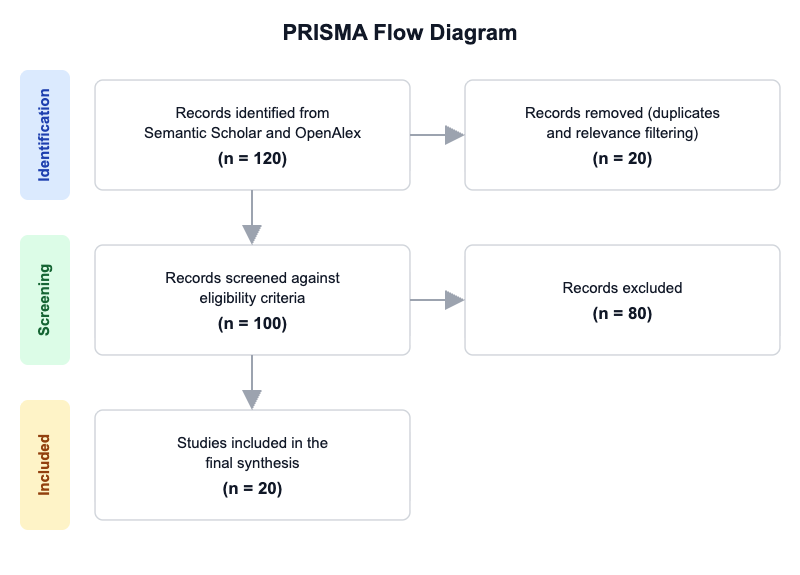
Initial database searching identified 120 records. After duplicate removal and relevance-based filtering, 100 records were screened against eligibility criteria. Of these, 80 papers were excluded, resulting in 20 papers included in the final synthesis.
PRISMA Flow Diagram
Eligibility criteria included:
- Human Studies: Does the study involve human participants, human tissue from clinical cases, or human-derived samples rather than only animals or cell lines?
- Hair Loss Focus: Does the study specifically investigate alopecia, hair loss, hair shedding, or scalp hair disorders as a primary topic?
- Cause or Treatment: Does the study address either the cause/pathogenesis of hair loss or a treatment/management approach for hair loss?
- Clinical Relevance: Does the paper report clinical, diagnostic, translational, or patient-centered findings rather than being purely unrelated basic science?
- Recent Evidence: Does the paper appear to provide recent evidence, newer therapy, or updated understanding of hair loss research?
- Treatment Outcome: Does the study report hair regrowth, reduced shedding, improved density, severity score change, or other measurable treatment response?
- Mechanistic Insight: Does the study provide mechanistic insight into inflammation, hormones, genetics, immune pathways, stem cells, or follicle biology?
- Review Quality: Does the paper appear to be a review, systematic review, meta-analysis, guideline, or consensus paper synthesizing multiple studies?
All included studies met the stated eligibility criteria.
2.3 Data Extraction and Synthesis
Data extraction focused on the following variables:
- Hair Loss Type
- Cause/Mechanism
- Treatment Type
- Intervention Details
- Clinical Outcomes
- Safety/Tolerability
- Study Design
- Population
Thematic analysis was employed to identify patterns and synthesize findings across studies. Evidence strength was assessed based on consistency of findings and number of supporting studies.
3. Results
3.1 Characteristics of Included Studies
| Study and Year | Study Type | Hair Loss Focus | Key Mechanistic Focus | Main Treatment Focus | Population |
|---|---|---|---|---|---|
| Cotsarelis and Millar 2001 [1] | Review | Common alopecias | Aberrant follicle cycling; follicle morphology | Molecularly targeted future therapies | Not specified |
| Stough et al. 2005 [2] | Review | Male androgenetic alopecia | DHT dependence; genetic predisposition | Minoxidil, finasteride, transplantation | Adult men |
| Varothai and Bergfeld 2014 [3] | Evidence-based review | Androgenetic alopecia | Androgen/DHT-mediated miniaturization | Finasteride; minoxidil | Adult men and women |
| Kelly et al. 2016 [4] | Review | Androgenetic alopecia | Genetic and hormonal factors | Finasteride, minoxidil, antiandrogens | Men and women |
| Trüeb and Reis Gavazzoni Dias 2018 [5] | Review | Alopecia areata | Autoimmune, IFN-γ-driven response | Corticosteroids, topical immunotherapy, JAK-pathway agents | General AA population |
| Adil and Godwin 2017 [6] | Systematic review and meta-analysis | Androgenetic alopecia | Genetic/hormonal influences | Minoxidil, finasteride, low-level laser therapy | Mainly men; women also included |
| Manabe et al. 2018 [7] | Guideline revision | Male- and female-pattern hair loss | Postpubertal, hormonal/genetic pattern loss | Finasteride, dutasteride, minoxidil, light therapies | Adult men and women |
| Fabbrocini et al. 2018 [8] | Clinical review | Female pattern hair loss | Follicle miniaturization; hyperandrogenism in some patients | Antiandrogens, minoxidil | Women |
| Starace et al. 2019 [9] | Review/guideline | Female androgenetic alopecia | Sex hormonal milieu; hyperandrogenic disorders | Minoxidil, anti-androgens | Women |
| Alessandrini et al. 2020 [10] | Review | Multiple alopecias | Diagnostic classification and trichoscopy | Broad therapy overview | General hair-loss population |
| Zhou et al. 2021 [11] | Review | Alopecia areata | Immune privilege collapse | Corticosteroids, immunomodulators, JAK inhibitors, PRP | General AA population |
| Sterkens et al. 2021 [12] | Review | Alopecia areata | Immune privilege collapse | Local/systemic therapies; JAK-STAT inhibitors; PRP | General AA population |
| Nestor et al. 2021 [13] | Review | Androgenetic alopecia | DHT/5-alpha-reductase mediated miniaturization | Minoxidil, finasteride, PRP, exosomes, transplantation | General AGA population |
| Saceda-Corralo et al. 2022 [14] | Review | Male androgenetic alopecia | Androgen sensitivity | Finasteride/dutasteride, oral minoxidil, PRP, LLLT, emerging agents | Adult men |
| Lintzeri et al. 2022 [15] | Review | Alopecia areata | Immune-mediated disease | Topical, systemic, injectable therapies; JAK inhibitors | General AA population |
| Devjani et al. 2023 [16] | Review | Androgenetic alopecia | Androgen response | Existing, alternative, and emerging therapies | General AGA population |
| Ntshingila et al. 2023 [17] | Review | Androgenetic alopecia | Genetic predisposition; follicular androgen sensitivity | Finasteride, minoxidil | General AGA population |
| Kaiser et al. 2023 [18] | Review | Androgenetic alopecia | Genetic predisposition | Oral/topical drugs, LLLT, PRP, microneedling, regenerative therapies | Men and women |
| Liu et al. 2025 [19] | Review/primer | Androgenetic alopecia | Androgen signaling; GWAS loci; WNT pathway | Finasteride, minoxidil, transplantation, emerging molecular therapies | Men and women |
| Ma et al. 2025 [20] | Review | Alopecia areata | Immune dysregulation; genetic, epigenetic, environmental triggers | Traditional therapies, biologics, small molecules, emerging treatments | General AA population |
The study landscape is dominated by narrative reviews, guidelines, and evidence syntheses rather than primary trials. Two recurring clinical entities structure the literature: androgenetic alopecia, repeatedly framed as androgen-sensitive follicular miniaturization, and alopecia areata, repeatedly framed as immune-mediated hair loss with relapse-prone treatment response. The included papers are also heavily weighted toward adult populations, especially men with male-pattern hair loss and women with female-pattern loss, while alopecia areata reviews generally describe broad, mixed-age clinical populations without detailed subgroup stratification.
3.2 Thematic Findings
3.2.1 Distinct but overlapping biological drivers explain the main hair-loss phenotypes
A consistent mechanistic split emerges across the literature. Androgenetic alopecia is repeatedly attributed to androgen signaling, especially dihydrotestosterone-mediated follicular miniaturization and shortening of anagen cycles [13], [3], [2]. More recent synthesis extends this model by adding genetic architecture, with genome-wide association work identifying more than 380 loci and implicating androgen and WNT pathways [19]. Female disease is described as biologically similar in its miniaturization phenotype but less mechanistically settled: the hormonal milieu is emphasized, yet abnormal androgen levels are reported in only one-third of affected women, and the molecular basis in women remains undetermined [9], [8].
By contrast, alopecia areata is consistently framed as an immune-mediated disorder caused by collapse of hair-follicle immune privilege, with IFN-γ-driven signaling, cytotoxic CD8 T cells, innate and acquired immunity, and broader immune dysregulation implicated in disease pathogenesis [11], [5], [20]. Genetic and environmental factors are described as contributors, but the central biological distinction is inflammatory rather than androgenic. Confidence: Strong for the broad mechanistic dichotomy; Moderate for the finer details in women with androgenetic alopecia, where molecular explanation remains incomplete.
3.2.2 First-line androgenetic alopecia therapy remains pharmacologic, with the most stable evidence for minoxidil and 5-alpha-reductase inhibition
Across androgenetic alopecia reviews, the most durable treatment signal centers on topical minoxidil and oral finasteride. Evidence synthesis indicates that oral finasteride is the best-supported therapy for men and topical minoxidil is effective in both men and women [3], while a systematic review and meta-analysis similarly concluded that minoxidil, finasteride, and low-level laser light therapy promote hair growth in men, with minoxidil also effective in women [6]. Later reviews reinforce this hierarchy: finasteride 1 mg daily, dutasteride 0.5 mg daily, and topical 5% minoxidil twice daily are recommended first-line for male-pattern hair loss, while topical 1% minoxidil twice daily is recommended for female-pattern hair loss in one guideline framework [7]. Another clinical review of female pattern hair loss states that oral antiandrogens such as cyproterone acetate and spironolactone, alongside topical minoxidil, can arrest progression and reverse miniaturization in many mild-to-moderate cases [8]. In male disease, oral finasteride 1 mg daily and dutasteride 0.5 mg daily are repeatedly discussed, with dutasteride described as producing better responses, especially in the frontal area [14].
The main pattern is therefore not a search for a completely different mechanism, but incremental optimization of androgen suppression and follicle stimulation. Outcomes are described mainly in qualitative clinical terms—improved hair growth, density, reduced shedding, or stabilization—rather than harmonized quantitative endpoints [4], [16]. Confidence: Strong for minoxidil and finasteride as core treatments; Moderate for comparative superiority of dutasteride and for antiandrogen use in women, because the supporting evidence is more heterogeneous and less standardized.
3.2.3 Treatment expansion has outpaced protocol standardization, especially for procedural and regenerative options
Recent literature shows rapid growth in adjunctive and alternative therapies for androgenetic alopecia, but the evidence is less uniform than for classic pharmacotherapy. Reviews describe low-level laser therapy, microneedling, platelet-rich plasma, oral minoxidil, topical finasteride, topical spironolactone, botulinum toxin, stem cell therapy, exosomes, and transplantation as part of the therapeutic landscape [18], [13], [16]. Low-level laser therapy has the most consistent procedural support among these options: it is endorsed in guidelines and meta-analytic synthesis as effective, and newer reviews note beneficial responses, though comparative evidence against standard drug therapy remains limited [7], [6], [18]. Platelet-rich plasma is repeatedly described as promising, with some trials showing improved hair count after several months, but the literature emphasizes protocol heterogeneity and lack of standardization [18], [14], [13].
Oral minoxidil represents a particularly visible expansion of use. Reviews describe it as effective despite lack of FDA approval, typically starting at 2.5 mg daily and often increased to 5 mg daily; adverse effects include hypertrichosis, dizziness, and lower-limb edema [14]. Topical finasteride 0.25% daily is also highlighted as a strategy to reduce systemic exposure while preserving efficacy [14]. The overall trend is toward diversification of treatment, but evidence quality varies greatly and standardized protocols are frequently absent. Confidence: Moderate for the existence of benefit across some newer modalities; Limited for broad comparative claims because many therapies are supported by heterogeneous or retrospective data.
3.2.4 Alopecia areata therapy remains constrained by relapse, limited durability, and an unmet need for targeted control
In alopecia areata, conventional treatments are described as offering incomplete and often temporary benefit. Corticosteroids, immunomodulators, minoxidil, and contact immunotherapy are repeatedly characterized as having limited efficacy, high recurrence rates, or frequent relapses [11], [15], [12]. The key therapeutic message is not that current therapy is ineffective in every case, but that response durability is poor, especially in severe disease and long-standing cases. The literature also notes that outcome depends on phenotype and context: severity, surface area, disease duration, nail involvement, alopecia totalis, alopecia universalis, and family history are associated with worse prognosis [11], [12].
The strongest emerging signal is for pathway-targeted immunotherapy, especially JAK inhibitors. Multiple reviews identify tofacitinib, ruxolitinib, baricitinib, and broader JAK-STAT inhibitors as promising future or ongoing therapies, along with abatacept and anti-IL15Rβ monoclonal antibodies [5], [11], [12], [20]. PRP also appears as a candidate adjunct, but again without standardized long-term evidence [11], [12]. Confidence: Strong for the overall pattern of relapse-prone conventional care; Moderate for JAK-pathway promise; Limited for durable comparative effectiveness because the reviews do not provide harmonized long-term outcome data.
3.2.5 Diagnosis, patient selection, and psychosocial burden are integral to management, not secondary considerations
Several reviews emphasize that outcomes depend as much on diagnostic precision and expectation management as on drug choice. Trichoscopy is described as fundamental across hair disorders, scalp biopsy is reserved for doubtful or cicatricial cases, and laboratory testing is often unnecessary in routine evaluation [10], [9]. For female-pattern hair loss, clinical history and examination are usually sufficient, while hyperandrogenic signs warrant endocrine investigation [8], [9]. In androgenetic alopecia, therapy is framed as a long-term commitment requiring adherence, with prolonged use of finasteride and minoxidil often necessary for sustained response [17], [2].
Psychosocial impact is repeatedly foregrounded. Androgenetic alopecia can produce severe psychosocial burden, especially in women and younger men, and alopecia areata is associated with depression, anxiety, and quality-of-life impairment [17], [15], [2]. This indicates that management should be phenotype-specific but also patient-centered, with psychological support considered when disease chronicity or visibility increases distress. Confidence: Strong for the importance of psychosocial burden and diagnostic evaluation; Moderate for precise diagnostic pathways because recommendations vary by subtype and setting.
3.3 Summary of Evidence
| Theme | Key Finding | Population Applicability | Effect Direction | Confidence Level | Supporting Studies |
|---|---|---|---|---|---|
| Androgenetic alopecia mechanism | AGA is linked to DHT/androgen signaling, follicular miniaturization, and >380 associated genomic loci involving androgen and WNT pathways [19] | Adults with androgenetic alopecia; women partially match because female mechanisms remain less defined | Positive mechanistic support for androgen-targeted causation | Strong | Liu et al. [19], Stough et al. [2], Ntshingila et al. [17] |
| Alopecia areata mechanism | AA is driven by immune privilege collapse, IFN-γ signaling, and immune dysregulation [5] | General alopecia areata population | Positive mechanistic support for immune-mediated causation | Strong | Trüeb et al. [5], Zhou et al. [11], Ma et al. [20] |
| Core AGA therapies | Minoxidil and finasteride remain the best-supported treatments; meta-analysis supports minoxidil, finasteride, and LLLT for men, and minoxidil for women [6] | Men with AGA; women partially match for minoxidil | Positive | Strong | Adil and Godwin [6], Varothai and Bergfeld [3], Kelly et al. [4] |
| Expanded AGA pharmacotherapy | Dutasteride, oral minoxidil, and topical finasteride show promising efficacy, but comparative evidence is less standardized [14] | Adult men with AGA; some data also apply to women for topical agents | Positive | Moderate | Saceda-Corralo et al. [14], Kaiser et al. [18], Devjani et al. [16] |
| Procedural/regenerative AGA treatments | PRP and LLLT show encouraging results, but protocols are heterogeneous and evidence quality varies [18] | Men and women with AGA | Positive but mixed | Moderate | Kaiser et al. [18], Nestor et al. [13], Adil and Godwin [6] |
| AGA safety and adherence | Finasteride may cause sexual adverse effects; oral minoxidil may cause hypertrichosis, dizziness, and edema; long-term adherence is a persistent challenge [14] | Men with AGA; adherence issues also relevant in women using long-term therapy | Mixed | Strong | Saceda-Corralo et al. [14], Ntshingila et al. [17], Stough et al. [2] |
| AA conventional therapy | Corticosteroids, immunomodulators, and contact immunotherapy have limited durability and frequent relapse [11] | General AA population | Negative to mixed | Strong | Zhou et al. [11], Lintzeri et al. [15], Sterkens et al. [12] |
| AA emerging therapy | JAK inhibitors and related immune-targeted agents are the most promising newer approach, but long-term effectiveness remains unproven [20] | General AA population; severe or refractory disease especially relevant | Positive but tentative | Moderate | Ma et al. [20], Trüeb and Reis Gavazzoni Dias [5], Sterkens et al. [12] |
| Diagnostic and psychosocial management | Trichoscopy, phenotype-specific evaluation, and psychological support are central to care [10] | Hair-loss patients broadly | Positive | Strong | Alessandrini et al. [10], Fabbrocini et al. [8], Lintzeri et al. [15] |
4. Discussion
4.1 Principal Findings and Their Interpretation
This synthesis shows that the field of hair-loss research in the recent literature is organized around two biologically distinct but clinically convergent disorders: androgen-driven follicular miniaturization in androgenetic alopecia and immune-mediated follicular attack in alopecia areata. That distinction matters because it explains why treatment development has followed different trajectories. Androgenetic alopecia lends itself to relatively direct pharmacologic modulation of androgen signaling and follicle cycling, which is why minoxidil, finasteride, and increasingly dutasteride or topical antiandrogens remain central [3], [6], [14]. Alopecia areata, by contrast, is pathobiologically more unstable and immunologically dynamic, so conventional local therapies often suppress activity without altering the underlying immune state, producing relapse once treatment stops [11], [12].
The evidence hierarchy is therefore uneven but interpretable. Confidence is highest for the core androgenetic alopecia treatments because efficacy signals recur across review, guideline, and meta-analytic sources, and because the mechanistic rationale is coherent with the clinical phenotype [3], [6], [7]. Confidence is lower for procedural and regenerative approaches not because they lack promise, but because their apparent effects are harder to compare across nonstandard protocols and outcome definitions. PRP, oral minoxidil, and LLLT each recur as promising options, yet the literature repeatedly notes heterogeneity in dosing, device parameters, or procedural schedules [18], [14], [13]. For alopecia areata, the main interpretive advance is not confirmation of a single “best” therapy, but recognition that durable remission likely requires immune pathway targeting rather than nonspecific anti-inflammatory suppression [5], [20]. That interpretation is strengthened by the alignment between mechanistic work on IFN-γ and immune privilege collapse and the therapeutic emergence of JAK inhibitors.
4.2 Comparison with Existing Literature and Resolution of Contradictions
The reviewed literature is broadly consistent in its support for minoxidil and finasteride in androgenetic alopecia, which strengthens confidence that these therapies represent true standard-of-care rather than publication-driven artifacts [3], [4], [6]. The apparent expansion of the treatment armamentarium does not contradict this core finding; rather, it reflects therapeutic layering in a chronic disease where patients seek either greater efficacy, fewer systemic effects, or improved adherence. This helps explain why topical finasteride, oral minoxidil, and combination approaches have risen in prominence: they are attempts to preserve the established pharmacologic logic while improving tolerability or convenience [14], [16].
The main contradictions concern newer or less standardized modalities. PRP and low-level laser therapy are repeatedly described as encouraging, yet the literature also stresses heterogeneity and limited comparative evidence. This is likely due to differences in preparation methods, treatment intervals, session counts, device settings, and endpoints, which make a positive signal difficult to translate into a uniform clinical recommendation [18], [13]. The contradiction is therefore methodological rather than conceptual: a treatment can plausibly work while still lacking enough standardization for broad use. A similar issue affects alopecia areata, where conventional therapies may help transiently but relapse remains common. That pattern is not necessarily evidence of treatment failure; it may instead indicate that the immune process is being suppressed without being durably reset [11], [15].
Publication bias is a realistic concern in both domains because many new therapies are introduced through review articles, early trials, or retrospective practice reports with inherently favorable reporting pressure. The most recent reviews also tend to emphasize innovation, which may overrepresent emerging interventions relative to null findings. At the same time, the persistence of convergent conclusions around core therapies suggests that the foundational evidence is robust even if the newer literature is more promotional than definitive.
4.3 Practical Implications
Clinically, the strongest implication is that hair-loss management should be phenotype-specific and expectation-sensitive rather than uniform. For androgenetic alopecia, practitioners can be most confident in recommending minoxidil and finasteride-based strategies, with consideration of dutasteride, oral minoxidil, topical finasteride, or adjunctive LLLT and PRP when standard therapy is insufficient or poorly tolerated [14], [16], [18]. For women, however, oral antiandrogens and topical minoxidil are more appropriate than assuming the male-pattern paradigm applies unchanged, especially when hyperandrogenic features are present [8], [9].
For alopecia areata, practitioners should counsel patients that conventional therapies often control but do not cure the disorder, and that relapse is common [15], [12]. This has practical implications for referral and longitudinal care: severe or recurrent cases may warrant earlier consideration of targeted immune therapies, particularly JAK-pathway approaches, while also addressing distress, anxiety, and depression [20], [15]. From a public health standpoint, the literature supports investment not only in new drugs but also in diagnostic rigor, standardized protocols, and psychosocial support. Regulatory implications are clearer for androgenetic alopecia than for alopecia areata: the former already has a relatively stable evidence base, whereas the latter still needs treatments that provide durable immune control rather than transient suppression. There is no convincing evidence in this literature for a no-threshold dose-response model analogous to environmental exposure research, so policy should focus on treatment standardization, safety surveillance, and access rather than threshold-based risk regulation.
4.4 Strengths and Limitations
This review benefits from a focused search strategy and a synthesis that spans pathogenesis, diagnosis, safety, and emerging therapies across the main nonscarring alopecias. A major strength is the integration of mechanistic and clinical literature, which allows the therapeutic landscape to be interpreted in light of underlying biology. The included literature also spans guidelines, systematic review evidence, and recent updates, supporting a broad view of the field.
Limitations remain substantial. Most included papers are narrative reviews rather than primary comparative studies, so the evidence base is highly dependent on how earlier studies were selected and interpreted. Outcome definitions vary widely, and many papers do not report quantitative efficacy measures, adverse event rates, or detailed population characteristics. The review itself is limited by abstract-level extraction for several studies and by the absence of a formal risk-of-bias appraisal of the underlying primary literature. As a result, confidence is strongest for broad mechanistic and first-line treatment conclusions and weaker for newer interventions, combination regimens, and subtype-specific claims.
5. Gaps and Future Directions
The most important gap is the lack of standardized, long-term comparative trials that directly test newer therapies against established first-line regimens in clearly defined alopecia subtypes. For androgenetic alopecia, future studies should compare finasteride-, minoxidil-, dutasteride-, oral minoxidil-, and device-based strategies using harmonized endpoints such as hair density, shedding, patient satisfaction, and durability after discontinuation. For alopecia areata, the literature still needs trials that distinguish patchy disease from alopecia totalis and universalis, because prognosis and treatment response differ meaningfully across these phenotypes [11], [12].
A second gap is protocol standardization. PRP, LLLT, microneedling, oral minoxidil, and topical finasteride are repeatedly discussed, but dosing, device settings, session frequency, and combination strategies vary enough to limit comparability [18], [14]. Future studies should report these parameters in full and include safety outcomes systematically, especially for systemic antiandrogens and off-label oral minoxidil. Finally, women with androgenetic alopecia and patients with severe or chronic alopecia areata remain underrepresented in high-resolution mechanistic and therapeutic studies. Better phenotyping, endocrine stratification, and immune profiling would help determine which subgroups benefit most from emerging treatments and which require different therapeutic logic.
6. Conclusion
The best-supported conclusion from the current literature is that the latest research on hair loss in 2026 still points to two dominant disease models and two different therapeutic paths. Androgenetic alopecia is primarily explained by androgen-sensitive follicular miniaturization, with strong support for minoxidil and finasteride-based therapy and growing but less standardized evidence for dutasteride, oral minoxidil, PRP, and low-level laser therapy [13], [14], [18]. Alopecia areata is instead an immune-mediated disorder driven by immune privilege collapse and IFN-γ-related pathways, where conventional therapies often relapse and JAK-targeted approaches represent the most plausible route toward more durable control [5], [11], [20].
This conclusion applies most directly to adults with androgenetic alopecia and general clinical populations with alopecia areata, while acknowledging that women with androgenetic alopecia and severe alopecia areata subtypes remain less completely characterized. The central unresolved question is not whether hair can regrow, but which interventions produce durable benefit with acceptable safety when used in real-world, long-term care. Answering that question will require standardized trials, subtype-specific stratification, and consistent outcome reporting. The broader significance is substantial: hair loss is not merely cosmetic, and the literature shows that diagnosis, treatment choice, adherence, and psychosocial support all shape outcomes. Stronger evidence in this area could improve quality of life, refine prescribing, and reduce the trial-and-error burden that still defines much hair-loss care.
References
- Cotsarelis, G., & Millar, S. E. (2001). Towards a molecular understanding of hair loss and its treatment. Trends in Molecular Medicine, 7(7), 293–301. https://doi.org/10.1016/S1471-4914(01)02027-502027-5)
- Stough, D., Stenn, K., Haber, R., Parsley, W. M., Vogel, J. E., Whiting, D. A., & Washenik, K. (2005). Psychological effect, pathophysiology, and management of androgenetic alopecia in men. Mayo Clinic Proceedings, 80(10), 1316–1322. https://doi.org/10.4065/80.10.1316
- Varothai, S., & Bergfeld, W. F. (2014). Androgenetic alopecia: An evidence-based treatment update. American Journal of Clinical Dermatology, 15(3), 217–230. https://doi.org/10.1007/s40257-014-0077-5
- Kelly, Y., Blanco, A., & Tosti, A. (2016). Androgenetic alopecia: An update of treatment options. Drugs, 76(14), 1349–1364. https://doi.org/10.1007/s40265-016-0629-5
- Trüeb, R. M., & Dias, M. F. R. G. (2018). Alopecia areata: A comprehensive review of pathogenesis and management. Clinical Reviews in Allergy & Immunology, 54(1), 68–87. https://doi.org/10.1007/s12016-017-8620-9
- Adil, A., & Godwin, M. (2017). The effectiveness of treatments for androgenetic alopecia: A systematic review and meta-analysis. Journal of the American Academy of Dermatology, 77(1), 136–141.e5. https://doi.org/10.1016/j.jaad.2017.02.054
- Manabe, M., Tsuboi, R., Itami, S., Osada, S.-I., Amoh, Y., Ito, T., Inui, S., Ueki, R., Ohyama, M., Kurata, S., Kono, T., Saito, N., Sato, A., Shimomura, Y., Nakamura, M., Narusawa, H., & Yamazaki, M. (2018). Guidelines for the diagnosis and treatment of male-pattern and female-pattern hair loss, 2017 version. The Journal of Dermatology, 45(9), 1031–1043. https://doi.org/10.1111/1346-8138.14470
- Fabbrocini, G., Cantelli, M., Masarà, A., Annunziata, M. C., Marasca, C., & Cacciapuoti, S. (2018). Female pattern hair loss: A clinical, pathophysiologic, and therapeutic review. International Journal of Women's Dermatology, 4(4), 203–211. https://doi.org/10.1016/j.ijwd.2018.05.001
- Starace, M. V. R., Orlando, G., Alessandrini, A. M., & Piraccini, B. M. (2019). Female androgenetic alopecia: An update on diagnosis and management. American Journal of Clinical Dermatology, 21(1), 69–84. https://doi.org/10.1007/s40257-019-00479-x
- Alessandrini, A. M., Bruni, F., Piraccini, B. M., & Starace, M. V. R. (2020). Common causes of hair loss – clinical manifestations, trichoscopy and therapy. Journal of the European Academy of Dermatology and Venereology, 35(3), 629–640. https://doi.org/10.1111/jdv.17079
- Zhou, C., Li, X., Wang, C., & Zhang, J. (2021). Alopecia areata: An update on etiopathogenesis, diagnosis, and management. Clinical Reviews in Allergy & Immunology, 61(3), 403–423. https://doi.org/10.1007/s12016-021-08883-0
- Sterkens, A., Lambert, J., & Bervoets, A. (2021). Alopecia areata: A review on diagnosis, immunological etiopathogenesis and treatment options. Clinical and Experimental Medicine, 21(2), 215–230. https://doi.org/10.1007/s10238-020-00673-w
- Nestor, M. S., Ablon, G., Gade, A., Han, H., & Fischer, D. L. (2021). Treatment options for androgenetic alopecia: Efficacy, side effects, compliance, financial considerations, and ethics. Journal of Cosmetic Dermatology, 20(12), 3759–3781. https://doi.org/10.1111/jocd.14537
- Saceda-Corralo, D., Domínguez-Santas, M., Vañó-Galván, S., & Grimalt, R. (2022). What's new in therapy for male androgenetic alopecia? American Journal of Clinical Dermatology, 24(1), 15–24. https://doi.org/10.1007/s40257-022-00730-y
- Lintzeri, D.-A., Constantinou, A., Hillmann, K., Ghoreschi, K., Vogt, A., & Blume-Peytavi, U. (2022). Alopecia areata – Current understanding and management. Journal der Deutschen Dermatologischen Gesellschaft, 20(1), 59–90. https://doi.org/10.1111/ddg.14689
- Devjani, S., Ezemma, O., Kelley, K. J., Stratton, E., & Senna, M. M. (2023). Androgenetic alopecia: Therapy update. Drugs, 83(8), 701–715. https://doi.org/10.1007/s40265-023-01880-x
- Ntshingila, S. N., Oputu, O. U., Arowolo, A., & Khumalo, N. P. (2023). Androgenetic alopecia: An update. JAAD International, 13, 150–158. https://doi.org/10.1016/j.jdin.2023.07.005
- Kaiser, M., Abdin, R., Gaumond, S. I., Issa, N. T., & Jimenez, J. J. (2023). Treatment of androgenetic alopecia: Current guidance and unmet needs. Clinical, Cosmetic and Investigational Dermatology, 16, 1387–1406. https://doi.org/10.2147/CCID.S385861
- Liu, Y., Tosti, A., Wang, E. C. E., Heilmann-Heimbach, S., Aguh, C., Jiménez, F., Lin, S.-J., Kwon, O., & Plikus, M. V. (2025). Androgenetic alopecia. Nature Reviews Disease Primers, 11(1), 73. https://doi.org/10.1038/s41572-025-00656-9
- Ma, T., Zhang, T., Miao, F., Liu, J., Zhu, Q., Chen, Z., Tai, Z., & He, Z. (2025). Alopecia areata: Pathogenesis, diagnosis, and therapies. MedComm, 6(5), e70182. https://doi.org/10.1002/mco2.70182