

Latest Research on Hashimoto’s Thyroiditis: Mechanisms, Biomarkers, Symptom Burden, and Emerging Management Strategies
Abstract
Recent research shows that Hashimoto’s thyroiditis is best understood as a multifactorial autoimmune disease driven by genetic susceptibility, environmental triggers, and immune dysregulation, with thyroid peroxidase antibodies (TPOAbs) and thyroglobulin antibodies (TGAbs) remaining central diagnostic biomarkers [1], [18]. Across clinical, translational, and review evidence, a consistent pattern emerges: antibody positivity is not merely a diagnostic marker but is also linked to inflammation, symptom burden, reduced quality of life, and persistent complaints despite biochemical euthyroidism [3], [7], [15]. The literature also indicates expanding attention to molecular pathogenesis, including immune-cell imbalance, oxidative stress, microbiome-related pathways, and tissue-level heterogeneity, alongside emerging treatment adjuncts such as vitamin D, selenium, combined levothyroxine/liothyronine therapy, and selected surgical approaches for refractory disease [5], [7], [9], [19]. This review synthesizes the latest work to clarify which findings are robust and clinically actionable versus tentative and context-dependent. A key theme is that standard levothyroxine replacement normalizes thyroid biochemistry for many patients but does not fully address symptom persistence in a subset, suggesting that disease activity may extend beyond hormone deficiency alone [3], [7]. Another important trend is the increasing recognition of risk stratification beyond thyroid function, including pregnancy complications, thyroid malignancy associations, pediatric genetic syndromes, and genotype-linked susceptibility loci [1], [2], [11], [12]. Overall, the evidence supports a more personalized, mechanism-informed approach to diagnosis and management, while major gaps remain in causal inference, standardized symptom measurement, and validation of novel biomarkers.
1. Introduction
Hashimoto’s thyroiditis is the most common cause of acquired hypothyroidism in iodine-sufficient settings and remains a major clinical challenge because its course is heterogeneous, its symptoms are often nonspecific, and biochemical euthyroidism does not reliably indicate symptom resolution [6], [7]. The disease is defined by thyroid-specific autoantibodies, especially TPOAbs and TGAbs, together with lymphocytic infiltration and progressive thyroid destruction [1], [8]. Yet the contemporary literature increasingly shows that this serologic definition captures only part of the disorder’s biology. Patients may experience fatigue, cognitive complaints, mood symptoms, gastrointestinal disturbance, and other extrathyroidal manifestations even when thyroid hormone levels are normalized [3], [7], [15].
Recent research has therefore shifted from describing Hashimoto’s thyroiditis solely as a cause of hypothyroidism toward explaining it as a broader autoimmune process shaped by genetic predisposition, environmental exposures, immune-cell imbalance, and tissue microenvironment changes [1], [9], [13]. Emerging studies have extended interest beyond conventional diagnosis and levothyroxine replacement to include molecular biomarkers, symptom-linked inflammation, dietary and micronutrient approaches, and alternative therapeutic strategies for refractory disease [3], [7], [13]. At the same time, several clinically important issues remain unsettled: which biomarkers best reflect ongoing disease activity, why some euthyroid patients remain symptomatic, how strongly HT contributes to malignancy risk, and whether newer therapies meaningfully improve patient-centered outcomes.
This review addresses the latest evidence on Hashimoto’s thyroiditis by integrating work on pathogenesis, biomarkers, clinical manifestations, comorbidity and cancer risk, and evolving treatment strategies. The aim is to synthesize what the recent literature collectively indicates about the disease’s biology and management, rather than to repeat individual study findings in isolation.
2. Methods
2.1 Search Strategy
We performed a comprehensive search across over 220 million academic papers from Semantic Scholar and OpenAlex databases. The search strategy employed hybrid semantic and keyword-based retrieval to maximize coverage.
Search queries included:
- "Hashimoto thyroiditis latest research diagnosis treatment autoimmune thyroid disease"
- "Hashimoto thyroiditis recent clinical studies antibody biomarkers hypothyroidism"
- "Hashimoto thyroiditis update pathogenesis genetics inflammation thyroid autoimmunity"
- "Hashimoto thyroiditis review recent advances management outcomes thyroid autoimmunity"
2.2 Study Selection
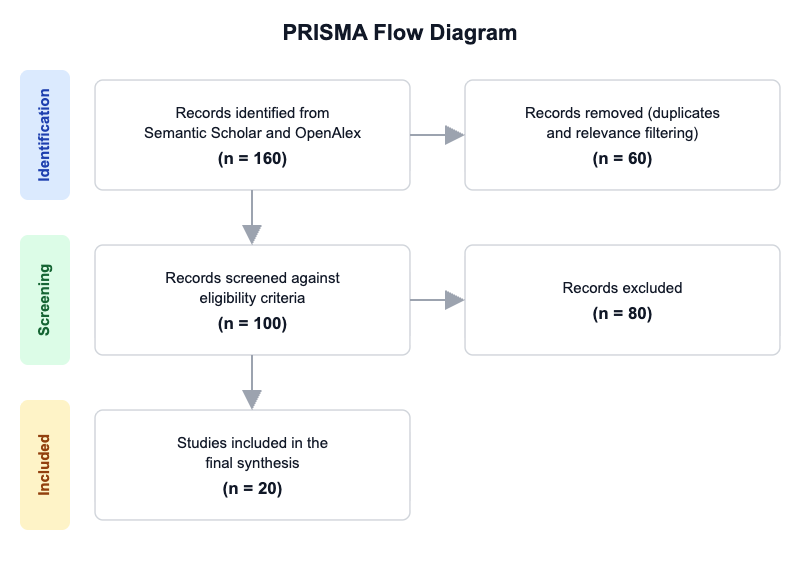
Initial database searching identified 160 records. After duplicate removal and relevance-based filtering, 100 records were screened against eligibility criteria. Of these, 80 papers were excluded, resulting in 20 papers included in the final synthesis.
PRISMA Flow Diagram
Eligibility criteria included:
- Topic Fit: Does the study focus on Hashimoto's thyroiditis, chronic autoimmune thyroiditis, or closely related autoimmune hypothyroidism?
- Human Study: Does the study involve human participants, patient samples, or human clinical data rather than only animals or cell lines?
- Recent: Was the study published between 2020 and 2026 inclusive?
- Primary Focus: Does the paper examine diagnosis, biomarkers, pathogenesis, treatment, prognosis, pregnancy, quality of life, imaging, genetics, or another direct clinical/research aspect of Hashimoto's thyroiditis?
- Clinical Data: Does the paper report original clinical data, patient-derived samples, or a systematic review/meta-analysis with direct relevance to Hashimoto's thyroiditis?
- Actionable Insight: Does the study provide findings that could inform diagnosis, monitoring, risk stratification, or management of Hashimoto's thyroiditis?
- Novelty: Does the study investigate an emerging biomarker, mechanism, subtype, imaging method, or treatment approach in Hashimoto's thyroiditis?
- Method Rigor: Does the paper use a clearly described analytic method such as cohort analysis, case-control design, trial, transcriptomics, imaging analysis, or meta-analysis?
All included studies met the stated eligibility criteria.
2.3 Data Extraction and Synthesis
Data extraction focused on the following variables:
- Focus: Identify the main focus of the study (e.g., diagnosis, pathogenesis, treatment, biomarkers, pregnancy, quality of life, microbiome, genetics, imaging).
- Study Type: Extract the study design or article type (e.g., review, cohort, case-control, randomized trial, cross-sectional, meta-analysis).
- Population: Describe the population or sample studied, including age group, sex, pregnancy status, or clinical context if reported.
- Key Finding: Summarize the main finding(s) related to Hashimoto's thyroiditis using only the paper's reported results or conclusions.
- Biomarker/Target: Extract the specific biomarker, antibody, gene, imaging feature, microbiome factor, or therapeutic target examined, if applicable.
- Clinical Implication: State the practical implication, diagnostic utility, treatment relevance, or management takeaway reported by the authors.
Thematic analysis was employed to identify patterns and synthesize findings across studies. Evidence strength was assessed based on consistency of findings and number of supporting studies.
3. Results
3.1 Characteristics of Included Studies
| Study and Year | Study Type | Population | Key Focus | Biomarker/Target | Main Clinical or Biological Contribution |
|---|---|---|---|---|---|
| Yilmaz et al. 2025 [1] | Review | Not specified | Pathogenesis of autoimmune thyroid disease | TPOAbs, TGAbs | Genetic, epigenetic, and environmental mechanisms |
| Klubo-Gwiezdzinska and Wartofsky 2022 [2] | Evidence-based review | Women and pregnant women emphasized | Etiology, diagnosis, and treatment | TPOAbs | Pregnancy risk, management strategies, malignancy risk |
| Li et al. 2024 [3] | Cross-sectional study | 108 euthyroid HT patients; 57 healthy controls | Symptoms, inflammation, quality of life | TPO-Ab, TG-Ab | Antibodies linked to inflammation, symptom burden, poor quality of life |
| Subhi et al. 2020 [4] | Comparative gene-expression analysis | HT, PTC with/without HT, micro-PTC, normal thyroid tissue | Genetics and cancer-related overlap | DEGs including CD86, IL2RG, IFI6, STAT1, MMP9, TOP2A, BRCA2 | Shared immune/inflammation and oncogenic pathways |
| Tywanek et al. 2024 [5] | Review | Not specified | Pathogenesis, treatment, biomarkers | TPO, TG antibodies | Emerging biomarkers and therapeutic trends |
| Wang et al. 2026 [6] | Narrative review | Adults generally | Pathogenesis and clinical management | TPOAb, TGAb | Clinical diagnosis and levothyroxine-based management |
| Zhang et al. 2025 [7] | Review | Euthyroid HT patients with persistent symptoms | Residual symptoms and management | Autoantibody titers; FT3/FT4 ratio | Combined LT4/LT3, thyroidectomy, selenium, vitamin D, TCM |
| Phagoora et al. 2023 [8] | Comprehensive review | Global populations | Epidemiology, diagnosis, treatment | TgAb, TPOAb, TSH-related antibodies | Broad clinical management overview |
| Bogusławska et al. 2022 [9] | Review | Human studies, animal models, cell lines | Cellular and molecular autoimmunity | CD40, TSHR, FLT3, PTPN22; ncRNAs; microbiome | Loss of immune tolerance and diagnostic biomarkers |
| Martínez-Hernández et al. 2024 [10] | Spatial transcriptomics study | AITD thyroid tissue from patients | Tissue architecture and heterogeneity | CD74, MIF; inflammatory fibroblasts | Cell-type-specific pathogenesis in HT |
| Kyritsi and Kanaka-Gantenbein 2020 [11] | Review | Children and adolescents with genetic syndromes | Pediatric autoimmune thyroid disease | Anti-thyroperoxidase antibodies | Increased ATD frequency in genetic syndromes |
| Zhang et al. 2020 [12] | Cohort genetic association study | 2,682 HT; 4,980 GD; 3,892 controls | Genetic susceptibility and disease differentiation | SLAMF6, CTLA4, HLA-B, GPR174/ITM2A | Distinct HT susceptibility loci and GD-HT heterogeneity |
| Delgadillo and Agrawal 2026 [13] | Literature review | Not specified | Immunopathogenesis, diagnosis, treatment | Anti-TPO, anti-TG; Th17/Treg; oxidative stress | Personalized treatment and predictive biomarkers |
| Almalali et al. 2022 [14] | Case report | 42-year-old female | Fibrous variant and surgery | Ultrasound, FNA | Rare compressive phenotype requiring thyroidectomy |
| Groenewegen et al. 2021 [15] | Systematic review | Biochemically euthyroid Hashimoto’s disease patients | Persistent symptoms and QoL | Thyroid autoimmunity | Symptom persistence despite normal thyroid hormones |
| Petranović Ovčariček et al. 2023 [16] | Review | Women more commonly affected | Differential diagnosis and imaging | TPO, TRAb | Nuclear medicine and antibody testing in AITD |
| Zhang et al. 2021 [17] | Systematic review and meta-analysis | HT patients | Vitamin D and autoimmunity | Autoantibody titres | Vitamin D reduces autoantibody titre |
| Sabti et al. 2025 [18] | Review | Not specified | Genetic and environmental pathophysiology | Not specified | Genetic and environmental contributions |
| Danailova et al. 2022 [19] | Review | HT patients | Nutritional management | Vitamin D, melatonin | Diet and lighting may reduce autoantibody reactivity |
| Rodriguez-Reyes et al. 2024 [20] | Systematic review | Pediatric populations | Pathogenesis, diagnosis, management, cancer risk | Selenium, thyroid antibodies | Pediatric HT may carry increased cancer risk |
The recent literature is dominated by reviews, but it also includes clinically informative cross-sectional, genetic, transcriptomic, and meta-analytic evidence. Across study types, the dominant focus is on immune pathogenesis, biomarkers, symptom persistence, and treatment optimization, while pediatric disease and cancer associations appear as important secondary concerns. The evidence base is therefore broad in topic, but uneven in causal strength.
3.2 Thematic Findings
3.2.1 Autoimmune pathogenesis is increasingly framed as a multi-layered process involving antibodies, T-cell imbalance, oxidative stress, and tissue microenvironment changes
Evidence converges on the view that Hashimoto’s thyroiditis is not driven by a single immune abnormality but by interacting humoral, cellular, and tissue-level processes. Classic thyroid autoantibodies remain central, but newer work expands the pathogenic model to include Th1/Th17-skewed immunity, Treg imbalance, oxidative stress, and stromal-cell participation [1], [7], [9], [13]. Spatial transcriptomic data add a tissue-architecture perspective by identifying damaged antigen-presenting thyroid follicular cells with upregulated CD74 and MIF and inflammatory fibroblast enrichment in HT, suggesting that the diseased gland actively shapes and sustains immune activation rather than serving as a passive target [10]. Genetic studies also support immune dysregulation, identifying susceptibility loci in immune-regulatory genes such as SLAMF6, CTLA4, HLA-B, and GPR174/ITM2A, along with shared inflammatory and apoptosis-related gene programs [4], [12]
The mechanistic picture is therefore becoming more integrated: autoantibodies mark disease, but cellular signaling, stromal remodeling, and oxidative injury appear to contribute to persistence and progression [1], [13]. Confidence in this theme is strong because multiple methods point in the same direction, although the relative contribution of each pathway remains unquantified.
3.2.2 Antibody burden is consistently linked to inflammation, symptom severity, and poorer quality of life, even when thyroid function is normal
A major clinical advance is the recognition that autoimmunity itself may carry symptom relevance beyond thyroid hormone levels. In euthyroid patients, elevated TPO-Ab and TG-Ab were inversely associated with general health and vitality and positively associated with TNF-α, IFN-γ, and multiple extrathyroidal symptoms, including abdominal distension, diarrhea, chilliness, forgetfulness, and fatigue [3]. TG-Ab also tracked with depressed mood, insomnia, and indifference [3]. This aligns with systematic-review evidence that thyroid autoimmunity is associated with persistent symptoms and lower quality of life in biochemically euthyroid Hashimoto’s disease [15], and with narrative review evidence that persistent symptoms may reflect a reduced FT3/FT4 ratio and persistently elevated autoantibody titers [7].
The important synthesis is that normal TSH or hormone replacement does not necessarily abolish disease burden. Instead, the studies suggest a symptom phenotype linked to residual immune activity or downstream inflammatory signaling, although direct causality remains unproven [3], [7]. Confidence is moderate to strong for the association, but limited for mechanism because the strongest direct evidence is cross-sectional and symptom measures were not standardized across all sources.
3.2.3 Standard levothyroxine remains foundational, but persistent symptoms are driving interest in combination therapy, supplementation, and selected surgery
The literature strongly supports levothyroxine as the standard treatment for hypothyroid Hashimoto’s thyroiditis [6], [8], [13]. However, recent reviews emphasize that biochemical control is not always equivalent to clinical recovery [7], [15]. This has prompted exploration of combined LT4/LT3 therapy in selected symptomatic patients, though robust selection criteria are not defined [7]. Adjunctive selenium and vitamin D supplementation are repeatedly discussed as modestly beneficial strategies [8], [13], while a meta-analysis reports that vitamin D reduces autoantibody titre in HT [17]. Nutritional and lighting interventions are also proposed to reduce autoantibody reactivity and preserve thyroid function [9], [19].
More invasive options appear only for refractory or compressive disease. Total thyroidectomy is described as improving health-related quality of life in selected patients with persistent symptoms [7], and a fibrous variant case illustrates that surgery may be needed when goiter causes dysphagia or mass effect [14]. The overall evidence supports a stepwise management model: hormone replacement remains central, but symptom persistence justifies individualized escalation. Confidence is moderate, because benefit signals are clinically plausible and recurring, yet comparative evidence remains limited and selection bias is likely.
3.2.4 Diagnostic thinking is expanding from thyroid function tests toward integrated biomarker, imaging, and molecular profiling
Across reviews and clinical studies, diagnosis is consistently grounded in TPOAb/TGAb measurement and thyroid ultrasound [1], [7], [16]. Yet the newer literature increasingly argues that these markers are insufficient for capturing disease activity or heterogeneity. Proposed extensions include ncRNA-based biomarkers, microbiome composition, inflammatory signatures, and gene-expression patterns [4], [5], [9]. Spatial transcriptomics further suggests that cell-type localization and stromal remodeling may identify biologically distinct HT subtypes [10].
The diagnostic direction is therefore toward multimodal assessment rather than a single marker. That shift is especially relevant for patients whose symptoms persist despite normalized hormones, because conventional tests may not reflect active immune or tissue-level disease [7], [15]. Confidence is moderate: antibody and ultrasound utility is well established, but novel biomarker proposals remain exploratory and not yet validated for routine practice.
3.2.5 Hashimoto’s thyroiditis has important risk-context implications in pregnancy, malignancy, and pediatric genetic syndromes
Several studies highlight that Hashimoto’s thyroiditis is clinically important beyond thyroid failure alone. TPOAbs are associated with a 2 to 4-fold increase in recurrent miscarriages and preterm birth in pregnant women [2]. The disease is also linked to a 1.6 times higher risk of papillary thyroid cancer and a 60 times higher risk of thyroid lymphoma compared with the general population [2]. Genetic-expression overlap between HT and papillary thyroid carcinoma with coexisting HT further supports a biologically plausible inflammation-to-oncogenesis sequence [4]. In pediatric populations and in children with genetic syndromes such as trisomy 21, Turner syndrome, Klinefelter syndrome, and 22q11.2 deletion syndrome, HT appears more frequent and warrants early follow-up [11], [20].
These findings suggest that HT functions as a risk marker in specific clinical contexts rather than merely a cause of hypothyroidism. Confidence is moderate: pregnancy and malignancy associations are repeatedly emphasized, but some evidence comes from review-level synthesis rather than direct new cohorts. The pediatric and syndromic data are clinically useful but partly context-specific and not fully generalizable to the broader adult HT population.
3.3 Summary of Evidence
| Theme | Key Finding | Population Applicability | Effect Direction | Confidence Level | Supporting Studies |
|---|---|---|---|---|---|
| Multi-layered autoimmune pathogenesis | Immune-regulatory loci such as SLAMF6, CTLA4, HLA-B, and GPR174/ITM2A were identified alongside inflammatory fibroblasts and upregulated CD74/MIF in diseased tissue | Broad HT population; some findings from mixed AITD tissues | Positive for immune and stromal dysregulation | Strong | Zhang et al. [12], Bogusławska et al. [9], Martínez-Hernández et al. [10], Subhi et al. [4] |
| Antibodies, inflammation, and symptoms | TPO-Ab and TG-Ab were inversely associated with general health and vitality and positively correlated with TNF-α, IFN-γ, and symptom severity | Euthyroid HT patients; partially matches broader HT population because symptoms were studied in clinically euthyroid individuals | Positive for symptom burden and inflammation | Strong | Li et al. [3], Groenewegen et al. [15], Zhang et al. [7] |
| Treatment beyond levothyroxine | Combined LT4/LT3, selenium, vitamin D, and thyroidectomy were proposed for selected refractory cases; vitamin D reduced autoantibody titre | Symptomatic or refractory HT patients; partially matches broader HT population because some evidence focuses on euthyroid symptomatic subgroups | Mixed but generally positive for adjunctive strategies | Moderate | Zhang et al. [7], Delgadillo and Agrawal [13], Phagoora et al. [8], Zhang et al. [17] |
| Diagnostic expansion | TPOAb/TGAb and ultrasound remain standard, while ncRNAs, microbiome, and tissue transcriptomics are emerging candidates | HT patients broadly; emerging tools remain investigational | Positive for diagnostic specificity | Moderate | Petranović Ovčariček et al. [16], Tywanek et al. [5], Bogusławska et al. [9], Martínez-Hernández et al. [10] |
| Risk in pregnancy, cancer, and pediatric syndromes | TPOAbs were associated with 2 to 4-fold higher miscarriage/preterm risk; HT was associated with 1.6 times higher papillary cancer risk and 60 times higher lymphoma risk | Pregnancy-specific and pediatric/syndromic subgroups; partially matches the general HT population | Positive for adverse risk associations | Moderate | Klubo-Gwiezdzinska and Wartofsky [2], Subhi et al. [4], Kyritsi and Kanaka-Gantenbein [11], Rodriguez-Reyes et al. [20] |
4. Discussion
4.1 Principal Findings and Their Interpretation
The latest literature portrays Hashimoto’s thyroiditis as a biologically heterogeneous autoimmune syndrome rather than a single endocrine endpoint. The strongest synthesis-level message is that classic thyroid autoantibodies remain important, but they are increasingly understood as part of a wider immune network involving T-cell imbalance, inflammatory cytokines, oxidative stress, and tissue remodeling [1], [7], [9], [13]. This matters because it helps explain why some patients continue to report symptoms despite biochemical euthyroidism: thyroid hormone levels may normalize while immune activation and local tissue dysfunction persist. The cross-sectional association between antibody titers, inflammatory markers, and symptom severity provides the most direct support for that interpretation [3], although causality cannot be inferred.
The translational implication is that disease activity may be better captured by combining serology, symptom assessment, and possibly tissue or molecular markers than by relying on TSH alone. That interpretation is strengthened by genetic and transcriptomic evidence showing pathways in immune regulation, apoptosis, and oncogenic stress responses that overlap with HT pathology [4], [10]. The convergence across methods suggests that the disease process is upstream of hypothyroidism itself and may persist independently of replacement therapy. Confidence is highest for autoantibody-based diagnosis and standard levothyroxine treatment, moderate for adjunctive nutritional or combination therapy, and tentative for novel molecular biomarkers because most remain review-level or exploratory.
4.2 Comparison with Existing Literature and Resolution of Contradictions
A notable pattern across the recent literature is the tension between biochemical control and patient-reported illness. This is not a true contradiction in the narrow sense, but it does challenge the conventional assumption that normal thyroid hormone values imply adequate disease control [7], [15]. The most plausible explanation is phenotypic heterogeneity: some patients may have symptoms driven by ongoing immune activation, altered deiodination or FT3/FT4 balance, or comorbid nonspecific symptom generators that are not captured by standard thyroid labs. The reviews that emphasize persistent symptoms do not prove autoimmune causality, but they do show that the clinical phenotype is stable enough to warrant specific management attention [3], [7].
Another area of uncertainty is treatment escalation. Supplementation with vitamin D or selenium and combined LT4/LT3 therapy are described as potentially helpful, yet the evidence base is not uniform and often comes from indirect or limited data [7], [13], [17]. This likely reflects differences in patient selection, symptom definitions, and outcome measurement rather than a simple lack of biological plausibility. The literature also shows a publication-bias risk toward positive adjunctive findings because many studies are reviews or small observational analyses in settings already interested in immune modulation. By contrast, the diagnostic role of antibodies and ultrasound is much more settled, suggesting that methodological maturity strongly influences certainty. Overall, the literature is converging on a nuanced position: the autoimmune substrate is real and measurable, but symptom response and adjunctive treatment effects are more context-dependent than classic endocrine markers imply.
4.3 Practical Implications
For clinicians, the clearest implication is that Hashimoto’s thyroiditis should be managed as both an endocrine and an autoimmune disorder. Standard levothyroxine remains the cornerstone for hypothyroidism, but persistent symptoms in biochemically euthyroid patients justify reassessment rather than reassurance alone [6], [7]. In symptomatic patients, particularly those with persistently elevated antibodies or inflammatory features, a broader workup may be reasonable, including symptom-specific assessment, antibody evaluation, and ultrasound where indicated [1], [7]. Selected patients with refractory symptoms may be candidates for individualized adjunctive therapy, though the current evidence does not support routine escalation for all patients [7].
For public health and preventive care, the strongest actionable signals concern pregnancy, pediatric genetic syndromes, and cancer surveillance. Women with TPOAb positivity appear to face higher obstetric risk, supporting closer monitoring in pregnancy [2]. Children and adolescents with syndromic risk should be followed regularly for early detection [11], [20], and patients with HT and suspicious nodular disease warrant careful malignancy evaluation given the reported association with papillary thyroid carcinoma and lymphoma [2]. These implications are clinical rather than regulatory in nature; the evidence does not speak to environmental exposure thresholds or population-wide regulatory limits.
4.4 Strengths and Limitations
This review is strengthened by the inclusion of recent evidence spanning clinical cohorts, genetic association studies, spatial transcriptomics, systematic reviews, and meta-analytic work, allowing synthesis across complementary levels of analysis. The main limitation of the included literature is heavy reliance on reviews and relatively small or context-specific primary studies, with many findings based on euthyroid subgroups, pediatric syndromic populations, or mixed autoimmune thyroid disease samples. Measurement heterogeneity is another limitation, especially for symptoms and quality of life, which were not standardized across studies. Limitations of this review include abstract-based extraction, no formal risk-of-bias scoring, and dependence on the information reported in the provided paper data.
5. Gaps and Future Directions
The most important gap is the lack of prospective, mechanism-linked studies that directly explain why some Hashimoto’s patients remain symptomatic despite normal thyroid hormone levels. Future work should combine antibody trajectories, inflammatory mediators, FT3/FT4 dynamics, symptom instruments, and longitudinal clinical outcomes in the same patients. Another major gap is validation of emerging biomarkers such as ncRNAs, microbiome signatures, CD74/MIF-related tissue states, and inflammatory fibroblast profiles in independent cohorts before clinical use can be considered [4], [9], [10].
The literature also needs better standardization of symptom and quality-of-life outcomes, because current evidence is difficult to compare across studies [7], [15]. Pediatric and syndromic populations are underrepresented in primary mechanistic studies despite their apparent elevated risk [11], [20]. Finally, adjunctive therapies such as vitamin D, selenium, LT4/LT3 combinations, and surgical escalation require larger controlled trials with clearly defined entry criteria, because the current evidence base is suggestive but not definitive [7], [13]. These gaps are especially important for patients whose disease burden is not captured by TSH alone.
6. Conclusion
The latest research indicates that Hashimoto’s thyroiditis is a heterogeneous autoimmune disorder in which classic thyroid autoantibodies, especially TPOAbs and TGAbs, remain central but do not fully capture disease activity or patient burden [1], [13]. The most defensible conclusion is that antibody-positive autoimmunity is consistently linked to inflammation, persistent symptoms, and poorer quality of life, including in clinically euthyroid patients, while standard levothyroxine treatment remains necessary but often insufficient for symptom relief [3], [7], [15]. Emerging mechanistic data suggest that immune dysregulation, oxidative stress, stromal remodeling, and tissue heterogeneity contribute to disease persistence, and genetic evidence supports partly distinct pathogenic pathways from Graves’ disease [1], [9], [10], [12].
Clinically, the evidence supports more personalized management that goes beyond thyroid hormone replacement, especially for patients with refractory symptoms, pregnancy, pediatric syndromic risk, or concern for malignancy [2], [6], [11]. Still, the most important unresolved question is whether persistent symptoms are directly driven by ongoing autoimmune activity or by a broader, mixed symptom biology that only partially overlaps with thyroid autoimmunity. Resolving this issue will require longitudinal, biomarker-rich studies with harmonized symptom outcomes and independent validation of new molecular targets. Until then, the field is moving toward a more nuanced and biologically informed model of Hashimoto’s thyroiditis that is more clinically useful than hormone values alone, but not yet ready for universal biomarker-guided treatment.
References
- Yilmaz, Y., Aydemir, E., & Ayaz, F. (2025). Hashimoto’s thyroiditis as an autoimmune disorder. Discover Medicine, 2(1), 302. https://doi.org/10.1007/s44337-025-00479-3
- Klubo-Gwiezdzinska, J., & Wartofsky, L. (2022). Hashimoto thyroiditis: An evidence-based guide to etiology, diagnosis and treatment. Polish Archives of Internal Medicine, 132(3), 16222. https://doi.org/10.20452/pamw.16222
- Li, J., Huang, Q., Sun, S., Zhou, K., Wang, X., Pan, K., Zhang, Y., Wang, Y., Han, Q., Si, C., Li, S., Fan, S., & Li, D. (2024). Thyroid antibodies in Hashimoto’s thyroiditis patients are positively associated with inflammation and multiple symptoms. Scientific Reports, 14(1), 27902. https://doi.org/10.1038/s41598-024-78938-7
- Subhi, O., Schulten, H.-J., Bagatian, N., Al-Dayini, R., Karim, S., Bakhashab, S., Alotibi, R., Al-Ahmadi, A., Ata, M., Elaimi, A., Al-Muhayawi, S., Mansouri, M., Al-Ghamdi, K., Hamour, O. A., Jamal, A., Al-Maghrabi, J., & Al-Qahtani, M. H. (2020). Genetic relationship between Hashimoto’s thyroiditis and papillary thyroid carcinoma with coexisting Hashimoto’s thyroiditis. PLoS ONE, 15(6), e0234566. https://doi.org/10.1371/journal.pone.0234566
- Tywanek, E., Michalak, A., Świrska, J., & Zwolak, A. (2024). Autoimmunity, new potential biomarkers and the thyroid gland—The perspective of Hashimoto’s thyroiditis and its treatment. International Journal of Molecular Sciences, 25(9), 4703. https://doi.org/10.3390/ijms25094703
- Wang, L., Zhu, X., Xu, S., Zhou, B., Wu, Y., Li, Z., Zhao, Y., Li, S., Cheng, F., & Zhu, L. (2026). Hashimoto’s thyroiditis: From pathogenesis to clinical management. Frontiers in Endocrinology, 17, 1729316. https://doi.org/10.3389/fendo.2026.1729316
- Zhang, H., Tong, W., Zeng, W., Luo, H., Zhang, L., Feng, J., Xiao, Y., & Wang, G. (2025). Persistent symptoms in euthyroid Hashimoto’s thyroiditis: Current hypotheses and emerging management strategies. Frontiers in Endocrinology, 16, 1627787. https://doi.org/10.3389/fendo.2025.1627787
- Phagoora, J., Saini, S., Raghunathan, A., Reji, J., Shabir, A., Wanis, M., & Dejesus, D. (2023). Hashimoto thyroiditis - A comprehensive review. Physician’s Journal of Medicine, 2(1), 8–15. https://doi.org/10.55070/pjom.v2i1.35
- Bogusławska, J., Godlewska, M., Gajda, E., & Piekiełko-Witkowska, A. (2022). Cellular and molecular basis of thyroid autoimmunity. European Thyroid Journal, 11(1). https://doi.org/10.1530/ETJ-21-0024
- Martínez-Hernández, R., Sánchez de la Blanca, N., Sacristán-Gómez, P., Serrano-Somavilla, A., Muñoz De Nova, J. L., Sánchez Cabo, F., Heyn, H., Sampedro-Núñez, M., & Marazuela, M. (2024). Unraveling the molecular architecture of autoimmune thyroid diseases at spatial resolution. Nature Communications, 15(1), 5895. https://doi.org/10.1038/s41467-024-50192-5
- Kyritsi, E. M., & Kanaka-Gantenbein, C. (2020). Autoimmune thyroid disease in specific genetic syndromes in childhood and adolescence. Frontiers in Endocrinology, 11, 543. https://doi.org/10.3389/fendo.2020.00543
- Zhang, Q.-Y., Liu, W., Li, L., Du, W.-H., Zuo, C.-L., Ye, X.-P., Zhou, Z., Yuan, F.-F., Ma, Y.-R., Sun, F., Yu, S.-S., Xie, H.-J., Zhang, C.-R., Ying, Y.-X., Yuan, G.-Y., Gao, G.-Q., Liang, J., Zhao, S.-X., & Song, H.-D. (2020). Genetic study in a large cohort supported different pathogenesis of Graves’ disease and Hashimoto’s hypothyroidism. The Journal of Clinical Endocrinology & Metabolism, 105(7), e2600–e2608. https://doi.org/10.1210/clinem/dgaa170
- Delgadillo, F., & Agrawal, D. K. (2026). Immunopathogenesis, diagnosis, and treatment of Hashimoto’s thyroiditis. Archives of Internal Medicine Research, 9(1), 1–13. https://doi.org/10.26502/aimr.0232
- Almalali, M. I. A., Takrouni, A. O., Alqattan, A. A., Alsolami, S., Salman, J. M. J., Aljehani, M. M. M., Albaqami, R. M. J., Alyahyaei, A. M., & Alrasheed, F. A. A. (2022). Autoimmune thyroiditis a fibrous variant of Hashimoto’s thyroiditis: A rare case. Annals of Medicine and Surgery, 79, 104019. https://doi.org/10.1016/j.amsu.2022.104019
- Groenewegen, K. L., Mooij, C. F., & van Trotsenburg, A. S. P. (2021). Persisting symptoms in patients with Hashimoto’s disease despite normal thyroid hormone levels: Does thyroid autoimmunity play a role? A systematic review. Journal of Translational Autoimmunity, 4, 100101. https://doi.org/10.1016/j.jtauto.2021.100101
- Petranović Ovčariček, P., Görges, R., & Giovanella, L. (2023). Autoimmune thyroid diseases. Seminars in Nuclear Medicine, 54(2), 219–236. https://doi.org/10.1053/j.semnuclmed.2023.11.002
- Zhang, J., Chen, Y., Li, H., & Li, H. (2021). Effects of vitamin D on thyroid autoimmunity markers in Hashimoto’s thyroiditis: Systematic review and meta-analysis. Journal of International Medical Research, 49(12), 03000605211060675. https://doi.org/10.1177/03000605211060675
- Sabti, Z. S., Muhammed, H. J., & Abu Alhab, A. D. A. (2025). Effect of the genetic and environmental factors on Hashimoto’s thyroiditis. Journal of the College of Basic Education, 30(131), 25–39. https://doi.org/10.35950/cbej.v30i131.13358
- Danailova, Y., Velikova, T., Nikolaev, G., Mitova, Z., Shinkov, A., Gagov, H., & Konakchieva, R. (2022). Nutritional management of thyroiditis of Hashimoto. International Journal of Molecular Sciences, 23(9), 5144. https://doi.org/10.3390/ijms23095144
- Rodriguez-Reyes, D., Lugo-Vicente, H., Acosta-Julbe, J. I., & Cruz-García, J. (2024). Hashimoto thyroiditis in pediatrics: Insights into pathogenesis, diagnosis, and management with considerations of cancer risk. Medical Research Archives, 12(6). https://doi.org/10.18103/mra.v12i6.5427