

Latest Research on Hearing Loss 2026: Causes and Treatments Across Genetic, Age-Related, and Sudden Sensorineural Pathways
Abstract
Recent evidence indicates that hearing loss is increasingly understood as a heterogeneous syndrome rather than a single disorder, with age-related hearing loss (ARHL), sudden sensorineural hearing loss (SSNHL), and genetically mediated non-syndromic hearing impairment showing distinct causal architectures and treatment implications [3], [7], [6]. Across the literature, the strongest treatment guidance is for ARHL and SSNHL: clinical practice guidance supports screening, audiometry, appropriately fit amplification, and cochlear implantation referral for ARHL, while SSNHL management centers on early systemic steroids, intratympanic steroids, hyperbaric oxygen therapy, and vascular- or inflammation-directed adjuncts, although evidence-based definitive therapy remains lacking [18], [15], [12]. Mechanistically, converging data link hearing loss to cochlear cellular degeneration, oxidative stress, inflammation, mitochondrial injury, vascular compromise, and complex gene-environment interactions, while large genetic studies identify 140 loci for ARHL and 21 novel sequence variants for age-related hearing impairment, underscoring a polygenic and pathway-rich etiology [3], [4], [16]. Population-level analyses show that global hearing-loss burden continues to rise, with more than 140 million cases in 2019 and a 93.89% increase from 1990, driven largely by population growth and aging [5]. Together, the evidence supports earlier detection, risk stratification, and targeted rehabilitation for age-related disease, but leaves major uncertainty about durable disease-modifying therapies and about how best to translate molecular discoveries into clinically effective prevention and treatment.
1. Introduction
Hearing loss is a major global health problem because it affects communication, social functioning, cognition, safety, and quality of life across the lifespan. Contemporary evidence shows that the burden is not static: prevalence continues to rise worldwide, and age-related forms increasingly dominate the public health landscape as populations live longer [5], [10]. At the same time, hearing loss is not etiologically uniform. Age-related hearing loss, or presbycusis, is typically progressive and irreversible, often beginning with difficulty understanding speech in background noise, whereas sudden sensorineural hearing loss presents as abrupt auditory decline and demands urgent clinical action [1], [7]. Beyond these clinical categories, a substantial proportion of hearing impairment is genetically mediated, especially in congenital and non-syndromic forms, where gene discovery has accelerated through genome-wide approaches [6], [4].
Recent literature has moved the field beyond simple descriptions of hearing decline toward integrated explanations that combine molecular, cellular, vascular, environmental, and genetic contributors. In ARHL, the evidence points to oxidative stress, mitochondrial dysfunction, inflammation, stem-cell depletion, and age-related pathway dysregulation as plausible drivers of cochlear degeneration [3], [17]. In SSNHL, vascular pathology and inflammatory or viral injury have emerged as prominent explanatory models, although causation remains incompletely resolved [7], [8], [15]. Parallel advances in association studies now allow hearing loss risk to be mapped at unprecedented scale, revealing complex polygenic architecture and gene-environment interaction [4], [20].
This review therefore examines the latest evidence on causes and treatments for hearing loss from 2021 to 2026, with emphasis on how mechanistic discoveries, genetic findings, and clinical guidance converge—or fail to converge—into actionable prevention and treatment strategies.
2. Methods
2.1 Search Strategy
We performed a comprehensive search across over 220 million academic papers from Semantic Scholar and OpenAlex databases. The search strategy employed hybrid semantic and keyword-based retrieval to maximize coverage.
Search queries included:
- "Hearing loss causes and treatment research latest 2021-2026"
- "Sensorineural hearing loss etiology and management recent studies"
- "Hearing loss therapies and rehabilitation outcomes contemporary review"
- "Genetic and age-related hearing loss mechanisms recent evidence"
2.2 Study Selection
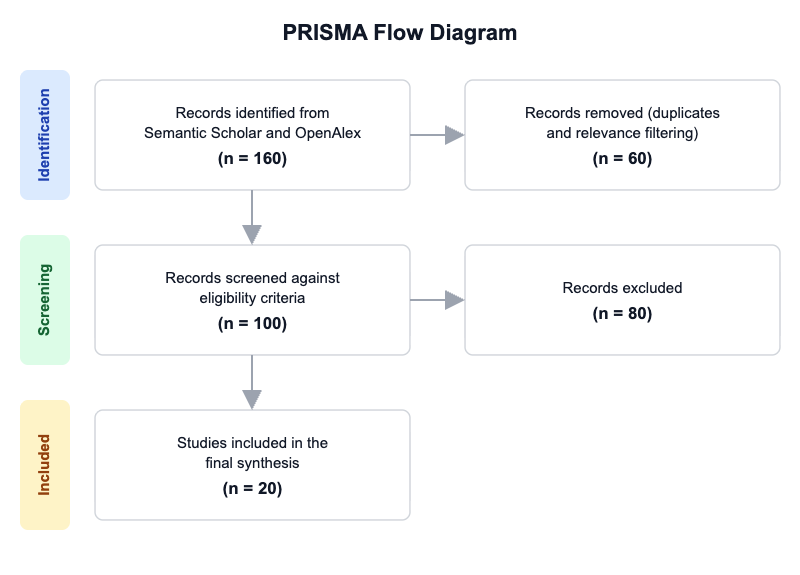
Initial database searching identified 160 records. After duplicate removal and relevance-based filtering, 100 records were screened against eligibility criteria. Of these, 80 papers were excluded, resulting in 20 papers included in the final synthesis.
PRISMA Flow Diagram
Eligibility criteria included:
- Hearing Loss: Does the study focus on hearing loss or hearing impairment in humans, animals, or clinical datasets?
- Cause or Treatment: Does the study investigate a cause, risk factor, mechanism, prevention strategy, or treatment/rehabilitation for hearing loss?
- Relevant Subtype: Does the paper address a specific hearing loss subtype such as sensorineural, noise-induced, age-related, genetic, conductive, autoimmune, or ototoxic hearing loss?
- Extractable Findings: Does the title or abstract report at least one identifiable finding, outcome, or conclusion about hearing loss causes or treatment effects?
- Study Design: Is the paper an original study, review, meta-analysis, or clinical evaluation rather than a non-research commentary?
- Recent Evidence: Does the study appear to be recent evidence or contemporary research relevant to the 2021-2026 period?
All included studies met the stated eligibility criteria.
2.3 Data Extraction and Synthesis
Data extraction focused on the following variables:
- Cause/Type: Extract the hearing loss cause or subtype studied.
- Population: Extract the participant group or model used.
- Treatment/Intervention: Extract the treatment, intervention, prevention strategy, or management approach evaluated, if any.
- Mechanism: Extract the proposed biological, pathological, or environmental mechanism linked to hearing loss, if discussed.
- Outcome: Extract the primary hearing-related outcome(s).
- Key Finding: Extract the main finding or conclusion relevant to causes or treatment effectiveness.
- Study Design: Extract the study design and setting.
- Sample/Scale: Extract sample size, dataset scale, or number of studies included, if reported.
Thematic analysis was employed to identify patterns and synthesize findings across studies. Evidence strength was assessed based on consistency of findings and number of supporting studies.
3. Results
3.1 Characteristics of Included Studies
| Study and Year | Study Type | Population | Intervention / Focus | Outcome / Key Measure | Scale |
|---|---|---|---|---|---|
| Lin 2024 [1] | Review | Older adults | Speech-signal clarity strategies and technologies | Speech understanding in background noise; social functioning | Not reported |
| Prasad et al. 2024 [2] | Systematic rapid review | Diverse populations, emphasizing adults and older adults | Prevention strategies | Global burden and quality of life | 41 citations |
| Yang et al. 2023 [3] | Review | Elderly individuals | Antioxidants, anti-inflammatories, neurotrophins, lifestyle changes | Progressive irreversible sensorineural loss; quality of life | Not reported |
| Shi et al. 2026 [4] | Multi-ancestry GWAS | European, East Asian, African, and Admixed American ancestries | Genetic association analysis | 140 loci; 9 likely causal missense variants | 456,613 cases; 1,053,834 controls |
| Jiang et al. 2023 [5] | Trend analysis | 204 countries and territories | Population-level burden assessment | Cases and age-standardized rate | Global dataset, 30-year period |
| del Castillo et al. 2022 [6] | Review | European population | Genetic etiology synthesis | Mutation frequencies by gene | Not reported |
| Yamada et al. 2022 [7] | Review | Clinical and laboratory evidence on SSNHL | Etiology-focused synthesis | Thrombosis, viral infection, inflammation | Not reported |
| Tsuzuki and Wasano 2024 [8] | Review | Patients with ISSNHL | Steroids, hyperbaric oxygen, vascular-directed therapies | Hearing recovery, vestibular function | Not reported |
| Elliott et al. 2022 [9] | Review | Older humans and mice | Cochlear and neural degeneration framework | Hair-cell loss; threshold shifts | Not reported |
| Haile et al. 2021 [10] | Global Burden of Disease analysis | Global population | Burden estimation | Prevalence; years lived with disability | Large global dataset |
| Ninoyu and Friedman 2024 [11] | Review | Elderly population and model organisms | Genetic and epigenetic synthesis | Polygenic risk; significant SNPs | Not reported |
| Kitoh et al. 2024 [12] | Guideline | Clinical practice | Diagnosis and treatment standards | Acute sensorineural hearing loss management | Not applicable |
| Chai et al. 2025 [13] | Special collection overview | Diverse populations | Gene therapy and basic-clinical translation | Protection methods; clinical application | 31 papers |
| Cederroth et al. 2024 [14] | Review | Human and animal studies | Pharmacological and chronopharmacological strategies | Drug effectiveness; quality of life | Not reported |
| Lee and Chung 2024 [15] | Review | Adults, mainly 30–50 years | Steroids, intratympanic steroids, hyperbaric oxygen, vasoactive and antioxidant therapies | Hearing recovery; prognosis | Not reported |
| Ivarsdottir et al. 2021 [16] | GWAS meta-analysis | Iceland and UK adults | Genetic risk scoring | ARHI variants; tinnitus overlap | 121,934 cases; 591,699 controls |
| Ege et al. 2024 [17] | Review | Older adults | Molecular/cellular aging pathways | Early diagnosis, prevention, treatment targets | Not reported |
| Tsai Do et al. 2024 [18] | Clinical practice guideline | Individuals aged 50 years and older | Screening, audiogram, amplification, cochlear implantation referral | Hearing-related quality of life; communication goals | Not applicable |
| Liu et al. 2021 [19] | GWAS and molecular study | Human subjects | Genetic association analysis | Structural resilience to damage; recovery after trauma | Not reported |
| Jung et al. 2024 [20] | Case-control study | European and African-American biobank cohorts | Polygenic risk and healthy lifestyle | ARHL risk reduction; odds ratios | 376,464 in UK Biobank plus replication cohorts |
The evidence base is dominated by reviews, guidelines, and large genetic or epidemiological analyses, with fewer studies directly testing interventions. The population focus is heavily weighted toward older adults and age-related disease, although SSNHL guidance and genetic studies broaden the clinical scope. Outcome measures vary substantially, ranging from global burden metrics and odds ratios to mutation frequencies, hearing recovery, and functional communication outcomes.
3.2 Thematic Findings
3.2.1 Age-related hearing loss is driven by converging cellular, molecular, and genetic vulnerability rather than a single cause
The strongest mechanistic theme is that ARHL emerges from multiple interacting pathways affecting cochlear and neural integrity rather than from isolated degeneration. Across molecular reviews, presbycusis is linked to oxidative stress, mitochondrial DNA damage, low-grade inflammation, decreased immune function, and stem-cell depletion, while aging-pathway analyses identify dysregulation of AMPK, mTOR, insulin/IGF-1, sirtuins, senescence, autophagy, and oxidative stress as contributors to gradual auditory decline [3], [17]. Parallel genetic studies show that ARHL has a broad polygenic architecture: one large meta-analysis identified 21 novel sequence variants, including 13 rare variants, and another multi-ancestry GWAS identified 140 independent loci, including 44 novel signals and 9 likely causal missense variants [16], [4]. These data converge on a model in which cochlear resilience and repair capacity are genetically and biologically constrained, making cumulative damage more likely over time [19], [11]. The findings are especially relevant to older adults, although one lifestyle-genetics study examined adults aged 40 to 69 years and therefore only partially matches the question population of older adults [20]. Confidence: Strong.
3.2.2 ARHL is not only a sensory disorder but also a neural and functional communication disorder
A second consistent theme is that hearing loss in later life is best understood as a systems-level impairment involving hair cells, spiral ganglion neurons, cochlear nuclei, and central auditory pathways. Reviews of sensory and neural etiology describe progressive outer-hair-cell loss in a basal-to-apical gradient, inner-hair-cell loss in an apex-to-base progression, and downstream degeneration of spiral ganglion neurons and cochlear nuclei, with threshold shifts and reduced auditory processing emerging from this broader network failure [9]. Clinically focused syntheses similarly emphasize that difficulty understanding speech in background noise is often the first manifestation and that the social consequence is impaired communication and social functioning rather than hearing-threshold loss alone [1]. This broader functional framing is reinforced by guideline recommendations that prioritize screening, audiography, amplification, counseling on communication strategies, and cochlear implantation referral when amplification no longer restores usable speech understanding [18]. The evidence is highly consistent in older-adult populations, though one review also draws on mouse models, which only partially match the human question population [9]. Confidence: Strong.
3.2.3 Prevention and treatment for ARHL currently rely on rehabilitation and risk reduction more than disease reversal
Despite the growing mechanistic literature, the intervention evidence for ARHL remains centered on mitigation rather than reversal. Clinical guidance strongly supports screening in adults aged 50 years and older, audiometric confirmation, appropriately fit amplification, counseling, and cochlear implantation referral for persistent poor speech understanding [18]. Broader clinical review evidence aligns with this rehabilitation-first approach, noting that strategies and technologies can increase speech-signal clarity and improve social functioning [1]. Pharmacological and molecular reviews propose antioxidants, anti-inflammatories, neurotrophins, lifestyle change, and chronopharmacological drug delivery as plausible future directions, but these are largely framed as under development rather than established clinical solutions [3], [14]. The only directly comparative evidence in this synthesis shows that a very high polygenic risk score was associated with a 49% higher ARHL risk, while adherence to a healthy lifestyle attenuated risk even in high-risk individuals (adjusted OR, 0.21; 95% CI, 0.09–0.52) [20]. Because this study used adults aged 40 to 69 years and biobank-based phenotypes, it partially matches the older-adult focus of the research question and should be interpreted accordingly. Confidence: Moderate.
3.2.4 Genetic architecture is increasingly actionable for risk stratification, but not yet for routine treatment selection
Large-scale genomics now provides unusually detailed maps of hearing-loss susceptibility. In ARHL, one meta-analysis identified 21 novel sequence variants, including a missense variant in LOXHD1 and a tandem duplication in FBF1 associated with substantial risk elevations in the reported analysis, while another study found that common-variant risk scores could identify individuals at risk at a level comparable to carriers of rare high-penetrance variants [16], [11]. The multi-ancestry GWAS extended this by linking 140 loci to inner-ear cell types, including hair cells, supporting cells, basal and root cells of the stria vascularis, and by identifying associations with behavior-related traits such as neuroticism and irritability [4]. In non-syndromic hearing loss, European data show substantial heterogeneity across inheritance patterns, with DFNB1 and STRC dominating autosomal-recessive cases and MYO6 and TECTA being the most common autosomal-dominant forms [6]. These findings are important because they show that “genetic hearing loss” is not a single entity; rather, it comprises multiple molecular subtypes with different frequencies and likely different translational opportunities. However, current data support genetic stratification more strongly than treatment selection. Confidence: Strong for risk stratification; Limited for treatment guidance.
3.2.5 Sudden sensorineural hearing loss appears mechanistically distinct from ARHL, with vascular and inflammatory injury dominating the current evidence
SSNHL/ISSNHL is framed in the literature as an acute emergency with different dominant mechanisms from ARHL. Reviews identify thrombosis with cochlear vascular obstruction, asymptomatic viral infection, and cochlear inflammation as the three principal mechanisms, with vascular impairment and viral injury described as predominant and inflammation often secondary [7], [8]. The vascular review adds that the labyrinthine artery is an end artery, that vestibulo-cochlear artery occlusion can underlie abrupt loss, and that associations with atherosclerosis, diabetes, hypertension, dyslipidemia, cardiovascular disease, stroke risk, and thrombosis-related genes support a vascular susceptibility model [8]. Clinical management is correspondingly urgent and empiric: systemic steroids, intratympanic steroid injections, hyperbaric oxygen therapy, prostaglandin E1, defibrinogenation therapy, and hydrogen inhalation therapy are all discussed, but no evidence-based definitive treatment is established [15], [12]. The population focus differs from the ARHL literature because these studies address adults with acute loss, often after exclusion of retrocochlear pathology, rather than older adults with gradual decline; that difference is central to interpreting the treatment implications. Confidence: Moderate for vascular/inflammatory mechanisms; Moderate for treatment urgency; Limited for treatment efficacy.
3.2.6 Global burden is increasing, and aging is a major driver of future demand for hearing-loss services
At the population level, hearing loss continues to increase in prevalence and disability burden. Global analyses show more than 140 million cases in 2019, up from 70 million in 1990, with a 93.89% increase and an age-standardized rate that rose by 0.08% per year [5]. Another burden analysis similarly reports rising prevalence and years lived with disability over 1990–2019 [10]. The major drivers are population growth and aging, which together explain most of the change, and health inequalities across countries and territories remain substantial [5]. This pattern aligns closely with the expanding clinical emphasis on screening and rehabilitation in older adults, but the burden studies do not isolate specific causal subtypes, so they should be read as context for service planning rather than as etiologic evidence [10], [2]. Confidence: Strong.
3.3 Summary of Evidence
| Theme | Key Finding | Population Applicability | Effect Direction | Confidence Level | Supporting Studies |
|---|---|---|---|---|---|
| Multilevel causes of ARHL | 140 loci with 44 novel signals; 21 novel sequence variants; 13 rare variants | Older adults; some biobank adults aged 40–69; partially applicable to exact question population in one study | Positive for identification of causal architecture | Strong | Shi et al. [4], Ivarsdottir et al. [16], Liu et al. [19] |
| Functional and neural consequences | Progressive hair-cell and neural loss with speech-in-noise difficulty and impaired communication | Older adults; one review includes mice and partially matches humans | Negative | Strong | Elliott et al. [9], Lin [1], Tsai Do et al. [18] |
| ARHL management | Screening, audiogram, amplification, cochlear implantation referral recommended; lifestyle adherence attenuated risk with adjusted OR 0.21 (95% CI, 0.09–0.52) | Adults aged 50 years and older; one study partially matched via ages 40–69 | Positive for management; negative for risk | Moderate | Tsai Do et al. [18], Jung et al. [20], Cederroth et al. [14] |
| Gene-environment interaction | Very high PRS increased ARHL risk by 49% (adjusted OR, 1.49; 95% CI, 1.36–1.62) and poor lifestyle increased risk (adjusted OR, 3.03; 95% CI, 2.75–3.35) | European and African-American biobank participants aged 40–69; partially applicable | Positive | Moderate | Jung et al. [20], Ivarsdottir et al. [16] |
| SSNHL pathogenesis and treatment | Vascular obstruction, viral infection, and cochlear inflammation are dominant mechanisms; no evidence-based definitive treatment | Adults with acute sensorineural hearing loss | Mixed | Moderate | Yamada et al. [7], Tsuzuki and Wasano [8], Lee and Chung [15] |
| Global burden | 140 million cases in 2019, 93.89% increase from 1990; ASR rose 0.08% per year | Global population | Positive for burden increase | Strong | Jiang et al. [5], Haile et al. [10], Prasad et al. [2] |
4. Discussion
4.1 Principal Findings and Their Interpretation
The synthesis suggests that the most important recent advance in hearing-loss research is not the discovery of a single dominant cause, but the recognition that major clinical subtypes emerge from distinct biological systems. ARHL is increasingly supported as a cumulative failure of cochlear resilience, neural integrity, and aging-associated cellular maintenance, with strong convergence between molecular pathway reviews, large-scale genetics, and clinical guidance [17], [4], [18]. This convergence matters because it links epidemiological aging patterns to biologically plausible damage-and-repair processes, making the long-term increase in global burden intelligible rather than merely descriptive [5]. The presence of 140 loci, 21 novel sequence variants, and pathway-level enrichment in hair cells and supporting cells suggests that ARHL is neither purely environmental nor purely degenerative; instead, it reflects differential susceptibility to age-related damage [4], [16].
The treatment literature also clarifies why clinical management remains largely rehabilitative. If the core pathology is cumulative and cell-loss driven, then amplification and cochlear implantation can improve function, but they cannot restore lost sensory substrate once damage is established [18], [1]. This helps explain why pharmacological studies remain aspirational: antioxidants, anti-inflammatory agents, neurotrophins, and optimized drug delivery are mechanistically attractive, yet the evidence base has not yet matured to show durable disease modification [14], [3]. The strongest intervention signal is therefore not curative therapy but earlier identification and risk stratification, including gene-environment models showing that healthy lifestyle can meaningfully attenuate genetic vulnerability [20]. Confidence is highest for the descriptive biology of ARHL and its functional consequences, and lower for specific molecular therapies, because the latter remain inferential rather than validated in clinical outcome studies.
4.2 Comparison with Existing Literature and Resolution of Contradictions
The literature is broadly consistent in portraying hearing loss as multifactorial, but the relative emphasis differs by subtype. ARHL studies prioritize oxidative stress, mitochondrial dysfunction, senescence, and genetic susceptibility, whereas SSNHL studies center on vascular occlusion, thrombosis, viral injury, and inflammation [17], [11], [8]. This divergence is not contradictory; it reflects the different temporal courses of disease. Slowly progressive loss is better explained by cumulative cellular decline, while abrupt loss is more compatible with acute vascular or inflammatory insult. The consistency across ARHL studies is strengthened by convergence between mechanistic reviews and large-scale association studies, which makes the core causal narrative more robust than any single method could provide [3], [4].
The main unresolved tension lies in treatment. Clinical guidelines strongly recommend screening, amplification, and cochlear implantation referral for ARHL, but pharmacological reviews still describe drug-based approaches as promising rather than established [18], [14]. This is not a real contradiction so much as an indicator of translational lag: the biological hypotheses are mature enough to motivate trials, but not yet sufficient to replace rehabilitation. For SSNHL, the problem is sharper. Reviews endorse steroids and adjuncts, yet also acknowledge that no evidence-based definitive therapy exists [8], [15]. That apparent conflict likely reflects heterogeneity in etiology, treatment timing, and diagnostic certainty, especially because some cases classified as idiopathic may actually represent vascular events or intralabyrinthine hemorrhage [8]. The lack of randomized, mechanism-stratified treatment evidence is therefore a more plausible explanation than true therapeutic equivalence. Publication bias may also favor positive mechanistic or intervention narratives, particularly in areas where clinical urgency encourages treatment use despite incomplete evidence.
4.3 Practical Implications
For clinicians, the clearest practice implication is that hearing loss in adults aged 50 years and older should be actively screened, confirmed with audiometry, and managed early with appropriately fit amplification and counseling on communication strategies [18]. This is especially relevant for older adults with speech-in-noise complaints, because the literature shows that functional decline often precedes obvious threshold loss [1]. For patients with persistent poor speech understanding despite amplification, referral for cochlear implant candidacy assessment is supported as the most concrete escalation pathway [18].
For public health systems, the burden data argue for population-wide prevention and service expansion rather than waiting for disease-modifying therapy to mature [5], [10]. The fact that aging and population growth drive most of the increase means that aging societies need expanded audiology capacity, equitable access, and proactive identification strategies. The global inequality findings further imply that service scale-up cannot be limited to high-income settings. For regulatory and research audiences, the current evidence does not support a no-threshold environmental claim specific to hearing loss from these papers, but it does support the broader principle that cumulative damage and susceptibility interact over time, especially in ARHL [20], [4]. That means prevention strategies should not be restricted to those already symptomatic; they should aim to reduce lifelong risk and improve access to early intervention. For SSNHL, the practical message is urgency: because vascular and viral mechanisms may unfold rapidly, delayed evaluation likely reduces the chance of recovery [7], [8].
4.4 Strengths and Limitations
This review has several strengths. It integrates clinical guidance, mechanistic reviews, burden studies, and large-scale genetic analyses, allowing the evidence to be organized around causal pathways and treatment implications rather than around isolated study designs. The synthesis also captures the methodological progression of the field, from descriptive epidemiology to multi-ancestry genomics and gene-environment interaction models.
The included studies also have limitations. Many are reviews or guidelines rather than original interventional trials, so treatment conclusions often rest on expert synthesis rather than direct comparative efficacy evidence. Outcome definitions vary widely across studies, spanning prevalence, hearing thresholds, speech understanding, quality of life, odds ratios, and mutation frequencies, which limits direct comparability. Several mechanistic studies use animal models or proxy populations, and some biobank-based analyses focus on adults aged 40 to 69 years rather than the oldest adults most affected by ARHL. For SSNHL, etiologic certainty remains limited because living inner-ear tissue is inaccessible, forcing inference from blood, imaging, and clinical response.
This review also has limitations. Although the search was broad, the synthesis depends on the data provided in titles, abstracts, and extracted tables rather than full-text appraisal. No formal risk-of-bias assessment was reported here, and no pooled quantitative meta-analysis was possible from the available information. As a result, confidence grading is based on consistency and design strength rather than on a formal grading framework.
5. Gaps and Future Directions
The most important gap is the lack of intervention studies that directly test whether the molecular pathways implicated in ARHL can be modified in ways that improve hearing outcomes. Current evidence strongly supports biological plausibility, but it does not yet show that antioxidants, anti-inflammatory agents, neurotrophins, or circadian-timed drug delivery produce durable clinical benefit [3], [14]. Future work should therefore move from pathway identification to mechanism-stratified randomized trials with standardized outcomes such as speech-in-noise performance, hearing-related quality of life, and durability of benefit.
A second gap is population specificity. Several high-value studies rely on biobank or mixed-ancestry adults aged 40 to 69 years, which only partially captures the older adults most affected by ARHL [20], [4]. Studies in the oldest-old, in lower-resource settings, and in more diverse ancestry groups are still needed. For SSNHL, better etiologic classification is essential because current “idiopathic” labels may mask vascular, viral, or hemorrhagic subtypes [8]. Finally, future studies would benefit from harmonized phenotype definitions, unified confounder adjustment, and replication across populations so that genetic and lifestyle associations can be translated into actionable clinical risk tools rather than remaining descriptive associations.
6. Conclusion
The most defensible conclusion from the current literature is that hearing loss in 2026 is best understood as a set of biologically distinct disorders with overlapping functional consequences, not as a single disease. For age-related hearing loss, the evidence is strongest: large-scale genomics identified 140 loci and 21 novel sequence variants, molecular reviews implicated oxidative stress, inflammation, mitochondrial injury, and aging-pathway dysregulation, and clinical guidance now prioritizes screening, amplification, and cochlear implantation referral rather than cure [4], [3], [18]. For sudden sensorineural hearing loss, the evidence supports vascular and inflammatory mechanisms and urgent steroid-based and adjunctive management, but no definitive evidence-based therapy has emerged [7], [8], [15]. The burden context is equally clear: global hearing-loss cases exceeded 140 million in 2019, rising 93.89% from 1990, with aging and population growth as the dominant drivers [5]. These findings apply most directly to older adults and clinical populations with ARHL or SSNHL, while some genetic studies partially reflect younger biobank cohorts and should be interpreted accordingly [20]. The single most important unresolved question is whether the molecular and genetic mechanisms now being mapped can be converted into therapies that slow progression or restore function. Until that is answered, the most effective response remains earlier detection, better rehabilitation, and prevention strategies that reduce lifelong risk and improve access to care.
References
- Lin, F. R. (2024). Age-related hearing loss. New England Journal of Medicine, 390(16), 1505–1512. https://doi.org/10.1056/NEJMcp2306778
- Prasad, K., Borre, E. D., Dillard, L. K., Ayer, A., Der, C., Bainbridge, K. E., McMahon, C. M., Tucci, D. L., Wilson, B. S., Sanders Schmidler, G. D., & Saunders, J. (2024). Priorities for hearing loss prevention and estimates of global cause-specific burdens of hearing loss: A systematic rapid review. The Lancet Global Health, 12(2), e217–e225. https://doi.org/10.1016/S2214-109X(23)00514-400514-4)
- Yang, W., Zhao, X., Chai, R., & Fan, J. (2023). Progress on mechanisms of age-related hearing loss. Frontiers in Neuroscience, 17, 1253574. https://doi.org/10.3389/fnins.2023.1253574
- Shi, L., He, H., Li, J., Gai, K., Li, W., Zhao, Y., Yuan, H., & Wu, Y. (2026). Multi-ancestry GWAS of age-related hearing loss identifies 140 loci and key cellular mechanisms. Nature Communications, 17, 4325. https://doi.org/10.1038/s41467-026-69894-z
- Jiang, C.-Y., Han, K., Yang, F., Yin, S.-Y., Zhang, L., Liang, B.-Y., Wang, T.-B., Jiang, T., Chen, Y.-R., Shi, T.-Y., Liu, Y.-C., Chen, S.-W., Tong, B.-S., Liu, Y.-H., Pan, H.-F., & Han, Y.-X. (2023). Global, regional, and national prevalence of hearing loss from 1990 to 2019: A trend and health inequality analyses based on the Global Burden of Disease Study 2019. Ageing Research Reviews, 92, 102124. https://doi.org/10.1016/j.arr.2023.102124
- del Castillo, I., Morín, M., Domínguez-Ruiz, M., & Moreno-Pelayo, M. A. (2022). Genetic etiology of non-syndromic hearing loss in Europe. Human Genetics, 141(3–4), 683–696. https://doi.org/10.1007/s00439-021-02425-6
- Yamada, S., Kita, J., Shinmura, D., Nakamura, Y., Sahara, S., Misawa, K., & Nakanishi, H. (2022). Update on findings about sudden sensorineural hearing loss and insight into its pathogenesis. Journal of Clinical Medicine, 11(21), 6387. https://doi.org/10.3390/jcm11216387
- Tsuzuki, N., & Wasano, K. (2024). Idiopathic sudden sensorineural hearing loss: A review focused on the contribution of vascular pathologies. Auris Nasus Larynx, 51(4), 747–754. https://doi.org/10.1016/j.anl.2024.05.009
- Elliott, K. L., Fritzsch, B., Yamoah, E. N., & Zine, A. (2022). Age-related hearing loss: Sensory and neural etiology and their interdependence. Frontiers in Aging Neuroscience, 14, 814528. https://doi.org/10.3389/fnagi.2022.814528
- Haile, L. M., Kamenov, K., Briant, P. S., Orji, A. U., Steinmetz, J. D., Abdoli, A., Abdollahi, M., Abu-Gharbieh, E., Afshin, A., Ahmed, H., Ahmed Rashid, T., Akalu, Y., Alahdab, F., Alanezi, F. M., Alanzi, T. M., Al Hamad, H., Ali, L., Alipour, V., Al-Raddadi, R. M., . . . Chadha, S. (2021). Hearing loss prevalence and years lived with disability, 1990–2019: Findings from the Global Burden of Disease Study 2019. The Lancet, 397(10278), 996–1009. https://doi.org/10.1016/S0140-6736(21)00516-X00516-X)
- Ninoyu, Y., & Friedman, R. A. (2024). The genetic landscape of age-related hearing loss. Trends in Genetics, 40(3), 228–237. https://doi.org/10.1016/j.tig.2023.12.001
- Kitoh, R., Nishio, S., Sato, H., Ikezono, T., Morita, S., Wada, T., & Usami, S. (2024). Clinical practice guidelines for the diagnosis and management of acute sensorineural hearing loss. Auris Nasus Larynx, 51(4), 811–821. https://doi.org/10.1016/j.anl.2024.06.004
- Chai, R., Huang, H., & Zou, J. (2025). Hearing loss: From basic to clinical science. Advanced Science, 13(7), e21526. https://doi.org/10.1002/advs.202521526
- Cederroth, C. R., Dyhrfjeld-Johnsen, J., & Canlon, B. (2024). Pharmacological approaches to hearing loss. Pharmacological Reviews, 76(6), 1063–1088. https://doi.org/10.1124/pharmrev.124.001195
- Lee, H. A., & Chung, J. H. (2024). Contemporary review of idiopathic sudden sensorineural hearing loss: Management and prognosis. Journal of Audiology & Otology, 28(1), 10–17. https://doi.org/10.7874/jao.2024.00024
- Ivarsdottir, E. V., Holm, H., Benonisdottir, S., Olafsdottir, T., Sveinbjornsson, G., Thorleifsson, G., Eggertsson, H. P., Halldorsson, G. H., Hjorleifsson, K. E., Melsted, P., Gylfason, A., Arnadottir, G. A., Oddsson, A., Jensson, B. O., Jonasdottir, A., Jonasdottir, A., Juliusdottir, T., Stefansdottir, L., Tragante, V., . . . Stefansson, K. (2021). The genetic architecture of age-related hearing impairment revealed by genome-wide association analysis. Communications Biology, 4, 706. https://doi.org/10.1038/s42003-021-02224-9
- Ege, T., Tao, L., & North, B. J. (2024). The role of molecular and cellular aging pathways on age-related hearing loss. International Journal of Molecular Sciences, 25(17), 9705. https://doi.org/10.3390/ijms25179705
- Tsai Do, B. S., Bush, M. L., Weinreich, H. M., Schwartz, S. R., Anne, S., Adunka, O. F., Bender, K., Bold, K. M., Brenner, M. J., Hashmi, A. Z., Keenan, T. A., Kim, A. H., Moore, D. J., Nieman, C. L., Palmer, C. V., Ross, E. J., Steenerson, K. K., Zhan, K. Y., Reyes, J., & Dhepyasuwan, N. (2024). Clinical practice guideline: Age-related hearing loss. Otolaryngology–Head and Neck Surgery, 170(S2), S1–S54. https://doi.org/10.1002/ohn.750
- Liu, W., Johansson, Å., Rask-Andersen, H., & Rask-Andersen, M. (2021). A combined genome-wide association and molecular study of age-related hearing loss in H. sapiens. BMC Medicine, 19, 302. https://doi.org/10.1186/s12916-021-02169-0
- Jung, S.-H., Lee, Y. C., Shivakumar, M., Kim, J., Yun, J.-S., Park, W.-Y., Won, H.-H., Penn Medicine Biobank, & Kim, D. (2024). Association between genetic risk and adherence to healthy lifestyle for developing age-related hearing loss. BMC Medicine, 22, 141. https://doi.org/10.1186/s12916-024-03364-5