

Contemporary Evidence on Hormone Replacement Therapy in Menopause: Benefits, Risks, Formulations, and Clinical Individualization
Abstract
Recent research shows that hormone replacement therapy remains the most effective treatment for vasomotor symptoms and genitourinary syndrome of menopause, with systemic estrogen reducing vasomotor symptoms by approximately 75% and low-dose vaginal estrogen improving genitourinary symptoms by roughly 60% to 80% [10]. However, safety varies substantially by formulation, timing, and progestogen exposure: combined oestrogen-progestogen therapy was associated with breast cancer odds ratios of 1.79 (95% CI 1.73-1.85) in long-term recent users, compared with 1.15 (95% CI 1.09-1.21) for oestrogen-only therapy [9], while oral oestrogen-progestin therapy increased risks of heart disease and venous thromboembolism and tibolone increased risks of ischaemic heart disease, cerebral infarction, and myocardial infarction [17]. This review synthesizes contemporary studies published from 2020 to 2024 to clarify where hormone therapy is strongly supported, where risks are formulation-specific, and why older “one-size-fits-all” interpretations of menopausal hormone therapy are no longer defensible. Across the evidence, younger women or those within 10 years of menopause onset generally have a more favorable benefit-risk profile, whereas women initiating therapy later face greater absolute cardiovascular, thrombotic, and dementia risks [3]. The emerging consensus is that clinical utility depends less on whether hormone therapy is used in general and more on which estrogen-progestogen combination, route, dose, and patient profile are chosen [3], [11]. Important gaps remain for long-term safety of newer formulations and for direct comparative evidence in underrepresented populations, especially women with cardiovascular disease risk or a history of breast cancer.
1. Introduction
Menopause is a universal life transition, but its clinical burden is highly variable. For many women, the menopausal transition brings vasomotor symptoms, genitourinary discomfort, sleep disruption, mood changes, and progressive bone loss that can persist for years and undermine quality of life. Hormone replacement therapy, also termed menopausal hormone therapy, remains central to management because estrogen deficiency is the biologic driver of many of these symptoms and sequelae [3]. Yet enthusiasm for treatment has been shaped by concerns about cardiovascular, thrombotic, breast cancer, and cognitive harms, particularly after the Women’s Health Initiative altered prescribing patterns and public perception. Contemporary literature now emphasizes that these risks are not uniform across all women or all preparations, and that age, time since menopause, comorbidity, and whether a progestogen is required materially change the benefit-risk balance [3], [10].
The latest evidence also reflects a shift away from viewing hormone therapy as a single intervention. Current studies and position statements distinguish among estrogen-only therapy, combined estrogen-progestogen therapy, low-dose vaginal estrogen, vaginal dehydroepiandrosterone, ospemifene, tibolone, and more individualized formulations such as micronized progesterone or transdermal estrogen. This differentiation is clinically important because symptom efficacy, breast cancer risk, and cardiovascular risk differ by regimen and route. At the same time, the literature increasingly frames hormone therapy within a broader menopause care model that includes nonhormonal treatments and shared decision-making, rather than as a universal default [10], [3].
Against this background, the central question is what the most recent research shows about the balance of efficacy and safety in hormone replacement therapy, and how that evidence should inform contemporary menopause care. The following synthesis focuses on symptom control, bone health, breast cancer, cardiovascular and thrombotic outcomes, and the extent to which benefit-risk profiles vary by formulation, timing, and patient characteristics [3], [9], [17].
2. Methods
2.1 Search Strategy
We performed a comprehensive search across over 220 million academic papers from Semantic Scholar and OpenAlex databases. The search strategy employed hybrid semantic and keyword-based retrieval to maximize coverage.
Search queries included:
- "hormone replacement therapy recent efficacy safety menopause 2020s"
- "menopausal hormone therapy latest clinical trials vasomotor symptoms bone health"
- "hormone replacement therapy cardiovascular breast cancer risks contemporary evidence"
- "bioidentical hormone therapy menopause review recent evidence 2020 2026"
2.2 Study Selection
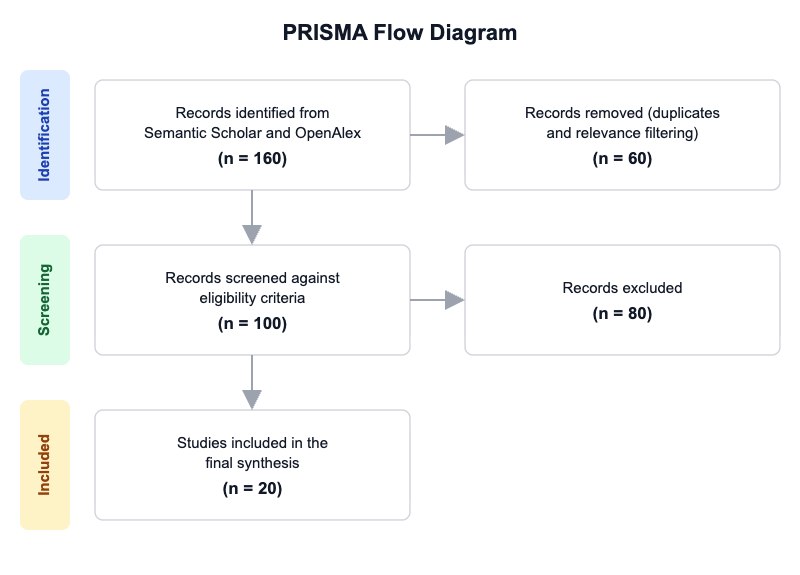
Initial database searching identified 160 records. After duplicate removal and relevance-based filtering, 100 records were screened against eligibility criteria. Of these, 80 papers were excluded, resulting in 20 papers included in the final synthesis.
PRISMA Flow Diagram
Eligibility criteria included:
- Human Subjects: Does the study involve human participants rather than animal, cell, or laboratory-only models?
- HRT Focus: Does the study investigate hormone replacement therapy, menopausal hormone therapy, or estrogen/progestogen-based treatment?
- Recent Evidence: Was the study published from 2020 onward?
- Menopause Context: Does the study focus on menopause, perimenopause, or postmenopausal care?
- Clinical Outcomes: Does the study report clinical outcomes such as symptoms, bone health, cardiovascular events, cancer risk, mood, or quality of life?
- Safety Reporting: Does the study report adverse events, harms, or risk outcomes?
- Comparative Evidence: Does the study compare hormone therapy with placebo, no treatment, or another active treatment?
- Evidence Type: Is the study a clinical trial, observational study, guideline, systematic review, or meta-analysis rather than a purely editorial piece?
All included studies met the stated eligibility criteria.
2.3 Data Extraction and Synthesis
Data extraction focused on the following variables:
- Population: Extract the participant group, including menopausal status, age range, and any key inclusion criteria.
- Therapy Type: Extract the hormone replacement therapy type, formulation, route, and whether it is conventional or bioidentical.
- Comparator: Extract the control/comparison condition if reported, such as placebo, no treatment, or alternative therapy.
- Outcomes: Extract the main outcomes studied, such as vasomotor symptoms, bone density, cardiovascular outcomes, breast cancer risk, mood, or quality of life.
- Key Findings: Summarize the main results and authors' conclusions relevant to hormone replacement therapy.
- Safety: Extract reported adverse events, safety signals, or risk findings, especially cardiovascular, thrombotic, and cancer-related outcomes.
- Study Design: Extract the study design, setting, sample size, and follow-up duration.
- Recency/Context: Extract whether the paper is a trial, observational study, systematic review, guideline, or narrative review, and note any special context such as postmenopausal care or menopause management.
Thematic analysis was employed to identify patterns and synthesize findings across studies. Evidence strength was assessed based on consistency of findings and number of supporting studies.
3. Results
3.1 Characteristics of Included Studies
| Study and Year | Study Type | Population | Therapy / Comparator | Main Focus |
|---|---|---|---|---|
| Chlebowski et al. 2020 [1] | Long-term follow-up of randomized clinical trials | Postmenopausal women with prior randomized exposure | CEE alone or CEE plus MPA vs placebo | Breast cancer incidence and mortality |
| Flores et al. 2021 [2] | Narrative review | Recently menopausal women with moderate to severe symptoms | HT; comparative framework from WHI and other trials | Symptom control, bone health, cardiovascular outcomes, mortality |
| Faubion et al. 2022 [3] | Position statement | Women younger than 60 years or within 10 years of menopause onset; women with GSM | Systemic HT; low-dose vaginal estrogen; other local options | Efficacy, timing, individualized risk-benefit assessment |
| Zhang et al. 2021 [4] | Umbrella review | Women experiencing menopause | MHT, ET, EPT | Benefits and harms across women’s health outcomes |
| Madsen et al. 2023 [5] | Narrative review | Women with menopausal symptoms | Estrogen, progestogen combinations, low-dose vaginal estrogen, nonhormonal therapies | Symptom management and safety |
| NAMS 2020 [6] | Position statement | Postmenopausal women with GSM | Nonhormonal therapies, low-dose vaginal estrogen, vaginal DHEA, systemic estrogen, ospemifene | GSM management and safety |
| Levy and Simon 2024 [7] | Narrative review | Perimenopausal and menopausal women | Contemporary MHT formulations | Individualized prescribing |
| Cho et al. 2023 [8] | Narrative review | Menopausal women with bothersome symptoms and cardiovascular risk | HT with emphasis on selection and formulation | Cardiovascular risk and patient selection |
| Vinogradova et al. 2020 [9] | Nested case-control studies | Women aged 50-79 | HRT formulations vs never use | Breast cancer risk |
| Crandall et al. 2023 [10] | Narrative review | Postmenopausal women | HT for vasomotor symptoms; vaginal estrogen for GSM | Symptom efficacy and prevention limits |
| Mehta et al. 2021 [11] | Narrative review | Healthy women less than 60 or within 10 years from menopause | HT types/routes/formulations | Risks and benefits by outcome |
| Davis and Baber 2022 [12] | Narrative review | Women with natural or iatrogenic menopause, including early/premature menopause | MHT and pharmaceutical alternatives | Contemporary use and long-term sequelae |
| Shufelt et al. 2023 [13] | Position statement | Menopausal women within 10 years of final menstrual period | Nonhormone options when HT unsuitable | Vasomotor symptom management |
| Vigneswaran and Hamoda 2022 [14] | Narrative review | Perimenopausal and postmenopausal women | HRT; current recommendations | Symptom relief and long-term health |
| Gosset et al. 2021 [15] | Narrative review | Postmenopausal women at low/moderate fracture risk | MHT | Osteoporosis prevention |
| Armeni et al. 2021 [16] | Narrative review | Women in menopause transition and POI | HRT/MHT regimens | Initiation, monitoring, discontinuation |
| Johansson et al. 2024 [17] | Nationwide register-based emulated target trial | Postmenopausal women | Oral oestrogen-progestin therapy; tibolone | Cardiovascular disease risk |
| Abenhaim et al. 2022 [18] | Population-based case-control study | Women aged 50 years or older | Bioidentical estrogens, animal-derived estrogens, micronized progesterone, synthetic progestin vs never use | Breast cancer risk by formulation |
| Panay et al. 2024 [19] | White paper / narrative review | Women experiencing menopause | MHT across types, doses, timing | Controversies, ethics, access, and prescribing principles |
| Duralde et al. 2023 [20] | Narrative review | Women in menopause transition or postmenopause, typically below 60 and within 10 years of menopause onset | Estrogen-based hormonal therapies | Symptom management and quality of life |
The evidence base is dominated by expert reviews and position statements, supplemented by large observational studies and long-term follow-up of randomized trials. Across studies, the population most often discussed is the early postmenopausal or recently menopausal woman, although several papers also address women with genitourinary syndrome of menopause, cardiovascular risk, osteoporosis risk, or premature ovarian insufficiency. Outcomes cluster around symptom relief, bone protection, and formulation-specific harms, especially breast cancer and cardiovascular events.
3.2 Thematic Findings
3.2.1 Symptom relief is the clearest and most consistent benefit, especially for vasomotor and genitourinary symptoms
The most robust signal across the literature is that estrogen-based hormone therapy remains the most effective treatment for menopausal vasomotor symptoms, with systemic estrogen reducing symptom frequency by approximately 75% [10], [20]. This benefit extends to genitourinary syndrome of menopause, where low-dose vaginal estrogen, vaginal DHEA, and ospemifene are repeatedly identified as effective options for symptom improvement and sexual health, particularly when symptoms are moderate to severe [6], [10]. The magnitude of response is clinically meaningful: low-dose vaginal estrogen improves GSM severity by approximately 60% to 80%, vaginal prasterone by 40% to 80%, and oral ospemifene by 30% to 50% [10]. Oral and transdermal estrogen appear similarly effective for vasomotor symptoms [10], suggesting that route selection may be driven more by risk profile and preferences than by efficacy alone.
Importantly, this symptomatic benefit is not limited to systemic therapy. The evidence base also supports nonhormonal options, especially for women who cannot or do not wish to use hormone therapy. Nonhormonal medications reduce vasomotor symptom frequency by approximately 40% to 65% [10], which is less than estrogen but still clinically useful. Taken together, these findings indicate that the symptom-control hierarchy is stable: systemic estrogen is most potent, local therapy is highly effective for GSM, and nonhormonal therapy provides a meaningful alternative when hormone therapy is contraindicated or undesired. Confidence: Strong.
3.2.2 Benefit-risk balance is strongly moderated by timing, age, and comorbidity
A second consistent pattern is that clinical benefit is concentrated in women who initiate therapy close to menopause. Women younger than 60 years or within 10 years of menopause onset generally have a favorable benefit-risk ratio for bothersome vasomotor symptoms and bone loss prevention [3], [11], [20]. By contrast, initiation more than 10 years after menopause or after age 60 is associated with less favorable risk profiles, especially for coronary heart disease, stroke, venous thromboembolism, and dementia [3]. This timing effect is not presented as a trivial subgroup difference; rather, it is treated across position statements and reviews as a core principle of current prescribing.
These findings matter because they reframe hormone therapy from a universal exposure to a context-dependent intervention. Women with bothersome symptoms and fewer comorbidities appear to gain the most, whereas later initiation shifts the balance toward harm. The literature also suggests that early menopause itself changes the equation: early or premature menopause is associated with increased risks of osteoporosis, cardiovascular disease, and premature death, strengthening the rationale for earlier hormone replacement in selected women [12], [16]. Confidence: Strong.
3.2.3 Breast cancer risk is formulation-dependent, with combined regimens and synthetic progestins driving the clearest harms
The breast cancer literature is more nuanced than earlier broad warnings implied. Large observational studies and randomized-trial follow-up converge on the finding that risk depends heavily on whether estrogen is opposed by a progestogen and on the type of progestogen used. In long-term follow-up of randomized trials, CEE alone was associated with lower breast cancer incidence and lower mortality, whereas CEE plus MPA increased breast cancer incidence without significantly changing mortality [1]. In observational work, recent long-term use of oestrogen only therapy was associated with an adjusted odds ratio of 1.15 (95% CI 1.09-1.21), while combined oestrogen and progestogen therapy showed an adjusted odds ratio of 1.79 (95% CI 1.73-1.85) [9]. Formulation-level analyses further indicate that synthetic progestins carry greater risk than micronized progesterone: menopausal hormone therapy overall was associated with breast cancer risk of OR 1.12 (95% CI 1.09-1.15), but synthetic progestin was associated with OR 1.28 (95% CI 1.22-1.35), whereas micronized progesterone was not clearly associated with increased risk [OR 0.99, 95% CI 0.55-1.79] [18].
The pattern is internally consistent despite differences in design and exposure definitions. The strongest signal of harm is not estrogen alone, but estrogen combined with certain progestogens, especially synthetic progestins. However, null estimates for bioidentical or animal-derived estrogens [OR 1.04, 95% CI 1.00-1.09; OR 1.01, 95% CI 0.96-1.06] complicate any class-wide assertion that all menopausal hormone therapies elevate breast cancer risk equally [18]. Confidence: Strong for the direction of progestogen-related risk; Moderate for direct safety ranking of specific estrogens because confidence intervals are close to the null and formulation comparisons remain observational.
3.2.4 Cardiovascular and thrombotic risk also varies by formulation and route, with oral combined therapy appearing less favorable
Cardiovascular safety is another domain where formulation matters. Reviews consistently warn that hormone therapy is not indicated for prevention of cardiovascular disease, and later initiation is associated with less favorable risk [3], [8]. Observational evidence adds specificity: oral oestrogen-progestin therapy was associated with increased risk of heart disease and venous thromboembolism, whereas tibolone was associated with increased ischaemic heart disease, cerebral infarction, and myocardial infarction but not venous thromboembolism [17]. The signal is therefore not merely “HT is risky,” but rather that distinct hormone combinations have distinct cardiovascular profiles.
This is aligned with narrative guidance that oral and transdermal routes may differ in safety even when efficacy is similar [3], [2]. However, direct comparative effect estimates are not consistently reported in the available data, and many papers emphasize individualized risk assessment without providing trial-level cardiovascular incidence estimates. That makes the evidence directional rather than fully quantified. Confidence: Moderate.
3.2.5 Bone protection is an established benefit, especially early after menopause, but long-term strategy remains individualized
Bone outcomes form one of the most stable non-symptom benefits. Menopausal hormone therapy prevents bone loss, preserves bone microarchitecture, and reduces fracture risk by 20% to 40% [15]. Position statements and reviews converge that hormone therapy can prevent bone loss and fracture, especially in women younger than 60 or within 10 years of menopause onset [3], [2]. The osteoporosis literature is notable for framing MHT as the only anti-osteoporotic therapy with proven efficacy regardless of baseline fracture risk, while still recommending periodic reassessment and transition to other therapies when the benefit-risk balance becomes less favorable [15].
This creates a clinically important synthesis: hormone therapy is most attractive in early postmenopause when symptom burden and accelerated bone loss overlap, but it should not be viewed as a one-time “bone solution” for all women indefinitely. Confidence: Strong.
3.3 Summary of Evidence
| Theme | Key Finding | Population Applicability | Effect Direction | Confidence Level | Supporting Studies |
|---|---|---|---|---|---|
| Vasomotor symptom control | Systemic estrogen reduces vasomotor symptoms by approximately 75%; nonhormonal agents reduce frequency by approximately 40% to 65% | Women with bothersome menopausal vasomotor symptoms, especially recently menopausal women | Positive | Strong | Crandall et al. [10], Duralde et al. [20], Madsen et al. [5] |
| Genitourinary syndrome of menopause | Low-dose vaginal estrogen improves GSM severity by approximately 60% to 80% | Postmenopausal women with GSM | Positive | Strong | Flores et al. [2], NAMS [6], Crandall et al. [10] |
| Timing and age effects | Benefit-risk ratio is favorable for women younger than 60 years or within 10 years of menopause onset; later initiation is less favorable | Recently menopausal women; partially matches broader postmenopausal populations | Mixed by timing | Strong | Faubion et al. [3], Mehta et al. [11], Cho et al. [8] |
| Breast cancer risk by regimen | Combined oestrogen-progestogen therapy showed OR 1.79 (95% CI 1.73-1.85); oestrogen-only therapy showed OR 1.15 (95% CI 1.09-1.21) | Postmenopausal women using HRT; aligns closely with question population | Negative for combined regimens | Strong | Vinogradova et al. [9], Chlebowski et al. [1], Abenhaim et al. [18] |
| Progestogen formulation | Synthetic progestin was associated with OR 1.28 (95% CI 1.22-1.35), while micronized progesterone showed OR 0.99 (95% CI 0.55-1.79) | Women requiring a progestogen component | Mixed | Moderate | Abenhaim et al. [18], Chlebowski et al. [1] |
| Cardiovascular and thrombotic risk | Oral oestrogen-progestin therapy increased risk of heart disease and venous thromboembolism; tibolone increased ischaemic heart disease, cerebral infarction, and myocardial infarction | Postmenopausal women receiving systemic therapy | Negative for some regimens | Moderate | Johansson et al. [17], Faubion et al. [3], Cho et al. [8] |
| Bone protection | MHT reduces fracture risk by 20% to 40% and prevents bone loss | Postmenopausal women, especially early postmenopause or low/moderate fracture risk | Positive | Strong | Gosset et al. [15], Faubion et al. [3], Mehta et al. [11] |
4. Discussion
4.1 Principal Findings and Their Interpretation
This synthesis shows that recent hormone replacement therapy research has moved decisively toward precision in prescribing rather than debating whether hormone therapy is broadly “good” or “bad.” The most defensible conclusion is that estrogen-based therapy remains highly effective for vasomotor symptoms and GSM, while the safety profile depends strongly on timing, route, and especially whether the regimen contains a synthetic progestin. This pattern is biologically plausible: estrogen replacement addresses the direct endocrine deficiency underlying vasomotor instability and urogenital atrophy, whereas adding progestogens appears to be the key inflection point for breast cancer risk in several datasets [9], [3]. The same logic likely applies to cardiovascular risk, where oral combined therapy and tibolone show less favorable profiles than the symptom-focused benefits might suggest [17].
The synthesis also clarifies that the field is not one of simple contradiction between efficacy and harm, but of outcome-specific tradeoffs. Bone protection is consistent and comparatively robust, especially in early postmenopause, which helps explain why current guidance supports hormone therapy in selected younger women with symptoms and fracture concerns [3], [11]. In contrast, breast cancer and cardiovascular outcomes are more sensitive to exposure characteristics and thus less generalizable across all formulations. That difference in robustness matters: symptom relief and bone preservation are supported by converging clinical guidance and trial-informed reviews, whereas formulation-level safety rankings rely more heavily on observational designs and thus deserve somewhat lower confidence. The literature as a whole therefore supports a selective, individualized model of hormone therapy rather than class-wide assumptions.
4.2 Comparison with Existing Literature and Resolution of Contradictions
The recent literature largely aligns with the post-WHI move toward timing-based prescribing, and that agreement is meaningful because it bridges symptom efficacy, chronic disease prevention, and harm minimization into one coherent framework [2], [3]. What appears at first like conflicting evidence on breast cancer risk is better understood as exposure heterogeneity: estrogen-only regimens, combined regimens, and different progestogens do not behave equivalently. The apparent null or near-null findings for some estrogen formulations, especially bioidentical or animal-derived estrogens in formulation-specific analyses, likely reflect the fact that the excess risk is not driven by estrogen alone but by opposing the endometrium with certain progestogens [9], [18]. That interpretation is reinforced by the lower or absent risk signals for micronized progesterone compared with synthetic progestins [18].
The cardiovascular evidence is more difficult to reconcile because several papers emphasize caution without giving comparable effect estimates, while the Swedish emulated target trial reports explicit risk increases for oral oestrogen-progestin therapy and tibolone [17]. This does not necessarily contradict the favorable timing-based guidance; rather, it suggests that even in women for whom hormone therapy is reasonable, route and formulation may still materially alter vascular risk. Methodological differences also matter: observational designs can detect rare harms and compare real-world regimens, whereas position statements synthesize broader evidence and are constrained by the absence of head-to-head randomized trials for many modern formulations. Publication bias is plausible, but the convergence of harms across independent observational studies and long-term trial follow-up makes the key risk signals difficult to dismiss as selective reporting alone [9], [17]. What remains unresolved is not whether risks exist, but how finely they can be stratified across the increasingly diverse hormone products used in practice.
4.3 Practical Implications
For clinicians, the evidence supports hormone therapy as first-line treatment for bothersome vasomotor symptoms and effective treatment for GSM, but only after matching regimen to patient profile. Women younger than 60 years or within 10 years of menopause onset, without major contraindications, are the clearest candidates for systemic therapy [3], [20]. Women with isolated GSM may often be managed with low-dose vaginal estrogen or other local therapies, reducing unnecessary systemic exposure [6]. When a progestogen is needed, the evidence suggests that micronized progesterone may be preferable to synthetic progestins from a breast cancer risk perspective, though this inference remains observational [18].
For patients with cardiovascular disease risk, oral oestrogen-progestin therapy and tibolone deserve caution because the contemporary evidence links them to higher rates of heart disease, venous thromboembolism, and ischemic events [17]. Public health messaging should therefore move away from blanket statements about “safe” or “unsafe” hormone therapy and instead emphasize regimen-specific counseling, periodic reassessment, and shared decision-making. Regulatory and formulary decisions should also recognize that not all hormones are equivalent, and that older trial-era generalizations based on CEE plus MPA should not be automatically extended to all estrogen products or delivery systems [7]. The practical implication is not abandonment of hormone therapy, but more selective use with clearer risk stratification.
4.4 Strengths and Limitations
This review benefits from a contemporary evidence base that includes large observational datasets, long-term randomized follow-up, and multiple authoritative syntheses and position statements. The convergence across designs strengthens confidence in symptom efficacy and in the importance of timing, while also highlighting formulation-specific harms. The main limitation of the included literature is heavy reliance on narrative reviews and guidance documents, which synthesize rather than generate new comparative data. Several studies also focus on selected populations such as women within 10 years of menopause onset, women with GSM, or women at low/moderate fracture risk, which limits direct generalizability.
The review itself is limited by abstract-based extraction and the absence of formal risk-of-bias assessment. Some studies report no comparator or do not specify route, dose, or duration in the abstract, restricting precision of cross-study comparisons. Nonetheless, the evidence is sufficiently coherent to support clinically meaningful conclusions about efficacy, timing, and regimen-specific safety.
5. Gaps and Future Directions
The clearest gap is the shortage of direct comparative evidence for newer, commonly used formulations and routes, especially in women who are not the “ideal” candidate described in guidelines. More randomized or well-controlled pragmatic studies are needed to compare transdermal versus oral estrogen, micronized progesterone versus synthetic progestins, and tibolone versus standard systemic therapy with long-term cardiovascular and cancer endpoints. Current evidence also remains thin for women with prior breast cancer, established cardiovascular disease, and those beyond 10 years from menopause onset, despite these groups being central to real-world decision-making [6], [3].
Future studies should harmonize exposure definitions, include exact dose and duration data, and report outcomes using comparable adjudication methods. This is especially important for breast cancer, where apparent safety differences may reflect formulation rather than class effects [9], [18]. Longer follow-up is also needed for vaginal estrogen, vaginal DHEA, and ospemifene, because current endometrial safety data do not extend beyond 1 year in the available guidance [6]. Finally, research on symptom burden should better integrate quality of life, sleep, sexual function, and metabolic outcomes rather than focusing narrowly on vasomotor symptoms alone.
6. Conclusion
The recent literature supports hormone replacement therapy as an effective and clinically important treatment for menopausal symptoms, particularly vasomotor symptoms and genitourinary syndrome of menopause, while also confirming meaningful benefits for bone preservation [3], [10]. The strongest conclusion is not that hormone therapy is uniformly safe or unsafe, but that benefit-risk balance depends on timing, formulation, and patient profile. Women younger than 60 years or within 10 years of menopause onset generally have the most favorable profile [3], whereas later initiation carries higher absolute risks. Breast cancer risk is most clearly elevated with combined regimens, especially those containing synthetic progestins, with long-term recent use of oestrogen-progestogen therapy associated with OR 1.79 (95% CI 1.73-1.85) and oestrogen-only therapy with OR 1.15 (95% CI 1.09-1.21) [9]. Cardiovascular risk likewise differs by regimen, with oral oestrogen-progestin therapy and tibolone showing less favorable profiles [17].
This evidence applies most directly to postmenopausal and recently menopausal women, but several findings are still drawn from proxy populations such as women with GSM, women at low fracture risk, or women with elevated cardiovascular concern. The single most important unresolved question is how to generate direct, long-term comparative safety data for modern formulations in the women most likely to use them in practice. Answering that question would refine individualized prescribing and improve both symptom relief and risk prevention. More broadly, these findings support a shift away from categorical warnings toward precise, patient-centered menopause care.
References
- Chlebowski, R. T., Anderson, G. L., Aragaki, A. K., Manson, J. E., Stefanick, M. L., Pan, K., Barrington, W. E., Kuller, L. H., Simon, M. S., Lane, D. S., Johnson, K., Rohan, T. E., Gass, M. L. S., Cauley, J. A., Paskett, E. D., Sattari, M., & Prentice, R. L. (2020). Association of menopausal hormone therapy with breast cancer incidence and mortality during long-term follow-up of the Women's Health Initiative randomized clinical trials. JAMA, 324(4), 369–380. https://doi.org/10.1001/jama.2020.9482
- Flores, V. A., Pal, L., & Manson, J. E. (2021). Hormone therapy in menopause: Concepts, controversies, and approach to treatment. Endocrine Reviews, 42(6), 720–752. https://doi.org/10.1210/endrev/bnab011
- The 2022 Hormone Therapy Position Statement Advisory Panel. (2022). The 2022 hormone therapy position statement of The North American Menopause Society. Menopause, 29(7), 767–794. https://doi.org/10.1097/GME.0000000000002028
- Zhang, G.-Q., Chen, J.-L., Luo, Y., Mathur, M. B., Anagnostis, P., Nurmatov, U., Talibov, M., Zhang, J., Hawrylowicz, C. M., Lumsden, M. A., Critchley, H., Sheikh, A., Lundbäck, B., Lässer, C., Kankaanranta, H., Lee, S. H., & Nwaru, B. I. (2021). Menopausal hormone therapy and women's health: An umbrella review. PLOS Medicine, 18(8), e1003731. https://doi.org/10.1371/journal.pmed.1003731
- Madsen, T. E., Sobel, T., Negash, S., Shrout, T. A., Stefanick, M. L., Manson, J. E., & Allison, M. (2023). A review of hormone and non-hormonal therapy options for the treatment of menopause. International Journal of Women's Health, 15, 825–836. https://doi.org/10.2147/IJWH.S379808
- The 2020 Genitourinary Syndrome of Menopause Position Statement Advisory Panel. (2020). The 2020 genitourinary syndrome of menopause position statement of The North American Menopause Society. Menopause, 27(9), 976–992. https://doi.org/10.1097/GME.0000000000001609
- Levy, B., & Simon, J. A. (2024). A contemporary view of menopausal hormone therapy. Obstetrics & Gynecology, 144(1), 12–23. https://doi.org/10.1097/AOG.0000000000005553
- Cho, L., Kaunitz, A. M., Faubion, S. S., Hayes, S. N., Lau, E. S., Pristera, N., Scott, N., Shifren, J. L., Shufelt, C. L., Stuenkel, C. A., Lindley, K. J., & ACC CVD in Women Committee. (2023). Rethinking menopausal hormone therapy: For whom, what, when, and how long? Circulation, 147(7), 597–610. https://doi.org/10.1161/CIRCULATIONAHA.122.061559
- Vinogradova, Y., Coupland, C., & Hippisley-Cox, J. (2020). Use of hormone replacement therapy and risk of breast cancer: Nested case-control studies using the QResearch and CPRD databases. BMJ, 371, m3873. https://doi.org/10.1136/bmj.m3873
- Crandall, C. J., Mehta, J. M., & Manson, J. E. (2023). Management of menopausal symptoms: A review. JAMA, 329(5), 405–420. https://doi.org/10.1001/jama.2022.24140
- Mehta, J., Kling, J. M., & Manson, J. E. (2021). Risks, benefits, and treatment modalities of menopausal hormone therapy: Current concepts. Frontiers in Endocrinology, 12, 564781. https://doi.org/10.3389/fendo.2021.564781
- Davis, S. R., & Baber, R. J. (2022). Treating menopause — MHT and beyond. Nature Reviews Endocrinology, 18(8), 490–502. https://doi.org/10.1038/s41574-022-00685-4
- The 2023 Nonhormone Therapy Position Statement Advisory Panel. (2023). The 2023 nonhormone therapy position statement of The North American Menopause Society. Menopause, 30(6), 573–590. https://doi.org/10.1097/GME.0000000000002200
- Vigneswaran, K., & Hamoda, H. (2022). Hormone replacement therapy – Current recommendations. Best Practice & Research Clinical Obstetrics & Gynaecology, 81, 8–21. https://doi.org/10.1016/j.bpobgyn.2021.12.001
- Gosset, A., Pouillès, J.-M., & Trémollieres, F. (2021). Menopausal hormone therapy for the management of osteoporosis. Best Practice & Research Clinical Endocrinology & Metabolism, 35(6), 101551. https://doi.org/10.1016/j.beem.2021.101551
- Armeni, E., Paschou, S. A., Goulis, D. G., & Lambrinoudaki, I. (2021). Hormone therapy regimens for managing the menopause and premature ovarian insufficiency. Best Practice & Research Clinical Endocrinology & Metabolism, 35(6), 101561. https://doi.org/10.1016/j.beem.2021.101561
- Johansson, T., Karlsson, T., Bliuc, D., Schmitz, D., Ek, W. E., Skalkidou, A., & Johansson, Å. (2024). Contemporary menopausal hormone therapy and risk of cardiovascular disease: Swedish nationwide register based emulated target trial. BMJ, 387, e078784. https://doi.org/10.1136/bmj-2023-078784
- Abenhaim, H. A., Suissa, S., Azoulay, L., Spence, A. R., Czuzoj-Shulman, N., & Tulandi, T. (2022). Menopausal hormone therapy formulation and breast cancer risk. Obstetrics & Gynecology, 139(6), 1103–1110. https://doi.org/10.1097/AOG.0000000000004723
- Panay, N., Ang, S. B., Cheshire, R., Goldstein, S. R., Maki, P., Nappi, R. E., & International Menopause Society Board. (2024). Menopause and MHT in 2024: Addressing the key controversies – an International Menopause Society White Paper. Climacteric, 27(5), 441–457. https://doi.org/10.1080/13697137.2024.2394950
- Duralde, E. R., Sobel, T. H., & Manson, J. E. (2023). Management of perimenopausal and menopausal symptoms. BMJ, 382, e072612. https://doi.org/10.1136/bmj-2022-072612