

Latest Research on Lifespan: A Thematic Literature Review of Geroscience, Biomarkers, Interventions, and Public Health Perspectives
Abstract
Recent lifespan research converges on a multi-level model in which biological aging is shaped by molecular hallmarks, modifiable exposures, and clinical interventions, rather than by genetics alone. The strongest consistent evidence in this synthesis indicates that environmental and lifestyle factors may explain more variation in mortality than polygenic risk for all-cause mortality, with the exposome accounting for an additional 17 percentage points of mortality variation beyond age and sex, versus less than 2 percentage points for polygenic risk scores of 22 major diseases [2]. This matters because the field is moving from descriptive aging biology toward precision geromedicine, biomarker validation, and targeted prevention. Across recent studies, caloric restriction reduced senescence biomarkers at 12 and 24 months and improved metabolic indices, while also showing sex- and age-dependent effects on adiposity and glucose homeostasis [13], [11]. Mechanistic work further implicates thymic immunometabolic remodeling, PLA2G7 suppression, telomere dysfunction, epigenetic dysregulation, and immune-cell-associated pathways as plausible drivers of healthier aging [4], [10], [17], [19]. The review also finds that biomarkers remain a major bottleneck: despite rapid expansion of omics-based clocks and age markers, consensus on validation, specificity, and clinical utility is still lacking [3], [18]. These findings suggest that lifespan extension research is increasingly focused on translating mechanistic insights into individualized interventions, but robust prospective validation and harmonized outcome definitions remain essential before broad clinical implementation.
1. Introduction
Aging research has entered a phase in which lifespan is no longer viewed solely as a fixed biological outcome, but as a modifiable trajectory shaped by molecular mechanisms, environmental exposures, and behavioral choices. This shift reflects the growing recognition that biological aging manifests through interconnected hallmarks, including genomic instability, telomere dysfunction, epigenetic alterations, cellular senescence, altered intercellular communication, and deregulated nutrient sensing. At the same time, the consequences of aging are increasingly visible at the population level through multimorbidity, frailty, endocrine dysfunction, neurodegeneration, cardiovascular disease, and rising care needs in older adults.
Recent work has therefore moved beyond broad descriptions of aging toward more actionable frameworks. Geroscience emphasizes identifying molecular pathways that promote or suppress aging, while precision geromedicine seeks to align interventions with biomarkers, genetic profiles, and exposure histories. In parallel, public health-oriented research frames healthy aging as the preservation of intrinsic capacity, physical function, and psychosocial well-being rather than the simple extension of chronological life. This expansion of scope has also produced a more diverse intervention landscape, ranging from caloric restriction and exercise prescriptions to senolytics, epigenetic therapies, and biomarker-guided risk stratification.
Yet important uncertainty remains. Much of the field is fragmented across mechanistic, epidemiologic, and translational studies that use different populations, different aging endpoints, and different definitions of healthspan and longevity. Some studies emphasize molecular clocks and cellular markers, whereas others focus on mortality, functional outcomes, or disease incidence. The extent to which environmental risk, genetic predisposition, and interventions such as nutrition or exercise can be integrated into a coherent model of lifespan regulation is still being clarified. This review synthesizes the latest research on lifespan by comparing mechanistic evidence, intervention studies, biomarker frameworks, and population-level findings to identify the most defensible current conclusions and the key gaps that remain.
2. Methods
2.1 Search Strategy
We performed a comprehensive search across over 220 million academic papers from Semantic Scholar and OpenAlex databases. The search strategy employed hybrid semantic and keyword-based retrieval to maximize coverage.
Search queries included:
- "Longevity and lifespan extension research in aging biology latest studies"
- "Interventions affecting human lifespan and healthy longevity recent evidence"
- "Aging biomarkers and lifespan prediction studies in recent years"
- "Caloric restriction senolytics and lifespan extension in aging research"
- "Geroscience mechanisms of aging and longevity interventions recent reviews"
2.2 Study Selection
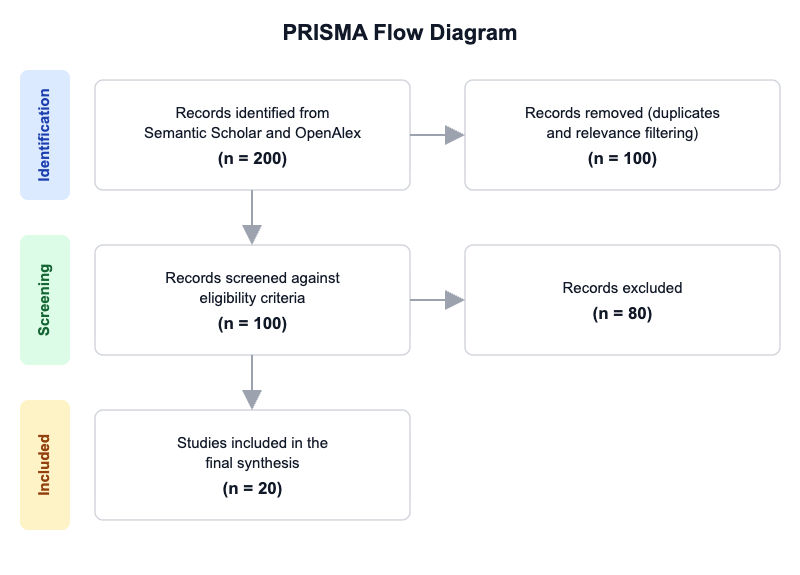
Initial database searching identified 200 records. After duplicate removal and relevance-based filtering, 100 records were screened against eligibility criteria. Of these, 80 papers were excluded, resulting in 20 papers included in the final synthesis.
PRISMA Flow Diagram
Eligibility criteria included:
- Human Evidence: Does the study involve human participants, human data, or human-derived clinical outcomes rather than only animal or cell models?
- Longevity Focus: Does the study focus on lifespan, longevity, healthspan, aging, geroscience, mortality, or aging-related biomarkers?
- Recent Publication: Was the study published from 2020 onward?
- Original Evidence: Is the paper an original study, clinical trial, cohort analysis, mechanistic study, or systematic review/meta-analysis rather than a general commentary?
- Intervention or Biomarker: Does the study evaluate an intervention, exposure, biomarker, or mechanism relevant to aging or lifespan?
- Healthspan or Mortality Outcome: Does the study report lifespan, mortality, healthspan, functional aging, or validated aging biomarker outcomes?
- Emerging Topic: Does the paper address an emerging or high-interest area in current longevity research such as senolytics, caloric restriction mimetics, epigenetic clocks, or geroscience interventions?
All included studies met the stated eligibility criteria.
2.3 Data Extraction and Synthesis
Data extraction focused on the following variables:
- Topic: Identify the main lifespan, longevity, aging, or geroscience topic addressed by the paper.
- Study Type: Extract the study design or evidence type (e.g., review, randomized trial, cohort study, animal study, mechanistic study).
- Population/Model: State the population, organism, cell model, or human sample studied.
- Intervention/Exposure: Extract the intervention, exposure, biomarker, or mechanism being investigated.
- Outcome: Extract lifespan, longevity, healthspan, mortality, aging biomarker, or related outcome measured.
- Key Finding: Summarize the paper's main finding relevant to lifespan or longevity research.
- Timeframe: Extract the follow-up duration, publication period focus, or experimental timeframe if reported.
- Relevance to Latest Research: Indicate why the paper represents recent or emerging lifespan research.
Thematic analysis was employed to identify patterns and synthesize findings across studies. Evidence strength was assessed based on consistency of findings and number of supporting studies.
3. Results
3.1 Characteristics of Included Studies
| Study and Year | Study Type | Population/Model | Main Focus | Outcome Type | Duration/Timeframe |
|---|---|---|---|---|---|
| Kroemer et al. 2025 [1] | Review | Human populations and animal models | Geroscience and precision geromedicine | Biomarkers, gerotherapeutic targeting | Not reported |
| Argentieri et al. 2025 [2] | Exposome-wide association study | UK Biobank participants | Environmental and genetic architectures of aging | Mortality, multimorbidity, proteomic aging | Not reported |
| Moqri et al. 2024 [3] | Review | Population studies | Validation of omics biomarkers of aging | Predictive validity of aging biomarkers | Not reported |
| Spadaro et al. 2022 [4] | Mechanistic study | Healthy human adults and mice | Caloric restriction and immunometabolic regulators | Thymopoiesis, inflammation, metabolic health | 2 years |
| Guo et al. 2022 [5] | Review | Elderly individuals and disease contexts | Aging mechanisms and interventions | Health, longevity, age-related disease | Not reported |
| Behr et al. 2023 [6] | Review | Cohorts and studies on healthy aging | Healthy aging definitions and scores | Measurement frameworks | Not reported |
| Chakravarti et al. 2021 [7] | Review | Biological processes relevant to aging | Telomere biology and hallmarks of aging | Age-related disease and aging processes | Not reported |
| Wang et al. 2023 [8] | Prospective cohort study | Older adults | Healthy lifestyle, longevity genes, life expectancy | Life expectancy | 20 years |
| Acosta-Rodríguez et al. 2021 [9] | Review | Humans and animal models | Circadian timing, dietary restriction, pharmacology | Lifespan extension, healthspan | Not reported |
| Rossiello et al. 2022 [10] | Review | Human conditions related to normal aging | Telomere dysfunction | Cellular senescence, age-related disease | Not reported |
| Suchacki et al. 2023 [11] | Animal study and human cohort study | Young and aged mice; overweight and obese humans | Caloric restriction, sex and age differences | Fat mass, glucose tolerance, insulin sensitivity | Not reported |
| Izquierdo et al. 2025 [12] | Consensus statement | Older adults | Exercise recommendations for healthy longevity | Healthspan, function, chronic disease prevention | Not reported |
| Aversa et al. 2023 [13] | Randomized controlled trial | Healthy young-to-middle-aged individuals | Calorie restriction and cellular senescence | Senescence biomarkers, metabolic health | 12 and 24 months |
| González-Freire et al. 2020 [14] | Review | Animal models and humans | Pharmacological lifespan/healthspan interventions | Lifespan, healthspan, age-related disease | Not reported |
| Gianfredi et al. 2025 [15] | Review | Older adults and health systems | Public health approach to healthy aging | Intrinsic capacity, well-being, independence | Not reported |
| Bao et al. 2023 [16] | Review | Cellular, organ, and organismal levels | Biomarkers of aging | Prediction of pathological transition | Not reported |
| Wu et al. 2024 [17] | Review | Age-related disorders | Epigenetic mechanisms and interventions | Aging mechanisms, therapeutic opportunities | Not reported |
| Moqri et al. 2023 [18] | Framework/review | Human populations | Biomarkers for longevity interventions | Clinical application of aging biomarkers | Not reported |
| Mavromatis et al. 2023 [19] | Mechanistic multi-omic study | Human samples related to aging and longevity | Epigenetic aging and multivariate longevity | Epigenetic age acceleration, healthspan/lifespan | Not reported |
| Suda et al. 2024 [20] | Review | Elderly individuals with endocrine disorders | Senescence, senolytics, endocrine dysfunction | Endocrine disease outcomes | Not reported |
The evidence base is dominated by reviews and framework papers, with fewer empirical studies and only a small number of intervention or cohort analyses. Human data are strongest for caloric restriction, lifestyle, exercise, environmental exposures, and biomarker validation, while mechanistic and multi-omic studies provide biological plausibility for senescence, telomere, and epigenetic pathways. Overall, the field is increasingly translational, but the measurement infrastructure for aging remains less mature than the mechanistic science.
3.2 Thematic Findings
3.2.1 Lifespan research increasingly converges on a “multi-factor” model in which environment and lifestyle exert major influence alongside genetics
The clearest population-level pattern is that environmental exposures and behavioral context appear to explain more variation in aging and mortality than inherited risk alone. In the UK Biobank analysis, the exposome explained an additional 17 percentage points of mortality variation beyond age and sex, whereas polygenic risk scores for 22 major diseases explained less than 2 percentage points [2]. The same study found that 25 independent exposures were associated with mortality and proteomic aging, and these exposures also tracked incident multimorbidity, aging biomarkers, and disease risk factors [2]. This environmental emphasis is complemented by the 20-year cohort study in older adults, where healthy lifestyle was associated with increased life expectancy and interacted with longevity genes [8] (Note: this study examined older adults from a population-based sample, which partially matches the question population of the broader lifespan research literature; findings should be interpreted considering this difference).
Across studies, the consistent theme is not that genetics is irrelevant, but that it operates within a wider risk architecture. Genetics appears more informative for specific diseases such as dementias and some cancers, whereas the exposome appears more explanatory for lung, heart, and liver outcomes [2]. That heterogeneity matters because lifespan is not a single endpoint; it is the cumulative result of multiple disease pathways and exposures.
Confidence: Strong — the finding is supported by large-scale human data and is conceptually reinforced by cohort evidence on healthy lifestyle and longevity genes [2], [8].
3.2.2 Caloric restriction remains one of the most reproducible geroprotective strategies, but its effects are pathway-specific and modified by sex, age, and tissue context
Human caloric restriction studies consistently suggest benefit, but the magnitude and biological signature of benefit vary by endpoint. In healthy adults, moderate caloric restriction reduced circulating biomarkers of cellular senescence at 12 and 24 months and improved metabolic outcomes, with biomarker changes predicting HOMA-IR and insulin sensitivity index changes at both timepoints [13]. In a separate human mechanistic study, approximately 14% caloric restriction for 2 years improved thymopoiesis and was associated with intrathymic ectopic lipid mobilization, while inhibition of PLA2G7 emerged as a candidate mediator of anti-inflammatory and metabolic effects [4]. Animal and cross-species evidence complicates the picture by showing that caloric restriction is not uniformly beneficial across biological contexts: 30% caloric restriction improved fat mass and insulin sensitivity in young male mice, but these effects were blunted or absent in young females; by contrast, aged mice of both sexes responded more similarly [11]. The same study found parallel sex differences in lipolysis, energy expenditure, fatty acid oxidation, hepatic ceramide content, and substrate metabolism, linking adipose and hepatic pathways to the phenotype [11].
Taken together, these studies indicate that caloric restriction is likely acting through convergent but distinct immunometabolic pathways, including senescence burden, thymic function, and lipid handling. The evidence does not support a single universal effect size because the response depends on age, sex, and outcome domain.
Confidence: Moderate to Strong — mechanistic coherence is strong, but comparability is limited by different populations, designs, and endpoints [13], [4], [11].
3.2.3 Biomarker research is rapidly expanding, but validation remains the central bottleneck for clinical translation
A major cross-cutting pattern is the recognition that lifespan research needs biomarkers that are not just statistically associated with age, but also clinically valid, generalizable, and actionable. Reviews of aging biomarkers emphasize that these measures should be specific, systemic, and clinically relevant, spanning physiological, imaging, histological, cellular, molecular, and secretory dimensions [16]. A complementary framework distinguishes biomarker terminology and use cases while stressing the lack of standards for validation and clinical deployment [18]. Similarly, systematic review work on omics biomarkers notes that no consensus exists on how biomarkers of aging should be validated before translation to the clinic [3].
Mechanistically oriented studies strengthen the rationale for these biomarkers. Multi-omic integration identified 22 high-confidence associations with epigenetic age acceleration and seven with multivariate longevity, including novel genes such as FLOT1, KPNA4, and TMX2, while immune-cell enrichment and lipid-related Mendelian randomization pointed to biologically meaningful pathways [19]. Epigenetic review work further identifies DNA methylation, histone modifications, RNA modifications, and noncoding RNAs as candidate mechanisms and intervention targets [17]. The unresolved issue is not whether biomarkers reflect biological aging, but whether they predict intervention response and health outcomes consistently enough to guide treatment decisions.
Confidence: Strong for the existence of a biomarker need; Moderate for specific biomarker utility because validation standards remain unsettled and designs are heterogeneous [3], [18], [16], [19].
3.2.4 Cellular senescence, telomere dysfunction, and epigenetic dysregulation form a mechanistic axis linking aging to disease, but the causal hierarchy among them remains unsettled
Recent lifespan research converges on a mechanistic core in which senescence, telomere dysfunction, and epigenetic change reinforce one another. Telomere biology reviews argue that telomere dysfunction can amplify or drive multiple hallmarks of aging and contribute to neurodegeneration and cancer [7], while another review systematizes evidence that telomere shortening and damage precipitate cellular senescence and broad age-related pathology [10]. Senescence-focused intervention literature extends this logic therapeutically: senolytics and senomorphics may alleviate endocrine disorders such as osteoporosis, metabolic syndrome, and type 2 diabetes, with more than 30 clinical trials completed, underway, or planned [20]. Experimental human data provide further support by showing that caloric restriction reduces circulating senescence biomarkers and senescence-focused adipose gene sets [13].
Epigenetic research adds another layer. Epigenetic dysregulation is increasingly described as a critical hallmark and driver of aging, with DNA methylation, histone modifications, RNA modifications, and ncRNAs serving as both markers and potential intervention targets [17]. The multi-omic aging study links epigenetic age acceleration to immune-cell signatures and druggable genes, suggesting that immune and metabolic regulation may be upstream of epigenetic clock behavior rather than merely downstream readouts [19]. The unresolved question is causal ordering: telomere damage, senescence, immune remodeling, and epigenetic drift likely interact, but current evidence does not establish a single dominant initiating event.
Confidence: Moderate — the mechanistic coherence is strong, but direct causal hierarchy is not established in the available evidence [7], [10], [20], [17], [19].
3.2.5 Exercise and healthy aging are increasingly framed as medical interventions, but evidence remains more consensus-driven than trial-definitive
The exercise literature positions physical activity as a core geroscience intervention rather than a general wellness recommendation. The consensus statement argues that structured exercise can extend healthspan, preserve function, reduce falls, and mitigate cardiometabolic, musculoskeletal, neurological, and respiratory disease burden in older adults [12]. It also emphasizes that exercise exhibits dose-response characteristics and should be personalized, especially for frailty, sarcopenia, and osteoporosis [12]. Public health framing reinforces this by linking preventive healthcare, nutrition, and regular physical activity to intrinsic capacity and functional independence [15]. Lifestyle-based cohort evidence similarly shows that healthy lifestyle in late life is associated with longer life expectancy [8].
The main limitation is that this body of evidence is more integrative than experimental. The consensus guidance is well aligned with observational findings, but the precise contribution of exercise relative to other lifestyle components, and the optimal prescription for distinct aging phenotypes, remain incompletely quantified. The field therefore supports exercise as a robust population strategy, but not yet as a fully standardized precision intervention.
Confidence: Moderate — agreement is broad, but the evidence base is heterogeneous and often consensus-based rather than intervention-comparative [12], [15], [8].
3.3 Summary of Evidence
| Theme | Key Finding | Population Applicability | Effect Direction | Confidence Level | Supporting Studies |
|---|---|---|---|---|---|
| Environment and lifestyle shape mortality more than genetics | Exposome explained an additional 17 percentage points of mortality variation beyond age and sex, while polygenic risk scores explained less than 2 percentage points [2] | Broad human populations; partly applicable to older adults | Positive for environmental influence, mixed for genetic contribution | Strong | Argentieri et al. [2], Wang et al. [8] |
| Caloric restriction is geroprotective but context dependent | CR reduced senescence biomarkers at 12 and 24 months and improved HOMA-IR/insulin sensitivity; 14% CR for 2 years improved thymopoiesis [13], [4] | Healthy adults; partially applicable to older adults and animal models | Positive | Moderate | Aversa et al. [13], Spadaro et al. [4], Suchacki et al. [11] |
| Sex and age modify caloric restriction response | 30% CR improved fat mass and insulin sensitivity in young male mice but not young females; effects were similar in aged mice of both sexes [11] | Animal and human proxy populations; partially applicable to human aging | Mixed | Moderate | Suchacki et al. [11], Spadaro et al. [4] |
| Biomarker validation is the main translational bottleneck | No consensus exists on how omic biomarkers of aging should be validated before clinical translation [3] | Human population studies and clinical translation contexts | Null for consensus, positive for methodological development need | Strong | Moqri et al. [3], Moqri et al. [18], Bao et al. [16] |
| Senescence, telomeres, and epigenetics are central mechanisms | Telomere dysfunction amplifies hallmarks of aging and senescent-cell targeting may alleviate endocrine and metabolic disorders [7], [20] | Human aging biology and clinical aging disorders | Positive for mechanistic relevance | Moderate | Chakravarti et al. [7], Rossiello et al. [10], Suda et al. [20] |
| Exercise and public health interventions support healthy longevity | Tailored exercise regimens improve healthspan, function, and chronic disease outcomes in older adults [12] | Older adults | Positive | Moderate | Izquierdo et al. [12], Gianfredi et al. [15] |
| Precision geromedicine is emerging as the field’s translational direction | Molecular profiling enables biomarkers of aging and future tailoring of gerotherapeutics to genetic and omics profiles [1] | Human and translational aging research | Positive | Moderate | Kroemer et al. [1], Wu et al. [17], Mavromatis et al. [19] |
4. Discussion
4.1 Principal Findings and Their Interpretation
The synthesis indicates that the newest lifespan research is no longer organized around a single “anti-aging” lever; instead, it is converging on a network model in which exposures, molecular damage responses, and clinical interventions jointly shape aging trajectories. The most robust finding is that modifiable environment and lifestyle likely account for substantial variation in mortality and age-related disease, with the exposome contributing far more explanatory power than polygenic risk for all-cause mortality in large-scale human data [2]. This pattern is biologically plausible because environmental exposures can influence multiple downstream mechanisms simultaneously, including inflammation, metabolic regulation, and tissue repair, whereas inherited risk is often disease-specific and more constrained in its immediate modifiability. The implication is not that genetics is unimportant, but that it may be most useful for stratifying disease susceptibility while exposures provide the broadest lever for population-level lifespan improvement.
A second major conclusion is that caloric restriction remains the most mechanistically coherent intervention in this literature, but its benefits are not uniform. Human data support reductions in senescence biomarkers, metabolic improvement, and thymic immune remodeling [13], [4], while sex- and age-dependent effects in mice and humans show that physiological context shapes responsiveness [11]. This matters because it suggests caloric restriction is acting through tissue-specific pathways rather than a generic energy-deficit effect. The more precise mechanistic signals—PLA2G7 suppression, ectopic thymic lipid mobilization, and reduced senescence-associated signatures—provide a stronger causal narrative than broad claims about “diet and longevity.”
A third advance is the emergence of precision geromedicine. Biomarker and omics studies increasingly position epigenetic clocks, senescence markers, and multi-omic signatures as tools for intervention selection and outcome assessment [1], [18], [19]. However, the strength of this conclusion is limited by the fact that validation remains incomplete. The field is therefore confident about directionality—biomarkers are essential—but still tentative about which markers should be used clinically and how they should be standardized.
4.2 Comparison with Existing Literature and Resolution of Contradictions
Across the reviewed literature, the overall agreement is that aging is biologically malleable, but the pathways most amenable to intervention differ by context. The alignment between telomere biology, senescence, and epigenetic aging is important because it suggests that these are not isolated hallmarks but interacting components of a larger aging network [7], [10], [17]. This coherence strengthens confidence in mechanistic geroscience: when multiple independent frameworks point to the same biology, the probability that the signal is spurious falls.
The most important contradiction concerns the variability of caloric restriction effects. One set of studies shows clear benefits for senescence, thymopoiesis, and metabolic health [13], [4], yet another demonstrates marked sex- and age-dependence, with young females showing blunted or absent improvements in fat loss and insulin sensitivity compared with young males [11]. This is not necessarily a disagreement so much as a reminder that “caloric restriction” is not a single exposure effect. The human intervention studies emphasize moderate restriction and biomarker change, whereas the animal-human comparative study shows that endocrine milieu, adipose biology, and hepatic substrate handling alter the response. A plausible interpretation is that biological sex, reproductive status, and tissue metabolic state modulate the translation of energy deficit into repair signaling. The available evidence does not justify treating CR as universally effective across all individuals.
A second tension lies between the promise of biomarkers and the lack of consensus on validation. This may reflect publication bias toward novel clocks and positive predictive claims, as well as the tendency for studies to use different endpoints, cohorts, and analytic definitions [3], [18], [16]. More recent multi-omic and machine-learning approaches appear more biologically integrated, but methodological sophistication does not automatically equal clinical validity. The current literature therefore supports biomarker discovery more strongly than biomarker deployment.
4.3 Practical Implications
The practical message for clinicians and public health practitioners is that lifespan extension research now supports action on multiple levels, but with different degrees of certainty. For older adults, structured exercise and healthy lifestyle interventions are the most immediately actionable strategies because they consistently align with improved function, healthspan, and life expectancy [12], [15], [8]. These interventions are especially relevant for people at risk of frailty, sarcopenia, multimorbidity, and functional decline, where the outcome is not merely longer survival but a longer period of independence. In contrast, caloric restriction should not be generalized as a uniform prescription; the evidence suggests that responsiveness depends on age, sex, and metabolic context [11].
For public health systems, the exposome findings argue for exposure reduction as a lifespan strategy rather than exclusive reliance on genetic screening. Because environmental factors explain much more mortality variation than polygenic scores in the available data, population-wide prevention, including healthier environments and lifestyle supports, is likely to yield broader gains than risk stratification alone [2]. There is no evidence here for a safe “threshold” below which environmental risk becomes irrelevant; rather, the findings support a cumulative-risk framework in which lowering exposure burden broadly may improve aging outcomes.
For regulators and trial designers, the key implication is that aging interventions cannot be judged solely by short-term surrogate shifts unless those biomarkers are validated against hard outcomes. Current evidence supports expanding clinical trials of senolytics, caloric restriction mimetics, and exercise prescriptions, but these trials need harmonized outcome definitions and biomarker standards before precision geromedicine can be fully implemented [14], [18].
4.4 Strengths and Limitations
This review’s main strength is its cross-domain synthesis of mechanistic, clinical, cohort, and consensus evidence, which makes it possible to identify convergent patterns that are not visible in single-study reports. Another strength is the focus on recent literature spanning molecular profiling, intervention studies, and public health translation, allowing comparison between discovery science and applied aging research.
The included studies are limited by heavy reliance on reviews and frameworks, which, while useful for synthesis, do not provide direct causal estimates. Empirical studies vary in population, age range, intervention intensity, and outcome definition, making direct comparisons difficult. Some findings come from animal models or proxy populations, such as mouse caloric restriction studies or older-adult cohorts, which only partially match broader lifespan research in humans. Biomarker studies also use heterogeneous assays and validation strategies, and many do not report standardized effect sizes or long-term hard outcomes. For this review, limitations include dependence on the provided abstracts and extracted data, no formal risk-of-bias assessment, and the absence of additional full-text verification beyond the supplied dataset.
5. Gaps and Future Directions
The synthesis reveals several concrete gaps. First, the field still lacks validated aging biomarkers that reliably predict hard outcomes across populations, limiting clinical translation of omics clocks and senescence markers [3], [18], [16]. Future studies should test biomarker performance prospectively against mortality, multimorbidity, and functional decline in diverse cohorts using harmonized validation criteria. Second, caloric restriction research needs better resolution of sex-, age-, and tissue-specific response patterns, because current evidence shows clear heterogeneity rather than uniform benefit [11], [13]. Third, mechanistic work should directly connect telomere dysfunction, senescence, epigenetic drift, and immune remodeling within the same longitudinal human samples, since the causal hierarchy remains unresolved [7], [10], [17], [19]. Finally, the evidence base would be strengthened by more studies in underrepresented populations outside large biobanks and by direct comparison of environmental interventions with genetic risk stratification.
6. Conclusion
The latest research on lifespan supports a clear but qualified conclusion: aging appears increasingly modifiable through environmental, behavioral, and biological interventions, with the strongest human evidence favoring exposure reduction, healthy lifestyle, exercise, and targeted metabolic interventions rather than genetics alone. In large-scale data, the exposome explained an additional 17 percentage points of mortality variation beyond age and sex, whereas polygenic risk scores explained less than 2 percentage points [2]; in parallel, healthy lifestyle over 20 years was associated with greater life expectancy in older adults [8]. Caloric restriction remains the most mechanistically supported dietary intervention, reducing senescence biomarkers at 12 and 24 months and improving thymopoiesis and metabolic health, but its benefits are clearly modified by sex, age, and tissue context [13], [4], [11]. The broader field is converging on precision geromedicine, yet the main unresolved question is which biomarkers can validly guide intervention choice and predict real-world lifespan and healthspan outcomes. Until those tools are standardized and prospectively validated, the most defensible approach is to prioritize interventions with consistent functional benefit, especially exercise and exposure reduction, while continuing to develop biomarker-guided aging medicine.
References
- Kroemer, G., Maier, A. B., Cuervo, A. M., Gladyshev, V. N., Ferrucci, L., Gorbunova, V., Kennedy, B. K., Rando, T. A., Seluanov, A., Sierra, F., Verdin, E., & López-Otín, C. (2025). From geroscience to precision geromedicine: Understanding and managing aging. Cell, 188(8), 2043–2062. https://doi.org/10.1016/j.cell.2025.03.011
- Argentieri, M. A., Amin, N., Nevado-Holgado, A. J., Sproviero, W., Collister, J. A., Keestra, S. M., Kuilman, M. M., Ginos, B. N. R., Ghanbari, M., Doherty, A., Hunter, D. J., Alvergne, A., & van Duijn, C. M. (2025). Integrating the environmental and genetic architectures of aging and mortality. Nature Medicine, 31(3), 1016–1025. https://doi.org/10.1038/s41591-024-03483-9
- Moqri, M., Herzog, C., Poganik, J. R., Ying, K., Justice, J. N., Belsky, D. W., Higgins-Chen, A. T., Chen, B. H., Cohen, A. A., Fuellen, G., Hägg, S., Marioni, R. E., Widschwendter, M., Fortney, K., Fedichev, P. O., Zhavoronkov, A., Barzilai, N., Lasky-Su, J., Kiel, D. P., . . . Ferrucci, L. (2024). Validation of biomarkers of aging. Nature Medicine, 30(2), 360–372. https://doi.org/10.1038/s41591-023-02784-9
- Spadaro, O., Youm, Y., Shchukina, I., Ryu, S., Sidorov, S., Ravussin, A., Nguyen, K., Aladyeva, E., Predeus, A. N., Smith, S. R., Ravussin, E., Galban, C., Artyomov, M. N., & Dixit, V. D. (2022). Caloric restriction in humans reveals immunometabolic regulators of health span. Science, 375(6581), 671–677. https://doi.org/10.1126/science.abg7292
- Guo, J., Huang, X., Dou, L., Yan, M., Shen, T., Tang, W., & Li, J. (2022). Aging and aging-related diseases: From molecular mechanisms to interventions and treatments. Signal Transduction and Targeted Therapy, 7(1), 391. https://doi.org/10.1038/s41392-022-01251-0
- Behr, L. C., Simm, A., Kluttig, A., & Grosskopf, A. (2023). 60 years of healthy aging: On definitions, biomarkers, scores and challenges. Ageing Research Reviews, 88, 101934. https://doi.org/10.1016/j.arr.2023.101934
- Chakravarti, D., LaBella, K. A., & DePinho, R. A. (2021). Telomeres: History, health, and hallmarks of aging. Cell, 184(2), 306–322. https://doi.org/10.1016/j.cell.2020.12.028
- Wang, J., Chen, C., Zhou, J., Ye, L., Li, Y., Xu, L., Xu, Z., Li, X., Wei, Y., Liu, J., Lv, Y., & Shi, X. (2023). Healthy lifestyle in late-life, longevity genes, and life expectancy among older adults: A 20-year, population-based, prospective cohort study. The Lancet Healthy Longevity, 4(10), e535–e543. https://doi.org/10.1016/S2666-7568(23)00140-X00140-X)
- Acosta-Rodríguez, V. A., Rijo-Ferreira, F., Green, C. B., & Takahashi, J. S. (2021). Importance of circadian timing for aging and longevity. Nature Communications, 12(1), 2862. https://doi.org/10.1038/s41467-021-22922-6
- Rossiello, F., Jurk, D., Passos, J. F., & d'Adda di Fagagna, F. (2022). Telomere dysfunction in ageing and age-related diseases. Nature Cell Biology, 24(2), 135–147. https://doi.org/10.1038/s41556-022-00842-x
- Suchacki, K. J., Thomas, B. J., Ikushima, Y. M., Chen, K.-C., Fyfe, C., Tavares, A. A. S., Sulston, R. J., Lovdel, A., Woodward, H. J., Han, X., Mattiucci, D., Brain, E. J., Alcaide-Corral, C. J., Kobayashi, H., Gray, G. A., Whitfield, P. D., Stimson, R. H., Morton, N. M., Johnstone, A. M., & Cawthorn, W. P. (2023). The effects of caloric restriction on adipose tissue and metabolic health are sex- and age-dependent. eLife, 12, e88080. https://doi.org/10.7554/eLife.88080
- Izquierdo, M., de Souto Barreto, P., Arai, H., Bischoff-Ferrari, H. A., Cadore, E. L., Cesari, M., Chen, L.-K., Coen, P. M., Courneya, K. S., Duque, G., Ferrucci, L., Fielding, R. A., García-Hermoso, A., Gutiérrez-Robledo, L. M., Harridge, S. D. R., Kirk, B., Kritchevsky, S., Landi, F., Lazarus, N., . . . Fiatarone Singh, M. A. (2025). Global consensus on optimal exercise recommendations for enhancing healthy longevity in older adults (ICFSR). The Journal of Nutrition, Health and Aging, 29(1), 100401. https://doi.org/10.1016/j.jnha.2024.100401
- Aversa, Z., White, T. A., Heeren, A. A., Hulshizer, C. A., Saul, D., Zhang, X., Molina, A. J. A., Redman, L. M., Martin, C. K., Racette, S. B., Huffman, K. M., Bhapkar, M., Khosla, S., Das, S. K., Fielding, R. A., Atkinson, E. J., & LeBrasseur, N. K. (2023). Calorie restriction reduces biomarkers of cellular senescence in humans. Aging Cell, 23(2), e14038. https://doi.org/10.1111/acel.14038
- Gonzalez-Freire, M., Diaz-Ruiz, A., Hauser, D., Martinez-Romero, J., Ferrucci, L., Bernier, M., & de Cabo, R. (2020). The road ahead for health and lifespan interventions. Ageing Research Reviews, 59, 101037. https://doi.org/10.1016/j.arr.2020.101037
- Gianfredi, V., Nucci, D., Pennisi, F., Maggi, S., Veronese, N., & Soysal, P. (2025). Aging, longevity, and healthy aging: The public health approach. Aging Clinical and Experimental Research, 37(1), 125. https://doi.org/10.1007/s40520-025-03021-8
- Aging Biomarker Consortium, Bao, H., Cao, J., Chen, M., Chen, M., Chen, W., Chen, X., Chen, Y., Chen, Y., Chen, Y., Chen, Z., Chhetri, J. K., Ding, Y., Feng, J., Guo, J., Guo, M., He, C., Jia, Y., Jiang, H., . . . Liu, G.-H. (2023). Biomarkers of aging. Science China Life Sciences, 66(5), 893–1066. https://doi.org/10.1007/s11427-023-2305-0
- Wu, Z., Zhang, W., Qu, J., & Liu, G.-H. (2024). Emerging epigenetic insights into aging mechanisms and interventions. Trends in Pharmacological Sciences, 45(2), 157–172. https://doi.org/10.1016/j.tips.2023.12.002
- Moqri, M., Herzog, C., Poganik, J. R., Justice, J., Belsky, D. W., Higgins-Chen, A., Moskalev, A., Fuellen, G., Cohen, A. A., Bautmans, I., Widschwendter, M., Ding, J., Fleming, A., Mannick, J., Han, J.-D. J., Zhavoronkov, A., Barzilai, N., Kaeberlein, M., Cummings, S., . . . Gladyshev, V. N. (2023). Biomarkers of aging for the identification and evaluation of longevity interventions. Cell, 186(18), 3758–3775. https://doi.org/10.1016/j.cell.2023.08.003
- Mavromatis, L. A., Rosoff, D. B., Bell, A. S., Jung, J., Wagner, J., & Lohoff, F. W. (2023). Multi-omic underpinnings of epigenetic aging and human longevity. Nature Communications, 14(1), 2236. https://doi.org/10.1038/s41467-023-37729-w
- Suda, M., Paul, K. H., Tripathi, U., Minamino, T., Tchkonia, T., & Kirkland, J. L. (2024). Targeting cell senescence and senolytics: Novel interventions for age-related endocrine dysfunction. Endocrine Reviews, 45(5), 655–675. https://doi.org/10.1210/endrev/bnae010