

Latest Research on Migraine: A Thematic Literature Review of Epidemiology, Mechanisms, and Contemporary Management
Abstract
Recent migraine research converges on three linked conclusions: migraine remains a highly prevalent and disabling neurologic disorder affecting more than 1 billion people worldwide, with global prevalence estimated at 14–15% and accounting for 4.9% of global population ill health quantified in years lived with disability (YLDs) [8], and the most consistent therapeutic advance is the calcitonin gene-related peptide (CGRP) pathway, where preventive agents reduced mean monthly migraine days versus placebo across nearly all phase 3 trials, except eptinezumab 30 mg, while responder rates were higher than placebo and adverse events remained generally acceptable [12], [10]. These findings matter because they align a stronger mechanistic understanding of migraine with increasingly individualized, evidence-based treatment pathways. Across contemporary reviews, consensus statements, and real-world studies, the field has shifted from broad symptomatic management toward stratified care that combines acute pharmacologic recommendations, preventive CGRP-targeted therapies, neuromodulation, and patient-centered decision-making [2], [3], [5]. Real-world evidence also indicates clinically meaningful benefit in difficult-to-treat populations, with 56.5% of anti-CGRP monoclonal antibody users achieving a ≥50% reduction in monthly headache days and 26.7% achieving a ≥75% reduction at 6 months [15]. Remaining gaps are not in whether CGRP-targeted therapy works, but in how best to match treatment to patient phenotype, how to compare agents head-to-head, and how to improve access and care systems globally, especially in under-resourced settings [9], [1].
1. Introduction
Migraine is among the most common and disabling neurologic disorders, with consequences that extend beyond headache episodes to lost productivity, family burden, and broader health-system costs. Contemporary epidemiologic syntheses place the condition at a global prevalence of 14–15% and attribute 4.9% of worldwide population ill health, measured as YLDs, to migraine [8]. Although these estimates underscore its public health importance, they also reveal a persistent tension in the field: migraine is common and consequential, yet care remains unevenly delivered and often suboptimal across settings [1]. Underdiagnosis, undertreatment, and the uneven availability of trained clinicians and medications continue to complicate management, particularly where health systems are less resourced [1], [8].
At the same time, migraine research has advanced rapidly at the biological and therapeutic levels. Updated pathophysiologic reviews describe a complex disorder involving central and peripheral neural networks, trigeminovascular activation, inflammatory signaling, and genetic susceptibility, providing a mechanistic framework that has supported the development of CGRP-targeted therapies, ditans, and non-invasive neuromodulation [4], [14]. This translational progress has been matched by a growing emphasis on practical care models that integrate diagnosis, patient education, acute treatment, prevention, and long-term follow-up [3], [2]. However, the literature remains fragmented across epidemiology, mechanism, guideline development, and drug evaluation, making it difficult to discern which advances represent durable shifts in practice and which reflect promising but still provisional developments.
This review addresses that gap by synthesizing the most recent literature on migraine to clarify how current evidence is reshaping understanding of burden, pathophysiology, and treatment. It focuses on the themes that most directly inform contemporary care: disease burden and systems of care, biologic mechanisms and emerging targets, and the comparative effectiveness, safety, and implementation of acute and preventive therapies.
2. Methods
2.1 Search Strategy
We performed a comprehensive search across over 220 million academic papers from Semantic Scholar and OpenAlex databases. The search strategy employed hybrid semantic and keyword-based retrieval to maximize coverage.
Search queries included:
- "Latest migraine research on treatments outcomes and clinical trials"
- "Recent migraine studies on diagnosis epidemiology and management advances"
- "Migraine novel therapies CGRP gepants monoclonal antibodies recent evidence"
- "Migraine pathophysiology biomarkers neuroimaging and translational research"
2.2 Study Selection
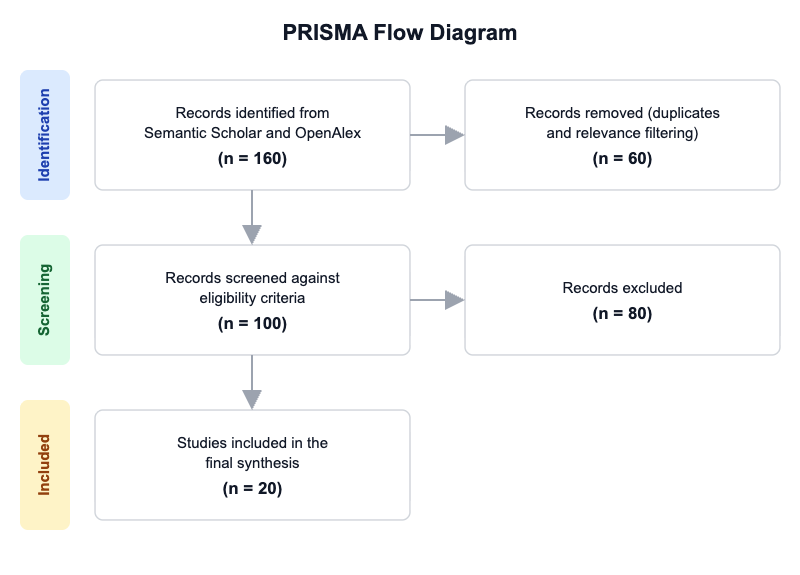
Initial database searching identified 160 records. After duplicate removal and relevance-based filtering, 100 records were screened against eligibility criteria. Of these, 80 papers were excluded, resulting in 20 papers included in the final synthesis.
PRISMA Flow Diagram
Eligibility criteria included:
- Human Studies: Does the study involve human participants or human-derived clinical data, rather than only animal or in-vitro experiments?
- Migraine Focus: Does the study specifically investigate migraine or migraine-related populations, outcomes, or interventions?
- Recent: Was the study published in 2020 or later?
- Research Type: Does the study present original research, a systematic review, or a meta-analysis rather than an editorial, protocol, or commentary?
- Clinical Relevance: Does the study address treatment, diagnosis, epidemiology, pathophysiology, biomarkers, neuroimaging, or comorbidity relevant to migraine?
- Actionable Findings: Does the study report findings that could inform clinical practice, mechanistic understanding, or future research directions?
- Sample Size: Does the study include a clearly described sample size or data source?
All included studies met the stated eligibility criteria.
2.3 Data Extraction and Synthesis
Data extraction focused on the following variables:
- Topic: State the main migraine subtopic addressed (e.g., acute treatment, prevention, diagnosis, epidemiology, pathophysiology, biomarkers, neuroimaging, comorbidity).
- Study Type: Identify the study design or review type (e.g., randomized trial, cohort, cross-sectional, systematic review, meta-analysis, imaging study).
- Population: Describe the participant group or dataset used, including age group and any relevant clinical characteristics if reported.
- Intervention/Exposure: Extract the treatment, exposure, biomarker, imaging method, or other main factor studied.
- Key Findings: Summarize the main findings or conclusions relevant to migraine research.
- Outcomes/Measures: List the primary outcomes, endpoints, scales, biomarkers, imaging measures, or clinical metrics reported.
- Safety/Limitations: Extract adverse events, safety concerns, study limitations, or important caveats if reported.
- Year: Record the publication year.
Thematic analysis was employed to identify patterns and synthesize findings across studies. Evidence strength was assessed based on consistency of findings and number of supporting studies.
3. Results
3.1 Characteristics of Included Studies
| Study and Year | Study Type | Population | Main Focus | Key Outcomes / Measures |
|---|---|---|---|---|
| Ashina et al. 2021 [1] | Review | Global population affected by migraine | Epidemiology and systems of care | Global burden, care systems, access barriers |
| Ashina et al. 2021 [2] | Systematic review | Individuals with migraine | Clinical management and emerging treatments | Efficacy, tolerability, safety, individualized treatment |
| Eigenbrodt et al. 2021 [3] | Consensus statement | Multiple migraine populations, including adults, children, adolescents, pregnant and breastfeeding women, and older people | Diagnosis and management | Diagnostic criteria, treatment response, treatment failure, follow-up |
| Puledda et al. 2023 [4] | Review | General migraine population | Pathophysiology and treatment | Mechanistic pathways; CGRP-targeted therapy, ditans, neuromodulation |
| Ailani et al. 2021 [5] | Consensus statement and review | Patients with migraine | Integration of new treatments | Patient-centered treatment selection |
| Torres-Ferrús et al. 2021 [6] | Observational study | Resistant migraine patients | Anti-CGRP monoclonal antibodies | Real-world effectiveness |
| Zobdeh et al. 2021 [7] | Systematic review | Broad migraine populations | Pharmacological treatment development | Drug classes, mechanisms, clinical trials |
| Steiner and Stovner 2023 [8] | Review | Global population | Epidemiology and public health | Prevalence, burden, YLDs |
| Vandervorst et al. 2021 [9] | Comparative review of trial evidence | Episodic and chronic migraine | CGRP monoclonal antibodies vs standard prophylaxis | Efficacy, tolerability, long-term safety |
| Messina et al. 2023 [10] | Systematic review and network meta-analysis | Patients in phase 3 prevention trials | Safety and tolerability of CGRP-pathway agents | Adverse events, discontinuation, serious adverse events |
| Puledda et al. 2024 [11] | Global practice recommendations | Global migraine patients | Acute pharmacological treatment | Treatment quality and access |
| Haghdoost et al. 2023 [12] | Systematic review and network meta-analysis | Episodic, chronic, and mixed migraine populations | Preventive efficacy of CGRP-pathway agents | Monthly migraine days, headache days, responder rates |
| Ornello et al. 2025 [13] | Evidence-based guidelines | Healthcare professionals treating migraine | Pharmacological treatment | Evidence grading, practice recommendations |
| Khan et al. 2021 [14] | Review | General migraine population | Genetics, pathophysiology, diagnosis, treatment | Mechanisms, prevention strategies |
| Caronna et al. 2024 [15] | Prospective real-world study | High-frequency episodic or chronic migraine patients | Anti-CGRP monoclonal antibody response | Monthly headache day reduction, response predictors |
| Iannone et al. 2022 [16] | Cohort study | Resistant chronic migraine patients | Anti-CGRP monoclonal antibodies | MIDAS score reduction, safety |
| Chiang et al. 2024 [17] | Review | General migraine population | Future treatment targets | Therapeutic target identification, safety considerations |
| Oliveira et al. 2024 [18] | Systematic review | Chronic migraine patients | CGRP-targeted medication | Effectiveness and safety |
| Amiri et al. 2022 [19] | Comprehensive review | Individuals with migraine, especially young adults and females | Epidemiology, risk factors, comorbidities | Prevalence, risk factor patterns, comorbidity burden |
| Hovaguimian and Roth 2022 [20] | Review article | Adults with chronic migraine; special populations discussed | Chronic migraine management | Drug and non-drug treatment, patient-centered care |
The included literature is dominated by reviews, consensus statements, systematic reviews, and real-world observational evidence. A smaller set of original studies addresses treatment response in resistant or high-frequency migraine, while the most recent guidelines synthesize trial and expert evidence into actionable pharmacologic recommendations.
3.2 Thematic Findings
3.2.1 Migraine remains a major global burden, but current epidemiology also exposes persistent measurement and care-system limitations
The epidemiologic literature consistently portrays migraine as a highly prevalent disorder with major disability implications. Global prevalence is estimated at 14–15%, and migraine accounts for 4.9% of global population ill health measured in YLDs [8]. This burden framing is reinforced by broader reviews describing migraine as affecting over 1 billion people worldwide and linking it to lost productivity, social disruption, and substantial economic costs [1], [19]. However, the epidemiologic evidence also stresses that these estimates are imperfect: older studies are considered less reliable, apparent increases in prevalence may be illusory, and YLDs do not fully capture migraine-attributed burden [8]. In parallel, health-system reviews highlight that underdiagnosis, mismanagement, inadequate access to medication, and insufficient professional training remain central barriers to effective care, especially in low- and middle-income settings [1]. Confidence: Strong.
3.2.2 The strongest therapeutic signal in recent migraine research is convergence around the CGRP pathway
Across preventive and management studies, CGRP-targeted therapies emerge as the most consistently supported pharmacologic advance. Phase 3 network meta-analysis shows that nearly all CGRP-pathway interventions reduced mean monthly migraine days compared with placebo, with eptinezumab 30 mg as the notable exception [12]. All medications also improved responder rates versus placebo, especially when delivered subcutaneously or intravenously [12]. In a separate network meta-analysis focused on safety, these agents were generally well tolerated, with no significant differences in serious adverse events between active treatment and placebo [10]. Real-world studies extend this efficacy signal into resistant and chronic migraine, where anti-CGRP monoclonal antibodies were effective in refractory patients [6], [16], [18]. A large prospective cohort further suggests that earlier use may matter: 56.5% of patients achieved a ≥50% reduction in monthly headache days and 26.7% achieved a ≥75% reduction at 6 months, while higher baseline frequency and disability predicted poorer response [15]. (Note: these studies examined resistant chronic migraine patients, high-frequency episodic migraine patients, or mixed episodic/chronic populations, which partially matches the question population of migraine broadly; findings should be interpreted considering this difference.) Confidence: Strong.
3.2.3 Comparative evidence suggests CGRP-based preventives are at least as effective as standard prophylaxis and often better tolerated
When CGRP monoclonal antibodies are compared with established prophylactic agents, the balance of evidence favors similar or greater efficacy with a more favorable tolerability profile. Trial-based comparative synthesis indicates that CGRP monoclonal antibodies have efficacy at least comparable to, and possibly higher than, standard preventive drugs, with robust support from large randomized trials and an “unprecedented” efficacy-to-adverse-effect profile [9]. Safety-focused network meta-analysis is consistent with this interpretation, identifying no excess serious adverse events overall while showing agent-specific differences in treatment-emergent adverse events and discontinuation risk [10]. However, the evidence is not uniform across all compounds and doses: atogepant 120 mg and galcanezumab 240 mg carried the highest odds of treatment-emergent adverse events versus placebo, whereas eptinezumab 30 mg had the greatest odds of discontinuation due to adverse events [10]. This pattern indicates that “class-level” tolerability should not be assumed to mean identical profiles across agents. Confidence: Moderate to strong.
3.2.4 Management is increasingly individualized, with response shaped by phenotype, disability, and comorbidity
Recent guidance consistently emphasizes that migraine treatment selection should be personalized rather than protocol-driven. Expert consensus recommends tailoring acute and preventive treatment to clinical characteristics, preferences, and needs, alongside education to improve adherence and satisfaction [3], [20], [5]. Real-world response predictors support this patient-centered approach: older age, unilateral pain, absence of depression, lower baseline monthly migraine days, and lower baseline Migraine Disability Assessment scores were associated with better anti-CGRP monoclonal antibody response [15]. Similarly, in resistant chronic migraine, a ≥50% reduction in MIDAS score was proposed as a useful outcome because it allowed very severe patients to remain on treatment [16]. These findings suggest that baseline burden and psychosocial context are not just descriptive features; they may influence measured treatment success and should shape follow-up expectations. (Note: the observational predictors study examined high-frequency episodic or chronic migraine patients, and the MIDAS-based cohort examined resistant chronic migraine patients; both partially match the broader migraine population.) Confidence: Moderate.
3.2.5 Pathophysiologic synthesis shows why CGRP-targeted and neuromodulatory therapies have become central, but mechanistic evidence remains incomplete
Mechanistic reviews converge on a model in which migraine arises from interconnected central and peripheral networks, trigeminovascular sensitization, inflammatory signaling, and genetic susceptibility [4], [14]. These papers also indicate that understanding has translated into therapies targeting CGRP, serotonin 5-HT1F receptors, and non-invasive neuromodulation [4]. More speculative work expands this translational horizon further, proposing nociception, homeostatic regulation, vasodilation, and reward circuits as potential future targets [17]. Yet the mechanistic literature remains descriptive rather than definitive: the exact full pathogenesis is still not established, and future target validation must address specificity, affinity, solubility, stability, efficacy, and safety [14], [17]. Confidence: Moderate.
3.2.6 Acute treatment guidance is becoming more standardized, but global implementation remains uneven
The recent international acute-treatment recommendations are explicit that adoption should improve migraine treatment quality worldwide, even in settings where pharmacologic options are limited [11]. This aligns with the broader management consensus that diagnosis, education, and early treatment planning are as important as drug selection itself [3], [5]. However, the evidence base summarized here provides limited comparative acute efficacy data because the newest high-level syntheses focus more on prevention than on acute head-to-head efficacy. As a result, the acute-treatment literature is strongest on standardization of practice and weakest on direct comparative outcomes across specific agents. Confidence: Limited to moderate.
3.3 Summary of Evidence
| Theme | Key Finding | Population Applicability | Effect Direction | Confidence Level | Supporting Studies |
|---|---|---|---|---|---|
| Global burden and epidemiology | Global migraine prevalence estimated at 14–15%; migraine accounts for 4.9% of global population ill health in YLDs | General global population; fully applicable to migraine broadly | Positive burden signal | Strong | Steiner and Stovner [8], Ashina et al. [1], Amiri et al. [19] |
| CGRP preventive efficacy | All CGRP-pathway interventions except eptinezumab 30 mg significantly reduced mean monthly migraine days vs placebo | Episodic, chronic, and mixed migraine trial populations; broadly applicable but not identical to all migraine patients | Positive | Strong | Haghdoost et al. [12], Vandervorst et al. [9], Oliveira et al. [18] |
| CGRP safety and tolerability | No significant difference in serious adverse events vs placebo; treatment-emergent adverse events varied by agent | Trial populations in prevention studies; applicable mainly to preventive-use populations | Positive / mixed by agent | Moderate to strong | Messina et al. [10], Vandervorst et al. [9] |
| Real-world response to anti-CGRP mAbs | 56.5% achieved ≥50% reduction in monthly headache days and 26.7% achieved ≥75% reduction at 6 months | High-frequency episodic or chronic migraine patients; partially matches broader migraine population | Positive | Strong | Caronna et al. [15], Torres-Ferrús et al. [6], Iannone et al. [16] |
| Individualized treatment selection | Older age, unilateral pain, absence of depression, fewer baseline migraine days, and lower disability predicted better response | High-frequency episodic or chronic migraine patients; partially matches broader migraine population | Positive for prediction, not treatment per se | Moderate | Caronna et al. [15], Eigenbrodt et al. [3], Ailani et al. [5] |
| Mechanistic and translational advances | Central and peripheral network dysfunction, trigeminovascular sensitization, inflammatory signaling, and genetic susceptibility support CGRP and related targets | General migraine population | Positive for mechanistic plausibility | Moderate | Puledda et al. [4], Khan et al. [14], Chiang et al. [17] |
| Acute treatment standardization | International recommendations are expected to improve acute migraine treatment quality worldwide | Global migraine patients; particularly relevant where access is limited | Positive | Limited to moderate | Puledda et al. [11], Eigenbrodt et al. [3] |
| Systems of care and access | Integrated care, referral pathways, and education are needed to reduce misdiagnosis and mismanagement | Global populations, especially low- and middle-income settings | Positive | Moderate | Ashina et al. [1], Eigenbrodt et al. [3] |
4. Discussion
4.1 Principal Findings and Their Interpretation
The clearest message from the recent migraine literature is that therapeutic progress is now being driven by a convergent biological and clinical logic: once migraine pathophysiology is understood as a disorder of overlapping neural networks, trigeminovascular activation, inflammatory signaling, and genetic susceptibility, the success of CGRP-targeted therapies becomes more intelligible [4], [14]. This synthesis matters because it links mechanism to outcome rather than treating efficacy as an isolated empirical fact. The preventive effect observed across trial and real-world studies is therefore not merely a drug-class success; it is evidence that a mechanistically defined pathway can be translated into meaningful symptom reduction in practice [12], [15].
Confidence is highest where independent designs agree. Trial synthesis, network meta-analysis, and real-world cohorts all point to benefit with CGRP-pathway therapies, and the absence of a signal for serious adverse events across prevention trials strengthens the view that this class has shifted the treatment landscape rather than adding another marginal option [12], [10]. The remaining variability across agents and doses is clinically informative rather than contradictory: it implies that CGRP-targeted therapy is a class with shared efficacy, not a homogeneous intervention. That distinction helps explain why eptinezumab 30 mg stands out as an exception in efficacy analyses while other doses and agents maintain a stronger benefit profile [12].
The more nuanced contribution of the synthesis is that treatment success is moderated by disease stage and baseline burden. Better responses in patients with lower migraine frequency and disability suggest that earlier intervention may preserve a higher probability of achieving meaningful benefit [15]. This pattern also supports the shift toward patient-centered selection and long-term follow-up, because a treatment’s apparent effectiveness depends partly on when and in whom it is introduced [3], [5]. Mechanistic evidence remains important but incomplete; the literature provides strong biological plausibility, not definitive causal proof for every clinical outcome [4].
4.2 Comparison with Existing Literature and Resolution of Contradictions
The broader migraine literature cited in these papers is highly consistent in describing migraine as a major cause of disability, which reinforces the public health relevance of current therapeutic advances [8], [19]. What is newer is the alignment between burden science and treatment science: the same disorder that remains underdiagnosed and under-treated is now one for which molecularly targeted prevention is increasingly feasible [1], [2]. That alignment strengthens confidence in the field because epidemiologic burden alone would not justify costly or complex biologic therapies unless treatment effects were also robust.
The main apparent contradictions are not between positive and negative findings, but between uniformly favorable class-level narratives and the agent-specific safety and efficacy differences seen in meta-analytic data. Atogepant 120 mg and galcanezumab 240 mg had higher odds of treatment-emergent adverse events, and eptinezumab 30 mg had greater odds of discontinuation due to adverse events, even though the class overall remained safe and well tolerated [10]. These differences are plausibly explained by dose, route of administration, and trial design rather than a fundamental inconsistency in the CGRP hypothesis. The efficacy meta-analysis also noted that some outcomes were unavailable for specific agents, such as no mean monthly headache day data for rimegepant and no mean monthly acute medication day data for eptinezumab, which limits direct comparability across products [12]. This incomplete outcome reporting can exaggerate apparent inconsistencies because different agents are not always being judged on the same endpoints.
Methodological evolution also helps reconcile the literature. Older reviews emphasize conceptual and mechanistic advances, whereas newer network meta-analyses and prospective cohorts provide more operationally useful estimates of benefit, response, and tolerability [12], [15]. Publication bias remains a concern because much of the recent literature focuses on promising preventive strategies and expert guidance, but the presence of agent-specific adverse-event signals argues against a uniformly selective positive narrative. The most defensible interpretation is therefore one of strong overall efficacy with meaningful but manageable within-class heterogeneity.
4.3 Practical Implications
For clinicians, the evidence supports earlier and more phenotype-informed use of CGRP-targeted prevention, particularly in patients with high-frequency episodic or chronic migraine who have substantial disability but have not yet accumulated entrenched treatment failure [15], [18]. The real-world data imply that patients with lower baseline monthly migraine burden and less disability are more likely to respond well, so delaying effective preventive therapy may reduce the chance of achieving a robust benefit. At the same time, the safety literature supports continued use of these agents as a generally well-tolerated option, though choice among specific drugs should consider their differing adverse-event profiles [10].
For public health systems, the findings argue that access and implementation may matter as much as drug discovery. Integrated care models, referral pathways, and clinician training are needed to reduce misdiagnosis and to support timely initiation and monitoring of treatment, especially in low- and middle-income settings where access constraints remain prominent [1], [3]. The acute-treatment recommendations are similarly important because they translate evidence into a global care standard, including settings where pharmacologic choices are limited [11].
For regulators and policymakers, the evidence does not imply a “one-size-fits-all” solution. Instead, it supports broader availability of CGRP-targeted therapies while also highlighting the need for comparative data, pricing considerations, and outcome monitoring to ensure that access translates into benefit [9], [13]. The clinical takeaway is clear: migraine care is moving toward individualized, mechanism-based treatment, but equitable benefit will depend on whether health systems can implement that shift beyond tertiary centers.
4.4 Strengths and Limitations
This review benefits from a broad, thematic synthesis of recent literature spanning epidemiology, pathophysiology, guidelines, and both trial and real-world treatment evidence. A major strength is that it integrates mechanistic and clinical findings, allowing interpretation of therapeutic advances in the context of migraine biology and care delivery. The included literature also contains several high-level evidence syntheses and large prospective datasets, which strengthens confidence in the main conclusions.
The limitations of the included studies are important. Much of the evidence is review-based or consensus-based rather than primary comparative research. Even the primary studies often focus on resistant chronic migraine or high-frequency episodic/chronic migraine, which only partially matches the broader migraine population. Outcome definitions vary, with studies using monthly migraine days, monthly headache days, MIDAS, and responder thresholds, complicating direct comparison. Several papers also note the absence of head-to-head trials and incomplete reporting for some endpoints. The limitations of this review include its abstract-based extraction, the lack of a formal risk-of-bias assessment, and potential incompleteness in the underlying metadata.
5. Gaps and Future Directions
The most important evidence gap is the lack of direct head-to-head comparative trials among CGRP-targeted agents and between CGRP therapies and established preventive options using harmonized outcomes [9], [12]. Future studies should also move beyond resistant or highly selected chronic migraine cohorts to include broader, more diverse migraine populations, because current real-world predictors may not generalize fully. Acute-treatment evidence remains less operationalized than preventive evidence, so studies comparing acute agents under global access constraints would better inform practice recommendations [11].
Methodologically, future research would be strengthened by standardizing response metrics across studies, pre-specifying adverse-event reporting, and using longer follow-up to determine durability of benefit and safety. There is also a need for research on treatment sequencing—who should start biologic prevention earlier, who can remain on conventional therapies, and how baseline burden and comorbidity should guide selection [15], [20]. Finally, underrepresented settings, especially low- and middle-income countries, require targeted study because the current care-system literature suggests that implementation barriers may blunt the impact of even highly effective therapies [1].
6. Conclusion
The latest migraine research supports a clear overall conclusion: migraine remains a major global cause of disability, but the field now has stronger evidence than before for mechanism-based management, especially through CGRP-targeted therapies and structured, patient-centered care [8], [12], [5]. Preventive CGRP-pathway agents consistently reduced mean monthly migraine days versus placebo in phase 3 analyses, with nearly all interventions showing benefit except eptinezumab 30 mg, and safety data indicate no significant increase in serious adverse events overall [12], [10]. Real-world studies extend this benefit to resistant and high-frequency migraine, where 56.5% achieved a ≥50% reduction in monthly headache days and 26.7% achieved a ≥75% reduction at 6 months [15].
At the same time, the evidence is most applicable to chronic, resistant, or high-frequency migraine populations rather than every migraine phenotype, so conclusions should be interpreted with that partial match in mind [16], [15]. The most important unresolved question is how best to personalize treatment selection and sequence across diverse migraine populations while preserving access and affordability. Addressing that issue will determine whether the current biological and therapeutic advances translate into equitable real-world gains. If that challenge is met, the recent progress could meaningfully reduce migraine-related disability, improve quality of life, and narrow persistent care gaps worldwide.
References
- Ashina, M., Katsarava, Z., Do, T. P., Buse, D. C., Pozo-Rosich, P., Özge, A., Krymchantowski, A. V., Lebedeva, E. R., Ravishankar, K., Yu, S., Sacco, S., Ashina, S., Younis, S., Steiner, T. J., & Lipton, R. B. (2021). Migraine: Epidemiology and systems of care. The Lancet, 397(10283), 1485–1495. https://doi.org/10.1016/S0140-6736(20)32160-732160-7)
- Ashina, M., Buse, D. C., Ashina, H., Pozo-Rosich, P., Peres, M. F. P., Lee, M. J., Terwindt, G. M., Halker Singh, R., Tassorelli, C., Do, T. P., Mitsikostas, D. D., & Dodick, D. W. (2021). Migraine: Integrated approaches to clinical management and emerging treatments. The Lancet, 397(10283), 1505–1518. https://doi.org/10.1016/S0140-6736(20)32342-432342-4)
- Eigenbrodt, A. K., Ashina, H., Khan, S., Diener, H.-C., Mitsikostas, D. D., Sinclair, A. J., Pozo-Rosich, P., Martelletti, P., Ducros, A., Lantéri-Minet, M., Braschinsky, M., Sanchez del Rio, M., Daniel, O., Özge, A., Mammadbayli, A., Arons, M., Skorobogatykh, K., Romanenko, V., Terwindt, G. M., … Ashina, M. (2021). Diagnosis and management of migraine in ten steps. Nature Reviews Neurology, 17(8), 501–514. https://doi.org/10.1038/s41582-021-00509-5
- Puledda, F., Silva, E. M., Suwanlaong, K., & Goadsby, P. J. (2023). Migraine: From pathophysiology to treatment. Journal of Neurology, 270(7), 3654–3666. https://doi.org/10.1007/s00415-023-11706-1
- Ailani, J., Burch, R. C., Robbins, M. S., & the Board of Directors of the American Headache Society. (2021). The American Headache Society Consensus Statement: Update on integrating new migraine treatments into clinical practice. Headache: The Journal of Head and Face Pain, 61(7), 1021–1039. https://doi.org/10.1111/head.14153
- Torres-Ferrús, M., Gallardo, V. J., Alpuente, A., Caronna, E., Gine-Cipres, E., & Pozo-Rosich, P. (2021). The impact of anti-CGRP monoclonal antibodies in resistant migraine patients: A real-world evidence observational study. Journal of Neurology, 268(10), 3789–3798. https://doi.org/10.1007/s00415-021-10523-8
- Zobdeh, F., ben Kraiem, A., Attwood, M. M., Chubarev, V. N., Tarasov, V. V., Schiöth, H. B., & Mwinyi, J. (2021). Pharmacological treatment of migraine: Drug classes, mechanisms of action, clinical trials and new treatments. British Journal of Pharmacology, 178(23), 4588–4607. https://doi.org/10.1111/bph.15657
- Steiner, T. J., & Stovner, L. J. (2023). Global epidemiology of migraine and its implications for public health and health policy. Nature Reviews Neurology, 19(2), 109–117. https://doi.org/10.1038/s41582-022-00763-1
- Vandervorst, F., Van Deun, L., Van Dycke, A., Paemeleire, K., Reuter, U., Schoenen, J., & Versijpt, J. (2021). CGRP monoclonal antibodies in migraine: An efficacy and tolerability comparison with standard prophylactic drugs. The Journal of Headache and Pain, 22(1), 128. https://doi.org/10.1186/s10194-021-01335-2
- Messina, R., Huessler, E.-M., Puledda, F., Haghdoost, F., Lebedeva, E. R., & Diener, H.-C. (2023). Safety and tolerability of monoclonal antibodies targeting the CGRP pathway and gepants in migraine prevention: A systematic review and network meta-analysis. Cephalalgia, 43(3), 03331024231152169. https://doi.org/10.1177/03331024231152169
- Puledda, F., Sacco, S., Diener, H.-C., Ashina, M., Al-Khazali, H. M., Ashina, S., Burstein, R., Liebler, E., Cipriani, A., Chu, M. K., Cocores, A., Dodd-Glover, F., Ekizoğlu, E., Garcia-Azorin, D., Göbel, C., Goicochea, M. T., Hassan, A., Hirata, K., Hoffmann, J., … Tassorelli, C. (2024). International Headache Society global practice recommendations for the acute pharmacological treatment of migraine. Cephalalgia, 44(8), 03331024241252666. https://doi.org/10.1177/03331024241252666
- Haghdoost, F., Puledda, F., Garcia-Azorin, D., Huessler, E.-M., Messina, R., & Pozo-Rosich, P. (2023). Evaluating the efficacy of CGRP mAbs and gepants for the preventive treatment of migraine: A systematic review and network meta-analysis of phase 3 randomised controlled trials. Cephalalgia, 43(4), 03331024231159366. https://doi.org/10.1177/03331024231159366
- Ornello, R., Caponnetto, V., Ahmed, F., Al-Khazali, H. M., Ambrosini, A., Ashina, S., Baraldi, C., Bellotti, A., Brighina, F., Calabresi, P., Casillo, F., Cevoli, S., Cheng, S., Chiang, C.-C., Chiarugi, A., Christensen, R. H., Chu, M. K., Coppola, G., Corbelli, I., … Sacco, S. (2025). Evidence-based guidelines for the pharmacological treatment of migraine. Cephalalgia, 45(4), 03331024241305381. https://doi.org/10.1177/03331024241305381
- Khan, J., Al Asoom, L. I., Al Sunni, A., Rafique, N., Latif, R., Al Saif, S., Almandil, N. B., Almohazey, D., AbdulAzeez, S., & Borgio, J. F. (2021). Genetics, pathophysiology, diagnosis, treatment, management, and prevention of migraine. Biomedicine & Pharmacotherapy, 139, 111557. https://doi.org/10.1016/j.biopha.2021.111557
- Caronna, E., Gallardo, V. J., Egeo, G., Millán Vázquez, M., Nieves Castellanos, C., Membrilla, J. A., Vaghi, G., Rodríguez-Montolio, J., Fabregat Fabra, N., Sánchez-Caballero, F., Jaimes Sánchez, A., Muñoz-Vendrell, A., Oliveira, R., Gárate, G., González-Osorio, Y., Guisado-Alonso, D., Ornello, R., Thunstedt, C., Fernández-Lázaro, I., … Pozo-Rosich, P. (2024). Redefining migraine prevention: Early treatment with anti-CGRP monoclonal antibodies enhances response in the real world. Journal of Neurology, Neurosurgery & Psychiatry, 95(10), 927–937. https://doi.org/10.1136/jnnp-2023-333295
- Iannone, L. F., Fattori, D., Benemei, S., Chiarugi, A., Geppetti, P., & De Cesaris, F. (2022). Long-term effectiveness of three anti-CGRP monoclonal antibodies in resistant chronic migraine patients based on the MIDAS score. CNS Drugs, 36(2), 191–202. https://doi.org/10.1007/s40263-021-00893-y
- Chiang, C.-C., Porreca, F., Robertson, C. E., & Dodick, D. W. (2024). Potential treatment targets for migraine: Emerging options and future prospects. The Lancet Neurology, 23(3), 313–324. https://doi.org/10.1016/S1474-4422(24)00003-600003-6)
- Oliveira, R., Gil-Gouveia, R., & Puledda, F. (2024). CGRP-targeted medication in chronic migraine: Systematic review. The Journal of Headache and Pain, 25(1), 51. https://doi.org/10.1186/s10194-024-01753-y
- Amiri, P., Kazeminasab, S., Nejadghaderi, S. A., Mohammadinasab, R., Pourfathi, H., Araj-Khodaei, M., Sullman, M. J. M., Kolahi, A.-A., & Safiri, S. (2022). Migraine: A review on its history, global epidemiology, risk factors, and comorbidities. Frontiers in Neurology, 12, 800605. https://doi.org/10.3389/fneur.2021.800605
- Hovaguimian, A., & Roth, J. (2022). Management of chronic migraine. BMJ, 379, e067670. https://doi.org/10.1136/bmj-2021-067670