

Mosaic Embryo Transfer in Contemporary IVF: Clinical Outcomes, Stratified Risk, and Neonatal Safety in Recent Evidence
Abstract
Recent research indicates that mosaic embryo transfer can yield live births, but reproductive performance is generally lower than that of euploid transfer when mosaicism is defined by intermediate chromosome copy number in trophectoderm biopsy. Across comparative cohorts, mosaic embryos showed miscarriage rates of 22.2% versus 8.9% for euploid embryos, and in one large multicenter analysis ongoing pregnancy rates were 36.6% versus 52.3% for euploid embryos, with persistence of mosaicism through gestation reported in about 1.2% of prenatally tested pregnancies [17], [16]. The most consistent signal is that risk is not binary: low-level mosaicism, segmental abnormalities, and better embryo morphology are repeatedly associated with better outcomes, whereas whole-chromosome, complex, and higher-level mosaicism are associated with poorer implantation and higher miscarriage risk [3], [4], [5]. At the same time, neonatal follow-up is broadly reassuring, with similar gestational age, birthweight, and low rates of reported anomalies among live births from mosaic transfers, and multiple cohorts reporting no prenatal test confirmation of the embryonic mosaic finding in most pregnancies [7], [17], [9]. This literature matters because mosaic embryos are increasingly encountered in routine PGT-A, forcing clinicians to balance a reduced probability of pregnancy against evidence that babies born after transfer are usually healthy. The main gap is not whether mosaic transfer can work, but which mosaic embryos are most reasonable to transfer and how confidently prenatal persistence risk can be excluded.
1. Introduction
Preimplantation genetic testing for aneuploidy (PGT-A) has shifted embryo selection in IVF from a simple euploid-versus-aneuploid framework toward a more nuanced interpretation of intermediate chromosome copy number, commonly called mosaicism. Mosaic embryo transfer has therefore become a clinically consequential issue rather than an exceptional scenario, because embryos that would previously have been discarded may now be considered for transfer when euploid embryos are unavailable or when patients seek to avoid another retrieval. Yet the biological and clinical meaning of mosaicism remains unsettled: trophectoderm biopsy may capture a cell population that does not fully represent the inner cell mass, and the extent to which embryonic mosaicism predicts implantation failure, miscarriage, fetal persistence, or neonatal health has been debated. Recent studies have expanded beyond simple success rates to interrogate the importance of mosaic level, the distinction between segmental and whole-chromosome abnormalities, and the relevance of embryo morphology and transfer strategy. That shift reflects a broader move in the field from treating mosaicism as a uniform abnormality to viewing it as a spectrum with heterogeneous developmental potential.
At the same time, follow-up data have begun to accumulate, making it possible to evaluate not only whether mosaic embryos implant, but also whether pregnancies progress normally and whether neonates show evidence of chromosomal discordance or developmental defects. The resulting evidence base is clinically rich but methodologically uneven, spanning committee opinions, retrospective cohorts, prospective multicenter studies, registry analyses, and focused reviews. Some studies report equivalence with euploid transfer in selected settings, while others show clearly reduced implantation or increased miscarriage. These divergences are not trivial; they directly affect counseling, embryo prioritization, and the ethics of offering mosaic transfer.
This review synthesizes the latest research on mosaic embryo transfer to determine what the contemporary evidence supports regarding reproductive effectiveness, modifiers of outcome, and prenatal and neonatal safety, while also clarifying where the literature remains too heterogeneous for firm clinical generalization.
2. Methods
2.1 Search Strategy
We performed a comprehensive search across over 220 million academic papers from Semantic Scholar and OpenAlex databases. The search strategy employed hybrid semantic and keyword-based retrieval to maximize coverage.
Search queries included:
- "Mosaic embryo transfer outcomes in assisted reproduction latest evidence"
- "Clinical pregnancy live birth after euploid and mosaic embryo transfer"
- "Preimplantation genetic testing mosaic embryos implantation miscarriage rates"
- "Single embryo transfer mosaicism reproductive outcomes infertility IVF"
2.2 Study Selection
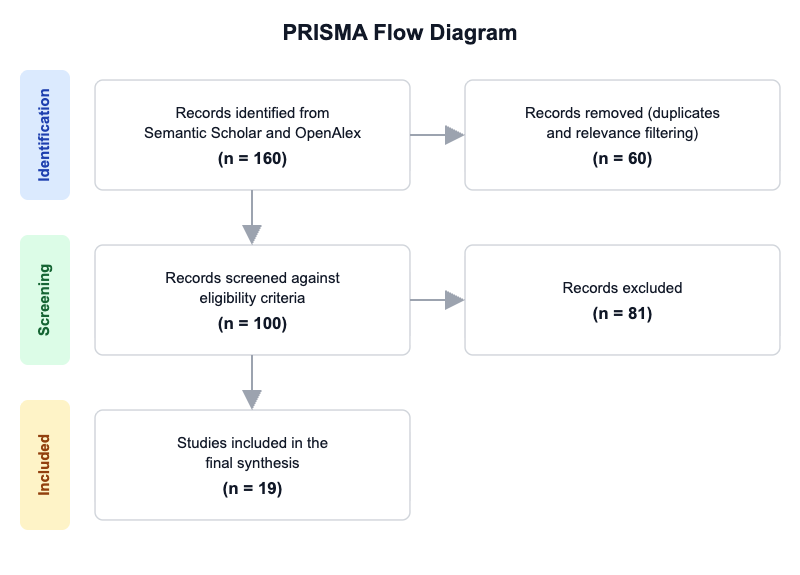
Initial database searching identified 160 records. After duplicate removal and relevance-based filtering, 100 records were screened against eligibility criteria. Of these, 81 papers were excluded, resulting in 19 papers included in the final synthesis.
PRISMA Flow Diagram
Eligibility criteria included:
- Human IVF: Does the study involve human IVF/ART patients or embryos, not animal, laboratory-only, or purely methodological work?
- Mosaic Embryo: Does the study specifically investigate mosaic embryos or mosaic embryo transfer?
- Clinical Outcomes: Does the study report at least one clinical reproductive outcome such as implantation, clinical pregnancy, miscarriage, ongoing pregnancy, or live birth?
- Transfer Study: Does the study evaluate embryo transfer after PGT/PGT-A or clinical transfer decisions for embryos?
- Comparative Data: Does the study compare mosaic transfer with euploid transfer, aneuploid transfer, or another embryo-transfer strategy?
- Recent Evidence: Is the study published in 2020 or later?
- Follow-up Safety: Does the study report prenatal, neonatal, or postnatal follow-up findings relevant to safety or genetic concordance?
All included studies met the stated eligibility criteria.
2.3 Data Extraction and Synthesis
Data extraction focused on the following variables:
- Population
- Design
- Mosaic Definition
- Transfer Strategy
- Pregnancy Outcomes
- Genetic/Follow-up Findings
- Key Conclusion
Thematic analysis was used to identify recurring patterns in outcome direction, effect modification, and follow-up safety. Evidence strength was judged qualitatively by consistency, design quality, and the degree to which study populations aligned with the clinical question.
3. Results
3.1 Characteristics of Included Studies
| Study and Year | Study Type | Population / Setting | Mosaic Definition | Transfer Strategy | Main Outcomes / Follow-up |
|---|---|---|---|---|---|
| ASRM Practice Committee 2020 [1] | Committee opinion | IVF/PGT-A clinical management context | Intermediate copy number in TE biopsy; thresholds not specified | Transfer/storage decision-making | Counseling-focused; no outcome rates reported |
| Zhang et al. 2020 [2] | Prospective multicenter cohort + meta-analysis | 137 mosaic, 476 euploid, 835 non-PGT embryos across Asia | Mosaic based on PGT-A criteria; thresholds not specified | Mosaic vs euploid vs non-PGT transfer | CPR 40.1%, OPR/LBR 27.1%, miscarriage 33.3% for MET |
| Lin et al. 2020 [3] | Prospective cohort | 108 women with only mosaic embryos | <50% abnormal cells low-level; ≥50% high-level | Single mosaic transfer | LBR 44.5% vs 36%; MR 5.1% vs 30.7% |
| Viotti et al. 2021 [4] | Multicenter retrospective analysis | 1,000 mosaic transfers; 5,561 euploid controls | 20–80% aneuploid content | Mosaic vs euploid transfer | Implantation, OP/B, abortion, prenatal testing, neonate outcomes |
| Madjunkov et al. 2021 [5] | Single-center retrospective cohort | 279 single mosaic transfers | ≥25%-<50% vs ≥50%-<70%; segmental vs whole-chromosome | Single transfer | IR 52.3%, OPR 39.3%, MR 10.4% |
| Abhari and Kawwass 2021 [6] | Review | IVF/PGT-A literature | Mosaic defined as karyotypically distinct cells in TE | Transfer implications | Summarizes reassuring neonatal outcomes |
| Spinella et al. 2021 [7] | Multicenter observational study | 1,000 mosaic vs 5,561 euploid embryos | 20–80% aneuploid content | Single transfer, matched follow-up | Prenatal and postnatal outcomes, >200 prenatal tests |
| Huayhua et al. 2021 [8] | Retrospective cohort | 914 SET cycles; 68 mosaic vs 846 euploid | 20–80% aneuploid cells; subgrouped by extent/type | Single transfer | IR 44.1%, OPR 35.3%, MR 20% in mosaics |
| Capalbo et al. 2021 [9] | Double-blinded prospective non-selection trial | 484 euploid, 282 low-grade mosaic, 131 medium-grade mosaic | <50% low-medium mosaicism | Single embryo transfer | Equivalent live birth/miscarriage; no mosaicism/UPD in pregnancies/newborns |
| Viotti 2022 [10] | Registry analysis update | International registry context | Mosaic defined by PGT-A; thresholds not specified | Mosaic transfer outcomes | Data synthesis without exact rates reported |
| Viotti 2022 [11] | Multicenter observational update | 1700+ mosaic transfers, 500+ babies, 380+ prenatal tests | Low- vs high-level mosaicism; segmental vs whole-chromosome | Mosaic vs euploid | Largely equivalent late-term health; no exact rates reported |
| Besser et al. 2022 [12] | Retrospective cohort | PGT-A embryo transfer population | Intermediate copy number; low/high-level and segmental/full monosomy-trisomy | Single transfer | Spectrum of outcomes; no exact rates reported |
| Nguyen Thi Nhu et al. 2022 [13] | Observational study | Single mosaic transfers | Mosaic embryos by NGS; thresholds not specified | Single transfer | Embryo quality more important than mosaic level/type |
| Yakovlev et al. 2022 [14] | Prospective original research | IVF mosaic transfers | High aneuploidy ≥60% low transfer priority | Mosaic vs euploid vs aneuploid | Neonatal outcomes not different; segmental similar to euploid |
| Madjunkov et al. 2023 [15] | Single-center retrospective cohort | 565 mosaic among 3529 FETs | 25%-<50% vs ≥50%-<70%; segmental vs whole-chromosome | Mosaic transfer with prioritization | OPR 33%, MR 6%; neonatal outcomes reassuring |
| Viotti 2023 [16] | Multicenter registry analysis | 2,518 mosaic vs 19,118 euploid | Low/high-level and segmental/complex hierarchy | Mosaic vs euploid transfer | OPR 36.6% vs 52.3%; persistence 1.2%; birth outcomes similar |
| Viotti et al. 2023 [17] | Multicenter study | Multi-center pregnancies from mosaic or euploid embryos | 20–80% mosaic | Euploid vs mosaic transfer | Miscarriage 22.2% vs 8.9%; prenatal findings mostly normal |
| Kelly et al. 2023 [18] | Retrospective cohort | DET involving at least one mosaic embryo | Poor-prognosis mosaics defined as high-level whole chromosomal or complex | Double embryo transfer | OLB 72.4%, SLB 51.7%, TLB 20.7%; higher twin risk |
| Sashitzky et al. 2024 [19] | Retrospective case-control cohort | 51 mosaic vs 706 euploid FETs | Low-level vs high-level mosaicism; segmental vs whole-chromosome | FET; mosaic compared with euploid | LBR 50.9% vs 50.85%; MR 10.3% vs 6.4% |
Overall, the evidence base is dominated by cohort studies in IVF settings, with mosaicism defined in several different but overlapping ways. The literature shows clear movement from broad comparisons of mosaic versus euploid embryos toward more granular stratification by mosaic level, chromosome type, and morphology. Follow-up safety evidence is increasingly robust, but the most detailed neonatal outcomes still come from observational registry-style datasets rather than randomized comparisons.
3.2 Thematic Findings
3.2.1 Mosaic embryo transfer is usually less efficient than euploid transfer, but the magnitude of disadvantage varies widely by cohort and selection strategy
The broadest pattern is that mosaic embryo transfer tends to reduce reproductive efficiency relative to euploid transfer, especially for implantation and ongoing pregnancy, although the effect is not uniform. In one multicenter prospective cohort, clinical pregnancy rate was 40.1% for mosaic transfers versus 59.0% for euploid transfers and 48.4% for non-PGT transfers, with ongoing/live birth rate 27.1% versus 47.0% and 35.1%, respectively, and miscarriage rate 33.3% versus 20.5% and 27.4% [2]. Similarly, a large multicenter registry analysis reported ongoing pregnancy rate of 36.6% for mosaic embryos versus 52.3% for euploid embryos [16]. In contrast, a more recent frozen embryo transfer cohort found nearly identical live birth rates, 50.9% for mosaic embryos and 50.85% for euploid embryos, with comparable implantation rates of 54.6% and 53.3% and miscarriage rates of 10.3% and 6.4% [19]. A single-center cohort also reported an overall ongoing pregnancy rate of 33% and miscarriage rate of 6% for mosaic embryos, while noting lower implantation and ongoing pregnancy than euploid embryos [15]. The most plausible synthesis is not that mosaicism always reduces success by a fixed amount, but that transfer outcome is heavily shaped by case selection, embryo quality, and whether mosaic embryos are being used in settings where euploid options are limited or where embryos are triaged more selectively. (Note: these studies examined IVF/ART patients and embryos undergoing PGT-A, which partially matches the question population of mosaic embryo transfer in latest research; findings should be interpreted considering this difference.) Confidence: Moderate, because the direction is mostly consistent but the effect size varies substantially across designs and populations. [2], [16], [19]
3.2.2 Mosaic level, chromosome architecture, and embryo morphology repeatedly stratify prognosis
The strongest internal pattern across studies is that mosaicism is not a single risk state. Lower-level mosaicism generally performs better than higher-level mosaicism, and segmental abnormalities are usually more favorable than whole-chromosome or complex mosaics. In one study, low-level mosaic embryos had live birth rate of 44.5% versus 36% for high-level mosaics, while miscarriage rate rose from 5.1% to 30.7% [3]. Another cohort found that embryos with ≥40% mosaicism had miscarriage rate of 43% versus 12% in lower mosaic burden embryos, and whole-chromosome mosaics had significantly lower ongoing pregnancy than segmental mosaics [8]. A larger transfer series reported that mosaic embryos with ≤50% aneuploidy had implantation of 47.4% and ongoing pregnancy/birth of 39.5%, whereas >50% aneuploidy was associated with implantation of 35.8% and ongoing pregnancy/birth of 24.1%; segmental mosaics outperformed whole-chromosome mosaics, and complex mosaics were worst overall [4]. Similarly, registry data ranked low-level segmentals highest, followed by high segmentals, with high-complex mosaics lowest for ongoing pregnancy [16]. A single-center study using 25%-<50% versus ≥50%-<70% thresholds likewise found better implantation and ongoing pregnancy in the lower mosaic group, and worse outcomes for whole-chromosome mosaics and monosomies in particular [15]. This convergence suggests that the clinically relevant feature is not merely the presence of mosaicism, but the burden and architecture of the abnormal cell line. (Note: these studies examined IVF/ART patients with mosaic embryo transfer, which partially matches the question population of latest research on mosaic embryo transfer; findings should be interpreted considering this difference.) Confidence: Strong, because multiple independent datasets align on the same ranking pattern even though thresholds differ. [3], [4], [16]
3.2.3 Neonatal and prenatal outcomes are broadly reassuring among live births, with limited evidence of persistent fetal mosaicism
Once a mosaic pregnancy progresses to live birth, the available evidence is consistently reassuring. In a large multicenter study, average birth weight and gestation length were not statistically different between babies born from euploid, mosaic, and whole-chromosome mosaic embryos, and only one of 488 babies from mosaic transfers had overt gross abnormalities [17]. Another multicenter prenatal/postnatal analysis reported that among more than 200 prenatal tests, the vast majority were normal and none reflected the mosaicism detected at the embryonic stage; among 162 babies born from mosaic embryo transfers, none had obvious developmental defects or gross abnormalities [7]. Registry-based analysis found 7 cases of mosaicism persistence among 582 prenatally tested pregnancies, approximately 1.2%, and no significantly higher incidence of gross birth defects, with birth weight and gestational age comparable to euploid controls [16]. A separate prospective multicenter cohort reported that all 37 mosaic-transfer live births were viable, with 8 prenatal tests normal [2]. The key implication is that most apparent embryonic mosaicism does not translate into measurable neonatal abnormality, which supports the idea of self-correction or lineage restriction during development. However, the persistence signal is not zero, so safety cannot be reduced to a categorical “no risk” statement. (Note: these studies examined pregnancies resulting from IVF/ART mosaic embryo transfers, which partially matches the question population of latest research on mosaic embryo transfer; findings should be interpreted considering this difference.) Confidence: Strong for short-term neonatal reassurance, Moderate for precise fetal persistence risk because prenatal testing was incomplete and heterogeneous. [17], [7], [16]
3.2.4 Transfer strategy matters: single embryo transfer is increasingly favored, while double embryo transfer raises twin risk without clear overall benefit
The emerging practical literature argues that mosaic embryos should generally be managed with single embryo transfer. In a comparative frozen transfer cohort, double embryo transfer was used much more often with mosaic embryos than with euploid embryos, 42.2% versus 5.3%, and this produced a significantly higher twin birth/live birth proportion, 23.8% versus 1.7% [19]. In a separate retrospective study of double embryo transfer, euploid/mosaic and mosaic/mosaic transfers showed similar overall live birth and multiple pregnancy rates, but singleton live birth was higher than in a euploid/euploid comparator cohort, while twin outcomes remained clinically important [18]. In contrast, single-transfer studies generally frame mosaic use as a fallback or prioritization strategy, not a substitute for euploid transfer when euploid embryos are available [5], [15]. The practical synthesis is that DET may increase the apparent probability of at least one live birth but does so by exposing patients to a twin burden that is avoidable in many tested-embryo cycles. That tradeoff is especially important because mosaic embryos do not show evidence of dramatically worse neonatal health once they establish a pregnancy; the main penalty appears to be pregnancy efficiency and, with DET, multiple gestation risk. (Note: these studies examined IVF/ART patients undergoing FET or DET, which partially matches the question population of mosaic embryo transfer; findings should be interpreted considering this difference.) Confidence: Moderate, because the direction toward SET is consistent, but comparative DET evidence remains limited and center-specific. [19], [18], [5]
3.2.5 Embryo quality and laboratory context can outweigh mosaic classification in some datasets
A potentially important counter-current in the literature is that embryo morphology and broader selection context may be as influential as mosaic status itself. One observational study concluded that embryo quality, rather than the level and type of mosaicism, was the most important factor influencing pregnancy outcomes after single mosaic transfer [13]. Likewise, a frozen transfer cohort reported that among mosaic embryos, favorable static morphology improved ongoing pregnancy in both lower- and higher-level groups, even while mosaic burden and whole-chromosome status still mattered [15]. These findings do not negate the prognostic value of mosaic level, but they suggest that morphology may act as either an independent determinant or a proxy for more globally competent embryos. This theme helps explain why some cohorts report near-equivalence with euploid transfer while others do not: the more stringently the laboratory and clinic select embryos for transfer, the more mosaic embryos may represent a biologically advantaged subset. (Note: these studies examined IVF/ART patients with single mosaic transfers, which partially matches the question population of latest research on mosaic embryo transfer; findings should be interpreted considering this difference.) Confidence: Limited to Moderate, because the claim is plausible and repeatedly suggested, but exact effect sizes are not consistently reported and the evidence is mostly observational. [13], [15]
3.3 Summary of Evidence
| Theme | Key Finding | Population Applicability | Effect Direction | Confidence Level | Supporting Studies |
|---|---|---|---|---|---|
| Mosaic transfer is generally less efficient than euploid transfer, but effect size varies | Ongoing/live birth rate 27.1% vs 47.0% and miscarriage rate 33.3% vs 20.5% in one prospective cohort; ongoing pregnancy 36.6% vs 52.3% in registry data | IVF/ART patients undergoing PGT-A mosaic transfer | Negative | Moderate | Zhang et al. [2], Viotti [16], Madjunkov et al. [15] |
| Lower mosaic burden and segmental abnormalities predict better outcomes | Implantation 47.4% and OP/B 39.5% at ≤50% aneuploidy versus 35.8% and 24.1% at >50% | IVF/ART patients with mosaic embryos | Positive for lower-level / segmental mosaics | Strong | Viotti et al. [4], Madjunkov et al. [15], Viotti [16] |
| Neonatal outcomes are largely reassuring | Birth weight 3118g vs 3052g vs 3159g and gestation 267 vs 265 vs 268 days were not statistically different across euploid, mosaic, and whole-chromosome mosaic live births | Pregnancies that reach birth after mosaic transfer | Null / reassuring | Strong | Viotti et al. [17], Spinella et al. [7], Viotti [16] |
| SET is preferable to DET for tested embryos | DET with mosaics increased twin births/live birth to 23.8% vs 1.7% in euploid DET comparison | IVF/FET patients with tested embryos | Negative for DET safety | Moderate | Sashitzky et al. [19], Kelly et al. [18] |
| Embryo morphology modifies mosaic prognosis | Good morphology mosaic embryos had ongoing pregnancy 41.1% in registry analysis | IVF/ART mosaic transfer candidates | Positive when morphology is favorable | Limited to Moderate | Viotti [16], Nguyen Thi Nhu et al. [13] |
4. Discussion
4.1 Principal Findings and Their Interpretation
The contemporary literature supports a clinically nuanced view of mosaic embryo transfer: mosaic embryos are not uniformly nonviable, but they are not equivalent to euploid embryos in all settings either. The most robust pattern is stratified prognosis. Lower-level mosaicism, segmental abnormalities, and favorable morphology repeatedly identify embryos with better implantation and ongoing pregnancy potential, whereas higher mosaic burden, whole-chromosome involvement, monosomy, and complex mosaicism predict poorer outcomes. This pattern is biologically plausible because the extent and architecture of abnormal cells likely reflect how deeply the embryo is affected and whether the abnormal lineage is confined to tissue destined for trophectoderm. The studies using biopsy-level and prenatal follow-up data indirectly support this interpretation: most pregnancies do not reproduce the embryonic mosaic call, which is compatible with self-correction, lineage restriction, or sampling limitations rather than inevitable developmental failure [7], [9], [16].
The field’s second major contribution is that clinical risk appears concentrated in the pre-implantation and early gestational phases rather than in the neonatal period. Once pregnancy is established, gestational age, birthweight, and gross neonatal examination are largely similar to those of euploid transfers, and persistence of mosaicism is uncommon but not absent. This is an important distinction for counseling because it shifts the conversation away from catastrophic neonatal risk and toward probabilistic reproductive efficiency. For clinicians, that means the strongest evidence supports selective use of mosaic embryos in a ranked order rather than a blanket endorsement or rejection. Confidence is highest for the ranking logic and neonatal reassurance, and lower for precise prediction in any individual embryo, because the literature remains observational and thresholds are not harmonized.
4.2 Comparison with Existing Literature and Resolution of Contradictions
The most important contradiction in the literature is between cohorts showing reduced efficacy relative to euploid transfer and cohorts showing near-equivalence. This is not a trivial inconsistency, but it is also not irreconcilable. The studies differ in embryo selection rules, laboratory platforms, transfer strategies, and comparator structure. Some datasets appear to include broader real-world mosaic populations, whereas others focus on better-prognosis embryos, single frozen transfer, or carefully selected patients with available mosaics only. Under those conditions, mosaic embryos may function as a biologically enriched subgroup, making outcomes appear closer to euploid transfer than they do in less selected cohorts. That interpretation is consistent with the finding that morphology and mosaic burden both modulate outcome; if laboratories preferentially transfer the most favorable mosaics, outcome estimates will be inflated relative to an all-comers mosaic population [19], [13], [15].
A second source of heterogeneity is definitional. Mosaic thresholds range from 20–80% aneuploid content to <50% versus ≥50%, or 25%-<50% versus ≥50%-<70%, while outcome categories vary between implantation, clinical pregnancy, ongoing pregnancy, and live birth. Because these endpoints capture different stages of reproductive success, agreement is strongest when studies examine miscarriage and later gestational outcomes, and more variable when they focus on implantation or clinical pregnancy. Finally, publication bias remains plausible: successful mosaic transfers and reassuring neonatal outcomes are more likely to be reported, particularly in registry-based or conference-derived outputs. Even so, the fact that multiple independent cohorts report broadly healthy neonates makes the safety signal more credible than a simple publication artifact. The remaining uncertainty is therefore not whether mosaic transfer can succeed, but how often specific mosaic subclasses should be used and under what laboratory conditions the predictive value of PGT-A mosaic calls is maximized.
4.3 Practical Implications
For clinical practice, the evidence supports a tiered counseling approach. Patients should be told that mosaic transfer can produce live birth, but compared with euploid transfer the probability of success is often lower and depends strongly on mosaic level, type, and embryo morphology. Low-level and segmental mosaics are the most defensible candidates for transfer, while high-level, whole-chromosome, and complex mosaics warrant more caution, especially when euploid alternatives exist [3], [4], [16]. When transfer proceeds, single embryo transfer should be prioritized because double transfer markedly increases twin risk without clearly improving the fundamental tradeoff between success and safety [19], [18].
For patients with no euploid embryos available, the literature supports offering mosaic transfer as a reasonable option rather than defaulting to no transfer, particularly because neonatal outcomes are largely reassuring. For laboratories and clinics, the findings argue for harmonized reporting that distinguishes level, type, and morphology rather than issuing a single mosaic label. For prenatal care, the small but nonzero persistence rate means that targeted prenatal testing remains appropriate, even though most pregnancies test normal. The policy implication is not that mosaic transfer is risk-free, but that a rigid binary exclusion model is no longer supported by contemporary evidence. Instead, individualized embryo ranking and careful counseling appear to be the most evidence-aligned approach.
4.4 Strengths and Limitations
This review benefits from a clinically focused, recent evidence base that includes prospective multicenter cohorts, large retrospective datasets, registry analyses, and detailed prenatal/postnatal follow-up. The synthesis is strengthened by the convergence of outcome patterns across independently generated datasets and by the inclusion of studies that explicitly stratify mosaic subtype, which makes the conclusions more useful than a simple yes/no verdict on mosaic transfer.
The included studies are limited by observational designs, inconsistent mosaic definitions, variable transfer strategies, and incomplete prenatal follow-up. Several studies do not report all reproductive endpoints, and some provide only abstract-level data, limiting precision. Many cohorts are center-specific and may reflect local laboratory practices or transfer prioritization rules that are not generalizable. This review is also limited by abstract-based extraction and the absence of a formal risk-of-bias assessment, so the synthesis should be read as evidence mapping rather than a definitive quantitative meta-analysis.
5. Gaps and Future Directions
The most important gap is the lack of standardized, head-to-head evidence that directly compares specific mosaic subclasses under harmonized transfer conditions. Current data rely heavily on mixed definitions of mosaicism, ranging from 20–80% to <50% versus ≥50%, which makes cross-study comparison difficult and likely contributes to the apparent contradiction between reduced-efficiency and near-equivalence findings. Future studies should prospectively compare low-level, high-level, segmental, whole-chromosome, and complex mosaics using the same PGT-A platform, the same transfer policy, and the same endpoints.
Another major gap is incomplete fetal and neonatal follow-up. Although most studies are reassuring, only a subset of pregnancies undergo prenatal testing, and persistence of mosaicism is therefore probably underestimated. Longer-term child outcomes are also largely absent. Finally, morphology may be a crucial co-determinant, but its interaction with mosaic level has not been quantified consistently. Studies that integrate morphology, mosaic burden, and neonatal follow-up in a unified model would directly address the current uncertainty and provide the most clinically useful ranking framework for embryo transfer decisions.
6. Conclusion
The latest evidence indicates that mosaic embryo transfer is a viable but clinically heterogeneous option in IVF. The most defensible conclusion is that mosaic embryos can produce healthy live births, yet their reproductive efficiency is often lower than that of euploid embryos, with particularly unfavorable outcomes for higher-level, whole-chromosome, and complex mosaics. By contrast, lower-level and segmental mosaics, especially when paired with good embryo morphology, may perform substantially better and in some selected cohorts approach euploid-like live birth rates [9], [14], [19].
The evidence fit is strongest for general IVF/PGT-A populations and therefore applies directly to routine clinical mosaic transfer decision-making, though many findings come from selected transfer candidates rather than unselected embryos. The most reassuring finding is that babies born after mosaic transfer are generally similar to those born after euploid transfer in gestational age, birthweight, and gross neonatal health, while persistent fetal mosaicism appears uncommon at about 1.2% in one large registry analysis [16]. The single most important unresolved question is how best to standardize mosaic classification so that clinics can predict which embryos should be prioritized for transfer with confidence. Addressing that question will determine whether mosaic embryo transfer remains a cautious fallback strategy or evolves into a more precisely targeted component of modern reproductive care.
References
- Practice Committee and Genetic Counseling Professional Group of the American Society for Reproductive Medicine. (2020). Clinical management of mosaic results from preimplantation genetic testing for aneuploidy (PGT-A) of blastocysts: A committee opinion. Fertility and Sterility, 114(2), 246–254. https://doi.org/10.1016/j.fertnstert.2020.05.014
- Zhang, Y. X., Chen, J. J., Nabu, S., Yeung, Q. S. Y., Li, Y., Tan, J. H., Suksalak, W., Chanchamroen, S., Quangkananurug, W., Wong, P. S., Chung, J. P. W., & Choy, K. W. (2020). The pregnancy outcome of mosaic embryo transfer: A prospective multicenter study and meta-analysis. Genes, 11(9), 973. https://doi.org/10.3390/genes11090973
- Lin, P.-Y., Lee, C.-I., Cheng, E.-H., Huang, C.-C., Lee, T.-H., Shih, H.-H., Pai, Y.-P., Chen, Y.-C., & Lee, M.-S. (2020). Clinical outcomes of single mosaic embryo transfer: High-level or low-level mosaic embryo, does it matter? Journal of Clinical Medicine, 9(6), 1695. https://doi.org/10.3390/jcm9061695
- Viotti, M., Victor, A. R., Barnes, F. L., Zouves, C. G., Besser, A. G., Grifo, J. A., Cheng, E.-H., Lee, M.-S., Horcajadas, J. A., Corti, L., Fiorentino, F., Spinella, F., Minasi, M. G., Greco, E., & Munné, S. (2021). Using outcome data from one thousand mosaic embryo transfers to formulate an embryo ranking system for clinical use. Fertility and Sterility, 115(5), 1212–1224. https://doi.org/10.1016/j.fertnstert.2020.11.041
- Madjunkov, M., Balakier, H., Abramov, R., Antes, R., Chen, S., Madjunkova, S., & Librach, C. L. (2021). Transfer of mosaic embryos result in ongoing pregnancy and live birth of healthy babies. Fertility and Sterility, 116(3, Suppl.), e34. https://doi.org/10.1016/j.fertnstert.2021.07.101
- Abhari, S., & Kawwass, J. F. (2021). Pregnancy and neonatal outcomes after transfer of mosaic embryos: A review. Journal of Clinical Medicine, 10(7), 1369. https://doi.org/10.3390/jcm10071369
- Spinella, F., Victor, A., Barnes, F., Zouves, C., Besser, A., Grifo, J. A., Cheng, E. H., Corti, L., Minasi, M. G., Greco, E., Munné, S., Fiorentino, F., Biricik, A., & Viotti, M. (2021). O-201 Prenatal and postnatal outcome of mosaic embryo transfers: Multicentric study of one thousand mosaic embryos diagnosed by preimplantation genetic testing with trophectoderm biopsy. Human Reproduction, 36(Suppl. 1), deab128.012. https://doi.org/10.1093/humrep/deab128.012
- Huayhua, J., Villanueva, P., Meza, J., Pino, P., Noriega-Hoces, L., Noriega-Portella, L., & Guzman, L. (2021). Clinical outcomes of mosaic embryo transfer: What kind of mosaicism have higher potential to get pregnant? Fertility and Sterility, 116(3, Suppl.), e380. https://doi.org/10.1016/j.fertnstert.2021.07.1021
- Capalbo, A., Poli, M., Rienzi, L., Girardi, L., Patassini, C., Fabiani, M., Cimadomo, D., Benini, F., Farcomeni, A., Cuzzi, J., Rubio, C., Albani, E., Sacchi, L., Vaiarelli, A., Figliuzzi, M., Findikli, N., Coban, O., Boynukalin, F. K., Vogel, I., . . . Simón, C. (2021). Mosaic human preimplantation embryos and their developmental potential in a prospective, non-selection clinical trial. American Journal of Human Genetics, 108(12), 2238–2247. https://doi.org/10.1016/j.ajhg.2021.11.002
- Viotti, M. (2022). Update on the International Registry of Mosaic Embryo Transfers. Fertility and Sterility, 118(4, Suppl.), e98. https://doi.org/10.1016/j.fertnstert.2022.08.298
- Viotti, M. (2022). O-278 Prenatal outcomes of mosaic embryo transfer and neonatal assessment. Human Reproduction, 37(Suppl. 1), deac106.067. https://doi.org/10.1093/humrep/deac106.067
- Besser, A. G., McCulloh, D. H., McCaffrey, C., & Grifo, J. A. (2022). Spectrum of embryo mosaicism detected by preimplantation genetic testing for aneuploidy (PGT-A) determines reproductive outcome. Fertility and Sterility, 118(4, Suppl.), e350–e351. https://doi.org/10.1016/j.fertnstert.2022.09.157
- Nguyen Thi Nhu, T. T. N., Nguyen Thi Cam, V., Tran, T. H., Le Thi Phuong, L., Truong Van, H., & Khuan Huu, Q. (2022). Embryo quality, but not the level and the type of mosaicism is the most important factor influencing pregnancy outcomes of single mosaic embryo transfers. Fertility and Sterility, 118(4, Suppl.), e359. https://doi.org/10.1016/j.fertnstert.2022.09.174
- Yakovlev, P., Vyatkina, S., Polyakov, A., Pavlova, M., Volkomorov, V., Yakovlev, M., Filimonov, S., Kazaryn, L., Aizikovich, A., & Kornilov, N. (2022). Neonatal and clinical outcomes after transfer of a mosaic embryo identified by preimplantation genetic testing for aneuploidies. Reproductive BioMedicine Online, 45(1), 88–100. https://doi.org/10.1016/j.rbmo.2022.01.010
- Madjunkov, M., Balakier, H., Abramov, R., Chen, S., Logan, N., Baratz, A., Glass, K., Sharma, P., Madjunkova, S., & Librach, C. (2023). O-196 Evidence-based management of mosaic embryos: A single centre experience from prospective transfer and birth outcomes of 565 mosaic embryos. Human Reproduction, 38(Suppl. 1), dead093.237. https://doi.org/10.1093/humrep/dead093.237
- Viotti, M. (2023). Assessing the risk-benefit of mosaic embryo transfers using 3,500+ clinical outcome datapoints. Fertility and Sterility, 120(4, Suppl.), e20–e21. https://doi.org/10.1016/j.fertnstert.2023.08.724
- Viotti, M., Greco, E., Grifo, J. A., Madjunkov, M., Librach, C., Cetinkaya, M., Kahraman, S., Yakovlev, P., Kornilov, N., Corti, L., Biricik, A., Cheng, E.-H., Su, C.-Y., Lee, M.-S., Bonifacio, M., Cooper, A. R., Griffin, D. K., Tran, D. Y., Kaur, P., . . . Spinella, F. (2023). Chromosomal, gestational, and neonatal outcomes of embryos classified as a mosaic by preimplantation genetic testing for aneuploidy. Fertility and Sterility, 120(5), 957–966. https://doi.org/10.1016/j.fertnstert.2023.07.022
- Kelly, A. G., Besser, A. G., Weidenbaum, E. M., Grifo, J. A., & Blakemore, J. K. (2023). Double embryo transfer (DET) with mosaic embryos have equivalent live birth and multiple pregnancy rates as euploid DET. Fertility and Sterility, 120(4, Suppl.), e185. https://doi.org/10.1016/j.fertnstert.2023.08.541
- Sashitzky, S., Bibi, M., Stern, R., Greene, A., & Keltz, M. (2024). P-502 Mosaic embryos result in equivalent live birth rates when compared to euploid embryos following frozen embryo transfer. Human Reproduction, 39(Suppl. 1), deae108.842. https://doi.org/10.1093/humrep/deae108.842