

Latest Research on Multiple Myeloma: A Synthesis of Contemporary Advances in Risk Stratification, Minimal Residual Disease, Genomic Prognosis, and Immunotherapy
Abstract
Recent research in multiple myeloma shows a clear shift toward precision risk stratification and response-adapted care, with minimal residual disease (MRD) negativity emerging as a validated early endpoint and genomic models outperforming legacy staging systems. In newly diagnosed disease, an individualized genomic-clinical model achieved a c-index for overall survival of 0.726 versus 0.61 for ISS, 0.572 for revised-ISS, and 0.625 for R2-ISS, while MRD-negativity showed strong trial-level and individual-level association with progression-free survival, including a global odds ratio of 4.02 (95% CI 2.57-5.46) in newly diagnosed disease and 7.67 (4.24-11.10) in relapsed/refractory disease [5], [4]. Parallel advances in therapy emphasize BCMA-directed immunotherapy and CAR T-cell approaches, which produce high-quality responses in heavily pretreated patients but remain constrained by toxicity, antigen loss, and relapse [13], [10], [12]. Contemporary guidelines now integrate these developments into routine algorithms for newly diagnosed, relapsed/refractory, and smouldering disease, reflecting rapid therapeutic expansion and more granular prognostic classification [2], [1]. The literature also suggests that “high-risk” multiple myeloma is increasingly recognized as biologically heterogeneous, with early relapse driven by overlapping cytogenetic, genomic, and functional features rather than any single marker [8], [9]. Collectively, the evidence supports a move away from one-size-fits-all staging toward MRD- and genomics-informed treatment selection, while highlighting unresolved questions about standardizing risk definitions and translating response endpoints into durable survival benefit.
1. Introduction
Multiple myeloma remains a major hematologic malignancy and a paradigmatic example of a cancer whose management has been transformed by biologic insight yet remains limited by heterogeneity, relapse, and incomplete cure. Contemporary updates note that it accounts for approximately 10% of hematologic malignancies and that survival has improved substantially with the introduction of novel agents, but many patients still experience early relapse or eventual treatment resistance [1], [18]. This changing landscape has shifted the field beyond broad disease labels toward increasingly refined classification by cytogenetics, somatic alterations, minimal residual disease, and treatment responsiveness.
The diagnostic framework now relies on clonal bone marrow plasma cells or plasmacytoma plus defining events such as CRAB features, very high clonal plasmacytosis, extreme free light-chain imbalance, or focal lesions on magnetic resonance imaging, underscoring how the definition of active disease is itself biologically driven [1], [3]. At the same time, the concept of risk has become more complex. High-risk disease has been defined by abnormalities such as del(17p), t(4;14), t(14;16), t(14;20), gain 1q, del 1p, and p53 mutation, but recent work suggests that these markers do not fully capture the patients destined for early relapse [1], [9]. In parallel, therapeutic innovation has accelerated, particularly in BCMA-targeted immunotherapy, CAR T-cell therapy, and contemporary monoclonal-antibody- and triplet-based regimens [10], [13], [2].
The latest literature therefore raises a central question: what does the most recent evidence collectively show about the direction of multiple myeloma research, particularly in prognosis, response assessment, and emerging treatment modalities? To address this, the present review synthesizes contemporary evidence on diagnosis and risk stratification, genomic and MRD-based prognostication, immunotherapy advances, and the clinical guidelines that are translating these developments into practice.
2. Methods
2.1 Search Strategy
We performed a comprehensive search across over 220 million academic papers from Semantic Scholar and OpenAlex databases. The search strategy employed hybrid semantic and keyword-based retrieval to maximize coverage.
Search queries included:
- "Multiple myeloma latest treatment outcomes and therapeutic advances"
- "Recent multiple myeloma prognosis survival and relapse studies"
- "Multiple myeloma novel agents immunotherapy and CAR-T research"
- "Multiple myeloma biomarkers minimal residual disease and risk stratification"
2.2 Study Selection
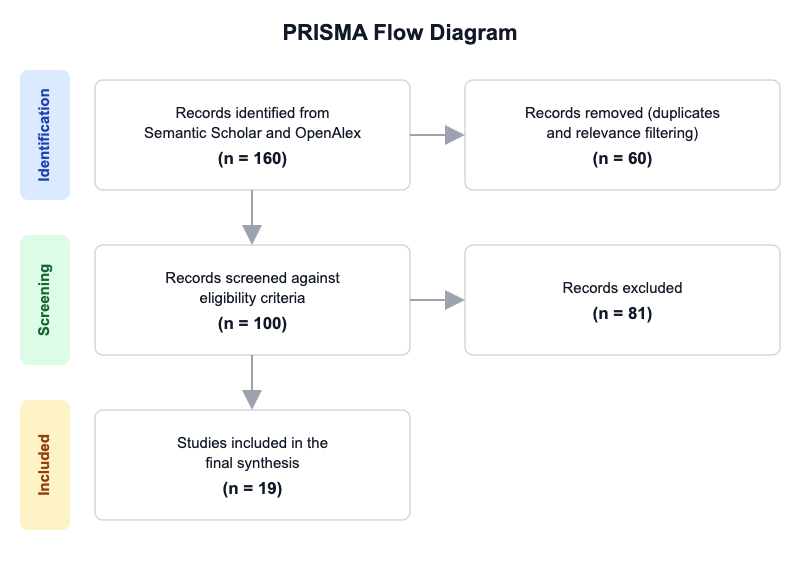
Initial database searching identified 160 records. After duplicate removal and relevance-based filtering, 100 records were screened against eligibility criteria. Of these, 81 papers were excluded, resulting in 19 papers included in the final synthesis.
PRISMA Flow Diagram
Eligibility criteria included:
- Human Studies: Does the study involve human participants or human patient data rather than animal or in-vitro models?
- Multiple Myeloma: Does the study focus on multiple myeloma, plasma cell myeloma, or a clearly defined myeloma subgroup?
- Recent Evidence: Is the study published in 2020 or later?
- Clinical or Translational: Does the study address treatment, prognosis, relapse, biomarkers, MRD, immune therapy, or other clinically relevant myeloma research?
- Primary Data or Review: Does the paper present original data, a clinical trial, observational study, translational study, systematic review, or meta-analysis rather than an unrelated commentary?
- Therapy Advance: Does the paper evaluate novel treatment approaches such as CAR-T, bispecific antibodies, next-generation combinations, or emerging agents?
- Biomarker Focus: Does the paper examine biomarkers, minimal residual disease, genomic risk, or risk stratification?
- Outcomes Reported: Does the paper report outcomes such as response rate, progression-free survival, overall survival, MRD negativity, relapse, or adverse events?
All included studies met the stated eligibility criteria.
2.3 Data Extraction and Synthesis
Data extraction focused on the following variables:
- Research Focus: State the main topic or clinical/research focus of the paper in multiple myeloma (e.g., treatment, relapse, biomarkers, MRD, CAR-T, prognosis).
- Study Type: Identify the study design or article type (trial, cohort, review, meta-analysis, translational study, biomarker study, etc.).
- Population: Extract the patient population or disease context, including newly diagnosed, relapsed/refractory, transplant-eligible, transplant-ineligible, or other relevant subgroup.
- Intervention/Exposure: Extract the therapy, biomarker, risk factor, or exposure being studied; include specific drug names, combinations, or assays when reported.
- Key Finding: Summarize the main finding or conclusion as reported in the paper, using only evidence from the abstract or available text.
- Outcome Metrics: Extract the main outcomes measured or reported, such as progression-free survival, overall survival, response rate, MRD negativity, relapse, or adverse events.
- Sample Size/Scope: Extract sample size, number of studies included, or scale of evidence when explicitly reported.
- Recency/Relevance: Note whether the paper represents a recent advance, current standard, or emerging area in multiple myeloma research based on the title/abstract.
Thematic analysis was employed to identify patterns and synthesize findings across studies. Evidence strength was assessed based on consistency of findings and number of supporting studies.
3. Results
3.1 Characteristics of Included Studies
| Study and Year | Study Type | Population | Main Focus | Key Outcome/Metric | Scope |
|---|---|---|---|---|---|
| Rajkumar 2024 [1] | Review | Newly diagnosed, transplant-eligible, frail, relapsed | Diagnosis, risk stratification, management | Treatment response, maintenance, relapse management | Not reported |
| Dimopoulos et al. 2025 [2] | Evidence-based guidelines | Newly diagnosed; relapsed/refractory | Diagnosis, treatment, follow-up, complications | Treatment recommendations; adverse event management | Not reported |
| Rajkumar 2022 [3] | Review | Newly diagnosed, transplant-eligible/ineligible, high-risk | Diagnosis, risk stratification, management | Maintenance, relapse therapy | Not reported |
| Landgren et al. 2024 [4] | Meta-analysis | Newly diagnosed; relapsed/refractory | MRD as intermediate endpoint | PFS association; MRD-negativity | 4,907 newly diagnosed patients; 4 relapsed/refractory studies |
| Maura et al. 2024 [5] | Translational risk model | Newly diagnosed | Genomic classification, prognosis | OS c-index; individualized risk | 1,933 patients; 256 validation |
| Samur et al. 2020 [6] | Translational genomic study | Newly diagnosed | Whole-genome somatic alterations, survival | OS and PFS; favorable subgroup | 183 patients |
| Mateos et al. 2020 [7] | Cohort/model development | Smoldering multiple myeloma | Progression risk stratification | 2-year progression risk | 1,996 patients |
| Hagen et al. 2022 [8] | Review | Newly diagnosed | High-risk definitions | Prognostic heterogeneity | Not reported |
| Rees and Kumar 2024 [9] | Review | High-risk multiple myeloma | Redefining high-risk disease | Early relapse; discordant models | Not reported |
| Yu et al. 2020 [10] | Review | Relapsed/refractory | BCMA-targeted immunotherapy | Clinical response | Not reported |
| Mikkilineni and Kochenderfer 2020 [11] | Review | Relapsed/refractory | CAR T-cell therapy | Objective responses; remission duration | >20 trials discussed |
| Roex et al. 2020 [12] | Meta-analysis | Advanced relapsed/refractory | BCMA CAR-T efficacy and safety | Efficacy, toxicity, heterogeneity | Not reported |
| van de Donk et al. 2021 [13] | Review | Heavily pretreated; earlier-stage exploratory | CAR T-cell therapy | MRD-negativity; relapse | Multiple trials discussed |
| Teoh and Chng 2021 [14] | Review | Relapsed/refractory | CAR T-cell therapy challenges | Efficacy, safety, manufacturing | Not reported |
| Manier et al. 2022 [15] | Review | Relapsed/refractory | Next-generation CAR-T cells | Approved and pipeline CAR-Ts | Multiple trials discussed |
| Swan et al. 2024 [16] | Review | Relapsed refractory; earlier lines emerging | CAR-T current status and challenges | Safety, BCMA-loss, patient selection | Not reported |
| Szalat et al. 2024 [17] | Review | Multiple myeloma, including high-risk and relapse | MRD assessment | MRD as prognostic factor | Not reported |
| Gullà and Anderson 2020 [18] | Review | Broad multiple myeloma population | Therapy evolution | Median survival improvement | Not reported |
| Rajkumar and Kumar 2020 [19] | Review | Newly diagnosed and relapsed | Treatment algorithms | Treatment strategy, clinical trial emphasis | Not reported |
Across the included literature, the evidence base is dominated by reviews, guideline papers, meta-analyses, and translational cohort/modeling studies rather than randomized treatment trials. The strongest quantitative evidence comes from MRD meta-analysis and genomic prognostic modeling, while the treatment literature is characterized mainly by synthesis of trial data and emerging regulatory approvals. Populations cluster around newly diagnosed disease, relapsed/refractory disease, and high-risk subgroups, with smouldering myeloma represented through dedicated risk-stratification work [7].
3.2 Thematic Findings
3.2.1 Risk stratification is moving from static cytogenetics to integrated genomic-clinical prediction
The contemporary literature shows a clear expansion from conventional high-risk markers toward individualized prognostic modeling that integrates genomics, treatment, and clinical variables. Legacy definitions consistently emphasize abnormalities such as del(17p), t(4;14), t(14;16), t(14;20), gain 1q, del 1p, and p53 mutation as high-risk features, but more recent work argues that these categories are insufficient because they miss patients who relapse early despite apparently favorable baseline profiles [1], [3], [9]. In newly diagnosed disease, a genomic-clinical model built from 1,933 patients achieved a c-index for overall survival of 0.726, outperforming ISS at 0.61, revised-ISS at 0.572, and R2-ISS at 0.625, with 20 genomic features contributing to discrimination, including 1q21 gain/amp, del 1p, TP53 loss, NSD2 translocations, APOBEC signatures, and chromothripsis-related copy-number signatures [5]. A separate whole-genome study of 183 newly diagnosed patients also identified a genomically defined subgroup with low DNA damage and chromosome 9 gain that had 100% overall survival at 69 months, showing that favorable biology can be captured only by deeper genomic resolution [6]. In smouldering disease, a distinct risk model stratified progression risk at 2 years to 6%, 23%, 46%, and 63% depending on accumulating clinical and cytogenetic factors, reinforcing the broader trend toward layered rather than binary risk classification [7]. Confidence: Strong.
3.2.2 MRD negativity has become a central intermediate endpoint, but its role in routine treatment guidance remains unresolved
The evidence consistently supports minimal residual disease negativity as a strong prognostic marker across disease states. A meta-analysis found that 12-month MRD-negativity was associated with progression-free survival at the trial level and at the individual level, with an odds ratio of 4.02 (95% CI 2.57-5.46) in newly diagnosed disease and 7.67 (4.24-11.10) in relapsed/refractory disease [4]. This finding aligns with review-level synthesis stating that MRD negativity is a strong and independent prognostic factor in both prospective trials and real-world settings [17]. However, the literature also emphasizes a separation between validation as an endpoint and implementation as a clinical decision tool: MRD is now described as validated in clinical trials, but its incorporation into routine practice is not yet established and its therapeutic implications remain under active evaluation [17], [2]. The heterogeneity of MRD assessment methods and time points likely limits comparability across studies, even as its prognostic direction is consistent. Note: these studies examined newly diagnosed and relapsed/refractory multiple myeloma populations, which partially match the question population of multiple myeloma broadly; findings should be interpreted considering this difference. Confidence: Strong for prognostic value; moderate for clinical utility.
3.2.3 BCMA-directed immunotherapy and CAR T-cell therapy show high response potential, but durability and toxicity remain the dominant constraints
A second major theme is the rapid expansion of BCMA-directed immunotherapy, especially CAR T-cell approaches. Across reviews and a meta-analysis, anti-BCMA CAR T cells are repeatedly described as producing objective responses or high-quality responses in heavily pretreated or advanced relapsed/refractory myeloma [13], [11], [12]. Belantamab mafodotin-blmf, a BCMA-targeted antibody-drug conjugate, is identified as approved for highly refractory disease, confirming that BCMA has moved from a biologic target into a therapeutic class [10]. Yet the same literature is equally clear that efficacy is tempered by toxicity and limited durability: cytokine-release syndrome, cytopenias, infections, neurotoxicity, and broader manufacturing challenges recur across the CAR T-cell literature, while relapse is common due to CAR T-cell loss, antigen escape, and the immunosuppressive microenvironment [13], [14], [16]. One review notes that most patients do not maintain remission beyond 18 months, despite early objective responses, underscoring the gap between response depth and long-term disease control [11]. The field is therefore shifting toward next-generation constructs, alternative antigens, dual targeting, and safer manufacturing platforms [15], [16]. Note: these studies examined heavily pretreated, relapsed/refractory, or advanced myeloma populations, which partially match the question population of multiple myeloma; findings should be interpreted considering this difference. Confidence: Strong for response potential; moderate for long-term durability.
3.2.4 Treatment algorithms now embed immunotherapy, transplantation, and risk-adapted maintenance, but the evidence base remains consensus-heavy
Clinical management in recent updates is increasingly structured around risk-adapted induction, transplantation, maintenance, and relapse sequencing. Current reviews and guidelines recommend anti-CD38 monoclonal antibody plus VRd for transplant-eligible induction, ASCT for suitable candidates, lenalidomide maintenance for standard-risk disease, and bortezomib plus lenalidomide maintenance for high-risk disease [1], [3], [2]. For relapse, triplet regimens remain standard, with choice varying by prior exposure and disease course [1], [3]. The practical message across sources is that therapy is no longer organized by disease stage alone but by fitness, transplant eligibility, and biologic risk, with early integration of immunotherapy into first-line pathways and relapsed settings [2], [19]. However, because much of this literature is guideline-driven or review-based, the recommendations reflect convergence of trial evidence rather than direct head-to-head comparisons within this synthesis. Confidence: Moderate to strong.
3.2.5 “High-risk” multiple myeloma is increasingly recognized as a biologically heterogeneous category rather than a fixed label
A recurring conceptual development is the recognition that high-risk disease is not fully captured by standard staging systems. Reviews emphasize that many prognostic characteristics remain ill-defined and that current models produce discordant or overly broad outputs, leaving early relapse incompletely predicted [8], [9]. Genomic work helps explain why: one model’s performance depended on 20 genomic features, while a whole-genome analysis showed that mutational processes such as APOBEC activity and DNA repair-associated signatures differ by subgroup and disease phase [5], [6]. This suggests that “high-risk” is an umbrella state produced by several distinct biological routes, including adverse cytogenetics, DNA repair disruption, and structural genomic complexity. The implication is that a clinically meaningful definition of high-risk disease will likely need to integrate molecular, functional, and treatment-response dimensions rather than rely on any single marker set [9]. Confidence: Moderate.
3.3 Summary of Evidence
| Theme | Key Finding | Population Applicability | Effect Direction | Confidence Level | Supporting Studies |
|---|---|---|---|---|---|
| Genomic risk stratification | IRMMa c-index for OS 0.726 vs ISS 0.61, revised-ISS 0.572, R2-ISS 0.625 | Newly diagnosed multiple myeloma; partially matches broad MM question | Positive for prediction | Strong | Maura et al. [5], Samur et al. [6] |
| MRD as endpoint | 12-month MRD-negativity OR 4.02 (95% CI 2.57-5.46) for PFS in newly diagnosed MM; OR 7.67 (4.24-11.10) in relapsed/refractory MM | Newly diagnosed and relapsed/refractory MM; partially matches broad MM question | Positive | Strong | Landgren et al. [4], Szalat et al. [17] |
| BCMA/CAR T efficacy | Anti-BCMA CAR T-cell therapy produced objective/high-quality responses, but most remissions were not durable beyond 18 months | Relapsed/refractory or heavily pretreated MM; partially matches broad MM question | Mixed | Strong | van de Donk et al. [13], Mikkilineni and Kochenderfer [11], Roex et al. [12] |
| CAR T toxicity and resistance | Toxicities included cytokine-release syndrome, cytopenia, infections, neurotoxicity; relapse linked to antigen loss and T-cell exhaustion | Relapsed/refractory MM; partially matches broad MM question | Negative for durability/safety | Strong | Swan et al. [16], Teoh and Chng [14], Manier et al. [15] |
| Risk-adapted treatment algorithms | VRd, ASCT, lenalidomide maintenance, and bortezomib-based maintenance remain central, with anti-CD38 added in contemporary regimens | Newly diagnosed and relapsed MM | Positive | Moderate | Rajkumar [1], Rajkumar and Kumar [19], Dimopoulos et al. [2] |
| Smouldering MM risk stratification | 2-year progression risk stratified to 6%, 23%, 46%, and 63% by accumulating factors | Smouldering MM; does not directly match active MM population | Positive for risk prediction | Moderate | Mateos et al. [7] |
| High-risk disease redefinition | Current risk models miss early relapsers and produce discordant outputs | Newly diagnosed/high-risk MM; partially matches broad MM question | Negative for current model adequacy | Moderate | Hagen et al. [8], Rees and Kumar [9] |
| Survival improvement over time | Median survival improved from 3 years to 8-10 years | Broad MM population | Positive | Limited | Gullà and Anderson [18] |
4. Discussion
4.1 Principal Findings and Their Interpretation
The synthesis suggests that the most consequential advance in recent multiple myeloma research is not a single new drug class but a reorganization of the field around biological precision. Genomic studies show that outcomes vary substantially even within apparently similar newly diagnosed populations, and the superior performance of individualized genomic-clinical prediction over ISS-based staging implies that baseline risk is shaped by interacting lesions rather than by a small set of canonical abnormalities [5], [6]. Mechanistically, this is biologically plausible because the studies identify genomic instability, DNA repair-associated signatures, APOBEC activity, and structural variants as contributors to outcome heterogeneity. In other words, prognosis appears to reflect the cumulative effect of mutational processes, not merely the presence or absence of one cytogenetic flag.
The same logic applies to MRD. The consistent association between MRD-negativity and subsequent progression-free survival indicates that response depth captures treatment effect more faithfully than conventional categorical response definitions [4], [17]. This is especially important in a disease where modern regimens can induce high response rates but still leave residual clonal disease capable of driving relapse. The evidence therefore supports MRD as a mechanistically meaningful surrogate of tumor burden reduction, while remaining cautious about its use as a stand-alone guide for treatment escalation or de-escalation.
The immunotherapy literature reinforces this interpretation. BCMA-directed CAR T-cell and related therapies demonstrate that deep cytoreduction is achievable even in heavily pretreated disease, but persistence of benefit is limited by antigen loss, immune exhaustion, and the suppressive microenvironment [13], [16]. The field’s trajectory thus points toward a more integrated therapeutic model in which genomic risk, MRD depth, and immune escape mechanisms are jointly considered. Confidence is highest for the prognostic value of MRD and for the existence of meaningful genomic heterogeneity; it is somewhat lower for immediate bedside translation of current risk models, because several are still under refinement and remain more descriptive than directive.
4.2 Comparison with Existing Literature and Resolution of Contradictions
The main apparent contradiction in this literature is that contemporary risk models are becoming more elaborate while reviewers simultaneously argue that high-risk disease remains poorly defined. This is not a true conflict so much as evidence of a transition in the field. Older schemas based on a restricted set of cytogenetic lesions remain clinically useful, but newer analyses show that they do not fully identify patients who relapse early, particularly when genomic context, disease burden, and clinical factors diverge from the expected pattern [8], [9]. The disagreement therefore likely reflects biological heterogeneity rather than analytic failure alone.
A second tension concerns MRD. On one hand, MRD negativity is validated as an endpoint and strongly associated with PFS; on the other, routine use for directing individual treatment decisions is not established [4], [17]. The most plausible explanation is methodological: MRD assays differ in sensitivity, specimen source, timing, and thresholding, and studies are not designed to answer the same decision question. Thus, MRD behaves robustly as a prognostic marker but is still being tested as a predictive tool. That distinction matters because a biomarker can be highly prognostic without yet being sufficiently standardized to determine therapy changes.
The CAR T-cell literature shows a similar pattern of agreement with an unresolved limitation. Early and later reviews converge on strong anti-myeloma activity, yet they also emphasize toxicity and relapse [11], [12], [16]. The persistence of this message across years suggests that the issue is not lack of efficacy signals but rather the biology of resistance and the practical constraints of cell therapy manufacturing. Publication bias remains possible, because highly positive early-phase immunotherapy results are more likely to be reported than null findings, but the recurring discussion of toxicity and limited durability argues against a purely selective narrative.
4.3 Practical Implications
Clinically, the evidence supports more individualized management of multiple myeloma than is possible with conventional staging alone. Patients with high-risk genomic profiles, those with residual disease after therapy, and those with early relapse represent the clearest candidates for intensified monitoring and treatment adaptation [5], [17], [9]. In practice, this means that genomic profiling and MRD assessment are becoming complementary rather than competing tools: the former helps define baseline risk, while the latter measures therapeutic success and residual vulnerability.
For treatment planning, the evidence supports maintaining current backbone strategies—VRd-based induction, transplantation in eligible patients, and risk-adapted maintenance—while increasingly incorporating anti-CD38 antibodies and considering BCMA-directed approaches in relapse [1], [2], [19]. However, CAR T-cell therapy should be viewed as a powerful but still imperfect option, best suited to settings where deep responses are needed and toxicity can be actively managed [13], [16]. The public health implication is not broad population screening alone, but better stratification of patients likely to benefit from intensified surveillance and advanced immunotherapies. Regulatory and guideline bodies should continue to prioritize harmonized MRD definitions and genomic reporting standards so that biologic advances translate into consistent clinical action. The evidence does not justify overextending MRD or CAR T-cell findings into contexts where assay standardization, access, or durability remain uncertain.
4.4 Strengths and Limitations
A major strength of this review is that it integrates multiple evidence layers—guidelines, meta-analysis, translational cohorts, and treatment reviews—allowing a broad view of the contemporary myeloma landscape. Another strength is that the included literature spans diagnosis, prognostic modeling, response assessment, and immunotherapy, making it possible to compare how advances in one domain influence another. The synthesis also benefits from the recency of the evidence base, which captures rapid developments in genomic prediction and BCMA-directed therapy.
The limitations of the included studies are substantial and shape how confidently conclusions can be applied. Much of the treatment literature is review-based rather than based on direct comparative trials, and several papers synthesize early-phase or heterogeneous studies with differing endpoints. Genomic studies are strong but remain concentrated in newly diagnosed populations, while CAR T-cell evidence largely reflects relapsed/refractory disease. MRD studies vary in assay methods and timing, limiting comparability. This review is limited by reliance on the provided abstracts and extracted fields, absence of formal risk-of-bias appraisal, and the inability to quantify pooled effects when not reported.
5. Gaps and Future Directions
The main evidence gap is the lack of a single, validated framework that unifies genomic risk, MRD, and clinical variables into one clinically actionable model for routine multiple myeloma care. Current studies show that each dimension adds information, but they do not yet establish how to combine them for treatment selection or de-escalation. Future work should therefore test integrated models prospectively in exact newly diagnosed, relapsed/refractory, and frail populations rather than relying primarily on retrospective or review-level synthesis [5], [17], [2].
A second gap is the limited standardization of MRD methods and reporting. The field needs harmonized assays, consistent time points, and clearer thresholds for decision-making if MRD is to move from endpoint validation to therapy guidance [4]. For immunotherapy, future studies should directly compare BCMA-directed CAR T-cell platforms, examine resistance mechanisms longitudinally, and include longer follow-up for durability and late toxicity [13], [16]. Finally, high-risk disease research should move beyond static cytogenetic lists to models that incorporate co-occurring mutations, early relapse biology, and treatment response heterogeneity [9], [8].
6. Conclusion
The latest evidence indicates that multiple myeloma research is rapidly moving toward precision prognostication and response-adapted therapy rather than reliance on fixed staging alone. The strongest conclusion is that MRD-negativity is a robust prognostic marker, with progression-free survival associations of 4.02 (95% CI 2.57-5.46) in newly diagnosed disease and 7.67 (4.24-11.10) in relapsed/refractory disease, while genomic-clinical models now outperform conventional staging systems in newly diagnosed patients, achieving a c-index for overall survival of 0.726 compared with 0.61 for ISS, 0.572 for revised-ISS, and 0.625 for R2-ISS [4], [5]. At the same time, BCMA-directed CAR T-cell and related immunotherapies show substantial activity in heavily pretreated disease, but durability and safety remain limiting factors [13], [12], [16].
Because much of the strongest evidence comes from newly diagnosed, relapsed/refractory, or otherwise specialized subgroups, the findings should be interpreted as highly informative for the broader disease landscape but not yet fully definitive for every clinical context. The most important unresolved question is how best to integrate genomic risk, MRD status, and immune-based therapy into a single prospective treatment strategy that improves survival without unnecessary toxicity. Addressing that question will determine whether the current wave of biologic advances becomes not only prognostic but truly transformative for patients with multiple myeloma.
References
- Rajkumar, S. V. (2024). Multiple myeloma: 2024 update on diagnosis, risk-stratification, and management. American Journal of Hematology, 99(9), 1802–1824. https://doi.org/10.1002/ajh.27422
- Dimopoulos, M. A., Terpos, E., Boccadoro, M., Moreau, P., Mateos, M.-V., Zweegman, S., Cook, G., Engelhardt, M., Delforge, M., Hajek, R., Schjesvold, F., Gay, F., Manier, S., Weisel, K. C., Kaiser, M., van de Donk, N. W. C. J., Zamagni, E., Rodriguez-Otero, P., Perrot, A., … Sonneveld, P. (2025). EHA–EMN evidence-based guidelines for diagnosis, treatment and follow-up of patients with multiple myeloma. Nature Reviews Clinical Oncology, 22(9), 680–700. https://doi.org/10.1038/s41571-025-01041-x
- Rajkumar, S. V. (2022). Multiple myeloma: 2022 update on diagnosis, risk stratification, and management. American Journal of Hematology, 97(8), 1086–1107. https://doi.org/10.1002/ajh.26590
- Landgren, O., Prior, T. J., Masterson, T., Heuck, C., Bueno, O. F., Dash, A. B., Einsele, H., Goldschmidt, H., Knop, S., Li, C., Mellqvist, U., McFadden, I., Oprea, C., Ross, J. A., Talpes, M., Hydren, J. R., Ahlstrom, J. M., Kazandjian, D., Weinhold, N., … Devlin, S. M. (2024). EVIDENCE meta-analysis: Evaluating minimal residual disease as an intermediate clinical end point for multiple myeloma. Blood, 144(4), 359–367. https://doi.org/10.1182/blood.2024024371
- Maura, F., Rajanna, A. R., Ziccheddu, B., Poos, A. M., Derkach, A., Maclachlan, K., Durante, M., Diamond, B., Papadimitriou, M., Davies, F., Boyle, E. M., Walker, B., Hultcrantz, M., Silva, A., Hampton, O., Teer, J. K., Siegel, E. M., Bolli, N., Jackson, G. H., … Landgren, O. (2024). Genomic classification and individualized prognosis in multiple myeloma. Journal of Clinical Oncology, 42(11), 1229–1240. https://doi.org/10.1200/JCO.23.01277
- Samur, M. K., Aktas Samur, A., Fulciniti, M., Szalat, R., Han, T., Shammas, M., Richardson, P., Magrangeas, F., Minvielle, S., Corre, J., Moreau, P., Thakurta, A., Anderson, K. C., Parmigiani, G., Avet-Loiseau, H., & Munshi, N. C. (2020). Genome-wide somatic alterations in multiple myeloma reveal a superior outcome group. Journal of Clinical Oncology, 38(27), 3107–3118. https://doi.org/10.1200/JCO.20.00461
- Mateos, M.-V., Kumar, S., Dimopoulos, M. A., González-Calle, V., Kastritis, E., Hajek, R., De Larrea, C. F., Morgan, G. J., Merlini, G., Goldschmidt, H., Geraldes, C., Gozzetti, A., Kyriakou, C., Garderet, L., Hansson, M., Zamagni, E., Fantl, D., Leleu, X., Kim, B.-S., … San-Miguel, J. (2020). International Myeloma Working Group risk stratification model for smoldering multiple myeloma (SMM). Blood Cancer Journal, 10(10), 102. https://doi.org/10.1038/s41408-020-00366-3
- Hagen, P., Zhang, J., & Barton, K. (2022). High-risk disease in newly diagnosed multiple myeloma: Beyond the R-ISS and IMWG definitions. Blood Cancer Journal, 12(5), 83. https://doi.org/10.1038/s41408-022-00679-5
- Rees, M. J., & Kumar, S. (2024). High-risk multiple myeloma: Redefining genetic, clinical, and functional high-risk disease in the era of molecular medicine and immunotherapy. American Journal of Hematology, 99(8), 1560–1575. https://doi.org/10.1002/ajh.27327
- Yu, B., Jiang, T., & Liu, D. (2020). BCMA-targeted immunotherapy for multiple myeloma. Journal of Hematology & Oncology, 13(1), 125. https://doi.org/10.1186/s13045-020-00962-7
- Mikkilineni, L., & Kochenderfer, J. N. (2020). CAR T cell therapies for patients with multiple myeloma. Nature Reviews Clinical Oncology, 18(2), 71–84. https://doi.org/10.1038/s41571-020-0427-6
- Roex, G., Timmers, M., Wouters, K., Campillo-Davo, D., Flumens, D., Schroyens, W., Chu, Y., Berneman, Z. N., Lion, E., Luo, F., & Anguille, S. (2020). Safety and clinical efficacy of BCMA CAR-T-cell therapy in multiple myeloma. Journal of Hematology & Oncology, 13(1), 164. https://doi.org/10.1186/s13045-020-01001-1
- van de Donk, N. W. C. J., Usmani, S. Z., & Yong, K. (2021). CAR T-cell therapy for multiple myeloma: State of the art and prospects. The Lancet Haematology, 8(6), e446–e461. https://doi.org/10.1016/S2352-3026(21)00057-000057-0)
- Teoh, P. J., & Chng, W. J. (2021). CAR T-cell therapy in multiple myeloma: More room for improvement. Blood Cancer Journal, 11(4), 84. https://doi.org/10.1038/s41408-021-00469-5
- Manier, S., Ingegnere, T., Escure, G., Prodhomme, C., Nudel, M., Mitra, S., & Facon, T. (2022). Current state and next-generation CAR-T cells in multiple myeloma. Blood Reviews, 54, 100929. https://doi.org/10.1016/j.blre.2022.100929
- Swan, D., Madduri, D., & Hocking, J. (2024). CAR-T cell therapy in multiple myeloma: Current status and future challenges. Blood Cancer Journal, 14(1), 206. https://doi.org/10.1038/s41408-024-01191-8
- Szalat, R., Anderson, K., & Munshi, N. (2024). Role of minimal residual disease assessment in multiple myeloma. Haematologica, 109, 2049–2059. https://doi.org/10.3324/haematol.2023.284662
- Gullà, A., & Anderson, K. C. (2020). Multiple myeloma: The (r)evolution of current therapy and a glance into future. Haematologica, 105(10), 2358–2367. https://doi.org/10.3324/haematol.2020.247015
- Rajkumar, S. V., & Kumar, S. (2020). Multiple myeloma current treatment algorithms. Blood Cancer Journal, 10(9), 94. https://doi.org/10.1038/s41408-020-00359-2