

Latest Research on Multiple Sclerosis: Integrative Review of Immunopathogenesis, Biomarkers, Imaging, and Therapeutic Stratification
Abstract
Recent research on multiple sclerosis (MS) converges on a shift from broad relapsing-disease control toward biologically targeted monitoring and individualized management. Across recent studies, high-efficacy disease-modifying therapy lowered the risk of EDSS worsening and relapses compared with moderate-efficacy therapy, while DMTs reduced annual relapse rate by 29% to 68% versus placebo or active comparator [16], [4]. At the same time, biomarkers and imaging increasingly distinguish acute inflammatory activity from chronic progressive biology: elevated CSF GFAP was associated with long-term disability progression with a hazard ratio of 2.1 (95% CI 1.3-3.4), and imaging biomarkers such as paramagnetic rim lesions and slowly expanding lesions are being standardized for chronic active lesion detection [6], [2]. This literature matters because the central challenge in MS is no longer only relapse suppression, but also prediction and interruption of nonrelapsing progression, which remains incompletely addressed by existing therapies [8], [17]. Additional evidence shows that anti-CD20 and S1PR-modulating therapies may reduce vaccine immunogenicity and increase COVID-19 risk, whereas interferons and glatiramer acetate show more favorable infectious-risk profiles [10], [3], [14]. Collectively, the literature supports a biologically stratified model of MS in which immune modulation, neurodegeneration, and fluid/imaging biomarkers are increasingly integrated to guide treatment, though standardized validation for progression biomarkers and progressive-disease therapies remains incomplete.
1. Introduction
Multiple sclerosis is a heterogeneous immune-mediated disorder of the central nervous system that remains a leading cause of neurological disability in young adults. Despite major advances in disease-modifying therapies, patients continue to experience relapse-associated injury, accumulating disability, cognitive impairment, and progressive neurodegeneration. This clinical heterogeneity has made MS a moving target for both diagnosis and treatment, especially as the field increasingly recognizes that inflammatory activity and progression are related but not identical biological processes [5], [17].
Recent work has therefore moved beyond a purely relapse-centered framework. On one hand, immunological studies emphasize that immune-cell behavior is shaped by context and plasticity rather than by a single antigen-specific pathway, implying that pathogenic states may be reversible rather than fixed [1]. On the other hand, biomarker and imaging studies are attempting to identify measurable signatures of chronic active lesions, progressive disease biology, and disability accrual, including CSF GFAP, neurofilament heavy chain, paramagnetic rim lesions, and slowly expanding lesions [6], [2]. Parallel therapeutic literature is also evolving, with consensus recommendations, network meta-analytic comparisons, and personalized treatment frameworks increasingly used to match drug potency, safety, and patient preferences to disease phenotype [7], [13], [15].
A further development is the growing attention to the prodromal phase of MS and to early disease detection, suggesting that the window for intervention may begin before classical diagnostic presentation [11]. Together, these strands of research indicate that the “latest” MS literature is no longer organized solely around relapse prevention, but around earlier risk identification, disease stratification, progression biomarkers, and patient-specific therapy selection. The present review synthesizes these recent directions to clarify where the field has converged, where uncertainty remains, and how current evidence informs clinical and translational research priorities.
2. Methods
2.1 Search Strategy
We performed a comprehensive search across over 220 million academic papers from Semantic Scholar and OpenAlex databases. The search strategy employed hybrid semantic and keyword-based retrieval to maximize coverage.
Search queries included:
- "Multiple sclerosis latest research clinical outcomes disease-modifying therapies"
- "Recent multiple sclerosis biomarkers imaging prognosis treatment advances"
- "Multiple sclerosis immunopathology neurodegeneration relapse disability recent studies"
- "Multiple sclerosis rehabilitation symptoms quality of life recent evidence"
2.2 Study Selection
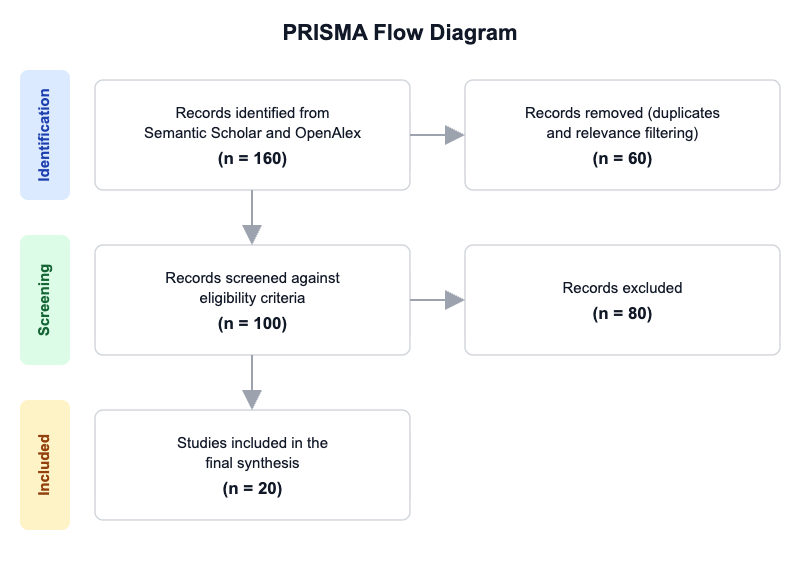
Initial database searching identified 160 records. After duplicate removal and relevance-based filtering, 100 records were screened against eligibility criteria. Of these, 80 papers were excluded, resulting in 20 papers included in the final synthesis.
PRISMA Flow Diagram
Eligibility criteria included:
- MS Topic: Does the study focus on multiple sclerosis or a clearly defined MS subgroup (e.g., relapsing-remitting, progressive, pediatric MS)?
- Human Evidence: Does the study involve human participants or human patient data rather than only animal, cell, or simulation models?
- Recent Evidence: Was the study published between 2020 and 2026 inclusive?
- Research Contribution: Does the study present original data, a systematic review, a meta-analysis, or a clinically relevant synthesis rather than a purely general commentary?
- Clinical/Translational Value: Does the study address treatment, prognosis, biomarkers, imaging, relapse, disability, rehabilitation, symptoms, or quality of life in MS?
- Therapy/Mechanism: Does the paper evaluate a disease-modifying therapy, biomarker, imaging method, pathophysiologic mechanism, or patient-centered outcome in MS?
- Current Relevance: Does the study address a topic that is likely useful for current MS research or clinical practice, such as treatment advances, monitoring, or symptom management?
All included studies met the stated eligibility criteria.
2.3 Data Extraction and Synthesis
Data extraction focused on the following variables:
- Research Focus: State the main topic of the paper within multiple sclerosis research, such as disease-modifying therapy, biomarkers, imaging, prognosis, rehabilitation, symptom management, neurodegeneration, or quality of life.
- Study Type: Identify the study design or evidence type (e.g., clinical trial, cohort study, cross-sectional study, systematic review, meta-analysis, review, imaging study).
- Population: Extract the participant group or model studied, including disease subtype if stated (e.g., relapsing-remitting MS, progressive MS, adults with MS, pediatric MS).
- Key Finding: Summarize the paper's main finding relevant to latest multiple sclerosis research, using only information stated in the paper.
- Outcome Measured: List the primary outcome(s) or endpoint(s) assessed, such as relapse rate, disability progression, MRI lesion burden, cognitive function, fatigue, walking ability, or quality of life.
- Intervention/Exposure: Extract the main intervention, exposure, biomarker, imaging method, or therapeutic approach investigated.
- Year: Record the publication year if available from the paper metadata.
- Clinical Relevance: Briefly note why the study matters for current multiple sclerosis research, such as treatment implications, prognosis, monitoring, or patient-centered outcomes.
Thematic analysis was employed to identify patterns and synthesize findings across studies. Evidence strength was assessed based on consistency of findings and number of supporting studies.
3. Results
3.1 Characteristics of Included Studies
| Study and Year | Study Type | Population | Key Focus | Intervention/Exposure | Main Outcome(s) |
|---|---|---|---|---|---|
| Attfield et al. 2022 [1] | Review | MS broadly | Immunology and immune-cell plasticity | Immune cell states; therapeutic manipulation | Pathogenic immune differentiation; disease mechanisms |
| Bagnato et al. 2024 [2] | Consensus statement | MS broadly | Chronic active lesion imaging | MRI/PET biomarkers | CAL identification, quantification, monitoring |
| Reder et al. 2021 [3] | Cohort study | PwMS on DMTs | COVID-19 risk and therapies | Interferons, glatiramer acetate, anti-CD20 | SARS-CoV-2 infection risk; safety reports |
| McGinley et al. 2021 [4] | Review | MS broadly | Diagnosis and treatment | DMTs | Annual relapse rate |
| Jakimovski et al. 2023 [5] | Review | Young adults with MS | Diagnosis, prognosis, personalization | Immunomodulatory treatment; lifestyle; comorbidity management | Diagnostic accuracy; treatment timing; QoL |
| Cross et al. 2024 [6] | Cohort study | RMS and PPMS | CSF biomarkers of progression | Ocrelizumab; CSF markers; MRI | CDP24; SELs; CSF biomarker associations |
| Wiendl et al. 2021 [7] | Consensus/position statement | MS patients in Europe | DMT recommendations | Approved DMTs | Treatment guidance/prognosis |
| Chataway et al. 2024 [8] | Review | Progressive MS | Clinical trials and progression | BTK inhibitors; neuroprotective compounds; remyelination | Disability progression; intermediate outcomes |
| Di Filippo et al. 2024 [9] | Review | MS broadly | Fluid biomarkers | CSF and blood biomarkers | Diagnosis; prognosis; treatment monitoring |
| Etemadifar et al. 2022 [10] | Systematic review/meta-analysis | PwMS on DMTs | Vaccination immunogenicity | S1PRM; anti-CD20; other DMTs | B/T-cell responses; seroconversion; breakthrough COVID-19 |
| Marrie et al. 2022 [11] | Roadmap/framework | High-risk individuals for MS | Prodrome and prevention | Prodromal identification | Early markers; standardized criteria |
| Inojosa et al. 2020 [12] | Review | MS broadly | Clinical outcome measures | EDSS; composite COMs; digital tools | Progression; treatment response |
| Liu et al. 2021 [13] | Systematic review/network meta-analysis | RRMS | Comparative DMT effectiveness | Ofatumumab; alemtuzumab; natalizumab | Effectiveness; compliance |
| Simpson-Yap et al. 2021 [14] | Cross-sectional study | MS with COVID-19 | COVID-19 severity | Rituximab; ocrelizumab | Hospitalization; ICU admission; ventilation |
| Lee & Chan 2024 [15] | Review | Relapsing MS | Personalized DMT use | Multiple DMTs | Shared decision-making; treatment fit |
| Buron et al. 2020 [16] | Comparative effectiveness study | MS patients | High-efficacy treatment initiation | High-efficacy vs moderate-efficacy DMT | EDSS worsening; relapses |
| Woo et al. 2024 [17] | Review | MS broadly | Neuropathobiology | Neuronal actuators; neurodegenerative mechanisms | Disability progression; neurodegeneration |
| Jokubaitis et al. 2022 [18] | Cohort genetic study | European ancestry, relapse-onset MS | Severity genetics | Genome-wide variants; machine learning | Severity prediction; clinical outcomes |
| Pérez et al. 2022 [19] | Review | MS broadly | Immunopathogenesis, diagnosis, treatment | Treatment approaches | Clinical management |
| Yousef et al. 2024 [20] | Review | MS broadly | MRI-based machine learning prognosis | MRI biomarkers; ML algorithms | CIS conversion; cognition; EDSS; motor disability; disease activity |
Overall, the included literature is dominated by reviews, consensus statements, and translational cohort or comparative-effectiveness studies. The evidence base spans three major domains: disease biology and progression, treatment optimization, and biomarker-driven stratification. Much of the recent work addresses relapsing MS, but progressive disease, chronic active lesions, and prodromal/preclinical stages are increasingly represented [8], [2], [11].
3.2 Thematic Findings
3.2.1 MS is increasingly understood as a biologically heterogeneous disease in which immune-cell plasticity, chronic inflammation, and neuronal degeneration jointly drive disability
Across the literature, the dominant conceptual shift is away from a single-pathway, relapse-centered model toward a layered framework in which immune dysregulation, glial activation, and neuron-intrinsic vulnerability contribute differently to disease stages. Reviews of MS immunology argue that pathogenic immune states are not necessarily fixed and that distinct immune cell types can share disease-driving functions, implying reversibility through therapeutic manipulation [1]. This mechanistic view aligns with neuropathobiological work describing chronic low-grade inflammation, ion imbalance, excitotoxicity, oxidative stress, mitochondrial dysfunction, epigenetic dysregulation, and downstream neuronal demise as contributors to progression [17]. The same progression-oriented framing is visible in clinical biomarker studies, where CSF GFAP and neurofilament heavy chain tracked slowly expanding lesions and long-term disability progression rather than acute inflammatory activity [6].
What emerges is not simple agreement that “inflammation matters,” but a more refined partitioning of pathology: acute inflammatory activity appears more tightly linked to relapse biology and immune markers, whereas progressive disease correlates more strongly with glial activation and tissue-damage markers. This distinction is especially important because it explains why therapies that suppress relapse activity may not fully halt disability accumulation. Confidence is strong because the mechanistic narrative is consistent with multiple forms of evidence, including synthesis reviews and biomarker-outcome associations [1], [17], [6].
3.2.2 Biomarker and imaging research is converging on a two-track strategy: capture chronic active lesions and detect progression biology before disability becomes clinically obvious
The biomarker literature strongly supports the emergence of CSF and imaging markers that differentiate focal inflammatory injury from smoldering progression. In one cohort, baseline CSF GFAP showed a correlation of r = 0.33 with slowly expanding lesion count, r = 0.24 with the proportion of T2 lesion volume from slowly expanding lesions, and r = -0.33 with lower T1-weighted intensity within slowly expanding lesions; neurofilament heavy chain showed r = 0.25 with slowly expanding lesion count and r = -0.28 with lower T1-weighted intensity within these lesions [6]. In the confirmation cohort, higher baseline CSF GFAP was associated with long-term disability progression with a hazard ratio of 2.1 (95% CI 1.3-3.4) [6]. Complementing this fluid-based approach, imaging consensus work identifies paramagnetic rim lesions, MRI-defined slowly expanding lesions, and TSPO PET-positive lesions as promising candidate biomarkers of chronic active lesions, while emphasizing that sensitivity and specificity remain incomplete relative to histopathology and that standardization is lacking [2]. Broader biomarker reviews reinforce that CSF and blood assays now have potential roles in diagnosis, prognosis, treatment monitoring, and relapse/disability prediction [9].
The synthesis indicates that biomarker development is not merely descriptive; it is becoming operational. However, the evidence also shows incomplete equivalence across platforms: MRI/PET markers and CSF markers likely capture overlapping but nonidentical biology. Confidence is moderate to strong because directionality is consistent, but standardization and external validation remain incomplete [6], [2], [9].
3.2.3 Disease-modifying therapy remains effective for relapse control, but its benefit is uneven across disease states and outcome domains
Therapeutic evidence continues to show that DMTs reduce inflammatory activity and relapse burden. A broad review reports that DMT treatment reduces annual relapse rate by 29% to 68% versus placebo or active comparator [4]. Comparative evidence in RRMS indicates that ofatumumab, alemtuzumab, and natalizumab have superior effectiveness and compliance relative to other DMTs [13]. In addition, starting high-efficacy therapy was associated with lower risk of EDSS worsening and relapses than starting moderate-efficacy therapy [16]. Consensus statements and treatment reviews also emphasize that the expanded DMT portfolio has improved prognosis and enabled more individualized treatment decisions [7], [15], [19].
The important cross-study pattern is that efficacy is clearest for relapse-related outcomes and less certain for long-term neurodegenerative progression. This does not imply failure of modern DMTs; rather, it suggests that current agents are better at suppressing overt inflammatory activity than at fully interrupting chronic disability accumulation. Confidence is strong for relapse reduction and moderate for progression prevention because the literature is consistent on inflammatory outcomes but more limited for durable neuroprotective effects [4], [16], [13].
3.2.4 Progressive MS remains the main therapeutic frontier, with emerging agents and trial designs attempting to bridge the gap between inflammation control and disability prevention
The literature on progressive MS consistently portrays this phenotype as the area of greatest unmet need. Reviews of clinical trials note that several immunomodulatory agents approved since 2014 have modest but clinically meaningful effects mainly in people with active inflammatory disease, yet disability continues to accrue in many patients [8]. New classes such as Bruton tyrosine-kinase inhibitors, neuroprotective compounds, and remyelination strategies are moving through development, while the field is seeking faster intermediate endpoints and more efficient trial designs [8]. This is conceptually aligned with neuropathobiology reviews emphasizing neuron-centric mechanisms and the need to target chronic low-grade inflammation and neuronal deregulation directly [17].
The synthesis supports a clear asymmetry: the relapse-inflammation arm of MS treatment is mature, whereas the progression arm is still experimental. Confidence is moderate because the literature is coherent, but many conclusions are based on reviews rather than definitive comparative trials [8], [17].
3.2.5 Treatment personalization is becoming a central organizing principle, driven by heterogeneity in efficacy, safety, pregnancy concerns, and infection risk
A major theme is the move from “best therapy” to “best therapy for this person at this time.” Reviews emphasize that DMTs differ in efficacy, administration route, adverse-effect profile, and pregnancy considerations, and that shared decision-making should incorporate patient preference and perceived risk-benefit balance [15]. This personalization imperative is reinforced by genetic and clinical prognostic research showing that disease severity in relapse-onset MS can be predicted with an area under the receiver operator curve of 0.84 (95% CI 0.79-0.88) when common variants are combined with clinical and demographic variables, versus 0.54 (95% CI 0.48-0.60) using clinical and demographic variables alone [18]. That same study found sex-specific loci and implicated CNS pathways including mitochondrial function, synaptic plasticity, oligodendroglial biology, cellular senescence, calcium signaling, and G-protein receptor signaling [18].
Taken together, personalization is not only about preference-sensitive prescribing; it is also increasingly biologically informed. Confidence is moderate because the conceptual direction is strong, but implementation remains uneven and evidence is still emerging [15], [18].
3.2.6 Infection risk and vaccine responsiveness substantially modify the risk-benefit profile of specific DMTs
COVID-19 studies add an important safety dimension to current MS management. In treated MS cohorts, comorbidities, obesity, and Black/African ancestry were associated with higher SARS-CoV-2 infection risk, whereas interferons and glatiramer acetate were linked to reduced risk and anti-CD20 therapies to increased risk [3]. A separate large cohort found rituximab associated with increased hospitalization, ICU admission, and need for artificial ventilation, while ocrelizumab was associated with hospitalization and ICU admission [14]. Vaccine-response synthesis likewise shows lower B-cell responses in S1PR-modulator-treated and anti-CD20-treated patients, lower T-cell responses in interferon-treated, S1PR-modulator-treated, and cladribine-treated patients, and a 1.94-fold increase in the odds of seroconversion with every 10-week increase in the anti-CD20-to-vaccine interval (95% CI 1.57-2.41, p < 0.00001) [10].
The combined evidence indicates that some high-efficacy therapies carry clinically relevant infectious tradeoffs, especially anti-CD20 agents and S1PR modulators, and that timing around vaccination matters. Confidence is strong for anti-CD20-associated infectious vulnerability and moderate for broader therapy-specific vaccine effects because immune-response outcomes and real-world severity outcomes align, though not perfectly [10], [14], [3].
3.2.7 Clinical outcome measurement and machine-learning prediction are expanding the tools available for prognosis, but comparability remains limited by heterogeneity in endpoints
The field is also refining how MS outcomes are measured. Reviews of clinical outcome measures note that EDSS remains the most frequently used disability scale, but composite and digital tools are emerging to better detect progression and therapeutic response [12]. Imaging-based machine learning further extends this trend by using MRI-derived biomarkers to predict conversion from clinically isolated syndrome to MS, cognitive outcomes, EDSS-related disability, motor disability, and disease activity [20]. Genetic and machine-learning methods similarly improve severity prediction at diagnosis in relapse-onset disease [18].
The implication is that the latest MS research is not only generating new biomarkers; it is also re-engineering how progression is operationalized. Confidence is moderate because prediction gains are promising, but endpoint harmonization is still incomplete and models are not yet fully validated for broad clinical use [12], [20], [18].
3.3 Summary of Evidence
| Theme | Key Finding | Population Applicability | Effect Direction | Confidence Level | Supporting Studies |
|---|---|---|---|---|---|
| Immune and neurodegenerative mechanisms jointly drive MS progression | Chronic low-grade inflammation, ion imbalance, excitotoxicity, oxidative stress, mitochondrial dysfunction, and epigenetic dysregulation contribute to disability progression | MS broadly | Positive for mechanistic explanation of progression | Strong | Attfield et al. [1], Woo et al. [17] |
| Fluid and imaging biomarkers identify progression biology | Higher CSF GFAP associated with long-term CDP24, HR 2.1 (95% CI 1.3-3.4); GFAP correlated with SEL count r = 0.33 | RMS and PPMS (partially matches MS broadly) | Positive | Strong | Cross et al. [6], Di Filippo et al. [9] |
| Chronic active lesion imaging is becoming standardized | Paramagnetic rim lesions, slowly expanding lesions, and TSPO PET-positive lesions are promising CAL biomarkers, but sensitivity/specificity and standardization remain incomplete | MS broadly | Positive | Moderate | Bagnato et al. [2] |
| DMTs reduce relapse activity and support early high-efficacy treatment | DMTs reduced annual relapse rate by 29% to 68%; starting high-efficacy therapy lowered risk of EDSS worsening and relapses vs moderate-efficacy therapy | MS broadly; RRMS emphasis in some studies | Positive | Strong | McGinley et al. [4], Buron et al. [16], Liu et al. [13] |
| Progressive MS remains incompletely controlled | Approved therapies have modest benefit mainly in active inflammatory disease; new BTK inhibitors and neuroprotective compounds are under study | Progressive MS | Mixed | Moderate | Chataway et al. [8], Woo et al. [17] |
| Personalized therapy is increasingly evidence-informed | Machine learning plus clinical/demographic variables predicted severity with AUC 0.84 (95% CI 0.79-0.88) vs 0.54 (95% CI 0.48-0.60) using clinical/demographic variables alone | Relapse-onset MS of European ancestry (partially matches MS broadly) | Positive | Moderate | Jokubaitis et al. [18], Lee & Chan [15] |
| Infectious risk differs substantially by DMT class | Anti-CD20 and S1PR-modulating therapies reduced vaccine immunogenicity; every 10-week increase in anti-CD20-to-vaccine interval increased seroconversion odds 1.94-fold (95% CI 1.57-2.41, p < 0.00001) | PwMS on DMTs | Negative for certain therapies | Strong | Etemadifar et al. [10], Simpson-Yap et al. [14], Reder et al. [3] |
| Outcome measurement and prediction are evolving | EDSS remains dominant, but composite/digital tools and MRI-based ML improve prediction of CIS conversion, cognition, disability, motor outcomes, and disease activity | MS broadly | Positive | Moderate | Inojosa et al. [12], Yousef et al. [20] |
4. Discussion
4.1 Principal Findings and Their Interpretation
The most robust conclusion from the recent literature is that MS is increasingly being redefined as a disease of biologically separable but interacting processes rather than a single inflammatory entity. The strongest mechanistic evidence points to a transition from acute immune activation to chronic smoldering injury, in which glial activation and neuronal vulnerability sustain disability even when relapse activity is controlled [17], [6]. This helps explain why biomarkers of tissue injury, such as CSF GFAP and neurofilament heavy chain, track progression more directly than markers of acute inflammation. The association of GFAP with long-term disability progression and slowly expanding lesion burden suggests that astroglial activation is not merely an epiphenomenon but likely a biologically meaningful signal of ongoing compartmentalized disease [6].
This synthesis also clarifies why DMT efficacy appears strongest for relapse-related endpoints. Current therapies are highly effective at suppressing inflammatory activity, as shown by reductions in annual relapse rate and the superior performance of high-efficacy regimens for relapses and EDSS worsening [4], [16], [13]. However, the limited effect on progressive disability indicates that inflammatory control alone does not fully address neuron-intrinsic degeneration, mitochondrial dysfunction, and chronic lesion biology [17], [2]. In other words, the field now has better tools for the “attack” phase of MS than for the “smoldering” phase.
Confidence is highest for three linked propositions: DMTs reduce relapses, anti-CD20/S1PR therapies alter vaccine and infection risk, and chronic active lesions can now be approximated in vivo with emerging biomarkers [4], [10], [2]. Confidence is lower, though still meaningful, for the claim that current biomarker and imaging approaches are ready for routine progression-guided treatment selection, because standardization and external validation remain incomplete [2], [9].
4.2 Comparison with Existing Literature and Resolution of Contradictions
The recent literature generally reinforces earlier MS concepts while also sharpening where those concepts fail clinically. The consistent finding that relapse suppression does not equal progression control is biologically coherent with the neuron-centric and chronic inflammation frameworks, because immune modulation would be expected to reduce acute lesion formation more readily than to reverse mitochondrial injury, epigenetic dysregulation, or axonal transport failure [17], [1]. Likewise, the alignment between CSF markers of glial injury and imaging markers of slowly expanding lesions indicates convergent validity across modalities, which strengthens the argument that these are capturing the same smoldering process rather than unrelated noise [6], [2].
The main contradiction in the literature is not between studies that entirely disagree, but between the optimism of biomarker development and the slow pace of clinical standardization. Imaging consensus work identifies several promising chronic active lesion markers, yet explicitly notes imperfect sensitivity and specificity relative to histopathology and a lack of standardization [2]. This is best interpreted as a translational gap rather than a scientific contradiction: the biology may be real, but operational thresholds, acquisition protocols, and cross-center reproducibility are still evolving. A similar tension appears in genetic prediction work, where machine learning markedly improves severity prediction over clinical variables alone, but only in relapse-onset European ancestry cohorts and with no single large-effect locus [18]. That pattern suggests polygenic architecture, but also warns that prediction models may not generalize evenly across ancestry groups or clinical phenotypes.
Publication bias is possible in the therapeutic literature, especially where positive efficacy results are more likely to be advanced into reviews and consensus statements. Even so, the convergence of multiple independent designs on relapse reduction and the consistency of anti-CD20 infectious-risk signals argue that at least some findings are robust rather than selectively reported [4], [14], [3]. The more uncertain area remains progression-specific benefit, where the field may be at a genuine efficacy ceiling rather than merely underpowered.
4.3 Practical Implications
For clinicians, the evidence supports a dual-track approach: aggressive suppression of inflammatory disease in appropriate patients, paired with active surveillance for progression biology that is not captured by relapse counts alone. Patients with relapsing disease may benefit from early high-efficacy treatment when relapse prevention is the priority, while those at risk of progression may need serial biomarker and imaging assessment to detect smoldering disease earlier [16], [6]. This is particularly important in patients for whom disability accrual continues despite apparently controlled inflammatory activity.
Infection and vaccination planning should be individualized, especially for patients receiving anti-CD20 or S1PR-modulating therapies. The evidence suggests that vaccine timing relative to anti-CD20 infusion matters, and that these therapies are associated with weaker humoral responses and higher COVID-19 risk [10], [14], [3]. Clinically, this implies that DMT choice should incorporate infectious-risk context, comorbidity burden, and local viral exposure conditions rather than focusing only on neurologic efficacy.
For public health and regulatory policy, the literature does not yet support a universal “one-size-fits-all” MS treatment pathway. Instead, it favors population-wide improvements in biomarker access, imaging standardization, and vaccine-risk mitigation strategies for high-risk therapy classes. Because the evidence base for progression biomarkers is promising but not fully standardized, routine implementation should be phased and context-sensitive rather than immediate and unconditional [2], [9].
4.4 Strengths and Limitations
A major strength of this review is the integration of mechanistic, biomarker, imaging, therapeutic, and prognostic evidence into a single synthesis of current MS research. The included literature spans consensus guidance, quantitative cohort studies, systematic reviews, meta-analyses, and comparative-effectiveness studies, allowing triangulation across evidence types.
The included studies also have limitations. Many are reviews or consensus statements rather than primary prospective trials, and several rely on specific subgroups such as RRMS, progressive MS, or relapse-onset European ancestry cohorts [13], [8], [18]. Biomarker studies often use different endpoints and measurement platforms, which complicates direct comparison. COVID-19 findings may also reflect pandemic-era exposure patterns and therapeutic practices that are not fully generalizable.
This review has limitations as well. The synthesis is restricted to the provided paper data, some studies have abstract-level information only, and no formal risk-of-bias assessment was available. Because numerical detail is unevenly reported across papers, interpretation is strongest for the outcomes with exact effect sizes and weakest for areas summarized qualitatively.
5. Gaps and Future Directions
The clearest gap is the lack of fully validated biomarkers that can distinguish relapsing from progressive biology across centers and disease subtypes. Although CSF GFAP, neurofilament heavy chain, paramagnetic rim lesions, and slowly expanding lesions all show promise, they remain insufficiently standardized for routine treatment stratification [6], [2], [9]. Future studies should link these markers prospectively to treatment response and disability trajectories in the same patients.
A second gap is the limited evidence that any current therapy robustly alters nonrelapsing progression. Trials of BTK inhibitors, neuroprotective compounds, and remyelination strategies are therefore essential, especially with intermediate endpoints that can accelerate readouts [8]. A third gap is generalizability: genetic prediction and machine-learning models are promising, but current evidence is concentrated in relapse-onset and European ancestry populations [18]. Future work should test whether these tools transfer across ancestry groups, progressive phenotypes, and real-world settings.
Finally, infection-risk and vaccine-response studies suggest a need for therapy-specific risk management frameworks rather than class-agnostic MS care [10], [14]. More precise prospective studies should evaluate optimal vaccine timing, longitudinal immune recovery, and the tradeoff between disease control and infectious vulnerability.
6. Conclusion
The latest MS literature supports a clear conclusion: modern disease-modifying therapy is highly effective for controlling inflammatory relapse activity, but current evidence shows that progression biology remains only partly addressed, especially in progressive disease. This conclusion is strongest for relapsing MS, where annual relapse rate falls by 29% to 68% with DMTs [4] and high-efficacy initiation lowers the risk of EDSS worsening and relapses compared with moderate-efficacy treatment [16]. However, the field now increasingly recognizes that disability progression is linked to chronic active lesion biology, glial activation, and neurodegeneration that are not fully captured by relapse metrics alone [2], [17].
The evidence base partially matches the broad question of “multiple sclerosis” because several studies focus on specific subgroups such as relapsing-onset disease, RRMS, PPMS, or relapse-onset European ancestry cohorts. Even so, the overall direction is consistent: biomarkers and imaging are becoming more useful for prognosis and monitoring, while personalized therapy selection is increasingly necessary because DMTs differ in efficacy, safety, pregnancy implications, and infectious risk [9], [15], [14]. The most important unresolved question is whether any emerging biomarker- or mechanism-guided therapy can meaningfully alter nonrelapsing progression in a standardized, reproducible way. Answering that question will determine whether the field can move from suppressing relapses to truly preventing long-term disability.
References
- Attfield, K. E., Jensen, L. T., Kaufmann, M., Friese, M. A., & Fugger, L. (2022). The immunology of multiple sclerosis. Nature Reviews Immunology, 22(12), 734–750. https://doi.org/10.1038/s41577-022-00718-z
- Bagnato, F., Sati, P., Hemond, C. C., Elliott, C., Gauthier, S. A., Harrison, D. M., Mainero, C., Oh, J., Pitt, D., Shinohara, R. T., Smith, S. A., Trapp, B., Azevedo, C. J., Calabresi, P. A., Henry, R. G., Laule, C., Ontaneda, D., Rooney, W. D., Sicotte, N. L., … Absinta, M. (2024). Imaging chronic active lesions in multiple sclerosis: A consensus statement. Brain, 147(9), 2913–2933. https://doi.org/10.1093/brain/awae013
- Reder, A. T., Centonze, D., Naylor, M. L., Nagpal, A., Rajbhandari, R., Altincatal, A., Kim, M., Berdofe, A., Radhakrishnan, M., Jung, E., Sandrock, A. W., Smirnakis, K., Popescu, C., & de Moor, C. (2021). COVID-19 in patients with multiple sclerosis: Associations with disease-modifying therapies. CNS Drugs, 35(3), 317–330. https://doi.org/10.1007/s40263-021-00804-1
- McGinley, M. P., Goldschmidt, C. H., & Rae-Grant, A. D. (2021). Diagnosis and treatment of multiple sclerosis: A review. JAMA, 325(8), 765–779. https://doi.org/10.1001/jama.2020.26858
- Jakimovski, D., Bittner, S., Zivadinov, R., Morrow, S. A., Benedict, R. H. B., Zipp, F., & Weinstock-Guttman, B. (2023). Multiple sclerosis. The Lancet, 403(10422), 183–202. https://doi.org/10.1016/S0140-6736(23)01473-301473-3)
- Cross, A. H., Gelfand, J. M., Thebault, S., Bennett, J. L., von Büdingen, H. C., Cameron, B., Carruthers, R., Edwards, K., Fallis, R., Gerstein, R., Giacomini, P. S., Greenberg, B., Hafler, D. A., Ionete, C., Kaunzner, U. W., Kodama, L., Lock, C., Longbrake, E. E., Musch, B., … Bar-Or, A. (2024). Emerging cerebrospinal fluid biomarkers of disease activity and progression in multiple sclerosis. JAMA Neurology, 81(4), 373–383. https://doi.org/10.1001/jamaneurol.2024.0017
- Wiendl, H., Gold, R., Berger, T., Derfuss, T., Linker, R., Mäurer, M., Aktas, O., Baum, K., Berghoff, M., Bittner, S., Chan, A., Czaplinski, A., Deisenhammer, F., Di Pauli, F., Du Pasquier, R., Enzinger, C., Fertl, E., Gass, A., Gehring, K., … Zipp, F.; Multiple Sclerosis Therapy Consensus Group (MSTCG). (2021). Multiple Sclerosis Therapy Consensus Group (MSTCG): Position statement on disease-modifying therapies for multiple sclerosis (white paper). Therapeutic Advances in Neurological Disorders, 14, 17562864211039648. https://doi.org/10.1177/17562864211039648
- Chataway, J., Williams, T., Li, V., Marrie, R. A., Ontaneda, D., & Fox, R. J. (2024). Clinical trials for progressive multiple sclerosis: Progress, new lessons learned, and remaining challenges. The Lancet Neurology, 23(3), 277–301. https://doi.org/10.1016/S1474-4422(24)00027-900027-9)
- Di Filippo, M., Gaetani, L., Centonze, D., Hegen, H., Kuhle, J., Teunissen, C. E., Tintoré, M., Villar, L. M., Willemse, E. A. J., Zetterberg, H., & Parnetti, L. (2024). Fluid biomarkers in multiple sclerosis: From current to future applications. The Lancet Regional Health – Europe, 44, 101009. https://doi.org/10.1016/j.lanepe.2024.101009
- Etemadifar, M., Nouri, H., Pitzalis, M., Idda, M. L., Salari, M., Baratian, M., Mahdavi, S., Abhari, A. P., & Sedaghat, N. (2022). Multiple sclerosis disease-modifying therapies and COVID-19 vaccines: A practical review and meta-analysis. Journal of Neurology, Neurosurgery & Psychiatry, 93(9), 986–994. https://doi.org/10.1136/jnnp-2022-329123
- Marrie, R. A., Allegretta, M., Barcellos, L. F., Bebo, B., Calabresi, P. A., Correale, J., Davis, B., De Jager, P. L., Gasperi, C., Greenbaum, C., Helme, A., Hemmer, B., Kanellis, P., Kostich, W., Landsman, D., Lebrun-Frenay, C., Makhani, N., Munger, K. L., Okuda, D. T., … Tremlett, H. (2022). From the prodromal stage of multiple sclerosis to disease prevention. Nature Reviews Neurology, 18(9), 559–572. https://doi.org/10.1038/s41582-022-00686-x
- Inojosa, H., Schriefer, D., & Ziemssen, T. (2020). Clinical outcome measures in multiple sclerosis: A review. Autoimmunity Reviews, 19(5), 102512. https://doi.org/10.1016/j.autrev.2020.102512
- Liu, Z., Liao, Q., Wen, H., & Zhang, Y. (2021). Disease modifying therapies in relapsing-remitting multiple sclerosis: A systematic review and network meta-analysis. Autoimmunity Reviews, 20(6), 102826. https://doi.org/10.1016/j.autrev.2021.102826
- Simpson-Yap, S., De Brouwer, E., Kalincik, T., Rijke, N., Hillert, J. A., Walton, C., Edan, G., Moreau, Y., Spelman, T., Geys, L., Parciak, T., Gautrais, C., Lazovski, N., Pirmani, A., Ardeshirdavanai, A., Forsberg, L., Glaser, A., McBurney, R., Schmidt, H., … Peeters, L. (2021). Associations of disease-modifying therapies with COVID-19 severity in multiple sclerosis. Neurology, 97(19), e1870–e1885. https://doi.org/10.1212/WNL.0000000000012753
- Lee, C.-Y., & Chan, K.-H. (2024). Personalized use of disease-modifying therapies in multiple sclerosis. Pharmaceutics, 16(1), 120. https://doi.org/10.3390/pharmaceutics16010120
- Buron, M. D., Chalmer, T. A., Sellebjerg, F., Barzinji, I., Sindberg, D. B., Christensen, J. R., Christensen, M. K., Hansen, V., Illes, Z., Jensen, H. B., Kant, M., Papp, V., Petersen, T., Prakash, S., Rasmussen, P. V., Schäfer, J., Theódórsdóttir, Á., Weglewski, A., Sørensen, P. S., & Magyari, M. (2020). Initial high-efficacy disease-modifying therapy in multiple sclerosis: A nationwide cohort study. Neurology, 95(8), e1041–e1051. https://doi.org/10.1212/WNL.0000000000010135
- Woo, M. S., Engler, J. B., & Friese, M. A. (2024). The neuropathobiology of multiple sclerosis. Nature Reviews Neuroscience, 25(7), 493–513. https://doi.org/10.1038/s41583-024-00823-z
- Jokubaitis, V. G., Campagna, M. P., Ibrahim, O., Stankovich, J., Kleinova, P., Matesanz, F., Hui, D., Eichau, S., Slee, M., Lechner-Scott, J., Lea, R., Kilpatrick, T. J., Kalincik, T., De Jager, P. L., Beecham, A., McCauley, J. L., Taylor, B. V., Vucic, S., Laverick, L., … Butzkueven, H. (2022). Not all roads lead to the immune system: The genetic basis of multiple sclerosis severity. Brain, 146(6), 2316–2331. https://doi.org/10.1093/brain/awac449
- Pérez, C. A., Cuascut, F. X., & Hutton, G. J. (2022). Immunopathogenesis, diagnosis, and treatment of multiple sclerosis: A clinical update. Neurologic Clinics, 41(1), 87–106. https://doi.org/10.1016/j.ncl.2022.05.004
- Yousef, H., Malagurski Tortei, B., & Castiglione, F. (2024). Predicting multiple sclerosis disease progression and outcomes with machine learning and MRI-based biomarkers: A review. Journal of Neurology, 271(10), 6543–6572. https://doi.org/10.1007/s00415-024-12651-3