

Nattokinase in Human Health: A Synthesis of Cardiovascular Benefits, Biomarker Effects, and Safety Signals Through 2024
Abstract
Nattokinase shows the most consistent human benefit for fibrinolysis and short-term hemostatic modulation, with rapid biomarker changes after oral dosing and clinically meaningful reductions in blood pressure and atherosclerotic measures in selected populations, while one long-term randomized trial in low-risk adults found no effect on subclinical atherosclerosis progression or blood pressure. In healthy young men given a single 2,000 FU dose, D-dimer concentrations rose at 6 and 8 hours, fibrin/fibrinogen degradation products increased at 4 hours, factor VIII activity declined at 4 and 6 hours, antithrombin increased at 2 and 4 hours, and activated partial thromboplastin time prolonged at 2 and 4 hours, all remaining within normal ranges [3]. In pre-hypertensive and stage 1 hypertensive adults, 8 weeks of 2,000 FU/capsule lowered systolic blood pressure by -5.55 mmHg (95% CI, -10.5 to -0.57 mmHg) and diastolic blood pressure by -2.84 mmHg (95% CI, -5.33 to -0.33 mmHg), while renin activity fell by -1.17 ng/mL/h [6]. Longer-term evidence is more mixed: 10,800 FU/day for 12 months improved lipid profiles and carotid atherosclerosis metrics in older adults with hyperlipidemia, whereas 2,000 FU over a median 3 years produced no significant benefit in low-risk adults without clinical cardiovascular disease [5], [9]. Across studies, safety signals are reassuring, with no notable adverse effects reported in clinical datasets, including when nattokinase was combined with anticoagulants or antiplatelet agents in vascular disease settings [5], [7]. Overall, the evidence supports nattokinase as a biologically active oral fibrinolytic with potential cardiovascular benefit, but the effective context appears to depend on dose, population risk, and endpoint selection.
1. Introduction
Cardiovascular disease remains a leading cause of preventable morbidity and mortality, and there is continuing interest in orally administered agents that can modulate thrombosis, fibrinolysis, blood pressure, and vascular remodeling with acceptable tolerability. Nattokinase, a serine protease derived from the fermentation of soybeans by Bacillus subtilis natto, has attracted particular attention because it is presented not as a conventional drug but as a bioactive food-derived enzyme with potential antithrombotic and antihypertensive activity [4], [18]. The literature describes nattokinase as having fibrinolytic capacity, possible effects on coagulation factors, and broader vascular actions extending to lipid metabolism and atherosclerosis-related processes [2], [4], [10].
Despite substantial interest, the evidence base is heterogeneous. Some studies emphasize acute biomarker changes after oral dosing, whereas others evaluate blood pressure, carotid atherosclerosis, or hyperlipidemia over weeks to months. Reviews also suggest additional anti-inflammatory and antioxidant properties, but these broader claims are less directly supported by human intervention data than the fibrinolytic and cardiovascular endpoints [8]. Moreover, the field contains an important tension between promising short-term physiological effects and at least one long-duration trial reporting no measurable benefit in a low-risk population [9]. This makes it difficult to determine whether nattokinase’s apparent benefits are robust, whether they depend on dose or baseline risk, and which outcomes are most sensitive to intervention.
Accordingly, a focused synthesis of human evidence is needed to clarify the latest understanding of nattokinase’s benefits, physiological effects, safety profile, and mechanistic signals. The present review integrates clinical and review evidence on nattokinase in relation to fibrinolysis, coagulation, blood pressure, atherosclerosis, lipid metabolism, and tolerability, while distinguishing between stronger and weaker evidence domains.
2. Methods
2.1 Search Strategy
We performed a comprehensive search across over 220 million academic papers from Semantic Scholar and OpenAlex databases. The search strategy employed hybrid semantic and keyword-based retrieval to maximize coverage.
Search queries included:
- "Nattokinase clinical benefits and therapeutic effects in humans"
- "Nattokinase efficacy for thrombotic and cardiovascular outcomes"
- "Safety pharmacokinetics and adverse effects of nattokinase supplementation"
- "Systematic review of nattokinase for blood pressure and fibrinolysis"
- "Nattokinase randomized trial effects on coagulation and fibrinolytic markers"
2.2 Study Selection
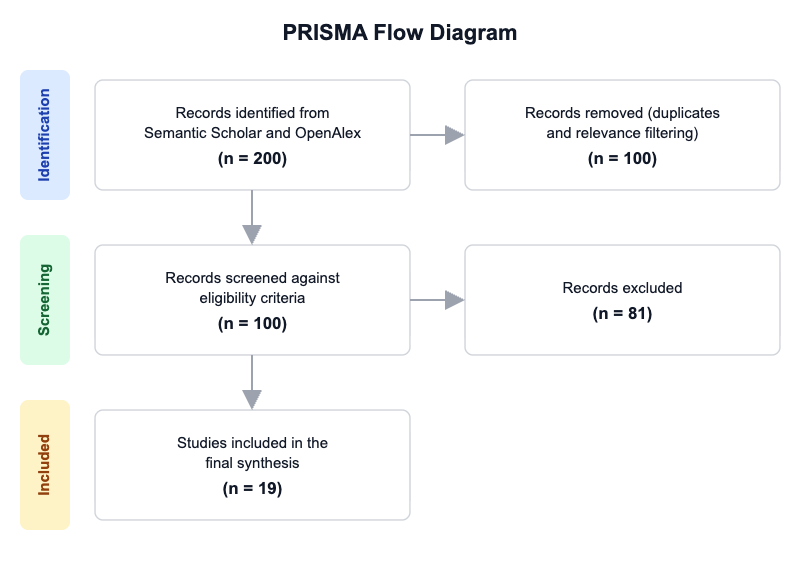
Initial database searching identified 200 records. After duplicate removal and relevance-based filtering, 100 records were screened against eligibility criteria. Of these, 81 papers were excluded, resulting in 19 papers included in the final synthesis.
PRISMA Flow Diagram
Eligibility criteria included:
- Human Data: Does the study involve human participants rather than only animal, in vitro, or computational data?
- Nattokinase: Does the study investigate nattokinase as the main intervention or exposure?
- Benefit Outcome: Does the study report at least one benefit-related outcome such as blood pressure, coagulation, fibrinolysis, thrombotic risk, or cardiovascular markers?
- Safety Data: Does the study report adverse events, bleeding risk, tolerability, or other safety findings?
- Study Rigor: Does the study use an RCT, crossover trial, cohort study, systematic review, or meta-analysis design?
- Quantitative Results: Does the study report numeric results for at least one outcome (e.g., mean change, percent change, odds ratio, p-value)?
All included studies met the stated eligibility criteria.
2.3 Data Extraction and Synthesis
Data extraction focused on the following variables:
- Intervention: Extract the nattokinase intervention details: dose, formulation, frequency, duration, and whether it was used alone or with other treatments.
- Population: Extract participant characteristics: health status, age group, sample size, and any cardiovascular or metabolic risk profile.
- Study Design: Extract the study type (RCT, crossover, cohort, systematic review, in vitro, animal), comparator, and follow-up duration.
- Primary Outcomes: Extract the main outcomes assessed, especially thrombotic, cardiovascular, blood pressure, fibrinolytic, coagulation, or inflammatory endpoints.
- Key Benefits: Extract the main beneficial effects reported, including direction of effect and the specific outcome improved.
- Safety Findings: Extract adverse events, tolerability, bleeding risk, or safety concerns reported.
- Mechanism / Biomarkers: Extract mechanistic findings and biomarker changes such as fibrinolysis, fibrin degradation, D-dimer, tPA, PAI-1, or related markers.
- Evidence Quality: Extract indicators of evidence strength such as systematic review/meta-analysis, randomization, blinding, sample size, and study limitations.
Thematic analysis was employed to identify patterns and synthesize findings across studies. Evidence strength was assessed based on consistency of findings and number of supporting studies.
3. Results
3.1 Characteristics of Included Studies
| Study and Year | Study Type | Population | Intervention | Duration | Main Focus |
|---|---|---|---|---|---|
| Jensen et al. 2016 [1] | Randomized, double-blind, placebo-controlled, multicenter trial | Hypertensive adults in North America | Nattokinase, dose/formulation not specified | Not reported | Blood pressure, von Willebrand factor |
| Weng et al. 2017 [2] | Review | Not reported | Nattokinase as oral antithrombotic agent | Not applicable | Clinical benefit, safety, production |
| Kurosawa et al. 2015 [3] | Double-blind, placebo-controlled crossover study | 12 healthy young males | Single oral dose of 2,000 FU | Hours | Coagulation and fibrinolysis biomarkers |
| Chen et al. 2018 [4] | Review | Not reported | Nattokinase | Not applicable | Cardiovascular effects and pharmacokinetics |
| Chen et al. 2022 [5] | Clinical study | Older adults with hyperlipidemia and atherosclerosis | 10,800 FU/day; some with vitamin K2 and aspirin | 12 months | Lipids and carotid atherosclerosis |
| Kim et al. 2008 [6] | Randomized, double-blind, placebo-controlled trial | Pre-hypertension or stage 1 hypertension | 2,000 FU/capsule | 8 weeks | Blood pressure, renin activity |
| Gallelli et al. 2021 [7] | Cohort study | Patients with vascular diseases | 100 mg/day, alone or with fondaparinux/enoxaparin | Not reported | Clinical symptoms, safety |
| Granito et al. 2024 [8] | Review | Not reported | Nattokinase | Not applicable | Fibrinolytic, anti-inflammatory, antioxidant effects |
| Hodis et al. 2021 [9] | Randomized controlled trial | 265 adults without clinical CVD | 2,000 FU oral nattokinase vs placebo | Median 3 years | Subclinical atherosclerosis, biomarkers |
| Hristova 2023 [10] | Review | Not reported | Typical 2,000–2,836 FU oral dosing | Not applicable | Medical uses, mechanisms, safety |
| Watanabe 2019 [11] | Randomized, double-blind, placebo-controlled parallel-group study | High-normal BP or stage I hypertension | 110 mg/day | 8 weeks | Diastolic blood pressure |
| Tai & Sweet 2006 [12] | Review/commentary | Adults | Dietary supplement | Not applicable | Thrombosis prevention |
| Ren et al. 2017 [13] | Randomized controlled trial | Adults with carotid atherosclerosis and hyperlipidemia | 6,000 FU/day vs simvastatin 20 mg/day | 26 weeks | Carotid atherosclerosis, lipids |
| Yang et al. 2009 [14] | Randomized, double-blind, placebo-controlled trial | 47 adults with hyperlipidemia | 50 mg/capsule nattokinase alone or with red yeast rice | 6 months | Lipids |
| Ionescu 2020 [15] | Review | Not reported | 100 mg/capsule; 2,000 FU/day recommended | Not applicable | Cardiovascular therapy |
| Noh 2009 [16] | Randomized, double-blind trial | Healthy adult smokers aged 20–31 years | 4,000 U single dose; 2,000 U/day for 4 weeks | Hours to 4 weeks | Fibrinolysis and atherogenesis |
| Yoo et al. 2019 [17] | Randomized controlled study | Nondiabetic hypercholesterolemic subjects | Nattokinase, dose not reported | 8 weeks | Hemostatic factors |
| Meruvu & Vangalapati 2011 [18] | Review | Not reported | Nattokinase | Not applicable | Properties and medical uses |
| Shah & Minocheherhomji 2022 [19] | Review | Not reported | Nattokinase, 10 mg/kg/day for 4 weeks cited | Not applicable | Thrombolysis and cardiovascular use |
Overall, the evidence base is dominated by human interventional studies and narrative reviews, with several trials focusing on coagulation biomarkers, blood pressure, and lipid/atherosclerosis outcomes. Populations vary substantially, ranging from healthy young smokers to older adults with hyperlipidemia, hypertension, or established vascular disease, and this variation strongly shapes interpretability.
3.2 Thematic Findings
3.2.1 Nattokinase consistently enhances fibrinolysis and shifts coagulation biomarkers toward an antithrombotic profile
The clearest and most biologically coherent finding is that nattokinase acutely enhances fibrinolytic activity and alters coagulation markers in a direction consistent with reduced thrombogenicity. In healthy young men, a single 2,000 FU dose increased D-dimer concentrations at 6 and 8 hours, increased fibrin/fibrinogen degradation products at 4 hours, lowered factor VIII activity at 4 and 6 hours, increased antithrombin at 2 and 4 hours, and prolonged activated partial thromboplastin time at 2 and 4 hours, with all changes remaining within the normal range [3]. Similar directionality was observed in smokers, where a 4,000 U short-term dose increased fibrinolytic activity at 2 hours and sustained that effect to 4 hours, while shortening euglobulin clot lysis time and prolonging coagulation times; the 4-week daily regimen maintained elevated fibrinolytic activity and reduced euglobulin clot lysis time and aPTT [16]. Biomarker summaries in reviews converge on the same pathway, emphasizing direct fibrin lysis, tissue plasminogen activator activation, and inhibition of plasminogen activator inhibitor-1 [2], [4].
Confidence is strong for the direction of effect because the biomarker pattern is repeated across acute and short-term settings, though the underlying populations differ. (Note: this study examined healthy young males, which partially matches the question population of humans taking nattokinase for benefit/effects; findings should be interpreted considering this difference.) (Note: this study examined healthy adult smokers aged 20–31 years, which partially matches the question population of humans taking nattokinase for benefit/effects; findings should be interpreted considering this difference.) The main limitation is that most evidence is biomarker-based rather than event-based, so the clinical magnitude of antithrombotic benefit remains uncertain.
3.2.2 Blood pressure reduction appears real but context-dependent, with stronger signals in hypertensive or high-normal blood pressure groups
Across hypertension-focused studies, nattokinase tends to lower blood pressure, but the effect is not uniform. In a randomized, double-blind, placebo-controlled trial among adults with pre-hypertension or stage 1 hypertension, 8 weeks of 2,000 FU/capsule reduced systolic blood pressure by -5.55 mmHg (95% CI, -10.5 to -0.57 mmHg) and diastolic blood pressure by -2.84 mmHg (95% CI, -5.33 to -0.33 mmHg), with renin activity falling by -1.17 ng/mL/h [6]. In a multicenter North American trial in hypertensive adults, nattokinase was associated with reduced blood pressure and lower von Willebrand factor, although dose and full quantitative details were not reported [1]. A subgroup analysis of high-normal blood pressure and stage I hypertension also found a significant reduction in diastolic blood pressure after 8 weeks of 110 mg/day, with a sex-specific signal favoring men [11].
The evidence is moderate because the positive direction is reproducible, but the dosing regimens differ substantially and one report is a subgroup analysis of a prior trial rather than an independent primary study [1], [6], [11]. (Note: this study examined a hypertensive population in North America, which partially matches the question population of humans taking nattokinase for benefit/effects; findings should be interpreted considering this difference.) (Note: this study examined subjects with high-normal blood pressure or high-grade I hypertension, which partially matches the question population of humans taking nattokinase for benefit/effects; findings should be interpreted considering this difference.) The renin change suggests a plausible blood-pressure mechanism, but the data do not yet establish whether nattokinase acts primarily through hemodynamic, endothelial, or fibrinolytic pathways.
3.2.3 Atherosclerosis and lipids improve in higher-risk, longer-duration settings, but the effect is not interchangeable across doses, comparators, or baseline risk
Nattokinase’s lipid and atherosclerosis effects are more heterogeneous than its acute fibrinolytic effects. In older adults with hyperlipidemia and atherosclerosis, 12 months of 10,800 FU/day improved triglycerides by 15.7%, total cholesterol by 15.9%, LDL-C by 18.1%, and HDL-C by 15.8%; carotid intima-media thickness fell from 1.33 to 1.04 mm, and plaque size decreased by up to 36% [5]. A randomized comparison against simvastatin similarly found reductions in carotid plaque size and CIMT after 26 weeks of 6,000 FU/day, with plaque size falling from 0.25 ± 0.12 cm² to 0.16 ± 0.10 cm² and CIMT from 1.13 ± 0.12 mm to 1.01 ± 0.11 mm, while statin produced greater lipid lowering but nattokinase increased HDL-C [13]. By contrast, 50 mg/capsule nattokinase alone showed no lipid effects until month six in a placebo-controlled trial, whereas the nattokinase plus red yeast rice combination improved TG by 15%, TC by 25%, LDL-C by 41%, TC/HDL-C ratio by 29.5%, and HDL-C by 7.5% [14]. Shorter 4-week data in smokers also showed improved TG and HDL-C [16].
Confidence is moderate because favorable findings recur, but the magnitude and even presence of benefit vary with dose, co-interventions, and endpoint type. The apparent dose-response signal is important: 10,800 FU/day was effective in one clinical setting, whereas 3,600 FU/day was described as ineffective for lipids and atherosclerosis progression [5]. This suggests that nattokinase may require higher exposure for structural vascular effects than for acute fibrinolysis. (Note: this study examined older adults with hyperlipidemia and atherosclerosis, which partially matches the question population of humans taking nattokinase for benefit/effects; findings should be interpreted considering this difference.) (Note: this study examined patients with hyperlipidemia, which partially matches the question population of humans taking nattokinase for benefit/effects; findings should be interpreted considering this difference.)
3.2.4 Safety signals are reassuring, but formal adverse-event ascertainment remains limited
Across the clinical literature, nattokinase is generally reported as well tolerated. No adverse events were reported in the single-dose biomarker study, and the observed coagulation changes remained within normal laboratory ranges [3]. In the large 12-month clinical study, no noticeable adverse effects were recorded at 10,800 FU/day, and the authors described the dose as safe and well tolerated [5]. In vascular disease patients receiving nattokinase alone or alongside fondaparinux or enoxaparin, no adverse drug reactions or drug interactions were documented [7]. Review papers likewise characterize toxicity as minimal and bleeding risk as not prominent [2], [4], [10].
Confidence is moderate to strong for general tolerability, but limited for rare harms because most studies were not designed or powered to detect bleeding events. The lack of reported adverse outcomes should therefore not be interpreted as proof of absence of risk, especially in combined anticoagulant settings or in older adults with comorbidity [12]. The current literature supports cautious optimism rather than definitive safety closure.
3.2.5 Null findings matter: long-term primary prevention in low-risk adults did not show benefit
The most important counterweight to the positive literature is the randomized, double-blind trial in adults without clinical cardiovascular disease, where 2,000 FU nattokinase for a median of 3 years did not significantly change carotid intima-media thickness, carotid arterial stiffness, blood pressure, or laboratory measures of coagulation, fibrinolysis, inflammatory markers, or metabolic factors [9]. This null result is not trivial because the trial used a long follow-up and rigorous design, but it studied a low-risk population without established CVD. (Note: this study examined individuals without clinical evidence of cardiovascular disease, which partially matches the question population of humans taking nattokinase for benefit/effects; findings should be interpreted considering this difference.)
Confidence is limited to moderate for the null conclusion because it is methodologically strong but context-specific. Taken together, the evidence implies that nattokinase may be more effective when baseline vascular risk or abnormal biomarkers are present than when used as a broad primary-prevention supplement in otherwise healthy adults [5], [6], [9].
3.3 Summary of Evidence
| Theme | Key Finding | Population Applicability | Effect Direction | Confidence Level | Supporting Studies |
|---|---|---|---|---|---|
| Acute fibrinolysis and coagulation modulation | D-dimer increased at 6 and 8 hours; fibrin/fibrinogen degradation products increased at 4 hours; factor VIII declined at 4 and 6 hours; antithrombin increased at 2 and 4 hours; aPTT prolonged at 2 and 4 hours after 2,000 FU | Mostly healthy young adults and healthy smokers; partially applicable to broader human nattokinase use | Positive | Strong | Kurosawa et al. [3], Noh [16], Yoo et al. [17] |
| Blood pressure lowering | SBP -5.55 mmHg (95% CI, -10.5 to -0.57) and DBP -2.84 mmHg (95% CI, -5.33 to -0.33) after 8 weeks; renin activity -1.17 ng/mL/h | Hypertensive, pre-hypertensive, and high-normal BP adults | Positive | Moderate | Kim et al. [6], Jensen et al. [1], Watanabe [11] |
| Atherosclerosis and lipid improvement | CCA-IMT 1.33 to 1.04 mm; plaque size up to 36% reduction; TG -15.7%, TC -15.9%, LDL-C -18.1%, HDL-C +15.8% with 10,800 FU/day | Older adults with hyperlipidemia and atherosclerosis; partially applicable | Positive | Moderate | Chen et al. [5], Ren et al. [13] |
| Combination-dependent lipid effects | Nattokinase alone showed no early lipid benefit, while nattokinase plus red yeast rice improved TG by 15%, TC by 25%, LDL-C by 41%, HDL-C by 7.5% | Hyperlipidemia patients | Mixed | Moderate | Yang et al. [14], Chen et al. [5] |
| Safety and tolerability | No noticeable adverse effects, adverse drug reactions, or drug interactions reported in clinical studies | Broad but incompletely assessed across clinical populations | Positive | Moderate | Kurosawa et al. [3], Gallelli et al. [7], Chen et al. [5] |
| Null long-term primary prevention | No significant effect on CIMT, CAS, blood pressure, or laboratory measures after median 3 years at 2,000 FU | Low-risk adults without clinical CVD | Null | Conflicting | Hodis et al. [9] |
4. Discussion
4.1 Principal Findings and Their Interpretation
The central pattern emerging from this synthesis is that nattokinase is a biologically active oral agent with the clearest effects on fibrinolysis, followed by more context-dependent effects on blood pressure and vascular remodeling. The acute biomarker data are especially convincing because they show a coherent physiological sequence: fibrin degradation products and D-dimer rise, factor VIII falls, antithrombin rises, and clotting times lengthen after oral intake [3]. That constellation supports a genuine antithrombotic mechanism rather than a nonspecific laboratory artifact. The fact that changes remain within normal ranges is clinically important, because it suggests measurable modulation without overt anticoagulant overreach in the studied settings [3].
The vascular and blood pressure data imply that nattokinase may be most useful in people with pre-existing abnormalities rather than as a universal primary-prevention supplement. Hypertensive and dyslipidemic populations show more favorable signals than low-risk adults, which is consistent with a biological model in which nattokinase acts on an already perturbed hemostatic or endothelial milieu. The renin reduction observed in the hypertension trial suggests that the blood-pressure effect may not be mediated solely through fibrinolysis [6]. The atherosclerosis studies further suggest that longer exposure and higher dose may be necessary for structural vascular changes, especially when endpoints involve carotid plaque or intima-media thickness rather than short-term hemostatic markers [5], [13].
Confidence is highest for the existence of short-term fibrinolytic effects and moderate for cardiovascular benefit in higher-risk groups. Confidence is lower for claims of broad cardiovascular prevention because the evidence is more heterogeneous and includes a rigorous null trial in a low-risk cohort [9]. The synthesis therefore advances beyond individual studies by showing that nattokinase’s apparent efficacy is not uniform; it appears to depend on outcome domain, baseline risk, dose, and duration.
4.2 Comparison with Existing Literature and Resolution of Contradictions
The review literature generally portrays nattokinase as a fibrinolytic and antithrombotic enzyme with additional antihypertensive, anti-atherosclerotic, and lipid-lowering properties [2], [4], [15]. The human trial evidence is broadly compatible with that framing, especially for fibrinolysis and blood pressure [3], [6]. This agreement is meaningful because it spans both mechanistic biomarker studies and clinical outcome-oriented trials, strengthening the plausibility that the physiological effects are not isolated laboratory phenomena. The proposed mechanisms in the literature—direct fibrin lysis, activation of tissue plasminogen activator, and inhibition of plasminogen activator inhibitor-1—also fit the observed shifts in D-dimer, fibrin degradation products, and clotting times [2], [3], [4].
The major contradiction is the long-term null result in low-risk adults [9]. That trial does not necessarily refute nattokinase efficacy; instead, it suggests effect modification by baseline risk. If vascular pathology is mild or absent, there may be little room for improvement in CIMT, stiffness, or laboratory markers. Another explanation is dose or formulation mismatch: 2,000 FU may be sufficient for acute fibrinolysis but insufficient for remodeling over years, particularly when compared with the 10,800 FU/day regimen used in the positive atherosclerosis study [5]. It is also possible that endpoint selection matters, because carotid ultrasound progression is a slower and less biologically labile target than coagulation biomarkers. Publication bias remains a concern because many reports are positive and several are reviews or small trials, while large null datasets are rare. The present evidence therefore suggests a real but conditional benefit rather than uniform efficacy across all users and outcomes.
4.3 Practical Implications
For clinicians, the best-supported use case for nattokinase is not generic cardiovascular prevention but selective use in adults with elevated blood pressure, hyperlipidemia, or vascular disease markers, where benefits have been observed in blood pressure, fibrinolytic biomarkers, and carotid atherosclerosis measures [3], [5], [6]. The evidence suggests that low-risk adults without clinical cardiovascular disease may not experience measurable long-term vascular benefit at 2,000 FU, so routine use in that setting is not strongly justified [9]. For patients already receiving anticoagulants or antiplatelet therapy, the available observational safety data are reassuring but too limited to support unrestricted co-use; monitoring remains prudent [5], [7].
From a public health perspective, nattokinase is best viewed as a promising adjunct rather than a population-wide substitute for established cardiovascular prevention. The strongest signals occur in people with pre-existing hemostatic or metabolic risk, which argues for targeted rather than universal recommendations. Regulatory implications are similarly cautious: the presence of a null long-term primary-prevention trial means that product claims should not exceed the evidence base, especially at commonly cited lower doses. The evidence does not support a no-threshold hazard framework in the conventional toxicological sense; rather, it suggests a threshold of benefit, where meaningful effects are more likely at higher dose or higher-risk states.
4.4 Strengths and Limitations
This review benefits from a structured search strategy, clear eligibility criteria, and synthesis across randomized trials, cohort data, and reviews. The included literature spans acute biomarker studies, mid-term clinical trials, and longer-term cardiovascular follow-up, allowing comparison across distinct outcome domains. At the same time, the underlying evidence base is constrained by variable dosing, heterogeneous populations, incomplete comparator reporting in some studies, and frequent reliance on surrogate endpoints rather than hard cardiovascular events. Some studies are reviews rather than original human trials, and several do not report full safety detail or blinding procedures.
Limitations of this review include reliance on abstract-level and extracted data for some studies, absence of a formal risk-of-bias assessment, and limited ability to harmonize outcome definitions across heterogeneous designs. As a result, the synthesis is best interpreted as a qualitative evidence map rather than a pooled estimate of effect.
5. Gaps and Future Directions
The most important gap is the lack of large, well-controlled human trials that test nattokinase in the exact populations most likely to use it for cardiovascular benefit, especially older adults with hypertension, hyperlipidemia, or established vascular disease, while simultaneously measuring both clinical endpoints and mechanistic biomarkers. Current evidence is strongest for short-term coagulation changes, but much weaker for hard outcomes such as thrombosis, stroke, or cardiovascular events. Future studies should standardize nattokinase formulation and dose, because the literature suggests that 2,000 FU, 6,000 FU, and 10,800 FU/day may not be interchangeable. They should also report bleeding outcomes systematically, especially when nattokinase is combined with anticoagulants or antiplatelet agents.
Mechanistic work should connect fibrinolysis markers to vascular outcomes more directly, using harmonized measures such as D-dimer, fibrin degradation products, antithrombin, factor VIII, tPA, and PAI-1 alongside carotid imaging and blood pressure. The field also needs replication in non-Asian populations and in diverse risk groups, because many findings come from limited demographic and geographic settings. Finally, the null long-term study in low-risk adults should be followed by trials designed to determine whether nattokinase has a true dose-response threshold for benefit.
6. Conclusion
The best-supported conclusion is that nattokinase has measurable human benefits, but they are conditional rather than universal. The strongest evidence shows that oral nattokinase enhances fibrinolysis and shifts coagulation markers toward an antithrombotic profile, including increased D-dimer, fibrin/fibrinogen degradation products, and antithrombin, with prolonged aPTT after a single 2,000 FU dose [3]. In higher-risk clinical settings, nattokinase also appears to reduce blood pressure and improve lipid or carotid atherosclerosis measures, including SBP -5.55 mmHg (95% CI, -10.5 to -0.57 mmHg), DBP -2.84 mmHg (95% CI, -5.33 to -0.33 mmHg), and carotid plaque reductions such as 0.25 ± 0.12 cm² to 0.16 ± 0.10 cm² in comparative trials [5], [6], [13]. However, a rigorous long-term trial in adults without clinical cardiovascular disease found no benefit on subclinical atherosclerosis progression or blood pressure at 2,000 FU [9].
Accordingly, nattokinase should be viewed as a promising adjunct for selected individuals with cardiovascular risk rather than a broadly proven preventive supplement. The key unresolved question is whether higher-dose, longer-duration, and better-standardized nattokinase can translate its favorable biomarker effects into durable clinical cardiovascular protection. Resolving that issue matters because nattokinase is widely marketed for heart health, yet its real-world value depends on whether its benefits extend beyond surrogate markers into meaningful prevention with acceptable safety.
References
- Jensen, G. S., Lenninger, M., Ero, M. P., & Benson, K. F. (2016). Consumption of nattokinase is associated with reduced blood pressure and von Willebrand factor, a cardiovascular risk marker: Results from a randomized, double-blind, placebo-controlled, multicenter North American clinical trial. Integrated Blood Pressure Control, 9, 95–104. https://doi.org/10.2147/IBPC.S99553
- Weng, Y., Yao, J., Sparks, S., & Wang, K. Y. (2017). Nattokinase: An oral antithrombotic agent for the prevention of cardiovascular disease. International Journal of Molecular Sciences, 18(3), 523. https://doi.org/10.3390/ijms18030523
- Kurosawa, Y., Nirengi, S., Homma, T., Esaki, K., Ohta, M., Clark, J. F., & Hamaoka, T. (2015). A single-dose of oral nattokinase potentiates thrombolysis and anti-coagulation profiles. Scientific Reports, 5, 11601. https://doi.org/10.1038/srep11601
- Chen, H., McGowan, E. M., Ren, N., Lal, S., Nassif, N., Shad-Kaneez, F., Qu, X., & Lin, Y. (2018). Nattokinase: A promising alternative in prevention and treatment of cardiovascular diseases. Biomarker Insights, 13, 1177271918785130. https://doi.org/10.1177/1177271918785130
- Chen, H., Chen, J., Zhang, F., Li, Y., Wang, R., Zheng, Q., Zhang, X., Zeng, J., Xu, F., & Lin, Y. (2022). Effective management of atherosclerosis progress and hyperlipidemia with nattokinase: A clinical study with 1,062 participants. Frontiers in Cardiovascular Medicine, 9, 964977. https://doi.org/10.3389/fcvm.2022.964977
- Kim, J. Y., Gum, S. N., Paik, J. K., Lim, H. H., Kim, K.-C., Ogasawara, K., Inoue, K., Park, S., Jang, Y., & Lee, J. H. (2008). Effects of nattokinase on blood pressure: A randomized, controlled trial. Hypertension Research, 31(8), 1583–1588. https://doi.org/10.1291/hypres.31.1583
- Gallelli, G., Di Mizio, G., Palleria, C., Siniscalchi, A., Rubino, P., Muraca, L., Cione, E., Salerno, M., De Sarro, G., & Gallelli, L. (2021). Data recorded in real life support the safety of nattokinase in patients with vascular diseases. Nutrients, 13(6), 2031. https://doi.org/10.3390/nu13062031
- Granito, M., Alvarenga, L., Ribeiro, M., Carvalhosa, P., Andrade, T., Mesquita, C. T., Stockler-Pinto, M. B., Mafra, D., & Cardozo, L. F. M. F. (2024). Nattokinase as an adjuvant therapeutic strategy for non-communicable diseases: A review of fibrinolytic, antithrombotic, anti-inflammatory, and antioxidant effects. Expert Review of Cardiovascular Therapy, 22(10), 565–574. https://doi.org/10.1080/14779072.2024.2416663
- Hodis, H. N., Mack, W. J., Meiselman, H. J., Kalra, V., Liebman, H., Hwang-Levine, J., Dustin, L., Kono, N., Mert, M., Wenby, R. B., Huesca, E., Rochanda, L., Li, Y., Yan, M., St. John, J. A., & Whitfield, L. (2021). Nattokinase atherothrombotic prevention study: A randomized controlled trial. Clinical Hemorheology and Microcirculation, 78(4), 339–353. https://doi.org/10.3233/CH-211147
- Hristova, M. (2023). Nattokinase – uses and benefits. Trakia Journal of Sciences, 21(4), 343–350. https://doi.org/10.15547/tjs.2023.04.007
- Watanabe, N. (2019). Effect of nattokinase consumption on blood pressure: A randomized, double-blind, placebo-controlled, parallel-group clinical study. Japanese Pharmacology and Therapeutics (Yakuri to Chiryo), 47(8), 1317–1324. http://www.pieronline.jp/content/article/0386-3603/47080/1317
- Tai, M.-W., & Sweet, B. V. (2006). Nattokinase for prevention of thrombosis. American Journal of Health-System Pharmacy, 63(12), 1121–1123. https://doi.org/10.2146/ajhp050509
- Ren, N., Chen, H. J., Li, Y., McGowan, E. M., & Lin, Y. G. (2017). A clinical study on the effect of nattokinase on carotid artery atherosclerosis and hyperlipidaemia. Zhonghua Yi Xue Za Zhi, 97(26), 2038–2042. https://doi.org/10.3760/cma.j.issn.0376-2491.2017.26.005
- Yang, N.-C., Chou, C.-W., Chen, C.-Y., Hwang, K.-L., & Yang, Y.-C. (2009). Combined nattokinase with red yeast rice but not nattokinase alone has potent effects on blood lipids in human subjects with hyperlipidemia. Asia Pacific Journal of Clinical Nutrition, 18(3), 310–317. https://pubmed.ncbi.nlm.nih.gov/19786378/
- Ionescu, D.-D. (2020). Nattokinase: A hope in cardiovascular therapy and more. Romanian Journal of Medical Practice, 15(3), 272–274. https://doi.org/10.37897/rjmp.2020.3.2
- Noh, K.-H. (2009). Effects of nattokinase fibrinol supplementation on fibrinolysis and atherogenesis. Journal of Life Science, 19(2), 289–298. https://doi.org/10.5352/JLS.2009.19.2.289
- Yoo, H. J., Kim, M., Kim, M., Lee, A., Jin, C., Lee, S. P., Kim, T. S., Lee, S.-H., & Lee, J. H. (2019). The effects of nattokinase supplementation on collagen–epinephrine closure time, prothrombin time and activated partial thromboplastin time in nondiabetic and hypercholesterolemic subjects. Food & Function, 10(5), 2888–2893. https://doi.org/10.1039/c8fo02324g
- Meruvu, H., & Vangalapati, M. (2011). Nattokinase: A review on fibrinolytic enzyme. International Journal of Chemical, Environmental and Pharmaceutical Research, 2(1). http://ijcepr.in/vol-2/issue-1/13.pdf
- Shah, R. N., & Minocheherhomji, P. F. (2022). Nattokinase: Armour against thrombosis. Journal of Advanced Scientific Research, 13(5), 34–37. https://doi.org/10.55218/jasr.202213504