

Latest Research on Nootropics: A Thematic Literature Review of Efficacy, Safety, and Population-Specific Effects
Abstract
Recent evidence suggests that nootropics can improve selected cognitive domains, but effects are highly compound-, population-, and context-dependent. In clinical populations with cognitive impairment, combined metabolic activators improved ADAS-Cog by 29% at day 84 versus baseline and significantly outperformed placebo in patients with higher baseline impairment (P = 0.0073), while donepezil and donepezil plus memantine improved MMSE by 1.41 points (95% CI 0.51 to 2.32) and 2.57 points (95% CI 0.07 to 5.07), respectively, versus placebo [15], [2]. In healthy adults, acute dietary formulations and specific compounds showed short-term gains in processing speed, inhibitory control, working memory, sustained attention, and memory, including effect sizes of 0.4–0.6 for a multi-ingredient supplement and sustained benefits of paraxanthine on several attention and memory measures, whereas GABA produced no improvement in temporal attention or visual working-memory precision [9], [18], [20]. Safety signals diverged sharply by class: some interventions were well tolerated with no serious adverse events, while reviews of stimulant-like smart drugs in healthy users emphasized cardiovascular, neurological, psychopathological, and addictive harms [17], [4]. Overall, the literature supports modest-to-meaningful pro-cognitive effects in targeted settings, but the evidence base remains uneven, with stronger support for clinical than for general enhancement use and substantial uncertainty about long-term safety, optimal dosing, and generalizability.
1. Introduction
Nootropics, also termed smart drugs or cognitive enhancers, occupy a contested space between therapeutics and enhancement, reflecting both clinical need and the growing demand for improved attention, memory, learning, and executive function in everyday life. Interest in these agents has expanded alongside population aging, rising prevalence of cognitive impairment, and the intensification of cognitive demands in work and study settings. At the same time, the term nootropic now covers a heterogeneous set of substances, including classical pharmacological agents, cholinergic compounds, metabolic activators, plant-derived supplements, and multi-ingredient formulations, each with distinct mechanisms, intended uses, and risk profiles [1], [12]. This heterogeneity complicates the interpretation of the literature because positive findings in clinical populations do not necessarily translate to healthy users, and acute improvements do not guarantee durable benefit.
The recent literature reflects this tension. Some interventions are being developed and tested as targeted therapies for dementia-related cognitive decline, including memantine, donepezil, rivastigmine, galantamine, and newer agents such as combined metabolic activators and Xanamem, whereas others are marketed as over-the-counter supplements for memory or general mental performance [6], [15], [2], [17], [13]. Meanwhile, reviews of healthy-user enhancement repeatedly raise concerns that perceived benefits may be temporary, domain-specific, or offset by cardiovascular, neurological, psychopathological, and ethical harms [4], [12]. Plant-derived nootropics and choline-based supplements are especially prominent, yet their evidence base remains uneven, with some compounds appearing promising and others supported by weak or inconsistent data [3], [10].
Against this backdrop, the key question is not whether nootropics exist, but which agents improve cognition, in whom, under what conditions, and at what cost. This review synthesizes the latest evidence on efficacy and safety across healthy adults, older adults, and clinical populations, with particular attention to cognitive domains, methodological quality, and mechanistic signals that may explain divergent outcomes.
2. Methods
2.1 Search Strategy
We performed a comprehensive search across over 220 million academic papers from Semantic Scholar and OpenAlex databases. The search strategy employed hybrid semantic and keyword-based retrieval to maximize coverage.
Search queries included:
- "Nootropics cognitive enhancement efficacy and safety in adults"
- "Smart drugs and nootropic supplements for memory attention focus studies"
- "Cognitive enhancer compounds clinical trials healthy adults nootropics"
- "Neuroenhancement supplements and pharmaceuticals systematic review nootropics"
2.2 Study Selection
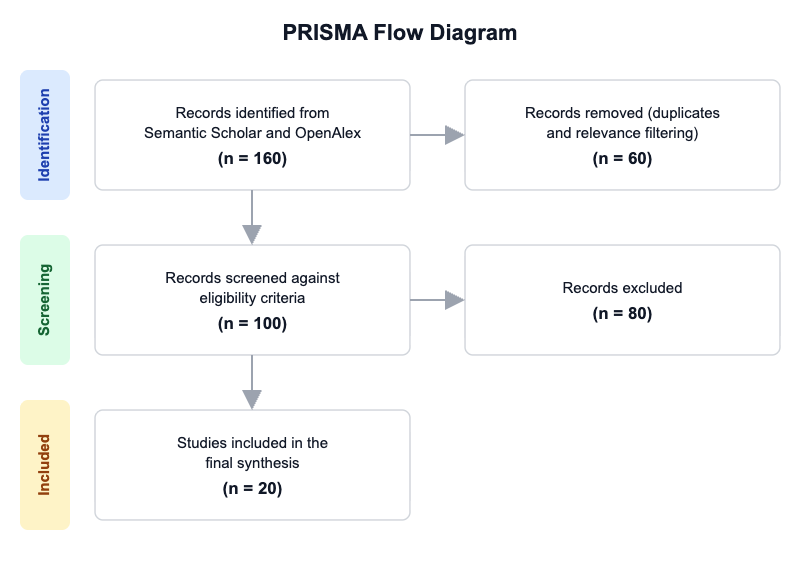
Initial database searching identified 160 records. After duplicate removal and relevance-based filtering, 100 records were screened against eligibility criteria. Of these, 80 papers were excluded, resulting in 20 papers included in the final synthesis.
PRISMA Flow Diagram
Eligibility criteria included:
- Human: Does the study involve human participants rather than animal, cell, or simulation studies?
- Nootropic: Does the study investigate a nootropic, cognitive enhancer, smart drug, or neuroenhancement supplement/pharmaceutical?
- Cognitive: Does the study measure cognition, memory, attention, executive function, alertness, learning, or fatigue outcomes?
- Recent: Was the study published in 2020 or later?
- Study Design: Is the paper an empirical study, clinical trial, systematic review, or meta-analysis rather than a purely conceptual discussion?
- Healthy or Clinical: Does the paper focus on healthy adults, students, older adults, or a defined patient group where cognition is central?
- Safety: Does the study report adverse effects, tolerability, misuse risk, or safety limitations?
- Comparative: Does the study compare the nootropic against placebo, standard care, another compound, or baseline?
All included studies met the stated eligibility criteria.
2.3 Data Extraction and Synthesis
Data extraction focused on the following variables:
- Focus: Identify the main nootropic compound, supplement, or class studied and the cognitive domain targeted (e.g., memory, attention, executive function, fatigue).
- Population: Extract the participant group, including age, health status, and whether the sample is healthy adults, students, patients, or older adults.
- Design: Extract the study design (e.g., RCT, crossover trial, cohort, systematic review, meta-analysis) and any comparator or control condition.
- Sample: Extract sample size and any relevant group sizes exactly as reported.
- Outcome: Summarize the primary cognitive or behavioral outcome(s) measured and the direction of effect.
- Safety: Extract reported adverse events, tolerability, misuse concerns, or safety limitations.
- Duration: Extract intervention or follow-up duration, especially whether the study assesses acute, short-term, or longer-term effects.
- Key Finding: Summarize the main conclusion of the paper about nootropic efficacy, limitations, or research implications.
Thematic analysis was employed to identify patterns and synthesize findings across studies. Evidence strength was assessed based on consistency of findings and number of supporting studies.
3. Results
3.1 Characteristics of Included Studies
| Study and Year | Study Type | Population | Intervention / Class | Outcome Focus | Duration |
|---|---|---|---|---|---|
| Malik and Tlustoš 2022 [1] | Review | Healthy and cognitively impaired individuals | Nootropics across four subgroups | Memory, learning, thinking | Not reported |
| Yuluğ et al. 2023 [2] | Randomized, double-blind, placebo-controlled phase-II trial | Alzheimer’s disease patients | Combined metabolic activators | ADAS-Cog, imaging, metabolomics | 84 days |
| Lorca et al. 2023 [3] | Systematic review | Human participants across health states | Plant-derived nootropics | Domain-specific cognition | Not reported |
| Schifano et al. 2022 [4] | Review | Healthy individuals | Smart drugs / cognitive enhancers | Memory, attention, learning, vigilance | Not reported |
| Kapur 2020 [5] | Review and experimental-data analysis | Healthy individuals, ADHD, older adults | Methylphenidate | Attention, memory, executive function | Not reported |
| Tari et al. 2024 [6] | Review | Alzheimer’s disease patients | Memantine | Cognitive decline | Not reported |
| Lenze et al. 2020 [7] | Randomized controlled trial | Older adults with age-related cognitive decline | Vortioxetine plus cognitive training | Cognitive decline | Not reported |
| Sagaro et al. 2023 [8] | Systematic review and meta-analysis | Adults with neurological conditions associated with cerebrovascular injury | α-GPC alone or with donepezil | Cognition, behavior, function | Not reported |
| Medrano et al. 2022 [9] | Randomized, triple-blinded, placebo-controlled, crossover trial | Young healthy adults | Multi-ingredient dietary nootropic | Processing speed, inhibitory control, working memory, creativity | Acute |
| Kansakar et al. 2023 [10] | Review | Mixed preclinical and clinical populations | Choline supplements | Memory, cognitive function | Not reported |
| Cave et al. 2023 [11] | Systematic review | Older adults with and without subjective cognitive impairment | Herbal and nutritional medicines | Cognitive function, safety | Mostly 12 weeks |
| Ingegneri et al. 2025 [12] | Review | General population | New psychoactive “smart drugs” | Cognitive and mood enhancement; harms | Not reported |
| Hersant et al. 2023 [13] | Review | Marketed supplements; evidence synthesized from studies | Over-the-counter memory supplements | Memory efficacy | Not reported |
| Hersant et al. 2023 [14] | Review | Older adult consumers and general supplement users | Memory supplements | Memory efficacy, safety, interactions | Not reported |
| Veroniki et al. 2022 [15] | Systematic review and IPD network meta-analysis | Adults with Alzheimer’s dementia | Donepezil, rivastigmine, galantamine, memantine | MMSE, adverse events | Not reported |
| Abbott-Imboden et al. 2023 [16] | Double-blind, placebo-controlled study | Healthy adults | Mind Lab Pro | Memory | 4 weeks |
| Hilt et al. 2023 [17] | Three placebo-controlled trials | Normal older volunteers and mild AD patients | Xanamem | Attention, working memory, executive function | Trial-dependent |
| Yoo et al. 2021 [18] | Randomized, double-blind, placebo-controlled, crossover trial | Healthy adults | Paraxanthine | Cognition, executive function, vigilance | Acute; 7-day crossover interval |
| Bishop et al. 2021 [19] | Systematic review | Adults over 65 years with depressive symptoms | Vortioxetine | Cognition in older adults | Not reported |
| Altınok et al. 2023 [20] | Randomized, double-blind, placebo-controlled, crossover trial | Young healthy adults | GABA | Working memory, attention | 45 minutes post-dose |
The evidence base is dominated by reviews and short-term controlled trials. Populations cluster around three contexts: healthy younger adults seeking enhancement, older adults with cognitive decline or depressive symptoms, and clinical neurodegenerative or cerebrovascular conditions. Acute and short-term interventions are common, whereas long-term safety and durability are rarely reported. Outcome measures vary substantially, ranging from domain-specific computerized tasks to global scales such as ADAS-Cog and MMSE.
3.2 Thematic Findings
3.2.1 Clinical nootropics show the clearest and most reproducible benefit in dementia and cognitive impairment
Across clinical populations, the most consistent signal comes from interventions aimed at pathological cognitive decline rather than enhancement in unimpaired brains. In Alzheimer’s disease, donepezil improved MMSE by 1.41 points (95% CI 0.51 to 2.32), and donepezil plus memantine improved MMSE by 2.57 points (95% CI 0.07 to 5.07) versus placebo [15]. In the same disease context, combined metabolic activators produced a 29% reduction in ADAS-Cog from day 0 to day 84 and significantly outperformed placebo among patients with higher baseline impairment (P = 0.0073) [2]. Xanamem also showed clinically meaningful improvements in attention and working memory, with Cohen’s d values up to 1.27 in normal older volunteers and a Cohen’s d of 0.41 on CDR-SB in the high p-Tau group [17]. These findings are directionally aligned with the broader review literature suggesting memantine slows cognitive decline and that vortioxetine may help older adults with depressive symptoms [6], [19]. Confidence: Moderate to strong for disease-focused benefit, because the direction is consistently positive and supported by controlled designs, though outcome heterogeneity and imprecise estimates remain.
Population applicability is strongest for older adults and patients with cognitive impairment; several studies in this theme explicitly examined clinical or proxy clinical populations rather than the general healthy adult population, so interpretation should be limited accordingly. For example, the combined metabolic activator trial examined Alzheimer’s disease patients, which only partially matches the broader question population of adults interested in nootropics [2].
3.2.2 Enhancement in healthy adults is typically acute, domain-specific, and modest
In healthy adults, benefits are most evident for narrowly defined tasks rather than global cognitive improvement. A multi-ingredient dietary nootropic improved response time and accuracy on processing speed, inhibitory control, spatial working memory, and cognitive flexibility, with effect sizes ranging from 0.4 to 0.6, and also improved creativity and positive emotion without changing heart rate or heart rate variability [9]. Paraxanthine similarly improved performance on executive and vigilance tasks, reducing Berg Wisconsin Card Sorting Test errors by -4.7 [−0.2, −9.20] and perseverative errors by -2.2 [−4.2, −0.2] at hour 6, while improving Sternberg task reaction times and sustaining vigilance over 6 hours [18]. Mind Lab Pro improved all subareas of memory over 4 weeks [16]. By contrast, GABA did not improve visual working-memory precision, temporal attention, or visual-search accuracy, although it increased visual-search time [20]. Confidence: Moderate, because positive findings are repeated across several controlled studies but are mostly short-term and often rely on single products or small samples.
This theme applies directly to healthy adults, although the evidence is uneven across compounds. The GABA trial also clearly matches the question population, but its null effects illustrate that not all putative nootropics produce measurable enhancement in healthy users [20]. Taken together, the pattern suggests that “nootropic” effects in non-clinical samples are more likely to emerge on effortful, time-sensitive tasks than on broad cognitive endpoints.
3.2.3 Plant-derived and supplement-based products are promising but methodologically unstable
Plant-derived nootropics and over-the-counter supplements are prominent in the literature, but the consistency of their effects is weaker than that seen for approved or trialed pharmacotherapies. Reviews indicate that Ginkgo biloba is most often associated with perceptual and motor functions, Bacopa monnieri with language, learning, and memory, Withania somnifera with anxiety and social cognition, and caffeine with attention and executive function [3]. Choline supplements, including α-GPC, choline bitartrate, lecithin, and citicoline, are also repeatedly described as effective for memory and cognitive function [10]. Yet broader reviews of marketed memory supplements conclude that evidence is not strong for apoaequorin, coenzyme Q10, coffee extracts, L-theanine, omega-3 fatty acids, vitamin B6, vitamin B9, and vitamin B12, while other ingredients such as ashwagandha, choline, curcumin, ginger, Lion’s Mane, polyphenols, phosphatidylserine, and turmeric show only mixed or preliminary support [13], [14]. In older adults with or without subjective cognitive impairment, 14/21 studies reported improvement in at least one cognitive domain, but 14/21 were also judged high risk of bias [11]. Confidence: Limited to moderate, because the direction is often favorable but the evidence is dominated by heterogeneous formulations, varied outcomes, and substantial risk-of-bias concerns.
These findings apply to older adults, healthy adults, and mixed consumer populations, but the evidence is often indirect because some reviews synthesize product-level rather than compound-level data. The older-adult review specifically addresses a population close to the question of cognitive enhancement, yet its risk-of-bias profile substantially weakens inference [11].
3.2.4 Safety concerns sharply distinguish therapeutic from non-medical use
Safety profiles diverge more clearly than efficacy profiles. Several targeted interventions report favorable tolerability: Xanamem had no treatment-related serious adverse events and predominantly mild adverse events equally distributed between active treatment and placebo [17], and the acute dietary multi-ingredient nootropic did not adversely affect heart rate or heart rate variability [9]. In contrast, reviews focused on healthy-user cognitive enhancement emphasize cardiovascular, neurological, psychopathological, and addictive risks associated with stimulant-like agents such as amphetamine-type stimulants, methylphenidate, modafinil, piracetam, and related compounds [4], [5]. The regulatory concern is amplified by the unregulated supplement market, where safety, purity, and labeling claims are often not preapproved and evidence for many products remains weak [13], [14]. Confidence: Moderate for the existence of important safety concerns, but limited for ranking specific products because adverse-event reporting is uneven and often non-comparative.
The contradiction between well-tolerated trialed products and high-risk recreational or off-label use is not a true inconsistency so much as a difference in context. Clinical trials typically involve selected participants, controlled dosing, and active monitoring, whereas market use includes heterogeneous products, uncertain purity, and potential misuse.
3.3 Summary of Evidence
| Theme | Key Finding | Population Applicability | Effect Direction | Confidence Level | Supporting Studies |
|---|---|---|---|---|---|
| Clinical cognitive enhancement is most robust in dementia-related impairment | Donepezil improved MMSE by 1.41 points (95% CI 0.51 to 2.32) and donepezil + memantine by 2.57 points (95% CI 0.07 to 5.07) versus placebo; CMA reduced ADAS-Cog by 29% at day 84 | Older adults with Alzheimer’s disease or related cognitive impairment | Positive | Moderate to strong | Veroniki et al. [15], Yuluğ et al. [2], Tari et al. [6] |
| Healthy-adult enhancement is acute and task-specific | Multi-ingredient nootropic improved multiple cognitive tasks with effect sizes 0.4–0.6; paraxanthine reduced BCST errors by -4.7 [−0.2, −9.20] and perseverative errors by -2.2 [−4.2, -0.2] | Healthy young adults | Positive | Moderate | Medrano et al. [9], Yoo et al. [18], Abbott-Imboden et al. [16] |
| Some candidate nootropics show null effects in healthy users | GABA did not affect temporal attention or visual-working-memory precision despite increasing visual-search time | Healthy young adults | Mixed / Null | Limited | Altınok et al. [20] |
| Plant-derived and choline-based products are promising but inconsistent | Bacopa, Ginkgo, α-GPC, citicoline, and some herbal/nutritional products show benefits, but many supplements lack strong evidence and 14/21 studies in older adults had high risk of bias | Older adults and mixed adult consumers | Mixed | Limited | Lorca et al. [3], Sagaro et al. [8], Cave et al. [11], Hersant et al. [13], [14] |
| Safety concerns depend heavily on context and compound class | Xanamem had no treatment-related SAEs, while stimulant-like cognitive enhancers carry cardiovascular, neurological, psychopathological, and addictive risks | Healthy users and patients | Mixed | Moderate | Hilt et al. [17], Schifano et al. [4], Kapur [5] |
4. Discussion
4.1 Principal Findings and Their Interpretation
The synthesis indicates that the most credible nootropic effects emerge where cognition is already compromised. In Alzheimer’s disease and related cognitive disorders, several agents improved global cognition or slowed decline, and the magnitude of benefit was not trivial: donepezil and donepezil plus memantine produced MMSE gains versus placebo, while combined metabolic activators improved ADAS-Cog and showed complementary metabolomic and imaging changes [15], [2]. The inclusion of imaging and metabolic signatures is important because it strengthens biological plausibility beyond symptom change alone: the reported improvements in NAD+ and glutathione metabolism, along with hippocampal volumes and cortical thickness, suggest that at least some cognitive gains may reflect altered cellular energetics and reduced oxidative stress rather than nonspecific expectancy effects [2]. Xanamem extends this logic by linking pro-cognitive effects to inhibition of 11β-hydroxysteroid dehydrogenase type 1 and the cortisol pathway, which is mechanistically coherent with the observed effects on attention and working memory [17]. This makes the clinical literature more coherent than the enhancement literature because the interventions are matched to a pathophysiological target.
By contrast, in healthy adults, the evidence supports narrower claims. Acute paraxanthine and a multi-ingredient dietary formulation improved attention, working memory, and speeded responding, but not all domains or all outcome measures [18], [9]. This pattern suggests that enhancement may depend on arousal, vigilance, or executive control under task demands rather than a broad increase in general intelligence or memory capacity. The null GABA findings are therefore informative rather than disappointing: they imply that putative nootropics are not interchangeable and that mechanistic class matters [20]. Overall, the strongest conclusion is not that nootropics universally “work,” but that some compounds produce context-specific cognitive benefits when their mechanism aligns with the cognitive deficit or task demand. Confidence is highest for therapeutic use in clinical impairment and considerably lower for general enhancement in healthy users.
4.2 Comparison with Existing Literature and Resolution of Contradictions
The recent literature broadly converges on a distinction between therapy and enhancement. This is consistent with reviews of methylphenidate and smart drugs showing that dose-, task-, and domain-dependence shape outcomes and that benefits in healthy individuals are uncertain or temporary [5], [4]. The same logic helps reconcile the apparent success of several supplement and plant-derived products with the mixed findings in the broader over-the-counter market. Compounds such as Bacopa, choline, and ashwagandha may appear beneficial in selected settings, but the more inclusive supplement reviews show that many marketed ingredients lack compelling evidence and that product-level claims often outrun the quality of supporting data [13], [14]. This is likely not a contradiction in biology but a reflection of heterogeneous formulations, variable dosing, and inconsistent cognitive endpoints.
The null or weak findings require more substantive interpretation. GABA increased visual-search time without improving the intended cognitive domains, which may indicate that behavioral effects are indirect, task-specific, or mediated through functions not captured by the selected battery [20]. Likewise, the apparent inconsistency in older-adult herbal medicine trials is plausibly explained by high risk of bias, variable definitions of subjective cognitive impairment, and mixed intervention durations, most of which were 12 weeks [11]. In other words, positive signals may be inflated by selective reporting in a field where many studies are small and methodologically uneven, while null findings may reflect underpowered designs rather than true inefficacy. Publication bias is therefore a realistic concern, especially for commercially attractive products and acute enhancement studies where positive subjective effects are highly marketable. The methodological evolution toward placebo-controlled crossover trials, IPD network meta-analysis, and biomarker-linked clinical studies improves confidence in the newer evidence, but the field still lacks harmonized outcome definitions and long-term follow-up.
4.3 Practical Implications
For clinicians, the most defensible recommendation is to differentiate between treating cognitive impairment and seeking enhancement in healthy people. In Alzheimer’s disease and related decline, evidence supports consideration of established cognitive enhancers such as donepezil and memantine, as well as emerging options like combined metabolic activators and Xanamem in research or specialist contexts [15], [2], [17]. For older adults with depressive symptoms and cognitive complaints, vortioxetine may have a role, but the evidence remains preliminary and does not yet justify broad extrapolation [19]. For healthy users, clinicians should counsel that acute performance gains tend to be task-specific and modest, and that stimulant-like products carry cardiovascular, neurological, psychiatric, and addictive risks [4], [12].
From a public health perspective, the strongest concern is not a single dangerous compound but an expanding supplement and smart-drug marketplace with weak premarket oversight and inconsistent labeling. The evidence does not support a universal safe threshold for “enhancement use” in the sense of risk-free consumption, because harms may arise from product class, dose, interactions, and unregulated use patterns rather than from any single exposure level. Regulatory policy therefore should emphasize product purity, claims substantiation, and post-market surveillance rather than reliance on consumer self-monitoring [13], [12]. For consumers, the practical message is cautious: evidence is most persuasive for medically supervised use in clinically impaired populations, not for unsupervised performance optimization in healthy adults.
4.4 Strengths and Limitations
This review’s strengths include a recent evidence base, inclusion of both controlled trials and higher-level syntheses, and thematic integration across pharmacological, botanical, and supplement-based nootropics. The comparative approach also makes it possible to distinguish therapeutic benefit from enhancement claims and to examine safety in parallel with efficacy. The included literature spans clinical trials, crossover experiments, meta-analysis, and systematic reviews, allowing triangulation across complementary forms of evidence.
The limitations of the included studies are substantial. Many healthy-adult studies are acute, product-specific, and based on small samples, while several reviews synthesize heterogeneous formulations and outcomes that are difficult to compare directly. Safety reporting is often incomplete, and many studies do not provide long-term follow-up. A further limitation is that some populations, such as older adults with subjective cognitive impairment or patients with Alzheimer’s disease, are closer to the clinical end of the spectrum than to general enhancement use, which limits generalizability.
This review also has limitations. It relies on abstract-level and extracted-data synthesis, so some study details remain unreported. No formal risk-of-bias reanalysis was undertaken beyond the extracted study summaries, and intervention-specific dose-response comparisons could not be computed because pooled quantitative data were not provided uniformly. Finally, the literature itself is uneven, making some themes inherently more certain than others.
5. Gaps and Future Directions
The clearest gap is the absence of long-term, head-to-head evidence in healthy adults using standardized cognitive batteries. Current data are dominated by acute or short-duration trials, which cannot determine whether observed gains persist, diminish, or reverse with repeated use [9], [18], [20]. Future studies should directly test common enhancement products against each other and against placebo in larger, well-characterized healthy samples, with pre-registered primary outcomes and harmonized definitions of attention, memory, and executive function. The supplement literature also needs component-specific analyses because many marketed products are multi-ingredient mixtures, making it impossible to identify the active ingredient or interaction pattern [13], [9].
A second gap concerns mechanistic validation. Only a subset of studies links cognition to biomarkers such as NAD+ metabolism, glutathione pathways, cortisol regulation, or structural imaging [2], [17]. More trials should integrate behavioral outcomes with mechanistic endpoints to distinguish genuine neurobiological enhancement from transient performance effects. Finally, underrepresented groups include diverse older adults, individuals with comorbidities, and real-world users of unregulated smart drugs. These populations are essential for determining safety, interactions, and generalizability.
6. Conclusion
The latest research suggests that nootropics can improve cognition, but the effect is most convincing in clinical populations with cognitive impairment and most limited in healthy users seeking enhancement. In Alzheimer’s disease, donepezil improved MMSE by 1.41 points (95% CI 0.51 to 2.32), donepezil plus memantine improved MMSE by 2.57 points (95% CI 0.07 to 5.07), and combined metabolic activators reduced ADAS-Cog by 29% at day 84 [15], [2]. In healthy adults, acute dietary nootropics and paraxanthine produced selective short-term gains in processing speed, attention, working memory, and response control, while GABA showed no meaningful benefit on temporal attention or visual-working-memory precision [9], [18], [20]. These findings fit best with a model in which nootropics are not universal brain boosters but context-dependent tools whose value depends on the underlying cognitive state, the mechanism of action, and the specificity of the task.
The evidence base remains uneven because many enhancement studies are short, small, and product-specific, whereas the more convincing clinical studies target well-defined disease mechanisms and incorporate stronger comparators or biomarker support. The most important unresolved question is whether any widely used nootropic can produce durable cognitive benefit in healthy adults without cumulative safety trade-offs. That question matters because the current market extends far beyond the evidence base, and the difference between therapeutic promise and consumer hype has direct implications for clinical counseling, regulation, and public health.
References
- Malík, M., & Tlustoš, P. (2022). Nootropics as cognitive enhancers: Types, dosage and side effects of smart drugs. Nutrients, 14(16), 3367. https://doi.org/10.3390/nu14163367
- Yulug, B., Altay, O., Li, X., Hanoglu, L., Cankaya, S., Lam, S., Velioglu, H. A., Yang, H., Coskun, E., Idil, E., Nogaylar, R., Ozsimsek, A., Bayram, C., Bolat, I., Oner, S., Tozlu, O. O., Arslan, M. E., Hacimuftuoglu, A., Yildirim, S., … Mardinoglu, A. (2023). Combined metabolic activators improve cognitive functions in Alzheimer's disease patients: A randomised, double-blinded, placebo-controlled phase-II trial. Translational Neurodegeneration, 12(1), 4. https://doi.org/10.1186/s40035-023-00336-2
- Lorca, C., Mulet, M., Arévalo-Caro, C., Sanchez, M. Á., Perez, A., Perrino, M., Bach-Faig, A., Aguilar-Martínez, A., Vilella, E., Gallart-Palau, X., & Serra, A. (2023). Plant-derived nootropics and human cognition: A systematic review. Critical Reviews in Food Science and Nutrition, 63(22), 5521–5545. https://doi.org/10.1080/10408398.2021.2021137
- Schifano, F., Catalani, V., Sharif, S., Napoletano, F., Corkery, J. M., Arillotta, D., Fergus, S., Vento, A., & Guirguis, A. (2022). Benefits and harms of 'smart drugs' (nootropics) in healthy individuals. Drugs, 82(6), 633–647. https://doi.org/10.1007/s40265-022-01701-7
- Kapur, A. (2020). Is methylphenidate beneficial and safe in pharmacological cognitive enhancement? CNS Drugs, 34(10), 1045–1062. https://doi.org/10.1007/s40263-020-00758-w
- Karimi Tari, P., Parsons, C. G., Collingridge, G. L., & Rammes, G. (2024). Memantine: Updating a rare success story in pro-cognitive therapeutics. Neuropharmacology, 244, 109737. https://doi.org/10.1016/j.neuropharm.2023.109737
- Lenze, E. J., Stevens, A., Waring, J. D., Pham, V. T., Haddad, R., Shimony, J., Miller, J. P., & Bowie, C. R. (2020). Augmenting computerized cognitive training with vortioxetine for age-related cognitive decline: A randomized controlled trial. American Journal of Psychiatry, 177(6), 548–555. https://doi.org/10.1176/appi.ajp.2019.19050561
- Sagaro, G. G., Traini, E., & Amenta, F. (2023). Activity of choline alphoscerate on adult-onset cognitive dysfunctions: A systematic review and meta-analysis. Journal of Alzheimer's Disease, 92(1), 59–70. https://doi.org/10.3233/JAD-221189
- Medrano, M., Molina-Hidalgo, C., Alcantara, J. M. A., Ruiz, J. R., & Jurado-Fasoli, L. (2022). Acute effect of a dietary multi-ingredient nootropic as a cognitive enhancer in young healthy adults: A randomized, triple-blinded, placebo-controlled, crossover trial. Frontiers in Nutrition, 9, 858910. https://doi.org/10.3389/fnut.2022.858910
- Kansakar, U., Trimarco, V., Mone, P., Varzideh, F., Lombardi, A., & Santulli, G. (2023). Choline supplements: An update. Frontiers in Endocrinology, 14, 1148166. https://doi.org/10.3389/fendo.2023.1148166
- Cave, A. E., Chang, D. H., Münch, G. W., & Steiner-Lim, G. Z. (2023). A systematic review of the safety and efficacy on cognitive function of herbal and nutritional medicines in older adults with and without subjective cognitive impairment. Systematic Reviews, 12(1), 143. https://doi.org/10.1186/s13643-023-02301-6
- Ingegneri, M., Smeriglio, E., Zebbiche, Y., Cornara, L., Visalli, L., Smeriglio, A., & Trombetta, D. (2025). The dark side of "smart drugs": Cognitive enhancement vs. clinical concerns. Toxics, 13(4), 247. https://doi.org/10.3390/toxics13040247
- Hersant, H., He, S., Maliha, P., & Grossberg, G. (2023). Over the counter supplements for memory: A review of available evidence. CNS Drugs, 37(9), 797–817. https://doi.org/10.1007/s40263-023-01031-6
- Hersant, H., He, S., Maliha, P., & Grossberg, G. T. (2023). Efficacy of common ingredients in over-the-counter memory supplements. Alzheimer's & Dementia, 19(S21). https://doi.org/10.1002/alz.073944
- Veroniki, A. A., Ashoor, H. M., Rios, P., Seitidis, G., Stewart, L., Clarke, M., Tudur-Smith, C., Mavridis, D., Hemmelgarn, B. R., Holroyd-Leduc, J., Straus, S. E., & Tricco, A. C. (2022). Comparative safety and efficacy of cognitive enhancers for Alzheimer's dementia: A systematic review with individual patient data network meta-analysis. BMJ Open, 12(4), e053012. https://doi.org/10.1136/bmjopen-2021-053012
- Abbott-Imboden, C., Gonzalez, Y., & Utley, A. (2023). Efficacy of the nootropic supplement Mind Lab Pro on memory in adults: Double blind, placebo-controlled study. Human Psychopharmacology: Clinical and Experimental, 38(4), e2872. https://doi.org/10.1002/hup.2872
- Hilt, D. C., Rolan, P. E., Taylor, J., Miller, T. H., Jaros, M. J., Harrison, J., Ritchie, C. W., & Woodward, M. (2023). Xanamem shows pro-cognitive activity with clinically meaningful effect sizes across 3 independent, placebo-controlled clinical trials. Alzheimer's & Dementia, 19(S21). https://doi.org/10.1002/alz.075897
- Yoo, C., Xing, D., Gonzalez, D., Jenkins, V., Nottingham, K., Dickerson, B., Leonard, M., Ko, J., Faries, M., Kephart, W., Purpura, M., Jäger, R., Wells, S. D., Sowinski, R., Rasmussen, C. J., & Kreider, R. B. (2021). Acute paraxanthine ingestion improves cognition and short-term memory and helps sustain attention in a double-blind, placebo-controlled, crossover trial. Nutrients, 13(11), 3980. https://doi.org/10.3390/nu13113980
- Bishop, M. M., Fixen, D. R., Linnebur, S. A., & Pearson, S. M. (2021). Cognitive effects of vortioxetine in older adults: A systematic review. Therapeutic Advances in Psychopharmacology, 11. https://doi.org/10.1177/20451253211026796
- Altınok, A., Karabay, A., de Jong, J., Balta, G., & Akyürek, E. G. (2023). Effects of gamma-aminobutyric acid on working memory and attention: A randomized, double-blinded, placebo-controlled, crossover trial. Journal of Psychopharmacology, 37(6), 554–565. https://doi.org/10.1177/02698811231161579