

Ovarian Cancer: Integrated Evidence on Causes, Molecular Drivers, and Contemporary Treatment Strategies
Abstract
Current evidence indicates that ovarian cancer is best understood as a biologically heterogeneous set of diseases in which causation, progression, and treatment response are strongly shaped by histotype, molecular alterations, and disease stage rather than by a single pathway. Across the reviewed literature, the most consistent etiologic signal is that high-grade serous ovarian carcinoma is frequently linked to BRCA1/BRCA2 dysfunction, TP53 mutation, homologous recombination deficiency, and a fallopian-tube origin, while type 1 tumors more often show KRAS, BRAF, ERBB2, PTEN, PIK3CA, and ARID1A alterations [4], [3], [6]. Therapeutically, the strongest converging evidence supports platinum-based chemotherapy, maximal cytoreductive surgery in appropriately selected advanced disease, and maintenance or biomarker-guided use of PARP inhibitors, with antiangiogenic therapy and hyperthermic intraperitoneal chemotherapy occupying more selective roles [5], [13], [11], [10]. These patterns matter because relapse and resistance remain common, particularly in platinum-resistant disease, where median survival is reported as under 12 months and biomarker-directed approaches are increasingly prioritized [14], [17]. The literature also shows that advanced stage at diagnosis, tumor heterogeneity, and subtype-specific resistance constrain the effectiveness of one-size-fits-all management, reinforcing the shift toward molecular profiling, expert pathology, and individualized treatment selection [18], [8], [20]. The central gap is not whether ovarian cancer is heterogeneous, but how to translate mechanistic and guideline-level advances into more durable benefit for underperforming subgroups, especially recurrent, platinum-resistant, and non-high-grade serous disease.
1. Introduction
Ovarian cancer remains one of the most lethal gynecologic malignancies because it is frequently diagnosed at an advanced stage and often relapses after initially effective surgery and platinum-based chemotherapy [1], [5]. The disease is not biologically uniform: epithelial ovarian cancer includes multiple histotypes with distinct molecular features, clinical trajectories, and treatment sensitivities, while less common malignant subtypes require different management considerations [18], [8]. This heterogeneity has become central to contemporary thinking because it helps explain why some tumors respond to standard cytotoxic therapy, whereas others are intrinsically resistant or rapidly acquire resistance [1], [14].
Etiologically, the literature increasingly rejects a simplified ovarian-surface model. High-grade serous ovarian carcinoma is repeatedly linked to fallopian-tube origin, especially serous tubal intraepithelial carcinoma, and is characterized by TP53 mutation, chromosomal instability, and frequent BRCA pathway dysfunction [4], [7], [3]. In contrast, low-grade serous, endometrioid, and clear-cell tumors follow more indolent and genetically stable pathways, often involving KRAS, BRAF, ERBB2, PTEN, PIK3CA, or ARID1A alterations [4], [6], [18]. These distinctions are not merely classificatory; they have become directly actionable through molecular testing, biomarker-informed maintenance therapy, and subtype-specific treatment algorithms [9], [15].
At the same time, therapeutic progress has been uneven. Surgery, platinum chemotherapy, PARP inhibitors, and antiangiogenic agents have improved outcomes for selected patients, yet recurrent and platinum-resistant disease remains a major clinical barrier [11], [12], [14]. Against this background, the present review synthesizes the latest evidence on ovarian cancer causes and treatments, emphasizing how molecular pathogenesis and modern management strategies intersect to shape prognosis and future care.
2. Methods
2.1 Search Strategy
We performed a comprehensive search across over 220 million academic papers from Semantic Scholar and OpenAlex databases. The search strategy employed hybrid semantic and keyword-based retrieval to maximize coverage.
Search queries included:
- "Ovarian cancer etiology risk factors genetics and molecular causes"
- "Ovarian cancer treatment current therapies surgery chemotherapy targeted immunotherapy"
- "Ovarian cancer latest advances 2021 2026 review treatment resistance"
- "High-grade serous ovarian carcinoma pathogenesis biomarkers and therapy"
- "Ovarian cancer prognosis prevention and emerging therapeutic strategies"
2.2 Study Selection
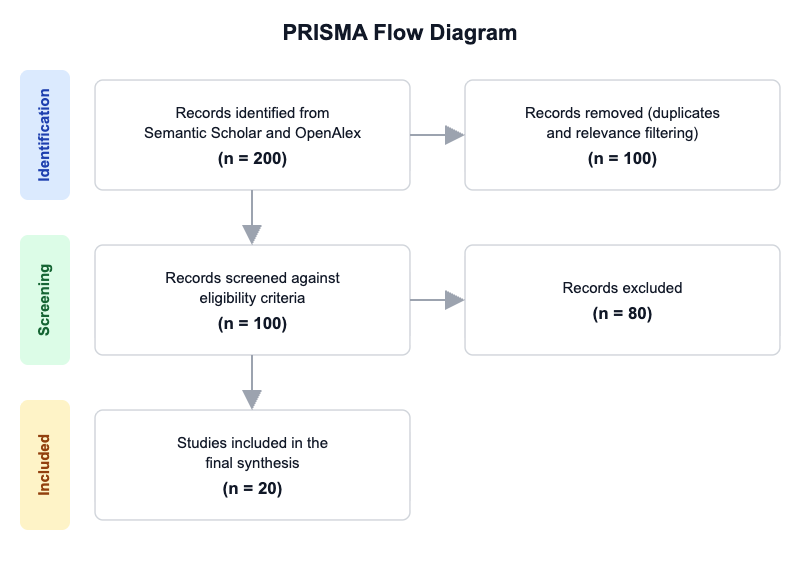
Initial database searching identified 200 records. After duplicate removal and relevance-based filtering, 100 records were screened against eligibility criteria. Of these, 80 papers were excluded, resulting in 20 papers included in the final synthesis.
PRISMA Flow Diagram
Eligibility criteria included:
- Human Study: Does the study involve human patients, human tumor samples, or clinical data rather than only cell lines or animal models?
- Ovarian Cancer: Does the study focus on ovarian cancer or ovarian carcinoma as the primary disease of interest?
- Cause or Treatment: Does the study address either ovarian cancer causes/risk factors/pathogenesis or treatment/management/therapeutics?
- Recent or Relevant: Is the study a recent review, clinical study, translational study, or otherwise directly relevant to contemporary ovarian cancer research?
- Mechanistic or Clinical Value: Does the study provide mechanistic insight, biomarker information, treatment response data, or clinical implications?
- Advanced Disease Context: Does the study address high-grade serous, recurrent, platinum-resistant, advanced, or epithelial ovarian cancer where specified?
All included studies met the stated eligibility criteria.
2.3 Data Extraction and Synthesis
Data extraction focused on study focus, cancer subtype, cause/risk factor, treatment type, key findings, biomarkers, study design, population/model, and outcomes. Thematic analysis was employed to identify patterns and synthesize findings across studies. Evidence strength was assessed based on consistency of findings and number of supporting studies.
3. Results
3.1 Characteristics of Included Studies
| Study and Year | Study Type | Cancer Context | Primary Focus | Key Molecular/Clinical Emphasis |
|---|---|---|---|---|
| Agarwal & Kaye, 2003 [1] | Review | Ovarian cancer | Chemotherapy resistance | Relapse and drug resistance |
| Vaughan et al., 2011 [2] | Opinion/recommendations | Ovarian cancer, especially high-grade serous | Outcome improvement | Biology-informed recommendations |
| Bowtell, 2010 [3] | Review | High-grade serous ovarian cancer | Genesis and evolution | BRCA pathway dysfunction, TP53, chromosomal instability |
| Kurman, 2013 [4] | Review | High-grade serous ovarian carcinoma | Pathogenesis | Type I/type II model, STIC, TP53 |
| Ledermann et al., 2013 [5] | Clinical practice guideline review | Newly diagnosed and relapsed epithelial ovarian carcinoma | Diagnosis, treatment, follow-up | Surgery, chemotherapy, CA 125, BRCA |
| Karnezis et al., 2016 [6] | Review | Multiple ovarian cancer origins | Pathogenesis and prevention | Histogenetic pathways, microenvironment |
| Ducie et al., 2017 [7] | Integrated genomic analysis | High-grade serous carcinoma | Molecular etiology | STIC, fallopian-tube origin |
| Colombo et al., 2019 [8] | Consensus conference | Early, advanced, borderline, recurrent disease | Clinical management recommendations | Pathology and molecular biology |
| Lheureux et al., 2019 [9] | Review | Epithelial ovarian cancer | Precision medicine | BRCA, PARP, biomarkers |
| NCCN, 2019 [10] | Guideline review | Epithelial ovarian cancer | Treatment updates | Neoadjuvant therapy, maintenance options |
| Kurnit et al., 2020 [11] | Review | Advanced epithelial ovarian cancer | Therapeutic advances | PARP inhibitors, antiangiogenics, genetics |
| Mirza et al., 2020 [12] | Review | Newly diagnosed ovarian cancer | PARP inhibitor role | Patient selection, biomarker refinement |
| Armstrong et al., 2021 [13] | NCCN guideline review | Ovarian, fallopian tube, peritoneal cancers | Primary treatment | Surgery, adjuvant, maintenance, PARP |
| Marchetti et al., 2021 [14] | Review | Platinum-resistant epithelial ovarian cancer | Chemoresistance | Biomarker prediction, emerging therapies |
| NCCN Insights, 2022 [15] | Guideline insights | Ovarian cancer | Diagnosis, treatment, follow-up | Older/comorbid patients, molecular analysis |
| Konstantinopoulos & Matulonis, 2023 [16] | Review | Epithelial ovarian cancer | Clinical and translational therapy | Targeted and immune-based approaches |
| Richardson et al., 2023 [17] | Review | Platinum-resistant ovarian cancer | Trial design and biomarker therapy | Patient selection, biomarker-directed care |
| Veneziani et al., 2023 [18] | Review | Ovarian carcinoma | Heterogeneity and treatment landscape | Molecular/cellular/anatomical heterogeneity |
| Wang et al., 2024 [19] | Review | High-grade serous ovarian cancer | Biology-driven therapies | HRD, VEGF, PARP resistance |
| Ledermann et al., 2024 [20] | Consensus conference | Early, advanced, recurrent disease | Pathology, molecular biology, management | Harmonized recommendations |
Overall, the corpus is dominated by reviews, consensus statements, and guideline documents, with the main empirical contribution coming from integrated genomic analysis of high-grade serous carcinoma [7]. The evidence base is therefore strongest for treatment paradigms, histotype-specific pathogenesis, and molecularly guided management, while direct comparative clinical effectiveness data are largely synthesized rather than newly generated.
3.2 Thematic Findings
3.2.1 Ovarian cancer is increasingly explained by histotype-specific molecular origins rather than a single ovarian-surface pathway
A central synthesis across the literature is that ovarian cancer is not one disease but a family of biologically distinct entities. High-grade serous carcinoma is consistently linked to fallopian-tube precursor lesions, especially serous tubal intraepithelial carcinoma, and to TP53 mutation, chromosomal instability, and BRCA-pathway dysfunction [4], [7], [3]. In contrast, type 1 tumors are characterized by earlier, stepwise evolution and relatively stable genomes with recurrent KRAS, BRAF, ERBB2, PTEN, PIK3CA, and ARID1A alterations [4], [6]. This distinction matters because it reframes etiology as a set of lineage- and pathway-specific processes rather than a common ovarian origin. The molecular analysis of tumors with and without STIC found broadly shared profiles and no clear separation by STIC status, which supports a common distal fallopian-tube origin across cases rather than distinct ovarian-surface subtypes [7]. Confidence: Strong.
3.2.2 Risk prediction and prevention are tied to genetic susceptibility, reproductive history, and precursor biology, but not all associations are equally mature
The evidence for risk is strongest for inherited and somatic DNA repair defects. BRCA1/BRCA2 mutations are repeatedly linked to increased ovarian cancer risk and to treatment-relevant biology, particularly in high-grade serous disease [5], [3], [9]. The literature also identifies reproductive history as relevant: multiple pregnancies, oral contraceptive use, breastfeeding, tubal ligation, and ovulation suppression are described as protective, whereas early menarche, late menopause, obesity, and possibly talcum powder are associated with higher risk [5]. However, these latter associations are reported in a guideline context rather than as harmonized effect estimates, so their relative weight is less certain than that of BRCA-related susceptibility. The prevention literature also emphasizes precursor lesions and histogenetic pathways, especially for high-grade serous, clear-cell, and endometrioid cancers, which are thought to arise from tissues not normally present in the ovary [6]. Confidence: Moderate.
3.2.3 Standard treatment remains surgery plus platinum-based chemotherapy, but the field has shifted toward maximal cytoreduction and biomarker-guided maintenance
Across guideline and review literature, surgery plus platinum-based chemotherapy remains the backbone of care for epithelial ovarian cancer [5], [13], [11]. In advanced disease, the consistent message is that surgical completeness matters: complete macroscopic resection or optimal cytoreduction is associated with better progression-free and overall survival, and specialist surgical expertise improves cytoreduction rates without increasing morbidity [5], [8]. For bulky stage IIIC/IV disease, neoadjuvant platinum-based chemotherapy followed by interval debulking is presented as non-inferior to primary debulking in appropriately selected patients [13], while neoadjuvant strategies and hyperthermic intraperitoneal chemotherapy have been incorporated into more recent guideline updates [10]. The treatment landscape has therefore become more individualized, with age, comorbidity, stage, and resectability guiding modality selection [15], [20]. Confidence: Strong.
3.2.4 PARP inhibition is the most consistently endorsed targeted advance, but benefit is concentrated in biomarker-selected populations
PARP inhibitors emerge as the most mature targeted therapy across the literature. They are described as having improved progression-free survival in both frontline and recurrent settings and as a pivotal component of maintenance treatment [11], [9], [12]. The biological rationale is closely tied to BRCA mutation and homologous recombination deficiency, both of which are treated as core predictive markers [19], [3]. Yet the literature also emphasizes that benefit is not uniform: patient selection and refinement of testing are repeatedly described as priorities, and populations that appear to benefit less from PARP inhibitors require alternative strategies [12], [16]. This is an important qualitative contrast: the field has moved from proving class efficacy to defining the boundaries of responsiveness. Confidence: Strong.
3.2.5 Heterogeneity and resistance are the main barriers to durable benefit, especially in recurrent and platinum-resistant disease
Multiple reviews converge on the conclusion that treatment failure is driven by intrinsic and acquired resistance arising from molecular heterogeneity, tumor-microenvironment interactions, and evolving clonal architecture [1], [14], [18]. Platinum-resistant ovarian cancer is described as a heterogeneous spectrum with low response rates to additional chemotherapy and median survival under 12 months [14]. Clinical trial failures in this setting are presented not as dead ends but as evidence that trial design, biomarker-directed therapy, and patient selection need improvement [17]. Importantly, the literature does not identify a single resistance mechanism sufficient to explain outcomes across subtypes; instead, resistance appears to be a systems-level property shaped by biology, prior therapy, and disease context [18], [19]. Confidence: Strong.
3.2.6 Molecular testing and pathology expertise are becoming foundational to ovarian cancer management
The consensus and guideline literature consistently shifts decision-making toward molecular analysis and expert histopathology. Germline testing is recommended broadly, somatic testing is increasingly relevant, and tumor molecular analysis is explicitly incorporated into updated guidance [13], [15], [20]. The practical consequence is subtype-aware management: low-grade serous tumors are less responsive to traditional chemotherapy, clear-cell and endometrioid cancers have distinct precursor biology, and BRCA-mutated or HRD-positive disease is more likely to benefit from PARP inhibition [20], [6], [9]. The evidence base here is largely consensus-driven, but its direction is highly consistent. Confidence: Moderate to strong.
3.3 Summary of Evidence
| Theme | Key Finding | Population Applicability | Effect Direction | Confidence Level | Supporting Studies |
|---|---|---|---|---|---|
| Histotype-specific pathogenesis | HGSC is strongly linked to TP53 mutation, BRCA-pathway dysfunction, and fallopian-tube/STIC origin | Mainly epithelial ovarian cancer, especially HGSC; partially matches broader ovarian cancer population | Positive for mechanistic clarity; not an intervention effect | Strong | Kurman et al. [4], Ducie et al. [7], Bowtell et al. [3] |
| Genetic and reproductive risk | BRCA1/2, family history, and reproductive history are major risk signals; oral contraceptives, breastfeeding, tubal ligation, and ovulation suppression are described as protective | Broad ovarian cancer populations, especially hereditary risk contexts | Mixed | Moderate | Ledermann et al. [5], Bowtell et al. [3], Karnezis et al. [6] |
| Surgery and platinum chemotherapy | Complete cytoreduction plus platinum-based chemotherapy remains the backbone of care; neoadjuvant strategies can be non-inferior in bulky stage IIIC/IV disease | Women with epithelial ovarian cancer, especially advanced-stage disease | Positive | Strong | Ledermann et al. [5], Armstrong et al. [13], Kurnit et al. [11] |
| PARP inhibitor maintenance | PARP inhibitors improve progression-free survival and are most useful in biomarker-selected patients | Newly diagnosed and recurrent epithelial ovarian cancer; strongest fit for BRCA/HRD-positive disease | Positive | Strong | Kurnit et al. [11], Lheureux et al. [9], Wang et al. [19] |
| Resistance and platinum-refractory disease | Platinum-resistant ovarian cancer has low response rates to further chemotherapy and median survival under 12 months | Platinum-resistant ovarian cancer; partially matches general ovarian cancer population | Negative | Strong | Marchetti et al. [14], Richardson et al. [17], Veneziani et al. [18] |
| Molecular testing and personalized care | Germline and somatic molecular testing increasingly direct treatment selection and maintenance choices | Epithelial ovarian cancer, especially advanced and recurrent disease | Positive | Moderate | Armstrong et al. [13], NCCN Insights [15], Ledermann et al. [20] |
4. Discussion
4.1 Principal Findings and Their Interpretation
The synthesis supports a clear shift in ovarian cancer research from organ-based thinking to biology-based stratification. The most robust mechanistic insight is that high-grade serous ovarian carcinoma behaves as a fallopian-tube-derived, genomically unstable disease driven by TP53 mutation and BRCA-pathway dysfunction [4], [7], [3]. This matters clinically because it explains why DNA-damage–targeting therapies, especially PARP inhibitors, have become central: their benefit is logically aligned with homologous recombination deficiency rather than with ovarian site alone [19], [12], [9]. The literature therefore converges on a causal chain linking lineage, mutation profile, and therapeutic vulnerability.
A second major interpretation is that treatment progress has been real but conditional. Surgery and platinum-based chemotherapy remain effective foundations, yet their impact depends heavily on resectability, stage, and subtype [5], [13]. The most meaningful gains are seen when complete cytoreduction is achieved and when maintenance therapy is biomarker guided. That pattern implies that ovarian cancer outcomes are determined as much by selecting the right patients for the right modality as by the modality itself. This is particularly evident in low-grade serous and platinum-resistant disease, where standard approaches are less effective and where heterogeneity likely overwhelms uniform treatment logic [15], [14], [18].
Confidence is highest for the molecular framing of HGSC and for the role of surgery/platinum/PARP inhibitors in biomarker-selected patients because these claims are repeated across mechanistic, guideline, and translational sources. Confidence is lower for prevention-related exposures such as obesity and talcum powder because those associations are acknowledged but not quantified in the provided material [5]. The synthesis adds value by showing that the same biology explaining origin also explains resistance: the field’s major challenge is not discovery of more treatment classes, but matching existing classes to disease architecture and timing.
4.2 Comparison with Existing Literature and Resolution of Contradictions
Across the literature, the strongest agreement concerns the inadequacy of a one-size-fits-all model. Historical approaches treated ovarian carcinoma largely as a single disease, whereas contemporary consensus and review literature repeatedly emphasize subtype-specific biology, molecular profiling, and expert pathology [8], [20], [18]. This convergence is meaningful because it links pathology to actionability: if the same histotype can arise through distinct precursor pathways, then uniform treatment will inevitably produce uneven benefit. The consistency of this message across reviews and guidelines strengthens confidence that the field has genuinely moved toward precision medicine rather than merely renaming old practices.
The main tension in the evidence concerns prevention and predictive testing. On one hand, BRCA mutation status, family history, and fallopian-tube origin are highly coherent biological signals [3], [7]. On the other hand, several broader risk factors are presented as associated with ovarian cancer without harmonized quantitative estimates [5]. This is best interpreted as a difference in evidentiary maturity, not contradiction: inherited DNA-repair defects and precursor lesions are mechanistically anchored, whereas reproductive and environmental factors are embedded in more heterogeneous observational frameworks. The same logic explains why some guideline statements are more confident than others.
The resistance literature also shows apparent contradiction only if one expects a single explanation. Platinum-resistant disease is described as broadly unresponsive to standard chemotherapy, yet PARP inhibitors, antiangiogenics, and biomarker-directed strategies are still considered useful in subsets [14], [17], [16]. This is not a true conflict; rather, it reflects genuine biological heterogeneity. It may also reflect selection bias in trials, because patients enrolled into biomarker-enriched studies are more likely to show benefit than unselected platinum-resistant cohorts. Accordingly, the literature supports stratified rather than universal optimism.
4.3 Practical Implications
For clinicians, the strongest implication is that ovarian cancer management should be histotype- and biomarker-driven. In practice, this means broad use of germline testing, increasing use of somatic profiling, and expert pathology review to distinguish HGSC from low-grade serous, clear-cell, endometrioid, mucinous, and rarer subtypes [13], [15], [20]. Patients with BRCA-mutated or HRD-positive disease are the clearest candidates for PARP inhibitor-based strategies, whereas low-grade serous or platinum-resistant disease should prompt consideration of alternative and trial-based approaches [9], [14].
For surgical oncology, the evidence supports maximizing complete cytoreduction when feasible and referring advanced cases to specialized centers with the expertise to perform complex debulking [5], [8]. For policy and health systems, the prevalence of advanced presentation and treatment resistance argues for investment in access to molecular testing, high-volume surgical care, and clinical trials, particularly for recurrent disease where standard chemotherapy performs poorly [17], [14].
The threshold question is less relevant than in environmental exposure literature, but the broader implication is similar: benefit cannot be assumed to arise from merely offering more treatment. Effective care requires population-wide access to appropriate diagnostics and modality selection, not just availability of drugs. The evidence is strongest for epithelial ovarian cancer and high-grade serous disease; recommendations are less certain for uncommon subtypes and for patients who do not fit biomarker-defined responder groups.
4.4 Strengths and Limitations
This review has several strengths: it integrates mechanistic, guideline, consensus, and translational literature; it prioritizes molecular pathogenesis alongside treatment; and it reflects the most current shift toward precision oncology. The included literature also captures the transition from broad clinical management to biomarker-guided and subtype-specific care.
The main limitation of the included studies is that most are reviews, guidelines, and consensus statements rather than primary comparative trials. This means that many claims are well reasoned but not always accompanied by uniform effect estimates. Another limitation is the frequent focus on epithelial and high-grade serous disease, which leaves less common histologies less fully characterized. For this review, the principal limitation is the reliance on abstract-level extraction and the absence of formal risk-of-bias assessment, which constrains fine-grained appraisal of study quality.
5. Gaps and Future Directions
The most important gap is the limited direct evidence connecting specific causal pathways to treatment response across all ovarian cancer subtypes. High-grade serous disease is well characterized mechanistically, but low-grade serous, clear-cell, mucinous, and rare tumors remain less definitively mapped in terms of origin, biomarkers, and optimal therapy [6], [18]. Future studies should therefore move beyond broad epithelial categories and test subtype-specific hypotheses in prospective cohorts.
A second gap is the lack of harmonized quantitative evidence for many risk factors beyond BRCA-related susceptibility. Reproductive and environmental associations are acknowledged, but the provided literature does not supply comparable effect estimates across studies [5]. Better studies would combine standardized exposure definitions, tumor histology, and germline/somatic profiling.
A third gap concerns platinum-resistant disease. The literature strongly indicates poor outcomes, but it remains unclear which biomarker-driven interventions reliably change survival rather than simply enriching response rates [14], [17]. Prospective biomarker-stratified trials with consistent response and survival endpoints are needed, especially in recurrent and non-HGSC populations.
6. Conclusion
The evidence supports a clear conclusion: the latest research on ovarian cancer shows that causes and treatments are now best understood through a precision-oncology framework in which histotype, molecular origin, and resistance biology determine risk and therapeutic responsiveness. High-grade serous ovarian carcinoma is most consistently linked to fallopian-tube origin, TP53 mutation, BRCA-pathway dysfunction, and homologous recombination deficiency [4], [7], [3], whereas type 1 tumors follow different molecular routes involving KRAS, BRAF, ERBB2, PTEN, PIK3CA, and ARID1A [4], [6]. Clinically, the most defensible treatment strategy remains complete cytoreduction when feasible, platinum-based chemotherapy, and biomarker-guided maintenance, especially with PARP inhibitors in selected patients [5], [13], [12]. At the same time, platinum-resistant disease remains a major unresolved problem, with low response rates and median survival under 12 months [14]. The evidence base is strongest for epithelial and high-grade serous disease and less complete for rarer subtypes, so the conclusion applies most confidently to those populations. The key unanswered question is how to translate molecular stratification into durable benefit for resistant and underrepresented subtypes. Addressing that question will be decisive for improving survival and making ovarian cancer care truly individualized.
References
- Agarwal, R., & Kaye, S. B. (2003). Ovarian cancer: Strategies for overcoming resistance to chemotherapy. Nature Reviews Cancer, 3(7), 502–516. https://doi.org/10.1038/nrc1123
- Vaughan, S., Coward, J. I., Bast, R. C., Jr., Berchuck, A., Berek, J. S., Brenton, J. D., Coukos, G., Crum, C. C., Drapkin, R., Etemadmoghadam, D., Friedlander, M., Gabra, H., Kaye, S. B., Lord, C. J., Lengyel, E., Levine, D. A., McNeish, I. A., Menon, U., Mills, G. B., ... Balkwill, F. R. (2011). Rethinking ovarian cancer: Recommendations for improving outcomes. Nature Reviews Cancer, 11(10), 719–725. https://doi.org/10.1038/nrc3144
- Bowtell, D. D. L. (2010). The genesis and evolution of high-grade serous ovarian cancer. Nature Reviews Cancer, 10(11), 803–808. https://doi.org/10.1038/nrc2946
- Kurman, R. J. (2013). Origin and molecular pathogenesis of ovarian high-grade serous carcinoma. Annals of Oncology, 24(Suppl. 10), x16–x21. https://doi.org/10.1093/annonc/mdt463
- Ledermann, J. A., Raja, F. A., Fotopoulou, C., Gonzalez-Martin, A., Colombo, N., & Sessa, C. (2013). Newly diagnosed and relapsed epithelial ovarian carcinoma: ESMO Clinical Practice Guidelines for diagnosis, treatment and follow-up. Annals of Oncology, 24(Suppl. 6), vi24–vi32. https://doi.org/10.1093/annonc/mdt333
- Karnezis, A. N., Cho, K. R., Gilks, C. B., Pearce, C. L., & Huntsman, D. G. (2016). The disparate origins of ovarian cancers: Pathogenesis and prevention strategies. Nature Reviews Cancer, 17(1), 65–74. https://doi.org/10.1038/nrc.2016.113
- Ducie, J., Dao, F., Considine, M., Olvera, N., Shaw, P. A., Kurman, R. J., Shih, I.-M., Soslow, R. A., Cope, L., & Levine, D. A. (2017). Molecular analysis of high-grade serous ovarian carcinoma with and without associated serous tubal intra-epithelial carcinoma. Nature Communications, 8(1), 990. https://doi.org/10.1038/s41467-017-01217-9
- Colombo, N., Sessa, C., du Bois, A., Ledermann, J., McCluggage, W. G., McNeish, I., Morice, P., Pignata, S., Ray-Coquard, I., Vergote, I., Baert, T., Belaroussi, I., Dashora, A., Olbrecht, S., Planchamp, F., Querleu, D., & ESMO-ESGO Ovarian Cancer Consensus Conference Working Group. (2019). ESMO–ESGO consensus conference recommendations on ovarian cancer: Pathology and molecular biology, early and advanced stages, borderline tumours and recurrent disease. Annals of Oncology, 30(5), 672–705. https://doi.org/10.1093/annonc/mdz062
- Lheureux, S., Braunstein, M., & Oza, A. M. (2019). Epithelial ovarian cancer: Evolution of management in the era of precision medicine. CA: A Cancer Journal for Clinicians, 69(4), 280–304. https://doi.org/10.3322/caac.21559
- Armstrong, D. K., Alvarez, R. D., Bakkum-Gamez, J. N., Barroilhet, L., Behbakht, K., Berchuck, A., Berek, J. S., Chen, L., Cristea, M., DeRosa, M., ElNaggar, A. C., Gershenson, D. M., Gray, H. J., Hakam, A., Jain, A., Johnston, C., Leath, C. A., III, Liu, J., Mahdi, H., ... Engh, A. M. (2019). NCCN Guidelines Insights: Ovarian Cancer, Version 1.2019. Journal of the National Comprehensive Cancer Network, 17(8), 896–909. https://doi.org/10.6004/jnccn.2019.0039
- Kurnit, K. C., Fleming, G. F., & Lengyel, E. (2020). Updates and new options in advanced epithelial ovarian cancer treatment. Obstetrics & Gynecology, 137(1), 108–121. https://doi.org/10.1097/AOG.0000000000004173
- Mirza, M. R., Coleman, R. L., González-Martín, A., Moore, K. N., Colombo, N., Ray-Coquard, I., & Pignata, S. (2020). The forefront of ovarian cancer therapy: Update on PARP inhibitors. Annals of Oncology, 31(9), 1148–1159. https://doi.org/10.1016/j.annonc.2020.06.004
- Armstrong, D. K., Alvarez, R. D., Bakkum-Gamez, J. N., Barroilhet, L., Behbakht, K., Berchuck, A., Chen, L., Cristea, M., DeRosa, M., Eisenhauer, E. L., Gershenson, D. M., Gray, H. J., Grisham, R., Hakam, A., Jain, A., Karam, A., Konecny, G. E., Leath, C. A., Liu, J., ... Engh, A. M. (2021). Ovarian Cancer, Version 2.2020, NCCN Clinical Practice Guidelines in Oncology. Journal of the National Comprehensive Cancer Network, 19(2), 191–226. https://doi.org/10.6004/jnccn.2021.0007
- Marchetti, C., De Felice, F., Romito, A., Iacobelli, V., Sassu, C. M., Corrado, G., Ricci, C., Scambia, G., & Fagotti, A. (2021). Chemotherapy resistance in epithelial ovarian cancer: Mechanisms and emerging treatments. Seminars in Cancer Biology, 77, 144–166. https://doi.org/10.1016/j.semcancer.2021.08.011
- Armstrong, D. K., Alvarez, R. D., Backes, F. J., Bakkum-Gamez, J. N., Barroilhet, L., Behbakht, K., Berchuck, A., Chen, L., Chitiyo, V. C., Cristea, M., DeRosa, M., Eisenhauer, E. L., Gershenson, D. M., Gray, H. J., Grisham, R., Hakam, A., Jain, A., Karam, A., Konecny, G. E., ... Hang, L. (2022). NCCN Guidelines® Insights: Ovarian Cancer, Version 3.2022. Journal of the National Comprehensive Cancer Network, 20(9), 972–980. https://doi.org/10.6004/jnccn.2022.0047
- Konstantinopoulos, P. A., & Matulonis, U. A. (2023). Clinical and translational advances in ovarian cancer therapy. Nature Cancer, 4(9), 1239–1257. https://doi.org/10.1038/s43018-023-00617-9
- Richardson, D. L., Eskander, R. N., & O'Malley, D. M. (2023). Advances in ovarian cancer care and unmet treatment needs for patients with platinum resistance: A narrative review. JAMA Oncology, 9(6), 851–859. https://doi.org/10.1001/jamaoncol.2023.0197
- Veneziani, A. C., Gonzalez-Ochoa, E., Alqaisi, H., Madariaga, A., Bhat, G., Rouzbahman, M., Sneha, S., & Oza, A. M. (2023). Heterogeneity and treatment landscape of ovarian carcinoma. Nature Reviews Clinical Oncology, 20(12), 820–842. https://doi.org/10.1038/s41571-023-00819-1
- Wang, Y., Duval, A. J., Adli, M., & Matei, D. (2024). Biology-driven therapy advances in high-grade serous ovarian cancer. Journal of Clinical Investigation, 134(1), e174013. https://doi.org/10.1172/JCI174013
- Ledermann, J. A., Matias-Guiu, X., Amant, F., Concin, N., Davidson, B., Fotopoulou, C., González-Martin, A., Gourley, C., Leary, A., Lorusso, D., Banerjee, S., Chiva, L., Cibula, D., Colombo, N., Croce, S., Eriksson, A. G., Falandry, C., Fischerova, D., Harter, P., ... Fagotti, A. (2024). ESGO–ESMO–ESP consensus conference recommendations on ovarian cancer: Pathology and molecular biology and early, advanced and recurrent disease. Annals of Oncology, 35(3), 248–266. https://doi.org/10.1016/j.annonc.2023.11.015