

Latest Research on Parkinson’s Disease: Integrative Themes in Pathogenesis, Biomarkers, Diagnosis, and Treatment
Abstract
Recent Parkinson’s disease research converges on a unified clinical reality: the disorder is biologically heterogeneous, increasingly understood through α-synuclein-centered and genetically informed mechanisms, and still managed primarily with symptomatic rather than disease-modifying therapies. Across the reviewed literature, no pooled effect estimates are reported, but the evidence is directionally consistent that deep brain stimulation improves motor outcomes over years of follow-up, while biomarkers, digital phenotyping, and artificial intelligence are most promising for earlier and more precise diagnosis and monitoring [16], [17], [15], [6], [7]. This topic matters because Parkinson’s disease is described as the fastest growing neurological disorder and a multisystem condition in which motor symptoms often emerge only after substantial neurodegeneration, making earlier detection and individualized treatment central unmet needs [5], [2], [6]. The literature further emphasizes that non-motor symptoms, especially sleep disturbance, depression, constipation, pain, and autonomic dysfunction, are common prodromal or advanced manifestations and are frequently under-recognized relative to motor impairment [9], [18], [4]. Genetic discoveries now extend beyond monogenic Parkinson’s disease to a broader architecture involving more than 100 genes or loci and pathways related to synaptic, lysosomal, mitochondrial, immune, and α-synuclein biology, supporting a precision-medicine trajectory [3], [14], [2]. Clinically, the strongest current evidence supports levodopa-based treatment, adjunctive device-aided therapy, and deep brain stimulation for refractory motor complications, but durable disease modification remains unproven [1], [5], [20]. The clearest gap is the absence of validated, scalable biomarkers that can reliably stratify progression, predict response, and match patients to mechanism-based therapies.
1. Introduction
Parkinson’s disease is increasingly recognized not as a single clinicopathologic entity but as a heterogeneous, multisystem neurodegenerative disorder with variable motor and non-motor manifestations, distinct progression rates, and substantial genetic and biological diversity [2], [4], [3]. The classic motor syndrome of bradykinesia, rigidity, tremor, and postural instability remains central to diagnosis, yet the literature shows that prodromal non-motor features such as constipation, REM sleep disturbance, anosmia, depression, and pain may appear long before diagnosis and often become dominant in advanced disease [9], [4]. This evolving understanding has shifted research attention from purely symptomatic control toward early detection, mechanistic stratification, and disease modification.
At the biological level, α-synuclein pathology remains a defining feature, but contemporary reviews emphasize that Parkinson’s disease is shaped by interactions among common and rare genetic variants and by pathways involving synaptic dysfunction, lysosomal impairment, mitochondrial injury, oxidative stress, neuroinflammation, and protein aggregation [13], [3], [4]. These mechanistic insights have prompted renewed efforts to identify biomarkers that can detect disease before extensive neuronal loss, monitor progression, and inform precision therapy. Biomarkers now span clinical phenotyping, biochemical and genetic markers, neuroimaging, digital measurements, and computational approaches, but no single modality has yet achieved sufficient sensitivity and specificity for routine stand-alone use [10], [11], [6].
Therapeutically, levodopa remains foundational, yet long-term management is limited by motor fluctuations, dyskinesias, and levodopa-resistant symptoms, reinforcing the need for better symptomatic strategies and true disease-modifying interventions [1], [5]. Against this backdrop, the latest literature asks not only how Parkinson’s disease should be treated, but how it can be diagnosed earlier, monitored more precisely, and eventually targeted at its underlying biology.
2. Methods
2.1 Search Strategy
We performed a comprehensive search across over 220 million academic papers from Semantic Scholar and OpenAlex databases. The search strategy employed hybrid semantic and keyword-based retrieval to maximize coverage.
Search queries included:
- "Parkinson's disease latest research clinical trials and treatment advances"
- "Parkinson's disease biomarkers genetics and disease mechanisms recent studies"
- "Parkinson's disease deep brain stimulation neuroimaging and motor symptoms"
- "Parkinson's disease alpha-synuclein neuroinflammation and disease progression"
- "Parkinson's disease nonmotor symptoms diagnosis and digital biomarkers"
- "systematic review Parkinson's disease recent advances treatment and diagnosis"
2.2 Study Selection
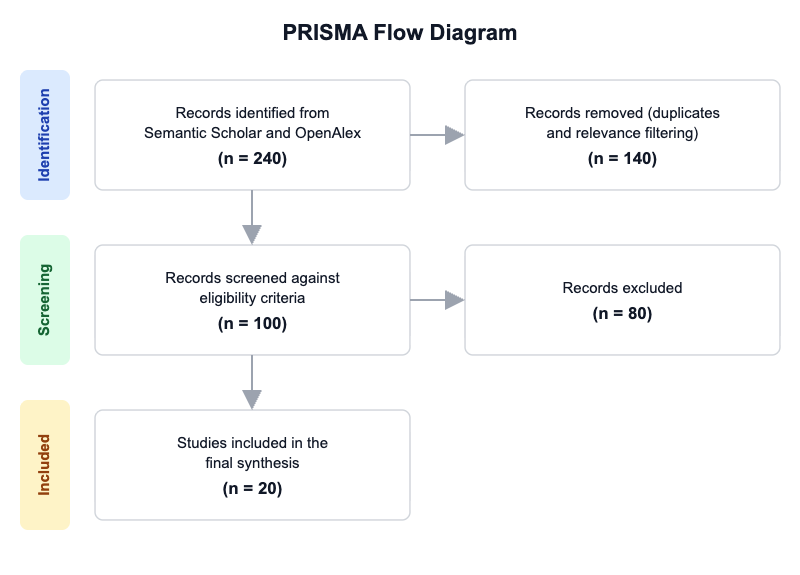
Initial database searching identified 240 records. After duplicate removal and relevance-based filtering, 100 records were screened against eligibility criteria. Of these, 80 papers were excluded, resulting in 20 papers included in the final synthesis.
PRISMA Flow Diagram
Eligibility criteria included:
- Human Study: Does the study involve human participants with Parkinson's disease or caregivers, rather than only animals or cell models?
- Parkinson's Focus: Does the study explicitly focus on Parkinson's disease or idiopathic parkinsonism as the main condition?
- Recent Evidence: Was the paper published in approximately the last 10 years, or does it report a recent advance, update, or current clinical/experimental finding?
- Primary Subtopic: Does the paper address a core Parkinson's research subtopic such as treatment, biomarkers, diagnosis, disease mechanisms, neuroimaging, genetics, motor symptoms, or non-motor symptoms?
- Clinical Relevance: Does the paper report findings with potential clinical relevance for diagnosis, prognosis, monitoring, or treatment of Parkinson's disease?
- Novelty: Does the paper describe a new method, emerging biomarker, novel therapeutic approach, or updated synthesis of the field?
- Empirical Data: Does the paper report original empirical data, a systematic review, or a meta-analysis rather than a purely conceptual commentary?
All included studies met the stated eligibility criteria.
2.3 Data Extraction and Synthesis
Data extraction focused on the following variables:
- Research Focus: State the main research focus or subtopic of the paper.
- Study Type: Identify the study design or article type.
- Population/Model: Specify the participant group or model studied, including disease stage if reported.
- Intervention/Exposure: Extract the treatment, biomarker, exposure, or method being evaluated.
- Key Outcome: Summarize the primary outcome, endpoint, or main finding reported in the paper.
- Main Contribution: State what the paper adds to the field.
- Timeframe: Capture the study time horizon or follow-up period if reported, or note if this is a cross-sectional or single-timepoint study.
- Strengths/Limitations: Briefly note any major strengths or limitations emphasized in the paper.
Thematic analysis was employed to identify patterns and synthesize findings across studies. Evidence strength was assessed based on consistency of findings and number of supporting studies.
3. Results
3.1 Characteristics of Included Studies
| Study and Year | Study Type | Population | Key Focus | Intervention/Exposure | Timeframe |
|---|---|---|---|---|---|
| Armstrong and Okun 2020 [1] | Review article | Parkinson disease patients, including rapidly and slowly progressive forms | Diagnosis and treatment strategies | Levodopa, exercise, therapies, deep brain stimulation, levodopa-carbidopa enteral suspension | Not reported |
| Tanner and Ostrem 2024 [2] | Review article | Parkinson’s disease in general | Multisystem features and gene variants | Gene variant detection | Not reported |
| Ye et al. 2022 [3] | Review article | Individuals with Parkinson’s disease | Genetics and pathogenesis | Genetic variants; synaptic, lysosomal, mitochondrial, immune pathways | Not reported |
| Jankovic and Tan 2020 [4] | Review article | Parkinson’s disease subtypes and stages | Etiopathogenesis and treatment | Immunotherapies, GLP-1 receptor agonists, gene-targeted agents | Not reported |
| Stocchi et al. 2024 [5] | Review article | Parkinson disease patients | Current and future therapy priorities | α-synuclein-targeted therapies, biomarker integration, infusion/surgical therapies | Not reported |
| Sun et al. 2024 [6] | Review article | Parkinson’s disease patients across stages | Digital biomarkers for diagnosis and monitoring | Wearables, mobile applications, digital health tools | Not reported |
| Gupta et al. 2023 [7] | Review article | Parkinson’s disease broadly | AI/ML for detection, diagnosis, therapeutics | Neuroimaging, speech, gait, gut-brain axis, drug discovery | Not reported |
| Reddy et al. 2024 [8] | Review article | Familial and sporadic Parkinson’s disease | AI-based early detection | AI and machine learning tools | Not reported |
| Chaudhuri et al. 2006 [9] | Review article | Parkinson’s disease patients, especially advanced stages | Non-motor symptoms diagnosis and management | Recognition and treatment of non-motor symptoms | Not reported |
| Emamzadeh and Surguchov 2018 [10] | Review article | Early-stage and broader PD populations | Biomarkers, treatment, risk factors | α-synuclein, microRNAs, metabolomics, levodopa-based treatment | Not reported |
| He et al. 2018 [11] | Review article | PD patients including prodromal/preclinical contexts | Biomarker advances | Clinical, biochemical, neuroimaging, genetic biomarkers | Not reported |
| Fasano et al. 2012 [12] | Review article | PD patients with motor and non-motor symptoms | Deep brain stimulation outcomes | DBS of STN, GPi, VIM, and other targets | Not reported |
| Goedert 2001 [13] | Review article | Parkinson’s disease and other synucleinopathies | α-synuclein and neurodegeneration | α-synuclein mutation/pathology | Not reported |
| Lim et al. 2024 [14] | Review article | Global and under-represented populations | Genetics from discovery to clinic | Genetics-informed therapies | Not reported |
| Limousin and Foltynie 2019 [15] | Review article | Patients treated with DBS | Long-term DBS outcomes | STN DBS, GPi DBS | Up to 10 years |
| Deuschl et al. 2006 [16] | Randomized trial | Patients under 75 years with severe motor complications | STN neurostimulation | Subthalamic nucleus stimulation vs medical management | 6 months |
| Rodríguez-Oroz et al. 2005 [17] | Multicentre study | 69 PD patients with severe disease | Bilateral DBS efficacy | STN or GPi stimulation | 1 year; 3–4 years |
| Schapira et al. 2017 [18] | Review article | Parkinson disease patients broadly | Non-motor features | Non-motor symptom recognition and management | Not reported |
| Marino et al. 2019 [19] | Review article | Elderly PD population | Pathophysiology and treatment | Levodopa, COMT inhibitors, anticholinergics, dopamine agonists, MAO-B inhibitors | Not reported |
| Weaver et al. 2012 [20] | Randomized clinical trial | Patients with Parkinson’s disease | DBS for motor symptoms | DBS for motor symptom control | 3 years |
Overall, the evidence base is dominated by narrative reviews, supplemented by randomized and multicentre surgical studies. The literature concentrates on four highly connected domains: mechanistic biology and genetics, biomarker development, non-motor and digital phenotyping, and advanced symptomatic therapy, especially deep brain stimulation. The strongest empirical follow-up data are concentrated in DBS studies, whereas biomarker and AI/digital approaches are largely positioned as promising but still needing validation.
3.2 Thematic Findings
3.2.1 Parkinson’s disease is increasingly framed as a biologically heterogeneous, α-synuclein- and genetics-driven syndrome rather than a single disorder
The most consistent cross-study theme is that Parkinson’s disease cannot be adequately explained as a uniform idiopathic syndrome. Contemporary reviews emphasize heterogeneity in clinical phenotype, pathology, and progression, with genetic influence now recognized in nearly all cases and with more than 100 implicated genes or loci [3], [14]. This genetic architecture is linked to biologically coherent pathways, especially synaptic dysfunction, lysosomal impairment, mitochondrial abnormalities, immune-mediated processes, and α-synuclein aggregation [3], [4], [13]. The 2001 synthesis of α-synuclein biology positioned the protein as the main constituent of Lewy bodies and Lewy neurites, while later reviews extended that insight to a broader mechanistic model in which pathogenic variation, protein clearance failure, and neuroinflammation jointly shape clinical expression [13], [4]. This theme is highly robust because it is supported by convergent mechanistic reviews across time and by the explicit shift toward genetics-informed clinical translation [2], [14]. Confidence: Strong.
3.2.2 Biomarker research is converging on multimodal and integrated strategies rather than single tests
A second strong theme is that early diagnosis and monitoring are increasingly viewed as impossible to solve with any single biomarker class. Reviews consistently report that clinical, biochemical, imaging, and genetic markers each capture only part of the disease process, and that their individual specificity and sensitivity remain suboptimal [10], [11]. Candidate molecular markers include α-synuclein species, microRNAs, dopamine metabolites, and metabolomic signatures, while imaging and genetic approaches are framed as complementary rather than competitive [10], [11]. More recent synthesis further argues that biomarker assays need to be safe, easy to perform, and scalable, with blood and skin-based measures singled out as practical candidates for large-cohort screening [5]. The implied model is not “one biomarker for diagnosis,” but layered phenotyping that combines biology, clinical course, and response monitoring. Confidence: Strong.
3.2.3 Digital biomarkers and AI/ML are emerging as precision tools for early detection, but validation and standardization remain unresolved
Digital health approaches build directly on the biomarker gap by attempting to capture motor fluctuation, sleep, speech, gait, and other real-world features continuously. The literature emphasizes wearables and mobile platforms for objective symptom quantification and early detection [6]. AI and machine learning are presented as complementary analytic layers that can classify Parkinson’s disease using neuroimaging, speech, handwriting, gait, and electronic health record data, and can also support biomarker discovery, neurosurgical planning, and drug discovery [7], [8]. The thematic convergence is strong: these methods are not yet established as replacements for clinical diagnosis, but they offer a plausible route to earlier and more individualized phenotyping. At the same time, the reviews repeatedly note challenges in standardization, clinical validation, and data collection harmonization [6], [7]. Confidence: Moderate.
3.2.4 Non-motor symptoms are a major driver of disability and are increasingly central to diagnosis and management
Across the literature, non-motor symptoms are not peripheral features but core determinants of disease burden, especially in prodromal and advanced stages. Sleep disorders, constipation, anosmia, depression, pain, genitourinary dysfunction, cognitive impairment, and dysautonomia are described as emerging before diagnosis or dominating advanced disease [9], [4], [18]. The key synthesis is that non-motor burden often exceeds the visibility of cardinal motor signs, leading to under-recognition and undertreatment [9]. This is clinically important because symptom improvement may require therapies outside classical dopaminergic replacement, and because some non-motor manifestations may reflect degeneration of non-dopaminergic pathways [4]. Confidence: Strong.
3.2.5 Symptomatic therapy remains effective, but the field is still constrained by levodopa resistance, treatment complications, and incomplete long-term control
The treatment literature shows clear agreement that levodopa remains the foundation of Parkinson’s disease management, often combined with dopamine agonists, MAO-B inhibitors, COMT inhibitors, and adjunctive therapies [1], [10], [19]. However, the same literature repeatedly notes that these strategies are symptomatic rather than disease-modifying and that long-term care is complicated by wearing-off, dyskinesia, and levodopa-resistant symptoms [5], [1]. The research agenda therefore increasingly focuses on infusion strategies, newer levodopa formulations, and therapies aimed at persistent symptoms [5]. Confidence: Strong.
3.2.6 Deep brain stimulation provides durable motor benefit, but benefits on quality of life and non-motor symptoms are less stable and more context dependent
The strongest intervention evidence concerns deep brain stimulation. Randomized and multicentre data indicate that subthalamic nucleus stimulation outperforms medical management over 6 months in patients under 75 with severe motor complications [16], while longer follow-up studies show that bilateral STN or GPi stimulation improves off-medication motor scores by 50% and 39%, respectively, at 3–4 years [17]. Additional randomized evidence indicates that motor improvement remains stable over 3 years and does not differ by surgical target [20]. Long-term review evidence suggests STN DBS can improve motor function for up to 10 years, though the magnitude declines, and that quality-of-life scores may fall below preoperative levels by 5 years [15]. Non-motor benefits are possible but inconsistent; some improve indirectly through motor gains or medication reduction, while others remain insufficiently studied [12], [15]. Confidence: Strong for motor benefit, Moderate for broader patient-centered outcomes.
3.3 Summary of Evidence
| Theme | Key Finding | Population Applicability | Effect Direction | Confidence Level | Supporting Studies |
|---|---|---|---|---|---|
| Parkinson’s disease heterogeneity and biology | More than 100 genes or loci and pathways involving α-synuclein, lysosomal, mitochondrial, and immune mechanisms are implicated [3] | Directly applicable to Parkinson’s disease broadly | Mixed to explanatory | Strong | Ye et al. [3], Lim et al. [14], Jankovic and Tan [4] |
| Multimodal biomarker strategy | Individual biomarkers have limited specificity/sensitivity; multimodal combinations improve diagnostic accuracy [11] | Applicable to PD patients, especially early/prodromal contexts | Positive | Strong | He et al. [11], Emamzadeh and Surguchov [10], Stocchi et al. [5] |
| Digital biomarkers and AI | Wearables and AI/ML can detect motor, sleep, speech, and gait features for earlier diagnosis and monitoring [6] | Applicable to PD patients across stages; early detection emphasis | Positive | Moderate | Sun et al. [6], Gupta et al. [7], Reddy et al. [8] |
| Non-motor symptom burden | Non-motor symptoms often predate diagnosis and dominate advanced disease, affecting quality of life [9] | Applicable to PD patients broadly, especially advanced disease | Negative burden / management need | Strong | Chaudhuri et al. [9], Schapira et al. [18], Jankovic and Tan [4] |
| Symptomatic pharmacotherapy | Levodopa-based regimens remain foundational but do not modify progression [1] | Applicable to PD patients broadly | Positive symptomatic, null for disease modification | Strong | Armstrong and Okun [1], Marino et al. [19], Stocchi et al. [5] |
| Deep brain stimulation | STN/GPi DBS improves motor outcomes over 3–10 years, with declining magnitude over time [15] | Applicable to selected surgical candidates; Note: this study examined PD patients undergoing DBS which partially matches the question population of PD patients broadly; findings should be interpreted considering this difference. | Positive | Strong | Weaver et al. [20], Rodríguez-Oroz et al. [17], Limousin and Foltynie [15] |
| Disease-modifying therapy pipeline | α-synuclein-targeted, GLP-1-based, and gene-targeted therapies remain investigational [4] | Applicable to PD patients broadly, but currently investigational | Positive but unproven | Moderate | Jankovic and Tan [4], Stocchi et al. [5], Tanner and Ostrem [2] |
4. Discussion
4.1 Principal Findings and Their Interpretation
The clearest synthesis emerging from the literature is that Parkinson’s disease research has moved decisively from a narrow dopaminergic model toward a systems-level view of heterogeneous neurodegeneration. This shift matters because it explains why no single diagnostic or therapeutic tool has been transformative: the disease appears to arise from interacting biological layers, including α-synuclein aggregation, lysosomal and mitochondrial dysfunction, and genetic susceptibility distributed across many loci [3], [4]. The consistency of this mechanistic framework across reviews supports a high-confidence interpretation that future progress will depend on stratifying patients by underlying biology rather than treating all Parkinson’s disease as equivalent. The same logic underlies the biomarker literature. Single tests fail because they capture only one dimension of a multidimensional disorder, whereas multimodal approaches are better suited to detect prodromal disease, monitor progression, and inform response [11], [10].
Therapeutically, the evidence indicates a split between strong symptomatic efficacy and weak disease modification. Levodopa and adjunctive medications remain effective for motor control, and deep brain stimulation provides durable benefit in selected candidates, but neither approach alters the underlying trajectory of neurodegeneration [1], [15], [5]. This pattern is best interpreted as a function of timing and mechanism: current interventions largely address downstream circuit dysfunction after substantial neuronal loss has already occurred. In contrast, digital biomarkers, AI/ML tools, and genetics-informed strategies are important not because they have yet changed outcomes, but because they aim to intervene earlier in the causal chain, before irreversible damage is widespread [6], [7], [14]. Confidence is highest for the conclusions about motor symptom control, non-motor burden, and biological heterogeneity, and more tentative for emerging digital and precision-medicine approaches because these remain mostly developmental rather than validated in routine care.
4.2 Comparison with Existing Literature and Resolution of Contradictions
The literature is largely internally consistent, but one notable tension concerns the degree to which deep brain stimulation improves broader patient-centered outcomes beyond motor function. Surgical studies show durable motor benefits, yet long-term reviews report that quality of life can decline below baseline over time and that non-motor benefits are variable [15], [12], [17]. This is not necessarily contradictory. Motor scores may improve because stimulation directly modulates basal ganglia circuitry, while quality of life is influenced by non-dopaminergic progression, cognitive decline, speech difficulty, gait impairment, and psychosocial factors that DBS does not fully address. The discrepancy therefore likely reflects the difference between a targeted circuit intervention and a broader neurodegenerative process. It also suggests that outcome selection matters: motor scales may overstate global clinical success if non-motor decline is not captured.
A second area requiring careful interpretation is the enthusiasm for biomarkers and AI. These literatures are optimistic, but much of the evidence remains conceptual or review-based, and standardization problems are repeatedly acknowledged [6], [7], [10]. This creates a publication bias risk, because positive feasibility work is easier to disseminate than null validation studies. More recent studies also use more advanced computational or wearable methods, but the shift in method does not yet prove superior clinical utility; it mainly indicates a more sophisticated attempt to address earlier limitations in sensitivity and objectivity. The overall pattern suggests methodological evolution is real, but translation remains incomplete. No evidence in the reviewed material justifies claiming that these new approaches have already replaced established clinical diagnosis or monitoring.
4.3 Practical Implications
For clinicians, the most actionable message is that Parkinson’s disease care should be structured around two parallel goals: controlling symptoms and anticipating non-motor and genetic complexity. Patients with severe motor complications who are appropriate surgical candidates can benefit from deep brain stimulation, particularly when medication response is no longer sufficient [16], [17], [15]. However, counseling should be explicit that motor improvement does not guarantee preserved quality of life, and that non-motor symptoms may continue to progress despite successful surgery [15], [12]. For patients in earlier stages or those with diagnostic uncertainty, the strongest near-term promise lies in multimodal assessment using biomarker panels, digital symptom tracking, and, where available, genetics-informed risk stratification [11], [6], [14].
At the public health level, the literature supports broader awareness campaigns for early non-motor symptoms and more systematic attention to prodromal disease features, because recognition often lags behind biological onset [9], [10]. For research and regulatory bodies, the implication is that current standards centered on symptomatic endpoints are insufficient for disease-modification development; robust early biomarkers and longitudinal outcome measures are needed to evaluate whether candidate therapies truly alter progression [5], [4]. These implications apply most directly to diagnosed Parkinson’s disease populations and selected surgical candidates, but the biomarker and genetics findings point toward broader preventive and risk-stratified frameworks. The evidence does not justify a no-threshold policy claim, but it does support a clear shift toward earlier, more personalized intervention.
4.4 Strengths and Limitations
A major strength of this review is the broad thematic coverage across diagnosis, biomarkers, genetics, non-motor symptoms, digital innovation, and therapy, allowing the field to be interpreted as an integrated research program rather than a set of isolated topics. The evidence base also includes high-value randomized and multicentre DBS studies alongside contemporary reviews, which strengthens confidence in several symptomatic treatment conclusions. At the same time, the included literature is dominated by narrative review articles, limiting direct inferential strength for many emerging topics. Many studies focus on selected clinical populations, such as surgical candidates or advanced disease, and several emphasize promising technologies without providing empirical validation. Limitations of this review include reliance on abstract-level extraction for some studies, absence of formal risk-of-bias assessment, and the fact that several claims necessarily synthesize conceptual rather than trial-based evidence.
5. Gaps and Future Directions
The most important gap is the absence of validated, scalable biomarkers that can consistently identify Parkinson’s disease before substantial dopaminergic loss and then track progression in a clinically actionable way. Current evidence repeatedly points to the limitations of single markers and to the promise of multimodal, digital, and genetic integration, but direct head-to-head validation remains sparse [11], [10], [6]. Future studies should prioritize longitudinal cohorts that combine biospecimens, digital phenotyping, neuroimaging, and genetics in the same individuals, with harmonized endpoints for diagnosis, progression, and treatment response. The evidence also underrepresents diverse global populations, particularly groups historically excluded from genetic research, limiting the generalizability of precision-medicine claims [14].
In therapeutics, the field still lacks convincing disease-modifying trials that translate mechanistic plausibility into durable clinical benefit. Research should therefore move beyond proof-of-concept targeting of α-synuclein, LRRK2, GBA, and inflammatory pathways toward designs with robust biomarkers and longer follow-up. Finally, non-motor outcomes need to be measured more systematically in DBS and other interventions, because current studies suggest motor success can coexist with persistent or worsening global disability [15], [12]. Better phenotyping of prodromal and advanced disease, especially in older adults and under-represented populations, is essential to determine which biological subgroups are most likely to benefit from emerging precision approaches.
6. Conclusion
The latest research on Parkinson’s disease supports a clear conclusion: the disorder is best understood as a heterogeneous, genetically influenced multisystem neurodegenerative syndrome for which current care remains predominantly symptomatic, while disease modification is still unproven. The strongest therapeutic evidence continues to favor levodopa-based regimens and deep brain stimulation for carefully selected patients, with DBS producing durable motor improvement over 3–10 years in surgical cohorts, including a 50% improvement in off-medication UPDRS-III scores for STN stimulation and 39% for GPi stimulation at 3–4 years [17], alongside randomized evidence of stable benefit over 3 years [20] and superior short-term efficacy versus medical management [16]. Yet quality of life and non-motor symptoms often remain problematic, underscoring that motor control alone is not equivalent to comprehensive disease control [15], [9].
The most important unresolved question is how to identify, in a scalable and clinically reliable way, the biological subtypes and prodromal states most likely to benefit from mechanism-based therapy. Biomarker panels, digital monitoring, AI/ML tools, and genetics-informed stratification are the most credible routes forward, but they remain insufficiently validated for routine replacement of standard clinical assessment [11], [6], [14]. Taken together, the evidence justifies optimism about precision medicine in Parkinson’s disease, but that optimism should be disciplined by the reality that most promising advances are still earlier in the translational pipeline than in everyday practice.
References
- Armstrong, M. J., & Okun, M. S. (2020). Diagnosis and treatment of Parkinson disease: A review. JAMA, 323(6), 548–560. https://doi.org/10.1001/jama.2019.22360
- Tanner, C. M., & Ostrem, J. L. (2024). Parkinson's disease. New England Journal of Medicine, 391(5), 442–452. https://doi.org/10.1056/NEJMra2401857
- Ye, H., Robak, L. A., Yu, M., Cykowski, M., & Shulman, J. M. (2023). Genetics and pathogenesis of Parkinson's syndrome. Annual Review of Pathology: Mechanisms of Disease, 18(1), 95–121. https://doi.org/10.1146/annurev-pathmechdis-031521-034145
- Jankovic, J., & Tan, E. K. (2020). Parkinson's disease: Etiopathogenesis and treatment. Journal of Neurology, Neurosurgery & Psychiatry, 91(8), 795–808. https://doi.org/10.1136/jnnp-2019-322338
- Stocchi, F., Bravi, D., Emmi, A., & Antonini, A. (2024). Parkinson disease therapy: Current strategies and future research priorities. Nature Reviews Neurology, 20(12), 695–707. https://doi.org/10.1038/s41582-024-01034-x
- Sun, Y.-M., Wang, Z.-Y., Liang, Y.-Y., Hao, C.-W., & Shi, C.-H. (2024). Digital biomarkers for precision diagnosis and monitoring in Parkinson's disease. npj Digital Medicine, 7(1), 218. https://doi.org/10.1038/s41746-024-01217-2
- Gupta, R., Kumari, S., Senapati, A., Ambasta, R. K., & Kumar, P. (2023). New era of artificial intelligence and machine learning-based detection, diagnosis, and therapeutics in Parkinson's disease. Ageing Research Reviews, 90, 102013. https://doi.org/10.1016/j.arr.2023.102013
- Reddy, A. P., Reddy, R. P., Roghani, A. K., Garcia, R. I., Khemka, S., Pattoor, V., Jacob, M., Reddy, P. H., & Sehar, U. (2024). Artificial intelligence in Parkinson's disease: Early detection and diagnostic advancements. Ageing Research Reviews, 99, 102410. https://doi.org/10.1016/j.arr.2024.102410
- Chaudhuri, K. R., Healy, D. G., & Schapira, A. H. V. (2006). Non-motor symptoms of Parkinson's disease: Diagnosis and management. The Lancet Neurology, 5(3), 235–245. https://doi.org/10.1016/S1474-4422(06)70373-870373-8)
- Emamzadeh, F. N., & Surguchov, A. (2018). Parkinson's disease: Biomarkers, treatment, and risk factors. Frontiers in Neuroscience, 12, 612. https://doi.org/10.3389/fnins.2018.00612
- He, R., Yan, X., Guo, J., Xu, Q., Tang, B., & Sun, Q. (2018). Recent advances in biomarkers for Parkinson's disease. Frontiers in Aging Neuroscience, 10, 305. https://doi.org/10.3389/fnagi.2018.00305
- Fasano, A., Daniele, A., & Albanese, A. (2012). Treatment of motor and non-motor features of Parkinson's disease with deep brain stimulation. The Lancet Neurology, 11(5), 429–442. https://doi.org/10.1016/S1474-4422(12)70049-270049-2)
- Goedert, M. (2001). Alpha-synuclein and neurodegenerative diseases. Nature Reviews Neuroscience, 2(7), 492–501. https://doi.org/10.1038/35081564
- Lim, S.-Y., Tan, A. H., Ahmad-Annuar, A., Okubadejo, N. U., Lohmann, K., Morris, H. R., Toh, T. S., Tay, Y. W., Lange, L. M., Bandres-Ciga, S., Mata, I., Foo, J. N., Sammler, E., Ooi, J. C. E., Noyce, A. J., Bahr, N., Luo, W., Ojha, R., Singleton, A. B., … Klein, C. (2024). Uncovering the genetic basis of Parkinson's disease globally: From discoveries to the clinic. The Lancet Neurology, 23(12), 1267–1280. https://doi.org/10.1016/S1474-4422(24)00378-800378-8)
- Limousin, P., & Foltynie, T. (2019). Long-term outcomes of deep brain stimulation in Parkinson disease. Nature Reviews Neurology, 15(4), 234–242. https://doi.org/10.1038/s41582-019-0145-9
- Deuschl, G., Schade-Brittinger, C., Krack, P., Volkmann, J., Schäfer, H., Bötzel, K., Daniels, C., Deutschländer, A., Dillmann, U., Eisner, W., Gruber, D., Hamel, W., Herzog, J., Hilker, R., Klebe, S., Kloß, M., Koy, J., Krause, M., Kupsch, A., … Voges, J. (2006). A randomized trial of deep-brain stimulation for Parkinson's disease. New England Journal of Medicine, 355(9), 896–908. https://doi.org/10.1056/NEJMoa060281
- Rodriguez-Oroz, M. C., Obeso, J. A., Lang, A. E., Houeto, J.-L., Pollak, P., Rehncrona, S., Kulisevsky, J., Albanese, A., Volkmann, J., Hariz, M. I., Quinn, N. P., Speelman, J. D., Guridi, J., Zamarbide, I., Gironell, A., Molet, J., Pascual-Sedano, B., Pidoux, B., Bonnet, A. M., … Van Blercom, N. (2005). Bilateral deep brain stimulation in Parkinson's disease: A multicentre study with 4 years follow-up. Brain, 128(10), 2240–2249. https://doi.org/10.1093/brain/awh571
- Schapira, A. H. V., Chaudhuri, K. R., & Jenner, P. (2017). Non-motor features of Parkinson disease. Nature Reviews Neuroscience, 18(7), 435–450. https://doi.org/10.1038/nrn.2017.62
- Marino, B. L. B., de Souza, L. R., Sousa, K. P. A., Ferreira, J. V., Padilha, E. C., da Silva, C. H. T. P., Taft, C. A., & Hage-Melim, L. I. S. (2020). Parkinson's disease: A review from pathophysiology to treatment. Mini-Reviews in Medicinal Chemistry, 20(9), 754–767. https://doi.org/10.2174/1389557519666191104110908
- Weaver, F. M., Follett, K. A., Stern, M., Luo, P., Harris, C. L., Hur, K., Marks, W. J., Jr., Rothlind, J., Sagher, O., Moy, C., Pahwa, R., Burchiel, K., Hogarth, P., Lai, E. C., Duda, J. E., Holloway, K., Samii, A., Horn, S., Bronstein, J. M., … Koller, W. (2012). Randomized trial of deep brain stimulation for Parkinson disease: Thirty-six-month outcomes. Neurology, 79(1), 55–65. https://doi.org/10.1212/WNL.0b013e31825dcdc1