

Latest Research on Renal Cell Carcinoma: Integrated Evidence on Molecular Drivers, Treatment Evolution, and Guideline-Based Management
Abstract
Recent renal cell carcinoma research shows a clear shift from cytokine-based therapy toward molecularly informed treatment, with VEGF-pathway inhibition, immune checkpoint blockade, and combination regimens now forming the core of advanced-disease care [15], [2], [6]. Across the reviewed evidence, the most defensible conclusion is that outcomes in metastatic RCC have improved through successive therapeutic generations, while the field now faces unresolved challenges in biomarker-guided selection, sequencing, and balancing efficacy against toxicity and patient preference. Early targeted therapy established activity for sorafenib, with final survival estimates of 17.8 months versus 15.2 months for placebo and a secondary crossover-censored analysis favoring sorafenib at 17.8 versus 14.3 months [12]; later combination strategies were associated with differential profiles, including best overall survival for nivolumab plus cabozantinib, best progression-free survival and objective response for lenvatinib plus pembrolizumab, and lowest toxicity for nivolumab plus ipilimumab [18]. Molecular studies also indicate that ccRCC is shaped by recurrent alterations in VHL, PBRM1, SETD2, and PI(3)K/AKT signaling, with broader metabolic remodeling linked to stage and severity [7], while papillary RCC is molecularly heterogeneous, with MET-linked type 1 disease and NRF2-ARE/CIMP-associated poor prognosis in type 2 disease [14]. The literature supports a clinically meaningful transition to individualized, guideline-driven care, but consistent gaps remain in predictive biomarkers, optimal sequencing, and evidence for precision treatment across histologies and risk groups.
1. Introduction
Renal cell carcinoma (RCC) represents a major and evolving oncologic challenge because its biology, clinical behavior, and treatment responsiveness vary substantially across histologic and molecular subtypes. Contemporary guidelines note that RCC accounts for approximately 90% of renal cancers and that incidence has increased even as mortality has declined, a pattern attributed in part to more frequent incidental detection and improvements in treatment [5]. This changing epidemiology reflects a broader transformation in the field: therapies have progressed from cytokine-based approaches to VEGF-targeted agents and, more recently, to immune checkpoint inhibition and combination strategies [1], [2].
At the biological level, RCC is increasingly understood as a disease driven by recurrent alterations in oxygen sensing, chromatin regulation, and metabolism. Comprehensive profiling of clear cell RCC identified significantly mutated genes including VHL, PBRM1, BAP1, and SETD2, together with recurrent PI(3)K/AKT pathway involvement and metabolic remodeling that correlates with stage and severity [7]. Papillary RCC is similarly heterogeneous, with distinct molecular programs in type 1 and type 2 disease and poor prognosis linked to CDKN2A loss and CIMP in type 2 tumors [14]. These findings have direct clinical implications because molecular subtype, risk classification, and treatment history now influence management decisions in metastatic disease [6].
Despite these advances, major questions remain unresolved. The literature repeatedly emphasizes uncertainty around biomarkers, patient selection, treatment sequencing, and the optimal use of combinations versus monotherapy [1], [13], [11]. At the same time, modern guidelines increasingly integrate evidence on diagnosis, follow-up, and line-of-therapy selection, indicating that RCC care has become both more effective and more complex [4], [5], [8]. Against this backdrop, a synthesis focused on the latest RCC literature is needed to integrate mechanistic, therapeutic, and guideline-based developments into a coherent clinical picture.
2. Methods
2.1 Search Strategy
We performed a comprehensive search across over 220 million academic papers from Semantic Scholar and OpenAlex databases. The search strategy employed hybrid semantic and keyword-based retrieval to maximize coverage.
Search queries included:
- "Renal cell carcinoma latest research treatment outcomes and biomarkers"
- "Renal cell carcinoma immunotherapy targeted therapy recent trials"
- "Renal cell carcinoma molecular biomarkers prognosis and recurrence"
- "Renal cell carcinoma review novel therapies and clinical landscape"
- "Advanced renal cell carcinoma survival response adverse events studies"
- "Metastatic renal cell carcinoma recent evidence on combination therapy"
2.2 Study Selection
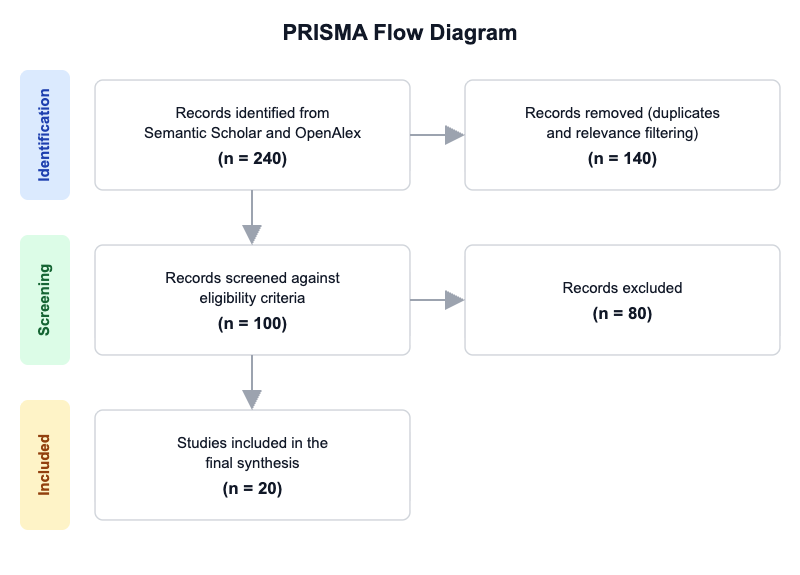
Initial database searching identified 240 records. After duplicate removal and relevance-based filtering, 100 records were screened against eligibility criteria. Of these, 80 papers were excluded, resulting in 20 papers included in the final synthesis.
PRISMA Flow Diagram
Eligibility criteria included:
- RCC Focus: Does the study focus on renal cell carcinoma, including clear cell, papillary, chromophobe, metastatic, or localized RCC?
- Human Evidence: Does the study involve human patients, human samples, or clinical data rather than only cell lines or animal models?
- Recent Evidence: Was the study published in the last 8 years or presented as recent clinical evidence on RCC?
- Therapy/Biomarker: Does the study evaluate RCC therapy, prognosis, recurrence, or a molecular/clinical biomarker?
- Clinical Outcome: Does the study report a clinical outcome such as survival, response, progression, toxicity, or predictive/prognostic association?
- Advanced Disease: Does the study specifically address advanced, metastatic, or treatment-resistant RCC?
- Combination Therapy: Does the study examine a combination regimen, sequencing strategy, or comparative treatment approach in RCC?
- Novel Mechanism: Does the study investigate a new biomarker, molecular pathway, or emerging therapeutic target in RCC?
All included studies met the stated eligibility criteria.
2.3 Data Extraction and Synthesis
Data extraction focused on the following variables:
- Study Focus
- Study Design
- Population
- Intervention/Exposure
- Key Outcomes
- Main Finding
- Clinical Relevance
Thematic analysis was employed to identify patterns and synthesize findings across studies. Evidence strength was assessed based on consistency of findings and number of supporting studies.
3. Results
3.1 Characteristics of Included Studies
| Study and Year | Study Type | Population | Main Focus | Intervention/Exposure | Core Outcomes |
|---|---|---|---|---|---|
| Barata and Rini, 2017 [1] | Clinical review | Advanced RCC | Treatment evolution and future directions | VEGF-targeted therapy, PDGF-related targets, mTOR, MET/AXL, immune checkpoint inhibition | Efficacy, biomarkers, patient selection, sequencing |
| Choueiri and Motzer, 2017 [2] | Review | Metastatic RCC | Systemic therapy | Tumor signaling pathway therapies, immunotherapy | Survival improvement |
| Ljungberg et al., 2015 [3] | Guideline | Broad RCC population | International management standards | Evidence synthesis for clinical care | Standards of care |
| Escudier et al., 2019 [4] | Guideline | Adult RCC population | Diagnosis, treatment, follow-up | Immunotherapy, targeted therapy, surgery | Overall survival, progression-free survival, toxicity |
| Powles et al., 2024 [5] | Guideline | RCC population | Diagnosis, treatment, follow-up | Contemporary management strategies | Incidence, mortality, early detection |
| Rathmell et al., 2022 [6] | Guideline | Metastatic clear cell RCC | Risk-adapted management | ICIs, VEGFR TKIs, surgery, surveillance | OS, PFS, treatment selection |
| Wheeler et al., 2013 [7] | Cohort/genomic profiling | >400 ccRCC tumors | Molecular characterization | VHL, PBRM1, BAP1, SETD2, PI(3)K/AKT | Mutated genes, metabolic shifts, prognosis |
| Bex et al., 2025 [8] | Guideline update | RCC population | Management update | Evidence-based care framework | Contemporary management recommendations |
| Motzer et al., 2017 [9] | Guideline | Clear cell and non-clear cell RCC | Multidisciplinary management | Clinical management recommendations | Practice guidance |
| Ljungberg et al., 2022 [10] | Guideline update | RCC population | International standards | Updated treatment strategies | Care standards |
| Posadas et al., 2017 [11] | Review | Metastatic RCC | Targeted therapy | Kinase inhibitors, immune checkpoint inhibitors, combinatorial/perioperative approaches | Benefit, toxicity, biomarkers, value |
| Escudier et al., 2009 [12] | Phase III randomized trial | Previously treated mRCC | Sorafenib efficacy and VEGF biomarker | Sorafenib vs placebo | OS, PFS, adverse events, VEGF prognostic value |
| Kotecha et al., 2019 [13] | Review | Advanced metastatic RCC | Individualized therapy | ICIs, targeted agents, combinations | Biomarker integration, tailored algorithms |
| Linehan, 2015 [14] | Molecular characterization | Papillary RCC | Type 1 vs type 2 biology | MET, NRF2-ARE, CDKN2A, CIMP | Molecular distinctions, prognosis |
| Motzer and Bukowski, 2006 [15] | Systematic review | Metastatic RCC | Targeted therapy | Sunitinib, temsirolimus, sorafenib, bevacizumab | Antitumor activity, PFS |
| Barragán-Carrillo et al., 2024 [16] | Clinical review | Metastatic RCC | First- and second-line treatment | Line-of-therapy selection | Efficacy, toxicity, preferences |
| Navani and Heng, 2021 [17] | Review | Metastatic clear cell RCC | Combination therapy era | Combination approaches | Survival improvement, treatment integration |
| Nocera et al., 2021 [18] | Systematic review and network meta-analysis | Metastatic RCC | First-line comparative effectiveness | Nivolumab+cabozantinib, lenvatinib+pembrolizumab, nivolumab+ipilimumab | OS, PFS, ORR, toxicity |
| Albigès et al., 2019 [19] | Guideline update | Treatment-naïve metastatic clear cell RCC | First-line immunotherapy backbone | Ipilimumab+nivolumab, pembrolizumab+axitinib | OS, PFS |
| Ljungberg et al., 2010 [20] | Guideline update | RCC population | Diagnosis, treatment, follow-up | Standardized clinical approach | Improved clinical handling |
Overall, the evidence base is dominated by reviews and guidelines, with a smaller number of primary translational and randomized clinical studies. The literature is heavily weighted toward metastatic clear cell RCC and combination systemic therapy, while papillary RCC and broader RCC management are represented through molecular characterization and guideline synthesis. Across the studies, the strongest recurring themes are treatment modernization, biomarker-driven stratification, and the institutionalization of evidence into successive guideline updates.
3.2 Thematic Findings
3.2.1 The RCC treatment landscape has moved from single-agent targeted therapy to combination immunotherapy and risk-adapted sequencing
The clearest cross-study pattern is a stepwise therapeutic evolution from early VEGF-pathway inhibition toward combination regimens anchored by immune checkpoint blockade. Early targeted therapy established antitumor activity for agents such as sunitinib, temsirolimus, sorafenib, and bevacizumab, with superior first-line activity versus cytokines and improved progression-free survival in second-line settings [15]. Subsequent reviews describe this as a major shift in management, with modern systemic therapy built around kinase inhibitors and immunotherapy [2], [11]. More recent evidence places combination regimens at the center of first-line treatment, with guideline updates explicitly identifying immune checkpoint inhibition as the new backbone in metastatic clear-cell RCC [19], [6].
The direction of effect is consistent across evidence types but the precision of comparative benefit varies. A randomized phase III trial of sorafenib showed a final overall survival of 17.8 months versus 15.2 months with placebo, with the crossover-censored analysis yielding 17.8 versus 14.3 months and a hazard ratio of 0.78 with P = .029 [12]. In the later combination era, network meta-analytic evidence suggested regimen-specific tradeoffs: nivolumab plus cabozantinib may provide the most favorable overall survival, lenvatinib plus pembrolizumab the most favorable progression-free survival and objective response rate, and nivolumab plus ipilimumab the lowest toxicity [18]. These findings indicate that “best” treatment now depends on the endpoint prioritized and the clinical context rather than on a single universal regimen.
Confidence: Strong. The pattern is supported by convergent guideline, review, and comparative evidence, although comparative rankings remain context dependent.
3.2.2 Biomarker and molecular evidence strongly supports biologically distinct RCC subtypes, but predictive clinical implementation remains incomplete
The translational literature shows that RCC is not a single biologic entity. In clear cell RCC, comprehensive genomic profiling identified 19 significantly mutated genes and implicated core alterations in oxygen sensing and chromatin regulation, including VHL, PBRM1, BAP1, and SETD2 [7]. The same study linked PI(3)K/AKT signaling to recurrent mutation and described metabolic remodeling associated with tumor stage and severity, including downregulation of TCA-cycle genes, decreased AMPK and PTEN protein levels, upregulation of pentose phosphate pathway and glutamine transporter genes, increased acetyl-CoA carboxylase protein, and altered promoter methylation of MIR21 and GRB10 [7]. Papillary RCC also shows distinct pathway logic: type 1 disease is associated with MET alterations, whereas type 2 disease is linked to NRF2-ARE activation, CDKN2A loss, and CIMP, with poor prognosis concentrated in the latter [14].
Clinical biomarker work aligns with this biologic heterogeneity but remains less mature. VEGF levels were prognostic for progression-free survival and overall survival in placebo patients in the sorafenib trial, with significant associations in univariate and multivariate analyses, and they also correlated with ECOG performance status and Memorial Sloan-Kettering Cancer Center score [12]. However, the same data also showed benefit from sorafenib in both high-VEGF and low-VEGF groups, indicating that prognostic value did not translate into clear predictive selection [12]. Reviews similarly emphasize that many biomarkers are associated with outcomes, but integration into routine clinical decision-making is still emerging [13], [1].
Confidence: Moderate. Molecular distinctness is well supported, but biomarker-driven treatment selection remains only partially validated.
3.2.3 Guideline convergence shows increasing standardization of RCC care, especially for metastatic clear-cell disease
Successive guidelines from EAU, NCCN, ESMO, and ASCO show an increasingly standardized and increasingly granular approach to RCC management [3], [4], [5], [8], [9], [10], [20], [6]. Earlier guidelines focused on standardized diagnosis, treatment, and follow-up [20], [3]. Later updates incorporated immunotherapy and combination regimens, particularly in treatment-naïve metastatic clear-cell disease, where ipilimumab plus nivolumab and pembrolizumab plus axitinib were identified as survival-improving options [19]. The ASCO guideline further operationalized risk stratification using the International Metastatic RCC Database Consortium criteria and recommended different strategies by risk group, prior nephrectomy status, and metastatic site [6].
The substantive pattern is not merely that guidelines are updated, but that they increasingly translate trial evidence into risk-adapted algorithms. This includes the use of active surveillance in selected asymptomatic, low-burden post-nephrectomy patients, selective use of cytoreductive nephrectomy, and distinct first-line options depending on favorable versus intermediate/poor-risk disease [6]. The 2024 ESMO guideline also notes that rising incidence and declining mortality are jointly shaping contemporary management priorities [5].
Confidence: Strong. The guideline trajectory is consistent across organizations and over time.
3.2.4 First-line therapy selection is increasingly a tradeoff between efficacy, toxicity, and patient-centered choice
Modern first-line RCC therapy is no longer judged by response alone. Comparative synthesis indicates that different combination regimens optimize different outcomes: nivolumab plus cabozantinib for overall survival, lenvatinib plus pembrolizumab for progression-free survival and objective response rate, and nivolumab plus ipilimumab for lower toxicity [18]. This aligns with clinical review evidence emphasizing the need to balance efficacy, toxicity, and patient preferences during transitions from first- to second-line therapy [16]. The same theme appears in first-line paradigm reviews, where combination approaches are treated as standard but must be integrated thoughtfully into treatment sequencing and study design [17].
This is an important divergence from earlier treatment eras, when the main question was whether targeted therapy worked at all [15], [12]. Now the issue is how to choose among active regimens with different benefit-to-toxicity profiles. The literature does not provide a single consensus hierarchy because the evidence is endpoint dependent and population differences may affect generalizability [18]. The shift therefore reflects maturity of the field rather than unresolved effectiveness.
Confidence: Moderate to strong. Comparative effectiveness is increasingly supported, but ranking depends on outcome priorities and patient context.
3.3 Summary of Evidence
| Theme | Key Finding | Population Applicability | Effect Direction | Confidence Level | Supporting Studies |
|---|---|---|---|---|---|
| Transition from targeted therapy to combination immunotherapy | Sorafenib improved survival in crossover-censored analysis to 17.8 vs 14.3 months, while later combination regimens showed regimen-specific advantages for OS, PFS, ORR, and toxicity [12], [18] | Primarily metastatic RCC, especially metastatic clear cell disease | Positive | Strong | Escudier et al. [12], Nocera et al. [18], Albigès et al. [19] |
| Molecular heterogeneity and biologic subtyping | ccRCC showed 19 significantly mutated genes and PI(3)K/AKT involvement; papillary RCC type 1 and type 2 differed by MET vs NRF2-ARE biology and type 2 poor prognosis linked to CDKN2A loss and CIMP [7], [14] | ccRCC and papillary RCC tissue cohorts; partially matches the question population because the question spans RCC broadly | Mixed: biologically informative, clinically translational | Moderate | Wheeler et al. [7], Linehan [14] |
| Guideline standardization and risk-adapted care | ASCO recommended ICI+VEGFR TKI for favorable-risk disease and doublets for intermediate/poor risk; EAU/ESMO/NCCN updates converge on evidence-based individualized management [6], [4] | Metastatic clear-cell RCC and broader RCC populations | Positive | Strong | Rathmell et al. [6], Escudier et al. [4], Motzer et al. [9] |
| Biomarker promise but incomplete predictive use | VEGF was prognostic for PFS and OS, yet sorafenib benefited both high- and low-VEGF groups [12] | Previously treated metastatic RCC; partially matches the question population of RCC broadly | Mixed | Moderate | Escudier et al. [12], Kotecha et al. [13] |
| Efficacy-toxicity tradeoffs in first-line selection | Nivolumab+cabozantinib had most favorable OS, lenvatinib+pembrolizumab had best PFS and ORR, and nivolumab+ipilimumab had lowest toxicity [18] | Metastatic RCC | Mixed | Moderate | Nocera et al. [18], Barragán-Carrillo et al. [16] |
4. Discussion
4.1 Principal Findings and Their Interpretation
This synthesis shows that RCC research has matured along two interlocking axes: therapeutic intensification and biologic stratification. The most robust finding is that treatment outcomes in metastatic disease have improved as therapy moved from cytokines to VEGF-targeted agents and then to immune-based combination regimens [15], [2], [17]. This progression is biologically plausible because the disease is repeatedly shown to depend on oxygen-sensing disruption, angiogenic signaling, and immune-responsive tumor ecology, especially in clear cell disease [7]. The genomic evidence makes the treatment shift more than a clinical trend; it links therapeutic responsiveness to recurrent pathway-level vulnerabilities, including PI(3)K/AKT signaling and chromatin remodeling defects.
A second major insight is that RCC has become less treatable as a single entity and more manageable as a set of molecularly and clinically distinct diseases. The distinction between clear cell and papillary RCC, and within papillary RCC between type 1 and type 2 biology, indicates that future gains will depend on matching treatment to tumor context rather than assuming uniform responsiveness [7], [14]. This is where the evidence is strongest mechanistically: the reviewed studies identify concrete pathways and prognostic features, even if they do not yet provide fully validated predictive rules.
Confidence is highest for the broad direction of benefit from modern systemic therapy and guideline-based risk adaptation, because these themes recur across reviews, guidelines, and comparative analyses [6], [5], [18]. Confidence is lower for biomarker-guided selection, not because biomarkers are absent, but because the literature still separates prognostic association from true clinical utility [12], [13]. The synthesis therefore suggests a field in transition: efficacy is established, precision is aspirational.
4.2 Comparison with Existing Literature and Resolution of Contradictions
The strongest agreement across the evidence is that modern RCC care is increasingly individualized, and this is reinforced by the convergence of EAU, ESMO, NCCN, and ASCO guidance [10], [5], [9], [6]. That consistency matters because guideline concordance usually reflects a sufficiently mature evidence base for clinical standardization. The move to combination immunotherapy as the first-line backbone is therefore not just a response to isolated positive trials, but a sign that multiple evidence streams now point to the same treatment architecture [19], [17].
The main contradiction in the literature concerns biomarkers. VEGF clearly carried prognostic information in the sorafenib trial, correlating with performance status, risk score, and both progression-free and overall survival in placebo patients [12]. Yet it did not identify a group that uniquely benefited from sorafenib, since both high- and low-VEGF patients benefited [12]. This discrepancy most likely reflects the difference between prognostic and predictive performance rather than a failure of the biomarker itself. It may also reflect treatment-era limitations: a single biomarker measured at baseline may not capture dynamic pathway dependence in a tumor with heterogeneous clonal architecture and strong adaptive potential. In addition, crossover in the trial complicates interpretation of survival endpoints, making it difficult to isolate pure treatment effect from post-progression therapy.
A second source of heterogeneity is endpoint prioritization. Network meta-analytic rankings favor different regimens for survival, response, and toxicity [18]. This is not a true contradiction but a reminder that RCC management is multi-objective, and the “best” regimen depends on the clinical question. The literature therefore does not support a single universal hierarchy. Instead, it supports a contextual framework in which efficacy, tolerability, and patient preferences must be balanced, especially in first-line and line-to-line transitions [16], [17]. Publication bias remains possible because much of the recent literature comes from settings where positive trial results are expected, but the presence of comparative tradeoffs and guideline nuance suggests that the evidence base is not simply uniformly positive.
4.3 Practical Implications
For clinicians, the immediate implication is that metastatic RCC should be managed with risk-adapted, subtype-aware, and preference-sensitive decision-making rather than a one-size-fits-all sequence [6], [16]. Treatment-naïve metastatic clear-cell RCC now has multiple active first-line options, including ipilimumab plus nivolumab and pembrolizumab plus axitinib, with regimen choice depending on risk group and tolerance considerations [19], [6]. In practice, this means toxicity profiles and expected endpoints matter as much as raw efficacy; a patient prioritizing lower toxicity may reasonably be managed differently from one for whom maximal response probability is the priority [18].
For public health and policy, the reduction in mortality despite rising incidence underscores the importance of early detection through incidental imaging and continued access to effective systemic therapy [5]. The evidence does not support a threshold-based complacency model in RCC care; instead, it favors population-wide improvements in diagnosis, referral, and treatment access because outcomes now depend heavily on timely access to specialized regimens and multidisciplinary guidance. For regulatory and institutional policy, the repeated guideline updates indicate that care pathways should be refreshed frequently to keep pace with rapidly changing evidence [10], [8].
The caveat is that much of this practice guidance is derived from metastatic clear-cell disease, while papillary RCC and non-clear-cell histologies remain less well supported by direct comparative evidence [14], [9]. Thus, the practical implications are strongest for the dominant metastatic clear-cell population and should be translated more cautiously for other histologic subtypes.
4.4 Strengths and Limitations
A major strength of this review is the integration of guideline updates, randomized evidence, network meta-analytic synthesis, and molecular characterization, allowing treatment, biology, and clinical practice to be interpreted together. The included literature spans pivotal transitions in RCC care, from early targeted therapy to the current combination-immunotherapy era, which provides historical depth as well as contemporary relevance.
Limitations of the included studies are substantial. Many are review or guideline papers rather than primary comparative trials, so several themes rely on expert synthesis rather than direct head-to-head evidence. Populations are unevenly represented, with a strong emphasis on metastatic clear-cell RCC and relatively limited direct evidence for papillary or non-clear-cell disease. Biomarker studies often demonstrate association rather than clinical utility, and some comparative findings are endpoint dependent or influenced by crossover.
Limitations of this review include abstract-level extraction for some studies, the absence of formal risk-of-bias assessment, and the possibility that full-text details could modify interpretation. In addition, because several included papers are guidelines or narrative reviews, the synthesis necessarily reflects both evidence and expert consensus.
5. Gaps and Future Directions
The clearest gap is the lack of validated predictive biomarkers that can reliably select therapy rather than merely describe prognosis [13], [12]. Future work should test whether genomic, transcriptomic, or metabolic markers can prospectively guide therapy choice across first-line combination regimens. Another gap is the limited evidence base for non-clear-cell and papillary RCC, despite clear biologic distinctiveness [14], [9]. Studies directly comparing regimens in these histologies are needed rather than extrapolation from clear-cell disease.
Future trials should also better separate efficacy from toxicity and patient-reported preference, since current evidence shows that different regimens optimize different outcomes [18], [16]. Methodologically, head-to-head comparisons, standardized risk stratification, and biomarker stratification would be especially valuable. Finally, the field would benefit from longitudinal studies that link baseline molecular alterations, evolving treatment exposure, and outcome trajectories, because current evidence rarely connects these levels in one design [13]. The most informative future studies would therefore be subtype-specific, biomarker-integrated, and designed to answer sequencing questions in real clinical populations.
6. Conclusion
The latest RCC literature supports a clear conclusion: renal cell carcinoma management has advanced from nonspecific and single-agent strategies to risk-adapted, biomarker-informed, combination-based care, with the strongest evidence concentrated in metastatic clear-cell disease [6], [5], [8]. The field now has convincing evidence that modern systemic therapy improves outcomes, exemplified by sorafenib’s survival signal in previously treated disease, where crossover-censored overall survival reached 17.8 months versus 14.3 months and VEGF retained prognostic significance [12]. It also has a more nuanced understanding of biology, including recurrent ccRCC alterations in VHL, PBRM1, BAP1, SETD2, and PI(3)K/AKT signaling, as well as papillary subtype-specific pathways such as MET and NRF2-ARE [7], [14].
At the same time, the most important unresolved issue is not whether active regimens exist, but how to select, sequence, and personalize them with validated biomarkers across histologies and risk groups. That uncertainty is especially important because current evidence is strongest for metastatic clear-cell RCC, while non-clear-cell disease remains comparatively underdefined [14], [9]. The practical significance is substantial: better stratification could reduce overtreatment, improve toxicity management, and ensure that patients receive the regimen most likely to fit their disease biology and clinical priorities.
References
- Barata, P. C., & Rini, B. I. (2017). Treatment of renal cell carcinoma: Current status and future directions. CA: A Cancer Journal for Clinicians, 67(6), 507–524. https://doi.org/10.3322/caac.21411
- Choueiri, T. K., & Motzer, R. J. (2017). Systemic therapy for metastatic renal-cell carcinoma. New England Journal of Medicine, 376(4), 354–366. https://doi.org/10.1056/NEJMra1601333
- Ljungberg, B., Bensalah, K., Canfield, S., Dabestani, S., Hofmann, F., Hora, M., Kuczyk, M. A., Lam, T., Marconi, L., Merseburger, A. S., Mulders, P., Powles, T., Staehler, M., Volpe, A., & Bex, A. (2015). EAU guidelines on renal cell carcinoma: 2014 update. European Urology, 67(5), 913–924. https://doi.org/10.1016/j.eururo.2015.01.005
- Escudier, B., Porta, C., Schmidinger, M., Rioux-Leclercq, N., Bex, A., Khoo, V., Grünwald, V., Gillessen, S., & Horwich, A. (2019). Renal cell carcinoma: ESMO Clinical Practice Guidelines for diagnosis, treatment and follow-up. Annals of Oncology, 30(5), 706–720. https://doi.org/10.1093/annonc/mdz056
- Powles, T., Albiges, L., Bex, A., Comperat, E., Grünwald, V., Kanesvaran, R., Kitamura, H., McKay, R., Porta, C., Procopio, G., Schmidinger, M., Suarez, C., Teoh, J., de Velasco, G., Young, M., & Gillessen, S. (2024). Renal cell carcinoma: ESMO Clinical Practice Guideline for diagnosis, treatment and follow-up. Annals of Oncology, 35(8), 692–706. https://doi.org/10.1016/j.annonc.2024.05.537
- Rathmell, W. K., Rumble, R. B., Van Veldhuizen, P. J., Al-Ahmadie, H., Emamekhoo, H., Hauke, R. J., Louie, A. V., Milowsky, M. I., Molina, A. M., Rose, T. L., Siva, S., Zaorsky, N. G., Zhang, T., Qamar, R., Kungel, T. M., Lewis, B., & Singer, E. A. (2022). Management of metastatic clear cell renal cell carcinoma: ASCO guideline. Journal of Clinical Oncology, 40(25), 2957–2995. https://doi.org/10.1200/JCO.22.00868
- The Cancer Genome Atlas Research Network. (2013). Comprehensive molecular characterization of clear cell renal cell carcinoma. Nature, 499(7456), 43–49. https://doi.org/10.1038/nature12222
- Bex, A., Abu Ghanem, Y., Albiges, L., Bonn, S., Campi, R., Capitanio, U., Dabestani, S., Hora, M., Klatte, T., Kuusk, T., Lund, L., Marconi, L., Palumbo, C., Pignot, G., Powles, T., Schouten, N., Tran, M., Volpe, A., & Bedke, J. (2025). European Association of Urology guidelines on renal cell carcinoma: The 2025 update. European Urology, 87(6), 683–696. https://doi.org/10.1016/j.eururo.2025.02.020
- Motzer, R. J., Jonasch, E., Agarwal, N., Bhayani, S., Bro, W. P., Chang, S. S., Choueiri, T. K., Costello, B. A., Derweesh, I. H., Fishman, M., Gallagher, T. H., Gore, J. L., Hancock, S. L., Harrison, M. R., Kim, W., Kyriakopoulos, C., LaGrange, C., Lam, E. T., Lau, C., ... Kumar, R. (2017). Kidney cancer, version 2.2017, NCCN Clinical Practice Guidelines in Oncology. Journal of the National Comprehensive Cancer Network, 15(6), 804–834. https://doi.org/10.6004/jnccn.2017.0100
- Ljungberg, B., Albiges, L., Abu-Ghanem, Y., Bedke, J., Capitanio, U., Dabestani, S., Fernández-Pello, S., Giles, R. H., Hofmann, F., Hora, M., Klatte, T., Kuusk, T., Lam, T. B., Marconi, L., Powles, T., Tahbaz, R., Volpe, A., & Bex, A. (2022). European Association of Urology guidelines on renal cell carcinoma: The 2022 update. European Urology, 82(4), 399–410. https://doi.org/10.1016/j.eururo.2022.03.006
- Posadas, E. M., Limvorasak, S., & Figlin, R. A. (2017). Targeted therapies for renal cell carcinoma. Nature Reviews Nephrology, 13(8), 496–511. https://doi.org/10.1038/nrneph.2017.82
- Escudier, B., Eisen, T., Stadler, W. M., Szczylik, C., Oudard, S., Staehler, M., Negrier, S., Chevreau, C., Desai, A. A., Rolland, F., Demkow, T., Hutson, T. E., Gore, M., Anderson, S., Hofilena, G., Shan, M., Pena, C., Lathia, C., & Bukowski, R. M. (2009). Sorafenib for treatment of renal cell carcinoma: Final efficacy and safety results of the phase III treatment approaches in renal cancer global evaluation trial. Journal of Clinical Oncology, 27(20), 3312–3318. https://doi.org/10.1200/JCO.2008.19.5511
- Kotecha, R. R., Motzer, R. J., & Voss, M. H. (2019). Towards individualized therapy for metastatic renal cell carcinoma. Nature Reviews Clinical Oncology, 16(10), 621–633. https://doi.org/10.1038/s41571-019-0209-1
- The Cancer Genome Atlas Research Network. (2015). Comprehensive molecular characterization of papillary renal-cell carcinoma. New England Journal of Medicine, 374(2), 135–145. https://doi.org/10.1056/NEJMoa1505917
- Motzer, R. J., & Bukowski, R. M. (2006). Targeted therapy for metastatic renal cell carcinoma. Journal of Clinical Oncology, 24(35), 5601–5608. https://doi.org/10.1200/JCO.2006.08.5415
- Barragan-Carrillo, R., Saad, E., Saliby, R.-M., Sun, M., Albiges, L., Bex, A., Heng, D., Mejean, A., Motzer, R. J., Plimack, E. R., Powles, T., Rini, B. I., Zhang, T., & Choueiri, T. K. (2024). First and second-line treatments in metastatic renal cell carcinoma. European Urology, 87(2), 143–154. https://doi.org/10.1016/j.eururo.2024.10.019
- Navani, V., & Heng, D. Y. C. (2021). Treatment selection in first-line metastatic renal cell carcinoma—The contemporary treatment paradigm in the age of combination therapy: A review. JAMA Oncology, 8(2), 292–299. https://doi.org/10.1001/jamaoncol.2021.4337
- Nocera, L., Karakiewicz, P. I., Wenzel, M., Tian, Z., Shariat, S. F., Saad, F., Chun, F. K. H., Briganti, A., Kapoor, A., & Lalani, A.-K. (2021). Clinical outcomes and adverse events after first-line treatment in metastatic renal cell carcinoma: A systematic review and network meta-analysis. Journal of Urology, 207(1), 16–24. https://doi.org/10.1097/JU.0000000000002252
- Albiges, L., Powles, T., Staehler, M., Bensalah, K., Giles, R. H., Hora, M., Kuczyk, M. A., Lam, T. B., Ljungberg, B., Marconi, L., Merseburger, A. S., Volpe, A., Abu-Ghanem, Y., Dabestani, S., Fernández-Pello, S., Hofmann, F., Kuusk, T., Tahbaz, R., & Bex, A. (2019). Updated European Association of Urology guidelines on renal cell carcinoma: Immune checkpoint inhibition is the new backbone in first-line treatment of metastatic clear-cell renal cell carcinoma. European Urology, 76(2), 151–156. https://doi.org/10.1016/j.eururo.2019.05.022
- Ljungberg, B., Cowan, N. C., Hanbury, D. C., Hora, M., Kuczyk, M. A., Merseburger, A. S., Patard, J.-J., Mulders, P. F. A., & Sinescu, I. C. (2010). EAU guidelines on renal cell carcinoma: The 2010 update. European Urology, 58(3), 398–406. https://doi.org/10.1016/j.eururo.2010.06.032