

Latest Research on Sjögren’s Syndrome: Integrated Evidence on Pathogenesis, Heterogeneity, Biomarkers, Systemic Disease, and Emerging Precision Treatment
Abstract
Recent research on Sjögren’s syndrome shows a convergent shift from symptomatic care toward mechanism-based stratification and targeted treatment, but no approved disease-modifying therapy has yet emerged [1], [3]. Across the available evidence, the most consistent signals are that disease heterogeneity is substantial, systemic involvement is common, and immune dysregulation centers on type I interferon signaling, B-cell activation, Th17-related cytokines, and epithelial–immune crosstalk [1], [9]. Diagnostic and prognostic refinement has advanced through autoantibodies, salivary gland histopathology, imaging, and multi-omic molecular subtyping, while clinically important complications include lymphoma, peripheral neuropathy, interstitial lung disease, and broader malignancy risk [19], [12], [8], [17], [14], [7]. A particularly important development is the emergence of stratification approaches that separate patients into molecular or clinical subgroups, because symptom burden and organ-specific phenotypes do not align uniformly with global systemic activity scores [8], [18]. This synthesis indicates that the latest literature is strongest in defining pathogenic pathways and patient heterogeneity, but weakest in delivering definitive therapeutic efficacy, as most interventional evidence remains indirect, exploratory, or review-based. The overall implication is that Sjögren’s syndrome research is moving toward personalized medicine, yet future progress depends on harmonized biomarkers, validated outcome measures, and prospective trials that link molecular subtype to treatment response [8], [11].
1. Introduction
Sjögren’s syndrome is a chronic autoimmune disease that primarily affects the exocrine glands, producing xerostomia and xerophthalmia, but it is increasingly recognized as a systemic disorder with pain, fatigue, organ involvement, and malignancy risk [1], [15]. The modern literature distinguishes primary Sjögren’s syndrome from secondary forms associated with other connective tissue diseases, while also acknowledging that the same disease label encompasses highly variable phenotypes, from gland-limited sicca symptoms to pulmonary, neurologic, vascular, and hematologic complications [10], [15], [16]. This heterogeneity has complicated diagnosis, prognostication, and treatment development, especially because standard care remains largely symptomatic and disease-modifying options remain limited [1], [3]
Recent research has therefore focused on several complementary problems: identifying the immunologic and epithelial mechanisms that initiate and sustain disease, defining biomarkers that improve classification and prognosis, mapping the burden of systemic complications, and testing whether molecular subtyping can guide precision therapy [1], [8], [15]. Mechanistic studies highlight the importance of innate immune dysregulation, type I interferon signaling, B-cell hyperactivity, and epithelial–immune cell feedback loops, while genetic, epigenetic, and environmental work suggests that disease risk arises from interactions rather than single causes [1], [4], [5], [6]. At the clinical level, newer studies also show that symptom burden, specific organ manifestations, and subgroup membership may predict patient experience better than aggregate systemic activity scores [8], [18]. Against this backdrop, the key question is not simply what Sjögren’s syndrome is, but how the latest literature redefines its mechanisms, phenotypes, and treatment prospects [1], [3].
2. Methods
2.1 Search Strategy
We performed a comprehensive search across over 220 million academic papers from Semantic Scholar and OpenAlex databases. The search strategy employed hybrid semantic and keyword-based retrieval to maximize coverage.
Search queries included:
- "Sjögren syndrome latest clinical trials and therapeutic advances"
- "Primary Sjögren syndrome pathogenesis biomarkers and disease mechanisms"
- "Sjögren syndrome diagnosis imaging autoantibodies and classification criteria"
- "Sjögren syndrome systemic manifestations fatigue pain and quality of life"
- "Recent reviews and meta-analyses on Sjögren syndrome management"
2.2 Study Selection
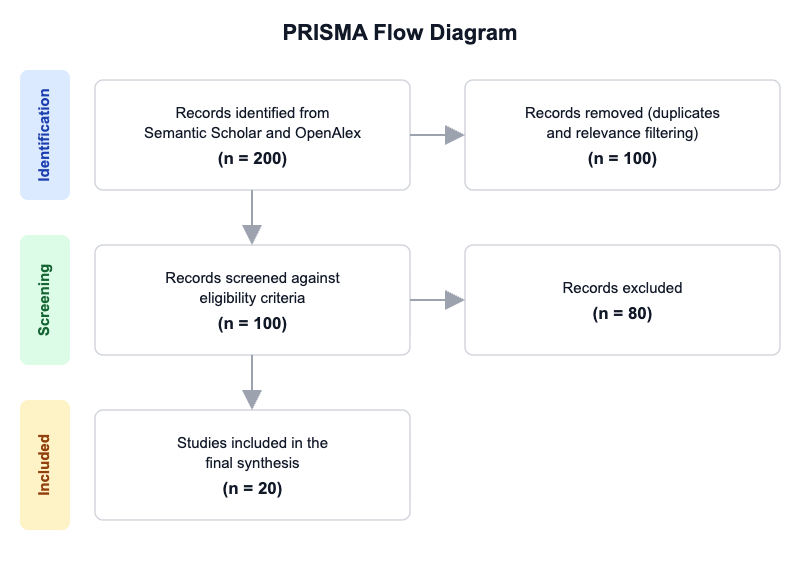
Initial database searching identified 200 records. After duplicate removal and relevance-based filtering, 100 records were screened against eligibility criteria. Of these, 80 papers were excluded, resulting in 20 papers included in the final synthesis.
PRISMA Flow Diagram
Eligibility criteria included:
- Sjögren Topic: Does the study focus on Sjögren's syndrome or primary/secondary Sjögren disease as the main topic?
- Human Study: Does the study involve human participants, patient samples, or human clinical data rather than only animal or in-vitro models?
- Recent Publication: Was the paper published between 2020 and 2026 inclusive?
- Research Type: Is the paper a clinical study, biomarker study, diagnostic study, therapeutic study, systematic review, or meta-analysis?
- Direct Relevance: Does the paper provide direct evidence on Sjögren's syndrome pathogenesis, diagnosis, biomarkers, systemic manifestations, or treatment?
- Therapeutic Insight: Does the paper report treatment effects, management strategies, or therapeutic targets for Sjögren's syndrome?
- Biomarker Insight: Does the paper report autoantibodies, salivary/lacrimal biomarkers, imaging markers, histology, or classification criteria?
- Review Evidence: Is the paper a systematic review, scoping review, narrative review, or meta-analysis synthesizing recent Sjögren's syndrome research?
All included studies met the stated eligibility criteria.
2.3 Data Extraction and Synthesis
Data extraction focused on the following variables:
- Research Focus: State the main focus of the paper (e.g., pathogenesis, diagnosis, biomarkers, systemic manifestations, treatment, review/meta-analysis).
- Study Type: Identify the study design or article type (e.g., clinical trial, cohort study, cross-sectional study, review, meta-analysis, guideline).
- Population: Extract the patient population or model studied, including whether it is primary Sjögren syndrome, secondary Sjögren syndrome, adults, children, or experimental models.
- Key Findings: Summarize the main findings or conclusions specifically about Sjögren syndrome research.
- Biomarkers/Measures: List the key biomarkers, imaging methods, classification criteria, clinical measures, or outcome measures reported.
- Therapy/Intervention: If applicable, extract the treatment, intervention, or management approach studied.
- Sample Size: Extract the number of participants or samples, if reported.
- Year: Extract the publication year.
Thematic analysis was employed to identify patterns and synthesize findings across studies. Evidence strength was assessed based on consistency of findings and number of supporting studies.
3. Results
3.1 Characteristics of Included Studies
| Study and Year | Study Type | Population | Sample Size | Key Focus | Main Measures |
|---|---|---|---|---|---|
| Baldini et al. 2024 [1] | Review | Primary Sjögren syndrome | Not reported | Pathophysiology and emerging treatments | Immune pathways, targeted therapies |
| Beydon et al. 2023 [2] | Review | Primary and secondary Sjögren syndrome, adult populations | Not reported | Epidemiology and lymphoma risk | Prevalence, incidence, geographic patterns |
| Séror et al. 2021 [3] | Review | Primary Sjögren syndrome | Not reported | Current and future therapies | Classification criteria, disease activity, patient-reported outcomes |
| Verstappen et al. 2021 [4] | Review | Primary Sjögren syndrome | Not reported | Salivary gland epithelial–immune interactions | NF-κB, inflammasome, interferon signaling |
| Thorlacius et al. 2023 [5] | Review | Primary Sjögren syndrome | Not reported | Genetics and epigenetics | Genetic variants, sex and environmental context |
| Björk et al. 2020 [6] | Review | Primary Sjögren syndrome | Not reported | Environmental risk factors | Type I interferon, autoantibodies, exogenous exposures |
| Zhong et al. 2022 [7] | Systematic review and meta-analysis | Primary Sjögren syndrome | Not reported | Malignancy risk | Overall cancer, NHL, hematologic and solid tumors |
| Soret et al. 2021 [8] | Cross-sectional cohort | Primary Sjögren syndrome | Over 300 patients and a similar number of healthy volunteers | Molecular subtyping and precision treatment | Multi-omic profiling, machine learning classifiers |
| Zhan et al. 2023 [9] | Review | Sjögren syndrome | Not reported | Pathogenesis and treatment | IFNs, IL-17, IL-23, TNF, BAFF, JAK |
| Negrini et al. 2021 [10] | Review | Primary and secondary Sjögren syndrome | Not reported | Clinical spectrum, diagnosis, treatment | Histopathology, autoantibodies, activity scores |
| Marino et al. 2025 [11] | Systematic literature review | Sjögren’s disease | Not reported | Targeted treatment evidence | ESSDAI domains, treatment effects |
| van Ginkel et al. 2020 [12] | Descriptive review | Primary Sjögren’s syndrome | Not reported | Imaging in diagnosis and follow-up | Salivary gland imaging, lymphoma staging |
| Goules et al. 2020 [13] | Cohort study | Primary Sjögren’s syndrome, early vs late onset | Not reported | Clinical phenotypes and lymphoma development | Onset timing, lymphoma distribution |
| Liampas et al. 2022 [14] | Systematic review and meta-analysis | Primary Sjögren syndrome | 49 papers | Peripheral neuropathy | Prevalence, neuropathy subtypes, treatment |
| Maleki-Fischbach et al. 2024 [15] | Review | Sjögren’s disease | Not reported | Systemic manifestations and management | Organ involvement, multidisciplinary care |
| Bálint et al. 2023 [16] | Review | Primary and secondary Sjögren syndrome | Not reported | Clinical associations and symptom profile | Dry eye, dry mouth, associated diseases |
| Lin et al. 2022 [17] | Retrospective cohort | Primary Sjögren’s syndrome | 333 patients | Interstitial lung disease | HRCT, PFTs, ESR, CRP |
| Tarn et al. 2022 [18] | Longitudinal observational cohort | Primary Sjögren’s syndrome | 377 patients | Health-related quality of life | EQ-5D-3L, NSST, ESSPRI, ESSDAI |
| Veenbergen et al. 2021 [19] | Review | Sjögren’s syndrome | Not reported | Autoantibodies and classification | Anti-Ro/SSA, Anti-La/SSB, novel autoantibodies |
| Lodbă et al. 2025 [20] | Retrospective cohort | Primary Sjögren’s syndrome | 32 patients | Serological and molecular biomarker profiling | Autoantibodies, complement, biopsy, salivary flow |
The evidence base is dominated by reviews, with a smaller number of observational studies that refine phenotype, biomarker interpretation, and organ-specific risk. Most studies focus on primary Sjögren’s syndrome, although several also include secondary disease or broader Sjögren’s disease terminology. The strongest direct clinical data relate to subgrouping, organ involvement, and biomarker associations rather than interventional efficacy.
3.2 Thematic Findings
3.2.1 Sjögren’s syndrome is increasingly understood as a biologically heterogeneous immune-epithelial disorder
Across the mechanistic literature, the most consistent advance is the consolidation of a shared pathogenic framework built around type I interferon signaling, B-cell hyperactivity, and epithelial–immune cell feedback loops [1], [4], [9]. The salivary gland epithelium is no longer treated as a passive target; instead, it is depicted as an active participant that sustains inflammatory signaling through pathways including NF-κB, inflammasome activation, and interferon signaling [4]. In parallel, genetic and epigenetic studies suggest that susceptibility is mediated by variants in innate and adaptive immune pathways, with context-dependent effects shaped by sex and environmental exposures [5]. This aligns with evidence that exogenous factors such as infections, hormones, smoking, and solvents likely modulate disease emergence rather than acting as single causes [6]. Confidence: Strong.
3.2.2 Molecular and clinical stratification is emerging as the main route to precision medicine
Recent studies converge on the idea that aggregate disease labels obscure clinically meaningful subgroups. Whole-blood multi-omic profiling identified four immune-dysregulation clusters in over 300 patients with primary Sjögren’s syndrome, and those biomarkers were explicitly framed as tools for machine-learning-based reclassification and treatment re-evaluation [8]. This stratification logic is reinforced clinically by the observation that early- and late-onset primary Sjögren’s syndrome show distinct phenotypes and different patterns of lymphoma predisposition [13]. In a smaller serological cohort, methotrexate use correlated strongly with Anti-Ro/SSA and Anti-La/SSB positivity, suggesting that seropositive sub-phenotypes may already be guiding treatment in practice even before formal precision frameworks are validated [20]. The most important interpretive point is that subtype definition is becoming both biological and therapeutic, not merely descriptive. Confidence: Moderate to strong.
3.2.3 Autoantibodies, histology, and imaging remain the core diagnostic and prognostic tools, but their roles are expanding
The diagnostic literature continues to support anti-Ro/SSA and anti-La/SSB as central biomarkers for classification and diagnosis, while also emphasizing novel autoantibodies that may better predict stages, phenotypes, and long-term complications [19]. Histopathology remains important, with salivary gland biopsy and focus score still used to anchor clinical characterization in biomarker studies [10], [20]. Imaging adds a complementary layer by helping with diagnosis, disease activity assessment, progression monitoring, and lymphoma staging, especially in salivary gland disease [12]. The methodological shift here is not replacement but integration: serology, tissue pathology, and imaging are increasingly treated as mutually informative rather than competing diagnostic modalities. Confidence: Strong.
3.2.4 Systemic involvement is common and prognostically important, especially for lung, neurologic, and malignant outcomes
Systemic manifestations recur across the clinical literature as a major reason Sjögren’s syndrome is difficult to manage. In pulmonary disease, interstitial lung disease was detected in 19.82% of 333 patients with newly diagnosed primary Sjögren’s syndrome, with common HRCT findings of ground glass opacities in 87.88% and septal/subpleural lines in 81.82% of affected cases [17]. Age, Raynaud’s phenomenon, lymphopenia, cough, dyspnoea, and rampant dental caries were associated with lung involvement, and ESR/CRP tracked with HRCT burden [17]. In neurologic disease, peripheral neuropathy had a pooled prevalence of 15.0% (95% CI 10.7%–20.7%), and symptoms often preceded the diagnosis by a 2:1 ratio [14]. Malignancy risk is likewise elevated: primary Sjögren’s syndrome was associated with increased overall cancer risk, including non-Hodgkin lymphoma, other hematologic malignancies, and solid tumors [7]. The most consistent message is that systemic disease is not exceptional but integral to the disorder’s burden and prognosis. Confidence: Strong.
3.2.5 Symptom burden and patient experience do not map neatly onto systemic activity scores
Longitudinal quality-of-life data show that symptom burden matters more than global systemic disease activity for patient-centered outcomes. In a cohort of 377 patients, 16% experienced HRQoL decline to a state comparable to or worse than death, and the Newcastle Sjögren’s Stratification Tool subgroup and ESSPRI, but not ESSDAI, were significantly associated with time to the EQ-5D event [18]. This is consistent with broader clinical reviews describing dryness, pain, fatigue, anxiety, and depression as major drivers of disease burden even when organ-threatening disease is not prominent [15], [16]. The implication is that standard systemic activity measures capture only part of the lived disease burden and may underestimate clinically meaningful deterioration. Confidence: Moderate.
3.2.6 Therapeutic progress is real but still largely indirect, exploratory, or extrapolated from related autoimmune diseases
The treatment literature remains the least mature domain. Reviews consistently note that there is still no approved disease-modifying therapy and that current management is largely symptomatic or borrowed from other autoimmune conditions [3], [11]. Mechanism-informed strategies are increasingly diverse, including BAFF targeting, JAK inhibition, Treg/Th17 modulation, mesenchymal stem cell approaches, nuclease therapy, IgG recycling inhibition, and CAR-T cell therapy [1], [9]. Yet the evidence base is still insufficient to support broad efficacy claims, and treatment decisions remain guided by expert opinion rather than robust comparative trials [3], [11]. A limited signal of biomarker-linked treatment selection appears in seropositive patients receiving methotrexate [20], but this is hypothesis-generating rather than definitive. Confidence: Limited to moderate.
3.3 Summary of Evidence
| Theme | Key Finding | Population Applicability | Effect Direction | Confidence Level | Supporting Studies |
|---|---|---|---|---|---|
| Immune-epithelial pathogenesis | Type I interferon, NF-κB, inflammasome, B-cell and epithelial signaling pathways are repeatedly implicated | Primarily primary Sjögren’s syndrome; some reviews include broader Sjögren disease | Positive for mechanistic convergence | Strong | Baldini et al. [1], Verstappen et al. [4], Zhan et al. [9] |
| Molecular stratification | Four molecular subgroups identified in over 300 patients using transcriptomic, genomic, epigenetic, cytokine, and flow cytometry data | Primary Sjögren’s syndrome | Mixed/heterogeneous | Moderate to strong | Soret et al. [8], Lodba et al. [20], Goules et al. [13] |
| Biomarker-based diagnosis | Anti-Ro/SSA and Anti-La/SSB remain core biomarkers; novel autoantibodies may improve prediction | Sjögren’s syndrome, mainly primary disease | Positive for diagnostic utility | Strong | Veenbergen et al. [19], Negrini et al. [10], Lodba et al. [20] |
| Imaging and histology | Imaging assists diagnosis, activity assessment, and lymphoma staging; biopsy focus score remains important | Primary Sjögren’s syndrome | Positive | Strong | van Ginkel et al. [12], Lodba et al. [20] |
| Systemic organ involvement | pSS-ILD prevalence was 19.82%; pSS-related peripheral neuropathy pooled prevalence was 15.0% (95% CI 10.7%–20.7%) | Primary Sjögren’s syndrome | Positive for systemic burden | Strong | Lin et al. [17], Liampas et al. [14], Maleki-Fischbach et al. [15] |
| Malignancy risk | Increased overall cancer risk including NHL, other hematologic malignancies, and solid tumors | Primary Sjögren’s syndrome | Positive for risk | Strong | Zhong et al. [7], Goules et al. [13], Beydon et al. [2] |
| Patient-centered burden | 16% experienced HRQoL decline to health state comparable to or worse than death; ESSPRI and NSST, not ESSDAI, tracked HRQoL change | Primary Sjögren’s syndrome | Negative for HRQoL | Moderate | Tarn et al. [18], Seror et al. [3] |
| Therapeutic maturity | No approved disease-modifying therapy; emerging strategies include BAFF, JAK, CAR-T, IgG recycling inhibition, and other targeted approaches | Primary Sjögren’s syndrome | Mixed/early | Limited | Marino et al. [11], Baldini et al. [1], Zhan et al. [9] |
4. Discussion
4.1 Principal Findings and Their Interpretation
The latest literature portrays Sjögren’s syndrome as a disease whose core biology is increasingly legible but whose treatment remains incompletely tractable. The most robust advance is the convergence on a multi-layered pathogenic model: innate immune activation, type I interferon signaling, B-cell hyperactivity, and epithelial–immune reciprocity appear to reinforce one another rather than operate as isolated pathways [1], [4], [9]. This matters because it explains why single-agent symptomatic or immunosuppressive strategies have often underperformed. If the salivary epithelium itself sustains immune activation, then gland dysfunction is not merely downstream injury but part of the disease engine [1], [4].
A second major advance is the shift from disease-label thinking to subtype thinking. Multi-omic clustering and serology-linked treatment patterns suggest that the field is beginning to identify biologically distinct patient groups with different therapeutic implications [8], [20]. This is not simply a methodological refinement; it is a conceptual correction that may resolve why clinical trials have frequently produced heterogeneous or modest results. Patients with active systemic inflammation, prominent sicca symptom burden, and lymphoma-prone phenotypes may not respond uniformly to the same intervention. The observed discordance between ESSDAI and HRQoL also reinforces that systemic activity is not an adequate surrogate for lived disease impact [18]. Confidence is highest for the mechanistic and diagnostic themes, because they are supported by multiple convergent review and cohort data, and lower for therapeutic claims because direct comparative evidence remains sparse.
4.2 Comparison with Existing Literature and Resolution of Contradictions
The clinical literature is broadly consistent in treating lymphoma and other malignancies as a central complication of Sjögren’s syndrome, but the epidemiologic framing is more nuanced than older descriptions that focused mainly on non-Hodgkin lymphoma [2], [7]. The expansion to other hematologic and solid tumors likely reflects longer follow-up, broader ascertainment, and a more mature understanding of chronic immune dysregulation as a cancer-promoting milieu. Similarly, earlier tendencies to interpret systemic activity scores as global disease proxies are increasingly challenged by quality-of-life and symptom data showing that ESSDAI may miss much of the patient burden [18]. This is not a contradiction so much as a measurement mismatch: organ inflammation and patient experience are related but not interchangeable domains.
Some heterogeneity remains unresolved. For example, environmental risk factor reviews identify plausible exogenous contributors, but the evidence is strongest for associations rather than direct causal attribution [6]. That limitation likely reflects exposure misclassification, recall bias in prevalent-case studies, and the fact that many exposures act as cofactors rather than stand-alone causes. Likewise, therapeutic reviews describe a rapidly expanding pipeline, yet the absence of approved disease-modifying therapy indicates that biomarker plausibility has not translated into consistently reproducible clinical benefit [1], [3], [11]. This gap may reflect genuine biological heterogeneity, but it may also indicate that trial populations have been too mixed, outcomes too coarse, and intervention windows too late to capture reversible disease biology [3], [11]. Overall, the pattern suggests a publication environment enriched for mechanistic and promising-positive signals, while definitive nulls remain harder to publish or synthesize.
4.3 Practical Implications
Clinically, the evidence argues for more phenotype-specific management. Patients with lymphopenia, Raynaud’s phenomenon, cough, dyspnoea, or systemic inflammatory markers warrant focused evaluation for interstitial lung disease, because HRCT and pulmonary function abnormalities are common once lung disease is present [15], [17]. Patients with neuropathic symptoms, especially when they precede sicca recognition, should be assessed for Sjögren’s-related peripheral neuropathy and vasculitic features [14]. For rheumatology practice, the key implication is that symptom burden should be measured systematically, not assumed to parallel systemic activity [18].
For public health and prognosis, the elevated risk of lymphoma and broader malignancy supports vigilance in long-term follow-up, particularly in patients with systemic features or high-risk phenotypes [2], [7], [13]. At the policy level, the literature does not yet justify a threshold-style regulatory conclusion because it concerns a disease process rather than a modifiable environmental exposure with quantified dose-response data. Instead, the practical message is that population-level prevention is currently less advanced than early detection and risk stratification. The most actionable near-term strategy is therefore biomarker-informed phenotyping, multidisciplinary care, and referral pathways for organ-specific complications [8], [15]. Evidence for precision therapy remains provisional, so treatment selection should remain cautious and individualized rather than algorithmically prescriptive [1], [8].
4.4 Strengths and Limitations
A major strength of this review is that it integrates mechanistic, epidemiologic, diagnostic, organ-specific, and therapeutic literature into a single synthesis, allowing the field’s common structure to emerge. Another strength is the inclusion of both longitudinal and cross-sectional clinical evidence alongside systematic reviews and meta-analyses, which provides complementary perspectives on burden and risk.
The included studies are limited by heavy reliance on reviews, heterogeneous populations, variable definitions of disease activity and phenotypes, and frequent lack of direct interventional testing. Several studies focus on primary Sjögren’s syndrome, while others mix primary, secondary, and broader Sjögren disease terminology, which complicates strict comparability. Some cohort studies are modest in size, and outcome measures vary from HRCT and serology to patient-reported indices, reducing direct synthesis.
This review is also limited by its dependence on extracted abstract-level data rather than full-text appraisal, and no formal risk-of-bias assessment was performed. Accordingly, the synthesis emphasizes thematic integration over granular study-level critique.
5. Gaps and Future Directions
The clearest gap is the lack of prospective trials that link molecular subtype to treatment response. Multi-omic clustering is promising, but it remains unclear whether the four-group framework will generalize beyond the original cohort or improve outcomes in routine practice [8]. Future studies should validate subtype models in independent, multi-center primary Sjögren populations and then test whether specific biologic pathways predict differential response to BAFF-, interferon-, JAK-, or cell-based therapies [1], [8], [9].
A second gap is the weak evidence base for causality in environmental risk. Studies emphasize plausible exposures, but the field still lacks well-designed prospective studies with harmonized exposure measurement and baseline serologic characterization [5], [6]. A third priority is harmonization of outcome definitions, because ESSDAI, ESSPRI, HRQoL, imaging burden, and organ-specific endpoints do not capture the same constructs [18]. Finally, underrepresented contexts include secondary Sjögren disease, non-European populations, and younger or early-onset phenotypes, all of which may have distinct risk profiles and lymphoma trajectories [2], [13]. Better prospective phenotyping, longer follow-up, and standardized biomarker panels are needed to move from association to actionable prediction [1], [8].
6. Conclusion
The latest research on Sjögren’s syndrome supports a clear conclusion: the disease is best understood as a heterogeneous immune-epithelial disorder in which type I interferon signaling, B-cell activation, epithelial crosstalk, and subtype-specific biology shape both prognosis and therapeutic opportunity [1], [4], [8]. The most defensible clinical message is that primary Sjögren’s syndrome is not confined to sicca symptoms; it carries substantial systemic burden, including interstitial lung disease in 19.82% of a newly diagnosed cohort, peripheral neuropathy with a pooled prevalence of 15.0% (95% CI 10.7%–20.7%), and increased malignancy risk beyond lymphoma [7], [14], [17]. At the same time, patient experience may be driven more by symptom burden than by global systemic activity, as shown by the finding that 16% of patients experienced HRQoL decline to a state comparable to or worse than death and that ESSPRI, not ESSDAI, tracked that decline [18].
This evidence base most strongly supports biomarker-driven phenotyping, organ-specific surveillance, and multidisciplinary management, while therapeutic claims remain provisional because no approved disease-modifying treatment has yet emerged [1], [3]. The single most important unresolved question is whether molecular subtypes can prospectively predict treatment response and clinical trajectory in a way that changes routine care. Resolving that question would mark the transition from descriptive heterogeneity to actionable precision medicine, which is now the central challenge for Sjögren’s syndrome research and practice [1], [8].
References
- Baldini, C., Fulvio, G., La Rocca, G., & Ferro, F. (2024). Update on the pathophysiology and treatment of primary Sjögren syndrome. Nature Reviews Rheumatology, 20(8), 473–491. https://doi.org/10.1038/s41584-024-01135-3
- Beydon, M., McCoy, S., Nguyen, Y., Sumida, T., Mariette, X., & Seror, R. (2023). Epidemiology of Sjögren syndrome. Nature Reviews Rheumatology, 20(3), 158–169. https://doi.org/10.1038/s41584-023-01057-6
- Seror, R., Nocturne, G., & Mariette, X. (2021). Current and future therapies for primary Sjögren syndrome. Nature Reviews Rheumatology, 17(8), 475–486. https://doi.org/10.1038/s41584-021-00634-x
- Verstappen, G. M., Pringle, S., Bootsma, H., & Kroese, F. G. M. (2021). Epithelial–immune cell interplay in primary Sjögren syndrome salivary gland pathogenesis. Nature Reviews Rheumatology, 17(6), 333–348. https://doi.org/10.1038/s41584-021-00605-2
- Thorlacius, G. E., Björk, A., & Wahren-Herlenius, M. (2023). Genetics and epigenetics of primary Sjögren syndrome: Implications for future therapies. Nature Reviews Rheumatology, 19(5), 288–306. https://doi.org/10.1038/s41584-023-00932-6
- Björk, A., Mofors, J., & Wahren-Herlenius, M. (2020). Environmental factors in the pathogenesis of primary Sjögren's syndrome. Journal of Internal Medicine, 287(5), 475–492. https://doi.org/10.1111/joim.13032
- Zhong, H., Liu, S., Wang, Y., Xu, D., Li, M., Zhao, Y., & Zeng, X. (2022). Primary Sjögren's syndrome is associated with increased risk of malignancies besides lymphoma: A systematic review and meta-analysis. Autoimmunity Reviews, 21(5), 103084. https://doi.org/10.1016/j.autrev.2022.103084
- Soret, P., Le Dantec, C., Desvaux, E., Foulquier, N., Chassagnol, B., Hubert, S., Jamin, C., Barturen, G., Desachy, G., Devauchelle-Pensec, V., Boudjeniba, C., Cornec, D., Saraux, A., Jousse-Joulin, S., Barbarroja, N., Rodríguez-Pintó, I., De Langhe, E., Beretta, L., Chizzolini, C., ... Pers, J.-O. (2021). A new molecular classification to drive precision treatment strategies in primary Sjögren's syndrome. Nature Communications, 12(1), 3523. https://doi.org/10.1038/s41467-021-23472-7
- Zhan, Q., Zhang, J., Lin, Y., Chen, W., Fan, X., & Zhang, D. (2023). Pathogenesis and treatment of Sjogren's syndrome: Review and update. Frontiers in Immunology, 14, 1127417. https://doi.org/10.3389/fimmu.2023.1127417
- Negrini, S., Emmi, G., Greco, M., Borro, M., Sardanelli, F., Murdaca, G., Indiveri, F., & Puppo, F. (2021). Sjögren's syndrome: A systemic autoimmune disease. Clinical and Experimental Medicine, 22(1), 9–25. https://doi.org/10.1007/s10238-021-00728-6
- Marino, A., Genovali, I., Navarini, L., Pontarini, E., Vomero, M., Currado, D., Pilato, A., Di Corcia, L. P., Bombardieri, M., Giacomelli, R., & Berardicurti, O. (2025). Clinical targeted treatment in Sjogren's disease: A systematic literature review for an evidence-based medicine approach. Journal of Autoimmunity, 153, 103416. https://doi.org/10.1016/j.jaut.2025.103416
- van Ginkel, M. S., Glaudemans, A. W. J. M., van der Vegt, B., Mossel, E., Kroese, F. G. M., Bootsma, H., & Vissink, A. (2020). Imaging in primary Sjögren's syndrome. Journal of Clinical Medicine, 9(8), 2492. https://doi.org/10.3390/jcm9082492
- Goules, A. V., Argyropoulou, O. D., Pezoulas, V. C., Chatzis, L., Critselis, E., Gandolfo, S., Ferro, F., Binutti, M., Donati, V., Zandonella Callegher, S., Venetsanopoulou, A., Zampeli, E., Mavrommati, M., Voulgari, P. V., Exarchos, T., Mavragani, C. P., Baldini, C., Skopouli, F. N., Fotiadis, D. I., ... Tzioufas, A. G. (2020). Primary Sjögren's syndrome of early and late onset: Distinct clinical phenotypes and lymphoma development. Frontiers in Immunology, 11, 594096. https://doi.org/10.3389/fimmu.2020.594096
- Liampas, A., Parperis, K., Erotocritou, M. F., Nteveros, A., Papadopoulou, M., Moschovos, C., Akil, M., Coaccioli, S., Hadjigeorgiou, G. M., Hadjivassiliou, M., & Zis, P. (2022). Primary Sjögren syndrome-related peripheral neuropathy: A systematic review and meta-analysis. European Journal of Neurology, 30(1), 255–265. https://doi.org/10.1111/ene.15555
- Maleki-Fischbach, M., Kastsianok, L., Koslow, M., & Chan, E. D. (2024). Manifestations and management of Sjögren's disease. Arthritis Research & Therapy, 26(1), 43. https://doi.org/10.1186/s13075-024-03262-4
- Balint, G., Buchanan, W. W., Kean, C. A., Kean, W., & Rainsford, K. D. (2023). Sjögren's syndrome. Inflammopharmacology, 32(1), 37–43. https://doi.org/10.1007/s10787-023-01222-z
- Lin, W., Xin, Z., Zhang, J., Liu, N., Ren, X., Liu, M., Su, Y., Liu, Y., Yang, L., Guo, S., Yang, Y., Li, Y., Cao, J., Ning, X., Li, J., Xue, H., Niu, N., Chen, Y., Li, F., ... Zhang, W. (2022). Interstitial lung disease in primary Sjögren's syndrome. BMC Pulmonary Medicine, 22(1), 73. https://doi.org/10.1186/s12890-022-01868-5
- Tarn, J., Lendrem, D., McMeekin, P., Lendrem, C., Hargreaves, B., & Ng, W.-F. (2022). Primary Sjögren's syndrome: Longitudinal real-world, observational data on health-related quality of life. Journal of Internal Medicine, 291(6), 849–855. https://doi.org/10.1111/joim.13451
- Veenbergen, S., Kozmar, A., van Daele, P. L. A., & Schreurs, M. W. J. (2021). Autoantibodies in Sjögren's syndrome and its classification criteria. Journal of Translational Autoimmunity, 5, 100138. https://doi.org/10.1016/j.jtauto.2021.100138
- Lodba, A., Ancuta, C., Tatarciuc, D., Antohe, M. E., Fatu, A. M., Lodba, L.-O., & Iordache, C. (2025). Comprehensive clinical, serological, and molecular biomarker profiling of primary Sjögren's syndrome: A single-center cohort study in northeastern Romania. International Journal of Molecular Sciences, 26(13), 6327. https://doi.org/10.3390/ijms26136327