

Latest Research on Statins 2026: Benefits and Side Effects
Abstract
Statin therapy shows a consistently favorable benefit-harm profile across primary and secondary cardiovascular prevention, with reductions in major vascular events of about one-quarter per mmol/L LDL cholesterol lowering during each year of continued treatment, and absolute benefits rising with higher baseline risk and longer exposure [8], [18]. In randomized evidence, lower LDL-C is linked to fewer coronary events, strokes, and revascularization procedures, while the main harms remain uncommon and are dominated by muscle symptoms, liver dysfunction, and a small excess of diabetes risk; serious muscle injury is reported at <0.1%, serious hepatotoxicity at ≈0.001%, and newly diagnosed diabetes at ≈0.2% per year of treatment in large safety syntheses [13], [8]. This review integrates trial, meta-analytic, and consensus evidence to clarify where benefit is strongest, where toxicity concerns are most credible, and how statin type, dose intensity, and treatment duration shape the clinical balance. Across contemporary analyses, high-intensity regimens and prolonged exposure generally amplify benefit, while adverse-event signals vary by outcome and population: primary-prevention meta-analysis found increased self-reported muscle symptoms, liver dysfunction, renal insufficiency, and eye conditions but no association with clinically confirmed muscle disorders or diabetes [17], whereas broader reviews emphasize that many routine complaints are not pharmacologically caused by statins [13], [8]. The evidence supports continued statin use for patients at increased cardiovascular risk, but also highlights the need for better adverse-effect phenotyping, individualized risk communication, and improved strategies to manage intolerance and adherence.
1. Introduction
Statins remain among the most widely used preventive pharmacotherapies in cardiovascular medicine because they lower low-density lipoprotein cholesterol and thereby reduce the risk of myocardial infarction, ischemic stroke, coronary revascularization, and cardiovascular death. Their central clinical appeal is straightforward: the same intervention that improves lipid profiles can also reduce hard vascular outcomes across a broad range of risk strata. Yet that apparent simplicity is complicated by persistent uncertainty in everyday practice. Patients and clinicians continue to weigh the magnitude of benefit against concerns about muscle symptoms, liver injury, dysglycemia, cognitive effects, hemorrhagic stroke, and the possibility that lower-intensity alternatives or discontinuation may be safer in some settings.
The modern statin literature is therefore shaped by two parallel questions. First, how large and durable are the cardiovascular benefits, especially when treatment is intensified, continued longer, or used earlier in primary prevention? Second, which adverse effects are truly attributable to statins, how common are they, and do they differ across statin type, dose, or patient subgroup? Large randomized evidence and subsequent reviews have generally supported a favorable benefit-harm balance, but the details are not uniform. Some analyses suggest a consistent reduction in all-cause mortality and major vascular events, whereas others show that the absolute gain depends strongly on baseline cardiovascular risk and duration of therapy. In parallel, safety syntheses distinguish between well-supported rare harms, such as myopathy or diabetes, and more common symptoms that may be misattributed to treatment.
Because the literature spans high-intensity versus moderate therapy, primary versus secondary prevention, systematic reviews, network meta-analyses, and consensus statements, it is difficult to infer the contemporary clinical picture from any single source. A synthesis that integrates benefit and harm across these strands is needed to clarify what is established, what remains uncertain, and how the balance should be interpreted for present-day statin use. This review therefore examines the latest evidence on statin benefits and side effects, with attention to cardiovascular efficacy, comparative intensity, treatment duration, and adverse-event patterns relevant to clinical decision-making.
2. Methods
2.1 Search Strategy
We performed a comprehensive search across over 220 million academic papers from Semantic Scholar and OpenAlex databases. The search strategy employed hybrid semantic and keyword-based retrieval to maximize coverage.
Search queries included:
- "Statins cardiovascular benefit and side effects in contemporary clinical studies"
- "Statin therapy efficacy adverse events and safety profile in adults"
- "Long-term statin outcomes myopathy diabetes and liver adverse effects"
- "Comparative effectiveness of different statins for lipid lowering and tolerability"
- "Systematic review meta-analysis of statins benefits harms cardiovascular prevention"
2.2 Study Selection
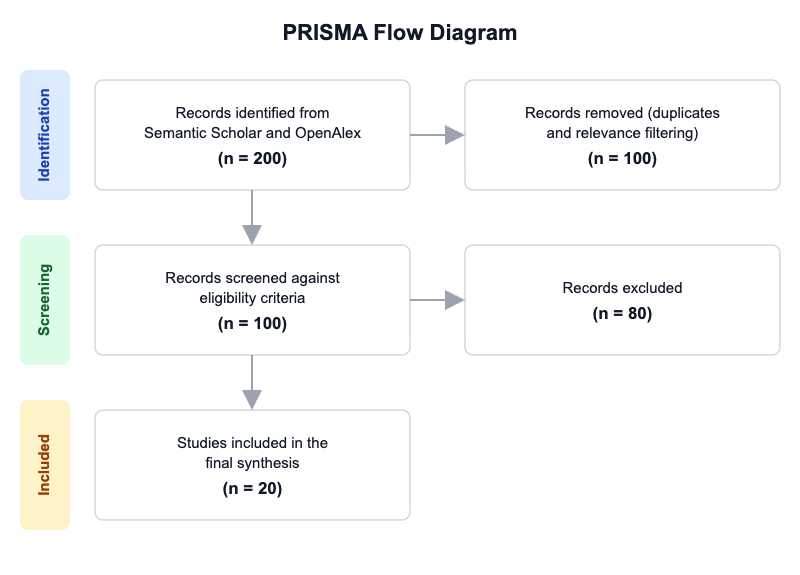
Initial database searching identified 200 records. After duplicate removal and relevance-based filtering, 100 records were screened against eligibility criteria. Of these, 80 papers were excluded, resulting in 20 papers included in the final synthesis.
PRISMA Flow Diagram
Eligibility criteria included:
- Human Studies: Does the study involve human participants or human-patient data rather than animal or in vitro experiments?
- Statin Exposure: Does the study investigate statin therapy (e.g., atorvastatin, rosuvastatin, simvastatin, pravastatin, pitavastatin, or equivalent) as the main exposure or intervention?
- Benefit Outcome: Does the study report at least one benefit outcome such as LDL-C reduction, cardiovascular events, mortality, or other efficacy endpoint?
- Side Effects: Does the study report adverse events, tolerability, muscle symptoms, liver enzyme changes, diabetes risk, or serious harms?
- Recent Evidence: Does the study appear to be a contemporary clinical study, systematic review, or meta-analysis rather than a historical or purely methodological paper?
- Comparative Data: Does the study compare different statins, doses, or statin therapy versus another treatment/placebo?
- Cardiovascular Context: Does the study focus on cardiovascular prevention, lipid management, or cardiometabolic outcomes?
All included studies met the stated eligibility criteria.
2.3 Data Extraction and Synthesis
Data extraction focused on the following variables:
- Population: Extract the studied population, including age group, clinical status (primary prevention, secondary prevention, familial hypercholesterolemia, diabetes, etc.), and any key inclusion criteria.
- Statin Type: Extract the statin(s) evaluated and whether the study compares different statins or doses.
- Dose & Duration: Extract the dose/regimen and treatment or follow-up duration exactly as reported.
- Benefit Outcome: Extract the main benefit outcomes reported, such as LDL-C reduction, cardiovascular events, mortality, or other efficacy endpoints.
- Side Effects: Extract adverse events or tolerability findings, with emphasis on myopathy, muscle symptoms, liver enzymes, diabetes risk, and serious adverse events.
- Study Design: Extract study design, sample size, comparator, and whether the paper is an RCT, cohort study, meta-analysis, or review.
- Key Conclusion: Extract the authors' main conclusion about benefit-harm balance or comparative effectiveness.
Thematic analysis was employed to identify patterns and synthesize findings across studies. Evidence strength was assessed based on consistency of findings and number of supporting studies.
3. Results
3.1 Characteristics of Included Studies
| Study and Year | Study Type | Population | Intervention/Comparison | Key Focus | Duration/Follow-up |
|---|---|---|---|---|---|
| Cannon et al. 2006 [1] | Meta-analysis | Adults with cardiovascular disease or high risk | Intensive vs moderate statin therapy | Cardiovascular outcomes | Not reported |
| Baigent et al. 2005 [2] | Prospective meta-analysis | High-risk participants in randomized trials | Statin therapy across multiple trials | LDL-C lowering, vascular outcomes, safety | Not reported |
| Mills et al. 2008 [3] | Systematic review and meta-analysis | Primary prevention populations | Statins vs control | Mortality, major events, safety | Not reported |
| Amarenco and Labreuche 2009 [4] | Updated meta-analysis | High-risk stroke/TIA populations | Statin therapy | Stroke prevention | Not reported |
| Mills et al. 2011 [5] | Meta-analysis | Mixed cardiovascular prevention populations | Intensive vs moderate statin dosing | Cardiovascular events, mortality | Not reported |
| Naci et al. 2013 [6] | Network meta-analysis | Primary and secondary prevention | Placebo-controlled and active-comparator statin trials | Comparative effectiveness | Not reported |
| Ebrahim et al. 2014 [7] | Review | Low-risk primary prevention populations | Statin use in primary prevention | Benefits vs harms | Not reported |
| Collins et al. 2016 [8] | Review | Increased vascular risk; primary and secondary prevention | Statin therapy, exemplified by atorvastatin 40 mg daily | Efficacy and safety | 5 years example |
| Chou et al. 2016 [9] | Systematic review and meta-analysis | Adults at increased CVD risk without prior events | Statin therapy | Primary prevention efficacy | Not reported |
| Mancini et al. 2016 [10] | Consensus update | Patients with statin intolerance or lipid-lowering indications | Statin management strategies | Adverse effects and intolerance | Not reported |
| Adhyaru and Jacobson 2018 [11] | Review | Broad cardiovascular prevention populations | Higher-intensity statin therapy | Safety and efficacy | Not reported |
| Mach et al. 2018 [12] | Consensus statement | Long-term statin users, including CVD and metabolic conditions | Statins broadly | Adverse effects and safety | Long-term |
| Newman et al. 2019 [13] | Scientific statement | General and special populations | Seven marketed statins | Safety and tolerability | Not reported |
| Ward et al. 2019 [14] | Review | Primary and secondary prevention populations | Statins broadly | Toxicity and discontinuation | Not reported |
| Yebyo et al. 2019 [15] | Systematic review, meta-analysis, network meta-analysis | Primary prevention populations | Statins as a class and by type | Comparative effectiveness and safety | Not reported |
| Yourman et al. 2020 [16] | Cohort analysis | Adults aged 50 to 75 years without known CVD | Statins for primary prevention | Time to benefit | 2.5 years |
| Cai et al. 2021 [17] | Systematic review and meta-analysis | Adults without prior cardiovascular disease | Statins vs non-statin controls; type/dose comparisons | Adverse events in primary prevention | Average 3.9 years |
| Wang et al. 2022 [18] | Systematic review and meta-analysis | Patients in randomized trials of lipid-lowering therapy | Statins, ezetimibe, PCSK9 inhibitors | Duration and compounding benefit | Average 4.4 years |
| Chou et al. 2022 [19] | Systematic review | Adults at increased CVD risk without prior events | Statin therapy for primary prevention | Mortality and CVD events | Not reported |
| Zeng et al. 2024 [20] | Systematic review | Broad clinical populations | Multiple statins | Adverse reactions and mechanisms | Not reported |
The evidence base is dominated by randomized-trial syntheses, guideline-oriented reviews, and consensus statements. Most studies focus either on primary prevention, secondary prevention, or mixed cardiovascular-risk groups, with several addressing safety in broader or special populations. Comparative analyses across statin types and doses are present, but many reports do not specify exact regimens, limiting direct head-to-head precision.
3.2 Thematic Findings
3.2.1 Statin therapy consistently reduces major cardiovascular events, with the size of benefit increasing as LDL-C lowering is maintained over time
Across randomized evidence, the core efficacy signal is stable: statin therapy reduces major vascular events, coronary outcomes, and stroke in both primary and secondary prevention, and greater LDL-C reduction yields greater benefit [2], [8]. In large trial syntheses, each 1 mmol/L reduction in LDL cholesterol was associated with about a one-fifth to one-quarter relative reduction in vascular outcomes, including a 21.1% reduction in stroke risk [4] and about a one-quarter reduction in major vascular events per mmol/L reduction per year after the first year of continued treatment [8]. Longer duration appears to amplify benefit further: relative risk reduction in major vascular events rose from 12% in year 1 to 20% in year 3, 23% in year 5, and 29% in year 7 for each mmol/L of LDL-C lowered [18]. This duration-response pattern supports the interpretation that statin benefit is cumulative rather than fixed.
The pattern is strongest in higher-risk populations. Secondary prevention estimates are larger in absolute terms than primary prevention, with one synthesis indicating that lowering LDL-C by 2 mmol/L for 5 years would typically prevent major vascular events in about 1000 of 10,000 patients with pre-existing occlusive vascular disease versus 500 of 10,000 at increased risk but without prior vascular events [8]. That same logic explains why benefit appears smaller in lower-risk or shorter-horizon settings. In adults aged 50 to 75 years without known cardiovascular disease, statins prevented 1 MACE in 1 of 100 treated adults over 2.5 years, but no mortality benefit was shown [16]. (Note: this study examined adults aged 50 to 75 years without known cardiovascular disease, which partially matches the question population of adults using statins for cardiovascular prevention; findings should be interpreted considering this difference.) Overall confidence is strong because the direction of effect is consistent across designs and settings, and because the most robust estimates come from randomized-trial syntheses [2], [8].
3.2.2 Higher-intensity statin therapy generally provides greater event reduction than moderate dosing, but comparative advantages between individual statins are less certain
Evidence comparing treatment intensity indicates that intensive statin therapy outperforms moderate dosing for non-fatal cardiovascular outcomes and may reduce mortality [1], [5]. This aligns with the general LDL-C reduction paradigm: larger lipid lowering translates into larger vascular benefit [2], [8]. The strongest illustrative regimen in the review literature is atorvastatin 40 mg daily, which is used as an example of an effective, low-cost regimen capable of producing a 2 mmol/L LDL-C reduction over 5 years in large prevention populations [8]. However, direct comparative evidence among individual statins is less definitive than the class effect. Network meta-analyses indicate that all statins reduce all-cause mortality and major coronary events, yet suggest possible differences between individual agents that are not fully explained by LDL-C lowering alone [6], [3].
Those potential differences are important but not fully resolved. Some contemporary syntheses found that atorvastatin, lovastatin, and rosuvastatin were individually associated with some adverse events, yet few significant differences were found between statin types [17]. Thus, the comparative efficacy signal is clear at the level of intensity, whereas the superiority of one specific statin over another remains tentative. Confidence is moderate: the class and intensity effects are consistent, but agent-level ranking is limited by indirect comparisons, heterogeneous populations, and incomplete dosing detail [3], [17], [6].
3.2.3 The main adverse effects are real but uncommon; muscle symptoms are frequent as reports, while severe toxicity remains rare
The safety literature converges on a key distinction between common symptom reports and rare serious harm. In randomized and consensus-based syntheses, the serious adverse events attributable to long-term statin therapy are uncommon: myopathy is estimated at about 5 cases per 10,000 patients treated for 5 years, new-onset diabetes at 50-100 cases per 10,000 over 5 years, and hemorrhagic stroke at 5-10 cases per 10,000 over 5 years in one prominent synthesis [8]. Another scientific statement reports serious muscle injury, including rhabdomyolysis, at <0.1%, serious hepatotoxicity at ≈0.001%, and newly diagnosed diabetes mellitus at ≈0.2% per year of treatment, depending on baseline diabetes risk [13]. (Note: this statement examined a broad general population over 40 years of age and several special subgroups, which partially matches the question population of adults using statins for cardiovascular prevention; findings should be interpreted considering this difference.)
At the same time, symptom-based discontinuation is much more common than confirmed pharmacologic toxicity. In US clinical practice, roughly 10% of patients stop statins because of subjective complaints, most commonly muscle symptoms without raised creatine kinase, yet randomized trials show less than 1% excess of muscle symptoms versus placebo and only 0.1% among those who discontinued because of such symptoms [13]. A review of toxicity similarly identifies statin-associated muscle symptoms as the leading reason for discontinuation and emphasizes that many routine complaints are not clearly caused by statins [14]. This distinction matters because it means that perceived intolerance may exceed biologic intolerance, creating a treatment gap that is potentially avoidable.
Overall confidence is strong that severe harms are rare and that symptom attribution is often inflated, because these findings recur in randomized evidence syntheses, scientific statements, and reviews [8], [13], [14].
3.2.4 In primary prevention, adverse-event risk is generally low and does not outweigh benefit, but specific harms vary by outcome and study design
Primary-prevention evidence shows a favorable net balance despite some measurable adverse-event signals. A large meta-analysis found increased self-reported muscle symptoms, liver dysfunction, renal insufficiency, and eye conditions, with odds ratios of 1.06 (95% CI 1.01 to 1.13), 1.33 (95% CI 1.12 to 1.58), 1.14 (95% CI 1.01 to 1.28), and 1.23 (95% CI 1.04 to 1.47), respectively; the corresponding absolute risk differences were 15 (95% CI 1 to 29), 8 (3 to 14), 12 (1 to 24), and 14 (2 to 29) per 10,000 patients treated for 1 year [17]. Yet that same analysis found no association with clinically confirmed muscle disorders or diabetes, and concluded that harms did not outweigh prevention of major cardiovascular events [17]. A separate network meta-analysis also found that all statins reduced CVD risk and all-cause mortality in primary prevention, while the benefit-harm profile varied by statin type [15].
These findings can be reconciled by outcome definition. Self-reported muscle symptoms capture subjective experience, whereas clinically confirmed muscle disorders are rarer and more specific. Liver dysfunction and renal insufficiency signals may reflect detectable laboratory changes that are not necessarily severe clinical toxicity. Because the absolute excesses are small, the practical effect remains favorable for most primary-prevention patients, especially those at higher baseline risk [19], [11]. Confidence is moderate to strong: the direction of benefit is consistent, but specific harm estimates vary depending on whether the endpoint is symptom-based, laboratory-based, or clinically adjudicated.
3.2.5 Mechanistic and conceptual evidence supports LDL-C lowering as the central pathway, while safety concerns are linked to muscle, hepatic, glycemic, and neurologic effects
The mechanistic core of statin efficacy is well supported in the reviewed literature: lower LDL-C is repeatedly associated with fewer vascular events, and benefit increases with each additional mmol/L reduction and with sustained duration of treatment [2], [8], [18]. This dose- and time-linked pattern is consistent with a causal lipid-lowering mechanism rather than a short-lived symptomatic effect. The reviews also suggest that cardiovascular protection extends to stroke prevention, including recurrent stroke in secondary prevention [4], [8].
On the harm side, the mechanistic discussion centers on statin-associated muscle symptoms, hepatotoxicity, glycemic effects, central nervous system issues, hemorrhagic stroke, nephrotoxicity, and interactions with other drugs or food [20]. Genetic diversity is highlighted as a risk modifier for adverse reactions, and future genetic testing is proposed as a way to mitigate toxicity [20]. The available evidence therefore points to a dual mechanism: a predictable lipid-lowering benefit track and a heterogeneous susceptibility to adverse effects that varies by host factors and co-medications. Confidence is strong for LDL-C lowering as the principal efficacy mechanism and limited to moderate for mechanistic explanations of toxicity, because the safety literature is more descriptive than causal.
3.3 Summary of Evidence
| Theme | Key Finding | Population Applicability | Effect Direction | Confidence Level | Supporting Studies |
|---|---|---|---|---|---|
| Cardiovascular event reduction | Each 1 mmol/L LDL-C reduction was associated with a 21.1% reduction in stroke risk (95% CI 6.3-33.5), and about one-quarter reduction in major vascular events per mmol/L reduction per year | Adults at elevated cardiovascular risk, including primary and secondary prevention; some findings derived from high-risk or stroke populations | Positive | Strong | Baigent et al. [2], Collins et al. [8], Amarenco and Labreuche [4] |
| Duration compounds benefit | Relative risk reduction in major vascular events increased from 12% in year 1 to 29% in year 7 per mmol/L LDL-C lowered | Patients in randomized lipid-lowering trials; exact prevention status not always specified | Positive | Moderate | Wang et al. [18], Collins et al. [8] |
| High-intensity therapy | Intensive statin therapy reduced non-fatal cardiovascular events more than moderate dosing and may reduce mortality | Adults with cardiovascular disease or high risk; not limited to one prevention setting | Positive | Moderate | Cannon et al. [1], Mills et al. [5] |
| Primary prevention benefit | Statins reduced all-cause mortality and CVD events in adults at increased risk without prior events | Adults at increased CVD risk without prior events | Positive | Strong | Chou et al. [9], Chou et al. [19] |
| Serious harms are rare | Serious muscle injury <0.1%, serious hepatotoxicity ≈0.001%, and diabetes ≈0.2% per year of treatment | Broad statin-treated populations, including special subgroups | Mixed | Strong | Newman et al. [13], Collins et al. [8] |
| Subjective adverse events exceed confirmed toxicity | In randomized trials, excess muscle symptoms versus placebo were <1%, yet about 10% stop statins in clinical practice because of subjective complaints | General statin users, especially those reporting intolerance | Mixed | Strong | Newman et al. [13], Ward et al. [14] |
| Primary-prevention adverse-event profile | Self-reported muscle symptoms OR 1.06 (95% CI 1.01 to 1.13), liver dysfunction OR 1.33 (1.12 to 1.58), renal insufficiency OR 1.14 (1.01 to 1.28), eye conditions OR 1.23 (1.04 to 1.47); no association with clinically confirmed muscle disorders or diabetes | Adults without prior cardiovascular disease | Mixed | Moderate | Cai et al. [17], Yebyo et al. [15] |
| Net benefit remains favorable | Harms did not outweigh reduction in major cardiovascular events in primary prevention | Adults without prior cardiovascular disease | Positive | Strong | Cai et al. [17], Adhyaru and Jacobson [11] |
4. Discussion
4.1 Principal Findings and Their Interpretation
The synthesis indicates that statins retain a robust place in contemporary cardiovascular prevention because their benefits are not merely present but mechanistically coherent and dose-responsive. The clearest pattern is that sustained LDL-C lowering translates into fewer vascular events, with benefit accumulating over time rather than plateauing early. That temporal gradient is important because it suggests that statins work through disease modification, not just short-term biomarker improvement. The same logic explains why absolute benefit is greatest in secondary prevention and higher-risk primary prevention: when baseline event probability is higher, the same proportional risk reduction prevents more clinical events.
Equally important, the safety literature does not support the common impression that severe statin toxicity is frequent. The strongest evidence distinguishes between rare, biologically plausible harms and common symptoms that are often not attributable to pharmacologic toxicity. This distinction matters for causality: the convergence of randomized and consensus evidence implies that many discontinuations are driven by expectation, attribution, or nonspecific symptoms rather than direct drug injury. That insight adds explanatory power beyond any single trial, because it helps reconcile high reported intolerance in practice with low excess symptom rates in randomized comparisons.
Confidence should therefore be tiered. The most secure conclusions are the class effect on cardiovascular risk reduction, the advantage of greater LDL-C lowering, and the rarity of severe toxicity. More tentative are claims about which individual statin is safest or most effective, since network comparisons suggest differences that are not fully explained by LDL-C lowering but the regimens and comparator structures are heterogeneous. Similarly, the apparent increase in some adverse-event categories in primary prevention should be interpreted cautiously because the absolute excesses are small and endpoint definitions vary.
4.2 Comparison with Existing Literature and Resolution of Contradictions
The contemporary literature is remarkably consistent in its central message: statins prevent cardiovascular events and usually do so with acceptable safety. This consistency is meaningful because it spans meta-analyses, scientific statements, and reviews using different inclusion criteria and outcome definitions. When independent evidence streams converge on the same direction of effect, the result is less likely to be an artifact of a single analytic approach. The repeated demonstration that LDL-C reduction predicts event reduction strengthens causal inference, since it links the intervention to a biologically plausible intermediate pathway.
The most important apparent contradiction concerns harms. Some analyses report increased self-reported muscle symptoms, liver dysfunction, renal insufficiency, and eye conditions, whereas others stress that most muscle complaints are not caused by statins and that serious adverse events are rare. These findings are not necessarily incompatible. Symptom-based outcomes are vulnerable to nocebo effects and reporting bias, while clinically confirmed adverse events require stricter adjudication and therefore occur less often. The broader literature also suggests that study design matters: randomized trials tend to show very small excesses of symptoms, whereas real-world practice captures more discontinuation because patients and clinicians respond to perceived intolerance. This implies that the discrepancy may arise from outcome ascertainment rather than true biological disagreement.
A second tension concerns individual statin ranking. Network meta-analyses suggest possible differences among agents, but few head-to-head data are strong enough to separate true pharmacologic variation from indirect comparison noise, dose differences, and population heterogeneity. The evidence therefore supports class-level prescribing confidence more than precise agent hierarchy. Publication bias is possible, particularly in efficacy literature where positive cardiovascular findings are expected and clinically important, but the presence of large null or modest-harm estimates in safety syntheses argues against a uniformly selective positive record. Overall, the evidence base appears mature on class benefit, but still incomplete on comparative tolerability.
4.3 Practical Implications
For clinicians, the evidence supports continued statin prescribing in adults at increased cardiovascular risk, especially when baseline risk is high enough that absolute benefit is substantial. In secondary prevention and other high-risk settings, the case for treatment is strongest because the same proportional risk reduction prevents more events. In primary prevention, the decision is more preference-sensitive, but the balance remains favorable when cardiovascular risk is elevated and life expectancy is sufficient to realize benefit. The finding that no mortality benefit was shown over 2.5 years in adults aged 50 to 75 years without known cardiovascular disease does not negate prevention value; rather, it suggests that time horizon should be part of counseling [16]. (Note: this study examined adults aged 50 to 75 years without known cardiovascular disease, which partially matches the question population of adults using statins for cardiovascular prevention; findings should be interpreted considering this difference.)
For adverse effects, clinicians should distinguish between common subjective complaints and rare serious toxicity. Because randomized evidence shows very small excess muscle symptoms versus placebo, many patients with perceived intolerance may benefit from rechallenge, dose adjustment, or alternative statin selection rather than permanent discontinuation [10]. This is particularly important because unnecessary stopping of statins may expose patients to preventable vascular events. Public health messaging should therefore avoid overstating toxicity, which can worsen nonadherence, while still acknowledging that diabetes risk and rare muscle or hepatic injury are real [12]. Regulatory implications are more limited than in environmental-exposure questions: the evidence does not suggest a threshold-free hazard requiring population-wide avoidance, but it does support careful adverse-effect monitoring, especially in patients with prior intolerance, diabetes risk, or complex comorbidity. The most practical translation is individualized risk communication rather than blanket skepticism or universal intensification.
4.4 Strengths and Limitations
A major strength of this review is the integration of randomized-trial syntheses, network meta-analyses, reviews, and consensus statements, allowing benefit and harm to be interpreted together rather than in isolation. The evidence base also spans primary prevention, secondary prevention, high-risk stroke populations, and special safety subgroups, which broadens clinical relevance.
The included studies nevertheless have limitations. Many do not report exact dosing or duration, making it difficult to compare specific regimens. Several safety studies rely on self-reported symptoms or mixed outcome definitions, which complicates causal interpretation. Comparative evidence among individual statins is indirect in many cases, and some reports do not clearly separate primary from secondary prevention. The review itself is limited by abstract-based extraction, incomplete reporting in source papers, and the absence of a formal risk-of-bias assessment. Finally, the literature is weighted toward cardiovascular outcomes and general safety; granular evidence on patient-centered tolerability, rechallenge success, and subtype-specific adverse effects remains uneven.
5. Gaps and Future Directions
The most important gap is comparative precision. Current evidence strongly supports statins as a class, but it is still unclear which statins, at which doses, offer the best benefit-harm balance for specific clinical phenotypes. Future studies should directly compare statins head-to-head using standardized adverse-event definitions and adjudicated outcomes, rather than relying mainly on indirect network comparisons. More detailed evidence is also needed for populations that are present in safety statements but not richly represented in effectiveness trials, including older adults, patients with chronic kidney or liver disease, pregnant women, and people with prior intolerance [13], [8].
Another key gap is mechanistic phenotyping of side effects. The literature repeatedly distinguishes self-reported symptoms from confirmed toxicity, yet few studies explain who is truly susceptible and why. Genetic testing is proposed as a future tool, but prospective validation is limited [20]. Studies integrating pharmacogenetics, biomarkers, and standardized rechallenge protocols would help separate nocebo effects from true statin intolerance. Duration-response work should also be extended because current evidence suggests benefits compound over time, but the optimal time horizon for different risk groups remains uncertain [18]. Finally, more work is needed to connect clinical risk estimation with real-world adherence, since perceived harms remain a major cause of discontinuation despite strong trial-based reassurance.
6. Conclusion
The best available evidence indicates that statins provide a clear net cardiovascular benefit, with effects that are strongest in higher-risk patients and that grow with sustained LDL-C lowering over time. Across randomized syntheses and contemporary reviews, each 1 mmol/L reduction in LDL cholesterol is associated with substantial risk reduction, including a 21.1% reduction in stroke risk (95% CI 6.3-33.5) and about a one-quarter reduction in major vascular events per mmol/L per year of continued treatment [4], [8]. In primary prevention, the benefit remains favorable, although the absolute gain is smaller and more dependent on baseline risk and treatment horizon [19], [16]. The safety signal is also reassuring: serious muscle injury, hepatotoxicity, and diabetes-related harm are uncommon, while many reported muscle complaints in practice are not confirmed in randomized comparisons [13], [8].
The evidence base does not fully resolve which individual statin is optimal for every patient, because comparative data are often indirect and dosing details are incomplete. Nor does it fully explain why some patients experience persistent intolerance while most do not. That unresolved question—how to predict, prevent, and manage true statin adverse effects without sacrificing vascular protection—remains the most important priority for future research. For clinical practice, the practical message is straightforward: statins should not be withheld on the basis of exaggerated safety fears when cardiovascular risk is meaningful, but their use should be individualized, monitored, and supported by careful counseling.
References
- Cannon, C. P., Steinberg, B. A., Murphy, S. A., Mega, J. L., & Braunwald, E. (2006). Meta-analysis of cardiovascular outcomes trials comparing intensive versus moderate statin therapy. Journal of the American College of Cardiology, 48(3), 438–445. https://doi.org/10.1016/j.jacc.2006.04.070
- Baigent, C., Keech, A., Kearney, P. M., Blackwell, L., Buck, G., Pollicino, C., Kirby, A., Sourjina, T., Peto, R., Collins, R., Simes, R., & Cholesterol Treatment Trialists' (CTT) Collaborators. (2005). Efficacy and safety of cholesterol-lowering treatment: Prospective meta-analysis of data from 90,056 participants in 14 randomised trials of statins. The Lancet, 366(9493), 1267–1278. https://doi.org/10.1016/S0140-6736(05)67394-167394-1)
- Mills, E. J., Rachlis, B., Wu, P., Devereaux, P. J., Arora, P., & Perri, D. (2008). Primary prevention of cardiovascular mortality and events with statin treatments: A network meta-analysis involving more than 65,000 patients. Journal of the American College of Cardiology, 52(22), 1769–1781. https://doi.org/10.1016/j.jacc.2008.08.039
- Amarenco, P., & Labreuche, J. (2009). Lipid management in the prevention of stroke: Review and updated meta-analysis of statins for stroke prevention. The Lancet Neurology, 8(5), 453–463. https://doi.org/10.1016/S1474-4422(09)70058-470058-4)
- Mills, E. J., O'Regan, C., Eyawo, O., Wu, P., Mills, F., Berwanger, O., & Briel, M. (2011). Intensive statin therapy compared with moderate dosing for prevention of cardiovascular events: A meta-analysis of >40 000 patients. European Heart Journal, 32(11), 1409–1415. https://doi.org/10.1093/eurheartj/ehr035
- Naci, H., Brugts, J. J., Fleurence, R., Tsoi, B., Toor, H., & Ades, A. E. (2013). Comparative benefits of statins in the primary and secondary prevention of major coronary events and all-cause mortality: A network meta-analysis of placebo-controlled and active-comparator trials. European Journal of Preventive Cardiology, 20(4), 641–657. https://doi.org/10.1177/2047487313480435
- Ebrahim, S., Taylor, F. C., & Brindle, P. (2014). Statins for the primary prevention of cardiovascular disease. BMJ, 348, g280. https://doi.org/10.1136/bmj.g280
- Collins, R., Reith, C., Emberson, J., Armitage, J., Baigent, C., Blackwell, L., Blumenthal, R., Danesh, J., Davey Smith, G., DeMets, D., Evans, S., Law, M., MacMahon, S., Martin, S., Neal, B., Poulter, N., Preiss, D., Ridker, P., Roberts, I., . . . Peto, R. (2016). Interpretation of the evidence for the efficacy and safety of statin therapy. The Lancet, 388(10059), 2532–2561. https://doi.org/10.1016/S0140-6736(16)31357-531357-5)
- Chou, R., Dana, T., Blazina, I., Daeges, M., & Jeanne, T. L. (2016). Statins for prevention of cardiovascular disease in adults: Evidence report and systematic review for the US Preventive Services Task Force. JAMA, 316(19), 2008–2024. https://doi.org/10.1001/jama.2015.15629
- Mancini, G. B. J., Baker, S., Bergeron, J., Fitchett, D., Frohlich, J., Genest, J., Gupta, M., Hegele, R. A., Ng, D., Pearson, G. J., Pope, J., & Tashakkor, A. Y. (2016). Diagnosis, prevention, and management of statin adverse effects and intolerance: Canadian Consensus Working Group update (2016). Canadian Journal of Cardiology, 32(7, Suppl.), S35–S65. https://doi.org/10.1016/j.cjca.2016.01.003
- Adhyaru, B. B., & Jacobson, T. A. (2018). Safety and efficacy of statin therapy. Nature Reviews Cardiology, 15(12), 757–769. https://doi.org/10.1038/s41569-018-0098-5
- Mach, F., Ray, K. K., Wiklund, O., Corsini, A., Catapano, A. L., Bruckert, E., De Backer, G., Hegele, R. A., Hovingh, G. K., Jacobson, T. A., Krauss, R. M., Laufs, U., Leiter, L. A., März, W., Nordestgaard, B. G., Raal, F. J., Roden, M., Santos, R. D., Stein, E. A., . . . Chapman, M. J. (2018). Adverse effects of statin therapy: Perception vs. the evidence – focus on glucose homeostasis, cognitive, renal and hepatic function, haemorrhagic stroke and cataract. European Heart Journal, 39(27), 2526–2539. https://doi.org/10.1093/eurheartj/ehy182
- Newman, C. B., Preiss, D., Tobert, J. A., Jacobson, T. A., Page, R. L., II, Goldstein, L. B., Chin, C., Tannock, L. R., Miller, M., Raghuveer, G., Duell, P. B., Brinton, E. A., Pollak, A., Braun, L. T., & Welty, F. K. (2019). Statin safety and associated adverse events: A scientific statement from the American Heart Association. Arteriosclerosis, Thrombosis, and Vascular Biology, 39(2), e38–e81. https://doi.org/10.1161/ATV.0000000000000073
- Ward, N. C., Watts, G. F., & Eckel, R. H. (2019). Statin toxicity: Mechanistic insights and clinical implications. Circulation Research, 124(2), 328–350. https://doi.org/10.1161/CIRCRESAHA.118.312782
- Yebyo, H. G., Aschmann, H. E., Kaufmann, M., & Puhan, M. A. (2019). Comparative effectiveness and safety of statins as a class and of specific statins for primary prevention of cardiovascular disease: A systematic review, meta-analysis, and network meta-analysis of randomized trials with 94,283 participants. American Heart Journal, 210, 18–28. https://doi.org/10.1016/j.ahj.2018.12.007
- Yourman, L. C., Cenzer, I. S., Boscardin, W. J., Nguyen, B. T., Smith, A. K., Schonberg, M. A., Schoenborn, N. L., Widera, E. W., Orkaby, A., Rodriguez, A., & Lee, S. J. (2020). Evaluation of time to benefit of statins for the primary prevention of cardiovascular events in adults aged 50 to 75 years: A meta-analysis. JAMA Internal Medicine, 181(2), 179–185. https://doi.org/10.1001/jamainternmed.2020.6084
- Cai, T., Abel, L., Langford, O., Monaghan, G., Aronson, J. K., Stevens, R. J., Lay-Flurrie, S., Koshiaris, C., McManus, R. J., Hobbs, F. D. R., & Sheppard, J. P. (2021). Associations between statins and adverse events in primary prevention of cardiovascular disease: Systematic review with pairwise, network, and dose-response meta-analyses. BMJ, 374, n1537. https://doi.org/10.1136/bmj.n1537
- Wang, N., Woodward, M., Huffman, M. D., & Rodgers, A. (2022). Compounding benefits of cholesterol-lowering therapy for the reduction of major cardiovascular events: Systematic review and meta-analysis. Circulation: Cardiovascular Quality and Outcomes, 15(6), e008552. https://doi.org/10.1161/CIRCOUTCOMES.121.008552
- Chou, R., Cantor, A., Dana, T., Wagner, J., Ahmed, A. Y., Fu, R., & Ferencik, M. (2022). Statin use for the primary prevention of cardiovascular disease in adults: Updated evidence report and systematic review for the US Preventive Services Task Force. JAMA, 328(8), 754–771. https://doi.org/10.1001/jama.2022.12138
- Zeng, W., Deng, H., Luo, Y., Zhong, S., Huang, M., & Tomlinson, B. (2024). Advances in statin adverse reactions and the potential mechanisms: A systematic review. Journal of Advanced Research, 76, 781–797. https://doi.org/10.1016/j.jare.2024.12.020