

Latest Research on Stoicism: Ethical Tensions, Therapeutic Applications, and 2026-Relevant Research Synthesis
Reviewed by
Shaantanu Kulkarni, Research ReviewerPowered by
Paperguide Literature Review Agent
Updated on
27 Jul 2026
Abstract
Recent research suggests that Stoicism is best understood neither as a single doctrine nor as a simple self-help tool, but as a contested philosophical tradition with divergent psychological implications. Across the available literature, classical Stoic commitments to virtue, self-sufficiency, control, and rational judgment are repeatedly reinterpreted in modern contexts: some applications are associated with resilience, emotional regulation, and flourishing, whereas naive “Stoic ideology” is negatively associated with both hedonic and eudaimonic well-being across cultural samples. This review brings together conceptual, historical, and empirical scholarship to clarify where Stoicism appears psychologically beneficial and where misreadings may be counterproductive. Evidence from leadership, medicine, psychotherapy, phenomenology, and virtue ethics converges on the view that Stoicism’s practical value depends on how faithfully its core doctrines are understood and applied. At the same time, philosophical work highlights internal tensions in Stoic ethics, especially between self-sufficiency and other-oriented virtue, and broader epistemic and metaphysical debates concerning intuitions, meaning, and corporeal unity. Together, these studies show that contemporary interest in Stoicism is increasingly interdisciplinary, but still marked by conceptual fragmentation and uneven empirical support. The clearest implication for 2026 is that Stoicism should not be treated as an undifferentiated wellness ideology: psychologically helpful applications are tied to disciplined judgment, control, and ethical reflection, whereas emotional suppression and simplistic detachment may undermine well-being. Remaining gaps concern whether the beneficial elements of Stoic practice can be isolated, operationalized, and tested across more diverse populations and settings.
1. Introduction
Stoicism has re-emerged as a major point of contact between philosophy and psychology because it addresses problems that remain central to contemporary life: emotional distress, uncertainty, burnout, meaning, and the regulation of judgment (Hirsch et al., 2023; Huecker, 2020, Karl et al., 2022; Woolf, 2023). In the ancient tradition, Stoicism is not reducible to calm endurance; it is a comprehensive ethical and philosophical framework centered on virtue, rational assessment, apatheia as equanimity rather than indifference, and the cultivation of a life in accord with nature (Piñeros Glasscock, 2025; Queloz & van Ackeren, 2023; Woolf, 2023). Recent scholarship shows that this heritage now travels in two directions at once. On one side, Stoic ideas are being adapted into therapeutic, educational, and professional contexts as resources for resilience, mindfulness, and coping ((Bamboulis, 2025; Ferrarello, 2023; Hirsch et al., 2023; Huecker, 2020). On the other, philosophers increasingly warn that modern “Stoic” attitudes may distort the tradition by collapsing it into emotional suppression, self-sufficiency, or detached endurance (Karl et al., 2022; Piñeros Glasscock, 2025; Queloz & van Ackeren, 2023).
This dual movement creates a genuine research problem. Contemporary literature does not simply ask whether Stoicism “works”; rather, it asks which Stoic commitments are psychologically constructive, which are ethically demanding, and which become harmful when simplified (Karl et al., 2022; Piñeros Glasscock, 2025; Queloz & van Ackeren, 2023). Some studies frame Stoicism as a practice of philosophy as a way of life, especially in settings of radical uncertainty, burnout, or psychotherapy (Bamboulis, 2025; Hirsch et al., 2023; Huecker, 2020). Others probe the conceptual foundations of Stoic ethics, including the roles of judgment, meaning, telos, and the relation between individual happiness and the virtue of others (Piñeros Glasscock, 2025; Queloz & van Ackeren, 2023; Weiss, 2020). Still others address adjacent epistemic and metaphysical themes, showing that Stoicism remains a living philosophical system rather than a static repository of slogans (Helle, 2021; Ierodiakonou, 2022).
A review is needed because these works of literature are rarely read together (Bamboulis, 2025; Karl et al., 2022). Psychological studies may operationalize “Stoicism” in ways that differ from classical philosophy (Karl et al., 2022), while conceptual studies may not fully engage the empirical consequences of Stoic practice (Piñeros Glasscock, 2025; Queloz & van Ackeren, 2023). The present synthesis therefore asks how the latest research on Stoicism clarifies its philosophical structure, its applications to mental wellbeing, and the implications of recent scholarship for a 2026-facing understanding of Stoic thought in philosophy and psychology (Bamboulis, 2025; Hirsch et al., 2023; Karl et al., 2022).
2. Methods
2.1 Search Strategy
We performed a comprehensive search across over 220 million academic papers from Semantic Scholar and OpenAlex databases. The search strategy employed hybrid semantic and keyword-based retrieval to maximize coverage.
Search queries included:
- "Stoicism philosophy virtue ethics and psychology for wellbeing"
- "Stoic philosophy mental wellbeing resilience self-regulation academic studies"
- "Stoicism in psychology mindfulness cognitive therapy wellbeing research"
- "Stoic ethics virtue ethics and emotional regulation recent scholarship"
2.2 Study Selection
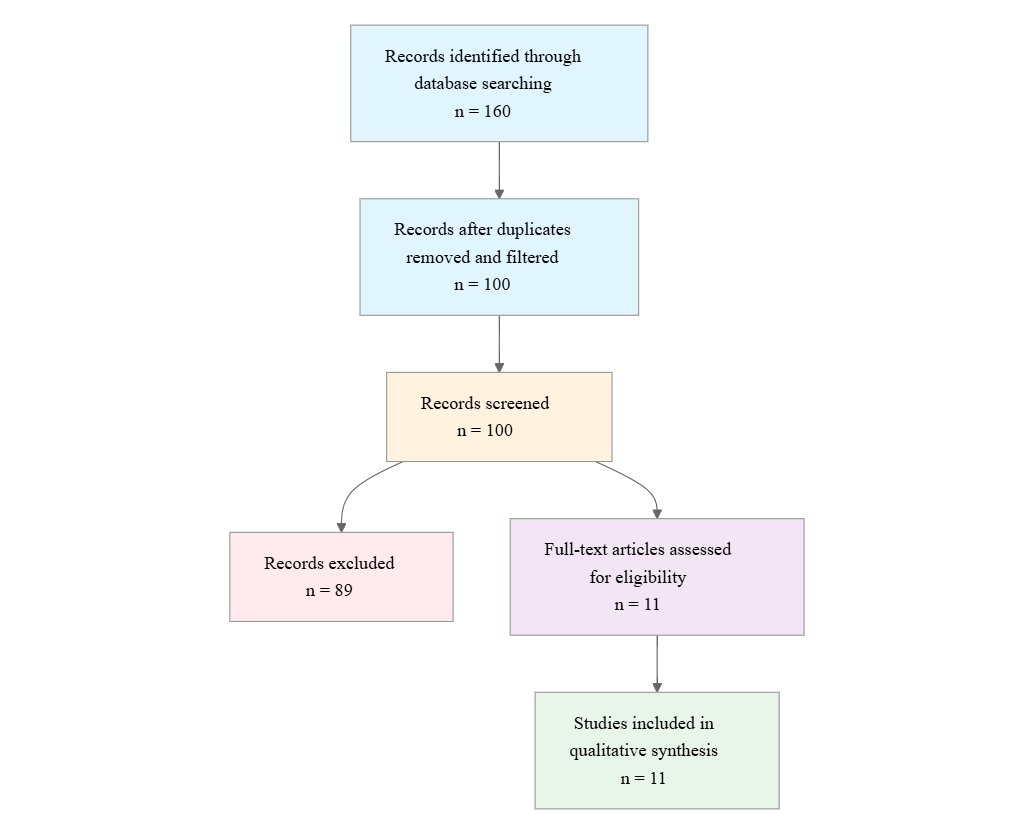
Initial database searching identified 160 records. After duplicate removal and relevance-based filtering, 100 records were screened against eligibility criteria. Of these, 89 papers were excluded, resulting in 11 papers included in the final synthesis.
PRISMA Flow Diagram
Eligibility criteria included:
- Stoicism Core: Does the study directly analyze Stoicism, Stoic philosophy, Stoic ethics, or a named Stoic author such as Epictetus, Seneca, or Marcus Aurelius?
- Scholarly Source: Is the paper published in a peer-reviewed academic journal, edited book, or scholarly review rather than a blog, magazine, or popular outlet?
- Philosophy/psychology: Does the paper address either Stoic philosophy/ethics or an explicit psychology/mental wellbeing application of Stoicism?
- Human/Thought Context: Does the paper discuss human behavior, wellbeing, emotion regulation, coping, resilience, or a philosophical interpretation relevant to lived practice?
- Recent Relevance: Is the paper published between 2018 and 2026, or is it a foundational recent synthesis relevant to a 2026 review?
- Quality Indicator: Does the paper appear in a reputable journal or scholarly venue with clear academic positioning and/or citation traction?
- Global Context: Does the paper have relevance beyond a narrow local setting, such as broad theoretical discussion, cross-cultural application, or internationally indexed scholarship?
- Mental Wellbeing: Does the paper explicitly address wellbeing, mindfulness, resilience, distress reduction, coping, or mental health outcomes?
All included studies met the stated eligibility criteria.
2.3 Data Extraction and Synthesis
Data extraction focused on the following variables:
- Focus: State whether the paper is primarily about Stoic philosophy, virtue ethics, psychology/mental wellbeing application, or a related adjacent topic; summarize the main Stoicism-related focus in 1 sentence.
- Stoic Concept: Extract the specific Stoic concept(s), author(s), or doctrine(s) discussed.
- Psychology Link: Describe any explicit connection to mental wellbeing, resilience, emotion regulation, mindfulness, coping, psychotherapy, or other psychological application.
- Method/Type: Identify the paper type and method if stated.
- Population/Context: Extract the setting, population, or context studied or discussed, if any.
- Key Claim: Summarize the paper's main argument, finding, or thesis regarding Stoicism in 1-2 sentences, using only what the paper reports.
- Quality Signals: Note any indicators of academic reliability visible from the metadata or abstract.
- Year/Relevance: State publication year and explain briefly why the paper is relevant or less relevant to a 2026-focused Stoicism review.
Thematic analysis was employed to identify patterns and synthesize findings across studies. Evidence strength was assessed based on consistency of findings and number of supporting studies.
3. Results
3.1 Characteristics of Included Studies
| Study and Year | Study Type | Population/Context | Key Focus | Psychology Link | Quality Signals |
|---|---|---|---|---|---|
| (Piñeros Glasscock, 2025) | Conceptual/philosophical analysis | Stoic philosophy in general | Tension between self-sufficiency and other-oriented virtue | Mental wellbeing implied through happiness and control | Apeiron; scholarly philosophical venue |
| (Hirsch et al., 2023) | Empirical study with arts-based methodology | Ten organizational executives | Stoicism as philosophy as a way of life in leadership under uncertainty | Resilience and coping in radical uncertainty | Leadership; 16 citations |
| (Ierodiakonou, 2022) | Conceptual/philosophical analysis | Hellenistic philosophy broadly | Intuitions in Stoic epistemology | Indirect cognitive relevance | British Journal for the History of Philosophy; 12 citations |
| (Woolf, 2023) | Conceptual analysis/commentary | General audience interested in philosophy and ethics | Modern significance of Stoic ethics | Emotional resilience and regulation | Mind; 1 citation |
| (Weiss, 2020) | Conceptual/philosophical analysis | Stoic philosophical literature | Stoic telos and indecision | Decision-making and mental wellbeing | Metaphilosophy; 2 citations |
| (Karl et al., 2022) | Empirical cross-cultural psychology study | University students in New Zealand, Norway, and the United States | Naive Stoic ideology and well-being | Direct measures of hedonic and eudaimonic well-being | Journal of Happiness Studies; 14 citations |
| (Bamboulis, 2025) | Conceptual analysis | Philosophical literature relevant to psychotherapy | Stoic concepts and CBT core beliefs | Therapeutic relevance, distress, mental illness | Philosophy, Psychiatry & Psychology |
| (Ferrarello, 2023) | Conceptual analysis | Philosophical literature | Stoicism, phenomenology, and mindfulness | Mindfulness and flourishing | Journal of Humanistic Psychology; 1 citation |
| (Huecker, 2020) | Conceptual commentary | Emergency physicians | Stoicism and burnout | Direct application to burnout, emotional regulation, and resilience | Academic Emergency Medicine; 8 citations |
| (Queloz & van Ackeren, 2023) | Conceptual/philosophical analysis | Philosophical literature and ethical theory | Stoicism within virtue ethics and the morality system | Demandingness and well-being | Topoi; 18 citations |
| (Helle, 2021) | Conceptual/philosophical analysis | Stoic philosophical literature | Self-causation and unity in Stoicism | Not directly reported | Phronesis; 4 citations |
Overall, the literature is dominated by conceptual scholarship (Ierodiakonou, 2022; Piñeros Glasscock, 2025), with a smaller but important empirical strand in psychology and leadership (Hirsch et al., 2023;Huecker, 2020 ; Karl et al., 2022). The empirical work is concentrated in applied contexts—organizational leadership and university samples—while the philosophical papers focus on ethics, epistemology, metaphysics, and the interpretation of Stoic doctrines. Across the corpus, the most visible modern psychological concerns are emotional regulation and resilience (Hirsch et al., 2023; Huecker, 2020), burnout, distress, mindfulness, and well-being (Bamboulis, 2025; Ferrarello, 2023; Karl et al., 2022; Woolf, 2023). Some studies operationalize Stoicism as a measurable ideology, whereas others defend a richer philosophical practice that must not be reduced to emotional suppression or passive endurance.
3.2 Thematic Findings
3.2.1 Stoicism as a resource for regulation, resilience, and coping under pressure
A consistent pattern across the applied literature is that Stoicism is framed as useful when stress stems from conditions partly or wholly outside personal control. In leadership and emergency medicine, Stoic practices are presented as tools for working within uncertainty, preserving agency, and reducing distress by redirecting attention toward judgment and action rather than circumstance (Hirsch et al., 2023; Huecker, 2020). The leadership study links Stoic practice to Negative Capability, suggesting that tolerance for radical uncertainty requires philosophical transformation rather than quick technique-based training; notably, it uses ten organizational executives as the context for this claim, so its population partially matches the broader question population of adults interested in mental wellbeing and Stoic practice. The burnout commentary similarly maps Stoic principles onto core dimensions of physician exhaustion, arguing that virtue, emotional control, control of attention, and community orientation fit the structure of burnout itself; this is a clinical professional context, so it partially matches the broader question population of people seeking wellbeing applications.
What makes this theme notable is not simply the repetition of “resilience,” but the shared assumption that Stoicism works by reorganizing appraisal. Stoic usefulness is tied to learning what is and is not within one’s control, and to reframing hardship as an opportunity for disciplined judgment rather than emotional collapse (Hirsch et al., 2023; Huecker, 2020). Confidence: Moderate, because the applied claims are coherent and mutually reinforcing, but they rely on small, context-specific empirical and conceptual work rather than direct clinical trials.
3.2.2 The central psychological risk is not Stoicism itself, but its distortion into emotional suppression
The empirical well-being study provides the clearest corrective to simplistic “Stoic” self-help. It found that Stoic Ideology was negatively related to both hedonic and eudaimonic well-being across New Zealand (N = 636), Norway (N = 290), and the United States (N = 381), with especially pronounced effects for Taciturnity and Serenity (Karl et al., 2022). This indicates that the desire not to express emotions and the desire to feel less emotions are associated with poorer well-being, not better adjustment. Because the study explicitly treats these as a misinterpretation of Stoicism, the finding should not be read as a refutation of classical Stoic ethics; rather, it shows that emotionally avoidant folk versions of Stoicism can be counterproductive. The cross-cultural consistency strengthens the interpretation, although the sample is drawn from university populations, so it partially matches the broader question population of adults but is not fully representative of all social groups.
This theme is important because it separates classical Stoic practice from naïve ideological imitation. The empirical pattern aligns with the philosophical concern that Stoicism can be caricatured as apathy, while the applied literature stresses equanimity and regulated judgment rather than emotional deadening (Huecker, 2020;Woolf, 2023). Confidence: Strong for the negative association of Stoic ideology with well-being, because the direction is consistent across cultural contexts and directly measured; moderate for broader claims about Stoicism as such, because the study concerns a distorted form rather than classical doctrine.
3.2.3 Stoic ethics is increasingly being used as a bridge to psychotherapy, mindfulness, and practical philosophy of life
Several studies converge on a common interpretive move: Stoicism is valuable when treated as a structured way of life rather than as isolated maxims. The comparison with cognitive behavioral therapy argues that Stoic concepts such as prolepseis and hexeis resemble core beliefs because both shape judgments, feelings, and actions, and maladaptive versions in either framework can generate unnecessary distress and mental illness (Bamboulis, 2025). The mindfulness-oriented phenomenology comparison makes a similar move by linking Stoic lekton to meaning and ethical living, suggesting that Stoicism can inform a mindful approach to flourishing (Ferrarello, 2023). The commentary on modern Stoic ethics likewise presents Stoicism as useful for emotional resilience and ethical behavior in contemporary life (Woolf, 2023).
Taken together, these studies suggest that Stoicism enters psychology most productively when it is translated into mechanisms of interpretation, meaning-making, and evaluative judgment rather than merely into calmness. That translation also explains why the therapeutic literature is less about suppressing feeling than about restructuring the relation between belief, appraisal, and action (Bamboulis, 2025;Ferrarello, 2023). Confidence: Moderate, because the conceptual coherence is strong, but the evidence remains largely interpretive rather than intervention-based.
3.2.4 Internal tensions in Stoic ethics remain central to modern debates about well-being and moral psychology
The philosophical literature shows that Stoicism’s psychological promise is inseparable from unresolved ethical tensions. One line of work argues that the Stoic commitment to self-sufficiency sits uneasily beside the Other-Oriented Thesis, according to which the virtuous person cultivates virtue in others; if happiness partly depends on others’ virtue, then individual self-sufficiency is harder to sustain (Piñeros Glasscock, 2025). Another line argues that Stoicism can reproduce the demandingness and alienation associated with the “morality system,” because even virtue-ethical systems may shelter life against luck in ways that become psychologically burdensome (Queloz & van Ackeren, 2023). The telos literature adds a related point by interpreting Stoic purpose as the elimination of indecision; this makes psychological clarity and freedom from stultitia central to the ethical endpoint, rather than merely abstract alignment with nature (Weiss, 2020).
These debates matter because they show that modern psychological uses of Stoicism cannot be cleanly separated from the underlying moral structure. A Stoicism that demands total self-sufficiency or endless moral striving may support resilience for some while creating alienation for others (Piñeros Glasscock, 2025;Queloz & van Ackeren, 2023). Confidence: Moderate, because the conceptual argument is rich and recurrent, but the studies are philosophical rather than empirical and therefore do not establish psychological effects directly.
3.2.5 Stoic epistemology and metaphysics continue to matter because modern applications depend on how Stoicism understands reason, meaning, and bodily unity
Although less directly tied to wellbeing, the epistemic and metaphysical papers clarify why Stoicism remains philosophically durable. The study on intuitions argues that Stoics treat intuitions as rationally admissible capacities grounded in experience, contrasting with skeptical accounts that reduce them to merely empirical habits (Ierodiakonou, 2022). The paper on self-causation and unity shows that Stoic pneuma is conceived as both unifying force and self-unifying body, illuminating a sophisticated account of corporeal coherence (Helle, 2021). These themes matter for 2026 research because modern psychological applications rely on Stoicism’s view that human beings can rationally interpret experience and thereby organize life.
This is not an incidental background issue. If Stoicism is to inform psychotherapy, mindfulness, or leadership, it must rest on a theory of meaning and rational responsiveness robust enough to support training in judgment, not merely motivational language (Helle, 2021; Ierodiakonou, 2022). Confidence: Limited for direct psychological implications, but strong for demonstrating that contemporary Stoic applications remain dependent on deeper philosophical assumptions.
3.3 Summary of Evidence
| Theme | Key Finding | Population Applicability | Effect Direction | Confidence Level | Supporting Studies |
|---|---|---|---|---|---|
| Stoicism as regulation and coping | Stoic practice is framed as useful for uncertainty, burnout, and emotional control, but no pooled quantitative estimate is available | Adults in leadership and emergency medicine contexts; partially matches broader wellbeing population | Positive | Moderate | (Hirsch et al., 2023), (Huecker, 2020) |
| Naive Stoic ideology and well-being | Stoic Ideology was negatively related to both hedonic and eudaimonic well-being across New Zealand (N = 636), Norway (N = 290), and the United States (N = 381) | University students in three countries; partially matches broader adult population | Negative | Strong | (Karl et al., 2022) |
| Stoicism as psychotherapy-adjacent philosophy | Stoic prolepseis and hexeis are compared with CBT core beliefs as frameworks shaping judgments, feelings, and actions | Philosophical/psychotherapeutic context; no direct population | Positive | Moderate | (Bamboulis, 2025) |
| Mindfulness, meaning, and flourishing | Stoic and phenomenological theories of meaning are linked to mindfulness and ethical flourishing | General philosophical readership; no direct population | Positive | Limited | (Ferrarello, 2023) |
| Ethical tensions and psychological cost | Stoic self-sufficiency is challenged by other-oriented virtue, and Stoicism may reproduce demandingness and alienation | Philosophical ethics context; no direct population | Mixed | Moderate | (Piñeros Glasscock, 2025), (Queloz & van Ackeren, 2023) |
| Stoic telos and indecision | Stoic telos is interpreted as the elimination of indecision (stultitia), linking ethics to decision-making clarity | Philosophical context; no direct population | Positive | Limited | (Weiss, 2020) |
4. Discussion
4.1 Principal Findings and Their Interpretation
The synthesis shows that contemporary Stoicism occupies a productive but unstable boundary between philosophy and psychology. The strongest converging pattern is that Stoicism is most psychologically plausible when it is understood as a discipline of judgment, control, and reflective action rather than as emotional suppression. That interpretation helps explain why the leadership and burnout studies present Stoic practice as a way to work with uncertainty and distress: both settings are defined by conditions that cannot be eliminated, only appraised and navigated (Hirsch et al., 2023;Huecker, 2020). The same logic appears in the CBT comparison, where Stoic prolepseis and hexeis function like deep interpretive structures that shape thought and affect (Bamboulis, 2025). In other words, Stoicism appears therapeutically relevant not because it denies emotion, but because it offers a theory of how emotion follows judgment.
The review also clarifies a crucial distinction between classical Stoicism and naïve Stoic ideology. The negative well-being association is best read as evidence that simplistic restraint, taciturnity, and affective flattening are psychologically costly, not that Stoic ethics is inherently harmful (Karl et al., 2022). This distinction is central for confidence calibration: the empirical evidence is strongest where Stoicism is measured as a maladaptive ideology, while the more favorable claims come mainly from conceptual work and context-bound applications. The literature therefore supports a cautious conclusion: Stoicism has real psychological potential, but only when its rational and ethical structure is preserved.
Finally, the philosophical studies reveal why this translation remains difficult. Stoicism is not a compact self-help technology; it is an ethical system with metaphysical and epistemic commitments that shape what counts as a flourishing life. Tensions around self-sufficiency, duty to others, and the demandingness of virtue show that even internally coherent Stoic ideals may generate pressure if detached from their fuller philosophical context (Piñeros Glasscock, 2025;Queloz & van Ackeren, 2023). That matters because the psychological usefulness of Stoicism depends on whether practitioners encounter a philosophy of resilient judgment or a mistaken ideal of invulnerability.
4.2 Comparison with Existing Literature and Resolution of Contradictions
The main agreement across the literature is that Stoicism remains attractive wherever human beings must act under uncertainty. This makes conceptual sense: if a philosophy is built around what is and is not within one’s control, then it should become especially salient in leadership, medicine, and psychotherapy-like settings where control is limited but responsibility remains high (Bamboulis, 2025; Hirsch et al., 2023;Huecker, 2020). The convergence across these very different contexts suggests that Stoicism’s appeal is not accidental or merely fashionable; it is structurally aligned with environments of chronic unpredictability.
The key contradiction concerns the relation between Stoicism and well-being. One strand depicts Stoicism as supportive of resilience and flourishing, whereas the empirical study links Stoic ideology to poorer hedonic and eudaimonic outcomes (Karl et al., 2022; Woolf, 2023). The most evidence-supported resolution is that these are not actually opposing findings about the same construct. The favorable literature usually refers to philosophically informed practices—reflection, control, virtue, and calm judgment—whereas the negative findings target a stylized ideology marked by emotional non-expression and reduced feeling. That distinction is crucial because it suggests construct misalignment rather than genuine theoretical failure. A second explanation is methodological: the positive claims are mostly conceptual or based on small applied samples, while the negative association is cross-cultural and directly measured, making it more robust as evidence about maladaptive interpretations.
There is also a broader risk of publication bias in the applied literature, because works on Stoicism in leadership, medicine, and therapy are likely to be published when they present it as useful. The philosophical literature partially counterbalances that tendency by foregrounding internal tensions and possible costs (Piñeros Glasscock, 2025;Queloz & van Ackeren, 2023). Taken together, the evidence suggests that the field is maturing: it is moving beyond celebratory appropriation toward a more careful distinction between Stoic philosophy, Stoic-style coping, and Stoic misinterpretation.
4.3 Practical Implications
For clinical and wellbeing applications, the clearest implication is that Stoicism should be taught as disciplined appraisal rather than emotional suppression. In contexts such as burnout-prone healthcare work or high-uncertainty leadership, the most relevant Stoic elements are the differentiation of controllable and uncontrollable aspects of experience, the regulation of judgment, and the maintenance of ethical purpose (Hirsch et al., 2023; Huecker, 2020). Practitioners should therefore be cautious about recommending “being stoic” in any colloquial sense that implies detachment from feeling, because the negative well-being findings indicate that taciturnity and the desire to feel less are associated with poorer outcomes (Karl et al., 2022).
For mental health and psychotherapy, the literature supports dialogue between Stoic philosophy and CBT, especially around the formation of core beliefs and interpretive tendencies (Bamboulis, 2025). This does not justify turning Stoicism into a therapy manual, but it does suggest that philosophical education may complement psychological treatment by strengthening reflective judgment and reducing unnecessary distress. In public health terms, the findings support targeted interventions in stressful professions rather than broad wellness slogans.
At the same time, the ethical tensions identified in the philosophical literature imply a cautionary note for policy and education. Stoic language can legitimize unrealistically high standards of self-command or moral striving if divorced from its broader philosophical context (Piñeros Glasscock, 2025;Queloz & van Ackeren, 2023). The practical implication is not to abandon Stoicism, but to teach it carefully: as a tradition of rational and ethical self-governance that must remain compatible with human limits, relational concern, and emotional realism.
4.4 Strengths and Limitations
A major strength of this review is the integration of conceptual philosophy with empirical psychology and applied professional literature, which makes it possible to distinguish classical Stoicism from modern misreadings. The included studies also span ethics, epistemology, metaphysics, leadership, medicine, psychotherapy, and wellbeing, revealing a broad contemporary landscape. However, the evidence base is limited by a heavy reliance on conceptual analysis and by the scarcity of direct intervention studies. The empirical work is concentrated in specific proxy populations such as university students and organizational executives, which limits generalizability to the broader public. Several papers discuss Stoicism in general philosophical terms without operationalizing specific practices, and outcome measures are inconsistent across studies.
This review also has limitations. The synthesis relies on the retrieved literature and does not include formal risk-of-bias appraisal. Some relevant claims in the source papers are interpretive rather than quantitative, which constrains comparative precision. Finally, because Stoicism is often studied through adjacent constructs—such as Negative Capability, CBT core beliefs, burnout, or mindfulness—there remains a risk that the label “Stoicism” is applied unevenly across contexts.
5. Gaps and Future Directions
The largest gap is the absence of direct, controlled studies testing classical Stoic practice as distinct from naïve Stoic ideology. The empirical literature currently captures a distorted emotional style more clearly than it captures philosophically faithful Stoicism (Karl et al., 2022). Future work should therefore isolate specific Stoic practices—such as judgment reappraisal, control discrimination, and virtue reflection—and test them in intervention designs across clinically relevant populations. There is also a need for studies in underrepresented groups beyond university students, organizational executives, and physicians, including broader community samples and culturally diverse populations.
Methodologically, future research would benefit from clearer construct definition and harmonized measures. The current literature mixes philosophy, psychotherapy analogies, and self-report ideology scales, making comparison difficult. Studies should also examine whether the positive effects attributed to Stoicism depend on preserving its ethical commitments rather than only its regulatory techniques. For the philosophical literature, the unresolved tensions around self-sufficiency, other-oriented virtue, and demandingness warrant integration with psychological outcomes so that normative claims can be linked to lived effects. Finally, more work is needed on whether Stoic-inspired wellbeing practices remain beneficial when they are detached from the broader metaphysical and epistemic framework that gives them coherence.
6. Conclusion
The evidence supports a cautious but clear conclusion: Stoicism remains highly relevant to contemporary philosophy and psychology in 2026, but its value depends on how it is understood. When Stoicism is treated as a disciplined philosophy of judgment, control, virtue, and rational meaning-making, it is plausibly useful for resilience, burnout, mindfulness, and coping under uncertainty (Bamboulis, 2025; Hirsch et al., 2023;Huecker, 2020) . When it is reduced to emotional non-expression or a desire to feel less, however, it is associated with poorer hedonic and eudaimonic well-being, as shown in cross-cultural student samples from New Zealand, Norway, and the United States (Karl et al., 2022).
This is not a simple endorsement of Stoicism as a wellness solution, nor is it a rejection of Stoic philosophy. Rather, the literature shows that classical Stoicism and modern Stoic ideology are not the same thing, and that distinction is decisive for interpretation. Philosophical work on self-sufficiency, telos, and virtue ethics shows that Stoicism is internally complex and sometimes tension-filled (Piñeros Glasscock, 2025; Queloz & van Ackeren, 2023;Weiss, 2020)(. The most important unresolved question is whether faithful Stoic practices can be operationalized and tested directly in diverse populations without collapsing into the very simplifications that the literature warns against. Answering that question would matter not only for scholarship, but also for how clinicians, educators, leaders, and policymakers think about resilience, emotional health, and human flourishing.
References
- Bamboulis, C. (2025). Core beliefs in cognitive behavioral therapy and stoicism. Philosophy, Psychiatry, & Psychology, 32(2), 163–177. https://doi.org/10.1353/ppp.2025.a964183
- Ferrarello, S. (2023). Husserl and stoicism: The theory of meaning as a bridge to mindfulness. Journal of Humanistic Psychology, 65(2), 370–388. https://doi.org/10.1177/00221678231182172
- Helle, R. (2021). Self-Causation and unity in stoicism. Phronesis, 66(2), 178–213. https://doi.org/10.1163/15685284-bja10038
- Hirsch, C., von Bülow, C., & Simpson, P. (2023). Stoicism, philosophy as a way of life and negative capability: Developing a capacity for working in radical uncertainty. Leadership, 19(5), 393–412. https://doi.org/10.1177/17427150231178092
- Huecker, M. R. (2020). Stoicism defeats burnout. Academic Emergency Medicine, 27(12), 1374–1376. https://doi.org/10.1111/acem.13967
- Ierodiakonou, K. (2022). Intuitions in stoic philosophy. British Journal for the History of Philosophy, 31(4), 614–629. https://doi.org/10.1080/09608788.2022.2028599
- Karl, J. A., Verhaeghen, P., Aikman, S. N., Solem, S., Lassen, E. R., & Fischer, R. (2022). Misunderstood stoicism: The negative association between stoic ideology and well-being. Journal of Happiness Studies, 23(7), 3531–3547. https://doi.org/10.1007/s10902-022-00563-w
- Piñeros Glasscock, A. (2025). To benefit or succeed: A tension in stoic ethics. Apeiron, 58(4), 453–480. https://doi.org/10.1515/apeiron-2024-0090
- Queloz, M., & van Ackeren, M. (2023). Virtue ethics and the morality system. Topoi, 43(2), 413–424. https://doi.org/10.1007/s11245-023-09964-9
- Weiss, R. (2020). Stoicism and its telos. Metaphilosophy, 51(2–3), 335–354. https://doi.org/10.1111/meta.12419
- Woolf, R. (2023). Learning to live naturally: Stoic ethics and its modern significance, by Christopher Gill. Mind, 134(534), 499–506. https://doi.org/10.1093/mind/fzad044